

ISO/TR 24666:2023
(Main)Sports and recreational facilities — Probes for entrapment/entanglement on playground equipment — Collection of data
General Information
- Abstract
This document compiles a collection of different probes/gauges for assessing common playground equipment safety performance to eliminate known safety hazards such as entrapment and entanglement hazards on playground, playspaces, and associated equipment used in different countries/regions around the world. It also explains some historical content of origins, the purpose and some rationales for the dimensions and shape of each of those probes. These test probes and gauges, their dimensions and related historic rationale for their existence are applicable to playground equipment manufacturers, designers, installers, assemblers, owners, operators and inspectors alike and are necessary tools to the reduction of serious, life-threatening and debilitating injuries to the public playground intended users.
- Status
- Published
- Publication Date
- 19-Sep-2023
- Technical Committee
- ISO/TC 83 - Sports and other recreational facilities and equipment
- Drafting Committee
- ISO/TC 83 - Sports and other recreational facilities and equipment
- Current Stage
- 6060 - International Standard published
- Start Date
- 20-Sep-2023
- Due Date
- 27-Jun-2024
- Completion Date
- 20-Sep-2023


Overview
ISO/TR 24666:2023 - Sports and recreational facilities - Probes for entrapment/entanglement on playground equipment - Collection of data - is a technical report that compiles and explains the variety of probes and gauges used internationally to assess entrapment and entanglement hazards on playgrounds. The document documents the origins, purpose and rationale for the shapes and dimensions of those test probes and provides an international inventory of test methods and probe/gauge figures. It is the second edition (2023), updating and expanding the 2022 edition.
Key topics and technical content
- Scope and purpose: Collection of different probes/gauges for identifying known safety hazards (head/neck entrapment, finger entrapment, impalement, entanglement, crush and shear, etc.) and the historical rationale for probe dimensions and shapes.
- Anthropometrics and user scoping: Discussion of referenced anthropometric datasets and age/size groupings used in regional standards (for example, ASTM F1487, ASTM F2373, EN 1176, AS 4685, CSA Z614, JPFA, SS 457, MS 966). The report explains how age groups (toddlers, preschool, school-age) influence probe selection and tests.
- International inventory: A consolidated list of probes/gauges and associated test procedures from different countries/regions, including figures and tables for practical use.
- Hazard-specific annexes: Informative annexes (A–I) that address specific hazard types such as completely bounded head entrapment, partially bounded openings, protrusion/impalement, suspended-component impalement, crush/shear, finger entrapment, entanglement, and hazard tests for toddlers.
- Normative reference: Cross-references ISO/TR 20183 for injury/safety definitions and thresholds.
Practical applications and users
ISO/TR 24666:2023 is a practical reference and toolkit for:
- Playground equipment manufacturers and designers - to evaluate product geometries against recognized probe tests during design and product development.
- Installers, assemblers and owners/operators - to verify installed equipment does not present entrapment/entanglement hazards.
- Inspectors and safety auditors - as a harmonized source of probe types and test procedures for routine inspections and compliance checks.
- Standards bodies and regulators - to compare regional practices and inform national standards or guidance.
- Risk assessors and safety consultants - to identify, communicate and mitigate life‑threatening hazards to intended users (toddlers to school-age children).
Related standards and keywords
Related standards discussed or referenced include ASTM F1487, ASTM F2373, EN 1176, CSA Z614, AS 4685, and regional specifications (JPFA, SS 457, MS 966).
SEO keywords: ISO/TR 24666, playground safety, entrapment probes, entanglement gauges, playground equipment standards, probe inventory, anthropometrics, playground inspection, safety test methods.
Relations
- Effective Date
- 02-Jul-2022
Frequently Asked Questions
ISO/TR 24666:2023 is a technical report published by the International Organization for Standardization (ISO). Its full title is "Sports and recreational facilities — Probes for entrapment/entanglement on playground equipment — Collection of data". This standard covers: This document compiles a collection of different probes/gauges for assessing common playground equipment safety performance to eliminate known safety hazards such as entrapment and entanglement hazards on playground, playspaces, and associated equipment used in different countries/regions around the world. It also explains some historical content of origins, the purpose and some rationales for the dimensions and shape of each of those probes. These test probes and gauges, their dimensions and related historic rationale for their existence are applicable to playground equipment manufacturers, designers, installers, assemblers, owners, operators and inspectors alike and are necessary tools to the reduction of serious, life-threatening and debilitating injuries to the public playground intended users.
This document compiles a collection of different probes/gauges for assessing common playground equipment safety performance to eliminate known safety hazards such as entrapment and entanglement hazards on playground, playspaces, and associated equipment used in different countries/regions around the world. It also explains some historical content of origins, the purpose and some rationales for the dimensions and shape of each of those probes. These test probes and gauges, their dimensions and related historic rationale for their existence are applicable to playground equipment manufacturers, designers, installers, assemblers, owners, operators and inspectors alike and are necessary tools to the reduction of serious, life-threatening and debilitating injuries to the public playground intended users.
ISO/TR 24666:2023 is classified under the following ICS (International Classification for Standards) categories: 97.200.40 - Playgrounds. The ICS classification helps identify the subject area and facilitates finding related standards.
ISO/TR 24666:2023 has the following relationships with other standards: It is inter standard links to ISO/TR 24666:2022. Understanding these relationships helps ensure you are using the most current and applicable version of the standard.
ISO/TR 24666:2023 is available in PDF format for immediate download after purchase. The document can be added to your cart and obtained through the secure checkout process. Digital delivery ensures instant access to the complete standard document.
Standards Content (Sample)
TECHNICAL ISO/TR
REPORT 24666
Second edition
2023-09
Sports and recreational facilities —
Probes for entrapment/entanglement
on playground equipment —
Collection of data
Installations sportives et récréatives — Gabarits d’évaluation du
coincement/happement sur les équipements d’aires de jeux — Recueil
de données
Reference number
© ISO 2023
All rights reserved. Unless otherwise specified, or required in the context of its implementation, no part of this publication may
be reproduced or utilized otherwise in any form or by any means, electronic or mechanical, including photocopying, or posting on
the internet or an intranet, without prior written permission. Permission can be requested from either ISO at the address below
or ISO’s member body in the country of the requester.
ISO copyright office
CP 401 • Ch. de Blandonnet 8
CH-1214 Vernier, Geneva
Phone: +41 22 749 01 11
Email: copyright@iso.org
Website: www.iso.org
Published in Switzerland
ii
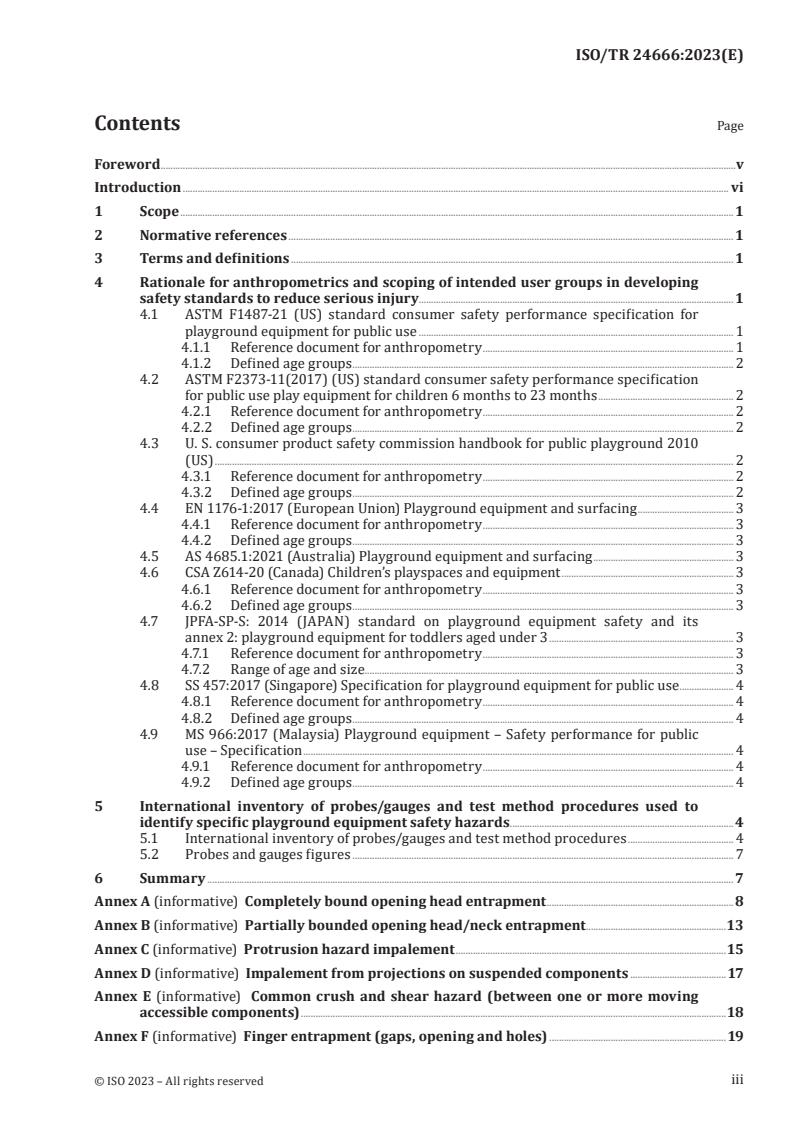
Contents Page
Foreword .v
Introduction . vi
1 Scope . 1
2 Normative references . 1
3 Terms and definitions . 1
4 Rationale for anthropometrics and scoping of intended user groups in developing
safety standards to reduce serious injury. 1
4.1 ASTM F1487-21 (US) standard consumer safety performance specification for
playground equipment for public use . 1
4.1.1 Reference document for anthropometry . 1
4.1.2 Defined age groups . 2
4.2 ASTM F2373-11(2017) (US) standard consumer safety performance specification
for public use play equipment for children 6 months to 23 months . 2
4.2.1 Reference document for anthropometry . 2
4.2.2 Defined age groups . 2
4.3 U. S. consumer product safety commission handbook for public playground 2010
(US) . 2
4.3.1 Reference document for anthropometry . 2
4.3.2 Defined age groups . 2
4.4 EN 1176-1:2017 (European Union) Playground equipment and surfacing . 3
4.4.1 Reference document for anthropometry . 3
4.4.2 Defined age groups . 3
4.5 AS 4685.1:2021 (Australia) Playground equipment and surfacing . 3
4.6 CSA Z614-20 (Canada) Children’s playspaces and equipment . 3
4.6.1 Reference document for anthropometry . 3
4.6.2 Defined age groups . 3
4.7 JPFA-SP-S: 2014 (JAPAN) standard on playground equipment safety and its
annex 2: playground equipment for toddlers aged under 3 . 3
4.7.1 Reference document for anthropometry . 3
4.7.2 Range of age and size. 3
4.8 SS 457:2017 (Singapore) Specification for playground equipment for public use . 4
4.8.1 Reference document for anthropometry . 4
4.8.2 Defined age groups . 4
4.9 MS 966:2017 (Malaysia) Playground equipment – Safety performance for public
use – Specification . 4
4.9.1 Reference document for anthropometry . 4
4.9.2 Defined age groups . 4
5 International inventory of probes/gauges and test method procedures used to
identify specific playground equipment safety hazards . 4
5.1 International inventory of probes/gauges and test method procedures . 4
5.2 Probes and gauges figures . 7
6 Summary . 7
Annex A (informative) Completely bound opening head entrapment . 8
Annex B (informative) Partially bounded opening head/neck entrapment .13
Annex C (informative) Protrusion hazard impalement .15
Annex D (informative) Impalement from projections on suspended components .17
Annex E (informative) Common crush and shear hazard (between one or more moving
accessible components) .18
Annex F (informative) Finger entrapment (gaps, opening and holes) .19
iii
Annex G (informative) Entanglement hazards .20
Annex H (informative) Hazard Test for Toddlers .23
Annex I (informative) Finger entrapment (gaps, opening, hinged objects, and holes) .26
Bibliography .27
iv
Foreword
ISO (the International Organization for Standardization) is a worldwide federation of national standards
bodies (ISO member bodies). The work of preparing International Standards is normally carried out
through ISO technical committees. Each member body interested in a subject for which a technical
committee has been established has the right to be represented on that committee. International
organizations, governmental and non-governmental, in liaison with ISO, also take part in the work.
ISO collaborates closely with the International Electrotechnical Commission (IEC) on all matters of
electrotechnical standardization.
The procedures used to develop this document and those intended for its further maintenance are
described in the ISO/IEC Directives, Part 1. In particular, the different approval criteria needed for the
different types of ISO document should be noted. This document was drafted in accordance with the
editorial rules of the ISO/IEC Directives, Part 2 (see www.iso.org/directives).
ISO draws attention to the possibility that the implementation of this document may involve the use
of (a) patent(s). ISO takes no position concerning the evidence, validity or applicability of any claimed
patent rights in respect thereof. As of the date of publication of this document, ISO had not received
notice of (a) patent(s) which may be required to implement this document. However, implementers are
cautioned that this may not represent the latest information, which may be obtained from the patent
database available at www.iso.org/patents. ISO shall not be held responsible for identifying any or all
such patent rights.
Any trade name used in this document is information given for the convenience of users and does not
constitute an endorsement.
For an explanation of the voluntary nature of standards, the meaning of ISO specific terms and
expressions related to conformity assessment, as well as information about ISO's adherence to
the World Trade Organization (WTO) principles in the Technical Barriers to Trade (TBT), see
www.iso.org/iso/foreword.html.
This document was prepared by Technical Committee ISO/TC 83, Sports and other recreational facilities
and equipment.
This second edition cancels and replaces the first edition (ISO/TR 24666:2022), which has been
technically revised.
The main changes are as follows:
— amendment of Table 1;
— amendment of Clause 6;
— amendment of Table A.5;
— amendment of Table B.2;
— amendment of Table C.2;
— amendment of Table F.1;
— amendment of Table G.3;
— inclusion of new Annex I;
Any feedback or questions on this document should be directed to the user’s national standards body. A
complete listing of these bodies can be found at www.iso.org/members.html.
v
Introduction
This document summarizes information about different regional and national standards on playground
safety in order to provide a reference point for different types of entrapments and probes/gauges.
Some standards apply to entrapment tests universally, regardless of the intended user age group, on the
basis that it is very difficult to control users when products are installed in a free access environment.
Other standards apply to specific entrapment probe tests related to specific intended user age groups.
For cases where user age references are provided in the standard, see Annex A to Annex I.
vi
TECHNICAL REPORT ISO/TR 24666:2023(E)
Sports and recreational facilities — Probes for
entrapment/entanglement on playground equipment —
Collection of data
1 Scope
This document compiles a collection of different probes/gauges for assessing common playground
equipment safety performance to eliminate known safety hazards such as entrapment and entanglement
hazards on playground, playspaces, and associated equipment used in different countries/regions
around the world. It also explains some historical content of origins, the purpose and some rationales
for the dimensions and shape of each of those probes.
These test probes and gauges, their dimensions and related historic rationale for their existence
are applicable to playground equipment manufacturers, designers, installers, assemblers, owners,
operators and inspectors alike and are necessary tools to the reduction of serious, life-threatening and
debilitating injuries to the public playground intended users.
2 Normative references
The following documents are referred to in the text in such a way that some or all of their content
constitutes requirements of this document. For dated references, only the edition cited applies. For
undated references, the latest edition of the referenced document (including any amendments) applies.
ISO/TR 20183, Sports and other recreational facilities and equipment — Injury and safety definitions and
thresholds — Guidelines for their inclusion in standards
3 Terms and definitions
For the purposes of this document, the terms and definitions given in ISO/TR 20183 apply.
ISO and IEC maintain terminology databases for use in standardization at the following addresses:
— ISO Online browsing platform: available at https:// www .iso .org/ obp
— IEC Electropedia: available at https:// www .electropedia .org/
4 Rationale for anthropometrics and scoping of intended user groups in
developing safety standards to reduce serious injury
4.1 ASTM F1487-21 (US) standard consumer safety performance specification for
playground equipment for public use
4.1.1 Reference document for anthropometry
Reference document for anthropometry – Anthropometry of Infants, Children, and Youths to age 18 for
[12]
Product Safety Design .
4.1.2 Defined age groups
The range of age and size users encompassed by this consumer safety performance specification is the
th th
5 percentile 2-year-old to the 95 percentile 12-year-old:
th
a) maximum user — 12-year-old child; measurement characteristics are the 95 percentile values for
combined sexes;
th
b) minimum user — 2-year-old child; measurement characteristics are the 5 percentile values for
combined sexes;
c) age groupings —preschool (2 years to 5 years), school age (5 years to 12 years), and (2 years to
12 years).
4.2 ASTM F2373-11(2017) (US) standard consumer safety performance specification
for public use play equipment for children 6 months to 23 months
4.2.1 Reference document for anthropometry
Reference document for anthropometry – Anthropometry of Infants, Children, and Youths to age 18 for
[12]
Product Safety Design .
4.2.2 Defined age groups
The range of age and size users encompassed by this consumer safety performance specification is the
th th
5 percentile 6-month-old to the 95 percentile 23-month-old:
th
a) maximum user — 23-month-old child; measurement characteristics are the 95 percentile values
for combined sexes;
th
b) minimum user — 6-month-old child; measurement characteristics are the 5 percentile values for
combined sexes;
c) age groupings — toddler (6 months to 23 months).
4.3 U. S. consumer product safety commission handbook for public playground 2010
(US)
4.3.1 Reference document for anthropometry
Reference document for anthropometry – Anthropometry of Infants, Children, and Youths to age 18 for
[12]
Product Safety Design .
4.3.2 Defined age groups
th
The range of age and size users encompassed by this consumer safety guideline is the 5 percentile
th
2-year-old to the 95 percentile 12-year-old:
th th
a) school-age user – 5 percentile 5-year-old to 95 percentile 12-year-old child, measurement
characteristic values for combined sexes;
th th
b) preschool user – 5 percentile 2-year-old to 95 percentile 5-year-old child, measurement
characteristic values for combined sexes;
th th
c) toddler – 5 percentile 6-month-old to 95 percentile 23-month-old child, measurement
characteristic values for combined sexes.
4.4 EN 1176-1:2017 (European Union) Playground equipment and surfacing
4.4.1 Reference document for anthropometry
The base anthropometric data used in Europe is:
a) SAE SP -450: 1977;
b) DIN 33402-2:2005.
Both sources are shown aligned with each other for any given body dimension. The data are presented
as a condensed set of tables giving minimum and maximum values for common body dimensions.
4.4.2 Defined age groups
There is no defined age range in EN 1176-1:2017.
4.5 AS 4685.1:2021 (Australia) Playground equipment and surfacing
NOTE AS 4685.1:2021 is significantly harmonized with the EN 1176-1:2017.
For reference document for anthropometry, see 4.4.1.
4.6 CSA Z614-20 (Canada) Children’s playspaces and equipment
4.6.1 Reference document for anthropometry
Reference document for anthropometry – Anthropometry of Infants, Children, and Youths to age 18 for
[12]
Product Safety Design .
4.6.2 Defined age groups
th
The range of age and size users encompassed by this standard is the dimensions of the 95 percentile
th
18-month-old to the 95 percentile 12-year-old.
4.7 JPFA-SP-S: 2014 (JAPAN) standard on playground equipment safety and its annex 2:
playground equipment for toddlers aged under 3
4.7.1 Reference document for anthropometry
Diagram of measurements (preschool-age) and data for 1-year olds to 6-year olds from the development
[13]
of child anthropometric database and simulation technology for human injury .
[15]
Data for 10-year and 12-year-old from AIST Japanese Body Dimension Data, 1997-98 .
Diagram of measurements (school age) from Compact Compendium of Architectural Design References
[14]
(1996) .
[16]
Part of data for 3-year olds from Infant/Toddler Body Measurements Report (1973) .
[17]
Part of data for 6-year olds from Anthropometric Charts and Table (1970) .
4.7.2 Range of age and size
The range of age and size users encompassed by the consumer safety performance standard, JPFA -SF
-S: 2014, are based on the median size (average by age) of pre-school children ages 3 to 6 years and
elementary school students around the ages of 6 to 12 years. CSA Z614, ASTM F1487, ASTM F2373 and
CPSC Handbook on Public Playground Safety recommend supervision for children from 3 to 6 years and
that children under 3-years-old be accompanied by a guardian at all times when using public parks.
4.8 SS 457:2017 (Singapore) Specification for playground equipment for public use
4.8.1 Reference document for anthropometry
Reference document for anthropometry – Anthropometry of Infants, Children, and Youths to age 18 for
[12]
Product Safety Design .
4.8.2 Defined age groups
th th
Children age and size based on 5 percentile 2-year-old to 95 percentile 12-year-old.
4.9 MS 966:2017 (Malaysia) Playground equipment – Safety performance for public use
– Specification
4.9.1 Reference document for anthropometry
Reference document for anthropometry – Anthropometry of Infants, Children, and Youths to age 18 for
[12]
Product Safety Design .
4.9.2 Defined age groups
th th
Children age and size based on 5 percentile 2-year-old to 95 percentile 12-year-old.
5 International inventory of probes/gauges and test method procedures used to
identify specific playground equipment safety hazards
5.1 International inventory of probes/gauges and test method procedures
See Table 1.
Table 1 — International inventory of probes/gauges and test method procedures used to identify specific playground equipment safety
hazards
Probes ASTM F 1487- ASTM 2373-11 AS 4685.1:2021 CPSC 2010 CSA Z614-20 EN 1176- MS 966:2017 SS 457:2017
21 and Handbook 1:2017
JPFS-SP-S:2014
AS 4685.6:2021
#325 EN1176-
6:2017+AC:2019
Head – Clause 6.1, Clause 6.1.1 to Clause Clauses 3.3, and Clauses 12.2.2, Clause 4.2.7.2 Clause 4.4.1; Clause 6.1.1 to Clause 6.1.1 to
completely Figures A.1.1 6.1.2, Fig- 4.2.7.2 and 3.3.1, Appen- 12.2.3 and Figure 4.4.1 (1) Clause 6.1.3, Clause 6.1.3,
bound to A.1.3 ure A.1.3 Annex D.2.1 dix B.2.4, B.2.5 Annex D.2.1.2 to (5) Figure 1 to 3 Figure A.1.1 to
Figure 3, Fig-
Figure A1.3
(Head and ure 4
feet first)
Clauses 6.1.3, Clause 6.1.3 to Clause 4.2.7.2 Clause 3.3.2, Ap- Clause 12.2.4, Clause 4.2.7.2 Clause 4.4.2; Clause 6.1.4, Clause 6.1.4,
Head –
6.1.4.1 to 6.1.4, Fig- and pendix B.2.5.6 12.2.5 and Figures 4.4.2 Figure 4
...