

ISO 1726-3:2023
(Main)Road vehicles — Mechanical couplings between tractors and semi-trailers — Part 3: Requirements for semi-trailer contact area to fifth wheel
General Information
- Abstract
This document specifies the test conditions of a static test performed on the semi-trailer contact area to the fifth wheel. It ensures the suitability of the semi-trailer to couple the greatest possible variety of tractor vehicles equipped with a fifth wheel coupling in accordance with ISO 3842. It also specifies requirements to avoid damages or malfunctions of the fifth wheel coupling caused by the semi-trailer chassis, the semi-trailer plate or any other of its components.
- Status
- Published
- Publication Date
- 26-Jul-2023
- Technical Committee
- ISO/TC 22/SC 40 - Specific aspects for light and heavy commercial vehicles, busses and trailers
- Drafting Committee
- ISO/TC 22/SC 40/WG 1 - Mechanical couplings
- Current Stage
- 6060 - International Standard published
- Start Date
- 27-Jul-2023
- Due Date
- 17-Oct-2022
- Completion Date
- 27-Jul-2023
Overview
ISO 1726-3:2023 specifies requirements and test methods for the semi‑trailer contact area to the fifth wheel. The standard defines static test conditions and acceptance criteria to ensure semi‑trailers are compatible with a wide variety of tractor vehicles fitted with fifth wheel couplings in accordance with ISO 3842. Its purpose is to prevent damage or malfunction of the fifth wheel caused by the semi‑trailer chassis, plate or related components.
Key topics and requirements
- Scope of test: Static verification of the semi‑trailer contact area (area centred on the kingpin) using a homogeneously distributed vertical load based on the trailer manufacturer’s declared maximum static load (test load).
- Deflection and flatness limits:
- Maximum overall vertical deflection during the static test: S ≤ 3.5 mm relative to the plane spanned by top surfaces of the support blocks.
- For calculation (elastic deformation only): S ≤ 1.5 mm.
- Total unevenness before and after test: ≤ 2 mm at any point within the contact zone.
- Test arrangement and procedure:
- Test performed on whole semi‑trailer or representative section; fixing must follow kingpin manufacturer’s fitting instructions.
- Test forces include a safety factor of 2 to cover dynamic influences.
- Load applied over a defined application area (figures in the standard).
- Support block geometry and placement:
- Support blocks: L = 240 mm, W = 140 mm, positioned 580 mm from kingpin centre (left and right).
- Minimum block height H = 95 mm; blocks must feature chamfers (max 5 mm × 30°) and corner radius R = 10 mm to avoid unrealistic local stresses.
- Design constraints for contact area:
- No protrusions or sharp edges in the contact area; holes with sharp edges or holes > 50 mm diameter are prohibited.
- Contact area diameter when coupled: minimum 965 mm (figures detail minimum dimensions).
Applications and users
ISO 1726-3:2023 is used by:
- Semi‑trailer manufacturers and chassis designers to ensure fifth wheel compatibility and to incorporate acceptable stiffness and flatness into designs.
- Test laboratories and certification bodies conducting static verification or validating calculation models against physical tests.
- Fifth wheel and kingpin manufacturers, to understand interface requirements and avoid mating‑piece damage.
- Fleet operators, maintenance teams and regulatory authorities concerned with safe coupling, durability and interchangeability between tractors and trailers.
Benefits include improved interoperability, reduced wear/damage to fifth wheel couplings, and clearer acceptance criteria for design validation and conformity assessment.
Related standards
- ISO 3842 - Fifth wheels - Interchangeability (referenced for fifth wheel coupling dimensions and compatibility).
Relations
- Effective Date
- 23-Apr-2020
Get Certified
Connect with accredited certification bodies for this standard

TÜV Rheinland
TÜV Rheinland is a leading international provider of technical services.

TÜV SÜD
TÜV SÜD is a trusted partner of choice for safety, security and sustainability solutions.

DEKRA Certification Inc.
DEKRA US certification services.
Sponsored listings
Frequently Asked Questions
ISO 1726-3:2023 is a standard published by the International Organization for Standardization (ISO). Its full title is "Road vehicles — Mechanical couplings between tractors and semi-trailers — Part 3: Requirements for semi-trailer contact area to fifth wheel". This standard covers: This document specifies the test conditions of a static test performed on the semi-trailer contact area to the fifth wheel. It ensures the suitability of the semi-trailer to couple the greatest possible variety of tractor vehicles equipped with a fifth wheel coupling in accordance with ISO 3842. It also specifies requirements to avoid damages or malfunctions of the fifth wheel coupling caused by the semi-trailer chassis, the semi-trailer plate or any other of its components.
This document specifies the test conditions of a static test performed on the semi-trailer contact area to the fifth wheel. It ensures the suitability of the semi-trailer to couple the greatest possible variety of tractor vehicles equipped with a fifth wheel coupling in accordance with ISO 3842. It also specifies requirements to avoid damages or malfunctions of the fifth wheel coupling caused by the semi-trailer chassis, the semi-trailer plate or any other of its components.
ISO 1726-3:2023 is classified under the following ICS (International Classification for Standards) categories: 43.040.70 - Couplings. The ICS classification helps identify the subject area and facilitates finding related standards.
ISO 1726-3:2023 has the following relationships with other standards: It is inter standard links to ISO 1726-3:2010. Understanding these relationships helps ensure you are using the most current and applicable version of the standard.
ISO 1726-3:2023 is available in PDF format for immediate download after purchase. The document can be added to your cart and obtained through the secure checkout process. Digital delivery ensures instant access to the complete standard document.
Standards Content (Sample)
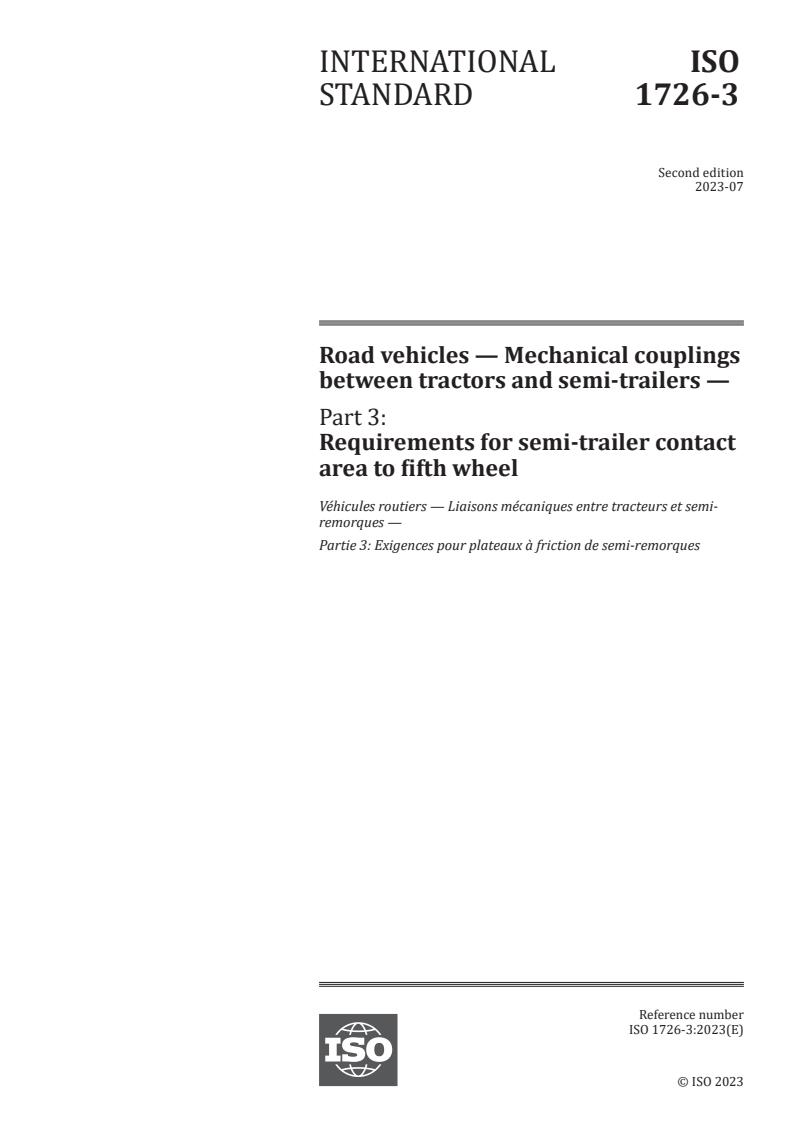
INTERNATIONAL ISO
STANDARD 1726-3
Second edition
2023-07
Road vehicles — Mechanical couplings
between tractors and semi-trailers —
Part 3:
Requirements for semi-trailer contact
area to fifth wheel
Véhicules routiers — Liaisons mécaniques entre tracteurs et semi-
remorques —
Partie 3: Exigences pour plateaux à friction de semi-remorques
Reference number
© ISO 2023
All rights reserved. Unless otherwise specified, or required in the context of its implementation, no part of this publication may
be reproduced or utilized otherwise in any form or by any means, electronic or mechanical, including photocopying, or posting on
the internet or an intranet, without prior written permission. Permission can be requested from either ISO at the address below
or ISO’s member body in the country of the requester.
ISO copyright office
CP 401 • Ch. de Blandonnet 8
CH-1214 Vernier, Geneva
Phone: +41 22 749 01 11
Email: copyright@iso.org
Website: www.iso.org
Published in Switzerland
ii
Contents Page
Foreword .iv
Introduction .v
1 Scope . 1
2 Normative references . 1
3 Terms and definitions . 1
4 Requirements . 1
5 Test methods . 2
5.1 General . 2
5.2 Test with static vertical force . 2
5.2.1 Test arrangement . 2
5.2.2 Test procedure. 2
5.3 Alternative method . 2
6 Design of the semi-trailer contact zones to the fifth wheel . 5
Bibliography . 7
iii
Foreword
ISO (the International Organization for Standardization) is a worldwide federation of national standards
bodies (ISO member bodies). The work of preparing International Standards is normally carried out
through ISO technical committees. Each member body interested in a subject for which a technical
committee has been established has the right to be represented on that committee. International
organizations, governmental and non-governmental, in liaison with ISO, also take part in the work.
ISO collaborates closely with the International Electrotechnical Commission (IEC) on all matters of
electrotechnical standardization.
The procedures used to develop this document and those intended for its further maintenance are
described in the ISO/IEC Directives, Part 1. In particular, the different approval criteria needed for the
different types of ISO document should be noted. This document was drafted in accordance with the
editorial rules of the ISO/IEC Directives, Part 2 (see www.iso.org/directives).
ISO draws attention to the possibility that the implementation of this document may involve the use
of (a) patent(s). ISO takes no position concerning the evidence, validity or applicability of any claimed
patent rights in respect thereof. As of the date of publication of this document, ISO had not received
notice of (a) patent(s) which may be required to implement this document. However, implementers are
cautioned that this may not represent the latest information, which may be obtained from the patent
database available at www.iso.org/patents. ISO shall not be held responsible for identifying any or all
such patent rights.
Any trade name used in this document is information given for the convenience of users and does not
constitute an endorsement.
For an explanation of the voluntary nature of standards, the meaning of ISO specific terms and
expressions related to conformity assessment, as well as information about ISO's adherence to
the World Trade Organization (WTO) principles in the Technical Barriers to Trade (TBT), see
www.iso.org/iso/foreword.html.
This document was prepared by Technical Committee ISO/TC 22, Road vehicles, Subcommittee SC 40,
Specific aspects for light and heavy commercial vehicles, busses and trailers.
This second edition cancels and replaces the first edition (ISO 1726-3:2010), which has been technically
revised
The main changes are as follows:
— modification of maximum displacement and load application in Clause 4;
— modification of static test requirements in Clause 5.
A list of all parts in the ISO 1726 series can be found on the ISO website.
Any feedback or questions on this document should be directed to the user’s national standards body. A
complete listing of these bodies can be found at www.iso.org/members.html.
iv
Introduction
The dimensional interchangeability of truck and trailer is specified in various standards and
regulations. In order to be able to
...