

ISO 18935:2018
(Main)Imaging materials — Colour images — Determination of water resistance of printed colour images
General Information
- Abstract
This document specifies tests to determine the relative water resistance of printed colour images. This document is applicable to both digital and analogue prints.
- Status
- Withdrawn
- Publication Date
- 30-Aug-2018
- Technical Committee
- ISO/TC 42 - Photography
- Current Stage
- 9599 - Withdrawal of International Standard
- Start Date
- 21-Feb-2025
- Completion Date
- 29-Aug-2026
Buy Documents


ISO 18935:2018 - Imaging materials -- Colour images -- Determination of water resistance of printed colour images
ISO 18935:2018 - Imaging materials — Colour images — Determination of water resistance of printed colour images/31/2018
Overview
ISO 18935:2018 - Imaging materials - Colour images - Determination of water resistance of printed colour images specifies standardized test procedures to assess the relative water resistance of printed colour images. Applicable to both digital and analogue prints, the standard defines qualitative categories of water resistance and four practical test methods that simulate everyday and catastrophic water exposure (spills, wiping, soaking, edge immersion). It is intended for reproducible, within-laboratory evaluation rather than absolute interlaboratory quantification.
Key topics and requirements
- Scope: Applies to colour prints produced by a variety of imaging processes (inkjet, photographic, etc.).
- Categories of water resistance:
- Water resistant - not noticeably affected by liquid water.
- Moderately water resistant - some reversible or minor damage; still usable.
- Not water resistant - easily damaged by incidental water contact.
- Test specimens & controls: Untreated control specimens are required for visual comparison. All specimens should be dried at ambient conditions for at least 24 hours before testing.
- Test media: Use deionized or distilled water for all tests (pH not controlled unless certified).
- Primary test methods (qualitative assessment):
- Method 1 - Standing water evaporation: Small water drops placed on colour patches and left to evaporate.
- Method 2 - Standing water plus wiping: Water placed on prints then removed with a weighted tissue swipe to simulate wiping before drying.
- Method 3 - Water soak: Immersion for 1 hour followed by vertical drying to model flood-like exposure.
- Method 4 - Edge immersion: Lower edge immersion (typically 24 hours) to test water penetration from an exposed edge; samples tested with paper grain both parallel and perpendicular to water surface.
- Colour targets: Tests include cyan, magenta, yellow, red, green, blue and black patches (black as produced by user-specified driver settings).
- Evaluation approach: Qualitative visual assessment (bleeding, smearing, gloss changes, delamination, curl) rather than fixed numeric pass/fail thresholds.
Practical applications
- Quality control for print manufacturers, ink and substrate developers, and print service providers evaluating water durability of printed colour images.
- Photo labs, digital print shops and conservation labs using the standard to assess vulnerability of prints to spills, handling, flooding or disaster recovery.
- Archival preservation and disaster-planning teams that need to categorize materials for salvage prioritization after water damage.
- R&D and comparative testing when developing water-resistant coatings, laminates or new inks.
Who uses this standard
- Print manufacturers and materials suppliers (inks, coatings, substrates)
- Imaging laboratories and print service providers
- Conservation professionals and archives
- Product test labs and quality assurance teams in photography and imaging industries
Related standards
- Prepared by ISO/TC 42 (Photography); ISO 18935:2018 sits alongside other ISO photographic/imaging standards covering image permanence, testing methods, and materials characterization. For implementation, consult your national standards body or ISO for the complete technical context.
Keywords: ISO 18935:2018, water resistance testing, printed colour images, imaging materials, inkjet durability, standing water, water soak, edge immersion, photo conservation.
Relations
- Effective Date
- 08-Jun-2024
- Effective Date
- 05-Aug-2017
Buy Documents
ISO 18935:2018 - Imaging materials -- Colour images -- Determination of water resistance of printed colour images
ISO 18935:2018 - Imaging materials — Colour images — Determination of water resistance of printed colour images/31/2018
Frequently Asked Questions
ISO 18935:2018 is a standard published by the International Organization for Standardization (ISO). Its full title is "Imaging materials — Colour images — Determination of water resistance of printed colour images". This standard covers: This document specifies tests to determine the relative water resistance of printed colour images. This document is applicable to both digital and analogue prints.
This document specifies tests to determine the relative water resistance of printed colour images. This document is applicable to both digital and analogue prints.
ISO 18935:2018 is classified under the following ICS (International Classification for Standards) categories: 37.100.99 - Other standards related to graphic technology. The ICS classification helps identify the subject area and facilitates finding related standards.
ISO 18935:2018 has the following relationships with other standards: It is inter standard links to ISO 18935:2025, ISO 18935:2016. Understanding these relationships helps ensure you are using the most current and applicable version of the standard.
ISO 18935:2018 is available in PDF format for immediate download after purchase. The document can be added to your cart and obtained through the secure checkout process. Digital delivery ensures instant access to the complete standard document.
Standards Content (Sample)
INTERNATIONAL ISO
STANDARD 18935
Third edition
2018-09
Imaging materials — Colour images —
Determination of water resistance of
printed colour images
Matériaux pour l'image — Images en couleurs sur impressions en
papier — Détermination de la résistance interne de la couleur à l'eau
Reference number
©
ISO 2018
© ISO 2018
All rights reserved. Unless otherwise specified, or required in the context of its implementation, no part of this publication may
be reproduced or utilized otherwise in any form or by any means, electronic or mechanical, including photocopying, or posting
on the internet or an intranet, without prior written permission. Permission can be requested from either ISO at the address
below or ISO’s member body in the country of the requester.
ISO copyright office
CP 401 • Ch. de Blandonnet 8
CH-1214 Vernier, Geneva
Phone: +41 22 749 01 11
Fax: +41 22 749 09 47
Email: copyright@iso.org
Website: www.iso.org
Published in Switzerland
ii © ISO 2018 – All rights reserved
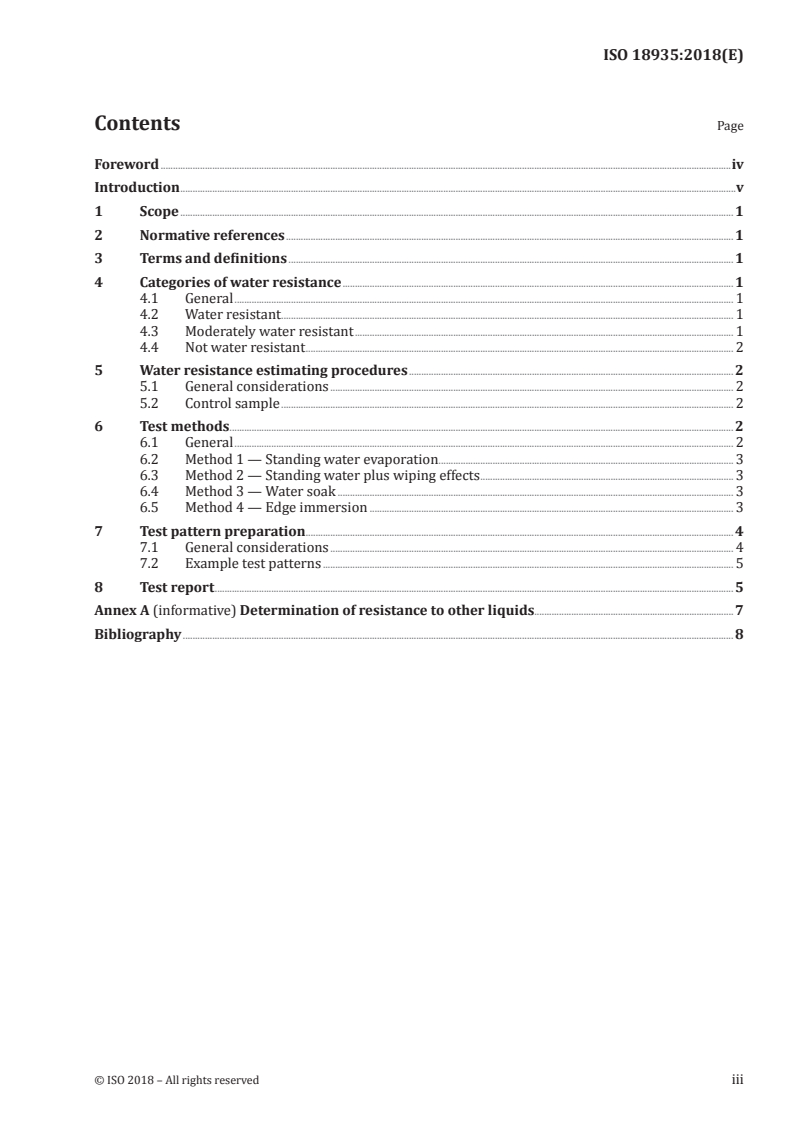
Contents Page
Foreword .iv
Introduction .v
1 Scope . 1
2 Normative references . 1
3 Terms and definitions . 1
4 Categories of water resistance . 1
4.1 General . 1
4.2 Water resistant . 1
4.3 Moderately water resistant . 1
4.4 Not water resistant . 2
5 Water resistance estimating procedures . 2
5.1 General considerations . 2
5.2 Control sample . 2
6 Test methods . 2
6.1 General . 2
6.2 Method 1 — Standing water evaporation . 3
6.3 Method 2 — Standing water plus wiping effects . 3
6.4 Method 3 — Water soak . 3
6.5 Method 4 — Edge immersion . 3
7 Test pattern preparation . 4
7.1 General considerations . 4
7.2 Example test patterns . 5
8 Test report . 5
Annex A (informative) Determination of resistance to other liquids. 7
Bibliography . 8
Foreword
ISO (the International Organization for Standardization) is a worldwide federation of national standards
bodies (ISO member bodies). The work of preparing International Standards is normally carried out
through ISO technical committees. Each member body interested in a subject for which a technical
committee has been established has the right to be represented on that committee. International
organizations, governmental and non-governmental, in liaison with ISO, also take part in the work.
ISO collaborates closely with the International Electrotechnical Commission (IEC) on all matters of
electrotechnical standardization.
The procedures used to develop this document and those intended for its further maintenance are
described in the ISO/IEC Directives, Part 1. In particular the different approval criteria needed for the
different types of ISO documents should be noted. This document was drafted in accordance with the
editorial rules of the ISO/IEC Directives, Part 2 (see www .iso .org/directives).
Attention is drawn to the possibility that some of the elements of this document may be the subject of
patent rights. ISO shall not be held responsible for identifying any or all such patent rights. Details of
any patent rights identified during the development of the document will be in the Introduction and/or
on the ISO list of patent declarations received (see www .iso .org/patents).
Any trade name used in this document is information given for the convenience of users and does not
constitute an endorsement.
For an explanation on the voluntary nature of standards, the meaning of ISO specific terms and
expressions related to conformity assessment, as well as information about ISO's adherence to the
World Trade Organization (WTO) principles in the Technical Barriers to Trade (TBT) see the following
URL: www .iso .org/iso/foreword .html.
This document was prepared by Technical Committee ISO/TC 42, Photography.
This third edition cancels and replaces the second edition (ISO 18935:2016), of which it constitutes a
minor revision. The changes compared to the previous edition are as follows:
— changes in Clauses 6 and 8 and in Annex A.
Any feedback or questions on this document should be directed to the user’s national standards body. A
complete listing of these bodies can be found at www .iso .org/members .html.
iv © ISO 2018 – All rights reserved
Introduction
Water resistance is not an important consideration in the normal storage of colour prints. However, in
a disaster situation, such as floods, earthquakes or water main breaks, this property can be of critical
importance if the print is to be salvaged. A wide variety of materials are used for digital colour prints
and the colorants used in some digital prints are water soluble. The degree of their water resistance
varies depending upon the colorants used and if the print has a water-resistant overcoat. In addition,
the paper or other substrate may be of equal importance. The same colorants may exhibit very good
water resistance on one substrate but can be completely washed off from a different substrate. Even
print systems that use water-insoluble colorants may be damaged by water exposure if the substrate
is not also water resistant. This document provides a standardized method to evaluate the qualitative
water resistance of colour prints.
INTERNATIONAL STANDARD ISO 18935:2018(E)
Imaging materials — Colour images — Determination of
water resistance of printed colour images
1 Scope
This document specifies tests to determine the relative water resistance of printed colour images. This
document is applicable to both digital and analogue prints.
2 Normative references
There are no normative references in this document.
3 Terms and definitions
For the purposes of this document, the following terms and definitions apply.
ISO and IEC maintain terminological databases for use in standardization at the following addresses:
— ISO Online browsing platform: available at https: //www .iso .org/obp
— IEC Electropedia: available at http: //www .electropedia .org/
3.1
ambient conditions
environmental conditions of (23 ± 1) °C and (50 ± 5) % RH
3.2
mordant
substance that combines with a dye, used to fix it in a material
4 Categories of water resistance
4.1 General
The water resistance of a print is categorized into one of three categories, i.e. water resistant,
moderately water resistant and not water resistant as defined in 4.2 to 4.4.
4.2 Water resistant
Water-resistant print is print that is not noticeably affected by exposure to liquid water.
NOTE No significant degradation of the colorant (bleeding, smearing, hue change), of the support (curl,
cockle, delamination) or of the image surface (gloss changes, water rings, etc.) is found.
4.3 Moderately water resistant
A moderately water-resistant print is a print that exhibits some change or damage by water but is still
considered usable for its intended application.
NOTE The damage can manifest itself as slight media curl, partial delamination along an edge, or ring-like
watermarks due to gloss changes or a minor amount of colorant migration. This damage can be mitigated by the
rapid removal of the water (careful blotting, shaking off the water, etc.).
4.4 Not water resistant
A print that is not water-resistant is a print that is easily damaged by contact with water, even when
incidental (e.g. a water mist) and is considered unsuitable for applications involving contact with water.
NOTE Such damage can manifest itself as appreciable curl, delamination of the image layer, colorant bleed
into non-imaged areas or from colour to colour, or image degradation (hue and gloss changes, surface marks,
etc.). It is strongly advisable to users of these materials to prevent water contact.
5 Water resistance estimating procedures
5.1 General considerations
Water resistance is the ability of a print to resist water damage which may manifest itself in a number
of ways, such as migration of colorants; changes in the size and/or optical density of image elements;
degradation of the image layer, as well as cockle, curl or loss of gloss. The water resistance of prints
made by current methods varies considerably. For example, some ink-jet prints sustain no observable
damage when the surface is rubbed immediately after water has been poured over the image. While
others that do no
...
INTERNATIONAL ISO
STANDARD 18935
Third edition
2018-09
Imaging materials — Colour images —
Determination of water resistance of
printed colour images
Matériaux pour l'image — Images en couleurs sur impressions en
papier — Détermination de la résistance interne de la couleur à l'eau
Reference number
©
ISO 2018
© ISO 2018
All rights reserved. Unless otherwise specified, or required in the context of its implementation, no part of this publication may
be reproduced or utilized otherwise in any form or by any means, electronic or mechanical, including photocopying, or posting
on the internet or an intranet, without prior written permission. Permission can be requested from either ISO at the address
below or ISO’s member body in the country of the requester.
ISO copyright office
CP 401 • Ch. de Blandonnet 8
CH-1214 Vernier, Geneva
Phone: +41 22 749 01 11
Fax: +41 22 749 09 47
Email: copyright@iso.org
Website: www.iso.org
Published in Switzerland
ii © ISO 2018 – All rights reserved
Contents Page
Foreword .iv
Introduction .v
1 Scope . 1
2 Normative references . 1
3 Terms and definitions . 1
4 Categories of water resistance . 1
4.1 General . 1
4.2 Water resistant . 1
4.3 Moderately water resistant . 1
4.4 Not water resistant . 2
5 Water resistance estimating procedures . 2
5.1 General considerations . 2
5.2 Control sample . 2
6 Test methods . 2
6.1 General . 2
6.2 Method 1 — Standing water evaporation . 3
6.3 Method 2 — Standing water plus wiping effects . 3
6.4 Method 3 — Water soak . 3
6.5 Method 4 — Edge immersion . 3
7 Test pattern preparation . 4
7.1 General considerations . 4
7.2 Example test patterns . 5
8 Test report . 5
Annex A (informative) Determination of resistance to other liquids. 7
Bibliography . 8
Foreword
ISO (the International Organization for Standardization) is a worldwide federation of national standards
bodies (ISO member bodies). The work of preparing International Standards is normally carried out
through ISO technical committees. Each member body interested in a subject for which a technical
committee has been established has the right to be represented on that committee. International
organizations, governmental and non-governmental, in liaison with ISO, also take part in the work.
ISO collaborates closely with the International Electrotechnical Commission (IEC) on all matters of
electrotechnical standardization.
The procedures used to develop this document and those intended for its further maintenance are
described in the ISO/IEC Directives, Part 1. In particular the different approval criteria needed for the
different types of ISO documents should be noted. This document was drafted in accordance with the
editorial rules of the ISO/IEC Directives, Part 2 (see www .iso .org/directives).
Attention is drawn to the possibility that some of the elements of this document may be the subject of
patent rights. ISO shall not be held responsible for identifying any or all such patent rights. Details of
any patent rights identified during the development of the document will be in the Introduction and/or
on the ISO list of patent declarations received (see www .iso .org/patents).
Any trade name used in this document is information given for the convenience of users and does not
constitute an endorsement.
For an explanation on the voluntary nature of standards, the meaning of ISO specific terms and
expressions related to conformity assessment, as well as information about ISO's adherence to the
World Trade Organization (WTO) principles in the Technical Barriers to Trade (TBT) see the following
URL: www .iso .org/iso/foreword .html.
This document was prepared by Technical Committee ISO/TC 42, Photography.
This third edition cancels and replaces the second edition (ISO 18935:2016), of which it constitutes a
minor revision. The changes compared to the previous edition are as follows:
— changes in Clauses 6 and 8 and in Annex A.
Any feedback or questions on this document should be directed to the user’s national standards body. A
complete listing of these bodies can be found at www .iso .org/members .html.
iv © ISO 2018 – All rights reserved
Introduction
Water resistance is not an important consideration in the normal storage of colour prints. However, in
a disaster situation, such as floods, earthquakes or water main breaks, this property can be of critical
importance if the print is to be salvaged. A wide variety of materials are used for digital colour prints
and the colorants used in some digital prints are water soluble. The degree of their water resistance
varies depending upon the colorants used and if the print has a water-resistant overcoat. In addition,
the paper or other substrate may be of equal importance. The same colorants may exhibit very good
water resistance on one substrate but can be completely washed off from a different substrate. Even
print systems that use water-insoluble colorants may be damaged by water exposure if the substrate
is not also water resistant. This document provides a standardized method to evaluate the qualitative
water resistance of colour prints.
INTERNATIONAL STANDARD ISO 18935:2018(E)
Imaging materials — Colour images — Determination of
water resistance of printed colour images
1 Scope
This document specifies tests to determine the relative water resistance of printed colour images. This
document is applicable to both digital and analogue prints.
2 Normative references
There are no normative references in this document.
3 Terms and definitions
For the purposes of this document, the following terms and definitions apply.
ISO and IEC maintain terminological databases for use in standardization at the following addresses:
— ISO Online browsing platform: available at https: //www .iso .org/obp
— IEC Electropedia: available at http: //www .electropedia .org/
3.1
ambient conditions
environmental conditions of (23 ± 1) °C and (50 ± 5) % RH
3.2
mordant
substance that combines with a dye, used to fix it in a material
4 Categories of water resistance
4.1 General
The water resistance of a print is categorized into one of three categories, i.e. water resistant,
moderately water resistant and not water resistant as defined in 4.2 to 4.4.
4.2 Water resistant
Water-resistant print is print that is not noticeably affected by exposure to liquid water.
NOTE No significant degradation of the colorant (bleeding, smearing, hue change), of the support (curl,
cockle, delamination) or of the image surface (gloss changes, water rings, etc.) is found.
4.3 Moderately water resistant
A moderately water-resistant print is a print that exhibits some change or damage by water but is still
considered usable for its intended application.
NOTE The damage can manifest itself as slight media curl, partial delamination along an edge, or ring-like
watermarks due to gloss changes or a minor amount of colorant migration. This damage can be mitigated by the
rapid removal of the water (careful blotting, shaking off the water, etc.).
4.4 Not water resistant
A print that is not water-resistant is a print that is easily damaged by contact with water, even when
incidental (e.g. a water mist) and is considered unsuitable for applications involving contact with water.
NOTE Such damage can manifest itself as appreciable curl, delamination of the image layer, colorant bleed
into non-imaged areas or from colour to colour, or image degradation (hue and gloss changes, surface marks,
etc.). It is strongly advisable to users of these materials to prevent water contact.
5 Water resistance estimating procedures
5.1 General considerations
Water resistance is the ability of a print to resist water damage which may manifest itself in a number
of ways, such as migration of colorants; changes in the size and/or optical density of image elements;
degradation of the image layer, as well as cockle, curl or loss of gloss. The water resistance of prints
made by current methods varies considerably. For example, some ink-jet prints sustain no observable
damage when the surface is rubbed immediately after water has been poured over the image. While
others that do no
...