

ISO/IEC 15963-2:2020
(Main)Information technology — Radio frequency identification for item management — Part 2: Unique identification for RF tags registration procedures
General Information
- Abstract
This document specifies the procedural requirements to maintain identities and outlines the obligations of the Registration Authority.
- Status
- Published
- Publication Date
- 18-Mar-2020
- Technical Committee
- ISO/IEC JTC 1/SC 31 - Automatic identification and data capture techniques
- Drafting Committee
- ISO/IEC JTC 1/SC 31/WG 4 - Radio communications
- Current Stage
- 9092 - International Standard to be revised
- Start Date
- 22-Jul-2025
- Completion Date
- 29-Aug-2026
Buy Documents

ISO/IEC 15963-2:2020 - Information technology -- Radio frequency identification for item management
ISO/IEC 15963-2:2020 - Information technology — Radio frequency identification for item management — Part 2: Unique identification for RF tags registration procedures/19/2020
Overview
ISO/IEC 15963-2:2020 is an international standard developed by ISO and IEC that specifies procedural requirements for the unique identification of radio frequency (RF) tags used in item management. This standard defines the registration procedures necessary to maintain unique identities for RF tags and sets out the obligations of the Registration Authority responsible for managing issuer codes.
Part 2 of ISO/IEC 15963 focuses on the registration procedures supporting the unique identification of RFID tags, ensuring consistency and interoperability across systems. It complements Part 1 of the standard, which addresses the numbering system for RF tag identifiers.
Key Topics
- Procedural Requirements: The standard outlines the steps organizations must follow to register an issuer code for RF tag identification, ensuring a structured approach to unique identity management.
- Registration Authority Role: Clearly defines the responsibilities of the Registration Authority, including processing applications, assigning issuer codes, maintaining registration databases, and publishing registers of assigned codes.
- Issuer Code Allocation: Specifies that issuer codes are hexadecimal values (using digits 0-9 and letters A-F) allocated to organizations for exclusive use in RF tag identity generation.
- Register of Issuer Codes: The Registration Authority maintains and publishes an up-to-date, alphabetically sorted register containing issuer names, addresses, assigned codes, recommended qualifiers, and numbering structures.
- Documentation & Compliance: Procedures comply with ISO/IEC Directives and align with other RFID and automatic identification standards to promote global standardization.
Applications
ISO/IEC 15963-2:2020 is essential for industries and organizations implementing RFID-based item management systems that require:
- Unique item identification for supply chain tracking, inventory management, and asset control.
- Global interoperability in RFID applications by ensuring that tag identities are managed consistently worldwide.
- Issuer code registration for manufacturers, distributors, or authority bodies assigning unique codes to RFID tags.
- Integration with related standards, enhancing compatibility with RFID communication protocols like ISO/IEC 18000 series and real-time locating systems (ISO/IEC 24730).
Sector use cases include retail, logistics, manufacturing, transportation, and healthcare, where reliable item tracking and inventory accuracy are critical.
Related Standards
- ISO/IEC 15963-1: Details the unique identification numbering systems for RF tags, complementing the registration procedures in Part 2.
- ISO/IEC 18000 series: Standards defining RFID air interface communications at various frequency bands critical for implementing RFID systems.
- ISO/IEC 24730 series: Real-time locating systems standards applicable to locating and tracking items tagged with RFID.
- ISO/IEC 19762: Provides harmonized vocabulary pertaining to automatic identification and data capture (AIDC) technologies, ensuring consistent terminology.
- Industry Guides:
- GS1 General Specifications – for global standards in supply chain management.
- EPCglobal Tag Data Standards – for electronic product code implementation.
ISO/IEC 15963-2:2020 provides a vital framework for organizations seeking to implement reliable, standardized, and scalable RF tag identification systems globally. By following the prescribed registration procedures and leveraging issuer codes assigned under this standard, organizations can ensure unique identification of tagged items, enhancing transparency and efficiency across supply chains.
Relations
- Effective Date
- 04-Feb-2017
Buy Documents
ISO/IEC 15963-2:2020 - Information technology -- Radio frequency identification for item management
ISO/IEC 15963-2:2020 - Information technology — Radio frequency identification for item management — Part 2: Unique identification for RF tags registration procedures/19/2020
Get Certified
Connect with accredited certification bodies for this standard

BSI Group
BSI (British Standards Institution) is the business standards company that helps organizations make excellence a habit.

NYCE
Mexican standards and certification body.
Sponsored listings
Frequently Asked Questions
ISO/IEC 15963-2:2020 is a standard published by the International Organization for Standardization (ISO). Its full title is "Information technology — Radio frequency identification for item management — Part 2: Unique identification for RF tags registration procedures". This standard covers: This document specifies the procedural requirements to maintain identities and outlines the obligations of the Registration Authority.
This document specifies the procedural requirements to maintain identities and outlines the obligations of the Registration Authority.
ISO/IEC 15963-2:2020 is classified under the following ICS (International Classification for Standards) categories: 35.040.50 - Automatic identification and data capture techniques. The ICS classification helps identify the subject area and facilitates finding related standards.
ISO/IEC 15963-2:2020 has the following relationships with other standards: It is inter standard links to ISO/IEC 15963:2009. Understanding these relationships helps ensure you are using the most current and applicable version of the standard.
ISO/IEC 15963-2:2020 is available in PDF format for immediate download after purchase. The document can be added to your cart and obtained through the secure checkout process. Digital delivery ensures instant access to the complete standard document.
Standards Content (Sample)
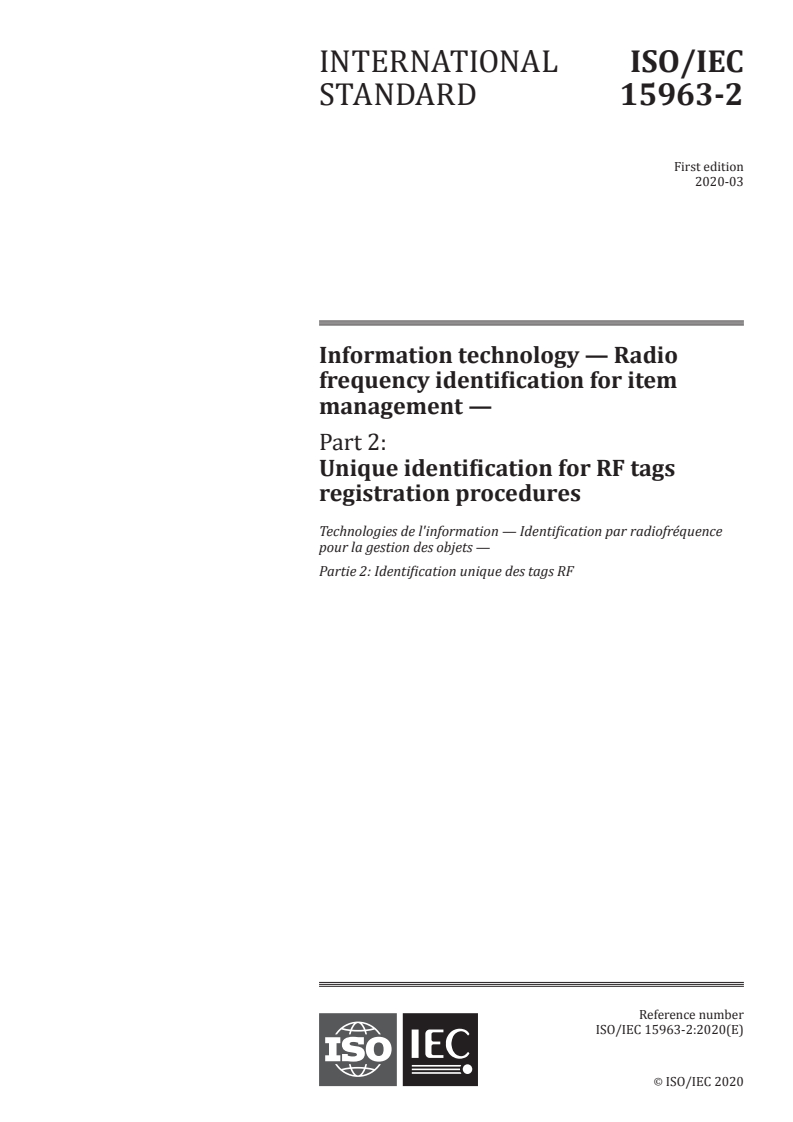
INTERNATIONAL ISO/IEC
STANDARD 15963-2
First edition
2020-03
Information technology — Radio
frequency identification for item
management —
Part 2:
Unique identification for RF tags
registration procedures
Technologies de l'information — Identification par radiofréquence
pour la gestion des objets —
Partie 2: Identification unique des tags RF
Reference number
©
ISO/IEC 2020
© ISO/IEC 2020
All rights reserved. Unless otherwise specified, or required in the context of its implementation, no part of this publication may
be reproduced or utilized otherwise in any form or by any means, electronic or mechanical, including photocopying, or posting
on the internet or an intranet, without prior written permission. Permission can be requested from either ISO at the address
below or ISO’s member body in the country of the requester.
ISO copyright office
CP 401 • Ch. de Blandonnet 8
CH-1214 Vernier, Geneva
Phone: +41 22 749 01 11
Fax: +41 22 749 09 47
Email: copyright@iso.org
Website: www.iso.org
Published in Switzerland
ii © ISO/IEC 2020 – All rights reserved
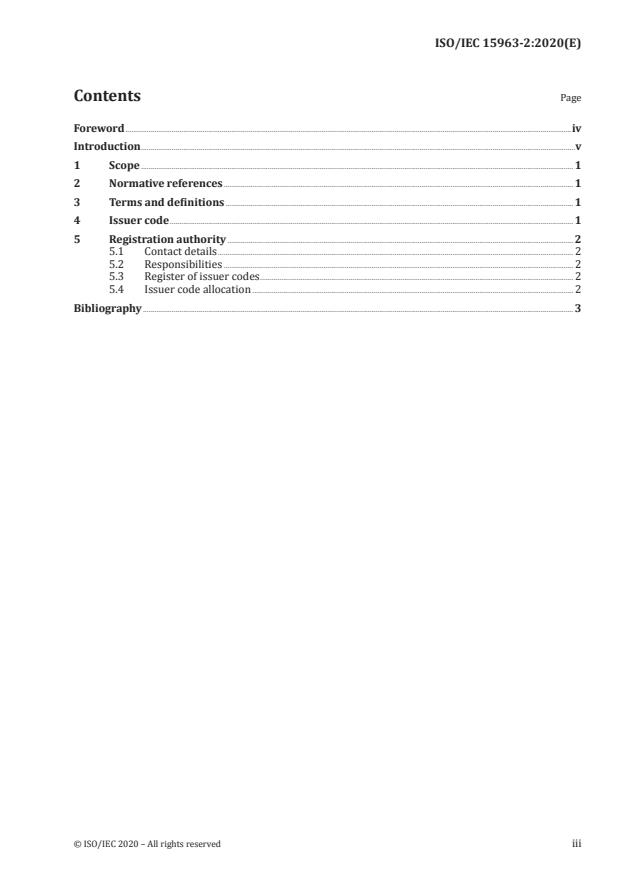
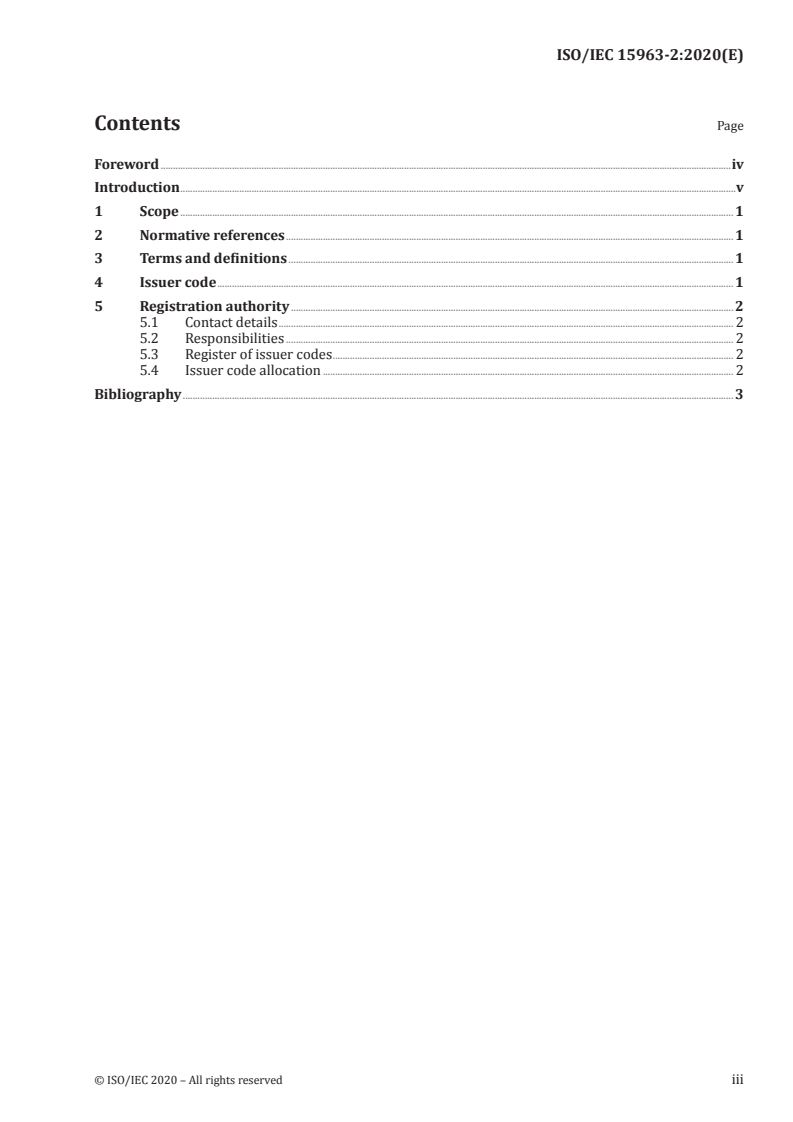
Contents Page
Foreword .iv
Introduction .v
1 Scope . 1
2 Normative references . 1
3 Terms and definitions . 1
4 Issuer code . 1
5 Registration authority . 2
5.1 Contact details . 2
5.2 Responsibilities . 2
5.3 Register of issuer codes . 2
5.4 Issuer code allocation . 2
Bibliography . 3
© ISO/IEC 2020 – All rights reserved iii
Foreword
ISO (the International Organization for Standardization) and IEC (the International Electrotechnical
Commission) form the specialized system for worldwide standardization. National bodies that
are members of ISO or IEC participate in the development of International Standards through
technical committees established by the respective organization to deal with particular fields of
technical activity. ISO and IEC technical committees collaborate in fields of mutual interest. Other
international organizations, governmental and non-governmental, in liaison with ISO and IEC, also
take part in the work.
The procedures used to develop this document and those intended for its further maintenance are
described in the ISO/IEC Directives, Part 1. In particular, the different approval criteria needed for
the different types of document should be noted. This document was drafted in accordance with the
editorial rules of the ISO/IEC Directives, Part 2 (see www .iso .org/ directives).
Attention is drawn to the possibility that some of the elements of this document may be the subject
of patent rights. ISO and IEC shall not be held responsible for identifying any or all such patent
rights. Details of any patent rights identified during the development of the document will be in the
Introduction and/or on the ISO list of patent declarations received (see www .iso .org/ patents) or the IEC
list of patent declarations received (see http:// patents .iec .ch).
Any trade name used in this document is information given for the convenience of users and does not
constitute an endorsement.
For an explanation of the voluntary nature of standards, the meaning of ISO specific terms and
expressions related to conformity assessment, as well as information about ISO's adherence to the
World Trade Organization (WTO) principles in the Technical Barriers to Trade (TBT) see www .iso .org/
iso/ foreword .html.
This document was prepared by Joint Technical Committee ISO/IEC JTC 1, Information technology,
Subcommittee SC 31 Automatic identification and data capture techniques.
This first edition of ISO/IEC 15963-2 together with of ISO/IEC 15963-1, cancels and replaces
ISO/IEC 15963:2009, which has been technically revised.
The main changes compared to the previous edition are as follows:
— Update to include the addition of part 2 — registration details, and to add new registration
information.
A list of all parts in the ISO/IEC 15963 series can be found on the ISO website.
Any feedback or questions on this document should be directed to the user’s national standards body. A
complete listing of these bodies can be found at www .iso .org/ members .html.
iv © ISO/IEC 2020 – All rights reserved
---------
...
INTERNATIONAL ISO/IEC
STANDARD 15963-2
First edition
2020-03
Information technology — Radio
frequency identification for item
management —
Part 2:
Unique identification for RF tags
registration procedures
Technologies de l'information — Identification par radiofréquence
pour la gestion des objets —
Partie 2: Identification unique des tags RF
Reference number
©
ISO/IEC 2020
© ISO/IEC 2020
All rights reserved. Unless otherwise specified, or required in the context of its implementation, no part of this publication may
be reproduced or utilized otherwise in any form or by any means, electronic or mechanical, including photocopying, or posting
on the internet or an intranet, without prior written permission. Permission can be requested from either ISO at the address
below or ISO’s member body in the country of the requester.
ISO copyright office
CP 401 • Ch. de Blandonnet 8
CH-1214 Vernier, Geneva
Phone: +41 22 749 01 11
Fax: +41 22 749 09 47
Email: copyright@iso.org
Website: www.iso.org
Published in Switzerland
ii © ISO/IEC 2020 – All rights reserved
Contents Page
Foreword .iv
Introduction .v
1 Scope . 1
2 Normative references . 1
3 Terms and definitions . 1
4 Issuer code . 1
5 Registration authority . 2
5.1 Contact details . 2
5.2 Responsibilities . 2
5.3 Register of issuer codes . 2
5.4 Issuer code allocation . 2
Bibliography . 3
© ISO/IEC 2020 – All rights reserved iii
Foreword
ISO (the International Organization for Standardization) and IEC (the International Electrotechnical
Commission) form the specialized system for worldwide standardization. National bodies that
are members of ISO or IEC participate in the development of International Standards through
technical committees established by the respective organization to deal with particular fields of
technical activity. ISO and IEC technical committees collaborate in fields of mutual interest. Other
international organizations, governmental and non-governmental, in liaison with ISO and IEC, also
take part in the work.
The procedures used to develop this document and those intended for its further maintenance are
described in the ISO/IEC Directives, Part 1. In particular, the different approval criteria needed for
the different types of document should be noted. This document was drafted in accordance with the
editorial rules of the ISO/IEC Directives, Part 2 (see www .iso .org/ directives).
Attention is drawn to the possibility that some of the elements of this document may be the subject
of patent rights. ISO and IEC shall not be held responsible for identifying any or all such patent
rights. Details of any patent rights identified during the development of the document will be in the
Introduction and/or on the ISO list of patent declarations received (see www .iso .org/ patents) or the IEC
list of patent declarations received (see http:// patents .iec .ch).
Any trade name used in this document is information given for the convenience of users and does not
constitute an endorsement.
For an explanation of the voluntary nature of standards, the meaning of ISO specific terms and
expressions related to conformity assessment, as well as information about ISO's adherence to the
World Trade Organization (WTO) principles in the Technical Barriers to Trade (TBT) see www .iso .org/
iso/ foreword .html.
This document was prepared by Joint Technical Committee ISO/IEC JTC 1, Information technology,
Subcommittee SC 31 Automatic identification and data capture techniques.
This first edition of ISO/IEC 15963-2 together with of ISO/IEC 15963-1, cancels and replaces
ISO/IEC 15963:2009, which has been technically revised.
The main changes compared to the previous edition are as follows:
— Update to include the addition of part 2 — registration details, and to add new registration
information.
A list of all parts in the ISO/IEC 15963 series can be found on the ISO website.
Any feedback or questions on this document should be directed to the user’s national standards body. A
complete listing of these bodies can be found at www .iso .org/ members .html.
iv © ISO/IEC 2020 – All rights reserved
---------
...