

ISO 17420-2:2021
(Main)Respiratory protective devices — Performance requirements — Part 2: Requirements for filtering RPD
General Information
- Abstract
This document specifies requirements for the performance and testing of filtering respiratory protective devices (RPD) in accordance with their classification and for use in the workplace to protect the wearer from hazardous atmospheres and/or environments. Requirements for RPD elements and components are also specified in this document.
- Status
- Published
- Publication Date
- 10-Jan-2021
- Technical Committee
- ISO/TC 94/SC 15 - Respiratory protective devices
- Drafting Committee
- ISO/TC 94/SC 15/WG 23 - Filtering and supplied breathable gas RPD
- Current Stage
- 9060 - Close of review
- Completion Date
- 02-Sep-2031
Buy Documents


ISO 17420-2:2021 - Respiratory protective devices -- Performance requirements

ISO 17420-2:2021 - Respiratory protective devices — Performance requirements — Part 2: Requirements for filtering RPD/11/2021


ISO 17420-2:2021 - Appareils de protection respiratoire -- Exigences de performances

ISO 17420-2:2021 - Appareils de protection respiratoire — Exigences de performances — Partie 2: Dispositifs de filtration/11/2021
Overview
ISO 17420-2:2021 - Respiratory protective devices - Performance requirements - Part 2: Requirements for filtering RPD specifies performance, testing and component requirements for filtering respiratory protective devices (RPD) intended for workplace use. The standard defines how filtering RPD are classified and evaluated to protect wearers from hazardous atmospheres and environments. It also covers requirements for RPD elements and replacement components and includes testing schedules, marking and manufacturer information requirements.
Key topics and technical requirements
ISO 17420-2:2021 addresses the main performance and verification elements needed for reliable filtering RPD:
- Classification and protection class determination - procedures to determine protection performance, including Total Inward Leakage (TIL) methods.
- Breathing performance - evaluation of work of breathing, breathing resistance (peak pressure) and elastance for both unassisted and assisted RPD.
- Contaminant limits and safety conditions - provisions for CO concentration limits and inhaled air temperature/humidity when relevant.
- Connections and connectors - strength and compatibility requirements (including requirements for RPD with standardized connectors and low-pressure hoses).
- Reliability and pre-conditioning - assessment of durability and pre-conditioning (sequential/non-sequential) before testing.
- Elements and components - specific requirements for filters, hoses, visors and other separable parts; performance when using prefilters.
- Validation by practical performance - donning/doffing, communication (speech and hearing), eye irritation, fogging and ergonomics.
- Testing, marking and information - test schedules, inspection methods, marking requirements and minimum information manufacturers must supply.
- Supporting annexes - reliability guidance, example FMEA, test schedules and normalization of test results.
Applications and who uses this standard
ISO 17420-2 is practical for organizations involved in respiratory protection lifecycle:
- Manufacturers and designers of filtering RPD and replacement filters - to design and verify products meet international performance requirements.
- Testing laboratories and conformity assessment bodies - to perform standardized tests, TIL measurements and reliability assessments.
- Occupational health & safety professionals and procurement teams - to select appropriate filtering RPD for workplace hazards and ensure supplier compliance.
- Regulators and certification schemes - to reference technical requirements for approval and market surveillance.
- Maintenance and training providers - to understand functional limits and required user information.
Related standards
- Part of the ISO 17420 series on respiratory protective devices. Users should consult other parts of the series and relevant national or industry standards for complete certification and workplace use guidance.
Keywords: ISO 17420-2:2021, respiratory protective devices, filtering RPD, performance requirements, Total Inward Leakage, breathing resistance, filter requirements, RPD testing, workplace respiratory protection.
Buy Documents
ISO 17420-2:2021 - Respiratory protective devices -- Performance requirements
ISO 17420-2:2021 - Respiratory protective devices — Performance requirements — Part 2: Requirements for filtering RPD/11/2021
ISO 17420-2:2021 - Appareils de protection respiratoire -- Exigences de performances
ISO 17420-2:2021 - Appareils de protection respiratoire — Exigences de performances — Partie 2: Dispositifs de filtration/11/2021
Get Certified
Connect with accredited certification bodies for this standard

CIS Institut d.o.o.
Personal Protective Equipment (PPE) certification body. Notified Body NB-2890 for EU Regulation 2016/425 PPE.

Kiwa BDA Testing
Building and construction product certification.
Kmetijski inštitut Slovenije
Agricultural Institute of Slovenia. Soil testing, plant health, agricultural product analysis.
Sponsored listings
Frequently Asked Questions
ISO 17420-2:2021 is a standard published by the International Organization for Standardization (ISO). Its full title is "Respiratory protective devices — Performance requirements — Part 2: Requirements for filtering RPD". This standard covers: This document specifies requirements for the performance and testing of filtering respiratory protective devices (RPD) in accordance with their classification and for use in the workplace to protect the wearer from hazardous atmospheres and/or environments. Requirements for RPD elements and components are also specified in this document.
This document specifies requirements for the performance and testing of filtering respiratory protective devices (RPD) in accordance with their classification and for use in the workplace to protect the wearer from hazardous atmospheres and/or environments. Requirements for RPD elements and components are also specified in this document.
ISO 17420-2:2021 is classified under the following ICS (International Classification for Standards) categories: 13.340.30 - Respiratory protective devices. The ICS classification helps identify the subject area and facilitates finding related standards.
ISO 17420-2:2021 is available in PDF format for immediate download after purchase. The document can be added to your cart and obtained through the secure checkout process. Digital delivery ensures instant access to the complete standard document.
Standards Content (Sample)
INTERNATIONAL ISO
STANDARD 17420-2
First edition
2021-01
Respiratory protective devices —
Performance requirements —
Part 2:
Requirements for filtering RPD
Appareils de protection respiratoire — Exigences de performances —
Partie 2: Dispositifs de filtration
Reference number
©
ISO 2021
© ISO 2021
All rights reserved. Unless otherwise specified, or required in the context of its implementation, no part of this publication may
be reproduced or utilized otherwise in any form or by any means, electronic or mechanical, including photocopying, or posting
on the internet or an intranet, without prior written permission. Permission can be requested from either ISO at the address
below or ISO’s member body in the country of the requester.
ISO copyright office
CP 401 • Ch. de Blandonnet 8
CH-1214 Vernier, Geneva
Phone: +41 22 749 01 11
Email: copyright@iso.org
Website: www.iso.org
Published in Switzerland
ii © ISO 2021 – All rights reserved
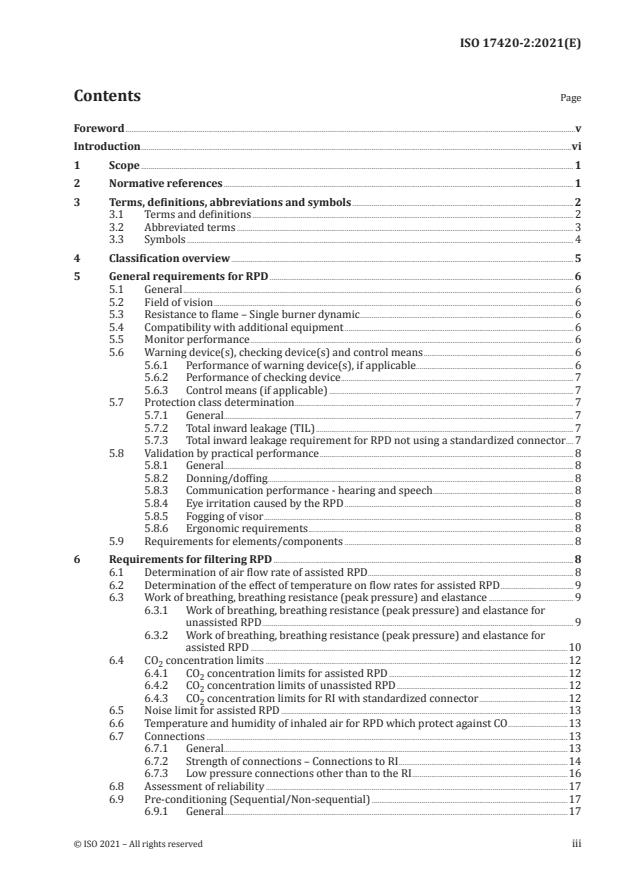
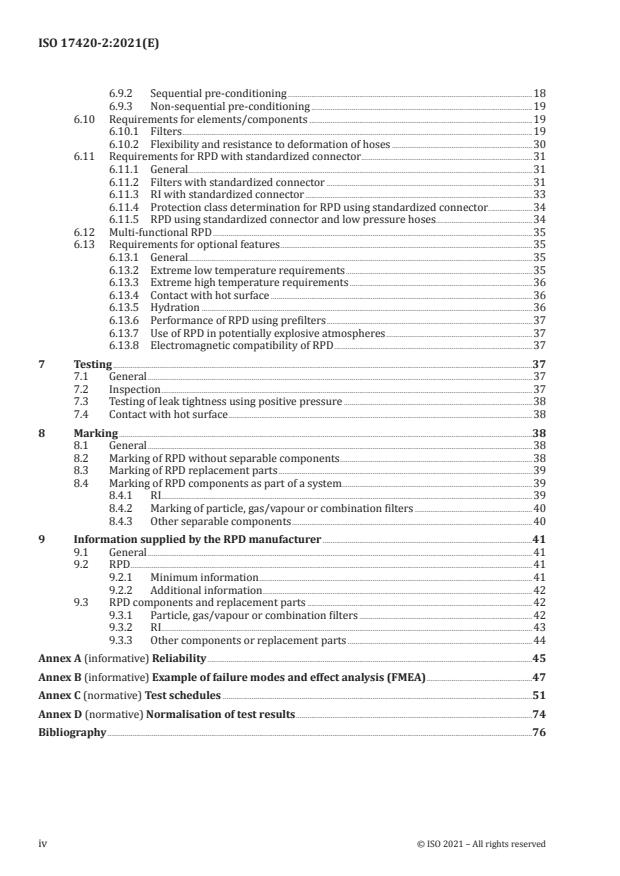
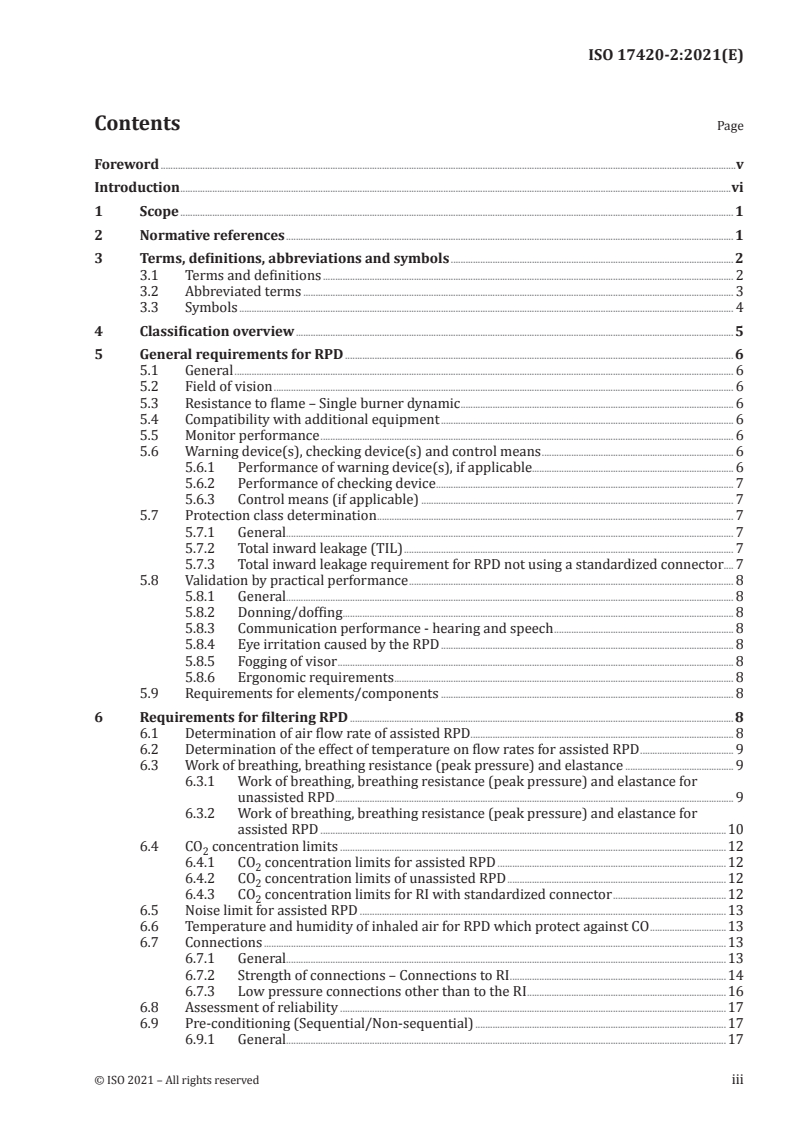
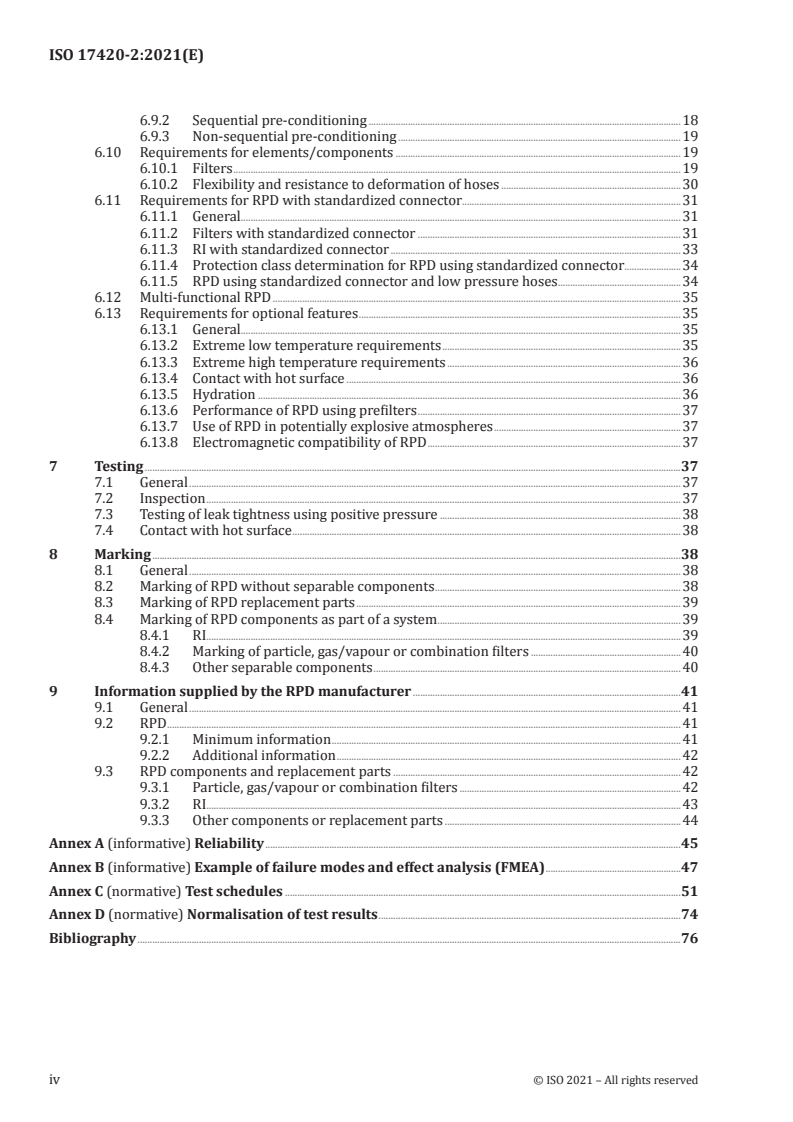
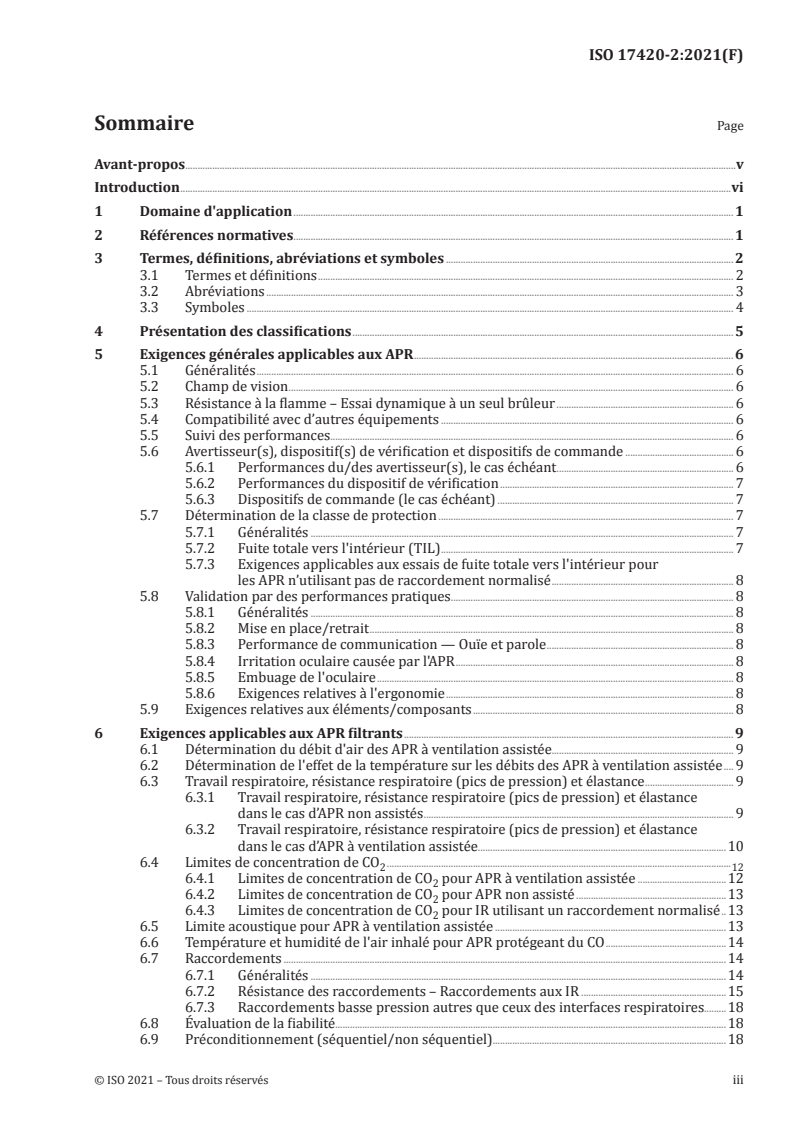
Contents Page
Foreword .v
Introduction .vi
1 Scope . 1
2 Normative references . 1
3 Terms, definitions, abbreviations and symbols . 2
3.1 Terms and definitions . 2
3.2 Abbreviated terms . 3
3.3 Symbols . 4
4 Classification overview . 5
5 General requirements for RPD . 6
5.1 General . 6
5.2 Field of vision . 6
5.3 Resistance to flame – Single burner dynamic . 6
5.4 Compatibility with additional equipment . 6
5.5 Monitor performance . 6
5.6 Warning device(s), checking device(s) and control means . 6
5.6.1 Performance of warning device(s), if applicable. 6
5.6.2 Performance of checking device . 7
5.6.3 Control means (if applicable) . 7
5.7 Protection class determination . 7
5.7.1 General. 7
5.7.2 Total inward leakage (TIL) . 7
5.7.3 Total inward leakage requirement for RPD not using a standardized connector . 7
5.8 Validation by practical performance . 8
5.8.1 General. 8
5.8.2 Donning/doffing . . 8
5.8.3 Communication performance - hearing and speech . 8
5.8.4 Eye irritation caused by the RPD . 8
5.8.5 Fogging of visor . 8
5.8.6 Ergonomic requirements . 8
5.9 Requirements for elements/components . 8
6 Requirements for filtering RPD . 8
6.1 Determination of air flow rate of assisted RPD . 8
6.2 Determination of the effect of temperature on flow rates for assisted RPD . 9
6.3 Work of breathing, breathing resistance (peak pressure) and elastance . 9
6.3.1 Work of breathing, breathing resistance (peak pressure) and elastance for
unassisted RPD . 9
6.3.2 Work of breathing, breathing resistance (peak pressure) and elastance for
assisted RPD .10
6.4 CO concentration limits .12
6.4.1 CO concentration limits for assisted RPD .12
6.4.2 CO concentration limits of unassisted RPD .12
6.4.3 CO concentration limits for RI with standardized connector .12
6.5 Noise limit for assisted RPD .13
6.6 Temperature and humidity of inhaled air for RPD which protect against CO .13
6.7 Connections .13
6.7.1 General.13
6.7.2 Strength of connections – Connections to RI .14
6.7.3 Low pressure connections other than to the RI .16
6.8 Assessment of reliability .17
6.9 Pre-conditioning (Sequential/Non-sequential) .17
6.9.1 General.17
6.9.2 Sequential pre-conditioning .18
6.9.3 Non-sequential pre-conditioning .19
6.10 Requirements for elements/components .19
6.10.1 Filters .19
6.10.2 Flexibility and resistance to deformation of hoses .30
6.11 Requirements for RPD with standardized connector.31
6.11.1 General.31
6.11.2 Filters with standardized connector .31
6.11.3 RI with standardized connector .33
6.11.4 Protection class determination for RPD using standardized connector.34
6.11.5 RPD using standardized connector and low pressure hoses .34
6.12 Multi-functional RPD .35
6.13 Requirements for optional features .35
6.13.1 General.35
6.13.2 Extreme low temperature requirements .35
6.13.3 Extreme high temperature requirements .36
6.13.4 Contact with hot surface .36
6.13.5 Hydration .36
6.13.6 Performance of RPD using prefilters .37
6.13.7 Use of RPD in potentially explosive atmospheres .37
6.13.8 Electromagnetic compatibility of RPD .37
7 Testing .37
7.1 General .37
7.2 Inspection .37
7.3 Testing of leak tightness using positive pressure .38
7.4 Contact with hot surface .38
8 Marking .38
8.1 General .38
8.2 Marking of RPD without separable components .38
8.3 Marking of RPD replacement parts .39
8.4 Marking of RPD components as part of a system .39
8.4.1 RI . . .39
8.4.2 Marking of particle, gas/vapour or combination filters .40
8.4.3 Other separable components .40
9 Information supplied by the RPD manufacturer .41
9.1 General .41
9.2 RPD .41
9.2.1 Minimum information .41
9.2.2 Additional information .42
9.3 RPD components and replacement parts .42
9.3.1 Particle, gas/vapour or combination filters .42
9.3.2 RI . . .43
9.3.3 Other components or replacement parts .44
Annex A (informative) Reliability .45
Annex B (informative) Example of failure modes and effect analysis (FMEA) .47
Annex C (normative) Test schedules .51
Annex D (normative) Normalisation of test results .74
Bibliography .76
iv © ISO 2021 – All rights reserved
Foreword
ISO (the International Organization for Standardization) is a worldwide federation of national standards
bodies (ISO member bodies). The work of preparing International Standards is normally carried out
through ISO technical committees. Each member body interested in a subject for which a technical
committee has been established has the right to be represented on that committee. International
organizations, governmental and non-governmental, in liaison with ISO, also take part in the work.
ISO collaborates closely with the International Electrotechnical Commission (IEC) on all matters of
electrotechnical standardization.
The procedures used to develop this document and those intended for its further maintenance are
described in the ISO/IEC Directives, Part 1. In particular the different approval criteria needed for the
different types of ISO documents should be noted. This document was drafted in accordance with the
editorial rules of the ISO/IEC Directives, Part 2 (see www .iso .org/ directives).
Attention is drawn to the possibility that some of the elements of this document may be the subject of
patent rights. ISO shall not be held responsible for identifying any or all such patent rights. Details of
any patent rights identified during the development of the document will be in the Introduction and/or
on the ISO list of patent declarations received (see www .iso .org/ patents).
Any trade name used in this document is information given for the convenience of users and does not
constitute an endorsement.
For an explanation on the voluntary nature of standards, the meaning of ISO specific terms and
expressions related to conformity assessment, as well as information about ISO's adherence to the
World Trade Organization (WTO) principles in the Technical Barriers to Trade (TBT) see the following
URL: www .iso .org/ iso/ foreword .html.
This document was prepared by Technical Committee ISO/TC 94, Personal safety - Personal protective
equipment, Subcommittee SC 15, Respiratory protective devices.
A list of all parts in the ISO 17420 series can be found on the ISO website.
Any feedback or questions on this document should be directed to the user’s national standards body. A
complete listing of these bodies can be found at www .iso .org/ members .html.
Introduction
This document describes basic requirements for filtering respiratory protective devices (RPD) and its
elements and components.
Requirements for RPD used in environments for special applications are given in the relevant parts of
the ISO 17420 series.
Some test methods are described. For other test methods references are given to the ISO 16900 series
"Methods of test and test equipment" or other test methods not developed by ISO/TC 94/SC 15.
Annex A gives information about reliability.
Annex B features an example of a FMEA (Failure Mode and Effects Analysis).
Annex C gives the test schedules including any pre-conditioning and number of samples.
Annex D provides information for normalisation of test results.
The sequence of testing follows the principle to minimize the necessary number of samples by carrying
out destructive tests at the end. It also includes for safety reason that tests with test subjects are only
carried out after the test samples have shown their safe performance in other tests.
vi © ISO 2021 – All rights reserved
INTERNATIONAL STANDARD ISO 17420-2:2021(E)
Respiratory protective devices — Performance
requirements —
Part 2:
Requirements for filtering RPD
1 Scope
This document specifies requirements for the performance and testing of filtering respiratory
protective devices (RPD) in accordance with their classification and for use in the workplace to protect
the wearer from hazardous atmospheres and/or environments.
Requirements for RPD elements and components are also specified in this document.
2 Normative references
The following documents, in whole or in part, are normatively referenced in this document and are
indispensable for its application. For dated references, only the edition cited applies. For undated
references, the latest edition of the referenced document (including any amendments) applies.
ISO 9227, Corrosion tests in artificial atmospheres — Salt spray tests
ISO 16900-1:2019, Respiratory protective devices — Methods of test and test equipment — Part 1:
Determination of inward leakage
ISO 16900-2, Respiratory protective devices — Methods of test and test equipment — Part 2: Determination
of breathing resistance
ISO 16900-3, Respiratory protective devices — Methods of test and test equipment — Part 3: Determination
of particle filter penetration
ISO 16900-4:2011, Respiratory protective devices — Methods of test and test equipment — Part 4:
Determination of gas filter capacity and migration, desorption and carbon monoxide dynamic testing
ISO 16900-5, Respiratory protective devices — Methods of test and test equipment — Part 5: Breathing
machine, metabolic simulator, RPD headforms and torso, tools and verification tools
1)
ISO 16900-6:— , Respiratory protective devices — Methods of test and test equipment — Part 6:
Mechanical resistance/strength of components and connections
ISO 16900-7:2020, Respiratory protective devices — Methods of test and test equipment — Part 7: Practical
performance test methods
ISO 16900-8, Respiratory protective devices — Methods of test and test equipment — Part 8: Measurement
of RPD air flow rates of assisted filtering RPD
ISO 16900-9, Respiratory protective devices — Methods of test and test equipment — Part 9: Determination
of carbon dioxide content of the inhaled gas
ISO 16900-12, Respiratory protective devices — Methods of test and test equipment — Part 12:
Determination of volume-averaged work of breathing and peak respiratory pressures
1) Under preparation, Stage at the time of publication ISO/DIS 16900-6:2020.
ISO 16900-14:2020, Respiratory protective devices — Methods of test and test equipment — Part 14:
Measurement of sound level
ISO 16972, Respiratory protective devices — Vocabulary and graphical symbols
ISO/TS 16973, Respiratory protective devices -- Classification for respiratory protective device (RPD),
excluding RPD for underwater application
ISO 17420-1:2021, Respiratory protective devices — Performance requirements — Part 1: General
ISO 17420-3, Respiratory protective devices — Performance requirements — Part 3: Thread connection
IEC 61000-6-2, Electromagnetic compatibility (EMC) — Part 6-2: Generic standards — Immunity standard
for industrial environments
3 Terms, definitions, abbreviations and symbols
3.1 Terms and definitions
For the purposes of this document, the terms and definitions given in ISO 16972 and the following apply.
ISO and IEC maintain terminological databases for use in standardization at the following addresses:
— ISO Online browsing platform: available at https:// www .iso .org/ obp
— IEC Electropedia: available at http:// www .electropedia .org/
3.1.1
non pre-conditioned state
without pre-conditioning but possibly modified to carry out tests or already used in non-destructive tests
Note 1 to entry: This includes e.g. cleaning and disinfection.
3.1.2
as worn state
RPD where all components are connected and assembled in the way that it is intended to be used and
worn (e.g. worn by the wearer, adapted to a RPD headform or RPD headform and torso or suitable holder)
Note 1 to entry: All of the various components [e.g. for an assisted filtering device: blower unit, battery,
respiratory interface (RI), filters, etc.] have been completely assembled and then connected (RI connected to the
hose of the blower unit) together in accordance with the information supplied by the manufacturer.
3.1.3
ready for assembly state
RPD or components with seals, plugs or other environmental protective means, still in place ready to be
assembled and/or donned
Note 1 to entry: RPD or components can remain sealed and plugged until donning if so stated in the information
supplied by the manufacturer.
3.1.4
integrated RPD
RPD designed so that components in the breathable gas supply chain are nonseparable
3.1.5
measured maximum flow rate
volumetric flow rate of an assisted filtering RPD, determined in a laboratory test, when the RPD is in the
condition which results in the highest air flow rate, where this condition takes into account the influences
of temperatures, settings of RPD, pre-conditionings, use of accessories and any other related factors
[SOURCE: ISO 16900-8:2015, 3.6]
2 © ISO 2021 – All rights reserved
3.1.6
migration
diffusion of the gas or vapour molecules within the sorbent after the filter is partially loaded
3.1.7
standardized connector
device that allows an optional connection between a filter and a respiratory interface
Note 1 to entry: Filter connector meeting the requirements of ISO 17420-3.
3.1.8
replacement part
identical to the one originally supplied with the RPD by the manufacturer, and declared interchangeable
by the manufacturer
3.1.9
normalised condition
test condition adjusted to 1013 hPa and body temperature (37 °C or 310 K) saturated with water
vapour, which is 63 hPa, used for the normalization of test results
Note 1 to entry: Further information is given in Annex D.
3.2 Abbreviated terms
FMEA Failure Mode and Effects Analysis
V Tidal volume
T
WoB Work of Breathing
BTPS body temperature pressure saturated
3.3 Symbols
3.3.1
Product information; information point (ISO 7000-2760).
Indication for the RI that it is a part of a RPD system with multiple configurations.
3.3.2
Operator's manual; operating instructions (ISO 7000-1641).
Booklet: "See information supplied by the RPD manufacturer"
3.3.3
Do not re-use (ISO 7000-1051).
Crossed out 2: “For single shift use only”
4 © ISO 2021 – All rights reserved
3.3.4
Use by date (ISO 7000-2607)
Hourglass: "End of shelf life"
Key: yyyy year, mm month
3.3.5
Roller; cylinder (ISO 7000-0566)
Target: "Standardized connector"
3.3.6
RPD headform number allocation for size designation
4 Classification overview
ISO 17420-1:2021, 4.1 applies with the following addition:
The classification of a filtering RPD is determined by the appropriate combination of the following
classes: (protection class) (work rate class) (RI class) (particle filterclass and/or gas filter type and class).
Additionally filtering RPD may be classified for one or more special applications, as given in ISO 17420-5
to ISO 17420-9.
Table 1 — Gas filter type and class
Type Class(es) Type description
OV 1, 2, 3 or 4 Organic vapours
OG 1 Organic gases (low boiling, i.e. below 65 °C)
AC 1, 2, 3 or 4 Acidic compounds
BC 1, 2, 3 or 4 Basic compounds
NO 1, 2 or 3 Nitrogen oxides
x
HG 1, 2 or 3 Mercury (Hg)
OZ 1 Ozone (O )
HCN 1, 2, 3 or 4 Hydrogen Cyanide (HCN)
AH 1 Arsine (AsH )
Table 1 (continued)
Type Class(es) Type description
HF 1, 2 or 3 Hydrogen fluoride (HF)
CD 1 Chlorine dioxide (ClO )
ETO 1, 2 or 3 Ethylene oxide ((CH ) O)
2 2
FM 1, 2 or 3 Formaldehyde (CH O)
MB 1, 2 or 3 Methyl bromide (CH Br)
CO Three classes based on time (20 min, 60 min or 180 min) Carbon monoxide (CO)
PH 1 or 2 Phosphine (PH )
The designation of a filtering RPD is determined by an appropriate combination of the classes given in
ISO 17420-1:2021, Table 1 and Table 1 of this document.
Example for a basic RPD with protection class (PC3), work rate class (W2), RI class (bT), particle filter
class (F3) and gas filter type and class (OV2).
Marking for the given example PC3 W2 bT F3 OV2
Multi-functional filtering RPD have separate classifications for each function, i.e. one classification for
the unassisted mode and one classification for the assisted mode.
5 General requirements for RPD
5.1 General
ISO 17420-1:2021, 5.1, applies.
5.2 Field of vision
ISO 17420-1:2021, 5.2, applies.
5.3 Resistance to flame – Single burner dynamic
ISO 17420-1:2021, 5.3, applies.
5.4 Compatibility with additional equipment
ISO 17420-1:2021, 5.4, applies.
5.5 Monitor performance
ISO 17420-1:2021, 5.5, applies with the following addition:
The monitor system shall not interfere with the operation of the RPD.
5.6 Warning device(s), checking device(s) and control means
5.6.1 Performance of warning device(s), if applicable
RPD shall be checked after sequential pre-conditioning in accordance with 6.9.2.
RPD powered by an energy source shall be equipped with a low energy warning device to warn the
wearer at least 5 min prior to the performance of the RPD falling below the manufacturer’s minimum
design conditions. From the activation of the warning the RPD shall be tested in accordance with 6.3.2
for a period of 5 min but with a fixed setting of 35 l/min, see Table 2.
6 © ISO 2021 – All rights reserved
Check in accordance with 7.2 and Clause 9.
For assisted filtering RPD a warning device shall warn the wearer when the performance of the RPD is
outside of the manufacturer’s design conditions.
Testing shall be performed in accordance with 6.3.2 and, if applicable, in accordance with ISO 16900-8.
During use, warning devices shall not switch off automatically and shall not be capable of being switched
off by the wearer while the cause of the warning remains other than to correct the warning condition.
Check in accordance with 7.2.
Any warning shall be detectable without any intervention by the wearer. Any warning shall be
detectable by the wearer within 15 s.
Testing shall be performed in accordance with ISO 16900-7:2020, Annex B, activity k).
Any warnings which require different reactions by the wearer shall be distinguishable from one
another.
Check in accordance with 7.2.
5.6.2 Performance of checking device
ISO 17420-1:2021, 5.6.2, applies.
5.6.3 Control means (if applicable)
Manual control means installed on a RPD shall be clearly identifiable and, if more than one,
distinguishable from one another by the wearer during use.
If there is a control means for setting different PC classes it shall not be possible to change the PC class
during use without indication to the wearer.
Adjustable control means shall be tested in accordance with 6.3.
Testing shall be performed in accordance with ISO 16900-7.
5.7 Protection class determination
5.7.1 General
ISO 17420-1:2021, 5.7.1, applies.
5.7.2 Total inward leakage (TIL)
ISO 17420-1:2021, 5.7.2, applies.
The following applies in addition to ISO 17420-1:2021, 5.7.
5.7.3 Total inward leakage requirement for RPD not using a standardized connector
RPD, except those with RIs class aT, shall be tested for total inward leakage in accordance with
ISO 17420-1:2021, 5.7.2.
NOTE 1 For RI using standardized connector see 6.11.3.3.
NOTE 2 For RI class a see ISO 17420-1:2021, 5.7.2.
5.8 Validation by practical performance
5.8.1 General
ISO 17420-1:2021, 5.8.1, and the following applies:
Two RPD sequentially pre-conditioned in accordance with 6.9.2 shall undergo practical performance tests.
Prior to the practical performance testing the RPD performance shall have passed the tests according
to at least the following clauses:
— 6.3 [work of breathing, breathing resistance (peak pressure) and elastance];
— 6.4 (CO concentration);
— ISO 17420-1:2021, 5.9.1 (RI);
— 6.5 (noise limit for assisted RPD),
— 6.7 (connections);
— 5.6 [warning and checking device(s)].
5.8.2 Donning/doffing
ISO 17420-1:2021, 5.8.2 applies.
5.8.3 Communication performance - hearing and speech
ISO 17420-1:2021, 5.8.3 applies.
5.8.4 Eye irritation caused by the RPD
ISO 17420-1:2021, 5.8.4 applies.
5.8.5 Fogging of visor
ISO 17420-1:2021, 5.8.5 applies.
5.8.6 Ergonomic requirements
ISO 17420-1:2021, 5.8.6 applies.
5.9 Requirements for elements/components
ISO 17420-1:2021, 5.9 applies.
6 Requirements for filtering RPD
6.1 Determination of air flow rate of assisted RPD
For assisted RPD the air flow rate shall be determined at conditions which result in the minimum flow
rate and the maximum flow rate of the RPD.
Depending on the design of the RPD these air flow rates can be influenced by
— possible flow settings of the RPD,
— service life,
8 © ISO 2021 – All rights reserved
— the charging status of the battery,
— different filter types,
— alarm settings,
— the temperature of the RPD, including the temperature range for use,
— use of accessories,
— hose length, and
— other factors, if applicable.
— Testing shall be performed in accordance with ISO 16900-8.
6.2 Determination of the effect of temperature on flow rates for assisted RPD
To determine the influence of temperature the RPD shall be tested for flow after each of the following:
a) equilibrated for a minimum of 4 h at 35 °C and at a relative humidity of (50 ± 20) %
−2
+2
b) and equilibrated for a minimum of 4 h at −5 °C.
Testing shall be started within 3 min after each equilibration at ambient laboratory conditions.
Taking into account the influencing parameters as listed in 6.1 the measured minimum and the
measured maximum flow rate shall be determined in accordance with ISO 16900-8.
6.3 Work of breathing, breathing resistance (peak pressure) and elastance
6.3.1 Work of breathing, breathing resistance (peak pressure) and elastance for unassisted RPD
For filters with standardized connectors see 6.11.2.1.
For RI with standardized connectors see 6.11.3.2.
The RPD shall be tested with one of each size of the RI.
The RPD headform number(s) allocated to the RI used for the tests is/are specified by the manufacturer.
Integrated RPD or components in ready for assembly state shall be exposed to the sequential
preconditioning in accordance with 6.9.2.
In addition to the sequential pre-conditioning in accordance with 6.9.2 one integrated RPD in its
ready to worn state containing electronics or component(s) in its ready for assembly state containing
electronics shall be exposed to the non-sequential preconditioning in accordance with 6.9.3.2. RPD shall
meet the requirements set forth in Table 3 for work of breathing/breathing resistance, when tested in
accordance with the settings for the breathing machine for each work rate as given in Table 2.
The temperature of operation of unassisted RPD is covered by the pre-conditioning according to 6.9.2.2
because for those types of RPD testing at the extremes gives no further information.
The work of breathing, breathing resistance (peak pressure), and elastance shall be calculated from the
average pressure volume loop based on 10 consecutive breathing cycles and shall not exceed the limits
given in Table 3.
The settings for the breathing machine for each work rate are given in Table 2.
Table 2 — Setting of breathing machine at work rates for assisted and unassisted RPD
Flow rate
Frequency Tidal volume
(dynamic sinusoidal)
Work rate
l/min at BTPS cycles/min l at BTPS
Resting 10 with a tolerance of ±3 % 10,0 1,0
W1 35 with a tolerance of ±2 % 23,3 1,5
W2 65 with a tolerance of ±2 % 32,5 2,0
W3 105 with a tolerance of ±2 % 42,0 2,5
W4 135 with a tolerance of ±1 % 45,0 3,0
Testing shall be performed in accordance with ISO 16900-5 and ISO 16900-12.
Tidal volumes are expressed at BTPS. In order to be able to compare the performance of different RPD
the results achieved at any laboratory conditions shall be normalized to body temperature (37 °C) and
normalized pressure (1 013 hPa) in accordance with Annex D.
An example for normalisation calculation for work of breathing results is given in D.2.1.
6.3.2 Work of breathing, breathing resistance (peak pressure) and elastance for assisted RPD
Integrated RPD or components in ready for assembly state shall be pre-conditioned in accordance
with 6.9.2.
In addition to the sequential pre-conditioning in accordance with 6.9.2 one integrated RPD or
component(s) in ready for assembly state shall be pre-conditioned in accordance with 6.9.3.2 (salt
spray) as applicable, prior to validation testing.
RPD shall be set to the minimum and maximum measured flow rates determined in accordance with 6.2.
RPD shall be tested in accordance with the test regime for its work rate class as stated by the
manufacturer and meet the requirements for work of breathing, breathing resistance and elastance for
each flow rate as given in Table 3.
RPD work of breathing and breathing resistance (peak pressures) shall be measured in each step of the
performance regime for the designated work rate class, given in Table 3. The measurements shall start
after the stabilization of each step in the test regimes W1 to W4.
The transition period between one work rate and the next work rate shall be no more than one minute,
which includes the stabilization, whilst the RPD remains in operational mode.
The work of breathing, breathing resistance and elastance shall be computed from the average pressure
volume loop based on ten consecutive breaths and shall not exceed the limits given in Table 3.
Test regime to achieve W1:
a) 35 l/min for 5 min;
b) 10 l/min for 5 min;
c) 35 l/min for 5 min.
Test regime to achieve W2:
a) 35 l/min for 5 min;
b) 65 l/min for 5 min;
c) 10 l/min for 5 min;
d) 35 l/min for 5 min.
10 © ISO 2021 – All rights reserved
Test regime to achieve W3:
a) 35 l/min for 4 min;
b) 65 l/min for 3 min;
c) 105 l/min for 3 min;
d) 10 l/min for 5 min;
e) 35 l/min for 5 min.
Test regime to achieve W4:
a) 35 l/min for 2 min;
b) 105 l/min for 3 min;
c) 65 l/min for 2 min;
d) 135 l/min for 3 min;
e) 10 l/min for 5 min;
f) 35 l/min for 5 min.
The test termination point shall be after one complete cycle of the applicable test regime. Each test
regime shall be performed with the operation of the RPD adjusted to both the maximum and the
minimum measured flow rates as determined by ISO 16900-8.
Table 3 — Limits of work of breathing, breathing resistance (peak pressure) and elastance for
assisted and unassisted RPD
Work of breathing limit
Elastance
Breathing resistance limit
measured as
Flow rate
limit
(peak pressures)
WoB/V
(dynamic sinusoidal)
T measured as
Δp/V
inhalation exhalation inhalation exhalation T
l/min at BTPS
kPa kPa kPa/l
a
10 with a tolerance of ± 3 %
35 with a tolerance of ± 2%
0,9 0,9 -1,2 1,2
65 with a tolerance of ± 2% 1,0
105 with a tolerance of ± 2%
135 with a tolerance of ± 1% 1,6 1,6 -2,0 2,0
Δp is the difference in pressure between the beginning of inhalation and beginning of exhalation.
NOTE Flow rates and tidal volumes are expressed at BTPS (body temperature, ambient pressure, saturated gas).
RPD work of breathing and breathing resistance (peak pressures) shall be measured in each step of the
regime for the designated work rate class above. The measurements shall begin after the stabilization
of each step.
The transition period between one work rate and the next work rate shall be no more than one minute,
which includes the stabilization, whilst the RPD remains in operational mode.
During the transition between different flow rates, stopping of the breathing machine is allowable as
long as the 1 min time period is not exceeded.
The settings for the breathing machine for each work rate are given in Table 2.
Testing shall be performed in accordance with ISO 17420-1 and ISO 16900-12.
6.4 CO concentration limits
6.4.1 CO concentration limits for assisted RPD
One RPD in non pre-conditioned state, for each size RI shall be tested on the RPD headform based on
the size as designated by the manufacturer.
RPD shall meet the requirements when tested at ambient temperature when adjusted to the measured
minimum flow as tested in ISO 16900-8.
The carbon dioxide content of the inhalation air shall not exceed an average volume fraction as given in
Table 4 tested at its work rate class and at resting to determine the average.
Table 4 — Maximum average volume fraction of CO concentration in the inhalation air in
relation to flow rate
Flow rate
CO concentration
(dynamic sinusoidal)
l/min at BTPS %
10 with a tolerance of ±3% 2,50
35 with a tolerance of ±2%
2,00
65 with a tolerance of ±2%
105 with a tolerance of ±2%
1,40
135 with a tolerance of ±1%
After stabilization, the measurement of at least 10 cycles shall be taken to determine the average.
Within at least 10 cycles the average value of CO at the end of each exhalation cycle shall contain
(5,3 ± 0,1) % CO .
The setting of the breathing machine is as given in Table 2.
Testing shall be performed in accordance with ISO 16900-9.
6.4.2 CO concentration limits of unassisted RPD
One RPD in non pre-conditioned state, for each RI size shall be tested on the RPD headform based on
the size as designated by the manufacturer.
The carbon dioxide content of the inhalation air shall not exceed an average volume fraction as
given in Table 4 with the setting of the breathing machine as given in Table 2. After stabilization, the
measurement of at least 10 cycles shall be taken to determine the average.
Within at least 10 cycles the average value of CO at the end of each exhalation cycle shall contain
(5,3 ± 0,1) % CO .
Testing shall be performed in accordance with ISO 16900-9.
6.4.3 CO concentration limits for RI with standardized connector
One RI with standardized connector in non pre-conditioned state, for each size shall be tested on the
RPD head
...
INTERNATIONAL ISO
STANDARD 17420-2
First edition
2021-01
Respiratory protective devices —
Performance requirements —
Part 2:
Requirements for filtering RPD
Appareils de protection respiratoire — Exigences de performances —
Partie 2: Dispositifs de filtration
Reference number
©
ISO 2021
© ISO 2021
All rights reserved. Unless otherwise specified, or required in the context of its implementation, no part of this publication may
be reproduced or utilized otherwise in any form or by any means, electronic or mechanical, including photocopying, or posting
on the internet or an intranet, without prior written permission. Permission can be requested from either ISO at the address
below or ISO’s member body in the country of the requester.
ISO copyright office
CP 401 • Ch. de Blandonnet 8
CH-1214 Vernier, Geneva
Phone: +41 22 749 01 11
Email: copyright@iso.org
Website: www.iso.org
Published in Switzerland
ii © ISO 2021 – All rights reserved
Contents Page
Foreword .v
Introduction .vi
1 Scope . 1
2 Normative references . 1
3 Terms, definitions, abbreviations and symbols . 2
3.1 Terms and definitions . 2
3.2 Abbreviated terms . 3
3.3 Symbols . 4
4 Classification overview . 5
5 General requirements for RPD . 6
5.1 General . 6
5.2 Field of vision . 6
5.3 Resistance to flame – Single burner dynamic . 6
5.4 Compatibility with additional equipment . 6
5.5 Monitor performance . 6
5.6 Warning device(s), checking device(s) and control means . 6
5.6.1 Performance of warning device(s), if applicable. 6
5.6.2 Performance of checking device . 7
5.6.3 Control means (if applicable) . 7
5.7 Protection class determination . 7
5.7.1 General. 7
5.7.2 Total inward leakage (TIL) . 7
5.7.3 Total inward leakage requirement for RPD not using a standardized connector . 7
5.8 Validation by practical performance . 8
5.8.1 General. 8
5.8.2 Donning/doffing . . 8
5.8.3 Communication performance - hearing and speech . 8
5.8.4 Eye irritation caused by the RPD . 8
5.8.5 Fogging of visor . 8
5.8.6 Ergonomic requirements . 8
5.9 Requirements for elements/components . 8
6 Requirements for filtering RPD . 8
6.1 Determination of air flow rate of assisted RPD . 8
6.2 Determination of the effect of temperature on flow rates for assisted RPD . 9
6.3 Work of breathing, breathing resistance (peak pressure) and elastance . 9
6.3.1 Work of breathing, breathing resistance (peak pressure) and elastance for
unassisted RPD . 9
6.3.2 Work of breathing, breathing resistance (peak pressure) and elastance for
assisted RPD .10
6.4 CO concentration limits .12
6.4.1 CO concentration limits for assisted RPD .12
6.4.2 CO concentration limits of unassisted RPD .12
6.4.3 CO concentration limits for RI with standardized connector .12
6.5 Noise limit for assisted RPD .13
6.6 Temperature and humidity of inhaled air for RPD which protect against CO .13
6.7 Connections .13
6.7.1 General.13
6.7.2 Strength of connections – Connections to RI .14
6.7.3 Low pressure connections other than to the RI .16
6.8 Assessment of reliability .17
6.9 Pre-conditioning (Sequential/Non-sequential) .17
6.9.1 General.17
6.9.2 Sequential pre-conditioning .18
6.9.3 Non-sequential pre-conditioning .19
6.10 Requirements for elements/components .19
6.10.1 Filters .19
6.10.2 Flexibility and resistance to deformation of hoses .30
6.11 Requirements for RPD with standardized connector.31
6.11.1 General.31
6.11.2 Filters with standardized connector .31
6.11.3 RI with standardized connector .33
6.11.4 Protection class determination for RPD using standardized connector.34
6.11.5 RPD using standardized connector and low pressure hoses .34
6.12 Multi-functional RPD .35
6.13 Requirements for optional features .35
6.13.1 General.35
6.13.2 Extreme low temperature requirements .35
6.13.3 Extreme high temperature requirements .36
6.13.4 Contact with hot surface .36
6.13.5 Hydration .36
6.13.6 Performance of RPD using prefilters .37
6.13.7 Use of RPD in potentially explosive atmospheres .37
6.13.8 Electromagnetic compatibility of RPD .37
7 Testing .37
7.1 General .37
7.2 Inspection .37
7.3 Testing of leak tightness using positive pressure .38
7.4 Contact with hot surface .38
8 Marking .38
8.1 General .38
8.2 Marking of RPD without separable components .38
8.3 Marking of RPD replacement parts .39
8.4 Marking of RPD components as part of a system .39
8.4.1 RI . . .39
8.4.2 Marking of particle, gas/vapour or combination filters .40
8.4.3 Other separable components .40
9 Information supplied by the RPD manufacturer .41
9.1 General .41
9.2 RPD .41
9.2.1 Minimum information .41
9.2.2 Additional information .42
9.3 RPD components and replacement parts .42
9.3.1 Particle, gas/vapour or combination filters .42
9.3.2 RI . . .43
9.3.3 Other components or replacement parts .44
Annex A (informative) Reliability .45
Annex B (informative) Example of failure modes and effect analysis (FMEA) .47
Annex C (normative) Test schedules .51
Annex D (normative) Normalisation of test results .74
Bibliography .76
iv © ISO 2021 – All rights reserved
Foreword
ISO (the International Organization for Standardization) is a worldwide federation of national standards
bodies (ISO member bodies). The work of preparing International Standards is normally carried out
through ISO technical committees. Each member body interested in a subject for which a technical
committee has been established has the right to be represented on that committee. International
organizations, governmental and non-governmental, in liaison with ISO, also take part in the work.
ISO collaborates closely with the International Electrotechnical Commission (IEC) on all matters of
electrotechnical standardization.
The procedures used to develop this document and those intended for its further maintenance are
described in the ISO/IEC Directives, Part 1. In particular the different approval criteria needed for the
different types of ISO documents should be noted. This document was drafted in accordance with the
editorial rules of the ISO/IEC Directives, Part 2 (see www .iso .org/ directives).
Attention is drawn to the possibility that some of the elements of this document may be the subject of
patent rights. ISO shall not be held responsible for identifying any or all such patent rights. Details of
any patent rights identified during the development of the document will be in the Introduction and/or
on the ISO list of patent declarations received (see www .iso .org/ patents).
Any trade name used in this document is information given for the convenience of users and does not
constitute an endorsement.
For an explanation on the voluntary nature of standards, the meaning of ISO specific terms and
expressions related to conformity assessment, as well as information about ISO's adherence to the
World Trade Organization (WTO) principles in the Technical Barriers to Trade (TBT) see the following
URL: www .iso .org/ iso/ foreword .html.
This document was prepared by Technical Committee ISO/TC 94, Personal safety - Personal protective
equipment, Subcommittee SC 15, Respiratory protective devices.
A list of all parts in the ISO 17420 series can be found on the ISO website.
Any feedback or questions on this document should be directed to the user’s national standards body. A
complete listing of these bodies can be found at www .iso .org/ members .html.
Introduction
This document describes basic requirements for filtering respiratory protective devices (RPD) and its
elements and components.
Requirements for RPD used in environments for special applications are given in the relevant parts of
the ISO 17420 series.
Some test methods are described. For other test methods references are given to the ISO 16900 series
"Methods of test and test equipment" or other test methods not developed by ISO/TC 94/SC 15.
Annex A gives information about reliability.
Annex B features an example of a FMEA (Failure Mode and Effects Analysis).
Annex C gives the test schedules including any pre-conditioning and number of samples.
Annex D provides information for normalisation of test results.
The sequence of testing follows the principle to minimize the necessary number of samples by carrying
out destructive tests at the end. It also includes for safety reason that tests with test subjects are only
carried out after the test samples have shown their safe performance in other tests.
vi © ISO 2021 – All rights reserved
INTERNATIONAL STANDARD ISO 17420-2:2021(E)
Respiratory protective devices — Performance
requirements —
Part 2:
Requirements for filtering RPD
1 Scope
This document specifies requirements for the performance and testing of filtering respiratory
protective devices (RPD) in accordance with their classification and for use in the workplace to protect
the wearer from hazardous atmospheres and/or environments.
Requirements for RPD elements and components are also specified in this document.
2 Normative references
The following documents, in whole or in part, are normatively referenced in this document and are
indispensable for its application. For dated references, only the edition cited applies. For undated
references, the latest edition of the referenced document (including any amendments) applies.
ISO 9227, Corrosion tests in artificial atmospheres — Salt spray tests
ISO 16900-1:2019, Respiratory protective devices — Methods of test and test equipment — Part 1:
Determination of inward leakage
ISO 16900-2, Respiratory protective devices — Methods of test and test equipment — Part 2: Determination
of breathing resistance
ISO 16900-3, Respiratory protective devices — Methods of test and test equipment — Part 3: Determination
of particle filter penetration
ISO 16900-4:2011, Respiratory protective devices — Methods of test and test equipment — Part 4:
Determination of gas filter capacity and migration, desorption and carbon monoxide dynamic testing
ISO 16900-5, Respiratory protective devices — Methods of test and test equipment — Part 5: Breathing
machine, metabolic simulator, RPD headforms and torso, tools and verification tools
1)
ISO 16900-6:— , Respiratory protective devices — Methods of test and test equipment — Part 6:
Mechanical resistance/strength of components and connections
ISO 16900-7:2020, Respiratory protective devices — Methods of test and test equipment — Part 7: Practical
performance test methods
ISO 16900-8, Respiratory protective devices — Methods of test and test equipment — Part 8: Measurement
of RPD air flow rates of assisted filtering RPD
ISO 16900-9, Respiratory protective devices — Methods of test and test equipment — Part 9: Determination
of carbon dioxide content of the inhaled gas
ISO 16900-12, Respiratory protective devices — Methods of test and test equipment — Part 12:
Determination of volume-averaged work of breathing and peak respiratory pressures
1) Under preparation, Stage at the time of publication ISO/DIS 16900-6:2020.
ISO 16900-14:2020, Respiratory protective devices — Methods of test and test equipment — Part 14:
Measurement of sound level
ISO 16972, Respiratory protective devices — Vocabulary and graphical symbols
ISO/TS 16973, Respiratory protective devices -- Classification for respiratory protective device (RPD),
excluding RPD for underwater application
ISO 17420-1:2021, Respiratory protective devices — Performance requirements — Part 1: General
ISO 17420-3, Respiratory protective devices — Performance requirements — Part 3: Thread connection
IEC 61000-6-2, Electromagnetic compatibility (EMC) — Part 6-2: Generic standards — Immunity standard
for industrial environments
3 Terms, definitions, abbreviations and symbols
3.1 Terms and definitions
For the purposes of this document, the terms and definitions given in ISO 16972 and the following apply.
ISO and IEC maintain terminological databases for use in standardization at the following addresses:
— ISO Online browsing platform: available at https:// www .iso .org/ obp
— IEC Electropedia: available at http:// www .electropedia .org/
3.1.1
non pre-conditioned state
without pre-conditioning but possibly modified to carry out tests or already used in non-destructive tests
Note 1 to entry: This includes e.g. cleaning and disinfection.
3.1.2
as worn state
RPD where all components are connected and assembled in the way that it is intended to be used and
worn (e.g. worn by the wearer, adapted to a RPD headform or RPD headform and torso or suitable holder)
Note 1 to entry: All of the various components [e.g. for an assisted filtering device: blower unit, battery,
respiratory interface (RI), filters, etc.] have been completely assembled and then connected (RI connected to the
hose of the blower unit) together in accordance with the information supplied by the manufacturer.
3.1.3
ready for assembly state
RPD or components with seals, plugs or other environmental protective means, still in place ready to be
assembled and/or donned
Note 1 to entry: RPD or components can remain sealed and plugged until donning if so stated in the information
supplied by the manufacturer.
3.1.4
integrated RPD
RPD designed so that components in the breathable gas supply chain are nonseparable
3.1.5
measured maximum flow rate
volumetric flow rate of an assisted filtering RPD, determined in a laboratory test, when the RPD is in the
condition which results in the highest air flow rate, where this condition takes into account the influences
of temperatures, settings of RPD, pre-conditionings, use of accessories and any other related factors
[SOURCE: ISO 16900-8:2015, 3.6]
2 © ISO 2021 – All rights reserved
3.1.6
migration
diffusion of the gas or vapour molecules within the sorbent after the filter is partially loaded
3.1.7
standardized connector
device that allows an optional connection between a filter and a respiratory interface
Note 1 to entry: Filter connector meeting the requirements of ISO 17420-3.
3.1.8
replacement part
identical to the one originally supplied with the RPD by the manufacturer, and declared interchangeable
by the manufacturer
3.1.9
normalised condition
test condition adjusted to 1013 hPa and body temperature (37 °C or 310 K) saturated with water
vapour, which is 63 hPa, used for the normalization of test results
Note 1 to entry: Further information is given in Annex D.
3.2 Abbreviated terms
FMEA Failure Mode and Effects Analysis
V Tidal volume
T
WoB Work of Breathing
BTPS body temperature pressure saturated
3.3 Symbols
3.3.1
Product information; information point (ISO 7000-2760).
Indication for the RI that it is a part of a RPD system with multiple configurations.
3.3.2
Operator's manual; operating instructions (ISO 7000-1641).
Booklet: "See information supplied by the RPD manufacturer"
3.3.3
Do not re-use (ISO 7000-1051).
Crossed out 2: “For single shift use only”
4 © ISO 2021 – All rights reserved
3.3.4
Use by date (ISO 7000-2607)
Hourglass: "End of shelf life"
Key: yyyy year, mm month
3.3.5
Roller; cylinder (ISO 7000-0566)
Target: "Standardized connector"
3.3.6
RPD headform number allocation for size designation
4 Classification overview
ISO 17420-1:2021, 4.1 applies with the following addition:
The classification of a filtering RPD is determined by the appropriate combination of the following
classes: (protection class) (work rate class) (RI class) (particle filterclass and/or gas filter type and class).
Additionally filtering RPD may be classified for one or more special applications, as given in ISO 17420-5
to ISO 17420-9.
Table 1 — Gas filter type and class
Type Class(es) Type description
OV 1, 2, 3 or 4 Organic vapours
OG 1 Organic gases (low boiling, i.e. below 65 °C)
AC 1, 2, 3 or 4 Acidic compounds
BC 1, 2, 3 or 4 Basic compounds
NO 1, 2 or 3 Nitrogen oxides
x
HG 1, 2 or 3 Mercury (Hg)
OZ 1 Ozone (O )
HCN 1, 2, 3 or 4 Hydrogen Cyanide (HCN)
AH 1 Arsine (AsH )
Table 1 (continued)
Type Class(es) Type description
HF 1, 2 or 3 Hydrogen fluoride (HF)
CD 1 Chlorine dioxide (ClO )
ETO 1, 2 or 3 Ethylene oxide ((CH ) O)
2 2
FM 1, 2 or 3 Formaldehyde (CH O)
MB 1, 2 or 3 Methyl bromide (CH Br)
CO Three classes based on time (20 min, 60 min or 180 min) Carbon monoxide (CO)
PH 1 or 2 Phosphine (PH )
The designation of a filtering RPD is determined by an appropriate combination of the classes given in
ISO 17420-1:2021, Table 1 and Table 1 of this document.
Example for a basic RPD with protection class (PC3), work rate class (W2), RI class (bT), particle filter
class (F3) and gas filter type and class (OV2).
Marking for the given example PC3 W2 bT F3 OV2
Multi-functional filtering RPD have separate classifications for each function, i.e. one classification for
the unassisted mode and one classification for the assisted mode.
5 General requirements for RPD
5.1 General
ISO 17420-1:2021, 5.1, applies.
5.2 Field of vision
ISO 17420-1:2021, 5.2, applies.
5.3 Resistance to flame – Single burner dynamic
ISO 17420-1:2021, 5.3, applies.
5.4 Compatibility with additional equipment
ISO 17420-1:2021, 5.4, applies.
5.5 Monitor performance
ISO 17420-1:2021, 5.5, applies with the following addition:
The monitor system shall not interfere with the operation of the RPD.
5.6 Warning device(s), checking device(s) and control means
5.6.1 Performance of warning device(s), if applicable
RPD shall be checked after sequential pre-conditioning in accordance with 6.9.2.
RPD powered by an energy source shall be equipped with a low energy warning device to warn the
wearer at least 5 min prior to the performance of the RPD falling below the manufacturer’s minimum
design conditions. From the activation of the warning the RPD shall be tested in accordance with 6.3.2
for a period of 5 min but with a fixed setting of 35 l/min, see Table 2.
6 © ISO 2021 – All rights reserved
Check in accordance with 7.2 and Clause 9.
For assisted filtering RPD a warning device shall warn the wearer when the performance of the RPD is
outside of the manufacturer’s design conditions.
Testing shall be performed in accordance with 6.3.2 and, if applicable, in accordance with ISO 16900-8.
During use, warning devices shall not switch off automatically and shall not be capable of being switched
off by the wearer while the cause of the warning remains other than to correct the warning condition.
Check in accordance with 7.2.
Any warning shall be detectable without any intervention by the wearer. Any warning shall be
detectable by the wearer within 15 s.
Testing shall be performed in accordance with ISO 16900-7:2020, Annex B, activity k).
Any warnings which require different reactions by the wearer shall be distinguishable from one
another.
Check in accordance with 7.2.
5.6.2 Performance of checking device
ISO 17420-1:2021, 5.6.2, applies.
5.6.3 Control means (if applicable)
Manual control means installed on a RPD shall be clearly identifiable and, if more than one,
distinguishable from one another by the wearer during use.
If there is a control means for setting different PC classes it shall not be possible to change the PC class
during use without indication to the wearer.
Adjustable control means shall be tested in accordance with 6.3.
Testing shall be performed in accordance with ISO 16900-7.
5.7 Protection class determination
5.7.1 General
ISO 17420-1:2021, 5.7.1, applies.
5.7.2 Total inward leakage (TIL)
ISO 17420-1:2021, 5.7.2, applies.
The following applies in addition to ISO 17420-1:2021, 5.7.
5.7.3 Total inward leakage requirement for RPD not using a standardized connector
RPD, except those with RIs class aT, shall be tested for total inward leakage in accordance with
ISO 17420-1:2021, 5.7.2.
NOTE 1 For RI using standardized connector see 6.11.3.3.
NOTE 2 For RI class a see ISO 17420-1:2021, 5.7.2.
5.8 Validation by practical performance
5.8.1 General
ISO 17420-1:2021, 5.8.1, and the following applies:
Two RPD sequentially pre-conditioned in accordance with 6.9.2 shall undergo practical performance tests.
Prior to the practical performance testing the RPD performance shall have passed the tests according
to at least the following clauses:
— 6.3 [work of breathing, breathing resistance (peak pressure) and elastance];
— 6.4 (CO concentration);
— ISO 17420-1:2021, 5.9.1 (RI);
— 6.5 (noise limit for assisted RPD),
— 6.7 (connections);
— 5.6 [warning and checking device(s)].
5.8.2 Donning/doffing
ISO 17420-1:2021, 5.8.2 applies.
5.8.3 Communication performance - hearing and speech
ISO 17420-1:2021, 5.8.3 applies.
5.8.4 Eye irritation caused by the RPD
ISO 17420-1:2021, 5.8.4 applies.
5.8.5 Fogging of visor
ISO 17420-1:2021, 5.8.5 applies.
5.8.6 Ergonomic requirements
ISO 17420-1:2021, 5.8.6 applies.
5.9 Requirements for elements/components
ISO 17420-1:2021, 5.9 applies.
6 Requirements for filtering RPD
6.1 Determination of air flow rate of assisted RPD
For assisted RPD the air flow rate shall be determined at conditions which result in the minimum flow
rate and the maximum flow rate of the RPD.
Depending on the design of the RPD these air flow rates can be influenced by
— possible flow settings of the RPD,
— service life,
8 © ISO 2021 – All rights reserved
— the charging status of the battery,
— different filter types,
— alarm settings,
— the temperature of the RPD, including the temperature range for use,
— use of accessories,
— hose length, and
— other factors, if applicable.
— Testing shall be performed in accordance with ISO 16900-8.
6.2 Determination of the effect of temperature on flow rates for assisted RPD
To determine the influence of temperature the RPD shall be tested for flow after each of the following:
a) equilibrated for a minimum of 4 h at 35 °C and at a relative humidity of (50 ± 20) %
−2
+2
b) and equilibrated for a minimum of 4 h at −5 °C.
Testing shall be started within 3 min after each equilibration at ambient laboratory conditions.
Taking into account the influencing parameters as listed in 6.1 the measured minimum and the
measured maximum flow rate shall be determined in accordance with ISO 16900-8.
6.3 Work of breathing, breathing resistance (peak pressure) and elastance
6.3.1 Work of breathing, breathing resistance (peak pressure) and elastance for unassisted RPD
For filters with standardized connectors see 6.11.2.1.
For RI with standardized connectors see 6.11.3.2.
The RPD shall be tested with one of each size of the RI.
The RPD headform number(s) allocated to the RI used for the tests is/are specified by the manufacturer.
Integrated RPD or components in ready for assembly state shall be exposed to the sequential
preconditioning in accordance with 6.9.2.
In addition to the sequential pre-conditioning in accordance with 6.9.2 one integrated RPD in its
ready to worn state containing electronics or component(s) in its ready for assembly state containing
electronics shall be exposed to the non-sequential preconditioning in accordance with 6.9.3.2. RPD shall
meet the requirements set forth in Table 3 for work of breathing/breathing resistance, when tested in
accordance with the settings for the breathing machine for each work rate as given in Table 2.
The temperature of operation of unassisted RPD is covered by the pre-conditioning according to 6.9.2.2
because for those types of RPD testing at the extremes gives no further information.
The work of breathing, breathing resistance (peak pressure), and elastance shall be calculated from the
average pressure volume loop based on 10 consecutive breathing cycles and shall not exceed the limits
given in Table 3.
The settings for the breathing machine for each work rate are given in Table 2.
Table 2 — Setting of breathing machine at work rates for assisted and unassisted RPD
Flow rate
Frequency Tidal volume
(dynamic sinusoidal)
Work rate
l/min at BTPS cycles/min l at BTPS
Resting 10 with a tolerance of ±3 % 10,0 1,0
W1 35 with a tolerance of ±2 % 23,3 1,5
W2 65 with a tolerance of ±2 % 32,5 2,0
W3 105 with a tolerance of ±2 % 42,0 2,5
W4 135 with a tolerance of ±1 % 45,0 3,0
Testing shall be performed in accordance with ISO 16900-5 and ISO 16900-12.
Tidal volumes are expressed at BTPS. In order to be able to compare the performance of different RPD
the results achieved at any laboratory conditions shall be normalized to body temperature (37 °C) and
normalized pressure (1 013 hPa) in accordance with Annex D.
An example for normalisation calculation for work of breathing results is given in D.2.1.
6.3.2 Work of breathing, breathing resistance (peak pressure) and elastance for assisted RPD
Integrated RPD or components in ready for assembly state shall be pre-conditioned in accordance
with 6.9.2.
In addition to the sequential pre-conditioning in accordance with 6.9.2 one integrated RPD or
component(s) in ready for assembly state shall be pre-conditioned in accordance with 6.9.3.2 (salt
spray) as applicable, prior to validation testing.
RPD shall be set to the minimum and maximum measured flow rates determined in accordance with 6.2.
RPD shall be tested in accordance with the test regime for its work rate class as stated by the
manufacturer and meet the requirements for work of breathing, breathing resistance and elastance for
each flow rate as given in Table 3.
RPD work of breathing and breathing resistance (peak pressures) shall be measured in each step of the
performance regime for the designated work rate class, given in Table 3. The measurements shall start
after the stabilization of each step in the test regimes W1 to W4.
The transition period between one work rate and the next work rate shall be no more than one minute,
which includes the stabilization, whilst the RPD remains in operational mode.
The work of breathing, breathing resistance and elastance shall be computed from the average pressure
volume loop based on ten consecutive breaths and shall not exceed the limits given in Table 3.
Test regime to achieve W1:
a) 35 l/min for 5 min;
b) 10 l/min for 5 min;
c) 35 l/min for 5 min.
Test regime to achieve W2:
a) 35 l/min for 5 min;
b) 65 l/min for 5 min;
c) 10 l/min for 5 min;
d) 35 l/min for 5 min.
10 © ISO 2021 – All rights reserved
Test regime to achieve W3:
a) 35 l/min for 4 min;
b) 65 l/min for 3 min;
c) 105 l/min for 3 min;
d) 10 l/min for 5 min;
e) 35 l/min for 5 min.
Test regime to achieve W4:
a) 35 l/min for 2 min;
b) 105 l/min for 3 min;
c) 65 l/min for 2 min;
d) 135 l/min for 3 min;
e) 10 l/min for 5 min;
f) 35 l/min for 5 min.
The test termination point shall be after one complete cycle of the applicable test regime. Each test
regime shall be performed with the operation of the RPD adjusted to both the maximum and the
minimum measured flow rates as determined by ISO 16900-8.
Table 3 — Limits of work of breathing, breathing resistance (peak pressure) and elastance for
assisted and unassisted RPD
Work of breathing limit
Elastance
Breathing resistance limit
measured as
Flow rate
limit
(peak pressures)
WoB/V
(dynamic sinusoidal)
T measured as
Δp/V
inhalation exhalation inhalation exhalation T
l/min at BTPS
kPa kPa kPa/l
a
10 with a tolerance of ± 3 %
35 with a tolerance of ± 2%
0,9 0,9 -1,2 1,2
65 with a tolerance of ± 2% 1,0
105 with a tolerance of ± 2%
135 with a tolerance of ± 1% 1,6 1,6 -2,0 2,0
Δp is the difference in pressure between the beginning of inhalation and beginning of exhalation.
NOTE Flow rates and tidal volumes are expressed at BTPS (body temperature, ambient pressure, saturated gas).
RPD work of breathing and breathing resistance (peak pressures) shall be measured in each step of the
regime for the designated work rate class above. The measurements shall begin after the stabilization
of each step.
The transition period between one work rate and the next work rate shall be no more than one minute,
which includes the stabilization, whilst the RPD remains in operational mode.
During the transition between different flow rates, stopping of the breathing machine is allowable as
long as the 1 min time period is not exceeded.
The settings for the breathing machine for each work rate are given in Table 2.
Testing shall be performed in accordance with ISO 17420-1 and ISO 16900-12.
6.4 CO concentration limits
6.4.1 CO concentration limits for assisted RPD
One RPD in non pre-conditioned state, for each size RI shall be tested on the RPD headform based on
the size as designated by the manufacturer.
RPD shall meet the requirements when tested at ambient temperature when adjusted to the measured
minimum flow as tested in ISO 16900-8.
The carbon dioxide content of the inhalation air shall not exceed an average volume fraction as given in
Table 4 tested at its work rate class and at resting to determine the average.
Table 4 — Maximum average volume fraction of CO concentration in the inhalation air in
relation to flow rate
Flow rate
CO concentration
(dynamic sinusoidal)
l/min at BTPS %
10 with a tolerance of ±3% 2,50
35 with a tolerance of ±2%
2,00
65 with a tolerance of ±2%
105 with a tolerance of ±2%
1,40
135 with a tolerance of ±1%
After stabilization, the measurement of at least 10 cycles shall be taken to determine the average.
Within at least 10 cycles the average value of CO at the end of each exhalation cycle shall contain
(5,3 ± 0,1) % CO .
The setting of the breathing machine is as given in Table 2.
Testing shall be performed in accordance with ISO 16900-9.
6.4.2 CO concentration limits of unassisted RPD
One RPD in non pre-conditioned state, for each RI size shall be tested on the RPD headform based on
the size as designated by the manufacturer.
The carbon dioxide content of the inhalation air shall not exceed an average volume fraction as
given in Table 4 with the setting of the breathing machine as given in Table 2. After stabilization, the
measurement of at least 10 cycles shall be taken to determine the average.
Within at least 10 cycles the average value of CO at the end of each exhalation cycle shall contain
(5,3 ± 0,1) % CO .
Testing shall be performed in accordance with ISO 16900-9.
6.4.3 CO concentration limits for RI with standardized connector
One RI with standardized connector in non pre-conditioned state, for each size shall be tested on the
RPD head
...
NORME ISO
INTERNATIONALE 17420-2
Première édition
2021-01
Appareils de protection
respiratoire — Exigences de
performances —
Partie 2:
Dispositifs de filtration
Respiratory protective devices — Performance requirements —
Part 2: Requirements for filtering RPD
Numéro de référence
©
ISO 2021
DOCUMENT PROTÉGÉ PAR COPYRIGHT
© ISO 2021
Tous droits réservés. Sauf prescription différente ou nécessité dans le contexte de sa mise en œuvre, aucune partie de cette
publication ne peut être reproduite ni utilisée sous quelque forme que ce soit et par aucun procédé, électronique ou mécanique,
y compris la photocopie, ou la diffusion sur l’internet ou sur un intranet, sans autorisation écrite préalable. Une autorisation peut
être demandée à l’ISO à l’adresse ci-après ou au comité membre de l’ISO dans le pays du demandeur.
ISO copyright office
Case postale 401 • Ch. de Blandonnet 8
CH-1214 Vernier, Genève
Tél.: +41 22 749 01 11
E-mail: copyright@iso.org
Web: www.iso.org
Publié en Suisse
ii © ISO 2021 – Tous droits réservés
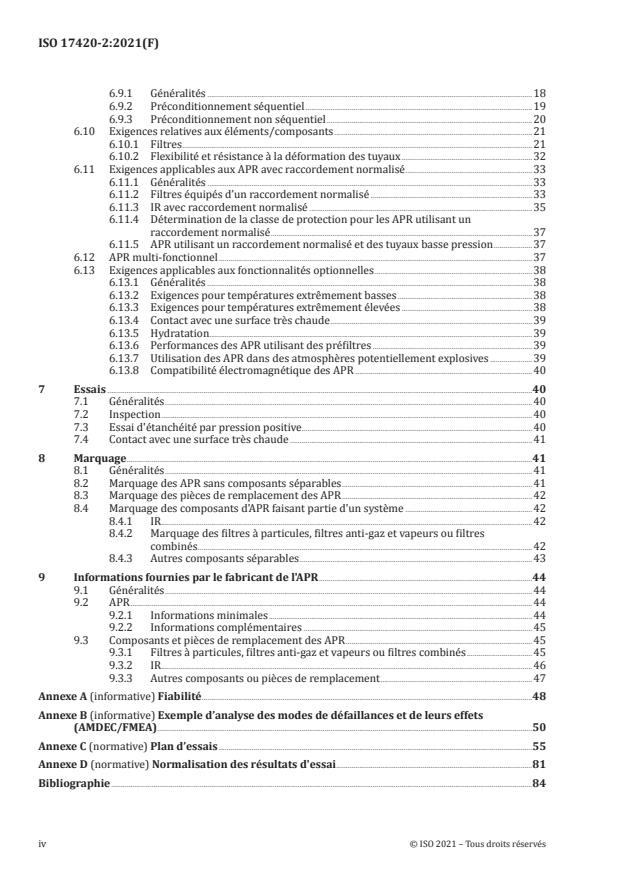
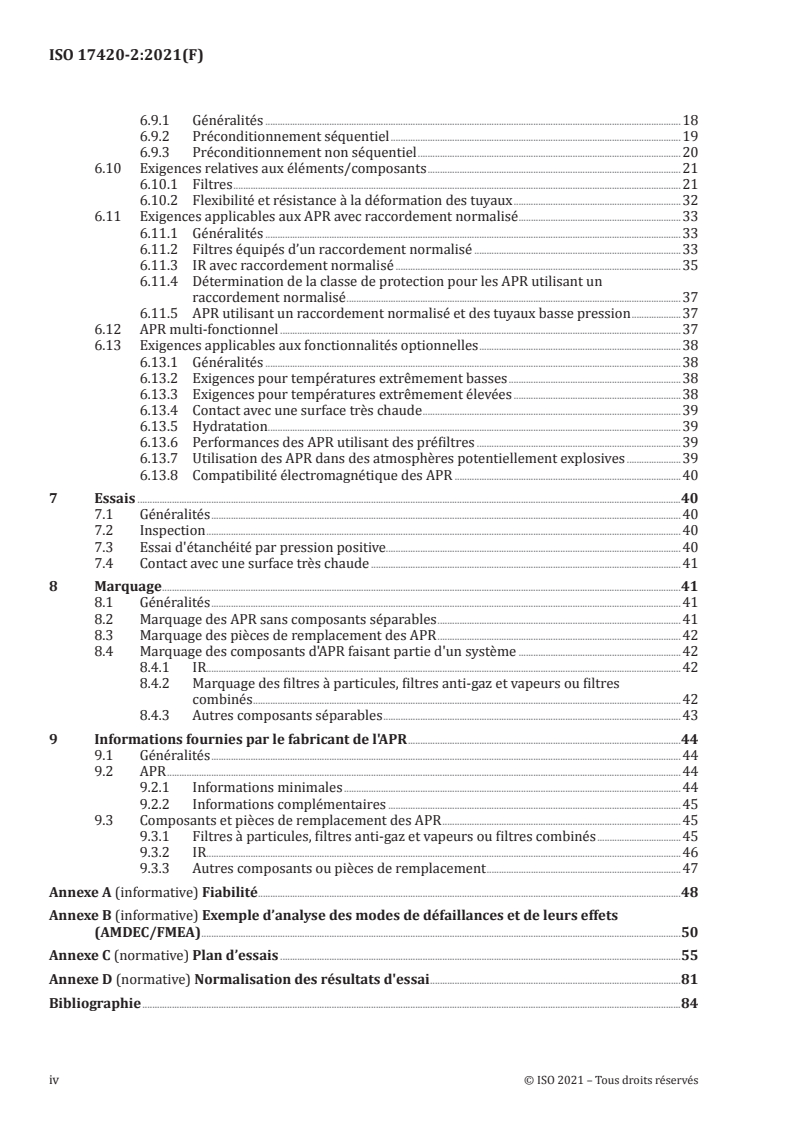
Sommaire Page
Avant-propos .v
Introduction .vi
1 Domaine d'application . 1
2 Références normatives . 1
3 Termes, définitions, abréviations et symboles . 2
3.1 Termes et définitions . 2
3.2 Abréviations . 3
3.3 Symboles . 4
4 Présentation des classifications . 5
5 Exigences générales applicables aux APR . 6
5.1 Généralités . 6
5.2 Champ de vision . 6
5.3 Résistance à la flamme – Essai dynamique à un seul brûleur . 6
5.4 Compatibilité avec d’autres équipements . 6
5.5 Suivi des performances. 6
5.6 Avertisseur(s), dispositif(s) de vérification et dispositifs de commande . 6
5.6.1 Performances du/des avertisseur(s), le cas échéant . 6
5.6.2 Performances du dispositif de vérification . 7
5.6.3 Dispositifs de commande (le cas échéant) . 7
5.7 Détermination de la classe de protection . 7
5.7.1 Généralités . 7
5.7.2 Fuite totale vers l'intérieur (TIL) . 7
5.7.3 Exigences applicables aux essais de fuite totale vers l'intérieur pour
les APR n’utilisant pas de raccordement normalisé . 8
5.8 Validation par des performances pratiques . . 8
5.8.1 Généralités . 8
5.8.2 Mise en place/retrait . 8
5.8.3 Performance de communication — Ouïe et parole . 8
5.8.4 Irritation oculaire causée par l'APR . 8
5.8.5 Embuage de l'oculaire . 8
5.8.6 Exigences relatives à l'ergonomie . 8
5.9 Exigences relatives aux éléments/composants . 8
6 Exigences applicables aux APR filtrants . 9
6.1 Détermination du débit d'air des APR à ventilation assistée. 9
6.2 Détermination de l'effet de la température sur les débits des APR à ventilation assistée . 9
6.3 Travail respiratoire, résistance respiratoire (pics de pression) et élastance . 9
6.3.1 Travail respiratoire, résistance respiratoire (pics de pression) et élastance
dans le cas d’APR non assistés . 9
6.3.2 Travail respiratoire, résistance respiratoire (pics de pression) et élastance
dans le cas d’APR à ventilation assistée.10
6.4 Limites de concentration de CO .
2 12
6.4.1 Limites de concentration de CO pour APR à ventilation assistée .12
6.4.2 Limites de concentration de CO pour APR non assisté .13
6.4.3 Limites de concentration de CO pour IR utilisant un raccordement normalisé .13
6.5 Limite acoustique pour APR à ventilation assistée .13
6.6 Température et humidité de l'air inhalé pour APR protégeant du CO .14
6.7 Raccordements .14
6.7.1 Généralités .14
6.7.2 Résistance des raccordements – Raccordements aux IR .15
6.7.3 Raccordements basse pression autres que ceux des interfaces respiratoires.18
6.8 Évaluation de la fiabilité.18
6.9 Préconditionnement (séquentiel/non séquentiel).18
6.9.1 Généralités .18
6.9.2 Préconditionnement séquentiel .19
6.9.3 Préconditionnement non séquentiel .20
6.10 Exigences relatives aux éléments/composants .21
6.10.1 Filtres .21
6.10.2 Flexibilité et résistance à la déformation des tuyaux .32
6.11 Exigences applicables aux APR avec raccordement normalisé .33
6.11.1 Généralités .33
6.11.2 Filtres équipés d’un raccordement normalisé .33
6.11.3 IR avec raccordement normalisé .35
6.11.4 Détermination de la classe de protection pour les APR utilisant un
raccordement normalisé .37
6.11.5 APR utilisant un raccordement normalisé et des tuyaux basse pression .37
6.12 APR multi-fonctionnel .37
6.13 Exigences applicables aux fonctionnalités optionnelles .38
6.13.1 Généralités .38
6.13.2 Exigences pour températures extrêmement basses .38
6.13.3 Exigences pour températures extrêmement élevées .38
6.13.4 Contact avec une surface très chaude .39
6.13.5 Hydratation.39
6.13.6 Performances des APR utilisant des préfiltres .39
6.13.7 Utilisation des APR dans des atmosphères potentiellement explosives .39
6.13.8 Compatibilité électromagnétique des APR .40
7 Essais .40
7.1 Généralités .40
7.2 Inspection .40
7.3 Essai d'étanchéité par pression positive.40
7.4 Contact avec une surface très chaude .41
8 Marquage .41
8.1 Généralités .41
8.2 Marquage des APR sans composants séparables .41
8.3 Marquage des pièces de remplacement des APR .42
8.4 Marquage des composants d'APR faisant partie d'un système .42
8.4.1 IR . . .42
8.4.2 Marquage des filtres à particules, filtres anti-gaz et vapeurs ou filtres
combinés .42
8.4.3 Autres composants séparables .43
9 Informations fournies par le fabricant de l'APR .44
9.1 Généralités .44
9.2 APR .44
9.2.1 Informations minimales .44
9.2.2 Informations complémentaires .45
9.3 Composants et pièces de remplacement des APR .45
9.3.1 Filtres à particules, filtres anti-gaz et vapeurs ou filtres combinés .45
9.3.2 IR . . .46
9.3.3 Autres composants ou pièces de remplacement .47
Annexe A (informative) Fiabilité .48
Annexe B (informative) Exemple d’analyse des modes de défaillances et de leurs effets
(AMDEC/FMEA) .50
Annexe C (normative) Plan d’essais .55
Annexe D (normative) Normalisation des résultats d'essai .81
Bibliographie .84
iv © ISO 2021 – Tous droits réservés
Avant-propos
L'ISO (Organisation internationale de normalisation) est une fédération mondiale d'organismes
nationaux de normalisation (comités membres de l'ISO). L'élaboration des Normes internationales est
en général confiée aux comités techniques de l'ISO. Chaque comité membre intéressé par une étude
a le droit de faire partie du comité technique créé à cet effet. Les organisations internationales,
gouvernementales et non gouvernementales, en liaison avec l'ISO participent également aux travaux.
L'ISO collabore étroitement avec la Commission électrotechnique internationale (IEC) en ce qui
concerne la normalisation électrotechnique.
Les procédures utilisées pour élaborer le présent document et celles destinées à sa mise à jour sont
décrites dans les Directives ISO/IEC, Partie 1. Il convient, en particulier, de prendre note des différents
critères d'approbation requis pour les différents types de documents ISO. Le présent document a été
rédigé conformément aux règles de rédaction données dans les Directives ISO/IEC, Partie 2 (voir www
.iso .org/ directives).
L'attention est attirée sur le fait que certains des éléments du présent document peuvent faire l'objet de
droits de propriété intellectuelle ou de droits analogues. L'ISO ne saurait être tenue pour responsable
de ne pas avoir identifié de tels droits de propriété et averti de leur existence. Les détails concernant
les références aux droits de propriété intellectuelle ou autres droits analogues identifiés lors de
l'élaboration du document sont indiqués dans l'Introduction et/ou dans la liste des déclarations de
brevets reçues par l'ISO (voir www .iso .org/ brevets).
Les appellations commerciales éventuellement mentionnées dans le présent document sont données
pour information, par souci de commodité, à l'intention des utilisateurs et ne sauraient constituer un
engagement.
Pour une explication de la nature volontaire des normes, la signification des termes et expressions
spécifiques de l'ISO liés à l'évaluation de la conformité, ou pour toute information au sujet de l'adhésion
de l'ISO aux principes de l'Organisation mondiale du commerce (OMC) concernant les obstacles
techniques au commerce (OTC), voir le lien suivant: www .iso .org/ iso/ fr/ avant -propos . ht m l .
Le présent document a été élaboré par le comité technique ISO/TC 94, Sécurité individuelle — Équipement
de protection individuelle, sous-comité SC 15, Appareils de protection respiratoire.
Une liste de toutes les parties de la série ISO 17420 se trouve sur le site web de l'ISO.
Il convient que l'utilisateur adresse tout retour d'information ou toute question concernant le présent
document à l'organisme national de normalisation de son pays. Une liste exhaustive desdits organismes
se trouve à l'adresse www .iso .org/ fr/ members .html.
Introduction
Le présent document décrit les exigences de base relatives aux appareils de protection respiratoire
(APR) filtrants ainsi qu'à leurs éléments et composants.
Les exigences relatives aux APR utilisés dans des environnements pour applications particulières sont
spécifiées dans les parties concernées de la série ISO 17420.
Certaines méthodes d'essai sont décrites. Pour les autres méthodes d'essai, il est fait référence à la série
ISO 16900, «Méthodes d'essai et équipement d'essai», ou à d'autres méthodes d'essai non élaborées par
l'ISO/TC 94/SC 15.
L'Annexe A donne des informations sur la fiabilité.
L'Annexe B présente un exemple d'AMDEC (Analyse des modes de défaillance et de leurs effets).
L'Annexe C précise les plans des essais, y compris les éventuels préconditionnements et le nombre
d'échantillons.
L'Annexe D fournit des informations pour la normalisation des résultats d'essais.
Les séquences d'essais ont pour principe de minimiser le nombre d'échantillons nécessaires en
prévoyant des essais destructifs à la fin. Pour des raisons de sécurité, il est également prévu que les
essais faisant intervenir des sujets d'essai ne soient effectués qu'après que les échantillons d'essai ont
prouvé la sécurité de leur fonctionnement, lors d'autres essais.
vi © ISO 2021 – Tous droits réservés
NORME INTERNATIONALE ISO 17420-2:2021(F)
Appareils de protection respiratoire — Exigences de
performances —
Partie 2:
Dispositifs de filtration
1 Domaine d'application
Le présent document spécifie les exigences concernant les performances et le contrôle des appareils de
protection respiratoire (APR) filtrants en fonction de leur classification et leur utilisation sur le lieu de
travail afin de protéger le porteur des atmosphères et/ou environnements dangereux.
Les exigences relatives aux éléments et aux composants des APR sont également spécifiées dans le
présent document.
2 Références normatives
Les documents ci-après, dans leur intégralité ou non, sont des références normatives indispensables à
l'application du présent document. Pour les références datées, seule l'édition citée s'applique. Pour les
références non datées, la dernière édition du document de référence s'applique (y compris les éventuels
amendements).
ISO 9227, Essais de corrosion en atmosphères artificielles — Essais aux brouillards salins
ISO 16900-1:2019, Appareils de protection respiratoire — Méthodes d'essai et équipement d'essai — Partie
1: Détermination des fuites vers l'intérieur
ISO 16900-2, Appareils de protection respiratoire — Méthodes d'essai et équipement d'essai — Partie 2:
Détermination de la résistance respiratoire
ISO 16900-3, Appareils de protection respiratoire — Méthodes d'essai et équipement d'essai — Partie 3:
Détermination de la pénétration d'un filtre à particules
ISO 16900-4:2011, Appareils de protection respiratoire — Méthodes d'essai et équipement d'essai — Partie
4: Détermination de la capacité d'un filtre à gaz et essais de migration, de désorption et dynamique au
monoxyde de carbone
ISO 16900-5, Appareils de protection respiratoire — Méthodes d'essai et équipement d'essai — Partie 5:
Machine respiratoire, simulateur métabolique, têtes factices et torses APR, outils et outils de vérification
1)
ISO 16900-6:— , Appareils de protection respiratoire — Méthodes d’essai et équipement d’essai —
Partie 6: Résistance mécanique — Résistance des composants
ISO 16900-7:2020, Appareils de protection respiratoire — Méthodes d'essai et équipement d'essai — Partie
7: Essai de performance pratique
ISO 16900-8, Appareils de protection respiratoire — Méthodes d'essai et équipement d'essai — Partie 8:
Mesurage des débit d'air des APR filtrants à ventilation assistée
ISO 16900-9, Appareils de protection respiratoire — Méthodes d'essai et équipement d'essai — Partie 9:
Détermination de la teneur en dioxyde de carbone du gaz inhalé
1) En cours d'élaboration. Stade au moment de la publication ISO/DIS 16900-6:2020.
ISO 16900-12, Appareils de protection respiratoire — Méthodes d'essai et équipement d'essai — Partie
12: Détermination du travail respiratoire en fonction du volume respiratoire et détermination des pics de
pressions respiratoires
ISO 16900-14:2020, Appareils de protection respiratoire — Méthodes d'essai et équipement d'essai —
Partie 14: Mesurage du niveau de pression acoustique
ISO 16972, Appareils de protection respiratoire — Vocabulaire et symboles graphiques
ISO/TS 16973, Appareils de protection respiratoire — Classification pour les APR, à l'exclusion des APR
pour application sous-marine
ISO 17420-1:2021, Appareils de protection respiratoire — Exigences de performances — Partie 1: Généralités
ISO 17420-3, Appareils de protection respiratoire — Exigences de performances — Partie 3: Raccord
normalisé
IEC 61000-6-2, Compatibilité électromagnétique (CEM) — Partie 6-2: Normes génériques — Immunité
pour les environnements industriels
3 Termes, définitions, abréviations et symboles
3.1 Termes et définitions
Pour les besoins du présent document, les termes et définitions donnés dans l'ISO 16972 ainsi que les
suivants s'appliquent.
L’ISO et l’IEC tiennent à jour des bases de données terminologiques destinées à être utilisées en
normalisation, consultables aux adresses suivantes:
— ISO Online browsing platform: disponible à l'adresse https:// www .iso .org/ obp
— IEC Electropedia: disponible à l'adresse http:// www .electropedia .org/
3.1.1
état non préconditionné
sans préconditionnement, mais éventuellement modifié pour effectuer des essais ou déjà utilisé dans
des essais non destructifs
Note 1 à l'article: Cela inclut, par exemple, le nettoyage et la désinfection.
3.1.2
tel que porté (état)
APR où tous les composants sont connectés et assemblés de la manière dont ils sont destinés à être
utilisés et portés (par exemple, porté par l'utilisateur, adapté à une tête factice pour APR ou à un
ensemble tête factice-torse pour APR, ou encore, à un support approprié)
Note 1 à l'article: Tous les différents composants [par exemple, pour un appareil filtrant à ventilation assistée:
ventilateur, batterie, interface respiratoire (IR), filtres, etc.] sont entièrement assemblés, puis raccordés (IR
raccordée au tuyau du ventilateur) selon les informations fournies par le fabricant.
3.1.3
prêt à l’assemblage (état)
APR ou composants équipés de joints, obturateurs ou autres moyens de protection contre
l'environnement, déjà présents et prêts à être assemblés et/ou mis en place
Note 1 à l'article: Les APR ou les composants peuvent rester hermétiquement assemblés jusqu'à la mise en place,
si les informations fournies par le fabricant l’indiquent.
2 © ISO 2021 – Tous droits réservés
3.1.4
APR intégré
APR conçu de manière à ce que les composants de la chaîne d'alimentation en gaz respirable ne puissent
être séparés
3.1.5
débit maximal mesuré
débit-volume d'un APR filtrant à ventilation assistée, déterminé lors d'un essai en laboratoire, lorsque
l'APR est dans une condition aboutissant au débit d'air le plus élevé, cette condition tenant compte
de l'influence des températures, des réglages de l'APR, des préconditionnements, de l'utilisation
d'accessoires et de tout autre facteur connexe
[SOURCE: ISO 16900-8:2015, 3.6]
3.1.6
migration
diffusion des molécules de gaz ou de vapeur à l'intérieur du sorbant lorsque le filtre est partiellement
chargé
3.1.7
raccordement normalisé
dispositif permettant un raccord optionnel entre un filtre et une interface respiratoire
Note 1 à l'article: Raccord pour filtre répondant aux exigences de l'ISO 17420-3.
3.1.8
pièce de remplacement
identique à celle fournie à l'origine avec l'APR par le fabricant, et considérée comme interchangeable
par le fabricant
3.1.9
conditions normalisées
conditions d'essai ajustées à 1013 hPa et température corporelle (37 °C ou 310 K) sous air saturé de
vapeur d'eau, soit 63 hPa, utilisées pour la normalisation des résultats d'essai
Note 1 à l'article: Voir l'Annexe D pour plus d'informations.
3.2 Abréviations
AMDEC Analyse des modes de défaillance et de leurs effets (FMEA)
V Volume courant
T
WoB Travail respiratoire
BTPS Température et pression corporelles, saturé
3.3 Symboles
3.3.1
Informations relatives au produit, point d’information (ISO 7000-2760).
Indication signalant que l'IR fait partie d'un système d'APR à configurations multiples.
3.3.2
Manuel d’utilisation, notice d'utilisation (ISO 7000-1641).
Manuel: «Voir la notice d’information du fabricant de l'APR.»
3.3.3
Ne pas réutiliser (ISO 7000-1051).
«2» barré: «Utilisation limitée à un seul poste ou une seule journée de travail»
4 © ISO 2021 – Tous droits réservés
3.3.4
Utiliser avant la date indiquée (ISO 7000-2607).
Sablier: «Fin de durée de stockage»
Légende: aaaa = année, mm = mois
3.3.5
Rouleau, cylindre (ISO 7000-0566)
Cible: «Raccordement normalisé»
3.3.6
Affectation du numéro de tête factice pour APR servant à désigner la taille
4 Présentation des classifications
L'ISO 17420-1:2021, 4.1 s'applique, avec l'ajout suivant:
La classification d'un APR filtrant est déterminée par la combinaison appropriée des classes suivantes:
(classe de protection) (classe de rythme de travail) (classe d'IR) (classe de filtre à particules et/ou type
et classe de filtre anti-gaz).
Les APR filtrants peuvent également être classés pour une ou plusieurs applications particulières,
comme indiqué dans les normes ISO 17420-5 à ISO 17420-9.
Tableau 1 — Type et classe de filtres anti-gaz
Type Classe(s) Description du type
OV 1, 2, 3 ou 4 Vapeurs organiques
Gaz organiques (bas point d'ébullition,
OG 1
c'est-à-dire inférieur à 65 °C)
AC 1, 2, 3 ou 4 Composés acides
BC 1, 2, 3 ou 4 Composés basiques
NO 1, 2 ou 3 Oxydes d'azote
x
HG 1, 2 ou 3 Mercure (Hg)
OZ 1 Ozone (O )
Tableau 1 (suite)
Type Classe(s) Description du type
HCN 1, 2, 3 ou 4 Acide cyanhydrique (HCN)
AH 1 Arsine (AsH )
HF 1, 2 ou 3 Fluorure d'hydrogène (HF)
CD 1 Dioxyde de chlore (ClO )
ETO 1, 2 ou 3 Oxyde d'éthylène ((CH ) O)
2 2
FM 1, 2 ou 3 Formaldéhyde (CH O)
MB 1, 2 ou 3 Bromure de méthyle (CH Br)
Trois classes en fonction du temps
CO Monoxyde de carbone (CO)
(20 min, 60 min ou 180 min)
PH 1 ou 2 Phosphine (PH )
La désignation d'un APR filtrant est déterminée par une combinaison appropriée des classes indiquées
dans le Tableau 1 de l’ISO 17420-1:2021 et le Tableau 1 du présent document.
Exemple pour un APR de base avec classe de protection (PC3), classe de rythme de travail (W2), classe
d’IR (bT), classe de filtre à particules (F3) et type et classe de filtre anti-gaz (OV2).
Marquage pour l'exemple donné PC3 W2 bT F3 OV2
Les APR filtrants multi-fonctionnels ont une classification distincte pour chaque fonction, à savoir une
classification pour le mode sans assistance et une classification pour le mode assisté.
5 Exigences générales applicables aux APR
5.1 Généralités
L’ISO 17420-1:2021, 5.1 s'applique.
5.2 Champ de vision
L’ISO 17420-1:2021, 5.2 s'applique.
5.3 Résistance à la flamme – Essai dynamique à un seul brûleur
L’ISO 17420-1:2021, 5.3 s'applique.
5.4 Compatibilité avec d’autres équipements
L’ISO 17420-1:2021, 5.4 s'applique.
5.5 Suivi des performances
L’ISO 17420-1:2021, 5.5 s'applique, avec l'ajout suivant:
Le système de suivi ne doit pas interférer avec le fonctionnement de l'APR.
5.6 Avertisseur(s), dispositif(s) de vérification et dispositifs de commande
5.6.1 Performances du/des avertisseur(s), le cas échéant
Après un préconditionnement séquentiel, l'APR doit être vérifié conformément à 6.9.2.
6 © ISO 2021 – Tous droits réservés
Les APR alimentés par une source d'énergie doivent être équipés d'un avertisseur de batterie faible,
afin que le porteur soit averti au moins 5 min à l’avance que le fonctionnement de l'APR va passer en
dessous des conditions minimales de conception prévues par le fabricant. À compter de l'activation
de l'avertissement, l'APR doit être soumis à essai conformément à 6.3.2 pendant une période de 5 min,
mais avec un réglage fixe de 35 l/min (voir Tableau 2).
Procéder aux vérifications nécessaires conformément à 7.2 et à l’Article 9.
Pour les APR filtrants à ventilation assistée, un avertisseur doit prévenir le porteur dès que les
performances de l'APR ne se situent plus dans la plage de valeurs de conception fixée par le fabricant.
L’essai doit être effectué conformément à 6.3.2 et, le cas échéant, conformément à l'ISO 16900-8.
Durant l'utilisation, les avertisseurs ne doivent pas s'éteindre automatiquement, ni pouvoir être éteints
par le porteur tant qu’il ne s’agit pas de remédier à la situation à l’origine de l'avertissement.
Procéder aux vérifications nécessaires conformément à 7.2.
Tout avertissement doit être détectable sans aucune intervention de la part du porteur. Tout
avertissement doit être détectable par le porteur dans les 15 s.
L'essai doit être effectué conformément à l'ISO 16900-7:2020, Annexe B activité k.
Tous les avertissements qui nécessitent des réactions différentes de la part du porteur doivent pouvoir
être différenciés les uns des autres.
Procéder aux vérifications nécessaires conformément à 7.2.
5.6.2 Performances du dispositif de vérification
L’ISO 17420-1:2021, 5.6.2 s'applique.
5.6.3 Dispositifs de commande (le cas échéant)
Les dispositifs de commande manuels installés sur un APR doivent être clairement identifiables et, s'il y
en a plusieurs, pouvoir être distingués les uns des autres par le porteur lors de l'utilisation.
S'il existe un dispositif de commande permettant de sélectionner différentes classes PC, il ne doit pas
être possible de changer la classe PC en cours d'utilisation sans en informer le porteur.
Les dispositifs de commande réglables doivent être soumis à essai conformément à 6.3.
L'essai doit être effectué conformément à l'ISO 16900-7.
5.7 Détermination de la classe de protection
5.7.1 Généralités
L’ISO 17420-1:2021, 5.7.1 s'applique.
5.7.2 Fuite totale vers l'intérieur (TIL)
L’ISO 17420-1:2021, 5.7.2 s'applique.
Les références suivantes s'appliquent en plus de celles données dans l'ISO 17420-1:2021, 5.7.
5.7.3 Exigences applicables aux essais de fuite totale vers l'intérieur pour les APR n’utilisant
pas de raccordement normalisé
Les APR, à l'exception des IR de classe aT, doivent être soumis à un essai de fuite totale vers l'intérieur,
conformément à l'ISO 17420-1:2021, 5.7.2.
NOTE 1 Pour les IR utilisant un raccordement normalisé, voir 6.11.3.3.
NOTE 2 Pour les IR de classe a, voir l’ISO 17420-1:2021, 5.7.2.
5.8 Validation par des performances pratiques
5.8.1 Généralités
L'ISO 17420-1:2021, 5.8.1 et les dispositions suivantes s'appliquent:
Après un préconditionnement séquentiel conforme à 6.9.2, deux APR doivent être soumis à des essais
de performance pratique.
Préalablement aux essais de performance pratique, le fonctionnement des APR doit avoir, au moins,
satisfait aux essais des paragraphes suivants:
— 6.3 [travail respiratoire, résistance respiratoire (pics de pression) et élastance];
— 6.4 (concentration de CO );
— ISO 17420-1:2021, 5.9.1 (IR);
— 6.5 (limite acoustique pour APR à ventilation assistée);
— 6.7 (raccordements);
— 5.6 (avertisseur(s) et dispositif(s) de vérification).
5.8.2 Mise en place/retrait
L’ISO 17420-1:2021, 5.8.2 s'applique.
5.8.3 Performance de communication — Ouïe et parole
L’ISO 17420-1:2021, 5.8.3 s'applique.
5.8.4 Irritation oculaire causée par l'APR
L’ISO 17420-1:2021, 5.8.4 s'applique.
5.8.5 Embuage de l'oculaire
L’ISO 17420-1:2021, 5.8.5 s'applique.
5.8.6 Exigences relatives à l'ergonomie
L’ISO 17420-1:2021, 5.8.6 s'applique.
5.9 Exigences relatives aux éléments/composants
L’ISO 17420-1:2021, 5.9 s'applique.
8 © ISO 2021 – Tous droits réservés
6 Exigences applicables aux APR filtrants
6.1 Détermination du débit d'air des APR à ventilation assistée
Dans le cas des APR à ventilation assistée, le débit d'air doit être déterminé dans les conditions
aboutissant au débit minimal et au débit maximal de l'APR.
Suivant la conception de l'APR, ces débits d’air peuvent être influencés par:
— les réglages possibles du débit de l'APR;
— la durée d’utilisation;
— l’état de charge de la batterie;
— les différents types de filtre;
— les réglages des alarmes;
— la température de l'APR, y compris la plage de température d'utilisation;
— l’utilisation d’accessoires;
— la longueur du tuyau souple; et
— d’autres facteurs, le cas échéant.
— L'essai doit être effectué conformément à l'ISO 16900-8.
6.2 Détermination de l'effet de la température sur les débits des APR à ventilation
assistée
Pour déterminer l'influence de la température, les débits des APR doivent être vérifiés après chacune
des étapes suivantes:
a) équilibrage pendant un minimum de 4 h à 35 °C et à une humidité relative de (50 ± 20) %; et
−2
+2
b) équilibrage pendant un minimum de 4 h à −5 °C.
L'essai doit débuter dans les 3 min qui suivent chaque équilibrage, dans les conditions ambiantes du
laboratoire.
Compte tenu des facteurs d'influence énumérés en 6.1, le débit minimal et le débit maximal mesurés
doivent être déterminés conformément à l'ISO 16900-8.
6.3 Travail respiratoire, résistance respiratoire (pics de pression) et élastance
6.3.1 Travail respiratoire, résistance respiratoire (pics de pression) et élastance dans le cas
d’APR non assistés
Pour les filtres avec raccordements normalisés, voir 6.11.2.1.
Pour les IR avec raccordements normalisés, voir 6.11.3.2.
Les APR doivent être soumis à essai pour chaque taille d'IR.
Le nombre de tête(s) factice(s) pour APR affectée(s) à l’IR à utiliser pour les essais est spécifié par le
fabricant.
Les APR intégrés ou les composants prêts à l'assemblage doivent être soumis à un préconditionnement
séquentiel conforme à 6.9.2.
Outre le préconditionnement séquentiel conforme à 6.9.2, un APR intégré prêt à être porté contenant de
l’électronique ou un ou plusieurs de ses composant(s) prêt(s) à l’assemblage contenant de l'électronique
doivent être exposés à un préconditionnement non séquentiel conforme à 6.9.3.2. L'APR doit satisfaire
aux exigences énoncées dans le Tableau 3 pour le travail respiratoire et la résistance respiratoire,
lorsqu'il est soumis à essai selon les réglages de la machine respiratoire pour les différents rythmes de
travail, tels qu’indiqués dans le Tableau 2.
La température de fonctionnement des APR non assistés est couverte par le préconditionnement
conformément à 6.9.2.2, car pour ces types d'APR, les essais aux extrêmes ne donnent pas plus
d'informations.
Le travail respiratoire, la résistance respiratoire (pics de pression) et l’élastance doivent être calculés à
partir de la boucle pression-volume moyenne basée sur 10 cycles respiratoires consécutifs et ne doivent
pas dépasser les limites indiquées dans le Tableau 3.
Les réglages de la machine respiratoire sont indiqués dans le Tableau 2, pour chaque rythme de travail.
Tableau 2 — Réglages de la machine respiratoire en fonction des rythmes de travail pour
des APR à ventilation assistée et des APR non assistés
Débit
Fréquence Volume courant
(dynamique sinusoïdal)
Rythme de travail
l/min à BTPS cycles/min l à BTPS
Repos 10 avec une tolérance de ± 3 % 10,0 1,0
W1 35 avec une tolérance de ± 2 % 23,3 1,5
W2 65 avec une tolérance de ± 2 % 32,5 2,0
W3 105 avec une tolérance de ± 2 % 42,0 2,5
W4 135 avec une tolérance de ± 1 % 45,0 3,0
L'essai doit être effectué conformément à l'ISO 16900-5 et l'ISO 16900-12.
Les volumes courants sont exprimés en conditions BTPS. Afin de pouvoir comparer les performances
des différents APR, les résultats obtenus dans des conditions de laboratoire doivent être normalisés à
la température corporelle (37 °C) et à la pression normalisée (1 013 hPa), conformément à l'Annexe D.
Un exemple de calcul de normalisation pour les résultats concernant le travail respiratoire est donné
en D.2.1.
6.3.2 Travail respiratoire, résistance respiratoire (pics de pression) et élastance dans le cas
d’APR à ventilation assistée
Les APR intégrés ou les composants prêts à l'assemblage doivent être préconditionnés conformément
à 6.9.2.
Outre le préconditionnement séquentiel conforme à 6.9.2, un APR intégré ou un ou plusieurs de ses
composants prêt(s) à l'assemblage doivent être, le cas échéant, préconditionnés conformément à 6.9.3.2
(brouillard salin), avant qu’il ne soit procédé aux essais de validation.
L'APR doit être réglé sur les débits minimal et maximal mesurés, tels que déterminés conformément à 6.2.
L'APR doit être soumis à essai conformément au programme d'essai correspondant à sa classe de rythme
de travail, tel que défini par le fabricant, et satisfaire aux exigences applicables au travail respiratoire, à
la résistance respiratoire et à l’élastance pour chaque débit, comme indiqué dans le Tableau 3.
Le travail respiratoire et la résistance respiratoire (pics de pression) d’un APR doivent être mesurés
à chaque étape du programme de performance pour la classe de rythme de travail désignée, telle que
10 © ISO 2021 – Tous droits réservés
définie dans le Tableau 3. Les mesures doivent débuter après la stabilisation de chaque étape dans les
programmes d’essai W1 à W4.
La période de transition entre un rythme de travail et le rythme de travail suivant ne doit pas excéder
une minute, ce qui comprend la stabilisation, alors que l'APR demeure en mode opérationnel.
Le travail respiratoire, la résistance respiratoire et l’élastance doivent être calculés à partir de la boucle
pression-volume moyenne basée sur dix respirations consécutives et ne doivent pas dépasser les limites
indiquées dans le Tableau 3.
Programme d'essai correspondant à W1:
a) 35 l/min pendant 5 min;
b) 10 l/min pendant 5 min;
c) 35 l/min pendant 5 min.
Programme d'essai correspondant à W2:
a) 35 l/min pendant 5 min;
b) 65 l/min pendant 5 min;
c) 10 l/min pendant 5 min;
d) 35 l/min pendant 5 min.
Programme d'essai correspondant à W3:
a) 35 l/min pendant 4 min;
b) 65 l/min pendant 3 min;
c) 105 l/min pendant 3 min;
d) 10 l/min pendant 5 min;
e) 35 l/min pendant 5 min.
Programme d'essai correspondant à W4:
a) 35 l/min pendant 2 min;
b) 105 l/min pendant 3 min;
c) 65 l/min pendant 2 min;
d) 135 l/min pendant 3 min;
e) 10 l/min pendant 5 min;
f) 35 l/min pendant 5 min.
Le point de terminaison de l'essai doit intervenir après un cycle complet du programme d'essai
applicable. Chaque programme d'essai doit être exécuté avec un APR réglé sur les débits maximal et
minimal mesurés, tels que déterminés par l'ISO 16900-8.
Tableau 3 — Limites de travail respiratoire, résistance respiratoire (pics de pression) et
élastance pour APR à ventilation ass
...
NORME ISO
INTERNATIONALE 17420-2
Première édition
2021-01
Appareils de protection
respiratoire — Exigences de
performances —
Partie 2:
Dispositifs de filtration
Respiratory protective devices — Performance requirements —
Part 2: Requirements for filtering RPD
Numéro de référence
©
ISO 2021
DOCUMENT PROTÉGÉ PAR COPYRIGHT
© ISO 2021
Tous droits réservés. Sauf prescription différente ou nécessité dans le contexte de sa mise en œuvre, aucune partie de cette
publication ne peut être reproduite ni utilisée sous quelque forme que ce soit et par aucun procédé, électronique ou mécanique,
y compris la photocopie, ou la diffusion sur l’internet ou sur un intranet, sans autorisation écrite préalable. Une autorisation peut
être demandée à l’ISO à l’adresse ci-après ou au comité membre de l’ISO dans le pays du demandeur.
ISO copyright office
Case postale 401 • Ch. de Blandonnet 8
CH-1214 Vernier, Genève
Tél.: +41 22 749 01 11
E-mail: copyright@iso.org
Web: www.iso.org
Publié en Suisse
ii © ISO 2021 – Tous droits réservés
Sommaire Page
Avant-propos .v
Introduction .vi
1 Domaine d'application . 1
2 Références normatives . 1
3 Termes, définitions, abréviations et symboles . 2
3.1 Termes et définitions . 2
3.2 Abréviations . 3
3.3 Symboles . 4
4 Présentation des classifications . 5
5 Exigences générales applicables aux APR . 6
5.1 Généralités . 6
5.2 Champ de vision . 6
5.3 Résistance à la flamme – Essai dynamique à un seul brûleur . 6
5.4 Compatibilité avec d’autres équipements . 6
5.5 Suivi des performances. 6
5.6 Avertisseur(s), dispositif(s) de vérification et dispositifs de commande . 6
5.6.1 Performances du/des avertisseur(s), le cas échéant . 6
5.6.2 Performances du dispositif de vérification . 7
5.6.3 Dispositifs de commande (le cas échéant) . 7
5.7 Détermination de la classe de protection . 7
5.7.1 Généralités . 7
5.7.2 Fuite totale vers l'intérieur (TIL) . 7
5.7.3 Exigences applicables aux essais de fuite totale vers l'intérieur pour
les APR n’utilisant pas de raccordement normalisé . 8
5.8 Validation par des performances pratiques . . 8
5.8.1 Généralités . 8
5.8.2 Mise en place/retrait . 8
5.8.3 Performance de communication — Ouïe et parole . 8
5.8.4 Irritation oculaire causée par l'APR . 8
5.8.5 Embuage de l'oculaire . 8
5.8.6 Exigences relatives à l'ergonomie . 8
5.9 Exigences relatives aux éléments/composants . 8
6 Exigences applicables aux APR filtrants . 9
6.1 Détermination du débit d'air des APR à ventilation assistée. 9
6.2 Détermination de l'effet de la température sur les débits des APR à ventilation assistée . 9
6.3 Travail respiratoire, résistance respiratoire (pics de pression) et élastance . 9
6.3.1 Travail respiratoire, résistance respiratoire (pics de pression) et élastance
dans le cas d’APR non assistés . 9
6.3.2 Travail respiratoire, résistance respiratoire (pics de pression) et élastance
dans le cas d’APR à ventilation assistée.10
6.4 Limites de concentration de CO .
2 12
6.4.1 Limites de concentration de CO pour APR à ventilation assistée .12
6.4.2 Limites de concentration de CO pour APR non assisté .13
6.4.3 Limites de concentration de CO pour IR utilisant un raccordement normalisé .13
6.5 Limite acoustique pour APR à ventilation assistée .13
6.6 Température et humidité de l'air inhalé pour APR protégeant du CO .14
6.7 Raccordements .14
6.7.1 Généralités .14
6.7.2 Résistance des raccordements – Raccordements aux IR .15
6.7.3 Raccordements basse pression autres que ceux des interfaces respiratoires.18
6.8 Évaluation de la fiabilité.18
6.9 Préconditionnement (séquentiel/non séquentiel).18
6.9.1 Généralités .18
6.9.2 Préconditionnement séquentiel .19
6.9.3 Préconditionnement non séquentiel .20
6.10 Exigences relatives aux éléments/composants .21
6.10.1 Filtres .21
6.10.2 Flexibilité et résistance à la déformation des tuyaux .32
6.11 Exigences applicables aux APR avec raccordement normalisé .33
6.11.1 Généralités .33
6.11.2 Filtres équipés d’un raccordement normalisé .33
6.11.3 IR avec raccordement normalisé .35
6.11.4 Détermination de la classe de protection pour les APR utilisant un
raccordement normalisé .37
6.11.5 APR utilisant un raccordement normalisé et des tuyaux basse pression .37
6.12 APR multi-fonctionnel .37
6.13 Exigences applicables aux fonctionnalités optionnelles .38
6.13.1 Généralités .38
6.13.2 Exigences pour températures extrêmement basses .38
6.13.3 Exigences pour températures extrêmement élevées .38
6.13.4 Contact avec une surface très chaude .39
6.13.5 Hydratation.39
6.13.6 Performances des APR utilisant des préfiltres .39
6.13.7 Utilisation des APR dans des atmosphères potentiellement explosives .39
6.13.8 Compatibilité électromagnétique des APR .40
7 Essais .40
7.1 Généralités .40
7.2 Inspection .40
7.3 Essai d'étanchéité par pression positive.40
7.4 Contact avec une surface très chaude .41
8 Marquage .41
8.1 Généralités .41
8.2 Marquage des APR sans composants séparables .41
8.3 Marquage des pièces de remplacement des APR .42
8.4 Marquage des composants d'APR faisant partie d'un système .42
8.4.1 IR . . .42
8.4.2 Marquage des filtres à particules, filtres anti-gaz et vapeurs ou filtres
combinés .42
8.4.3 Autres composants séparables .43
9 Informations fournies par le fabricant de l'APR .44
9.1 Généralités .44
9.2 APR .44
9.2.1 Informations minimales .44
9.2.2 Informations complémentaires .45
9.3 Composants et pièces de remplacement des APR .45
9.3.1 Filtres à particules, filtres anti-gaz et vapeurs ou filtres combinés .45
9.3.2 IR . . .46
9.3.3 Autres composants ou pièces de remplacement .47
Annexe A (informative) Fiabilité .48
Annexe B (informative) Exemple d’analyse des modes de défaillances et de leurs effets
(AMDEC/FMEA) .50
Annexe C (normative) Plan d’essais .55
Annexe D (normative) Normalisation des résultats d'essai .81
Bibliographie .84
iv © ISO 2021 – Tous droits réservés
Avant-propos
L'ISO (Organisation internationale de normalisation) est une fédération mondiale d'organismes
nationaux de normalisation (comités membres de l'ISO). L'élaboration des Normes internationales est
en général confiée aux comités techniques de l'ISO. Chaque comité membre intéressé par une étude
a le droit de faire partie du comité technique créé à cet effet. Les organisations internationales,
gouvernementales et non gouvernementales, en liaison avec l'ISO participent également aux travaux.
L'ISO collabore étroitement avec la Commission électrotechnique internationale (IEC) en ce qui
concerne la normalisation électrotechnique.
Les procédures utilisées pour élaborer le présent document et celles destinées à sa mise à jour sont
décrites dans les Directives ISO/IEC, Partie 1. Il convient, en particulier, de prendre note des différents
critères d'approbation requis pour les différents types de documents ISO. Le présent document a été
rédigé conformément aux règles de rédaction données dans les Directives ISO/IEC, Partie 2 (voir www
.iso .org/ directives).
L'attention est attirée sur le fait que certains des éléments du présent document peuvent faire l'objet de
droits de propriété intellectuelle ou de droits analogues. L'ISO ne saurait être tenue pour responsable
de ne pas avoir identifié de tels droits de propriété et averti de leur existence. Les détails concernant
les références aux droits de propriété intellectuelle ou autres droits analogues identifiés lors de
l'élaboration du document sont indiqués dans l'Introduction et/ou dans la liste des déclarations de
brevets reçues par l'ISO (voir www .iso .org/ brevets).
Les appellations commerciales éventuellement mentionnées dans le présent document sont données
pour information, par souci de commodité, à l'intention des utilisateurs et ne sauraient constituer un
engagement.
Pour une explication de la nature volontaire des normes, la signification des termes et expressions
spécifiques de l'ISO liés à l'évaluation de la conformité, ou pour toute information au sujet de l'adhésion
de l'ISO aux principes de l'Organisation mondiale du commerce (OMC) concernant les obstacles
techniques au commerce (OTC), voir le lien suivant: www .iso .org/ iso/ fr/ avant -propos . ht m l .
Le présent document a été élaboré par le comité technique ISO/TC 94, Sécurité individuelle — Équipement
de protection individuelle, sous-comité SC 15, Appareils de protection respiratoire.
Une liste de toutes les parties de la série ISO 17420 se trouve sur le site web de l'ISO.
Il convient que l'utilisateur adresse tout retour d'information ou toute question concernant le présent
document à l'organisme national de normalisation de son pays. Une liste exhaustive desdits organismes
se trouve à l'adresse www .iso .org/ fr/ members .html.
Introduction
Le présent document décrit les exigences de base relatives aux appareils de protection respiratoire
(APR) filtrants ainsi qu'à leurs éléments et composants.
Les exigences relatives aux APR utilisés dans des environnements pour applications particulières sont
spécifiées dans les parties concernées de la série ISO 17420.
Certaines méthodes d'essai sont décrites. Pour les autres méthodes d'essai, il est fait référence à la série
ISO 16900, «Méthodes d'essai et équipement d'essai», ou à d'autres méthodes d'essai non élaborées par
l'ISO/TC 94/SC 15.
L'Annexe A donne des informations sur la fiabilité.
L'Annexe B présente un exemple d'AMDEC (Analyse des modes de défaillance et de leurs effets).
L'Annexe C précise les plans des essais, y compris les éventuels préconditionnements et le nombre
d'échantillons.
L'Annexe D fournit des informations pour la normalisation des résultats d'essais.
Les séquences d'essais ont pour principe de minimiser le nombre d'échantillons nécessaires en
prévoyant des essais destructifs à la fin. Pour des raisons de sécurité, il est également prévu que les
essais faisant intervenir des sujets d'essai ne soient effectués qu'après que les échantillons d'essai ont
prouvé la sécurité de leur fonctionnement, lors d'autres essais.
vi © ISO 2021 – Tous droits réservés
NORME INTERNATIONALE ISO 17420-2:2021(F)
Appareils de protection respiratoire — Exigences de
performances —
Partie 2:
Dispositifs de filtration
1 Domaine d'application
Le présent document spécifie les exigences concernant les performances et le contrôle des appareils de
protection respiratoire (APR) filtrants en fonction de leur classification et leur utilisation sur le lieu de
travail afin de protéger le porteur des atmosphères et/ou environnements dangereux.
Les exigences relatives aux éléments et aux composants des APR sont également spécifiées dans le
présent document.
2 Références normatives
Les documents ci-après, dans leur intégralité ou non, sont des références normatives indispensables à
l'application du présent document. Pour les références datées, seule l'édition citée s'applique. Pour les
références non datées, la dernière édition du document de référence s'applique (y compris les éventuels
amendements).
ISO 9227, Essais de corrosion en atmosphères artificielles — Essais aux brouillards salins
ISO 16900-1:2019, Appareils de protection respiratoire — Méthodes d'essai et équipement d'essai — Partie
1: Détermination des fuites vers l'intérieur
ISO 16900-2, Appareils de protection respiratoire — Méthodes d'essai et équipement d'essai — Partie 2:
Détermination de la résistance respiratoire
ISO 16900-3, Appareils de protection respiratoire — Méthodes d'essai et équipement d'essai — Partie 3:
Détermination de la pénétration d'un filtre à particules
ISO 16900-4:2011, Appareils de protection respiratoire — Méthodes d'essai et équipement d'essai — Partie
4: Détermination de la capacité d'un filtre à gaz et essais de migration, de désorption et dynamique au
monoxyde de carbone
ISO 16900-5, Appareils de protection respiratoire — Méthodes d'essai et équipement d'essai — Partie 5:
Machine respiratoire, simulateur métabolique, têtes factices et torses APR, outils et outils de vérification
1)
ISO 16900-6:— , Appareils de protection respiratoire — Méthodes d’essai et équipement d’essai —
Partie 6: Résistance mécanique — Résistance des composants
ISO 16900-7:2020, Appareils de protection respiratoire — Méthodes d'essai et équipement d'essai — Partie
7: Essai de performance pratique
ISO 16900-8, Appareils de protection respiratoire — Méthodes d'essai et équipement d'essai — Partie 8:
Mesurage des débit d'air des APR filtrants à ventilation assistée
ISO 16900-9, Appareils de protection respiratoire — Méthodes d'essai et équipement d'essai — Partie 9:
Détermination de la teneur en dioxyde de carbone du gaz inhalé
1) En cours d'élaboration. Stade au moment de la publication ISO/DIS 16900-6:2020.
ISO 16900-12, Appareils de protection respiratoire — Méthodes d'essai et équipement d'essai — Partie
12: Détermination du travail respiratoire en fonction du volume respiratoire et détermination des pics de
pressions respiratoires
ISO 16900-14:2020, Appareils de protection respiratoire — Méthodes d'essai et équipement d'essai —
Partie 14: Mesurage du niveau de pression acoustique
ISO 16972, Appareils de protection respiratoire — Vocabulaire et symboles graphiques
ISO/TS 16973, Appareils de protection respiratoire — Classification pour les APR, à l'exclusion des APR
pour application sous-marine
ISO 17420-1:2021, Appareils de protection respiratoire — Exigences de performances — Partie 1: Généralités
ISO 17420-3, Appareils de protection respiratoire — Exigences de performances — Partie 3: Raccord
normalisé
IEC 61000-6-2, Compatibilité électromagnétique (CEM) — Partie 6-2: Normes génériques — Immunité
pour les environnements industriels
3 Termes, définitions, abréviations et symboles
3.1 Termes et définitions
Pour les besoins du présent document, les termes et définitions donnés dans l'ISO 16972 ainsi que les
suivants s'appliquent.
L’ISO et l’IEC tiennent à jour des bases de données terminologiques destinées à être utilisées en
normalisation, consultables aux adresses suivantes:
— ISO Online browsing platform: disponible à l'adresse https:// www .iso .org/ obp
— IEC Electropedia: disponible à l'adresse http:// www .electropedia .org/
3.1.1
état non préconditionné
sans préconditionnement, mais éventuellement modifié pour effectuer des essais ou déjà utilisé dans
des essais non destructifs
Note 1 à l'article: Cela inclut, par exemple, le nettoyage et la désinfection.
3.1.2
tel que porté (état)
APR où tous les composants sont connectés et assemblés de la manière dont ils sont destinés à être
utilisés et portés (par exemple, porté par l'utilisateur, adapté à une tête factice pour APR ou à un
ensemble tête factice-torse pour APR, ou encore, à un support approprié)
Note 1 à l'article: Tous les différents composants [par exemple, pour un appareil filtrant à ventilation assistée:
ventilateur, batterie, interface respiratoire (IR), filtres, etc.] sont entièrement assemblés, puis raccordés (IR
raccordée au tuyau du ventilateur) selon les informations fournies par le fabricant.
3.1.3
prêt à l’assemblage (état)
APR ou composants équipés de joints, obturateurs ou autres moyens de protection contre
l'environnement, déjà présents et prêts à être assemblés et/ou mis en place
Note 1 à l'article: Les APR ou les composants peuvent rester hermétiquement assemblés jusqu'à la mise en place,
si les informations fournies par le fabricant l’indiquent.
2 © ISO 2021 – Tous droits réservés
3.1.4
APR intégré
APR conçu de manière à ce que les composants de la chaîne d'alimentation en gaz respirable ne puissent
être séparés
3.1.5
débit maximal mesuré
débit-volume d'un APR filtrant à ventilation assistée, déterminé lors d'un essai en laboratoire, lorsque
l'APR est dans une condition aboutissant au débit d'air le plus élevé, cette condition tenant compte
de l'influence des températures, des réglages de l'APR, des préconditionnements, de l'utilisation
d'accessoires et de tout autre facteur connexe
[SOURCE: ISO 16900-8:2015, 3.6]
3.1.6
migration
diffusion des molécules de gaz ou de vapeur à l'intérieur du sorbant lorsque le filtre est partiellement
chargé
3.1.7
raccordement normalisé
dispositif permettant un raccord optionnel entre un filtre et une interface respiratoire
Note 1 à l'article: Raccord pour filtre répondant aux exigences de l'ISO 17420-3.
3.1.8
pièce de remplacement
identique à celle fournie à l'origine avec l'APR par le fabricant, et considérée comme interchangeable
par le fabricant
3.1.9
conditions normalisées
conditions d'essai ajustées à 1013 hPa et température corporelle (37 °C ou 310 K) sous air saturé de
vapeur d'eau, soit 63 hPa, utilisées pour la normalisation des résultats d'essai
Note 1 à l'article: Voir l'Annexe D pour plus d'informations.
3.2 Abréviations
AMDEC Analyse des modes de défaillance et de leurs effets (FMEA)
V Volume courant
T
WoB Travail respiratoire
BTPS Température et pression corporelles, saturé
3.3 Symboles
3.3.1
Informations relatives au produit, point d’information (ISO 7000-2760).
Indication signalant que l'IR fait partie d'un système d'APR à configurations multiples.
3.3.2
Manuel d’utilisation, notice d'utilisation (ISO 7000-1641).
Manuel: «Voir la notice d’information du fabricant de l'APR.»
3.3.3
Ne pas réutiliser (ISO 7000-1051).
«2» barré: «Utilisation limitée à un seul poste ou une seule journée de travail»
4 © ISO 2021 – Tous droits réservés
3.3.4
Utiliser avant la date indiquée (ISO 7000-2607).
Sablier: «Fin de durée de stockage»
Légende: aaaa = année, mm = mois
3.3.5
Rouleau, cylindre (ISO 7000-0566)
Cible: «Raccordement normalisé»
3.3.6
Affectation du numéro de tête factice pour APR servant à désigner la taille
4 Présentation des classifications
L'ISO 17420-1:2021, 4.1 s'applique, avec l'ajout suivant:
La classification d'un APR filtrant est déterminée par la combinaison appropriée des classes suivantes:
(classe de protection) (classe de rythme de travail) (classe d'IR) (classe de filtre à particules et/ou type
et classe de filtre anti-gaz).
Les APR filtrants peuvent également être classés pour une ou plusieurs applications particulières,
comme indiqué dans les normes ISO 17420-5 à ISO 17420-9.
Tableau 1 — Type et classe de filtres anti-gaz
Type Classe(s) Description du type
OV 1, 2, 3 ou 4 Vapeurs organiques
Gaz organiques (bas point d'ébullition,
OG 1
c'est-à-dire inférieur à 65 °C)
AC 1, 2, 3 ou 4 Composés acides
BC 1, 2, 3 ou 4 Composés basiques
NO 1, 2 ou 3 Oxydes d'azote
x
HG 1, 2 ou 3 Mercure (Hg)
OZ 1 Ozone (O )
Tableau 1 (suite)
Type Classe(s) Description du type
HCN 1, 2, 3 ou 4 Acide cyanhydrique (HCN)
AH 1 Arsine (AsH )
HF 1, 2 ou 3 Fluorure d'hydrogène (HF)
CD 1 Dioxyde de chlore (ClO )
ETO 1, 2 ou 3 Oxyde d'éthylène ((CH ) O)
2 2
FM 1, 2 ou 3 Formaldéhyde (CH O)
MB 1, 2 ou 3 Bromure de méthyle (CH Br)
Trois classes en fonction du temps
CO Monoxyde de carbone (CO)
(20 min, 60 min ou 180 min)
PH 1 ou 2 Phosphine (PH )
La désignation d'un APR filtrant est déterminée par une combinaison appropriée des classes indiquées
dans le Tableau 1 de l’ISO 17420-1:2021 et le Tableau 1 du présent document.
Exemple pour un APR de base avec classe de protection (PC3), classe de rythme de travail (W2), classe
d’IR (bT), classe de filtre à particules (F3) et type et classe de filtre anti-gaz (OV2).
Marquage pour l'exemple donné PC3 W2 bT F3 OV2
Les APR filtrants multi-fonctionnels ont une classification distincte pour chaque fonction, à savoir une
classification pour le mode sans assistance et une classification pour le mode assisté.
5 Exigences générales applicables aux APR
5.1 Généralités
L’ISO 17420-1:2021, 5.1 s'applique.
5.2 Champ de vision
L’ISO 17420-1:2021, 5.2 s'applique.
5.3 Résistance à la flamme – Essai dynamique à un seul brûleur
L’ISO 17420-1:2021, 5.3 s'applique.
5.4 Compatibilité avec d’autres équipements
L’ISO 17420-1:2021, 5.4 s'applique.
5.5 Suivi des performances
L’ISO 17420-1:2021, 5.5 s'applique, avec l'ajout suivant:
Le système de suivi ne doit pas interférer avec le fonctionnement de l'APR.
5.6 Avertisseur(s), dispositif(s) de vérification et dispositifs de commande
5.6.1 Performances du/des avertisseur(s), le cas échéant
Après un préconditionnement séquentiel, l'APR doit être vérifié conformément à 6.9.2.
6 © ISO 2021 – Tous droits réservés
Les APR alimentés par une source d'énergie doivent être équipés d'un avertisseur de batterie faible,
afin que le porteur soit averti au moins 5 min à l’avance que le fonctionnement de l'APR va passer en
dessous des conditions minimales de conception prévues par le fabricant. À compter de l'activation
de l'avertissement, l'APR doit être soumis à essai conformément à 6.3.2 pendant une période de 5 min,
mais avec un réglage fixe de 35 l/min (voir Tableau 2).
Procéder aux vérifications nécessaires conformément à 7.2 et à l’Article 9.
Pour les APR filtrants à ventilation assistée, un avertisseur doit prévenir le porteur dès que les
performances de l'APR ne se situent plus dans la plage de valeurs de conception fixée par le fabricant.
L’essai doit être effectué conformément à 6.3.2 et, le cas échéant, conformément à l'ISO 16900-8.
Durant l'utilisation, les avertisseurs ne doivent pas s'éteindre automatiquement, ni pouvoir être éteints
par le porteur tant qu’il ne s’agit pas de remédier à la situation à l’origine de l'avertissement.
Procéder aux vérifications nécessaires conformément à 7.2.
Tout avertissement doit être détectable sans aucune intervention de la part du porteur. Tout
avertissement doit être détectable par le porteur dans les 15 s.
L'essai doit être effectué conformément à l'ISO 16900-7:2020, Annexe B activité k.
Tous les avertissements qui nécessitent des réactions différentes de la part du porteur doivent pouvoir
être différenciés les uns des autres.
Procéder aux vérifications nécessaires conformément à 7.2.
5.6.2 Performances du dispositif de vérification
L’ISO 17420-1:2021, 5.6.2 s'applique.
5.6.3 Dispositifs de commande (le cas échéant)
Les dispositifs de commande manuels installés sur un APR doivent être clairement identifiables et, s'il y
en a plusieurs, pouvoir être distingués les uns des autres par le porteur lors de l'utilisation.
S'il existe un dispositif de commande permettant de sélectionner différentes classes PC, il ne doit pas
être possible de changer la classe PC en cours d'utilisation sans en informer le porteur.
Les dispositifs de commande réglables doivent être soumis à essai conformément à 6.3.
L'essai doit être effectué conformément à l'ISO 16900-7.
5.7 Détermination de la classe de protection
5.7.1 Généralités
L’ISO 17420-1:2021, 5.7.1 s'applique.
5.7.2 Fuite totale vers l'intérieur (TIL)
L’ISO 17420-1:2021, 5.7.2 s'applique.
Les références suivantes s'appliquent en plus de celles données dans l'ISO 17420-1:2021, 5.7.
5.7.3 Exigences applicables aux essais de fuite totale vers l'intérieur pour les APR n’utilisant
pas de raccordement normalisé
Les APR, à l'exception des IR de classe aT, doivent être soumis à un essai de fuite totale vers l'intérieur,
conformément à l'ISO 17420-1:2021, 5.7.2.
NOTE 1 Pour les IR utilisant un raccordement normalisé, voir 6.11.3.3.
NOTE 2 Pour les IR de classe a, voir l’ISO 17420-1:2021, 5.7.2.
5.8 Validation par des performances pratiques
5.8.1 Généralités
L'ISO 17420-1:2021, 5.8.1 et les dispositions suivantes s'appliquent:
Après un préconditionnement séquentiel conforme à 6.9.2, deux APR doivent être soumis à des essais
de performance pratique.
Préalablement aux essais de performance pratique, le fonctionnement des APR doit avoir, au moins,
satisfait aux essais des paragraphes suivants:
— 6.3 [travail respiratoire, résistance respiratoire (pics de pression) et élastance];
— 6.4 (concentration de CO );
— ISO 17420-1:2021, 5.9.1 (IR);
— 6.5 (limite acoustique pour APR à ventilation assistée);
— 6.7 (raccordements);
— 5.6 (avertisseur(s) et dispositif(s) de vérification).
5.8.2 Mise en place/retrait
L’ISO 17420-1:2021, 5.8.2 s'applique.
5.8.3 Performance de communication — Ouïe et parole
L’ISO 17420-1:2021, 5.8.3 s'applique.
5.8.4 Irritation oculaire causée par l'APR
L’ISO 17420-1:2021, 5.8.4 s'applique.
5.8.5 Embuage de l'oculaire
L’ISO 17420-1:2021, 5.8.5 s'applique.
5.8.6 Exigences relatives à l'ergonomie
L’ISO 17420-1:2021, 5.8.6 s'applique.
5.9 Exigences relatives aux éléments/composants
L’ISO 17420-1:2021, 5.9 s'applique.
8 © ISO 2021 – Tous droits réservés
6 Exigences applicables aux APR filtrants
6.1 Détermination du débit d'air des APR à ventilation assistée
Dans le cas des APR à ventilation assistée, le débit d'air doit être déterminé dans les conditions
aboutissant au débit minimal et au débit maximal de l'APR.
Suivant la conception de l'APR, ces débits d’air peuvent être influencés par:
— les réglages possibles du débit de l'APR;
— la durée d’utilisation;
— l’état de charge de la batterie;
— les différents types de filtre;
— les réglages des alarmes;
— la température de l'APR, y compris la plage de température d'utilisation;
— l’utilisation d’accessoires;
— la longueur du tuyau souple; et
— d’autres facteurs, le cas échéant.
— L'essai doit être effectué conformément à l'ISO 16900-8.
6.2 Détermination de l'effet de la température sur les débits des APR à ventilation
assistée
Pour déterminer l'influence de la température, les débits des APR doivent être vérifiés après chacune
des étapes suivantes:
a) équilibrage pendant un minimum de 4 h à 35 °C et à une humidité relative de (50 ± 20) %; et
−2
+2
b) équilibrage pendant un minimum de 4 h à −5 °C.
L'essai doit débuter dans les 3 min qui suivent chaque équilibrage, dans les conditions ambiantes du
laboratoire.
Compte tenu des facteurs d'influence énumérés en 6.1, le débit minimal et le débit maximal mesurés
doivent être déterminés conformément à l'ISO 16900-8.
6.3 Travail respiratoire, résistance respiratoire (pics de pression) et élastance
6.3.1 Travail respiratoire, résistance respiratoire (pics de pression) et élastance dans le cas
d’APR non assistés
Pour les filtres avec raccordements normalisés, voir 6.11.2.1.
Pour les IR avec raccordements normalisés, voir 6.11.3.2.
Les APR doivent être soumis à essai pour chaque taille d'IR.
Le nombre de tête(s) factice(s) pour APR affectée(s) à l’IR à utiliser pour les essais est spécifié par le
fabricant.
Les APR intégrés ou les composants prêts à l'assemblage doivent être soumis à un préconditionnement
séquentiel conforme à 6.9.2.
Outre le préconditionnement séquentiel conforme à 6.9.2, un APR intégré prêt à être porté contenant de
l’électronique ou un ou plusieurs de ses composant(s) prêt(s) à l’assemblage contenant de l'électronique
doivent être exposés à un préconditionnement non séquentiel conforme à 6.9.3.2. L'APR doit satisfaire
aux exigences énoncées dans le Tableau 3 pour le travail respiratoire et la résistance respiratoire,
lorsqu'il est soumis à essai selon les réglages de la machine respiratoire pour les différents rythmes de
travail, tels qu’indiqués dans le Tableau 2.
La température de fonctionnement des APR non assistés est couverte par le préconditionnement
conformément à 6.9.2.2, car pour ces types d'APR, les essais aux extrêmes ne donnent pas plus
d'informations.
Le travail respiratoire, la résistance respiratoire (pics de pression) et l’élastance doivent être calculés à
partir de la boucle pression-volume moyenne basée sur 10 cycles respiratoires consécutifs et ne doivent
pas dépasser les limites indiquées dans le Tableau 3.
Les réglages de la machine respiratoire sont indiqués dans le Tableau 2, pour chaque rythme de travail.
Tableau 2 — Réglages de la machine respiratoire en fonction des rythmes de travail pour
des APR à ventilation assistée et des APR non assistés
Débit
Fréquence Volume courant
(dynamique sinusoïdal)
Rythme de travail
l/min à BTPS cycles/min l à BTPS
Repos 10 avec une tolérance de ± 3 % 10,0 1,0
W1 35 avec une tolérance de ± 2 % 23,3 1,5
W2 65 avec une tolérance de ± 2 % 32,5 2,0
W3 105 avec une tolérance de ± 2 % 42,0 2,5
W4 135 avec une tolérance de ± 1 % 45,0 3,0
L'essai doit être effectué conformément à l'ISO 16900-5 et l'ISO 16900-12.
Les volumes courants sont exprimés en conditions BTPS. Afin de pouvoir comparer les performances
des différents APR, les résultats obtenus dans des conditions de laboratoire doivent être normalisés à
la température corporelle (37 °C) et à la pression normalisée (1 013 hPa), conformément à l'Annexe D.
Un exemple de calcul de normalisation pour les résultats concernant le travail respiratoire est donné
en D.2.1.
6.3.2 Travail respiratoire, résistance respiratoire (pics de pression) et élastance dans le cas
d’APR à ventilation assistée
Les APR intégrés ou les composants prêts à l'assemblage doivent être préconditionnés conformément
à 6.9.2.
Outre le préconditionnement séquentiel conforme à 6.9.2, un APR intégré ou un ou plusieurs de ses
composants prêt(s) à l'assemblage doivent être, le cas échéant, préconditionnés conformément à 6.9.3.2
(brouillard salin), avant qu’il ne soit procédé aux essais de validation.
L'APR doit être réglé sur les débits minimal et maximal mesurés, tels que déterminés conformément à 6.2.
L'APR doit être soumis à essai conformément au programme d'essai correspondant à sa classe de rythme
de travail, tel que défini par le fabricant, et satisfaire aux exigences applicables au travail respiratoire, à
la résistance respiratoire et à l’élastance pour chaque débit, comme indiqué dans le Tableau 3.
Le travail respiratoire et la résistance respiratoire (pics de pression) d’un APR doivent être mesurés
à chaque étape du programme de performance pour la classe de rythme de travail désignée, telle que
10 © ISO 2021 – Tous droits réservés
définie dans le Tableau 3. Les mesures doivent débuter après la stabilisation de chaque étape dans les
programmes d’essai W1 à W4.
La période de transition entre un rythme de travail et le rythme de travail suivant ne doit pas excéder
une minute, ce qui comprend la stabilisation, alors que l'APR demeure en mode opérationnel.
Le travail respiratoire, la résistance respiratoire et l’élastance doivent être calculés à partir de la boucle
pression-volume moyenne basée sur dix respirations consécutives et ne doivent pas dépasser les limites
indiquées dans le Tableau 3.
Programme d'essai correspondant à W1:
a) 35 l/min pendant 5 min;
b) 10 l/min pendant 5 min;
c) 35 l/min pendant 5 min.
Programme d'essai correspondant à W2:
a) 35 l/min pendant 5 min;
b) 65 l/min pendant 5 min;
c) 10 l/min pendant 5 min;
d) 35 l/min pendant 5 min.
Programme d'essai correspondant à W3:
a) 35 l/min pendant 4 min;
b) 65 l/min pendant 3 min;
c) 105 l/min pendant 3 min;
d) 10 l/min pendant 5 min;
e) 35 l/min pendant 5 min.
Programme d'essai correspondant à W4:
a) 35 l/min pendant 2 min;
b) 105 l/min pendant 3 min;
c) 65 l/min pendant 2 min;
d) 135 l/min pendant 3 min;
e) 10 l/min pendant 5 min;
f) 35 l/min pendant 5 min.
Le point de terminaison de l'essai doit intervenir après un cycle complet du programme d'essai
applicable. Chaque programme d'essai doit être exécuté avec un APR réglé sur les débits maximal et
minimal mesurés, tels que déterminés par l'ISO 16900-8.
Tableau 3 — Limites de travail respiratoire, résistance respiratoire (pics de pression) et
élastance pour APR à ventilation ass
...