

ISO 211:2023
(Main)Essential oils — General requirements for labelling and marking of containers
General Information
- Abstract
This document specifies the general requirements for the labelling and marking of containers for essential oils to enable the identification of the contents.
- Status
- Published
- Publication Date
- 01-May-2023
- Technical Committee
- ISO/TC 54 - Essential oils
- Drafting Committee
- ISO/TC 54 - Essential oils
- Current Stage
- 6060 - International Standard published
- Start Date
- 02-May-2023
- Due Date
- 22-Mar-2023
- Completion Date
- 02-May-2023
Overview
ISO 211:2023 sets forth the general requirements for labelling and marking of containers for essential oils, ensuring accurate identification and traceability of their contents. Published by the International Organization for Standardization (ISO), this standard replaces the earlier ISO/TS 211:2014 and introduces updated guidelines to improve clarity and durability in essential oil container labelling.
The standard addresses key aspects such as labelling formats, marking processes, durability of labels, and necessary information to be included on containers. Its primary aim is to facilitate safe handling, consumer transparency, regulatory compliance, and quality assurance within the essential oil industry.
Key Topics
Labelling vs. Marking
Labelling involves attaching information via external means like stickers or tags that do not form part of the container. Marking refers to permanent identifiers such as stamps or engravings directly on the container's surface. ISO 211:2023 emphasizes marking for larger containers to withstand transport and handling, while labelling is more suitable for smaller sample containers.Durability and Security
Labels must be made of durable materials capable of withstanding transportation and environmental conditions. Fixing methods should prevent label substitution or reuse, ensuring legitimacy. Markings should be indelible and long-lasting to avoid loss of essential information.Visibility and Legibility
Labelling and marking must be clear, legible, and placed in a visible location on the container. They should not be obscured or misrepresent the contents or properties of the essential oil.Information Requirements
Containers must bear specific details to identify and characterize the essential oil, including:- Commercial and botanical (Latin) names of the oil and plant source
- Manufacturer or distributor name and address
- Production process (e.g., distillation, fractionation)
- Percentage of main constituent if commercially relevant
- Gross, tare, and net mass of the container contents
- Storage conditions and handling instructions
- Batch number or manufacturing date for traceability
- Country of origin or provenance
- Hazard symbols and risk indications in accordance with relevant regulations
- Flash point for flammable oils
- Shelf-life date and limits on additive contents for oils intended for human consumption
Compliance with Legal Regulations
The standard recognizes applicable national or international legislation, such as the European CLP Regulation (EC No 1272/2008) and food safety laws, which may mandate additional labelling information.
Applications
ISO 211:2023 is essential for organizations involved in the production, packaging, distribution, and retailing of essential oils. It supports:
Quality Control and Traceability
Accurate labelling and marking enable identification of batches to manage quality, recalls, or disputes regarding essential oil properties or safety.Regulatory Compliance
Adhering to this standard helps meet international labelling regulations and facilitates smooth trade and inspection processes.Consumer Safety and Information
Visible, accurate labelling informs consumers and users about product characteristics, hazards, and usage guidelines, reducing risks related to improper handling.Industrial and Commercial Handling
Durable markings on large containers ensure essential details are preserved throughout handling, storage, and transportation.
This standard is applicable across various sectors including aromatherapy, cosmetics, food flavoring, pharmaceuticals, and chemical industries where essential oils are utilized.
Related Standards
ISO 4720 – Essential oils - Nomenclature
Defines the naming conventions for essential oils to standardize identification.Regulation (EC) No 1272/2008 (CLP Regulation)
Covers classification, labelling, and packaging of substances to inform hazard communication.FDA Cosmetics Labelling Regulations (21 CSR Part 1)
Governs labelling requirements for cosmetic products containing essential oils.Food Safety Decree 91-366 (France)
Addresses labelling and safety requirements for aromas and essential oils used in foodstuffs.
These related standards complement ISO 211:2023 by ensuring consistency in nomenclature, safety communication, and legal compliance for essential oils.
By following ISO 211:2023, stakeholders in the essential oils sector can enhance product transparency, maintain consumer trust, and meet global trade and safety requirements effectively.
Relations
- Effective Date
- 06-Jun-2022
Get Certified
Connect with accredited certification bodies for this standard

ECOCERT
Organic and sustainability certification.

Eurofins Food Testing Global
Global leader in food, environment, and pharmaceutical product testing.

Intertek Bangladesh
Intertek certification and testing services in Bangladesh.
Sponsored listings
Frequently Asked Questions
ISO 211:2023 is a standard published by the International Organization for Standardization (ISO). Its full title is "Essential oils — General requirements for labelling and marking of containers". This standard covers: This document specifies the general requirements for the labelling and marking of containers for essential oils to enable the identification of the contents.
This document specifies the general requirements for the labelling and marking of containers for essential oils to enable the identification of the contents.
ISO 211:2023 is classified under the following ICS (International Classification for Standards) categories: 71.100.60 - Essential oils. The ICS classification helps identify the subject area and facilitates finding related standards.
ISO 211:2023 has the following relationships with other standards: It is inter standard links to ISO/TS 211:2014. Understanding these relationships helps ensure you are using the most current and applicable version of the standard.
ISO 211:2023 is available in PDF format for immediate download after purchase. The document can be added to your cart and obtained through the secure checkout process. Digital delivery ensures instant access to the complete standard document.
Standards Content (Sample)
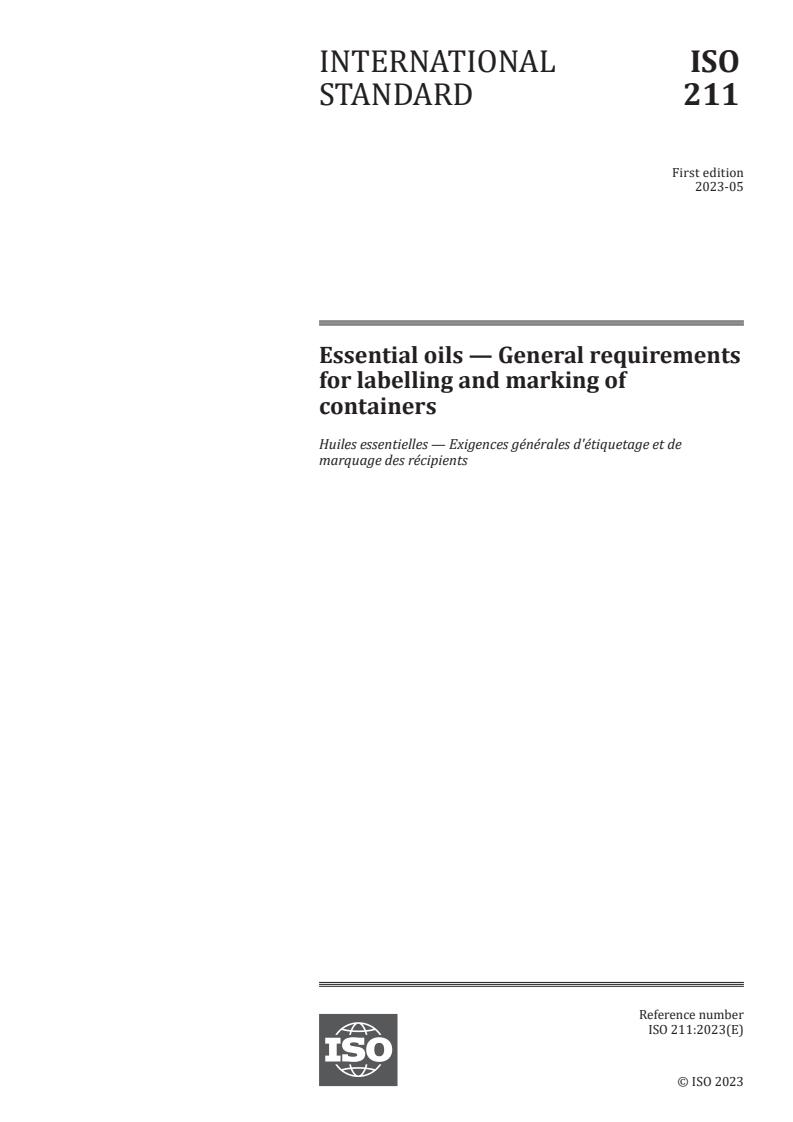
INTERNATIONAL ISO
STANDARD 211
First edition
2023-05
Essential oils — General requirements
for labelling and marking of
containers
Huiles essentielles — Exigences générales d'étiquetage et de
marquage des récipients
Reference number
© ISO 2023
All rights reserved. Unless otherwise specified, or required in the context of its implementation, no part of this publication may
be reproduced or utilized otherwise in any form or by any means, electronic or mechanical, including photocopying, or posting on
the internet or an intranet, without prior written permission. Permission can be requested from either ISO at the address below
or ISO’s member body in the country of the requester.
ISO copyright office
CP 401 • Ch. de Blandonnet 8
CH-1214 Vernier, Geneva
Phone: +41 22 749 01 11
Email: copyright@iso.org
Website: www.iso.org
Published in Switzerland
ii
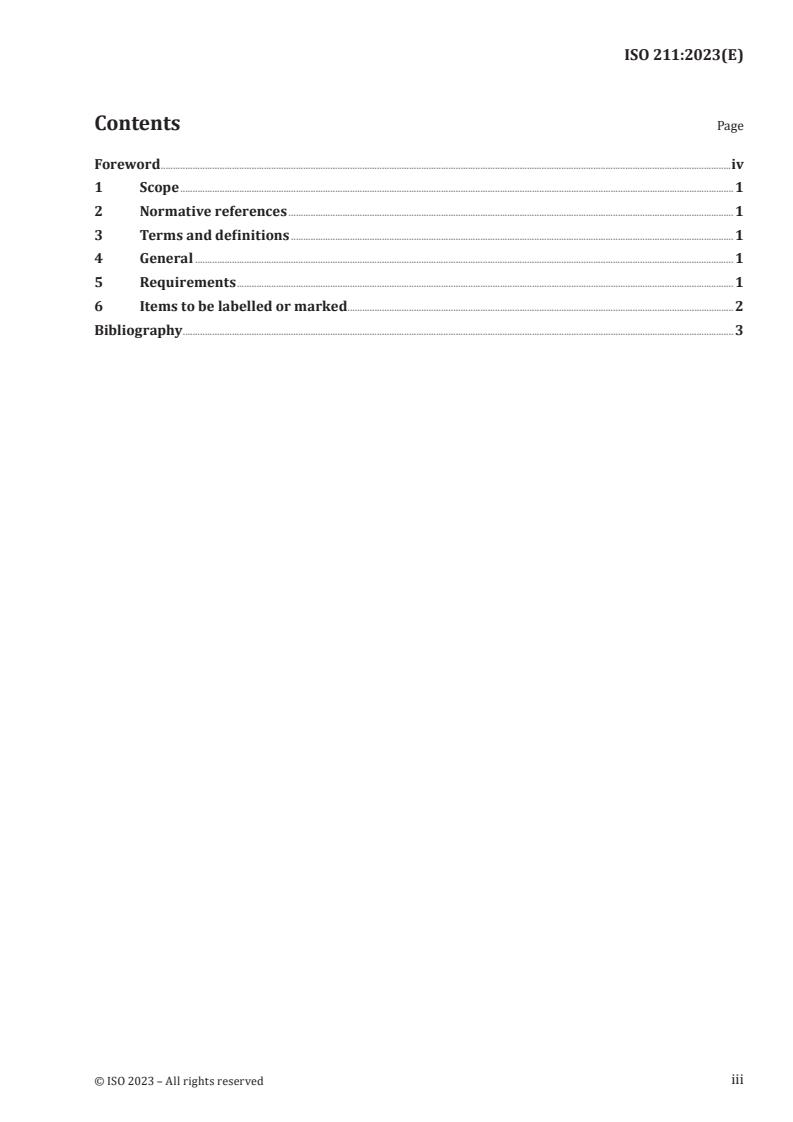
Contents Page
Foreword .iv
1 Scope . 1
2 Normative references . 1
3 Terms and definitions . 1
4 General . 1
5 Requirements . 1
6 Items to be labelled or marked . .2
Bibliography . 3
iii
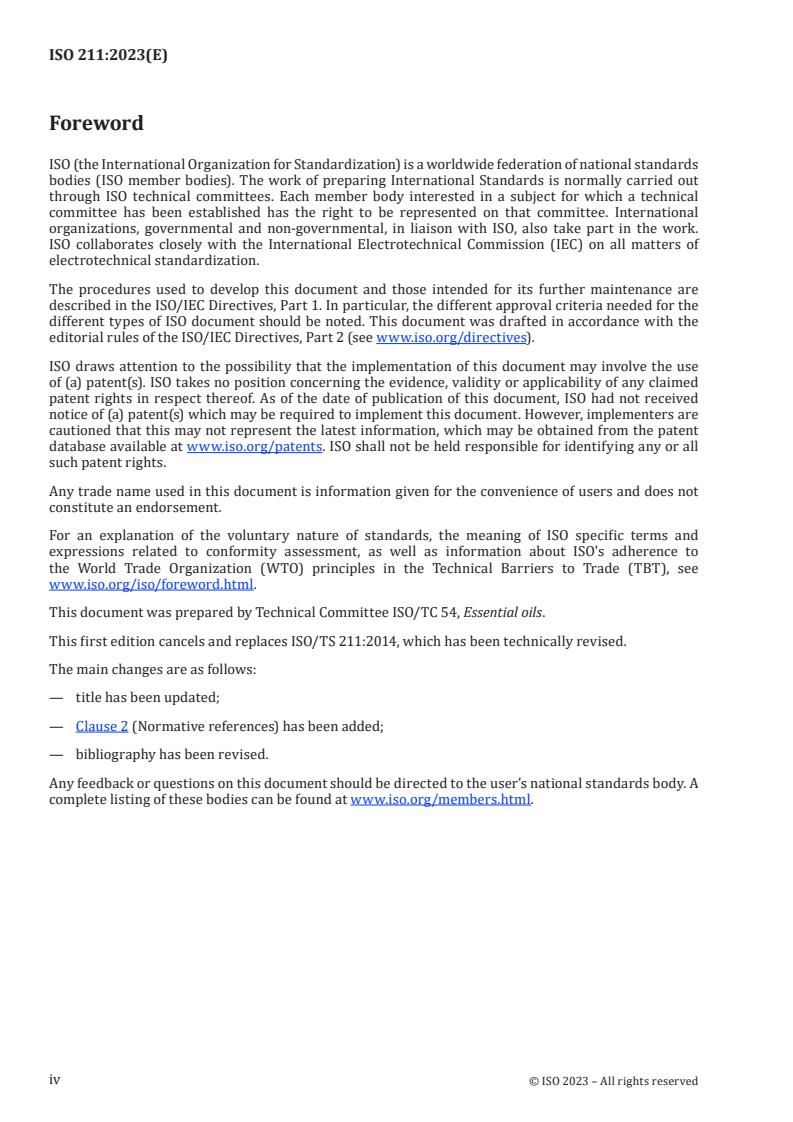
Foreword
ISO (the International Organization for Standardization) is a worldwide federation of national standards
bodies (ISO member bodies). The work of preparing International Standards is normally carried out
through ISO technical committees. Each member body interested in a subject for which a technical
committee has been established has the right to be represented on that committee. International
organizations, governmental and non-governmental, in liaison with ISO, also take part in the work.
ISO collaborates closely with the International Electrotechnical Commission (IEC) on all matters of
electrotechnical standardization.
The procedures used to develop this document and those intended for its further maintenance are
described in the ISO/IEC Directives, Part 1. In particular, the different approval criteria needed for the
different types of ISO document should be noted. This document was drafted in accordance with the
editorial rules of the ISO/IEC Directives, Part 2 (see www.iso.org/directives).
ISO draws attention to the possibility that the implementation of this document may involve the use
of (a) patent(s). ISO takes no position concerning the evidence, validity or applicability of any claimed
patent rights in respect thereof. As of the date of publication of this document, ISO had not received
notice of (a) patent(s) which may be required to implement this document. However, implementers are
cautioned that this may not represent the latest information, which may be obtained from the patent
database available at www.iso.org/patents. ISO shall not be held responsible for identifying any or all
such patent rights.
Any trade name used in this document is information given for the convenience of users and does not
constitute an endorsement.
For an explanation of the voluntary nature of standards, the meaning of ISO specific terms and
expressions related to conformity assessment, as well as information about ISO's adherence to
the World Trade Organization (WTO) principles in the Technical Barriers to Trade (TBT), see
www.iso.org/iso/foreword.html.
This document was prepared by Technical Committee ISO/TC 54, Essential oils.
This first edition cancels and replaces ISO/TS 211:2014, which has been technically revised.
The main changes are as follows:
— title has been updated;
— Clause 2 (Normative ref
...