

ISO 9220:2022
(Main)Metallic coatings — Measurement of coating thickness — Scanning electron microscope method
General Information
- Abstract
This document specifies a destructive method for the measurement of the local thickness of metallic and other inorganic coatings by examination of cross-sections with a scanning electron microscope (SEM). The method is applicable for thicknesses up to several millimetres, but for such thick coatings it is usually more practical to use a light microscope (see ISO 1463). The lower thickness limit depends on the achieved measurement uncertainty (see Clause 10). NOTE The method can also be used for organic layers when they are neither damaged by the preparation of the cross-section nor by the electron beam during imaging.
- Status
- Published
- Publication Date
- 10-Feb-2022
- Technical Committee
- ISO/TC 107 - Metallic and other inorganic coatings
- Drafting Committee
- ISO/TC 107 - Metallic and other inorganic coatings
- Current Stage
- 6060 - International Standard published
- Start Date
- 11-Feb-2022
- Due Date
- 28-Feb-2022
- Completion Date
- 11-Feb-2022
Buy Documents



ISO 9220:2022 - Metallic coatings — Measurement of coating thickness — Scanning electron microscope method Released:2/11/2022



ISO 9220:2022 - Metallic coatings — Measurement of coating thickness — Scanning electron microscope method Released:2/11/2022
Overview
ISO 9220:2022 - "Metallic coatings - Measurement of coating thickness - Scanning electron microscope method" specifies a destructive SEM cross‑section method for determining the local thickness of metallic and other inorganic coatings. The method is applicable for coatings up to several millimetres (for very thick coatings ISO 1463 is usually more practical). The standard covers specimen preparation, SEM instrumentation and calibration, measurement procedure, factors affecting results, expression of results, and precision (including round‑robin data in Annex B).
Key topics and technical requirements
- Method principle: Measure coating thickness on polished cross‑section images acquired with a scanning electron microscope (SEM) using the SEM software or external image analysis tools.
- Destructive testing: The specimen is cut, mounted, ground and polished for materialographic examination.
- Instrumentation: Requires a suitable SEM and calibration tools (stage micrometre, graticule, certified patterned silicon, or polymer spheres). Calibration tools should have an uncertainty of less than 5%.
- Calibration: Calibrate the SEM length measurement under the same imaging conditions used for the sample.
- Preparation requirements:
- Cross‑section plane perpendicular to the coating plane.
- Flat surface with entire coating width in focus.
- Remove material deformed by cutting.
- Well‑defined coating boundaries.
- Factors influencing measurement:
- Surface roughness, cross‑section taper (cosine error), specimen tilt, coating deformation, edge rounding, overplating, etching quality, smearing from polishing, poor material contrast, magnification and SEM imaging parameters (acceleration voltage, probe current, brightness/contrast/gamma).
- Magnification guidance: Prefer a field of view about 1.5 to 3 times the coating thickness where practical; use maximum practical magnification for very thin coatings.
- Precision and reporting: Clause 10 and Annex B address measurement uncertainty, repeatability and reproducibility; test report content is specified.
Applications and users
ISO 9220:2022 is used for:
- Quality control and failure analysis of electroplated, deposited or diffusion coatings.
- R&D and materials characterization where local thickness and layer structure must be resolved at high spatial resolution.
- Certification and acceptance testing when destructive cross‑section measurements are required.
Typical users:
- Materials laboratories, coating manufacturers, surface engineering and metallography labs, automotive/aerospace component inspection teams, and academic researchers.
Related standards
- ISO 1463 - Microscopic (light microscope) method for coating thickness (recommended for very thick coatings).
- ISO 2064 - Definition reference for local thickness (terminology used in ISO 9220).
- SEM imaging and EDS guidance referenced in the standard’s bibliography and Annexes.
Keywords: ISO 9220:2022, coating thickness measurement, SEM method, scanning electron microscope, metallic coatings, cross‑section preparation, calibration, measurement uncertainty.
Relations
- Effective Date
- 12-Feb-2026
- Effective Date
- 17-Jun-2023
- Effective Date
- 23-Apr-2020
Buy Documents
ISO 9220:2022 - Metallic coatings — Measurement of coating thickness — Scanning electron microscope method Released:2/11/2022
ISO 9220:2022 - Metallic coatings — Measurement of coating thickness — Scanning electron microscope method Released:2/11/2022
Get Certified
Connect with accredited certification bodies for this standard

DVS-ZERT GmbH
German welding certification society.
CARES (UK Certification Authority for Reinforcing Steels)
UK certification for reinforcing steels and construction.
EWF/IIW (European/International Welding Federation)
International welding personnel certification.
Sponsored listings
Frequently Asked Questions
ISO 9220:2022 is a standard published by the International Organization for Standardization (ISO). Its full title is "Metallic coatings — Measurement of coating thickness — Scanning electron microscope method". This standard covers: This document specifies a destructive method for the measurement of the local thickness of metallic and other inorganic coatings by examination of cross-sections with a scanning electron microscope (SEM). The method is applicable for thicknesses up to several millimetres, but for such thick coatings it is usually more practical to use a light microscope (see ISO 1463). The lower thickness limit depends on the achieved measurement uncertainty (see Clause 10). NOTE The method can also be used for organic layers when they are neither damaged by the preparation of the cross-section nor by the electron beam during imaging.
This document specifies a destructive method for the measurement of the local thickness of metallic and other inorganic coatings by examination of cross-sections with a scanning electron microscope (SEM). The method is applicable for thicknesses up to several millimetres, but for such thick coatings it is usually more practical to use a light microscope (see ISO 1463). The lower thickness limit depends on the achieved measurement uncertainty (see Clause 10). NOTE The method can also be used for organic layers when they are neither damaged by the preparation of the cross-section nor by the electron beam during imaging.
ISO 9220:2022 is classified under the following ICS (International Classification for Standards) categories: 25.220.40 - Metallic coatings. The ICS classification helps identify the subject area and facilitates finding related standards.
ISO 9220:2022 has the following relationships with other standards: It is inter standard links to EN ISO 9220:2022, ISO 11125-5:2025, ISO 9220:1988. Understanding these relationships helps ensure you are using the most current and applicable version of the standard.
ISO 9220:2022 is available in PDF format for immediate download after purchase. The document can be added to your cart and obtained through the secure checkout process. Digital delivery ensures instant access to the complete standard document.
Standards Content (Sample)
INTERNATIONAL ISO
STANDARD 9220
Second edition
2022-02
Metallic coatings — Measurement of
coating thickness — Scanning electron
microscope method
Revêtements métalliques — Mesurage de l'épaisseur de revêtement —
Méthode au microscope électronique à balayage
Reference number
© ISO 2022
All rights reserved. Unless otherwise specified, or required in the context of its implementation, no part of this publication may
be reproduced or utilized otherwise in any form or by any means, electronic or mechanical, including photocopying, or posting on
the internet or an intranet, without prior written permission. Permission can be requested from either ISO at the address below
or ISO’s member body in the country of the requester.
ISO copyright office
CP 401 • Ch. de Blandonnet 8
CH-1214 Vernier, Geneva
Phone: +41 22 749 01 11
Email: copyright@iso.org
Website: www.iso.org
Published in Switzerland
ii
Contents Page
Foreword .iv
1 Scope . 1
2 Normative references . 1
3 Terms and definitions . 1
4 Principle . 1
5 Instrumentation . 1
5.1 Scanning electron microscope . 1
5.2 Tools to calibrate the length measurement function of the SEM software . 1
6 Factors influencing the measurement results . 2
6.1 Surface roughness . 2
6.2 Taper of cross-section . 2
6.3 Specimen tilt . 2
6.4 Coating deformation . 2
6.5 Rounding of edges of the coating . 2
6.6 Plating a protection layer . 2
6.7 Etching . 2
6.8 Smearing . 3
6.9 Poor contrast . 3
6.10 Magnification . 3
6.11 SEM imaging parameters . 3
7 Preparation of cross-sections . 3
8 Calibration of instruments . 3
8.1 General . 3
8.2 Photography . 4
8.3 Measurement . 4
9 Procedure .4
10 Precision . 4
10.1 General . 4
10.2 Repeatability, r. 4
10.3 Reproducibility limit, R . 5
11 Expression of results . 5
12 Test report . 5
Annex A (informative) General guidance on the preparation and measurement of cross-
sections . 7
Annex B (informative) Details on precision .10
Bibliography .12
iii
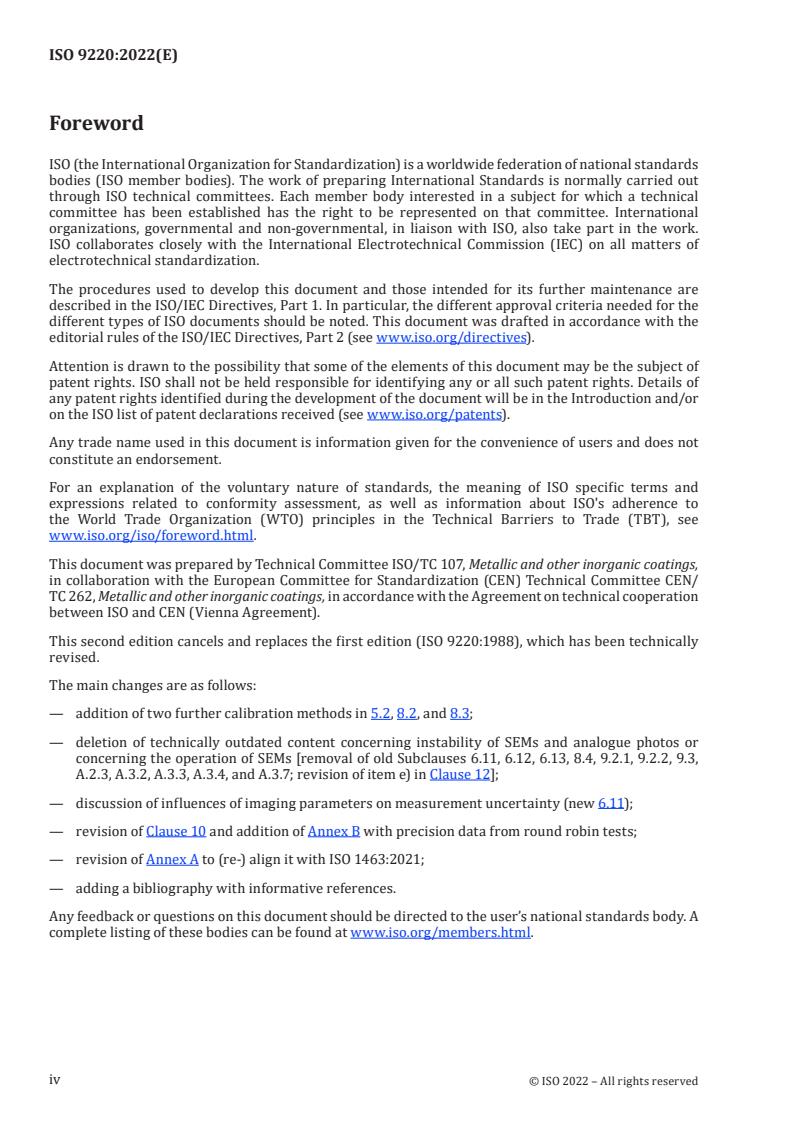
Foreword
ISO (the International Organization for Standardization) is a worldwide federation of national standards
bodies (ISO member bodies). The work of preparing International Standards is normally carried out
through ISO technical committees. Each member body interested in a subject for which a technical
committee has been established has the right to be represented on that committee. International
organizations, governmental and non-governmental, in liaison with ISO, also take part in the work.
ISO collaborates closely with the International Electrotechnical Commission (IEC) on all matters of
electrotechnical standardization.
The procedures used to develop this document and those intended for its further maintenance are
described in the ISO/IEC Directives, Part 1. In particular, the different approval criteria needed for the
different types of ISO documents should be noted. This document was drafted in accordance with the
editorial rules of the ISO/IEC Directives, Part 2 (see www.iso.org/directives).
Attention is drawn to the possibility that some of the elements of this document may be the subject of
patent rights. ISO shall not be held responsible for identifying any or all such patent rights. Details of
any patent rights identified during the development of the document will be in the Introduction and/or
on the ISO list of patent declarations received (see www.iso.org/patents).
Any trade name used in this document is information given for the convenience of users and does not
constitute an endorsement.
For an explanation of the voluntary nature of standards, the meaning of ISO specific terms and
expressions related to conformity assessment, as well as information about ISO's adherence to
the World Trade Organization (WTO) principles in the Technical Barriers to Trade (TBT), see
www.iso.org/iso/foreword.html.
This document was prepared by Technical Committee ISO/TC 107, Metallic and other inorganic coatings,
in collaboration with the European Committee for Standardization (CEN) Technical Committee CEN/
TC 262, Metallic and other inorganic coatings, in accordance with the Agreement on technical cooperation
between ISO and CEN (Vienna Agreement).
This second edition cancels and replaces the first edition (ISO 9220:1988), which has been technically
revised.
The main changes are as follows:
— addition of two further calibration methods in 5.2, 8.2, and 8.3;
— deletion of technically outdated content concerning instability of SEMs and analogue photos or
concerning the operation of SEMs [removal of old Subclauses 6.11, 6.12, 6.13, 8.4, 9.2.1, 9.2.2, 9.3,
A.2.3, A.3.2, A.3.3, A.3.4, and A.3.7; revision of item e) in Clause 12];
— discussion of influences of imaging parameters on measurement uncertainty (new 6.11);
— revision of Clause 10 and addition of Annex B with precision data from round robin tests;
— revision of Annex A to (re-) align it with ISO 1463:2021;
— adding a bibliography with informative references.
Any feedback or questions on this document should be directed to the user’s national standards body. A
complete listing of these bodies can be found at www.iso.org/members.html.
iv
INTERNATIONAL STANDARD ISO 9220:2022(E)
Metallic coatings — Measurement of coating thickness —
Scanning electron microscope method
1 Scope
This document specifies a destructive method for the measurement of the local thickness of metallic
and other inorganic coatings by examination of cross-sections with a scanning electron microscope
(SEM). The method is applicable for thicknesses up to several millimetres, but for such thick coatings it
is usually more practical to use a light microscope (see ISO 1463). The lower thickness limit depends on
the achieved measurement uncertainty (see Clause 10).
NOTE The method can also be used for organic layers when they are neither damaged by the preparation of
the cross-section nor by the electron beam during imaging.
2 Normative references
There are no normative references in this document.
3 Terms and definitions
For the purposes of this document, the following terms and definitions apply.
ISO and IEC maintain terminological databases for use in standardization at the following addresses:
— ISO Online browsing platform: available at https:// www .iso .org/ obp
— IEC Electropedia: available at https:// www .electropedia .org/
3.1
local thickness
mean of the thickness measurements, of which a specified number is made within a reference area
[SOURCE: ISO 2064:1996, 3.4]
4 Principle
A test specimen is cut, ground, and polished from a cross-section of the coating for materialographic
examination by a scanning electron microscope. The measurement is made on the digital image
generated by the SEM using either the tools of the SEM’s operating software or by importing the image
file together with its calibration data into an image processing software and using that software’s tools.
5 Instrumentation
5.1 Scanning electron microscope
Suitable instruments are available commercially.
5.2 Tools to calibrate the length measurement function of the SEM software
Suitable tools are required for the calibration of the length measurement function of the SEM’s
software, e.g. a stage micrometre, or a graticule, or a piece from a silicon wafer with a regular pattern
of (cylindrical) metallic bumps with a certified distance of the cylinder axes, or spherical polymer
particles of certified diameter in the range of a few tenths of a micrometre to a few micrometres can be
used, all of which are commercially available. They should have an uncertainty of less than 5 %.
6 Factors influencing the measurement results
6.1 Surface roughness
If the coating or its substrate is rough relative to the coating thickness, one or both of the interfaces of
the coating cross-section can be too irregular to permit accurate measurement of the average thickness
in the field of view. In this case, it can be helpful to use software solutions, which can identify the
boundary lines of the coating and either determine its area and divide it by the image width or place
automatically, for example, 100 measurement lines in order to calculate an average coating thickness.
6.2 Taper of cross-section
If the plane of the cross-section is not perpendicular to the plane of the coating, the measured thickness
will be greater than the true thickness. For example, an inclination of 10° to the perpendicular will
contribute a 1,5 % error.
NOTE This source of error is also known as cosine error in the small-angle approximation.
6.3 Specimen tilt
Any tilt of the specimen (plane of cross-section) with respect to the SEM beam can result in an
inaccurate measurement.
NOTE 1 If the tilt of the test specimen is different from that used for calibration, inaccuracies can result.
NOTE 2 This source of error is also known as cosine error in the small-angle approximation.
6.4 Coating deformation
Detrimental deformation of the coating can be caused by excessive temperature or pressure during the
mounting and preparation of cross-sections of soft coatings or coatings that melt at low temperatures,
and by excessive abrasion of brittle materials during preparation of cross-sections.
6.5 Rounding of edges of the coating
If the edge of the coating cross-section is rounded, i.e. if the coating cross-section is not completely flat
up to its edges, the observed thickness can differ from the true thickness. Edge rounding can be caused
by improper mounting, grinding, polishing, or etching (see 6.6 and A.2).
6.6 Plating a protection layer
Overplating of the test specimen, i.e. plating a protection layer onto the test specimen, serves to protect
the coating edges during preparation of cross-sections and thus to prevent an inaccurate measurement.
Removal of the coating material during surface preparation for overplating can cause a low thickness
measurement.
6.7 Etching
Optimum etching will produce a clearly defined and narrow dark line at the interface between the two
materials. A wide or poorly defined line can result in an inaccurate measurement.
NOTE Etching is usually applied for the microscopic method (see ISO 1463) and can be useful for relatively
thick coatings in the SEM, too, especially when individual layers from the same material need to be distinguished
and there is no or too weak material contrast in the back scattered electron image (see 6.9). For (very) thin
coatings, etching has often a negative effect on the measurement uncertainty.
6.8 Smearing
Polishing can leave smeared metal that obscures the true boundary between two metals and results
in an inaccurate measurement. This can occur with soft metals like indium or gold. To help identify
whether or not there is smearing, repeat the polishing, etching, and measurement several times. Any
significant variation in readings is an indication of possible smearing.
6.9 Poor contrast
The visual contrast between metals in an SEM is poor when their atomic numbers are close together. For
example, bright and semi-bright nickel layers cannot be discriminable unless their common boundary
can be brought out sufficiently by appropriate etching (see 6.7) and SEM techniques.
6.10 Magnification
For a given coating thickness, measurement errors tend to increase with decreasing magnification.
If practical, the magnification should be chosen so that the field of view is between 1,5 and 3 times
the coating thickness. For very thin coatings this is often not practicable; then choose the maximum
magnification at which the image of the coating and its boundaries appears still “sharp”.
6.11 SEM imaging parameters
The acceleration voltage of the SEM can influence the appearance of the coating in the image. For
example, a higher acceleration voltage causes a higher depth from which the signal is collected and can
lead to not clearly discernible edges, e.g. at a metal to polymer (e.g. molding resin) interface.
High probe currents can improve the brightness and contrast of the image and increase count rates for
energy-dispersive X-ray spectroscopy (EDS), but can at the same time reduce the resolution and thus
increase measurement uncertainty.
The settings of brightness, contrast and gamma can influence the appearance of the coating in the
image and – especially for thin coatings – the measured thickness.
7 Preparation of cross-sections
Prepare the test specimen so that:
a) the cross-section is perpendicular to the plane of the coating;
b) the surface is flat and the entire width of the coating image is simultaneously in focus at the
magnification to be used for the measurement;
c) all material deformed by cutting or cross-sectioning is removed;
d) the boundaries of the coating cross-section are sharply defined by no more than contrasting
appearance, or by a narrow, well-defined line.
NOTE Further guidance is given in Annex A.
8 Calibration of instruments
8.1 General
Before use, each instrument (5.1) shall be calibrated with an appropriate tool (5.2) under the same
conditions as used for the sample measurement.
------------
...
NORME ISO
INTERNATIONALE 9220
Deuxième édition
2022-02
Revêtements métalliques — Mesurage
de l'épaisseur de revêtement —
Méthode au microscope électronique
à balayage
Metallic coatings — Measurement of coating thickness — Scanning
electron microscope method
Numéro de référence
DOCUMENT PROTÉGÉ PAR COPYRIGHT
© ISO 2022
Tous droits réservés. Sauf prescription différente ou nécessité dans le contexte de sa mise en œuvre, aucune partie de cette
publication ne peut être reproduite ni utilisée sous quelque forme que ce soit et par aucun procédé, électronique ou mécanique,
y compris la photocopie, ou la diffusion sur l’internet ou sur un intranet, sans autorisation écrite préalable. Une autorisation peut
être demandée à l’ISO à l’adresse ci-après ou au comité membre de l’ISO dans le pays du demandeur.
ISO copyright office
Case postale 401 • Ch. de Blandonnet 8
CH-1214 Vernier, Genève
Tél.: +41 22 749 01 11
E-mail: copyright@iso.org
Web: www.iso.org
Publié en Suisse
ii
Sommaire Page
Avant-propos .iv
1 Domaine d’application . 1
2 Références normatives .1
3 Termes et définitions . 1
4 Principe. 1
5 Appareillage . 1
5.1 Microscope électronique à balayage . 1
5.2 Outils destinés à l’étalonnage de la fonction de mesure de longueur du logiciel
du MEB . 2
6 Facteurs ayant une influence sur les résultats du mesurage . 2
6.1 Rugosité de surface . 2
6.2 Conicité de la coupe transversale . 2
6.3 Inclinaison de l’éprouvette . . 2
6.4 Déformation du revêtement . 2
6.5 Arrondissement des bords du revêtement . 2
6.6 Dépôt d’une couche de protection . 3
6.7 Attaque . 3
6.8 Souillures . 3
6.9 Mauvais contraste . 3
6.10 Grossissement . 3
6.11 Paramètres d’imagerie MEB . 3
7 Préparation des coupes transversales . 4
8 Étalonnage des appareils .4
8.1 Généralités . 4
8.2 Photographie . 4
8.3 Mesurage . 4
9 Mode opératoire . 4
10 Fidélité . 5
10.1 Généralités . 5
10.2 Répétabilité, r . 5
10.3 Limite de reproductibilité, R . 5
11 Expression des résultats . 6
12 Rapport d’essai . 6
Annexe A (informative) Recommandations générales de préparation et de mesurage
des coupes transversales . 7
Annexe B (informative) Informations sur la fidélité .10
Bibliographie .13
iii
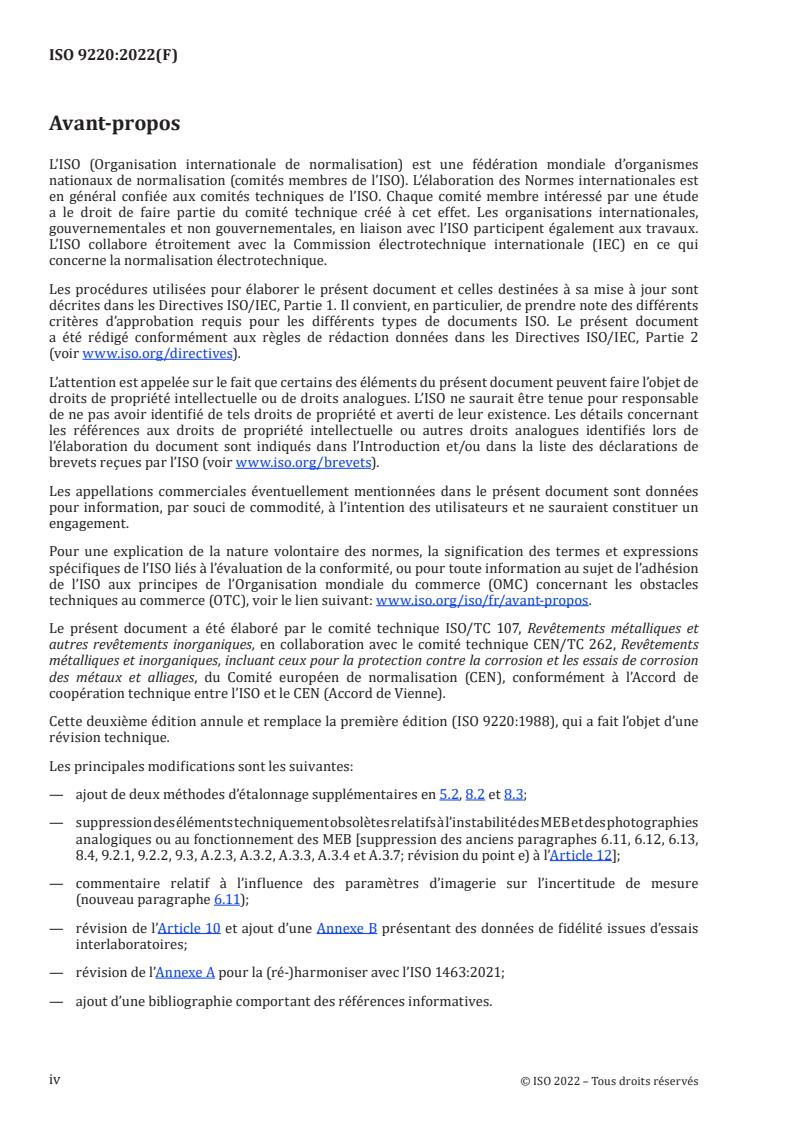
Avant-propos
L’ISO (Organisation internationale de normalisation) est une fédération mondiale d’organismes
nationaux de normalisation (comités membres de l’ISO). L’élaboration des Normes internationales est
en général confiée aux comités techniques de l’ISO. Chaque comité membre intéressé par une étude
a le droit de faire partie du comité technique créé à cet effet. Les organisations internationales,
gouvernementales et non gouvernementales, en liaison avec l’ISO participent également aux travaux.
L’ISO collabore étroitement avec la Commission électrotechnique internationale (IEC) en ce qui
concerne la normalisation électrotechnique.
Les procédures utilisées pour élaborer le présent document et celles destinées à sa mise à jour sont
décrites dans les Directives ISO/IEC, Partie 1. Il convient, en particulier, de prendre note des différents
critères d’approbation requis pour les différents types de documents ISO. Le présent document
a été rédigé conformément aux règles de rédaction données dans les Directives ISO/IEC, Partie 2
(voir www.iso.org/directives).
L’attention est appelée sur le fait que certains des éléments du présent document peuvent faire l’objet de
droits de propriété intellectuelle ou de droits analogues. L’ISO ne saurait être tenue pour responsable
de ne pas avoir identifié de tels droits de propriété et averti de leur existence. Les détails concernant
les références aux droits de propriété intellectuelle ou autres droits analogues identifiés lors de
l’élaboration du document sont indiqués dans l’Introduction et/ou dans la liste des déclarations de
brevets reçues par l’ISO (voir www.iso.org/brevets).
Les appellations commerciales éventuellement mentionnées dans le présent document sont données
pour information, par souci de commodité, à l’intention des utilisateurs et ne sauraient constituer un
engagement.
Pour une explication de la nature volontaire des normes, la signification des termes et expressions
spécifiques de l’ISO liés à l’évaluation de la conformité, ou pour toute information au sujet de l’adhésion
de l’ISO aux principes de l’Organisation mondiale du commerce (OMC) concernant les obstacles
techniques au commerce (OTC), voir le lien suivant: www.iso.org/iso/fr/avant-propos.
Le présent document a été élaboré par le comité technique ISO/TC 107, Revêtements métalliques et
autres revêtements inorganiques, en collaboration avec le comité technique CEN/TC 262, Revêtements
métalliques et inorganiques, incluant ceux pour la protection contre la corrosion et les essais de corrosion
des métaux et alliages, du Comité européen de normalisation (CEN), conformément à l’Accord de
coopération technique entre l’ISO et le CEN (Accord de Vienne).
Cette deuxième édition annule et remplace la première édition (ISO 9220:1988), qui a fait l’objet d’une
révision technique.
Les principales modifications sont les suivantes:
— ajout de deux méthodes d’étalonnage supplémentaires en 5.2, 8.2 et 8.3;
— suppression des éléments techniquement obsolètes relatifs à l’inst abilité des MEB et des photographies
analogiques ou au fonctionnement des MEB [suppression des anciens paragraphes 6.11, 6.12, 6.13,
8.4, 9.2.1, 9.2.2, 9.3, A.2.3, A.3.2, A.3.3, A.3.4 et A.3.7; révision du point e) à l’Article 12];
— commentaire relatif à l’influence des paramètres d’imagerie sur l’incertitude de mesure
(nouveau paragraphe 6.11);
— révision de l’Article 10 et ajout d’une Annexe B présentant des données de fidélité issues d’essais
interlaboratoires;
— révision de l’Annexe A pour la (ré-)harmoniser avec l’ISO 1463:2021;
— ajout d’une bibliographie comportant des références informatives.
iv
Il convient que l’utilisateur adresse tout retour d’information ou toute question concernant le présent
document à l’organisme national de normalisation de son pays. Une liste exhaustive desdits organismes
se trouve à l’adresse www.iso.org/fr/members.html.
v
NORME INTERNATIONALE ISO 9220:2022(F)
Revêtements métalliques — Mesurage de l'épaisseur de
revêtement — Méthode au microscope électronique à
balayage
1 Domaine d’application
Le présent document spécifie une méthode destructive pour le mesurage de l’épaisseur locale des
revêtements métalliques et d’autres revêtements inorganiques par examen de coupes transversales au
microscope électronique à balayage (MEB). Cette méthode s’applique aux épaisseurs pouvant atteindre
plusieurs millimètres; toutefois, pour les revêtements d’une telle épaisseur, il est généralement plus
pratique d’utiliser un microscope optique (voir l’ISO 1463). La limite inférieure de l’épaisseur dépend de
l’incertitude de mesure obtenue (voir l’Article 10).
NOTE Cette méthode peut également être utilisée pour les couches organiques lorsqu’elles ne sont
endommagées ni par la préparation de la coupe transversale ni par le faisceau d’électrons pendant l’imagerie.
2 Références normatives
Le présent document ne contient aucune référence normative.
3 Termes et définitions
Pour les besoins du présent document, les termes et définitions suivants s’appliquent.
L’ISO et l’IEC tiennent à jour des bases de données terminologiques destinées à être utilisées en
normalisation, consultables aux adresses suivantes:
— ISO Online browsing platform: disponible à l’adresse https:// www .iso .org/ obp
— IEC Electropedia: disponible à l’adresse https:// www .electropedia .org/
3.1
épaisseur locale
moyenne des mesures d’épaisseur, correspondant au nombre prescrit à l’intérieur de l’aire de référence
[SOURCE: ISO 2064:1996, 3.4]
4 Principe
Une éprouvette est découpée, meulée et polie à partir d’une coupe transversale du revêtement afin
d’être soumise à un examen matérialographique au microscope électronique à balayage. Le mesurage
s’effectue sur l’image numérique générée par le MEB soit à l’aide des outils du logiciel d’exploitation
du MEB, soit par importation du fichier image, conjointement avec ses données d’étalonnage, dans un
logiciel de traitement d’image et utilisation des outils inclus dans ce logiciel.
5 Appareillage
5.1 Microscope électronique à balayage
Des instruments appropriés sont disponibles dans le commerce.
5.2 Outils destinés à l’étalonnage de la fonction de mesure de longueur du logiciel
du MEB
Des outils appropriés sont nécessaires pour l’étalonnage de la fonction de mesure de longueur du logiciel
du MEB. Peuvent être utilisés, par exemple: une platine micrométrique; un repère de visée; un morceau
de plaquette de silicium comportant un motif régulier de bosses métalliques (cylindriques) présentant
une distance certifiée des axes de cylindre; des particules polymères sphériques de diamètre certifié
dans la plage de quelques dixièmes de micromètre à quelques micromètres. Tous ces éléments sont
disponibles dans le commerce. Il convient qu’ils présentent une incertitude inférieure à 5 %.
6 Facteurs ayant une influence sur les résultats du mesurage
6.1 Rugosité de surface
Si la rugosité du revêtement ou du subjectile est élevée par rapport à l’épaisseur du revêtement, l’une des
interfaces ou les deux interfaces de la coupe transversale de revêtement peuvent être trop irrégulières
pour permettre un mesurage exact de l’épaisseur moyenne dans le champ de vision. Dans ce cas, il peut
s’avérer utile de recourir à des solutions logicielles, qui permettent d’identifier les limites du revêtement
et soit de déterminer son aire et de la diviser par la largeur de l’image, soit de placer automatiquement,
par exemple, 100 lignes de mesure afin de calculer une épaisseur moyenne de revêtement.
6.2 Conicité de la coupe transversale
Si le plan de la coupe n’est pas perpendiculaire au plan du revêtement, l’épaisseur mesurée sera
supérieure à la valeur vraie de l’épaisseur. Par exemple, une inclinaison de 10° par rapport à la
perpendiculaire entraînera une erreur de 1,5 %.
NOTE Cette source d’erreur est également connue comme étant l’erreur en cosinus dans l’approximation des
petits angles.
6.3 Inclinaison de l’éprouvette
Toute inclinaison de l’éprouvette (dans le plan de la coupe) par rapport au faisceau du MEB peut
conduire à un mesurage inexact.
NOTE 1 Si l’inclinaison de l’éprouvette est différente de celle qu’elle présentait lors de l’étalonnage, il peut en
résulter des erreurs.
NOTE 2 Cette source d’erreur est également connue comme étant l’erreur en cosinus dans l’approximation des
petits angles.
6.4 Déformation du revêtement
Une température ou une pression excessive pendant le montage et la préparation des coupes de
revêtements tendres ou de revêtements fondant à basse température ainsi qu’une abrasion excessive
des matériaux fragiles pendant la préparation des coupes peuvent provoquer une déformation
rémanente du revêtement.
6.5 Arrondissement des bords du revêtement
Si les bords du revêtement sont arrondis, c’est-à-dire si la coupe transversale n’est pas complètement
plane jusqu’aux bords, l’épaisseur observée peut différer de la valeur vraie de l’épaisseur. Cet
arrondissement des bords peut résulter d’une mauvaise opération de montage, de meulage, de polissage
ou d’attaque (voir 6.6 et A.2).
6.6 Dépôt d’une couche de protection
Le revêtement complémentaire de l’éprouvette, c’est-à-dire le dépôt d’une couche de protection sur
cette dernière, vise à protéger les bords du revêtement pendant la préparation des coupes transversales
et ainsi à éviter les erreurs de mesurage. L’élimination de matériau de revêtement au cours de la
préparation de la surface pour le revêtement complémentaire peut entraîner le mesurage d’une
épaisseur plus faible.
6.7 Attaque
Une attaque optimale produit une ligne sombre, étroite et bien nette à l’interface entre les deux métaux.
Une ligne large ou mal définie peut entraîner des erreurs de mesurage.
NOTE Une attaque est généralement appliquée pour la méthode par coupe micrographique (voir l’ISO 1463)
et peut également s’avérer utile pour les revêtements relativement épais examinés par MEB, en particulier lorsque
des couches individuelles du même matériau doivent être distinguées et que l’image d’électrons rétrodiffusés
présente un contraste nul ou trop faible entre les matériaux (voir 6.9). Pour les revêtements (très) fins, l’attaque a
souvent un effet défavorable sur l’incertitude de mesure.
6.8 Souillures
Le polissage peut laisser des souillures métalliques qui obscurcissent la véritable limite entre les deux
métaux, et entraînent des erreurs de mesurage. Ce phénomène peut se produire avec les métaux tendres,
tels que l’indium ou l’or. Pour permettre de déterminer la présence ou non de souillures, réitérer à
plusieurs reprises le polissage, l’attaque et le mesurage. Tout écart significatif entre les mesures est
signe d’une éventuelle souillure.
6.9 Mauvais contraste
Le MEB présente un mauvais contraste visuel entre métaux dont le numéro atomique est voisin. Par
exemple, des couches de nickel brillant et semi-brillant ne peuvent pas être distinguées sans mise
en évidence particulière de leur limite commune par des techniques d’attaque (voir 6.7) et de MEB
appropriées.
6.10 Grossissement
Pour une épaisseur de revêtement donnée, les erreurs de mesurage tendent à croître de façon
inversement proportionnelle au grossissement. Si possible, il convient que le grossissement soit choisi
de sorte que le champ de vision soit compris entre 1,5 fois et 3 fois l’épaisseur du revêtement. Pour les
revêtements très fins, souvent cela n’est pas réalisable; dans ce cas, choisir le grossissement maximal
auquel l’image du revêtement et de ses limites apparaissent toujours nettes.
6.11 Paramètres d’imagerie MEB
La tension d’accélération du MEB peut influer sur l’aspect du revêtement apparaissant à l’image. À titre
d’exemple, une tension d’accélération plus élevée augmente la profondeur à partir de laquelle le signal
est capté et peut altérer la visibilité des bords, par exemple, à l’interface entre un métal et un polymère
(par exemple, résine de moulage).
Les courants de sonde élevés peuvent améliorer la brillance et le contraste de l’image et augmenter
les taux de comptage pour la spectroscopie de rayons X à dispersion d’énergie (EDS), mais peuvent
également réduire la résolution et donc augmenter l’incertitude de mesure.
Le réglage de la brillance, du contraste et des rayons gamma peut influer sur l’aspect du revêtement
apparaissant à l’image et, en particulier pour les revêtements fins, l’épaisseur mesurée.
7 Préparation des coupes transversales
Préparer l’éprouvette de façon que:
a) la coupe soit perpendiculaire au plan du revêtement;
b) la surface soit plane et que la mise au point soit correcte sur toute la largeur de l’image du
revêtement, au grossissement utilisé par le mesurage;
c) tout matériau déformé par le découpage soit éliminé;
d) les limites de la coupe transversale soient nettement définies soit par leur aspect contrastant, soit
par une ligne étroite bien nette.
NOTE D’autres recommandations figurent à l’Annexe A.
8 Étalonnage des appareils
8.1 Généralités
Chaque appareil (5.1) doit être étalonné avant emploi à l’aide d’un outil approprié (5.2) dans les mêmes
conditions que pour le mesurage sur échantillon.
Il doit être pris soin de veiller scrupuleusement au respect des facteurs indiqués à l’Article 6, du
mode opératoire spécifié à l’Article 9 et des limites d’incertitude figurant à l’Article 10. La stabilité de
l’étalonnage doit être vérifiée à intervalles réguliers.
8.2 Photographie
Capturer une image de l’étalon de référence certifié, par exemple l’échelle du micromètre, le repère de
visée, 10 × 10 à 15 × 15 des bosses métalliques en vue du dessus ou quelques particules sphériques (5.2),
avec un contraste suffisant pour un mesurage ultérieur.
Les particules sphériques (5.2), provenant d’une suspension, déposées sur un porte-échantillon
MEB propre tendent à s’agglomérer. Rechercher des particules isolées sur le porte-échantillon pour
enregi
...