

ISO 5939:1980
(Main)Carbonaceous materials for the production of aluminium — Pitch for electrodes — Determination of water content — Azeotropic distillation (Dean and Stark) method
General Information
- Abstract
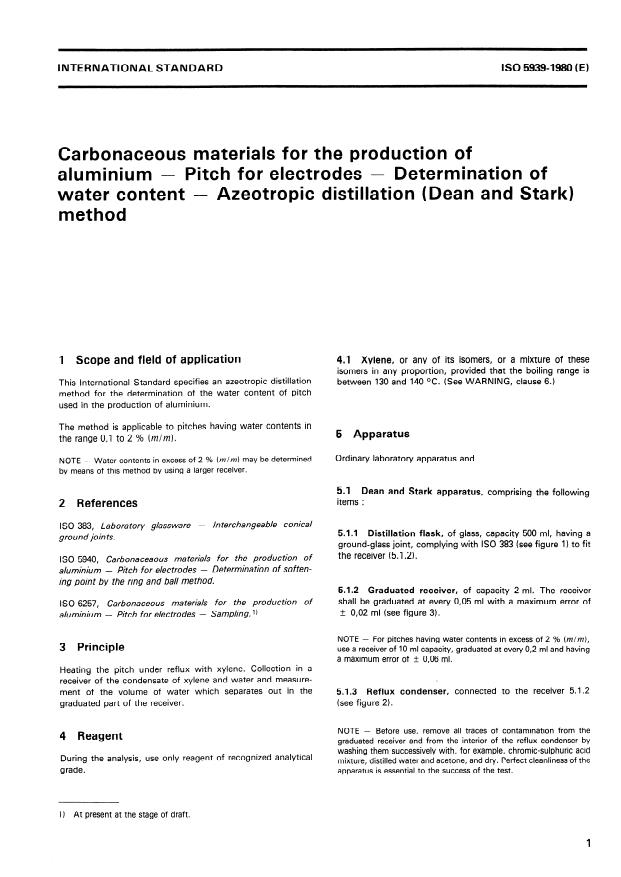
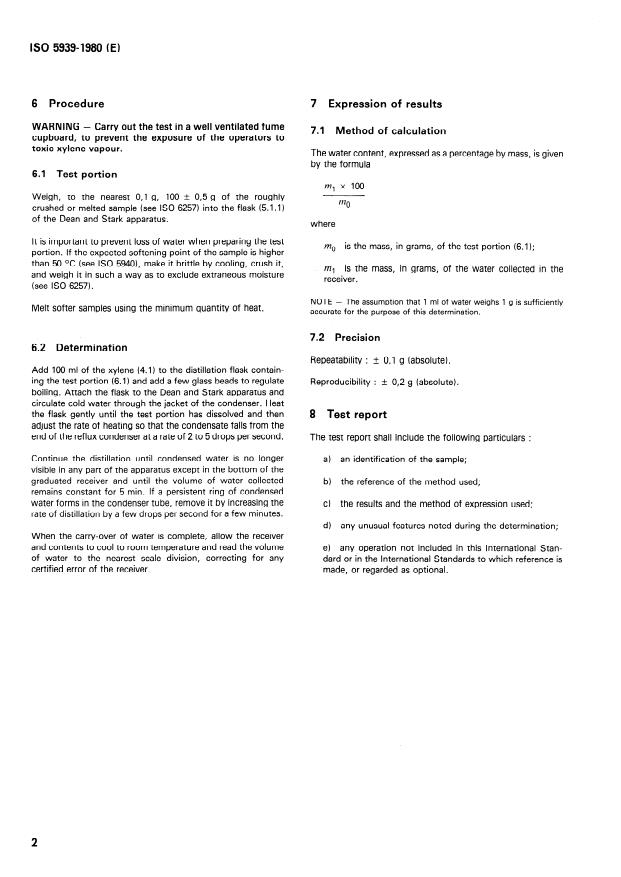
Describes a method comprising the heating of the pitch under reflux with xylene, collection in a receiver of the condensate of xylene and water and measurement of the volume of water which separates out in the graduated part of the receiver. Applies to pitches having water contents in the range between 0,1 and 2 % (m/m).
- Status
- Published
- Publication Date
- 30-Jun-1980
- Technical Committee
- ISO/TC 226 - Materials for the production of primary aluminium
- Drafting Committee
- ISO/TC 226 - Materials for the production of primary aluminium
- Current Stage
- 9093 - International Standard confirmed
- Start Date
- 27-Oct-2025
- Completion Date
- 29-Aug-2026
Buy Documents
ISO 5939:1980 - Carbonaceous materials for the production of aluminium — Pitch for electrodes — Determination of water content — Azeotropic distillation (Dean and Stark) method Released:7/1/1980
ISO 5939:1980 - Produits carbonés utilisés pour la production de l'aluminium — Brai pour électrodes — Dosage de l'eau — Méthode par entraînement azéotropique (Dean et Stark) Released:7/1/1980
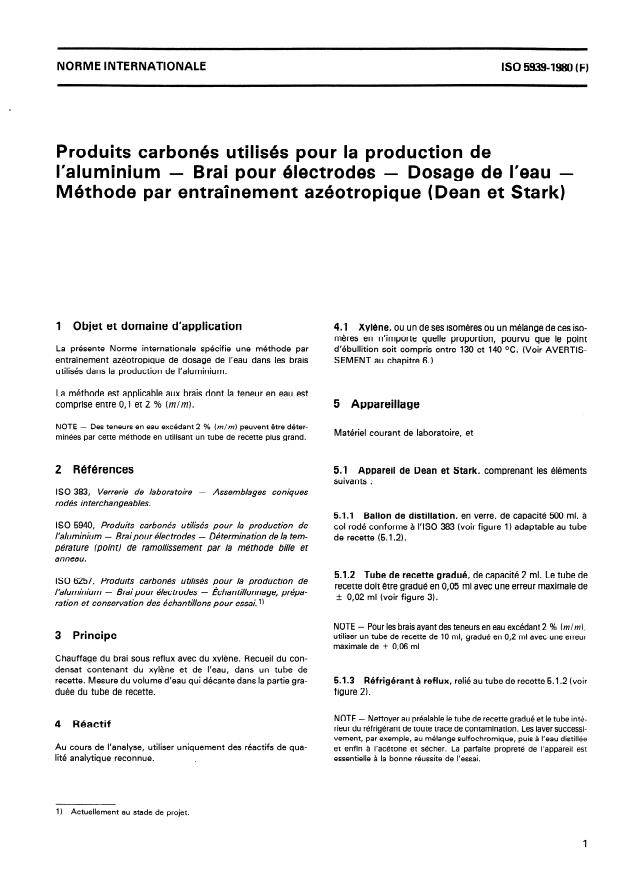
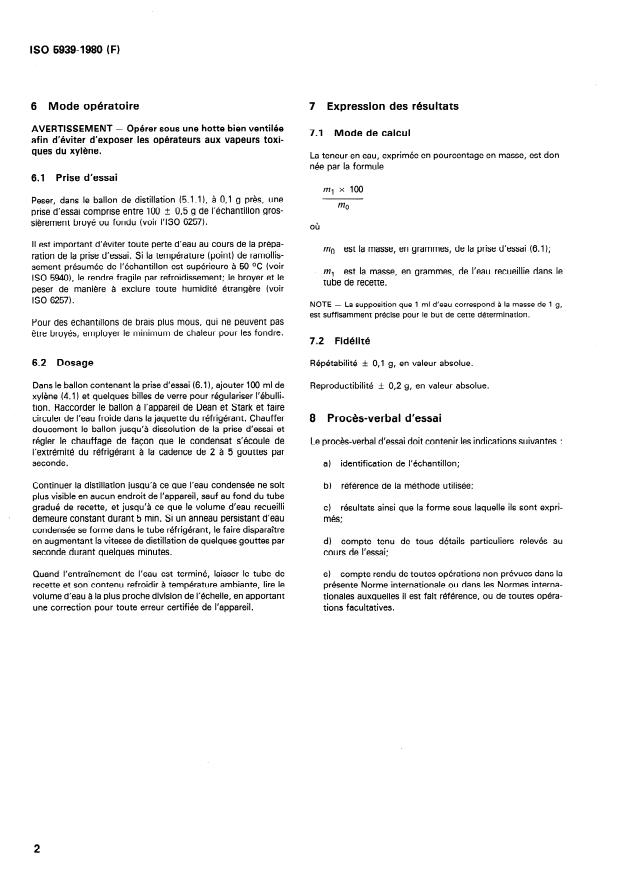
ISO 5939:1980 - Produits carbonés utilisés pour la production de l'aluminium — Brai pour électrodes — Dosage de l'eau — Méthode par entraînement azéotropique (Dean et Stark) Released:7/1/1980
Overview
ISO 5939:1980 specifies a standardized method for determining the water content in pitch used for electrodes in aluminium production. This International Standard employs the azeotropic distillation technique, commonly known as the Dean and Stark method, which involves heating pitch under reflux with xylene. The distillate-a mixture of xylene and water-is collected and the volume of separated water is measured. This method is applicable for pitches with water content ranging from 0.1% to 2% by mass (m/m).
Developed by ISO Technical Committee ISO/TC 47 on Chemistry, ISO 5939:1980 ensures precise, repeatable, and reproducible chemical analysis of carbonaceous materials critical in aluminium electrode manufacture. It is essential for maintaining quality control and optimizing electrode performance by accurately measuring water contamination in pitch.
Key Topics
Azeotropic Distillation (Dean and Stark) Method
Utilizes heating under reflux with a solvent (xylene) to separate water from pitch. Water volume is then quantitatively measured in a calibrated receiver.Scope of Application
Suitable for pitch samples containing between 0.1% and 2% water by mass. For higher water content, modifications such as using larger receivers are recommended.Apparatus Requirements
- Dean and Stark apparatus with a 500 ml distillation flask
- Graduated receiver calibrated to 0.05 ml with maximum error ±0.02 ml
- Reflux condenser designed to minimize water carryover
- Use of analytical-grade reagents, including xylene or its isomers
Testing Procedure
- Sample preparation ensuring representative and moisture-controlled portions
- Controlled heating to dissolve pitch and maintain drop rate of condensate (2–5 drops per second)
- Continuous monitoring until water volume stabilizes
- Accurate volume measurement corrected for receiver calibration errors
Safety Considerations
Tests must be performed in well-ventilated areas to minimize operator exposure to toxic xylene vapors.Precision and Accuracy
- Repeatability: ±0.1 g water
- Reproducibility: ±0.2 g water
These metrics guarantee trustworthy results in laboratory and industrial settings.
Applications
Quality Control in Aluminium Production
Monitoring water content in electrode pitch ensures improved conductivity, mechanical strength, and overall electrode performance.Industrial Material Testing
Enables precise water determination that influences processing parameters and material specifications within carbonaceous electrode materials.Research and Development
Supports formulation adjustments in pitch production to optimize water levels for desired electrode characteristics.Environmental and Safety Compliance
Measuring moisture assists in preventing degradation and safety hazards during handling and processing of carbonaceous materials.
Related Standards
ISO 5939:1980 references and correlates with multiple ISO standards within the realm of carbonaceous materials and water content analysis, including:
- ISO 383 – Laboratory glassware - Interchangeable conical ground joints
- ISO 5940 – Carbonaceous materials - Determination of softening point by the ring and ball method
- ISO 6257 – Carbonaceous pitch - Sampling procedures
- ISO 3733 – Petroleum products and bituminous materials - Determination of water by distillation
- ISO 348, 589, 934, 939, 1015 – Various methods for moisture determination in coals, oils, spices, and other materials using volumetric or azeotropic distillation methods
These related standards provide complementary procedures and apparatus specifications to ensure robust and consistent moisture determination across diverse carbonaceous and industrial materials.
Keywords: ISO 5939:1980, water determination, electrode pitch, carbonaceous materials, aluminium production, azeotropic distillation, Dean and Stark method, xylene reflux, moisture analysis, electrode manufacturing standards, pitch water content testing.
Relations
- Effective Date
- 25-Aug-2026
- Effective Date
- 25-Aug-2026
Buy Documents
ISO 5939:1980 - Carbonaceous materials for the production of aluminium — Pitch for electrodes — Determination of water content — Azeotropic distillation (Dean and Stark) method Released:7/1/1980
ISO 5939:1980 - Produits carbonés utilisés pour la production de l'aluminium — Brai pour électrodes — Dosage de l'eau — Méthode par entraînement azéotropique (Dean et Stark) Released:7/1/1980
ISO 5939:1980 - Produits carbonés utilisés pour la production de l'aluminium — Brai pour électrodes — Dosage de l'eau — Méthode par entraînement azéotropique (Dean et Stark) Released:7/1/1980
Get Certified
Connect with accredited certification bodies for this standard

ECOCERT
Organic and sustainability certification.

Eurofins Food Testing Global
Global leader in food, environment, and pharmaceutical product testing.

Intertek Bangladesh
Intertek certification and testing services in Bangladesh.
Sponsored listings
Frequently Asked Questions
ISO 5939:1980 is a standard published by the International Organization for Standardization (ISO). Its full title is "Carbonaceous materials for the production of aluminium — Pitch for electrodes — Determination of water content — Azeotropic distillation (Dean and Stark) method". This standard covers: Describes a method comprising the heating of the pitch under reflux with xylene, collection in a receiver of the condensate of xylene and water and measurement of the volume of water which separates out in the graduated part of the receiver. Applies to pitches having water contents in the range between 0,1 and 2 % (m/m).
Describes a method comprising the heating of the pitch under reflux with xylene, collection in a receiver of the condensate of xylene and water and measurement of the volume of water which separates out in the graduated part of the receiver. Applies to pitches having water contents in the range between 0,1 and 2 % (m/m).
ISO 5939:1980 is classified under the following ICS (International Classification for Standards) categories: 71.100.10 - Materials for aluminium production. The ICS classification helps identify the subject area and facilitates finding related standards.
ISO 5939:1980 has the following relationships with other standards: It is inter standard links to EN 14261:2003, EN 14262:2003. Understanding these relationships helps ensure you are using the most current and applicable version of the standard.
ISO 5939:1980 is available in PDF format for immediate download after purchase. The document can be added to your cart and obtained through the secure checkout process. Digital delivery ensures instant access to the complete standard document.
Standards Content (Sample)
International Standard
INTERNATIONAL ORGANIZATION FOR STANDARDIZATION*ME>KflYtiAPO~HAFl OPfAHM3Al.WlR fl0 CTAH~APTM3A~Mt4.ORGANISATION INTERNATIONALE DE NORMALISATION
Carbonaceous materials for the production of
aluminium
- Pitch for electrodes - Determination of
water content
- Azeotropic distillation (Dean and Stark)
method
Produits carbones utilises pour Ia production de l’aluminium - Brai pour electrodes - Dosage de l’eau - Mthode par
en trainemen t azeo tropique (Dean et S tarkl
First edition
- 1980-07-15
UDC 665.775: 669.713.7 : 543.812
Ref. No. ISO 5939-1980 (EI
Descriptors : pitch (materials), electrodes, Chemical analysis,
determination of content, water, Dean and Stark apparatus.
Price based on 5 pages
Foreword
ISO (the International Organization for Standardization) is a worldwide federation of
national Standards institutes (ISO member bedies). The work of developing Inter-
national Standards is carried out through ISO technical committees. Every member
body interested in a subject for which a technical committee has been set up has the
right to be represented on that committee. International organizations, governmental
and non-governmental, in liaison with ISO, also take part in the work.
Draft International Standards adopted by the technical committees are circulated to
the member bodies for approval before their acceptance as International Standards by
the ISO Council.
International Standard ISO 5939 was developed by Technical Committee ISO/TC 47,
Chemistry, and was circulated to the member bodies in November 1978.
lt has been approved by the member bodies of the following countries :
Australia India Sweden
Belgiu m Israel Switzerland
Bulgaria Italy Thailand
Canada Korea, Rep. of Turkey
Czechoslovakia Mexico United Kingdom
Egypt, Arab Rep. of New Zealand USA
France Poland USSR
Germany, F. R. Romania
Hungary South Africa, Rep. of
The mem ber body of the following country expressed disapproval of the document on
technical grounds
Netherlands
0 International Organkation for Standardkation, 1980
Printed in Switzerland
INTERNATIONAL STANDARD
ISO 5939-1980 (EI
Carbonaceous materials for the production of
Pitch for electrodes - Determination of
aluminium -
water content - Azeotropic distillation (Dean and Stark)
method
1 Scope and field of application 4.1 Xylene, or any of its isomers, or a mixture of these
isomers in any Proportion, provided that the boiling range is
This International Standard specifies an azeotropic distillation between 130 and 140 OC. (See WARNING, clause 6.)
method for the determination of the water content of pitch
used in the production of aluminium.
The method is applicable to pitches having water contents in
5 Apparatus
the range 0,l to 2 % (mlm).
Ordinary laboratory apparatus and
NOTE - Water contents in excess of 2 % (mlm) may be determined
by means of this method by using a larger receiver.
5.1
Dean and Stark apparatus, comprising the following
items :
2 References
ISO 383, Laboratory glassware - lnterchangeable conical
51.1 Distillation flask, of glass, capacity 500 ml, having a
ground join ts.
ground-glass joint, complying with ISO 383 (sec figure 1) to fit
the receiver (5.1.2).
ISO 5940, Carbonaceaous materials for the production of
Determination of soften-
aluminium - Pitch for electrodes -
ing Point by the ring and ball method.
5.1.2 Graduated receiver, of capacity 2 ml. The receiver
shall be graduated at every 0,05 ml with a maximum error of
ISO 6257, Carbonaceous materials for the production of
+ 0,02 ml (sec figure 3).
Pitch for electrodes - Sampling. 1)
aluminium -
NOTE - For pitches having water contents in excess of 2 % (mlm),
3 Principle
use a receiver of IO ml capacity, graduated at every 0,2 ml and having
a maximum error of Z!Z 0,06 ml.
Heating the pitch under reflux with xylene. Collection in a
receiver of the condensate of xylene and water and measure-
ment of the volume of water which separates out in the 5.1.3 Reflux condenser, connected to the receiver 5.1.2
graduated part of the receiver. (sec figure 2).
NOTE - Before use, remove all traces of contamination from the
4 Reagent
graduated receiver and from the interior of the reflux condenser by
washing them successively with, for example, chromic-sulphuric acid
During the analysis, use only reagent of recognized analytical
mixture, distilled water and acetone, and dry. Perfett cleanliness of the
grade.
apparatus is essential to the success of the
...
Norme internationale
INTERNATIONAL ORGANIZATION FOR STANDARDIZATION.MEX~YHAPO~HAR OPI-AHM3AUMfl Il0 CTAH~APTM3AL(MM.ORGANISATION INTERNATIONALE DE NORMALISATION
Produits carbonés utilisés pour la production de
l’aluminium - Brai pour électrodes - Dosage de l’eau -
Méthode par entraînement azéotropique (Dean et Stark)
Determina tion of water content - Azeo tropic
Carbonaceous materials for the production of aluminium - Pitch for electrodes -
distillation (Dean and Stark) method
Première édition - 1980-07-15
CDU 665.775 : 669.713.7 : 543.812
Réf. no : ISO 59394980 (F)
Descripteurs : brai, électrode, analyse chimique,
dosage, eau, appareil de Dean et Star-k.
Prix basé sur 5 pages
Avant-propos
L’ISO (Organisation internationale de normalisation) est une fédération mondiale
d’organismes nationaux de normalisation (comités membres de I’ISO). L’élaboration
des Normes internationales est confiée aux comités techniques de I’ISO. Chaque
comité membre intéressé par une étude a le droit de faire partie du comité technique
correspondant. Les organisations internationales, gouvernementales et non gouverne-
mentales, en liaison avec I’ISO, participent également aux travaux.
Les projets de Normes internationales adoptés par les comités techniques sont soumis
aux comités membres pour approbation, avant leur acceptation comme Normes inter-
nationales par le Conseil de I’ISO.
La Norme internationale ISO 5939 a été élaborée par le comité technique ISO/TC 47,
Chimie, et a été soumise aux comités membres en novembre 1978.
Les comités membres des pays suivants l’ont approuvée :
Afrique du Sud, Rép. d’ Hongrie Suède
Allemagne, R. F. Inde Suisse
Australie Israël
Tchécoslovaquie
Belgique Italie Thailande
Bulgarie Mexique
Turquie
Canada Nouvelle-Zélande URSS
Corée, Rép. de Pologne USA
Égypte, Rép. arabe d’ Roumanie
France Royaume-Uni
Le comité membre du pays suivant l’a désapprouvée pour des raisons techniques :
Pays- Bas
Organisation internationale de normalisation, 1980
Imprimé en Suisse
ISO 5939-1980 (F)
NORME INTERNATIONALE
Produits carbonés utilisés pour, la production de
- Brai pour électrodes - Dosage de l’eau -
l’aluminium
Méthode par entraînement azéotropique (Dean et Stark)
4.1 Xylène, ou un de ses isoméres ou un mélange de ces iso-
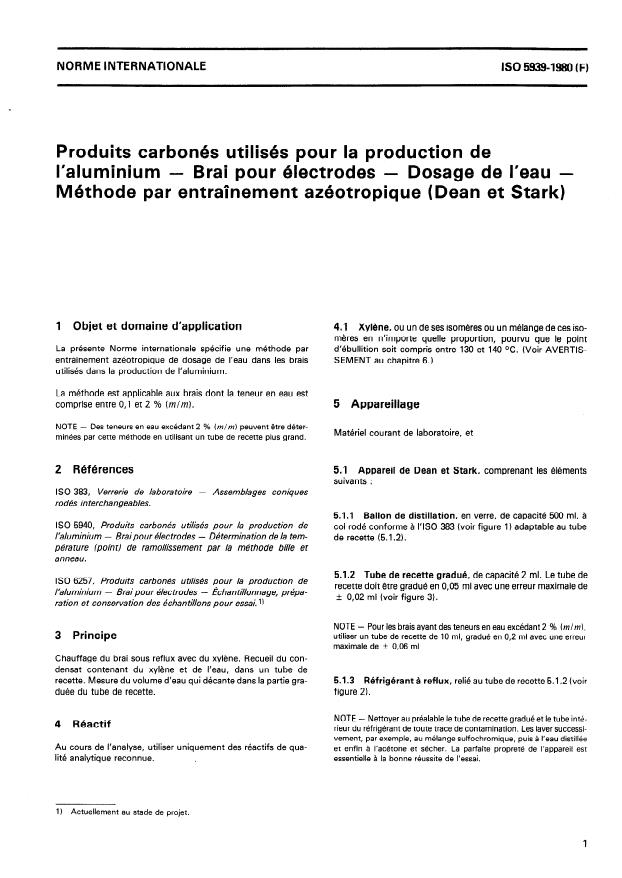
1 Objet et domaine d’application
mères en n’importe quelle proportion, pourvu que le point
La présente Norme internationale spécifie une méthode par d’ébullition soit compris entre 130 et 140 OC. (Voir AVERTIS-
entraînement azéotropique de dosage de l’eau dans les brais SEMENT au chapitre 6.)
utilisés dans la production de l’aluminium.
La méthode est applicable aux brais dont la teneur en eau est
5 Appareillage
comprise entre 0,l et 2 % (mlm).
NOTE - Des teneurs en eau excédant 2 % (mlm) peuvent être déter-
Matériel courant de laboratoire, et
minées par cette méthode en utilisant un tube de recette plus grand.
5.1 Appareil de Dean et Stark, comprenant les éléments
2 Références
suivants :
ISO 383, Verrerie de laboratoire - Assemblages coniques
rodés in terchangeables.
5.1.1 Ballon de distillation, en verre, de capacité 500 ml, à
ISO 5940, Produits carbonés utilisés pour la production de col rodé conforme à I’ISO 383 (voir figure 1) adaptable au tube
- Brai pour électrodes - Détermination de la tem-
l’aluminium de recette (5.1.2).
pérature (pain tl de ramollissement par la méthode bille et
anneau.
Tube de recette gradué, de capacité 2 ml. Le tube de
5.1.2
ISO 6257, Produits carbonés utilisés pour la production de
recette doit être gradué en 0,05 ml avec une erreur maximale de
l’aluminium - Brai pour électrodes - Échantillonnage, prépa-
+ 0,02 ml (voir figure 3).
ration et conservation des échantillons pour essai.‘)
NOTE - Pour les brais ayant des teneurs en eau excédant 2 % (mlm),
utiliser un tube de recette de 10 ml, gradué en 0,2 ml avec une erreur
3 Principe
maximale de + 0,06 ml
Chauffage du brai sous reflux avec du xylène. Recueil du con-
densat contenant du xylène et de l’eau, dans un tube de
5.1.3 Réfrigérant à reflux, relié au tube de recette 5.1.2 (voir
recette. Mesure du volume d’eau qui décante dans la partie gra-
figure 2).
duée du tube de recette.
NOTE - Nettoyer au préalable le tube de recette gradué et le tube in&
4 Réactif
rieur du réfrigérant de toute trace de contamination. Les laver successi-
vement, par exemple, au mélange sulfochromique, puis à l’eau distillée
Au cours de l’analyse, utiliser uniquement des réactifs de qua- et enfin à l’acétone et sécher. La parfaite propreté de l’appareil est
essentielle à la bonne réussite de l’essai.
lité analytique reconnue.
.
1) Actuellement au stade de projet.
ISO 59394980 (F)
6 Mode opératoire
7 Expression des
...
Norme internationale
INTERNATIONAL ORGANIZATION FOR STANDARDIZATION.MEX~YHAPO~HAR OPI-AHM3AUMfl Il0 CTAH~APTM3AL(MM.ORGANISATION INTERNATIONALE DE NORMALISATION
Produits carbonés utilisés pour la production de
l’aluminium - Brai pour électrodes - Dosage de l’eau -
Méthode par entraînement azéotropique (Dean et Stark)
Determina tion of water content - Azeo tropic
Carbonaceous materials for the production of aluminium - Pitch for electrodes -
distillation (Dean and Stark) method
Première édition - 1980-07-15
CDU 665.775 : 669.713.7 : 543.812
Réf. no : ISO 59394980 (F)
Descripteurs : brai, électrode, analyse chimique,
dosage, eau, appareil de Dean et Star-k.
Prix basé sur 5 pages
Avant-propos
L’ISO (Organisation internationale de normalisation) est une fédération mondiale
d’organismes nationaux de normalisation (comités membres de I’ISO). L’élaboration
des Normes internationales est confiée aux comités techniques de I’ISO. Chaque
comité membre intéressé par une étude a le droit de faire partie du comité technique
correspondant. Les organisations internationales, gouvernementales et non gouverne-
mentales, en liaison avec I’ISO, participent également aux travaux.
Les projets de Normes internationales adoptés par les comités techniques sont soumis
aux comités membres pour approbation, avant leur acceptation comme Normes inter-
nationales par le Conseil de I’ISO.
La Norme internationale ISO 5939 a été élaborée par le comité technique ISO/TC 47,
Chimie, et a été soumise aux comités membres en novembre 1978.
Les comités membres des pays suivants l’ont approuvée :
Afrique du Sud, Rép. d’ Hongrie Suède
Allemagne, R. F. Inde Suisse
Australie Israël
Tchécoslovaquie
Belgique Italie Thailande
Bulgarie Mexique
Turquie
Canada Nouvelle-Zélande URSS
Corée, Rép. de Pologne USA
Égypte, Rép. arabe d’ Roumanie
France Royaume-Uni
Le comité membre du pays suivant l’a désapprouvée pour des raisons techniques :
Pays- Bas
Organisation internationale de normalisation, 1980
Imprimé en Suisse
ISO 5939-1980 (F)
NORME INTERNATIONALE
Produits carbonés utilisés pour, la production de
- Brai pour électrodes - Dosage de l’eau -
l’aluminium
Méthode par entraînement azéotropique (Dean et Stark)
4.1 Xylène, ou un de ses isoméres ou un mélange de ces iso-
1 Objet et domaine d’application
mères en n’importe quelle proportion, pourvu que le point
La présente Norme internationale spécifie une méthode par d’ébullition soit compris entre 130 et 140 OC. (Voir AVERTIS-
entraînement azéotropique de dosage de l’eau dans les brais SEMENT au chapitre 6.)
utilisés dans la production de l’aluminium.
La méthode est applicable aux brais dont la teneur en eau est
5 Appareillage
comprise entre 0,l et 2 % (mlm).
NOTE - Des teneurs en eau excédant 2 % (mlm) peuvent être déter-
Matériel courant de laboratoire, et
minées par cette méthode en utilisant un tube de recette plus grand.
5.1 Appareil de Dean et Stark, comprenant les éléments
2 Références
suivants :
ISO 383, Verrerie de laboratoire - Assemblages coniques
rodés in terchangeables.
5.1.1 Ballon de distillation, en verre, de capacité 500 ml, à
ISO 5940, Produits carbonés utilisés pour la production de col rodé conforme à I’ISO 383 (voir figure 1) adaptable au tube
- Brai pour électrodes - Détermination de la tem-
l’aluminium de recette (5.1.2).
pérature (pain tl de ramollissement par la méthode bille et
anneau.
Tube de recette gradué, de capacité 2 ml. Le tube de
5.1.2
ISO 6257, Produits carbonés utilisés pour la production de
recette doit être gradué en 0,05 ml avec une erreur maximale de
l’aluminium - Brai pour électrodes - Échantillonnage, prépa-
+ 0,02 ml (voir figure 3).
ration et conservation des échantillons pour essai.‘)
NOTE - Pour les brais ayant des teneurs en eau excédant 2 % (mlm),
utiliser un tube de recette de 10 ml, gradué en 0,2 ml avec une erreur
3 Principe
maximale de + 0,06 ml
Chauffage du brai sous reflux avec du xylène. Recueil du con-
densat contenant du xylène et de l’eau, dans un tube de
5.1.3 Réfrigérant à reflux, relié au tube de recette 5.1.2 (voir
recette. Mesure du volume d’eau qui décante dans la partie gra-
figure 2).
duée du tube de recette.
NOTE - Nettoyer au préalable le tube de recette gradué et le tube in&
4 Réactif
rieur du réfrigérant de toute trace de contamination. Les laver successi-
vement, par exemple, au mélange sulfochromique, puis à l’eau distillée
Au cours de l’analyse, utiliser uniquement des réactifs de qua- et enfin à l’acétone et sécher. La parfaite propreté de l’appareil est
essentielle à la bonne réussite de l’essai.
lité analytique reconnue.
.
1) Actuellement au stade de projet.
ISO 59394980 (F)
6 Mode opératoire
7 Expression des
...