

ISO 20636:2018
(Main)Infant formula and adult nutritionals — Determination of vitamin D by liquid chromatography-mass spectrometry
General Information
- Abstract
This document specifies a method for the quantitative determination of vitamin D2 and/or vitamin D3 in infant formula, and adult nutritionals in solid (i.e. powders) or liquid (i.e. ready-to-feed liquids and liquid concentrates) forms using liquid chromatography-mass spectrometry. The application range runs from 0,15 µg/100 g (limit of quantification) to 59 µg/100 g for vitamin D2 and from 0,25 µg/100 g to 65 µg/100 g for vitamin D3.
- Status
- Published
- Publication Date
- 01-Jul-2018
- Technical Committee
- ISO/TC 34 - Food products
- Drafting Committee
- ISO/TC 34/WG 14 - Vitamins, carotenoids and other nutrients
- Current Stage
- 9093 - International Standard confirmed
- Start Date
- 20-Dec-2023
- Completion Date
- 29-Aug-2026
Buy Documents



ISO 20636:2018 - Infant formula and adult nutritionals -- Determination of vitamin D by liquid chromatography-mass spectrometry
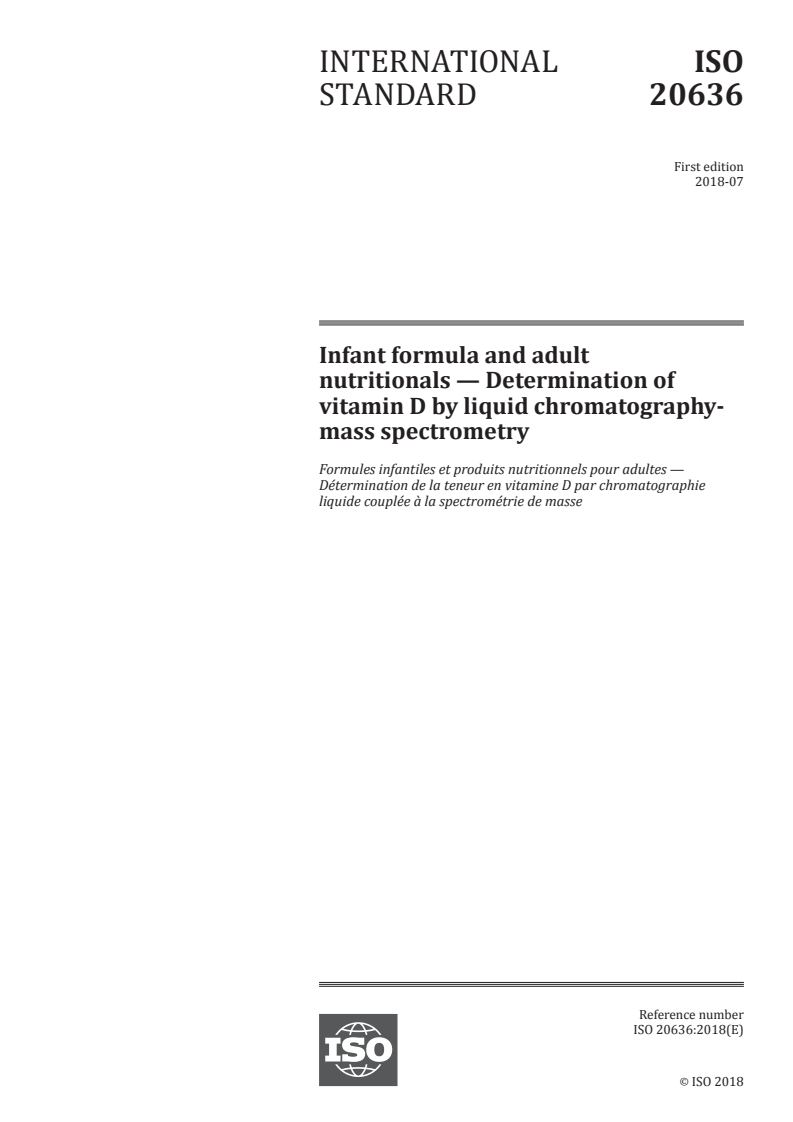
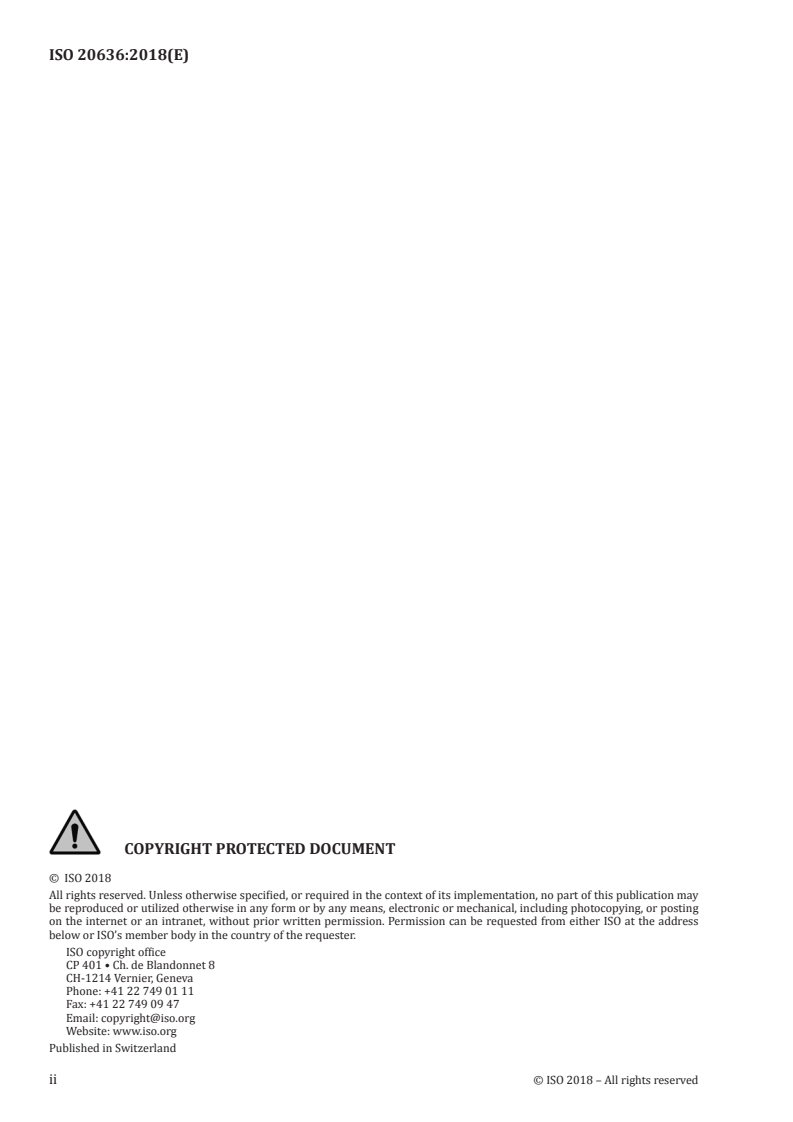
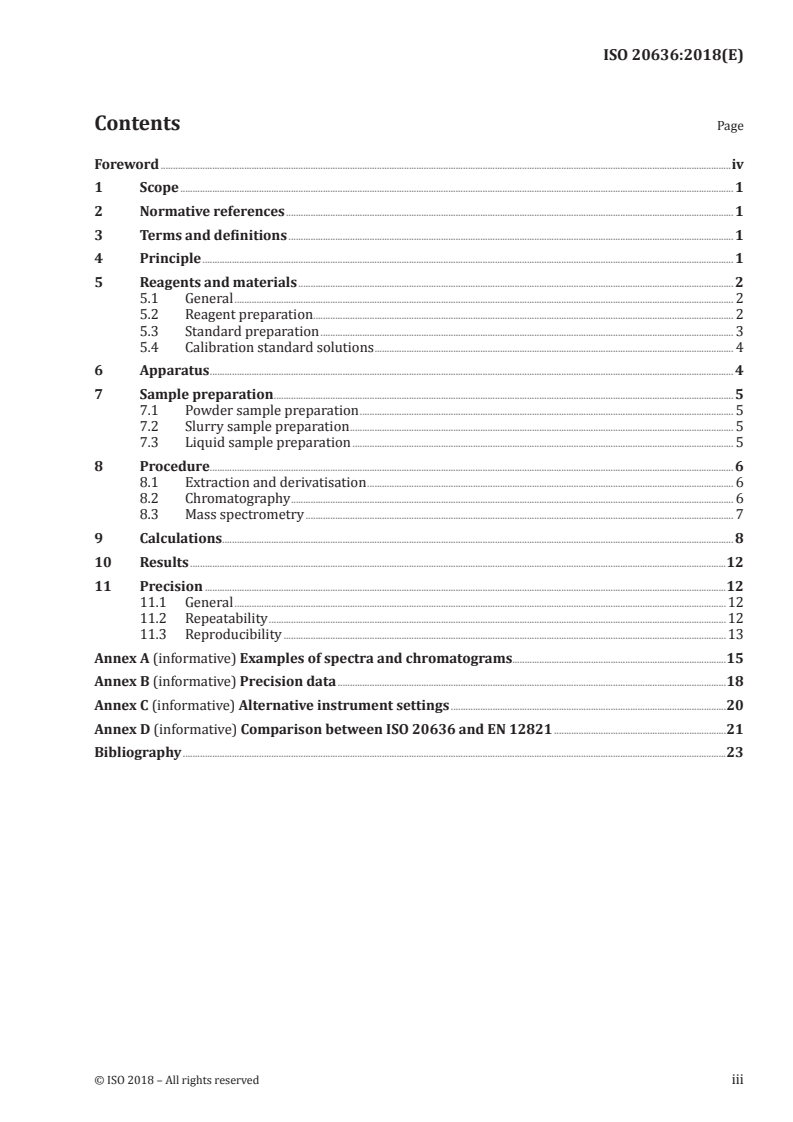
ISO 20636:2018 - Infant formula and adult nutritionals — Determination of vitamin D by liquid chromatography-mass spectrometry/2/2018



ISO 20636:2018 - Formules infantiles et produits nutritionnels pour adultes -- Détermination de la teneur en vitamine D par chromatographie liquide couplée a la spectrométrie de masse

ISO 20636:2018 - Formules infantiles et produits nutritionnels pour adultes — Détermination de la teneur en vitamine D par chromatographie liquide couplée à la spectrométrie de masse/20/2018
Overview
ISO 20636:2018 - Infant formula and adult nutritionals: Determination of vitamin D by liquid chromatography‑mass spectrometry (LC‑MS) specifies a validated analytical method for the quantitative determination of vitamin D2 (ergocalciferol) and vitamin D3 (cholecalciferol) in powdered and liquid infant formulas and adult nutritional products. The method covers sample types including powders, ready‑to‑feed liquids and liquid concentrates, with application ranges from 0.15 µg/100 g (LOQ) to 59 µg/100 g for vitamin D2 and 0.25 µg/100 g to 65 µg/100 g for vitamin D3.
Key topics and technical requirements
- Analytical principle: alkaline saponification → extraction into isooctane → PTAD derivatisation → re‑extraction into acetonitrile → reversed‑phase LC separation → detection by mass spectrometry (MRM).
- Derivatisation reagent: 4‑phenyl‑1,2,4‑triazoline‑3,5‑dione (PTAD) to form easily ionisable vitamin D adducts.
- Internal standards: use of stable isotope labelled d6‑vitamin D2 and d6‑vitamin D3 to correct for extraction, derivatisation and ionisation variability.
- Calibration and quantitation: daily calibration standards prepared with non‑labelled working solutions and labelled internal standards; quantitative ranges and limits of quantification defined in the standard.
- Reagents and instrument requirements: LC‑MS (LC coupled to MS/MS), LC‑MS grade solvents (acetonitrile, methanol, formic acid), isooctane, KOH saponification, PTAD reagent.
- Quality and safety: method includes precision data (repeatability, reproducibility); warns about hazardous materials and the need for laboratory safety practices.
- Sample preparation: procedures for powder, slurry and liquid samples are specified to ensure consistent extraction.
Practical applications
- Routine quality control and specification testing of fortified infant formulas and adult nutritionals.
- Regulatory compliance testing by food safety authorities and third‑party laboratories.
- Product development and stability studies in infant nutrition and medical nutrition formulations.
- Research on vitamin D fortification levels and bioanalytical method validation.
Who should use this standard
- Food testing laboratories and LC‑MS analytical teams
- Infant formula and clinical nutrition manufacturers (QC/R&D)
- Regulatory agencies and inspection bodies
- Accreditation and proficiency testing organizations
Related standards
- ISO 20636:2018 is equivalent to AOAC Official Method 2016.05 (as noted in the introduction).
- Annex D of ISO 20636 provides a comparison with EN 12821, useful for laboratories comparing methods.
Keywords: ISO 20636:2018, vitamin D determination, LC‑MS, infant formula testing, PTAD derivatisation, d6 internal standards, MRM, vitamin D2, vitamin D3.
Relations
- Consolidated By
ISO 14284:2022 - Steel and iron — Sampling and preparation of samples for the determination of chemical composition - Effective Date
- 06-Jun-2022
Buy Documents
ISO 20636:2018 - Infant formula and adult nutritionals -- Determination of vitamin D by liquid chromatography-mass spectrometry
ISO 20636:2018 - Infant formula and adult nutritionals — Determination of vitamin D by liquid chromatography-mass spectrometry/2/2018
ISO 20636:2018 - Formules infantiles et produits nutritionnels pour adultes -- Détermination de la teneur en vitamine D par chromatographie liquide couplée a la spectrométrie de masse
ISO 20636:2018 - Formules infantiles et produits nutritionnels pour adultes — Détermination de la teneur en vitamine D par chromatographie liquide couplée à la spectrométrie de masse/20/2018
Get Certified
Connect with accredited certification bodies for this standard

BSI Group
BSI (British Standards Institution) is the business standards company that helps organizations make excellence a habit.

Bureau Veritas
Bureau Veritas is a world leader in laboratory testing, inspection and certification services.

DNV
DNV is an independent assurance and risk management provider.
Sponsored listings
Frequently Asked Questions
ISO 20636:2018 is a standard published by the International Organization for Standardization (ISO). Its full title is "Infant formula and adult nutritionals — Determination of vitamin D by liquid chromatography-mass spectrometry". This standard covers: This document specifies a method for the quantitative determination of vitamin D2 and/or vitamin D3 in infant formula, and adult nutritionals in solid (i.e. powders) or liquid (i.e. ready-to-feed liquids and liquid concentrates) forms using liquid chromatography-mass spectrometry. The application range runs from 0,15 µg/100 g (limit of quantification) to 59 µg/100 g for vitamin D2 and from 0,25 µg/100 g to 65 µg/100 g for vitamin D3.
This document specifies a method for the quantitative determination of vitamin D2 and/or vitamin D3 in infant formula, and adult nutritionals in solid (i.e. powders) or liquid (i.e. ready-to-feed liquids and liquid concentrates) forms using liquid chromatography-mass spectrometry. The application range runs from 0,15 µg/100 g (limit of quantification) to 59 µg/100 g for vitamin D2 and from 0,25 µg/100 g to 65 µg/100 g for vitamin D3.
ISO 20636:2018 is classified under the following ICS (International Classification for Standards) categories: 67.050 - General methods of tests and analysis for food products. The ICS classification helps identify the subject area and facilitates finding related standards.
ISO 20636:2018 has the following relationships with other standards: It is inter standard links to ISO 14284:2022. Understanding these relationships helps ensure you are using the most current and applicable version of the standard.
ISO 20636:2018 is available in PDF format for immediate download after purchase. The document can be added to your cart and obtained through the secure checkout process. Digital delivery ensures instant access to the complete standard document.
Standards Content (Sample)
INTERNATIONAL ISO
STANDARD 20636
First edition
2018-07
Infant formula and adult
nutritionals — Determination of
vitamin D by liquid chromatography-
mass spectrometry
Formules infantiles et produits nutritionnels pour adultes —
Détermination de la teneur en vitamine D par chromatographie
liquide couplée à la spectrométrie de masse
Reference number
©
ISO 2018
© ISO 2018
All rights reserved. Unless otherwise specified, or required in the context of its implementation, no part of this publication may
be reproduced or utilized otherwise in any form or by any means, electronic or mechanical, including photocopying, or posting
on the internet or an intranet, without prior written permission. Permission can be requested from either ISO at the address
below or ISO’s member body in the country of the requester.
ISO copyright office
CP 401 • Ch. de Blandonnet 8
CH-1214 Vernier, Geneva
Phone: +41 22 749 01 11
Fax: +41 22 749 09 47
Email: copyright@iso.org
Website: www.iso.org
Published in Switzerland
ii © ISO 2018 – All rights reserved
Contents Page
Foreword .iv
1 Scope . 1
2 Normative references . 1
3 Terms and definitions . 1
4 Principle . 1
5 Reagents and materials . 2
5.1 General . 2
5.2 Reagent preparation. 2
5.3 Standard preparation . 3
5.4 Calibration standard solutions . 4
6 Apparatus . 4
7 Sample preparation . 5
7.1 Powder sample preparation . 5
7.2 Slurry sample preparation . 5
7.3 Liquid sample preparation . 5
8 Procedure. 6
8.1 Extraction and derivatisation . 6
8.2 Chromatography . 6
8.3 Mass spectrometry . 7
9 Calculations. 8
10 Results .12
11 Precision .12
11.1 General .12
11.2 Repeatability .12
11.3 Reproducibility .13
Annex A (informative) Examples of spectra and chromatograms.15
Annex B (informative) Precision data .18
Annex C (informative) Alternative instrument settings .20
Annex D (informative) Comparison between ISO 20636 and EN 12821 .21
Bibliography .23
Foreword
ISO (the International Organization for Standardization) is a worldwide federation of national standards
bodies (ISO member bodies). The work of preparing International Standards is normally carried out
through ISO technical committees. Each member body interested in a subject for which a technical
committee has been established has the right to be represented on that committee. International
organizations, governmental and non-governmental, in liaison with ISO, also take part in the work.
ISO collaborates closely with the International Electrotechnical Commission (IEC) on all matters of
electrotechnical standardization.
The procedures used to develop this document and those intended for its further maintenance are
described in the ISO/IEC Directives, Part 1. In particular, the different approval criteria needed for the
different types of ISO documents should be noted. This document was drafted in accordance with the
editorial rules of the ISO/IEC Directives, Part 2 (see www .iso .org/directives).
Attention is drawn to the possibility that some of the elements of this document may be the subject of
patent rights. ISO shall not be held responsible for identifying any or all such patent rights. Details of
any patent rights identified during the development of the document will be in the Introduction and/or
on the ISO list of patent declarations received (see www .iso .org/patents).
Any trade name used in this document is information given for the convenience of users and does not
constitute an endorsement.
For an explanation of the voluntary nature of standards, the meaning of ISO specific terms and
expressions related to conformity assessment, as well as information about ISO's adherence to the
World Trade Organization (WTO) principles in the Technical Barriers to Trade (TBT) see www .iso
.org/iso/foreword .html.
This document was prepared by Technical Committee ISO/TC 34, Food products, in collaboration
with AOAC INTERNATIONAL. It is being published by ISO and separately by AOAC INTERNATIONAL.
The method described in this document is equivalent to the AOAC Official Method 2016.05, Analysis
of Vitamin D and Vitamin D in Fortified Milk Powders, Infant Formulas, and Adult/Pediatric Nutritional
2 3
Formulas.
Any feedback or questions on this document should be directed to the user’s national standards body. A
complete listing of these bodies can be found at www .iso .org/members .html.
iv © ISO 2018 – All rights reserved
INTERNATIONAL STANDARD ISO 20636:2018(E)
Infant formula and adult nutritionals — Determination of
vitamin D by liquid chromatography-mass spectrometry
WARNING — The use of this method can involve hazardous materials, operations and equipment.
This method does not purport to address all the safety problems associated with its use. It is the
responsibility of the user of this method to establish appropriate safety and health practices.
1 Scope
This document specifies a method for the quantitative determination of vitamin D and/or vitamin D
2 3
in infant formula, and adult nutritionals in solid (i.e. powders) or liquid (i.e. ready-to-feed liquids and
liquid concentrates) forms using liquid chromatography-mass spectrometry. The application range
runs from 0,15 µg/100 g (limit of quantification) to 59 µg/100 g for vitamin D and from 0,25 µg/100 g
to 65 µg/100 g for vitamin D .
2 Normative references
There are no normative references in this document.
3 Terms and definitions
For the purposes of this document, the following terms and definitions apply.
ISO and IEC maintain terminological databases for use in standardization at the following addresses:
— ISO Online browsing platform: available at https: //www .iso .org/obp
— IEC Electropedia: available at http: //www .electropedia .org/
3.1
adult nutritional
nutritionally complete, specially formulated food, consumed in liquid form, which may constitute the
sole source of nourishment, made from any combination of milk, soy, rice, whey, hydrolysed protein,
starch and amino acids, with and without intact protein
3.2
infant formula
breast-milk substitute specially manufactured to satisfy, by itself, the nutritional requirements of
infants during the first months of life up to the introduction of appropriate complementary feeding
[SOURCE: CODEX STAN 72-1981]
4 Principle
Samples are saponified at high temperature then lipid soluble components are extracted into isooctane.
A portion of the isooctane layer is transferred, washed, and an aliquot of 4-phenyl-1,2,4-triazoline-3,5-
dione (PTAD) is added to derivatise vitamin D to form a high molecular mass, easily ionisable adduct.
The vitamin D-adduct is then re extracted into a small volume of acetonitrile and analysed by reversed-
phase liquid chromatography. Detection is by mass spectrometry using multiple reaction monitoring
(MRM). Stable isotope labelled d6-vitamin D and d6-vitamin D internal standards are used for
2 3
quantitation to correct for losses in extraction and any variation in derivatisation and ionisation
[2]
efficiencies .
5 Reagents and materials
During the analysis, unless otherwise stated, use only reagents of recognized analytical grade and
distilled or demineralized water or water of equivalent purity.
5.1 General
5.1.1 Standards, ≥99 % pure.
5.1.2 Vitamin D , ergocalciferol.
5.1.3 Vitamin D , cholecalciferol.
5.1.4 d6-Vitamin D , 26,26,26,27,27,27-d6 ergocalciferol.
5.1.5 d6-Vitamin D , 26,26,26,27,27,27-d6 cholecalciferol.
5.1.6 PTAD (4-phenyl-1,2,4-triazoline-3,5-dione).
5.1.7 Formic acid (HCO H), LC-MS grade.
5.1.8 Potassium hydroxide (KOH).
5.1.9 Pyrogallol (C H (OH) ).
6 3 3
5.1.10 Ethanol (C H OH).
2 5
5.1.11 Methanol (CH OH), LC-MS grade.
5.1.12 Isooctane ((CH ) CCH CH(CH ) ).
3 3 2 3 2
5.1.13 Acetone (CH COCH ).
3 3
5.1.14 Acetonitrile (CH CN), LC-MS grade.
5.2 Reagent preparation
5.2.1 PTAD solution, c(4-phenyl-1,2,4-triazoline-3,5-dione) = 10 mg/ml. Dissolve 50 mg PTAD (5.1.6)
in 5,0 ml acetone (5.1.13).
5.2.2 Potassium hydroxide solution, c(KOH) = 8,9 mol/l. Dissolve 100 g potassium hydroxide (5.1.8)
in 200 ml water.
5.2.3 Ethanolic pyrogallol solution, c(C H (OH) ) = 0,079 mol/l. Dissolve 5 g pyrogallol (5.1.9) in
6 3 3
500 ml ethanol (5.1.10).
5.2.4 Mobile phase A, c(HCO H) = 0,026 5 mol/l. To 500 ml of water, add 0,5 ml formic acid (5.1.7).
5.2.5 Mobile phase B, methanol, 500 ml (5.1.11).
2 © ISO 2018 – All rights reserved
5.3 Standard preparation
5.3.1 Vitamin D is sensitive to light. Perform all steps under low-level incandescent lighting. If exclusively
vitamin D is required for analysis, then standards pertaining to vitamin D need not be used and vice
3 2
versa. Calibration standards should be bracketed at the beginning and at the end of an analytical run.
5.3.2 Vitamin D stable isotope labelled stock standard solution, ρ ≈ 10 μg/ml. Dispense the
contents of a 1 mg vial of d6-vitamin D (5.1.4) into a 100 ml volumetric flask. Dissolve in 90 ml of ethanol
(5.1.10). To promote dissolution, sonicate if necessary. Mix thoroughly, make up to volume with ethanol
(5.1.10). Measure the absorbance of an aliquot at 265 nm. The spectrophotometer should be zeroed
against an ethanol (5.1.10) blank solution. Calculate and record concentration. Immediately dispense
aliquots (~1,3 ml) into cryogenic vials and freeze at < –15 °C for up to 6 months.
5.3.3 Vitamin D stable isotope labelled stock standard solution, ρ ≈ 10 μg/ml. Dispense the
contents of a 1 mg vial of d6-vitamin D (5.1.5) into a 100 ml volumetric flask. Dissolve in 90 ml of ethanol
(5.1.10). To promote dissolution, sonicate if necessary. Mix thoroughly, make up to volume with ethanol
(5.1.10). Measure the absorbance of an aliquot at 265 nm. The spectrophotometer should be zeroed
against an ethanol (5.1.10) blank solution. Calculate and record concentration. Immediately dispense
aliquots (~1,3 ml) into cryogenic vials and freeze at < –15 °C for up to 6 months.
5.3.4 Stable isotope labelled internal standard solution, ρ ≈ 1 μg/ml. Depending on the number
of samples that need to be analysed in a run, more or less stable isotope labelled internal standard
solution needs to be made up. For every 15 samples (or part thereof) in an analytical run, remove 1 vial
of Vitamin D stable isotope labelled stock standard solution (5.3.2) and/or 1 vial of Vitamin D stable
2 3
isotope labelled stock standard solution (5.3.3) from the freezer and allow to warm to room temperature.
Pipette 1,0 ml of vitamin D stable isotope labelled stock standard solution (5.3.2) and/or 1,0 ml of
vitamin D stable isotope labelled stock standard solution (5.3.3) into a 10 ml volumetric flask (use a
separate 10 ml volumetric flask for each set of 15 samples). Make each 10 ml volumetric flask to volume
with acetonitrile, pool together and mix thoroughly. Make fresh daily.
5.3.5 Vitamin D non-labelled stock standard solution, ρ ≈ 1 mg/ml. Weigh accurately,
approximately 50 mg of vitamin D (5.1.2) into a 50 ml volumetric flask. Dissolve in 40 ml of ethanol
(5.1.10). To promote dissolution, sonicate if necessary. Mix thoroughly, make up to volume with ethanol
(5.1.10). Store in freezer at < –15 °C for up to 1 month.
5.3.6 Vitamin D non-labelled stock standard solution, ρ ≈ 1 mg/ml. Weigh accurately,
approximately 50 mg of vitamin D (5.1.3) into a 50 ml volumetric flask. Dissolve in 40 ml of ethanol
(5.1.10). To promote dissolution, sonicate if necessary. Mix thoroughly, make up to volume with ethanol
(5.1.10). Store in freezer at < −15 °C for up to 1 month.
5.3.7 Vitamin D non-labelled purity standard solution, ρ ≈ 10 μg/ml. Pipette 1,0 ml of vitamin D
2 2
non-labelled stock standard solution (5.3.5) into a 100 ml volumetric flask. Make to volume with ethanol
(5.1.10). Measure the absorbance of an aliquot at 265 nm. The spectrophotometer should be zeroed against
an ethanol (5.1.10) blank solution. Record absorbance and calculate concentration. Make fresh daily.
5.3.8 Vitamin D non-labelled purity standard solution, ρ ≈ 10 μg/ml. Pipette 1,0 ml of vitamin D
3 3
non-labelled stock standard solution (5.3.6) into a 100 ml volumetric flask. Make to volume with ethanol
(5.1.10). Measure the absorbance of an aliquot at 265 nm. The spectrophotometer should be zeroed against
an ethanol (5.1.10) blank solution. Record absorbance and calculate concentration. Make fresh daily.
5.3.9 Non-labelled working standard solution, ρ ≈ 1 μg/ml. Pipette 1,0 ml of vitamin D non-
labelled purity standard solution (5.3.7) and/or 1,0 ml of vitamin D non-labelled purity standard
solution (5.3.8) into a 10 ml volumetric flask. Make to volume with acetonitrile (5.1.14) and mix
thoroughly. Make fresh daily.
5.4 Calibration standard solutions
5.4.1 See Table 1 for nominal vitamin D concentrations of the calibration standard solutions. Make
fresh daily.
5.4.2 Calibration standard 1. Pipette 10 μl non-labelled working standard solution (5.3.9) and 250 μl
stable isotope labelled internal standard solution (5.3.4) into a 25 ml volumetric flask. Add 5 ml of
acetonitrile (5.1.14) and 75 µl of PTAD solution (5.2.1), shake to mix and leave in the dark for 5 min. Add
6,25 ml of water then make to volume with acetonitrile (5.1.14), mix, and transfer to HPLC vial ready for
analysis.
5.4.3 Calibration standard 2. Pipette 50 μl non-labelled working standard solution (5.3.9) and 250 μl
ntable isotope labelled internal standard solution (5.3.4) into a 25 ml volumetric flask. Add 5 ml of
acetonitrile (5.1.14) and 75 µl of PTAD solution (5.2.1), shake to mix and leave in the dark for 5 min. Add
6,25 ml of water then make to volume with acetonitrile (5.1.14), mix, and transfer to HPLC vial ready for
analysis.
5.4.4 Calibration standard 3. Pipette 250 μl non-labelled working standard solution (5.3.9) and
250 μl stable isotope labelled internal standard solution (5.3.4) into a 25 ml volumetric flask. Add 5 ml of
acetonitrile (5.1.14) and 75 µl of PTAD solution (5.2.1), shake to mix and leave in the dark for 5 min. Add
6,25 ml of water then make to volume with acetonitrile (5.1.14), mix, and transfer to HPLC vial ready for
analysis.
5.4.5 Calibration standard 4. Pipette 500 μl non-labelled working standard solution (5.3.9) and
250 μl stable isotope labelled internal standard solution (5.3.4) into a 25 ml volumetric flask. Add 5 ml of
acetonitrile (5.1.14) and 75 µl of PTAD solution (5.2.1), shake to mix and leave in the dark for 5 min. Add
6,25 ml of water then make to volume with acetonitrile (5.1.14), mix, and transfer to HPLC vial ready for
analysis.
5.4.6 Calibration standard 5. Pipette 1 250 μl non-labelled working standard solution (5.3.9) and
250 μl stable isotope labelled internal standard solution (5.3.4) into a 25 ml volumetric flask. Add 5 ml of
acetonitrile (5.1.14) and 75 µl of PTAD solution (5.2.1), shake to mix and leave in the dark for 5 min. Add
6,25 ml of water then make to volume with acetonitrile (5.1.14), mix, and transfer to HPLC vial ready for
analysis.
Table 1 — Nominal concentration of calibration standards
Concentration of vitamin D Concentration of d6-vitamin D
Calibration solution
ng/ml ng/ml
1 0,4 10
2 2,0 10
3 10 10
4 20 10
5 50 10
6 Apparatus
Usual laboratory glassware an equipment and, in particular, the following.
6.1 Ultra high performance liquid chromatography (UHPLC) system, consisting of dual pump
system, a sample injector unit, a degasser unit, and a column oven.
6.2 Triple quadrupole mass spectrometer, with sufficient sensitivity to detect and quantify vitamin
D in PTAD adduct at 0,4 ng/ml.
4 © ISO 2018 – All rights reserved
1)
6.3 Solid core silica column, e.g. Phenomenex Kinetex C 2,6 μm, 2,1 mm × 50 mm, or equivalent.
6.4 Spectrophotometer, capable of digital readout to three decimal places.
6.5 Centrifuge tubes, polypropylene, 15 ml.
6.6 Boiling tubes, glass, 60 ml.
6.7 Water bath, 20 °C to 70 °C.
6.8 Disposable syringes, capacity 1 ml.
6.9 Syringe filters, PTFE, 0,2 µm, 13 mm.
6.10 Centrifuges, suitable for 60 ml boiling tubes, and 15 ml centrifuge tubes.
6.11 Pasteur pipettes, glass, ~140 mm.
6.12 Horizontal shaker.
6.13 Micro centrifuge tubes, 2 ml.
6.14 Filter membranes, 0,45 µm polyamide.
6.15 Cryogenic vials, 2 ml.
6.16 High performance liquid chromatography (HPLC) vials, septa, and caps.
7 Sample preparation
7.1 Powder sample preparation
Accurately weigh 1,8 g to 2,2 g of powder sample into a boiling tube. Record mass.
7.2 Slurry sample preparation
Accurately weigh 19,0 g to 21,0 g of powder to a disposable slurry container. Record mass.
Accurately weigh ~80 ml water to container. Record mass.
Shake thoroughly until mixed. Place in the dark at room temperature for 15 min and shake to mix
every 5 min.
Accurately weigh 9,5 g to 10,5 g of slurry or reconstituted powder sample into a boiling tube. Record mass.
7.3 Liquid sample preparation
Accurately weigh 10,0 ml of liquid milk into a boiling tube. Record mass.
1) This is an example of a suitable product available commercially. This information is given for the convenience of
users of this document and does not constitute an endorsement by ISO of this product.
8 Procedure
8.1 Extraction and derivatisation
To powder, slurry, or liquid sample in a boiling tube, add 10 ml of ethanolic pyrogallol solution (5.2.3),
and 0,5 ml of stable isotope labelled internal standard solution (5.3.4), cap and vortex mix.
Add 2 ml of potassium hydroxide solution (5.2.2) to boiling tube, cap and vortex mix.
Place boiling tube in water bath at 70 °C for 1 h, vortex mix every 15 min.
Place boiling tube in water bath at room temperature until cool
...
INTERNATIONAL ISO
STANDARD 20636
First edition
2018-07
Infant formula and adult
nutritionals — Determination of
vitamin D by liquid chromatography-
mass spectrometry
Formules infantiles et produits nutritionnels pour adultes —
Détermination de la teneur en vitamine D par chromatographie
liquide couplée à la spectrométrie de masse
Reference number
©
ISO 2018
© ISO 2018
All rights reserved. Unless otherwise specified, or required in the context of its implementation, no part of this publication may
be reproduced or utilized otherwise in any form or by any means, electronic or mechanical, including photocopying, or posting
on the internet or an intranet, without prior written permission. Permission can be requested from either ISO at the address
below or ISO’s member body in the country of the requester.
ISO copyright office
CP 401 • Ch. de Blandonnet 8
CH-1214 Vernier, Geneva
Phone: +41 22 749 01 11
Fax: +41 22 749 09 47
Email: copyright@iso.org
Website: www.iso.org
Published in Switzerland
ii © ISO 2018 – All rights reserved
Contents Page
Foreword .iv
1 Scope . 1
2 Normative references . 1
3 Terms and definitions . 1
4 Principle . 1
5 Reagents and materials . 2
5.1 General . 2
5.2 Reagent preparation. 2
5.3 Standard preparation . 3
5.4 Calibration standard solutions . 4
6 Apparatus . 4
7 Sample preparation . 5
7.1 Powder sample preparation . 5
7.2 Slurry sample preparation . 5
7.3 Liquid sample preparation . 5
8 Procedure. 6
8.1 Extraction and derivatisation . 6
8.2 Chromatography . 6
8.3 Mass spectrometry . 7
9 Calculations. 8
10 Results .12
11 Precision .12
11.1 General .12
11.2 Repeatability .12
11.3 Reproducibility .13
Annex A (informative) Examples of spectra and chromatograms.15
Annex B (informative) Precision data .18
Annex C (informative) Alternative instrument settings .20
Annex D (informative) Comparison between ISO 20636 and EN 12821 .21
Bibliography .23
Foreword
ISO (the International Organization for Standardization) is a worldwide federation of national standards
bodies (ISO member bodies). The work of preparing International Standards is normally carried out
through ISO technical committees. Each member body interested in a subject for which a technical
committee has been established has the right to be represented on that committee. International
organizations, governmental and non-governmental, in liaison with ISO, also take part in the work.
ISO collaborates closely with the International Electrotechnical Commission (IEC) on all matters of
electrotechnical standardization.
The procedures used to develop this document and those intended for its further maintenance are
described in the ISO/IEC Directives, Part 1. In particular, the different approval criteria needed for the
different types of ISO documents should be noted. This document was drafted in accordance with the
editorial rules of the ISO/IEC Directives, Part 2 (see www .iso .org/directives).
Attention is drawn to the possibility that some of the elements of this document may be the subject of
patent rights. ISO shall not be held responsible for identifying any or all such patent rights. Details of
any patent rights identified during the development of the document will be in the Introduction and/or
on the ISO list of patent declarations received (see www .iso .org/patents).
Any trade name used in this document is information given for the convenience of users and does not
constitute an endorsement.
For an explanation of the voluntary nature of standards, the meaning of ISO specific terms and
expressions related to conformity assessment, as well as information about ISO's adherence to the
World Trade Organization (WTO) principles in the Technical Barriers to Trade (TBT) see www .iso
.org/iso/foreword .html.
This document was prepared by Technical Committee ISO/TC 34, Food products, in collaboration
with AOAC INTERNATIONAL. It is being published by ISO and separately by AOAC INTERNATIONAL.
The method described in this document is equivalent to the AOAC Official Method 2016.05, Analysis
of Vitamin D and Vitamin D in Fortified Milk Powders, Infant Formulas, and Adult/Pediatric Nutritional
2 3
Formulas.
Any feedback or questions on this document should be directed to the user’s national standards body. A
complete listing of these bodies can be found at www .iso .org/members .html.
iv © ISO 2018 – All rights reserved
INTERNATIONAL STANDARD ISO 20636:2018(E)
Infant formula and adult nutritionals — Determination of
vitamin D by liquid chromatography-mass spectrometry
WARNING — The use of this method can involve hazardous materials, operations and equipment.
This method does not purport to address all the safety problems associated with its use. It is the
responsibility of the user of this method to establish appropriate safety and health practices.
1 Scope
This document specifies a method for the quantitative determination of vitamin D and/or vitamin D
2 3
in infant formula, and adult nutritionals in solid (i.e. powders) or liquid (i.e. ready-to-feed liquids and
liquid concentrates) forms using liquid chromatography-mass spectrometry. The application range
runs from 0,15 µg/100 g (limit of quantification) to 59 µg/100 g for vitamin D and from 0,25 µg/100 g
to 65 µg/100 g for vitamin D .
2 Normative references
There are no normative references in this document.
3 Terms and definitions
For the purposes of this document, the following terms and definitions apply.
ISO and IEC maintain terminological databases for use in standardization at the following addresses:
— ISO Online browsing platform: available at https: //www .iso .org/obp
— IEC Electropedia: available at http: //www .electropedia .org/
3.1
adult nutritional
nutritionally complete, specially formulated food, consumed in liquid form, which may constitute the
sole source of nourishment, made from any combination of milk, soy, rice, whey, hydrolysed protein,
starch and amino acids, with and without intact protein
3.2
infant formula
breast-milk substitute specially manufactured to satisfy, by itself, the nutritional requirements of
infants during the first months of life up to the introduction of appropriate complementary feeding
[SOURCE: CODEX STAN 72-1981]
4 Principle
Samples are saponified at high temperature then lipid soluble components are extracted into isooctane.
A portion of the isooctane layer is transferred, washed, and an aliquot of 4-phenyl-1,2,4-triazoline-3,5-
dione (PTAD) is added to derivatise vitamin D to form a high molecular mass, easily ionisable adduct.
The vitamin D-adduct is then re extracted into a small volume of acetonitrile and analysed by reversed-
phase liquid chromatography. Detection is by mass spectrometry using multiple reaction monitoring
(MRM). Stable isotope labelled d6-vitamin D and d6-vitamin D internal standards are used for
2 3
quantitation to correct for losses in extraction and any variation in derivatisation and ionisation
[2]
efficiencies .
5 Reagents and materials
During the analysis, unless otherwise stated, use only reagents of recognized analytical grade and
distilled or demineralized water or water of equivalent purity.
5.1 General
5.1.1 Standards, ≥99 % pure.
5.1.2 Vitamin D , ergocalciferol.
5.1.3 Vitamin D , cholecalciferol.
5.1.4 d6-Vitamin D , 26,26,26,27,27,27-d6 ergocalciferol.
5.1.5 d6-Vitamin D , 26,26,26,27,27,27-d6 cholecalciferol.
5.1.6 PTAD (4-phenyl-1,2,4-triazoline-3,5-dione).
5.1.7 Formic acid (HCO H), LC-MS grade.
5.1.8 Potassium hydroxide (KOH).
5.1.9 Pyrogallol (C H (OH) ).
6 3 3
5.1.10 Ethanol (C H OH).
2 5
5.1.11 Methanol (CH OH), LC-MS grade.
5.1.12 Isooctane ((CH ) CCH CH(CH ) ).
3 3 2 3 2
5.1.13 Acetone (CH COCH ).
3 3
5.1.14 Acetonitrile (CH CN), LC-MS grade.
5.2 Reagent preparation
5.2.1 PTAD solution, c(4-phenyl-1,2,4-triazoline-3,5-dione) = 10 mg/ml. Dissolve 50 mg PTAD (5.1.6)
in 5,0 ml acetone (5.1.13).
5.2.2 Potassium hydroxide solution, c(KOH) = 8,9 mol/l. Dissolve 100 g potassium hydroxide (5.1.8)
in 200 ml water.
5.2.3 Ethanolic pyrogallol solution, c(C H (OH) ) = 0,079 mol/l. Dissolve 5 g pyrogallol (5.1.9) in
6 3 3
500 ml ethanol (5.1.10).
5.2.4 Mobile phase A, c(HCO H) = 0,026 5 mol/l. To 500 ml of water, add 0,5 ml formic acid (5.1.7).
5.2.5 Mobile phase B, methanol, 500 ml (5.1.11).
2 © ISO 2018 – All rights reserved
5.3 Standard preparation
5.3.1 Vitamin D is sensitive to light. Perform all steps under low-level incandescent lighting. If exclusively
vitamin D is required for analysis, then standards pertaining to vitamin D need not be used and vice
3 2
versa. Calibration standards should be bracketed at the beginning and at the end of an analytical run.
5.3.2 Vitamin D stable isotope labelled stock standard solution, ρ ≈ 10 μg/ml. Dispense the
contents of a 1 mg vial of d6-vitamin D (5.1.4) into a 100 ml volumetric flask. Dissolve in 90 ml of ethanol
(5.1.10). To promote dissolution, sonicate if necessary. Mix thoroughly, make up to volume with ethanol
(5.1.10). Measure the absorbance of an aliquot at 265 nm. The spectrophotometer should be zeroed
against an ethanol (5.1.10) blank solution. Calculate and record concentration. Immediately dispense
aliquots (~1,3 ml) into cryogenic vials and freeze at < –15 °C for up to 6 months.
5.3.3 Vitamin D stable isotope labelled stock standard solution, ρ ≈ 10 μg/ml. Dispense the
contents of a 1 mg vial of d6-vitamin D (5.1.5) into a 100 ml volumetric flask. Dissolve in 90 ml of ethanol
(5.1.10). To promote dissolution, sonicate if necessary. Mix thoroughly, make up to volume with ethanol
(5.1.10). Measure the absorbance of an aliquot at 265 nm. The spectrophotometer should be zeroed
against an ethanol (5.1.10) blank solution. Calculate and record concentration. Immediately dispense
aliquots (~1,3 ml) into cryogenic vials and freeze at < –15 °C for up to 6 months.
5.3.4 Stable isotope labelled internal standard solution, ρ ≈ 1 μg/ml. Depending on the number
of samples that need to be analysed in a run, more or less stable isotope labelled internal standard
solution needs to be made up. For every 15 samples (or part thereof) in an analytical run, remove 1 vial
of Vitamin D stable isotope labelled stock standard solution (5.3.2) and/or 1 vial of Vitamin D stable
2 3
isotope labelled stock standard solution (5.3.3) from the freezer and allow to warm to room temperature.
Pipette 1,0 ml of vitamin D stable isotope labelled stock standard solution (5.3.2) and/or 1,0 ml of
vitamin D stable isotope labelled stock standard solution (5.3.3) into a 10 ml volumetric flask (use a
separate 10 ml volumetric flask for each set of 15 samples). Make each 10 ml volumetric flask to volume
with acetonitrile, pool together and mix thoroughly. Make fresh daily.
5.3.5 Vitamin D non-labelled stock standard solution, ρ ≈ 1 mg/ml. Weigh accurately,
approximately 50 mg of vitamin D (5.1.2) into a 50 ml volumetric flask. Dissolve in 40 ml of ethanol
(5.1.10). To promote dissolution, sonicate if necessary. Mix thoroughly, make up to volume with ethanol
(5.1.10). Store in freezer at < –15 °C for up to 1 month.
5.3.6 Vitamin D non-labelled stock standard solution, ρ ≈ 1 mg/ml. Weigh accurately,
approximately 50 mg of vitamin D (5.1.3) into a 50 ml volumetric flask. Dissolve in 40 ml of ethanol
(5.1.10). To promote dissolution, sonicate if necessary. Mix thoroughly, make up to volume with ethanol
(5.1.10). Store in freezer at < −15 °C for up to 1 month.
5.3.7 Vitamin D non-labelled purity standard solution, ρ ≈ 10 μg/ml. Pipette 1,0 ml of vitamin D
2 2
non-labelled stock standard solution (5.3.5) into a 100 ml volumetric flask. Make to volume with ethanol
(5.1.10). Measure the absorbance of an aliquot at 265 nm. The spectrophotometer should be zeroed against
an ethanol (5.1.10) blank solution. Record absorbance and calculate concentration. Make fresh daily.
5.3.8 Vitamin D non-labelled purity standard solution, ρ ≈ 10 μg/ml. Pipette 1,0 ml of vitamin D
3 3
non-labelled stock standard solution (5.3.6) into a 100 ml volumetric flask. Make to volume with ethanol
(5.1.10). Measure the absorbance of an aliquot at 265 nm. The spectrophotometer should be zeroed against
an ethanol (5.1.10) blank solution. Record absorbance and calculate concentration. Make fresh daily.
5.3.9 Non-labelled working standard solution, ρ ≈ 1 μg/ml. Pipette 1,0 ml of vitamin D non-
labelled purity standard solution (5.3.7) and/or 1,0 ml of vitamin D non-labelled purity standard
solution (5.3.8) into a 10 ml volumetric flask. Make to volume with acetonitrile (5.1.14) and mix
thoroughly. Make fresh daily.
5.4 Calibration standard solutions
5.4.1 See Table 1 for nominal vitamin D concentrations of the calibration standard solutions. Make
fresh daily.
5.4.2 Calibration standard 1. Pipette 10 μl non-labelled working standard solution (5.3.9) and 250 μl
stable isotope labelled internal standard solution (5.3.4) into a 25 ml volumetric flask. Add 5 ml of
acetonitrile (5.1.14) and 75 µl of PTAD solution (5.2.1), shake to mix and leave in the dark for 5 min. Add
6,25 ml of water then make to volume with acetonitrile (5.1.14), mix, and transfer to HPLC vial ready for
analysis.
5.4.3 Calibration standard 2. Pipette 50 μl non-labelled working standard solution (5.3.9) and 250 μl
ntable isotope labelled internal standard solution (5.3.4) into a 25 ml volumetric flask. Add 5 ml of
acetonitrile (5.1.14) and 75 µl of PTAD solution (5.2.1), shake to mix and leave in the dark for 5 min. Add
6,25 ml of water then make to volume with acetonitrile (5.1.14), mix, and transfer to HPLC vial ready for
analysis.
5.4.4 Calibration standard 3. Pipette 250 μl non-labelled working standard solution (5.3.9) and
250 μl stable isotope labelled internal standard solution (5.3.4) into a 25 ml volumetric flask. Add 5 ml of
acetonitrile (5.1.14) and 75 µl of PTAD solution (5.2.1), shake to mix and leave in the dark for 5 min. Add
6,25 ml of water then make to volume with acetonitrile (5.1.14), mix, and transfer to HPLC vial ready for
analysis.
5.4.5 Calibration standard 4. Pipette 500 μl non-labelled working standard solution (5.3.9) and
250 μl stable isotope labelled internal standard solution (5.3.4) into a 25 ml volumetric flask. Add 5 ml of
acetonitrile (5.1.14) and 75 µl of PTAD solution (5.2.1), shake to mix and leave in the dark for 5 min. Add
6,25 ml of water then make to volume with acetonitrile (5.1.14), mix, and transfer to HPLC vial ready for
analysis.
5.4.6 Calibration standard 5. Pipette 1 250 μl non-labelled working standard solution (5.3.9) and
250 μl stable isotope labelled internal standard solution (5.3.4) into a 25 ml volumetric flask. Add 5 ml of
acetonitrile (5.1.14) and 75 µl of PTAD solution (5.2.1), shake to mix and leave in the dark for 5 min. Add
6,25 ml of water then make to volume with acetonitrile (5.1.14), mix, and transfer to HPLC vial ready for
analysis.
Table 1 — Nominal concentration of calibration standards
Concentration of vitamin D Concentration of d6-vitamin D
Calibration solution
ng/ml ng/ml
1 0,4 10
2 2,0 10
3 10 10
4 20 10
5 50 10
6 Apparatus
Usual laboratory glassware an equipment and, in particular, the following.
6.1 Ultra high performance liquid chromatography (UHPLC) system, consisting of dual pump
system, a sample injector unit, a degasser unit, and a column oven.
6.2 Triple quadrupole mass spectrometer, with sufficient sensitivity to detect and quantify vitamin
D in PTAD adduct at 0,4 ng/ml.
4 © ISO 2018 – All rights reserved
1)
6.3 Solid core silica column, e.g. Phenomenex Kinetex C 2,6 μm, 2,1 mm × 50 mm, or equivalent.
6.4 Spectrophotometer, capable of digital readout to three decimal places.
6.5 Centrifuge tubes, polypropylene, 15 ml.
6.6 Boiling tubes, glass, 60 ml.
6.7 Water bath, 20 °C to 70 °C.
6.8 Disposable syringes, capacity 1 ml.
6.9 Syringe filters, PTFE, 0,2 µm, 13 mm.
6.10 Centrifuges, suitable for 60 ml boiling tubes, and 15 ml centrifuge tubes.
6.11 Pasteur pipettes, glass, ~140 mm.
6.12 Horizontal shaker.
6.13 Micro centrifuge tubes, 2 ml.
6.14 Filter membranes, 0,45 µm polyamide.
6.15 Cryogenic vials, 2 ml.
6.16 High performance liquid chromatography (HPLC) vials, septa, and caps.
7 Sample preparation
7.1 Powder sample preparation
Accurately weigh 1,8 g to 2,2 g of powder sample into a boiling tube. Record mass.
7.2 Slurry sample preparation
Accurately weigh 19,0 g to 21,0 g of powder to a disposable slurry container. Record mass.
Accurately weigh ~80 ml water to container. Record mass.
Shake thoroughly until mixed. Place in the dark at room temperature for 15 min and shake to mix
every 5 min.
Accurately weigh 9,5 g to 10,5 g of slurry or reconstituted powder sample into a boiling tube. Record mass.
7.3 Liquid sample preparation
Accurately weigh 10,0 ml of liquid milk into a boiling tube. Record mass.
1) This is an example of a suitable product available commercially. This information is given for the convenience of
users of this document and does not constitute an endorsement by ISO of this product.
8 Procedure
8.1 Extraction and derivatisation
To powder, slurry, or liquid sample in a boiling tube, add 10 ml of ethanolic pyrogallol solution (5.2.3),
and 0,5 ml of stable isotope labelled internal standard solution (5.3.4), cap and vortex mix.
Add 2 ml of potassium hydroxide solution (5.2.2) to boiling tube, cap and vortex mix.
Place boiling tube in water bath at 70 °C for 1 h, vortex mix every 15 min.
Place boiling tube in water bath at room temperature until cool
...
NORME ISO
INTERNATIONALE 20636
Première édition
2018-07
Formules infantiles et produits
nutritionnels pour adultes —
Détermination de la teneur en vitamine
D par chromatographie liquide couplée
à la spectrométrie de masse
Infant formula and adult nutritionals — Determination of vitamin D
by liquid chromatography-mass spectrometry
Numéro de référence
©
ISO 2018
DOCUMENT PROTÉGÉ PAR COPYRIGHT
© ISO 2018
Tous droits réservés. Sauf prescription différente ou nécessité dans le contexte de sa mise en œuvre, aucune partie de cette
publication ne peut être reproduite ni utilisée sous quelque forme que ce soit et par aucun procédé, électronique ou mécanique,
y compris la photocopie, ou la diffusion sur l’internet ou sur un intranet, sans autorisation écrite préalable. Une autorisation peut
être demandée à l’ISO à l’adresse ci-après ou au comité membre de l’ISO dans le pays du demandeur.
ISO copyright office
Case postale 401 • Ch. de Blandonnet 8
CH-1214 Vernier, Genève
Tél.: +41 22 749 01 11
Fax: +41 22 749 09 47
E-mail: copyright@iso.org
Web: www.iso.org
Publié en Suisse
ii © ISO 2018 – Tous droits réservés
Sommaire Page
Avant-propos .iv
1 Domaine d’application . 1
2 Références normatives . 1
3 Termes et définitions . 1
4 Principe . 2
5 Réactifs et matériaux . 2
5.1 Généralités . 2
5.2 Préparation du réactif . 2
5.3 Préparation de l’étalon . 3
5.4 Solutions d’étalonnage . 4
6 Appareillage . 5
7 Préparation des échantillons . 6
7.1 Préparation des échantillons de poudre . 6
7.2 Préparation des échantillons de suspension . 6
7.3 Préparation des échantillons de liquide . 6
8 Mode opératoire. 6
8.1 Extraction et dérivatisation . 6
8.2 Chromatographie . 7
8.3 Spectrométrie de masse . 7
9 Calculs . 9
10 Résultats .13
11 Fidélité .13
11.1 Généralités .13
11.2 Répétabilité .13
11.3 Reproductibilité .14
Annex A (informative) Exemples de spectres et chromatogrammes .16
Annex B (informative) Données de fidélité .19
Annex C (informative) Autres paramètres d’instrument .21
Annex D (informative) Comparaison entre l’ISO 20636 et l’EN 12821 .22
Bibliographie .24
Avant-propos
L’ISO (Organisation internationale de normalisation) est une fédération mondiale d’organismes
nationaux de normalisation (comités membres de l’ISO). L’élaboration des Normes internationales est
en général confiée aux comités techniques de l’ISO. Chaque comité membre intéressé par une étude
a le droit de faire partie du comité technique créé à cet effet. Les organisations internationales,
gouvernementales et non gouvernementales, en liaison avec l’ISO participent également aux travaux.
L’ISO collabore étroitement avec la Commission électrotechnique internationale (IEC) en ce qui
concerne la normalisation électrotechnique.
Les procédures utilisées pour élaborer le présent document et celles destinées à sa mise à jour sont
décrites dans les Directives ISO/IEC, Partie 1. Il convient, en particulier de prendre note des différents
critères d’approbation requis pour les différents types de documents ISO. Le présent document a été
rédigé conformément aux règles de rédaction données dans les Directives ISO/IEC, Partie 2 (voir www
.iso .org/directives).
L’attention est attirée sur le fait que certains des éléments du présent document peuvent faire l’objet de
droits de propriété intellectuelle ou de droits analogues. L’ISO ne saurait être tenue pour responsable
de ne pas avoir identifié de tels droits de propriété et averti de leur existence. Les détails concernant
les références aux droits de propriété intellectuelle ou autres droits analogues identifiés lors de
l’élaboration du document sont indiqués dans l’Introduction et/ou dans la liste des déclarations de
brevets reçues par l’ISO (voir www .iso .org/brevets).
Les appellations commerciales éventuellement mentionnées dans le présent document sont données
pour information, par souci de commodité, à l’intention des utilisateurs et ne sauraient constituer un
engagement.
Pour une explication de la nature volontaire des normes, la signification des termes et expressions
spécifiques de l’ISO liés à l’évaluation de la conformité, ou pour toute information au sujet de l’adhésion
de l’ISO aux principes de l’Organisation mondiale du commerce (OMC) concernant les obstacles
techniques au commerce (OTC), voir le lien suivant: www .iso .org/iso/fr/avant -propos.
Le présent document a été élaboré par le Comité technique ISO/TC 34, Produits alimentaires,
en collaboration avec l’AOAC INTERNATIONAL. Il est publié par l’ISO et séparément par l’AOAC
INTERNATIONAL. La méthode décrite dans le présent document est équivalente à la Méthode officielle
de l’AOAC 2016.05, Analysis of Vitamin D and Vitamin D in Fortified Milk Powders, Infant Formulas, and
2 3
Adult/Pediatric Nutritional Formulas.
Il convient d’adresser les commentaires ou questions portant sur le présent document à l’organisme
national de normalisation de l’utilisateur. Un référencement complet de ces organismes est disponible à
l’adresse www .iso .org/members .html.
iv © ISO 2018 – Tous droits réservés
NORME INTERNATIONALE ISO 20636:2018(F)
Formules infantiles et produits nutritionnels pour
adultes — Détermination de la teneur en vitamine D par
chromatographie liquide couplée à la spectrométrie de
masse
AVERTISSEMENT — L’utilisation de la présente méthode peut impliquer des matériaux, des
opérations et des équipements dangereux. La présente méthode n’a pas pour but de traiter
les problèmes de sécurité qui peuvent être liés à son utilisation. Il est de la responsabilité de
l’utilisateur de la présente méthode de mettre en place des pratiques appropriées en matière de
santé et de sécurité.
1 Domaine d’application
Le présent document spécifie une méthode destinée à la détermination quantitative de la vitamine D
et/ou de la vitamine D dans les formules infantiles et les produits nutritionnels pour adultes sous
forme solide (à savoir les poudres) ou sous forme liquide (à savoir les liquides prêts à l’emploi et les
liquides concentrés) par chromatographie liquide couplée à la spectrométrie de masse. La plage
d’application s’étend de 0,15 µg/100 g (limite de quantification) à 59 µg/100 g pour la vitamine D , et de
0,25 µg/100 g à 65 µg/100 g pour la vitamine D .
2 Références normatives
Le présent document ne contient aucune référence normative.
3 Termes et définitions
Pour les besoins du présent document, les termes et définitions suivants s’appliquent.
L’ISO et l’IEC tiennent à jour des bases de données terminologiques destinées à être utilisées en
normalisation, consultables aux adresses suivantes:
— ISO Online browsing platform: disponible à l’adresse https: //www .iso .org/obp
— IEC Electropedia: disponible à l’adresse http: //www .electropedia .org/
3.1
produit nutritionnel pour adultes
aliment complet sur le plan nutritionnel, spécialement formulé, consommé sous forme liquide, pouvant
constituer la seule source d’alimentation, composé de n’importe quelle combinaison de lait, soja, riz,
lactosérum, protéine hydrolysée, amidon et acides aminés, avec et sans protéine intacte
3.2
formule infantile
substitut du lait maternel spécialement fabriqué pour satisfaire, par lui-même, les besoins nutritionnels
des nourrissons pendant les premiers mois de la vie jusqu’à l’introduction d’une alimentation
complémentaire appropriée
[SOURCE: NORME CODEX 72-1981]
4 Principe
Des échantillons sont saponifiés à haute température, puis les composants lipidiques solubles sont
extraits dans de l’isooctane. Une partie de la couche d’isooctane est transférée et lavée, puis une
aliquote de 4-phényl-1,2,4-triazoline-3,5-dione (PTAD) est ajoutée pour dérivatiser la vitamine D
afin de former un adduit facilement ionisable de masse moléculaire élevée. L’adduit de vitamine D est
ensuite de nouveau extrait dans un petit volume d’acétonitrile et analysé par chromatographie liquide
en phase inverse. La détection est réalisée par spectrométrie de masse en mode MRM (multiple reaction
monitoring). Des étalons internes de vitamine D -d6 et de vitamine D -d6 marquées par un isotope
2 3
stable sont utilisés pour la quantification afin de corriger les pertes d’extraction et toute variation
[2]
d’efficacité dans la dérivatisation et l’ionisation .
5 Réactifs et matériaux
Au cours de l’analyse, sauf indication contraire, utiliser uniquement des réactifs de qualité analytique
reconnue et de l’eau distillée ou déminéralisée ou de l’eau de pureté équivalente.
5.1 Généralités
5.1.1 Étalons, de pureté ≥ 99 %.
5.1.2 Vitamine D , ergocalciférol.
5.1.3 Vitamine D , cholécalciférol.
5.1.4 Vitamine D -d6, ergocalciférol 26,26,26,27,27,27-d6.
5.1.5 Vitamine D -d6, cholécalciférol 26,26,26,27,27,27-d6.
5.1.6 PTAD (4-phényl-1,2,4-triazoline-3,5-dione).
5.1.7 Acide formique (HCO H), de qualité CL-SM.
5.1.8 Hydroxyde de potassium (KOH).
5.1.9 Pyrogallol (C H (OH) ).
6 3 3
5.1.10 Éthanol (C H OH).
2 5
5.1.11 Méthanol (CH OH), de qualité CL-SM.
5.1.12 Isooctane ((CH ) CCH CH(CH ) ).
3 3 2 3 2
5.1.13 Acétone (CH COCH ).
3 3
5.1.14 Acétonitrile (CH CN), de qualité CL-SM.
5.2 Préparation du réactif
5.2.1 Solution de PTAD, c(4-phényl-1,2,4-triazoline-3,5-dione) = 10 mg/ml. Dissoudre 50 mg de PTAD
(5.1.6) dans 5,0 ml d’acétone (5.1.13).
2 © ISO 2018 – Tous droits réservés
5.2.2 Solution d’hydroxyde de potassium, c(KOH) = 8,9 mol/l. Dissoudre 100 g d’hydroxyde de
potassium (5.1.8) dans 200 ml d’eau.
5.2.3 Solution éthanolique de pyrogallol, c(C H (OH) ) = 0,079 mol/l. Dissoudre 5 g de pyrogallol
6 3 3
(5.1.9) dans 500 ml d’éthanol (5.1.10).
5.2.4 Phase mobile A, c(HCO H) = 0,026 5 mol/l. Ajouter 0,5 ml d’acide formique (5.1.7) à 500 ml d’eau.
5.2.5 Phase mobile B, méthanol, 500 ml (5.1.11).
5.3 Préparation de l’étalon
5.3.1 La vitamine D est sensible à la lumière. Réaliser toutes les étapes sous éclairage incandescent
de faible intensité. Si seule la vitamine D est exigée pour l’analyse, il n’est alors pas nécessaire d’utiliser
les étalons correspondant à la vitamine D , et inversement. Il convient de regrouper les solutions
d’étalonnage au début et à la fin d’un cycle d’analyse.
5.3.2 Solution étalon mère de vitamine D marquée par un isotope stable, ρ ≈ 10 μg/ml. Répartir
le contenu d’un flacon de 1 mg de vitamine D -d6 (5.1.4) dans une fiole jaugée de 100 ml. Dissoudre dans
90 ml d’éthanol (5.1.10). Pour favoriser la dissolution, passer au bain à ultrasons, le cas échéant. Mélanger
soigneusement, compléter au volume avec de l’éthanol (5.1.10). Mesurer l’absorbance d’une aliquote à
265 nm. Il convient de régler le zéro du spectrophotomètre à l’aide d’un blanc d’éthanol (5.1.10). Calculer
et consigner la teneur. Répartir immédiatement les aliquotes (~1,3 ml) dans des flacons cryogéniques et
les congeler à < –15 °C pendant une durée maximale de 6 mois.
5.3.3 Solution étalon mère de vitamine D marquée par un isotope stable, ρ ≈ 10 μg/ml. Répartir
le contenu d’un flacon de 1 mg de vitamine D -d6 (5.1.5) dans une fiole jaugée de 100 ml. Dissoudre dans
90 ml d’éthanol (5.1.10). Pour favoriser la dissolution, passer au bain à ultrasons, le cas échéant. Mélanger
soigneusement, compléter au volume avec de l’éthanol (5.1.10). Mesurer l’absorbance d’une aliquote à
265 nm. Il convient de régler le zéro du spectrophotomètre à l’aide d’un blanc d’éthanol (5.1.10). Calculer
et consigner la teneur. Répartir immédiatement les aliquotes (~1,3 ml) dans des flacons cryogéniques et
les congeler à < –15 °C pendant une durée maximale de 6 mois.
5.3.4 Solution étalon interne marquée par un isotope stable, ρ ≈ 1 μg/ml. En fonction du
nombre d’échantillons à analyser au cours d’un cycle, il est nécessaire de préparer un volume plus ou
moins important de solution étalon interne marquée par un isotope stable. Pour chaque ensemble de
15 échantillons (complet ou partiel) dans un cycle d’analyse, retirer 1 flacon de solution étalon mère de
vitamine D marquée par un isotope stable (5.3.2) et/ou 1 flacon de solution étalon mère de vitamine D
2 3
marquée par un isotope stable (5.3.3) du congélateur et les laisser réchauffer à température ambiante.
Prélever à la pipette 1,0 ml de solution étalon mère de vitamine D marquée par un isotope stable (5.3.2)
et/ou 1,0 ml de solution étalon mère de vitamine D marquée par un isotope stable (5.3.3) et les déposer
respectivement dans une fiole jaugée de 10 ml (utiliser une fiole jaugée de 10 ml séparée pour chaque
ensemble de 15 échantillons). Compléter chaque fiole jaugée de 10 ml au volume avec de l’acétonitrile,
regrouper les fioles et mélanger soigneusement. Renouveler la préparation chaque jour.
5.3.5 Solution étalon mère de vitamine D non marquée, ρ ≈ 1 mg/ml. Peser avec précision environ
50 mg de vitamine D (5.1.2) dans une fiole jaugée de 50 ml. Dissoudre dans 40 ml d’éthanol (5.1.10).
Pour favoriser la dissolution, passer au bain à ultrasons, le cas échéant. Mélanger soigneusement,
compléter au volume avec de l’éthanol (5.1.10). Conserver au congélateur à < –15 °C pendant une durée
maximale d’un mois.
5.3.6 Solution étalon mère de vitamine D non marquée, ρ ≈ 1 mg/ml. Peser avec précision environ
50 mg de vitamine D (5.1.3) dans une fiole jaugée de 50 ml. Dissoudre dans 40 ml d’éthanol (5.1.10).
Pour favoriser la dissolution, passer au bain à ultrasons, le cas échéant. Mélanger soigneusement,
compléter au volume avec de l’éthanol (5.1.10). Conserver au congélateur à < –15 °C pendant une durée
maximale d’un mois.
5.3.7 Solution étalon de pureté de vitamine D non marquée, ρ ≈ 10 μg/ml. Prélever à la pipette
1,0 ml de solution étalon mère de vitamine D non marquée (5.3.5) et la déposer dans une fiole jaugée de
100 ml. Compléter au volume avec de l’éthanol (5.1.10). Mesurer l’absorbance d’une aliquote à 265 nm.
Il convient de régler le zéro du spectrophotomètre à l’aide d’un blanc d’éthanol (5.1.10). Consigner
l’absorbance et calculer la teneur. Renouveler la préparation chaque jour.
5.3.8 Solution étalon de pureté de vitamine D non marquée, ρ ≈ 10 μg/ml. Prélever à la pipette
1,0 ml de solution étalon mère de vitamine D non marquée (5.3.6) et la déposer dans une fiole jaugée de
100 ml. Compléter au volume avec de l’éthanol (5.1.10). Mesurer l’absorbance d’une aliquote à 265 nm.
Il convient de régler le zéro du spectrophotomètre à l’aide d’un blanc d’éthanol (5.1.10). Consigner
l’absorbance et calculer la teneur. Renouveler la préparation chaque jour.
5.3.9 Solution étalon de travail non marquée, ρ ≈ 1 μg/ml. Prélever à la pipette 1,0 ml de solution étalon
de pureté de vitamine D non marquée (5.3.7) et/ou 1,0 ml de solution étalon de pureté de vitamine D non
2 3
marquée (5.3.8) et les déposer respectivement dans une fiole jaugée de 10 ml. Compléter au volume avec de
l’acétonitrile (5.1.14) et mélanger soigneusement. Renouveler la préparation chaque jour.
5.4 Solutions d’étalonnage
5.4.1 Voir Tableau 1 pour connaître les teneurs nominales en vitamine D des solutions d’étalonnage.
Renouveler la préparation chaque jour.
5.4.2 Solution d’étalonnage 1. Prélever à la pipette 10 µl de solution étalon de travail non marquée
(5.3.9) et 250 µl de solution étalon interne marquée par un isotope stable (5.3.4) et les déposer dans
une fiole jaugée de 25 ml. Ajouter 5 ml d’acétonitrile (5.1.14) et 75 µl de solution de PTAD (5.2.1), agiter
pour mélanger et laisser reposer dans l’obscurité pendant 5 min. Ajouter 6,25 ml d’eau, puis compléter
au volume avec de l’acétonitrile (5.1.14), mélanger et transférer dans le flacon pour CLHP prêt pour
l’analyse.
5.4.3 Solution d’étalonnage 2. Prélever à la pipette 50 µl de solution étalon de travail non marquée
(5.3.9) et 250 µl de solution étalon interne marquée par un isotope stable (5.3.4) et les déposer dans
une fiole jaugée de 25 ml. Ajouter 5 ml d’acétonitrile (5.1.14) et 75 µl de solution de PTAD (5.2.1), agiter
pour mélanger et laisser reposer dans l’obscurité pendant 5 min. Ajouter 6,25 ml d’eau, puis compléter
au volume avec de l’acétonitrile (5.1.14), mélanger et transférer dans le flacon pour CLHP prêt pour
l’analyse.
5.4.4 Solution d’étalonnage 3. Prélever à la pipette 250 µl de solution étalon de travail non marquée
(5.3.9) et 250 µl de solution étalon interne marquée par un isotope stable (5.3.4) et les déposer dans
une fiole jaugée de 25 ml. Ajouter 5 ml d’acétonitrile (5.1.14) et 75 µl de solution de PTAD (5.2.1), agiter
pour mélanger et laisser reposer dans l’obscurité pendant 5 min. Ajouter 6,25 ml d’eau, puis compléter
au volume avec de l’acétonitrile (5.1.14), mélanger et transférer dans le flacon pour CLHP prêt pour
l’analyse.
5.4.5 Solution d’étalonnage 4. Prélever à la pipette 500 µl de solution étalon de travail non marquée
(5.3.9) et 250 µl de solution étalon interne marquée par un isotope stable (5.3.4) et les déposer dans
une fiole jaugée de 25 ml. Ajouter 5 ml d’acétonitrile (5.1.14) et 75 µl de solution de PTAD (5.2.1), agiter
pour mélanger et laisser reposer dans l’obscurité pendant 5 min. Ajouter 6,25 ml d’eau, puis compléter
au volume avec de l’acétonitrile (5.1.14), mélanger et transférer dans le flacon pour CLHP prêt pour
l’analyse.
5.4.6 Solution d’étalonnage 5. Prélever à la pipette 1 250 µl de solution étalon de travail non marquée
(5.3.9) et 250 µl de solution étalon interne marquée par un isotope stable (5.3.4) et les déposer dans une
4 © ISO 2018 – Tous droits réservés
fiole jaugée de 25 ml. Ajouter 5 ml d’acétonitrile (5.1.15) et 75 µl de solution de PTAD (5.2.1), agiter
pour mélanger et laisser reposer dans l’obscurité pendant 5 min. Ajouter 6,25 ml d’eau, puis compléter
au volume avec de l’acétonitrile (5.1.15), mélanger et transférer dans le flacon pour CLHP prêt pour
l’analyse.
Tableau 1 — Teneur nominale des solutions d’étalonnage
Teneur en vitamine D Teneur en vitamine D-d6
Solution d’étalonnage
ng/ml ng/ml
1 0,4 10
2 2,0 10
3 10 10
4 20 10
5 50 10
6 Appareillage
Verrerie et équipement de laboratoire habituels et, en particulier, les éléments suivants.
6.1 Système de chromatographie liquide à ultra haute performance (CLUHP), composé d’un
système à double pompe, d’une unité d’injection d’échantillons, d’une unité de dégazage et d’un four
pour colonne.
6.2 Spectromètre de masse triple quadripôle, avec une sensibilité suffisante pour détecter et
quantifier la vitamine D dans l’adduit de PTAD à 0,4 ng/ml.
1)
6.3 Colonne de silice à noyau solide, par exemple, colonnes Phenomenex Kinetex C 2,6 μm,
2,1 mm × 50 mm ou équivalent.
6.4 Spectrophotomètre, capable d’une lecture numérique à trois décimales.
6.5 Tubes à centrifuger, polypropylène, 15 ml.
6.6 Tubes à essai pour ébullition, verre, 60 ml.
6.7 Bain-marie, 20 °C à 70 °C.
6.8 Seringues jetables, capacité 1 ml.
6.9 Filtres seringue, PFTE, 0,2 µm, 13 mm.
6.10 Centrifugeuses, adaptées pour des tubes à essai pour ébullition de 60 ml et des tubes à centrifuger
de 15 ml.
6.11 Pipettes Pasteur, verre, ~140 mm.
6.12 Agitateur horizontal
6.13 Tubes de microcentrifugeuse, 2 ml.
1) Il s’agit d’un exemple de produit adapté et disponible dans le commerce. Cette information est donnée par souci
de commodité à l’intention des utilisateurs du présent document et ne saurait constituer un engagement de l’ISO à
l’égard de ce produit.
6.14 Membranes filtres, 0,45 µm polyamide.
6.15 Flacons cryogéniques, 2 ml.
6.16 Flacons, septums et bouchons pour chromatographie liquide à haute performance (CLHP)
7 Préparation des échantillons
7.1 Préparation des échantillons de poudre
Peser avec précision 1,8 g à 2,2 g d’échantillon de poudre dans un tube à essai pour ébullition. Consigner
la masse.
7.2 Préparation des échantillons de suspension
Peser avec précision 19,0 g à 21,0 g de poudre dans un récipient pour suspension à usage unique.
Consigner la masse.
Peser avec précision ~80 ml d’eau dans le récipient. Consigner la masse.
Agiter soigneusement pour mélanger. Placer le récipient dans l’obscurité à température ambiante
pendant 15 min et agiter pour mélanger toutes les 5 min.
Peser avec précision 9,5 g à 10,5 g de suspension ou de poudre reconstituée dans un tube à essai pour
ébullition. Consigner la masse.
7.3 Préparation des échantillons de liquide
Peser avec précision 10,0 ml de lait liquide dans un tube à essai pour ébullition. Consigner la masse.
8 Mode opératoire
8.1 Extraction et dérivatisation
Dans un tube à essai pour ébullition, ajouter 10 ml de solution éthanolique de pyrogallol (5.2.3) et
0,5 ml de solution étalon interne marquée par un isotope stable (5.3.4) à l’échantillon de poudre, de
suspension ou de liquide; boucher et mélanger avec un agitateur de type vortex.
Ajouter 2 ml de solution d’hydroxyde de potassium (5.2.2) au tube à essai pour ébullition; boucher et
mélanger avec un agitateur de type vortex.
Placer le tube à essai pour ébullition dans le bain-marie à 70 °C pendant 1 h, mélanger avec un agitateur
de type vortex toutes les 15 min.
Placer le tube à essai pour ébullition dans le bain-marie à température ambiante jusqu’à ce qu’il ait
refroidi.
Ajouter 10 ml d’isooctane (5.1.12) au tube à essai pour ébullition; boucher le tube à essai pour ébullition
et le placer dans l’agitateur horizontal pendant 10 min.
Ajouter 20 ml d’eau au tube à essai pour ébullition et retourner le tube 10 fois; le placer dans la
centrifugeuse à ≥ 250 g pendant 15 min.
Transférer une aliquote de 5 ml de la couche supérieure d’isooctane dans un tube à centrifuger de 15 ml
à
...
NORME ISO
INTERNATIONALE 20636
Première édition
2018-07
Formules infantiles et produits
nutritionnels pour adultes —
Détermination de la teneur en vitamine
D par chromatographie liquide couplée
à la spectrométrie de masse
Infant formula and adult nutritionals — Determination of vitamin D
by liquid chromatography-mass spectrometry
Numéro de référence
©
ISO 2018
DOCUMENT PROTÉGÉ PAR COPYRIGHT
© ISO 2018
Tous droits réservés. Sauf prescription différente ou nécessité dans le contexte de sa mise en œuvre, aucune partie de cette
publication ne peut être reproduite ni utilisée sous quelque forme que ce soit et par aucun procédé, électronique ou mécanique,
y compris la photocopie, ou la diffusion sur l’internet ou sur un intranet, sans autorisation écrite préalable. Une autorisation peut
être demandée à l’ISO à l’adresse ci-après ou au comité membre de l’ISO dans le pays du demandeur.
ISO copyright office
Case postale 401 • Ch. de Blandonnet 8
CH-1214 Vernier, Genève
Tél.: +41 22 749 01 11
Fax: +41 22 749 09 47
E-mail: copyright@iso.org
Web: www.iso.org
Publié en Suisse
ii © ISO 2018 – Tous droits réservés
Sommaire Page
Avant-propos .iv
1 Domaine d’application . 1
2 Références normatives . 1
3 Termes et définitions . 1
4 Principe . 2
5 Réactifs et matériaux . 2
5.1 Généralités . 2
5.2 Préparation du réactif . 2
5.3 Préparation de l’étalon . 3
5.4 Solutions d’étalonnage . 4
6 Appareillage . 5
7 Préparation des échantillons . 6
7.1 Préparation des échantillons de poudre . 6
7.2 Préparation des échantillons de suspension . 6
7.3 Préparation des échantillons de liquide . 6
8 Mode opératoire. 6
8.1 Extraction et dérivatisation . 6
8.2 Chromatographie . 7
8.3 Spectrométrie de masse . 7
9 Calculs . 9
10 Résultats .13
11 Fidélité .13
11.1 Généralités .13
11.2 Répétabilité .13
11.3 Reproductibilité .14
Annex A (informative) Exemples de spectres et chromatogrammes .16
Annex B (informative) Données de fidélité .19
Annex C (informative) Autres paramètres d’instrument .21
Annex D (informative) Comparaison entre l’ISO 20636 et l’EN 12821 .22
Bibliographie .24
Avant-propos
L’ISO (Organisation internationale de normalisation) est une fédération mondiale d’organismes
nationaux de normalisation (comités membres de l’ISO). L’élaboration des Normes internationales est
en général confiée aux comités techniques de l’ISO. Chaque comité membre intéressé par une étude
a le droit de faire partie du comité technique créé à cet effet. Les organisations internationales,
gouvernementales et non gouvernementales, en liaison avec l’ISO participent également aux travaux.
L’ISO collabore étroitement avec la Commission électrotechnique internationale (IEC) en ce qui
concerne la normalisation électrotechnique.
Les procédures utilisées pour élaborer le présent document et celles destinées à sa mise à jour sont
décrites dans les Directives ISO/IEC, Partie 1. Il convient, en particulier de prendre note des différents
critères d’approbation requis pour les différents types de documents ISO. Le présent document a été
rédigé conformément aux règles de rédaction données dans les Directives ISO/IEC, Partie 2 (voir www
.iso .org/directives).
L’attention est attirée sur le fait que certains des éléments du présent document peuvent faire l’objet de
droits de propriété intellectuelle ou de droits analogues. L’ISO ne saurait être tenue pour responsable
de ne pas avoir identifié de tels droits de propriété et averti de leur existence. Les détails concernant
les références aux droits de propriété intellectuelle ou autres droits analogues identifiés lors de
l’élaboration du document sont indiqués dans l’Introduction et/ou dans la liste des déclarations de
brevets reçues par l’ISO (voir www .iso .org/brevets).
Les appellations commerciales éventuellement mentionnées dans le présent document sont données
pour information, par souci de commodité, à l’intention des utilisateurs et ne sauraient constituer un
engagement.
Pour une explication de la nature volontaire des normes, la signification des termes et expressions
spécifiques de l’ISO liés à l’évaluation de la conformité, ou pour toute information au sujet de l’adhésion
de l’ISO aux principes de l’Organisation mondiale du commerce (OMC) concernant les obstacles
techniques au commerce (OTC), voir le lien suivant: www .iso .org/iso/fr/avant -propos.
Le présent document a été élaboré par le Comité technique ISO/TC 34, Produits alimentaires,
en collaboration avec l’AOAC INTERNATIONAL. Il est publié par l’ISO et séparément par l’AOAC
INTERNATIONAL. La méthode décrite dans le présent document est équivalente à la Méthode officielle
de l’AOAC 2016.05, Analysis of Vitamin D and Vitamin D in Fortified Milk Powders, Infant Formulas, and
2 3
Adult/Pediatric Nutritional Formulas.
Il convient d’adresser les commentaires ou questions portant sur le présent document à l’organisme
national de normalisation de l’utilisateur. Un référencement complet de ces organismes est disponible à
l’adresse www .iso .org/members .html.
iv © ISO 2018 – Tous droits réservés
NORME INTERNATIONALE ISO 20636:2018(F)
Formules infantiles et produits nutritionnels pour
adultes — Détermination de la teneur en vitamine D par
chromatographie liquide couplée à la spectrométrie de
masse
AVERTISSEMENT — L’utilisation de la présente méthode peut impliquer des matériaux, des
opérations et des équipements dangereux. La présente méthode n’a pas pour but de traiter
les problèmes de sécurité qui peuvent être liés à son utilisation. Il est de la responsabilité de
l’utilisateur de la présente méthode de mettre en place des pratiques appropriées en matière de
santé et de sécurité.
1 Domaine d’application
Le présent document spécifie une méthode destinée à la détermination quantitative de la vitamine D
et/ou de la vitamine D dans les formules infantiles et les produits nutritionnels pour adultes sous
forme solide (à savoir les poudres) ou sous forme liquide (à savoir les liquides prêts à l’emploi et les
liquides concentrés) par chromatographie liquide couplée à la spectrométrie de masse. La plage
d’application s’étend de 0,15 µg/100 g (limite de quantification) à 59 µg/100 g pour la vitamine D , et de
0,25 µg/100 g à 65 µg/100 g pour la vitamine D .
2 Références normatives
Le présent document ne contient aucune référence normative.
3 Termes et définitions
Pour les besoins du présent document, les termes et définitions suivants s’appliquent.
L’ISO et l’IEC tiennent à jour des bases de données terminologiques destinées à être utilisées en
normalisation, consultables aux adresses suivantes:
— ISO Online browsing platform: disponible à l’adresse https: //www .iso .org/obp
— IEC Electropedia: disponible à l’adresse http: //www .electropedia .org/
3.1
produit nutritionnel pour adultes
aliment complet sur le plan nutritionnel, spécialement formulé, consommé sous forme liquide, pouvant
constituer la seule source d’alimentation, composé de n’importe quelle combinaison de lait, soja, riz,
lactosérum, protéine hydrolysée, amidon et acides aminés, avec et sans protéine intacte
3.2
formule infantile
substitut du lait maternel spécialement fabriqué pour satisfaire, par lui-même, les besoins nutritionnels
des nourrissons pendant les premiers mois de la vie jusqu’à l’introduction d’une alimentation
complémentaire appropriée
[SOURCE: NORME CODEX 72-1981]
4 Principe
Des échantillons sont saponifiés à haute température, puis les composants lipidiques solubles sont
extraits dans de l’isooctane. Une partie de la couche d’isooctane est transférée et lavée, puis une
aliquote de 4-phényl-1,2,4-triazoline-3,5-dione (PTAD) est ajoutée pour dérivatiser la vitamine D
afin de former un adduit facilement ionisable de masse moléculaire élevée. L’adduit de vitamine D est
ensuite de nouveau extrait dans un petit volume d’acétonitrile et analysé par chromatographie liquide
en phase inverse. La détection est réalisée par spectrométrie de masse en mode MRM (multiple reaction
monitoring). Des étalons internes de vitamine D -d6 et de vitamine D -d6 marquées par un isotope
2 3
stable sont utilisés pour la quantification afin de corriger les pertes d’extraction et toute variation
[2]
d’efficacité dans la dérivatisation et l’ionisation .
5 Réactifs et matériaux
Au cours de l’analyse, sauf indication contraire, utiliser uniquement des réactifs de qualité analytique
reconnue et de l’eau distillée ou déminéralisée ou de l’eau de pureté équivalente.
5.1 Généralités
5.1.1 Étalons, de pureté ≥ 99 %.
5.1.2 Vitamine D , ergocalciférol.
5.1.3 Vitamine D , cholécalciférol.
5.1.4 Vitamine D -d6, ergocalciférol 26,26,26,27,27,27-d6.
5.1.5 Vitamine D -d6, cholécalciférol 26,26,26,27,27,27-d6.
5.1.6 PTAD (4-phényl-1,2,4-triazoline-3,5-dione).
5.1.7 Acide formique (HCO H), de qualité CL-SM.
5.1.8 Hydroxyde de potassium (KOH).
5.1.9 Pyrogallol (C H (OH) ).
6 3 3
5.1.10 Éthanol (C H OH).
2 5
5.1.11 Méthanol (CH OH), de qualité CL-SM.
5.1.12 Isooctane ((CH ) CCH CH(CH ) ).
3 3 2 3 2
5.1.13 Acétone (CH COCH ).
3 3
5.1.14 Acétonitrile (CH CN), de qualité CL-SM.
5.2 Préparation du réactif
5.2.1 Solution de PTAD, c(4-phényl-1,2,4-triazoline-3,5-dione) = 10 mg/ml. Dissoudre 50 mg de PTAD
(5.1.6) dans 5,0 ml d’acétone (5.1.13).
2 © ISO 2018 – Tous droits réservés
5.2.2 Solution d’hydroxyde de potassium, c(KOH) = 8,9 mol/l. Dissoudre 100 g d’hydroxyde de
potassium (5.1.8) dans 200 ml d’eau.
5.2.3 Solution éthanolique de pyrogallol, c(C H (OH) ) = 0,079 mol/l. Dissoudre 5 g de pyrogallol
6 3 3
(5.1.9) dans 500 ml d’éthanol (5.1.10).
5.2.4 Phase mobile A, c(HCO H) = 0,026 5 mol/l. Ajouter 0,5 ml d’acide formique (5.1.7) à 500 ml d’eau.
5.2.5 Phase mobile B, méthanol, 500 ml (5.1.11).
5.3 Préparation de l’étalon
5.3.1 La vitamine D est sensible à la lumière. Réaliser toutes les étapes sous éclairage incandescent
de faible intensité. Si seule la vitamine D est exigée pour l’analyse, il n’est alors pas nécessaire d’utiliser
les étalons correspondant à la vitamine D , et inversement. Il convient de regrouper les solutions
d’étalonnage au début et à la fin d’un cycle d’analyse.
5.3.2 Solution étalon mère de vitamine D marquée par un isotope stable, ρ ≈ 10 μg/ml. Répartir
le contenu d’un flacon de 1 mg de vitamine D -d6 (5.1.4) dans une fiole jaugée de 100 ml. Dissoudre dans
90 ml d’éthanol (5.1.10). Pour favoriser la dissolution, passer au bain à ultrasons, le cas échéant. Mélanger
soigneusement, compléter au volume avec de l’éthanol (5.1.10). Mesurer l’absorbance d’une aliquote à
265 nm. Il convient de régler le zéro du spectrophotomètre à l’aide d’un blanc d’éthanol (5.1.10). Calculer
et consigner la teneur. Répartir immédiatement les aliquotes (~1,3 ml) dans des flacons cryogéniques et
les congeler à < –15 °C pendant une durée maximale de 6 mois.
5.3.3 Solution étalon mère de vitamine D marquée par un isotope stable, ρ ≈ 10 μg/ml. Répartir
le contenu d’un flacon de 1 mg de vitamine D -d6 (5.1.5) dans une fiole jaugée de 100 ml. Dissoudre dans
90 ml d’éthanol (5.1.10). Pour favoriser la dissolution, passer au bain à ultrasons, le cas échéant. Mélanger
soigneusement, compléter au volume avec de l’éthanol (5.1.10). Mesurer l’absorbance d’une aliquote à
265 nm. Il convient de régler le zéro du spectrophotomètre à l’aide d’un blanc d’éthanol (5.1.10). Calculer
et consigner la teneur. Répartir immédiatement les aliquotes (~1,3 ml) dans des flacons cryogéniques et
les congeler à < –15 °C pendant une durée maximale de 6 mois.
5.3.4 Solution étalon interne marquée par un isotope stable, ρ ≈ 1 μg/ml. En fonction du
nombre d’échantillons à analyser au cours d’un cycle, il est nécessaire de préparer un volume plus ou
moins important de solution étalon interne marquée par un isotope stable. Pour chaque ensemble de
15 échantillons (complet ou partiel) dans un cycle d’analyse, retirer 1 flacon de solution étalon mère de
vitamine D marquée par un isotope stable (5.3.2) et/ou 1 flacon de solution étalon mère de vitamine D
2 3
marquée par un isotope stable (5.3.3) du congélateur et les laisser réchauffer à température ambiante.
Prélever à la pipette 1,0 ml de solution étalon mère de vitamine D marquée par un isotope stable (5.3.2)
et/ou 1,0 ml de solution étalon mère de vitamine D marquée par un isotope stable (5.3.3) et les déposer
respectivement dans une fiole jaugée de 10 ml (utiliser une fiole jaugée de 10 ml séparée pour chaque
ensemble de 15 échantillons). Compléter chaque fiole jaugée de 10 ml au volume avec de l’acétonitrile,
regrouper les fioles et mélanger soigneusement. Renouveler la préparation chaque jour.
5.3.5 Solution étalon mère de vitamine D non marquée, ρ ≈ 1 mg/ml. Peser avec précision environ
50 mg de vitamine D (5.1.2) dans une fiole jaugée de 50 ml. Dissoudre dans 40 ml d’éthanol (5.1.10).
Pour favoriser la dissolution, passer au bain à ultrasons, le cas échéant. Mélanger soigneusement,
compléter au volume avec de l’éthanol (5.1.10). Conserver au congélateur à < –15 °C pendant une durée
maximale d’un mois.
5.3.6 Solution étalon mère de vitamine D non marquée, ρ ≈ 1 mg/ml. Peser avec précision environ
50 mg de vitamine D (5.1.3) dans une fiole jaugée de 50 ml. Dissoudre dans 40 ml d’éthanol (5.1.10).
Pour favoriser la dissolution, passer au bain à ultrasons, le cas échéant. Mélanger soigneusement,
compléter au volume avec de l’éthanol (5.1.10). Conserver au congélateur à < –15 °C pendant une durée
maximale d’un mois.
5.3.7 Solution étalon de pureté de vitamine D non marquée, ρ ≈ 10 μg/ml. Prélever à la pipette
1,0 ml de solution étalon mère de vitamine D non marquée (5.3.5) et la déposer dans une fiole jaugée de
100 ml. Compléter au volume avec de l’éthanol (5.1.10). Mesurer l’absorbance d’une aliquote à 265 nm.
Il convient de régler le zéro du spectrophotomètre à l’aide d’un blanc d’éthanol (5.1.10). Consigner
l’absorbance et calculer la teneur. Renouveler la préparation chaque jour.
5.3.8 Solution étalon de pureté de vitamine D non marquée, ρ ≈ 10 μg/ml. Prélever à la pipette
1,0 ml de solution étalon mère de vitamine D non marquée (5.3.6) et la déposer dans une fiole jaugée de
100 ml. Compléter au volume avec de l’éthanol (5.1.10). Mesurer l’absorbance d’une aliquote à 265 nm.
Il convient de régler le zéro du spectrophotomètre à l’aide d’un blanc d’éthanol (5.1.10). Consigner
l’absorbance et calculer la teneur. Renouveler la préparation chaque jour.
5.3.9 Solution étalon de travail non marquée, ρ ≈ 1 μg/ml. Prélever à la pipette 1,0 ml de solution étalon
de pureté de vitamine D non marquée (5.3.7) et/ou 1,0 ml de solution étalon de pureté de vitamine D non
2 3
marquée (5.3.8) et les déposer respectivement dans une fiole jaugée de 10 ml. Compléter au volume avec de
l’acétonitrile (5.1.14) et mélanger soigneusement. Renouveler la préparation chaque jour.
5.4 Solutions d’étalonnage
5.4.1 Voir Tableau 1 pour connaître les teneurs nominales en vitamine D des solutions d’étalonnage.
Renouveler la préparation chaque jour.
5.4.2 Solution d’étalonnage 1. Prélever à la pipette 10 µl de solution étalon de travail non marquée
(5.3.9) et 250 µl de solution étalon interne marquée par un isotope stable (5.3.4) et les déposer dans
une fiole jaugée de 25 ml. Ajouter 5 ml d’acétonitrile (5.1.14) et 75 µl de solution de PTAD (5.2.1), agiter
pour mélanger et laisser reposer dans l’obscurité pendant 5 min. Ajouter 6,25 ml d’eau, puis compléter
au volume avec de l’acétonitrile (5.1.14), mélanger et transférer dans le flacon pour CLHP prêt pour
l’analyse.
5.4.3 Solution d’étalonnage 2. Prélever à la pipette 50 µl de solution étalon de travail non marquée
(5.3.9) et 250 µl de solution étalon interne marquée par un isotope stable (5.3.4) et les déposer dans
une fiole jaugée de 25 ml. Ajouter 5 ml d’acétonitrile (5.1.14) et 75 µl de solution de PTAD (5.2.1), agiter
pour mélanger et laisser reposer dans l’obscurité pendant 5 min. Ajouter 6,25 ml d’eau, puis compléter
au volume avec de l’acétonitrile (5.1.14), mélanger et transférer dans le flacon pour CLHP prêt pour
l’analyse.
5.4.4 Solution d’étalonnage 3. Prélever à la pipette 250 µl de solution étalon de travail non marquée
(5.3.9) et 250 µl de solution étalon interne marquée par un isotope stable (5.3.4) et les déposer dans
une fiole jaugée de 25 ml. Ajouter 5 ml d’acétonitrile (5.1.14) et 75 µl de solution de PTAD (5.2.1), agiter
pour mélanger et laisser reposer dans l’obscurité pendant 5 min. Ajouter 6,25 ml d’eau, puis compléter
au volume avec de l’acétonitrile (5.1.14), mélanger et transférer dans le flacon pour CLHP prêt pour
l’analyse.
5.4.5 Solution d’étalonnage 4. Prélever à la pipette 500 µl de solution étalon de travail non marquée
(5.3.9) et 250 µl de solution étalon interne marquée par un isotope stable (5.3.4) et les déposer dans
une fiole jaugée de 25 ml. Ajouter 5 ml d’acétonitrile (5.1.14) et 75 µl de solution de PTAD (5.2.1), agiter
pour mélanger et laisser reposer dans l’obscurité pendant 5 min. Ajouter 6,25 ml d’eau, puis compléter
au volume avec de l’acétonitrile (5.1.14), mélanger et transférer dans le flacon pour CLHP prêt pour
l’analyse.
5.4.6 Solution d’étalonnage 5. Prélever à la pipette 1 250 µl de solution étalon de travail non marquée
(5.3.9) et 250 µl de solution étalon interne marquée par un isotope stable (5.3.4) et les déposer dans une
4 © ISO 2018 – Tous droits réservés
fiole jaugée de 25 ml. Ajouter 5 ml d’acétonitrile (5.1.15) et 75 µl de solution de PTAD (5.2.1), agiter
pour mélanger et laisser reposer dans l’obscurité pendant 5 min. Ajouter 6,25 ml d’eau, puis compléter
au volume avec de l’acétonitrile (5.1.15), mélanger et transférer dans le flacon pour CLHP prêt pour
l’analyse.
Tableau 1 — Teneur nominale des solutions d’étalonnage
Teneur en vitamine D Teneur en vitamine D-d6
Solution d’étalonnage
ng/ml ng/ml
1 0,4 10
2 2,0 10
3 10 10
4 20 10
5 50 10
6 Appareillage
Verrerie et équipement de laboratoire habituels et, en particulier, les éléments suivants.
6.1 Système de chromatographie liquide à ultra haute performance (CLUHP), composé d’un
système à double pompe, d’une unité d’injection d’échantillons, d’une unité de dégazage et d’un four
pour colonne.
6.2 Spectromètre de masse triple quadripôle, avec une sensibilité suffisante pour détecter et
quantifier la vitamine D dans l’adduit de PTAD à 0,4 ng/ml.
1)
6.3 Colonne de silice à noyau solide, par exemple, colonnes Phenomenex Kinetex C 2,6 μm,
2,1 mm × 50 mm ou équivalent.
6.4 Spectrophotomètre, capable d’une lecture numérique à trois décimales.
6.5 Tubes à centrifuger, polypropylène, 15 ml.
6.6 Tubes à essai pour ébullition, verre, 60 ml.
6.7 Bain-marie, 20 °C à 70 °C.
6.8 Seringues jetables, capacité 1 ml.
6.9 Filtres seringue, PFTE, 0,2 µm, 13 mm.
6.10 Centrifugeuses, adaptées pour des tubes à essai pour ébullition de 60 ml et des tubes à centrifuger
de 15 ml.
6.11 Pipettes Pasteur, verre, ~140 mm.
6.12 Agitateur horizontal
6.13 Tubes de microcentrifugeuse, 2 ml.
1) Il s’agit d’un exemple de produit adapté et disponible dans le commerce. Cette information est donnée par souci
de commodité à l’intention des utilisateurs du présent document et ne saurait constituer un engagement de l’ISO à
l’égard de ce produit.
6.14 Membranes filtres, 0,45 µm polyamide.
6.15 Flacons cryogéniques, 2 ml.
6.16 Flacons, septums et bouchons pour chromatographie liquide à haute performance (CLHP)
7 Préparation des échantillons
7.1 Préparation des échantillons de poudre
Peser avec précision 1,8 g à 2,2 g d’échantillon de poudre dans un tube à essai pour ébullition. Consigner
la masse.
7.2 Préparation des échantillons de suspension
Peser avec précision 19,0 g à 21,0 g de poudre dans un récipient pour suspension à usage unique.
Consigner la masse.
Peser avec précision ~80 ml d’eau dans le récipient. Consigner la masse.
Agiter soigneusement pour mélanger. Placer le récipient dans l’obscurité à température ambiante
pendant 15 min et agiter pour mélanger toutes les 5 min.
Peser avec précision 9,5 g à 10,5 g de suspension ou de poudre reconstituée dans un tube à essai pour
ébullition. Consigner la masse.
7.3 Préparation des échantillons de liquide
Peser avec précision 10,0 ml de lait liquide dans un tube à essai pour ébullition. Consigner la masse.
8 Mode opératoire
8.1 Extraction et dérivatisation
Dans un tube à essai pour ébullition, ajouter 10 ml de solution éthanolique de pyrogallol (5.2.3) et
0,5 ml de solution étalon interne marquée par un isotope stable (5.3.4) à l’échantillon de poudre, de
suspension ou de liquide; boucher et mélanger avec un agitateur de type vortex.
Ajouter 2 ml de solution d’hydroxyde de potassium (5.2.2) au tube à essai pour ébullition; boucher et
mélanger avec un agitateur de type vortex.
Placer le tube à essai pour ébullition dans le bain-marie à 70 °C pendant 1 h, mélanger avec un agitateur
de type vortex toutes les 15 min.
Placer le tube à essai pour ébullition dans le bain-marie à température ambiante jusqu’à ce qu’il ait
refroidi.
Ajouter 10 ml d’isooctane (5.1.12) au tube à essai pour ébullition; boucher le tube à essai pour ébullition
et le placer dans l’agitateur horizontal pendant 10 min.
Ajouter 20 ml d’eau au tube à essai pour ébullition et retourner le tube 10 fois; le placer dans la
centrifugeuse à ≥ 250 g pendant 15 min.
Transférer une aliquote de 5 ml de la couche supérieure d’isooctane dans un tube à centrifuger de 15 ml
à
...