


ISO 14284:2022
(Main)Steel and iron — Sampling and preparation of samples for the determination of chemical composition
Steel and iron — Sampling and preparation of samples for the determination of chemical composition
This document specifies methods for sampling and sample preparation for the determination of the chemical composition of pig irons, cast irons and steels. Methods are specified for both liquid and solid metal.
Aciers et fontes — Prélèvement et préparation des échantillons pour la détermination de la composition chimique
Le présent document spécifie les méthodes de prélèvement et de préparation des échantillons pour la détermination de la composition chimique des fontes brutes, des fontes moulées et des aciers. Ces méthodes sont spécifiées à la fois pour le métal liquide et le métal solide.
General Information
- Status
- Published
- Publication Date
- 24-Oct-2022
- Technical Committee
- ISO/TC 17/SC 1 - Methods of determination of chemical composition
- Drafting Committee
- ISO/TC 17/SC 1/WG 73 - Revision of ISO 14284
- Current Stage
- 6060 - International Standard published
- Start Date
- 25-Oct-2022
- Due Date
- 23-Nov-2022
- Completion Date
- 25-Oct-2022
Relations
- Effective Date
- 09-Feb-2026
- Effective Date
- 09-Feb-2026
- Effective Date
- 09-Feb-2026
- Effective Date
- 09-Feb-2026
- Effective Date
- 09-Feb-2026
- Effective Date
- 09-Feb-2026
- Effective Date
- 09-Feb-2026
- Effective Date
- 09-Feb-2026
- Effective Date
- 12-Feb-2026
- Effective Date
- 06-Jun-2022
- Effective Date
- 23-Apr-2020
Overview
ISO 14284:2022 - Steel and iron - Sampling and preparation of samples for the determination of chemical composition - defines standardized methods for taking and preparing samples of pig iron, cast iron and steels for chemical analysis. The standard covers both liquid and solid metal sampling and establishes requirements for sample quality, identification, conservation and arbitration samples to ensure reliable, reproducible chemical composition results.
Key topics and technical requirements
- Scope and terminology: Definitions and normative references to establish consistent sampling language.
- General requirements: Criteria for sample quality, size, identification, conservation and record-keeping.
- Sampling methods:
- From melts - procedures for taking samples directly from liquid metal.
- From products - selecting representative laboratory samples from cast and wrought products.
- Spoon sampling and probe sampling - methods and maintenance for both pig-iron, cast-iron and liquid steel.
- Sample preparation:
- Preliminary preparation and production of test samples in the form of chips, fragments, solid blocks, or by remelting.
- Specific preparation for chemical, thermal and physical test methods.
- Gas determinations: Special sampling and test‑portion preparation for oxygen, nitrogen and hydrogen analysis.
- Product‑specific guidance: Increment sampling for pig-iron consignments; sampling and preparation for cast-iron products, plates, bars, tubes and pipes.
- Safety and maintenance: Personal protection, machinery safety, hazardous materials handling and equipment upkeep to secure valid samples and protect personnel.
Practical applications and users
ISO 14284 is essential for organizations involved in metal production, testing and quality assurance:
- Steelmakers and foundries - process control, tapping and ladle sampling, alloy verification.
- Metallurgical laboratories - preparing representative test portions for chemical, thermal (e.g., combustion, spectrometric) and physical testing.
- Quality control and inspection bodies - acceptance testing, consignment checks and arbitration samples.
- Procurement and materials engineering - verifying incoming materials against specifications and standards.
- Research & development - producing reproducible samples for new alloy development and comparative studies.
Using ISO 14284 helps ensure traceable, representative sampling and consistent sample preparation, reducing analytical variability and disputes over composition.
Related standards
ISO 14284 is used alongside other ISO standards for chemical analysis, metallurgical testing and sampling practice. Laboratories and producers should cross‑reference applicable ISO standards for analytical methods, equipment calibration and safety procedures when implementing this sampling guidance.
Keywords: ISO 14284, sampling and preparation, steel and iron, chemical composition, spoon sampling, probe sampling, pig iron, cast iron, liquid steel, sample preparation, metallurgy, quality control.

ISO 14284:2022 - Steel and iron — Sampling and preparation of samples for the determination of chemical composition Released:25. 10. 2022

ISO 14284:2022 - Steel and iron — Sampling and preparation of samples for the determination of chemical composition Released:25. 10. 2022
Get Certified
Connect with accredited certification bodies for this standard

Element Materials Technology
Materials testing and product certification.

Inštitut za kovinske materiale in tehnologije
Institute of Metals and Technology. Materials testing, metallurgical analysis, NDT.
Sponsored listings
Frequently Asked Questions
ISO 14284:2022 is a standard published by the International Organization for Standardization (ISO). Its full title is "Steel and iron — Sampling and preparation of samples for the determination of chemical composition". This standard covers: This document specifies methods for sampling and sample preparation for the determination of the chemical composition of pig irons, cast irons and steels. Methods are specified for both liquid and solid metal.
This document specifies methods for sampling and sample preparation for the determination of the chemical composition of pig irons, cast irons and steels. Methods are specified for both liquid and solid metal.
ISO 14284:2022 is classified under the following ICS (International Classification for Standards) categories: 77.080.01 - Ferrous metals in general. The ICS classification helps identify the subject area and facilitates finding related standards.
ISO 14284:2022 has the following relationships with other standards: It is inter standard links to EN ISO 13680:2025, EN ISO 4937:2024, EN ISO 9658:2024, EN ISO 9556:2025, EN ISO 10714:2024, EN ISO 683-7:2024, EN ISO 683-17:2023, EN ISO 10280:2025, EN ISO 14284:2022, ISO 20636:2018, ISO 14284:1996. Understanding these relationships helps ensure you are using the most current and applicable version of the standard.
ISO 14284:2022 is available in PDF format for immediate download after purchase. The document can be added to your cart and obtained through the secure checkout process. Digital delivery ensures instant access to the complete standard document.
Standards Content (Sample)
INTERNATIONAL ISO
STANDARD 14284
Second edition
2022-10
Steel and iron — Sampling and
preparation of samples for
the determination of chemical
composition
Aciers et fontes — Prélèvement et préparation des échantillons pour
la détermination de la composition chimique
Reference number
© ISO 2022
All rights reserved. Unless otherwise specified, or required in the context of its implementation, no part of this publication may
be reproduced or utilized otherwise in any form or by any means, electronic or mechanical, including photocopying, or posting on
the internet or an intranet, without prior written permission. Permission can be requested from either ISO at the address below
or ISO’s member body in the country of the requester.
ISO copyright office
CP 401 • Ch. de Blandonnet 8
CH-1214 Vernier, Geneva
Phone: +41 22 749 01 11
Email: copyright@iso.org
Website: www.iso.org
Published in Switzerland
ii
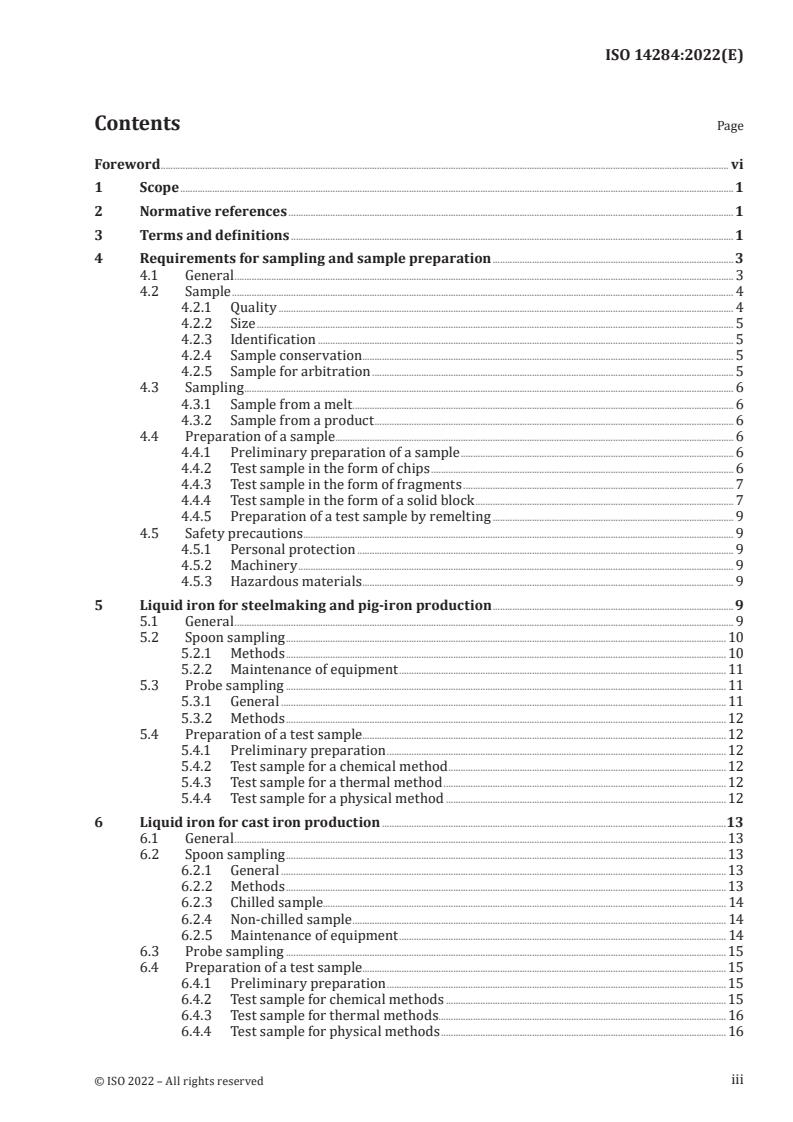
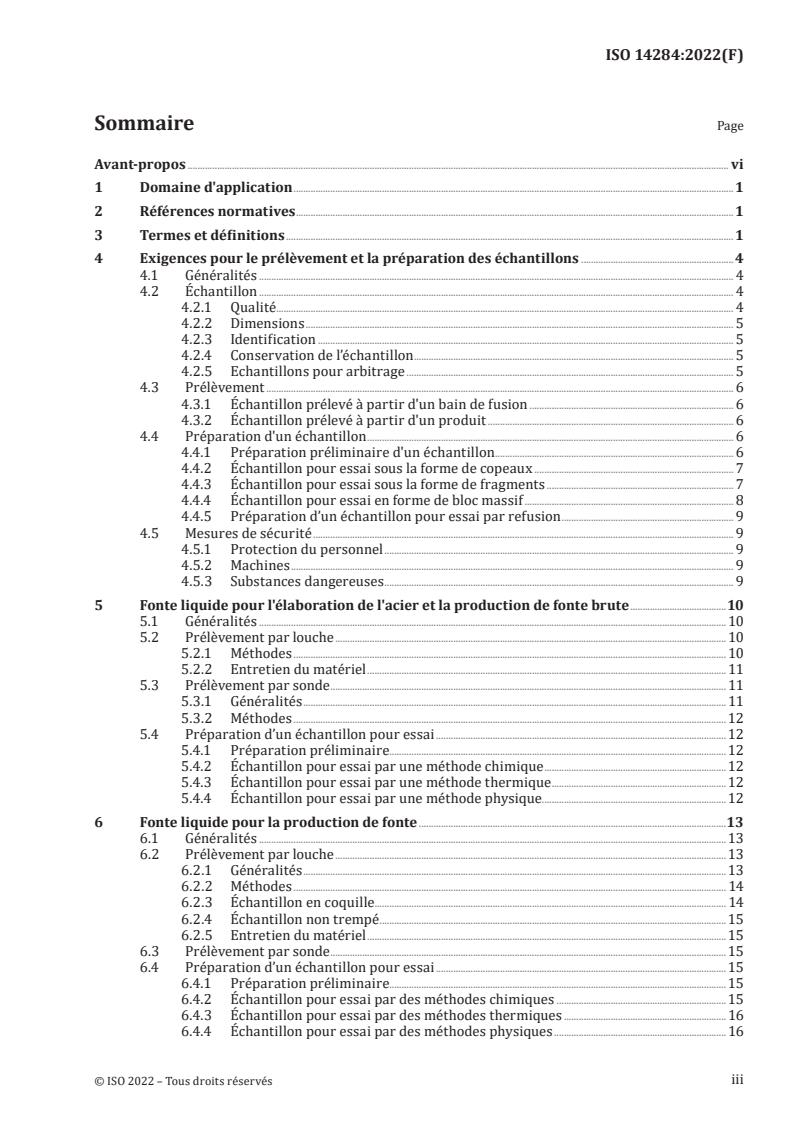
Contents Page
Foreword . vi
1 Scope . 1
2 Normative references . 1
3 Terms and definitions . 1
4 Requirements for sampling and sample preparation . 3
4.1 General . 3
4.2 Sample . 4
4.2.1 Quality . 4
4.2.2 Size . 5
4.2.3 Identification . 5
4.2.4 Sample conservation . 5
4.2.5 Sample for arbitration . 5
4.3 Sampling . 6
4.3.1 Sample from a melt . 6
4.3.2 Sample from a product . 6
4.4 Preparation of a sample . . 6
4.4.1 Preliminary preparation of a sample . 6
4.4.2 Test sample in the form of chips . 6
4.4.3 Test sample in the form of fragments . 7
4.4.4 Test sample in the form of a solid block . 7
4.4.5 Preparation of a test sample by remelting . 9
4.5 Safety precautions . 9
4.5.1 Personal protection . 9
4.5.2 Machinery . 9
4.5.3 Hazardous materials . . 9
5 Liquid iron for steelmaking and pig-iron production . 9
5.1 General . 9
5.2 Spoon sampling . 10
5.2.1 Methods . 10
5.2.2 Maintenance of equipment . 11
5.3 Probe sampling . 11
5.3.1 General . 11
5.3.2 Methods . 12
5.4 Preparation of a test sample . 12
5.4.1 Preliminary preparation .12
5.4.2 Test sample for a chemical method .12
5.4.3 Test sample for a thermal method .12
5.4.4 Test sample for a physical method .12
6 Liquid iron for cast iron production .13
6.1 General .13
6.2 Spoon sampling . 13
6.2.1 General .13
6.2.2 Methods .13
6.2.3 Chilled sample. 14
6.2.4 Non-chilled sample . 14
6.2.5 Maintenance of equipment . 14
6.3 Probe sampling . 15
6.4 Preparation of a test sample . 15
6.4.1 Preliminary preparation . 15
6.4.2 Test sample for chemical methods . 15
6.4.3 Test sample for thermal methods. 16
6.4.4 Test sample for physical methods . 16
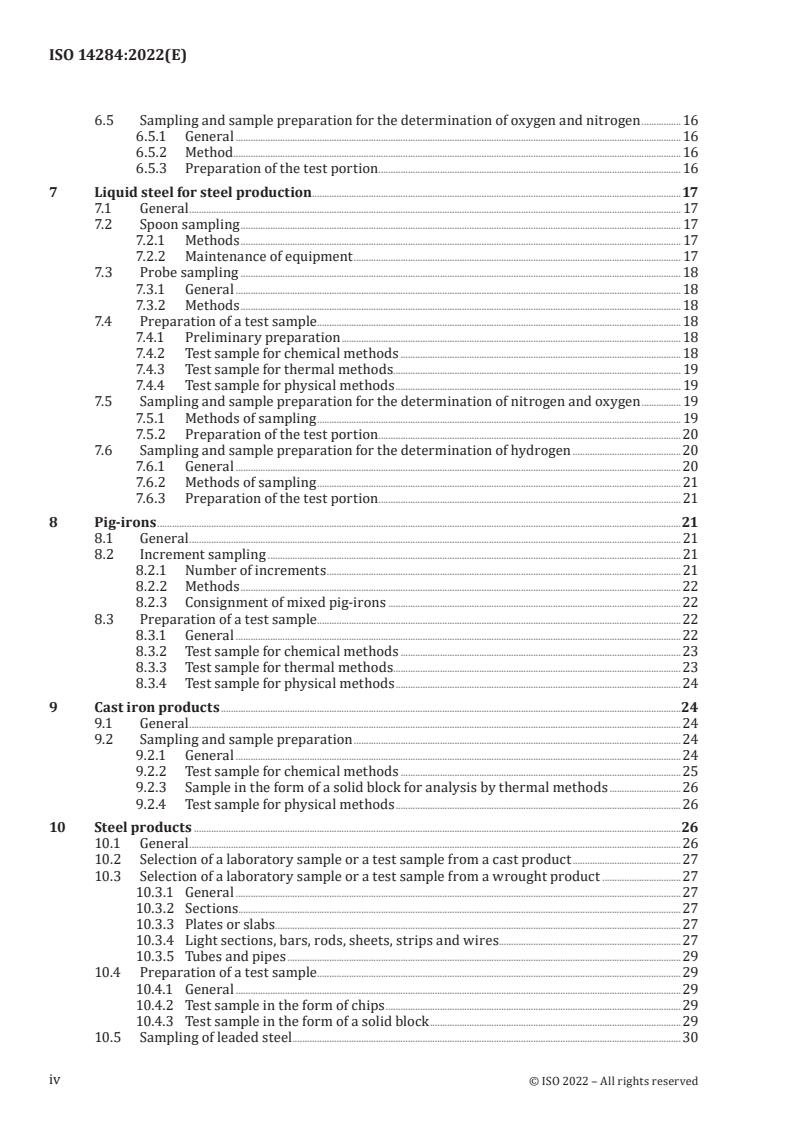
iii
6.5 Sampling and sample preparation for the determination of oxygen and nitrogen . 16
6.5.1 General . 16
6.5.2 Method . . 16
6.5.3 Preparation of the test portion . 16
7 Liquid steel for steel production . .17
7.1 General . 17
7.2 Spoon sampling . 17
7.2.1 Methods . 17
7.2.2 Maintenance of equipment . 17
7.3 Probe sampling . 18
7.3.1 General . 18
7.3.2 Methods . 18
7.4 Preparation of a test sample . . 18
7.4.1 Preliminary preparation . 18
7.4.2 Test sample for chemical methods . 18
7.4.3 Test sample for thermal methods. 19
7.4.4 Test sample for physical methods . 19
7.5 Sampling and sample preparation for the determination of nitrogen and oxygen . 19
7.5.1 Methods of sampling . 19
7.5.2 Preparation of the test portion . 20
7.6 Sampling and sample preparation for the determination of hydrogen .20
7.6.1 General .20
7.6.2 Methods of sampling . 21
7.6.3 Preparation of the test portion . 21
8 Pig-irons .21
8.1 General . 21
8.2 Increment sampling . 21
8.2.1 Number of increments . 21
8.2.2 Methods .22
8.2.3 Consignment of mixed pig-irons . 22
8.3 Preparation of a test sample . .22
8.3.1 General .22
8.3.2 Test sample for chemical methods . 23
8.3.3 Test sample for thermal methods. 23
8.3.4 Test sample for physical methods . 24
9 Cast iron products .24
9.1 General . 24
9.2 Sampling and sample preparation . 24
9.2.1 General . 24
9.2.2 Test sample for chemical methods . 25
9.2.3 Sample in the form of a solid block for analysis by thermal methods .26
9.2.4 Test sample for physical methods . 26
10 Steel products .26
10.1 General . 26
10.2 Selection of a laboratory sample or a test sample from a cast product . 27
10.3 Selection of a laboratory sample or a test sample from a wrought product . 27
10.3.1 General . 27
10.3.2 Sections . . 27
10.3.3 Plates or slabs . . 27
10.3.4 Light sections, bars, rods, sheets, strips and wires. 27
10.3.5 Tubes and pipes .29
10.4 Preparation of a test sample .29
10.4.1 General .29
10.4.2 Test sample in the form of chips .29
10.4.3 Test sample in the form of a solid block .29
10.5 Sampling of leaded steel . 30
iv
10.6 Sampling and sample preparation for the determination of oxygen .30
10.6.1 General .30
10.6.2 Methods of sampling .30
10.6.3 Preparation of a test portion . 31
10.7 Sampling and sample preparation for the determination of hydrogen . 31
10.7.1 General . 31
10.7.2 Methods of sampling . 31
10.7.3 Preparation of a test portion . 32
Annex A (informative) Sampling probes for use with liquid iron and steel .33
Annex B (informative) Sampling probes for use with liquid steel for the determination of
hydrogen .41
Bibliography . 44
v
Foreword
ISO (the International Organization for Standardization) is a worldwide federation of national standards
bodies (ISO member bodies). The work of preparing International Standards is normally carried out
through ISO technical committees. Each member body interested in a subject for which a technical
committee has been established has the right to be represented on that committee. International
organizations, governmental and non-governmental, in liaison with ISO, also take part in the work.
ISO collaborates closely with the International Electrotechnical Commission (IEC) on all matters of
electrotechnical standardization.
The procedures used to develop this document and those intended for its further maintenance are
described in the ISO/IEC Directives, Part 1. In particular, the different approval criteria needed for the
different types of ISO documents should be noted. This document was drafted in accordance with the
editorial rules of the ISO/IEC Directives, Part 2 (see www.iso.org/directives).
Attention is drawn to the possibility that some of the elements of this document may be the subject of
patent rights. ISO shall not be held responsible for identifying any or all such patent rights. Details of
any patent rights identified during the development of the document will be in the Introduction and/or
on the ISO list of patent declarations received (see www.iso.org/patents).
Any trade name used in this document is information given for the convenience of users and does not
constitute an endorsement.
For an explanation of the voluntary nature of standards, the meaning of ISO specific terms and
expressions related to conformity assessment, as well as information about ISO's adherence to
the World Trade Organization (WTO) principles in the Technical Barriers to Trade (TBT), see
www.iso.org/iso/foreword.html.
This document was prepared by Technical Committee ISO/TC 17, Steel, Subcommittee SC 1, Methods
of determination of chemical composition, in collaboration with the European Committee for
Standardization (CEN) Technical Committee CEN/TC 459/SC 2, Methods of chemical analysis for iron
and steel, in accordance with the Agreement on technical cooperation between ISO and CEN (Vienna
Agreement).
This second edition cancels and replaces the first edition (ISO 14284:1996), which has been technically
revised. The main changes are as follows:
— figures updated;
— Clause 3 updated;
— text updated;
— new sampling probes added;
— units changed to SI units.
Any feedback or questions on this document should be directed to the user’s national standards body. A
complete listing of these bodies can be found at www.iso.org/members.html.
vi
INTERNATIONAL STANDARD ISO 14284:2022(E)
Steel and iron — Sampling and preparation of samples for
the determination of chemical composition
1 Scope
This document specifies methods for sampling and sample preparation for the determination of the
chemical composition of pig irons, cast irons and steels.
Methods are specified for both liquid and solid metal.
2 Normative references
There are no normative references in this document.
3 Terms and definitions
For the purposes of this document, the following terms and definitions apply.
ISO and IEC maintain terminology databases for use in standardization at the following addresses:
— ISO Online browsing platform: available at https:// www .iso .org/ obp
— IEC Electropedia: available at https:// www .electropedia .org/
3.1
chemical method
method for the determination of chemical composition in which the test sample (3.16) or the test portion
(3.17) is submitted to chemical reactions
3.2
physical method of analysis
physical method
method for the determination of chemical composition in which the determination is carried out
without submitting the test sample (3.16) to chemical reactions
EXAMPLE Optical emission spectrometric (OES) method or X-ray fluorescence spectrometric (XRF) method.
3.3
thermal method of analysis
thermal method
method for the determination of chemical composition in which the test sample (3.16) is submitted to a
process of heating, combustion or fusion
3.4
melt
liquid metal from which a sample (3.25) is taken
3.5
spoon sampling
method in which a sample (3.25) is taken from the melt (3.4), or during the pouring of the melt, using a
long-handled spoon and poured into a small mould
3.6
spoon sample
sample (3.25) obtained from spoon sampling (3.5)
3.7
probe sampling
method in which a sample (3.25) is taken from the melt (3.4) using a commercially available sampling
probe that is immersed in the melt
3.8
probe sample
sample (3.25) obtained from probe sampling (3.7)
3.9
suction sampling
method of probe sampling (3.7) in which the probe is immersed in the melt (3.4) and the sample chamber
in the probe fills by aspiration
3.10
stream sampling
method of probe sampling (3.7) in which the probe is inserted into a stream of liquid metal and the
sample chamber in the probe fills by the force of the metal flow
3.11
immersion sampling
method of probe sampling (3.7) in which the probe is immersed in the melt (3.4) and the sample chamber
in the probe fills by ferrostatic pressure or gravity
3.12
cast product
steel or cast iron product that has not been subjected to deformation
EXAMPLE An ingot, a semi-finished product obtained by continuous casting, a casting.
3.13
wrought product
product obtained by hot and/or cold plastic deformation processes such as extruding, forging, hot
rolling, cold rolling or drawing, either exclusively or in combination
EXAMPLE Rods, bars, wires, tubes, profiles, sheets, strips, forgings.
3.14
batch sample
sufficient amount of cast iron, pig iron or steel selected from a product batch for the purpose of
obtaining one or more laboratory samples (3.15)
3.15
laboratory sample
part of a sample (3.25) that is processed so that it can be sent to the laboratory for the purpose of
obtaining one or more test samples (3.16)
3.16
test sample
part of a batch sample (3.14), part of a laboratory sample (3.15) taken from a batch sample or part of a
sample (3.25) taken from the melt (3.4) and brought to the appropriate condition required for analysis
Note 1 to entry: The test sample can also be the batch sample itself or a sample taken from the melt.
Note 2 to entry: The categories of test samples are the following:
— sample in the form of a solid block;
— sample obtained by remelting;
— sample in the form of chips obtained by machining;
— sample in the form of fragments obtained by crushing (3.19);
— sample in the form of powder obtained by comminution (3.18).
3.17
test portion
part of a test sample (3.16), or part of a sample (3.25) taken from the melt (3.4), submitted to analysis
Note 1 to entry: In some cases, the test portion may be selected from the batch sample (3.14) itself.
Note 2 to entry: Specific types of test portions in the form of solid blocks are the following:
— small disc, commonly described as a slug, obtained by punching;
— small appendage, commonly described as a lug;
— small-diameter rod, commonly described as a pin, obtained by cutting.
3.18
comminution
operation of reducing particle size by crushing (3.19) or grinding (3.21)
3.19
crushing
mechanical reduction of the particle size of a material by fracturing large pieces into multiple smaller
pieces
3.20
linishing
method of preparing a sample (3.25) of metal for a physical method of analysis (3.2) in which the surface
of the test sample (3.16) is abraded using a rotating disc or a continuous belt coated with an abrasive
material
3.21
grinding
method of preparing a sample (3.25) of metal for a physical method of analysis (3.2) in which the surface
of the test sample (3.16) is abraded using an abrasive wheel
3.22
milling
method of preparing chips or the surface of a sample (3.25) for a physical method of analysis (3.2) in
which the surface of the sample (3.25) is machined using a rotating, multi-edged cutting tool
3.23
consignment
quantity of metal delivered at one time
3.24
increment
quantity of metal obtained by sampling at one time from a consignment (3.23)
3.25
sample
portion of material selected from a larger quantity of material
4 Requirements for sampling and sample preparation
4.1 General
This clause covers the general requirements for the sampling, the sample and the sample preparation of
liquid iron and steel. Specific requirements applying to each category of liquid and solid metal are given
in the relevant subclauses.
The sequence of sampling and sample preparation of liquid iron and steel, pig-iron, cast iron and steel
products is shown in Figure 1. For requirements applying to pig irons, see Clause 8.
a) Liquid iron and steel b) Pig-iron, cast iron and steel products
Figure 1 — Sequence of sampling and sample preparation
4.2 Sample
4.2.1 Quality
Sampling practices shall be designed to provide a test sample that is representative of the chemical
composition of the melt or the batch sample.
The test sample shall be sufficiently homogeneous with respect to chemical composition such that
inhomogeneity does not appreciably contribute to the uncertainty of the results of the analysis.
However, in the case of a sample taken from a melt, some variability in analysis, both within and
between test samples, is unavoidable. This variability will form an inherent part of the accuracy of the
analysis.
The test sample shall be free from surface coatings, and from moisture, dirt or other forms of
contamination.
As far as possible, the test sample should be free from voids, cracks and porosities, and from fins, laps
or other surface imperfections.
Particular care shall be taken when selecting and preparing the test sample, where a sample taken from
a melt is expected to be heterogeneous or contaminated in any way. If such inconsistencies are found in
the samples, they shall be rejected.
A sample taken from a melt shall be cooled in such a manner that its chemical composition and
metallurgical microstructure are consistent from sample to sample.
Analysis by some physical methods can be influenced by the metallurgical microstructure of the
sample, particularly in the case of cast irons (even with white microstructure) and steels in the as-cast
and wrought conditions.
4.2.2 Size
The dimensions of a laboratory sample in the form of a solid block shall be sufficient to permit additional
test samples to be taken for re-analysis.
Test samples shall have a sufficient mass to allow any further analysis. Generally, a mass of 100 g will be
sufficient for a sample in the form of chips or powder.
The shape and dimensions of the samples shall be determined to ensure the following:
— their homogeneity;
— their acceptability as representative with respect to the composition of the melt;
— a microstructure adapted to the techniques of analysis of solid samples.
In the case of optical emission and X-ray fluorescence spectrometric methods, the shape and size of the
test sample will be determined by the dimensions of the sample chamber.
4.2.3 Identification
A test sample shall be assigned a unique identification in order to trace back the melt from which it was
taken and, if necessary, the processing conditions of the melt or the location of the laboratory sample or
the test sample in the batch sample.
A test sample of pig iron shall be assigned a unique identification in order to trace back the consignment
or part of a consignment and the increment from which it was taken.
Labelling or some equivalent method of marking shall be used to ensure that the assigned identification
remains associated with the test sample.
The identification, status and condition of the sample shall be recorded to ensure that confusion cannot
arise as to the identity of the item to which analysis and records refer.
4.2.4 Sample conservation
Adequate storage facilities shall be provided to separate and protect the test sample. During and after
preparation, the test sample shall be stored in such a way as to prevent contamination or chemical
change.
It is permitted to conserve the laboratory sample in the form of a solid block, and a test sample may
then be prepared when required.
The test sample, or the laboratory sample in the form of a solid block, shall be kept for a sufficient
period of time in the laboratory for audits and/or retests purposes.
4.2.5 Sample for arbitration
In the case of samples intended for arbitration, the test samples shall be prepared jointly by the supplier
and purchaser, or by their representatives. The records shall be kept of the methods used for preparing
the test samples.
Containers with test samples intended for arbitration shall be sealed by both parties or by their
representatives. Unless otherwise agreed, these containers shall be kept by the representatives of each
party responsible for the preparation of samples.
4.3 Sampling
4.3.1 Sample from a melt
Melts are sampled at various stages of the manufacturing process for the purposes of monitoring
and controlling the process. Samples may be taken during the casting of the melt to verify chemical
composition in accordance with the specification of the cast product. In the case of liquid metal intended
for the production of a casting, the test sample may be selected from test bars or blocks specially cast
from the same metal as that of the casting for purposes of mechanical testing, in accordance with the
product standard.
Sampling practices for melts shall be designed to provide samples during a particular manufacturing
process in accordance with requirements related to the quality of the sample (see 4.2.1). The sample
obtained from a melt is usually in the form of a small ingot, a cylindrical or rectangular block, a chill-
cast disc, pins or a combination of a disc with one or more attached pins. In some cases, small lugs are
attached to a disc.
NOTE Sampling probes for use with liquid iron and steel can be obtained from a number of suppliers. The
main features of several types of probes are given in Annexes A and B.
4.3.2 Sample from a product
The laboratory sample or the test sample may be selected from the batch sample at the location indicated
in the product specification for the selection of material for mechanical testing, when available.
In the case of an iron casting, the test sample may be selected from a bar or block cast onto the casting.
In the case of a forging, the test sample may be selected from the initial starting material from which
the forging has been made, or from prolongations of the forging or from additional forgings.
In the absence of requirements given in the product standard, or of a specification when ordering the
product, the test sample may be selected from the sample for mechanical testing or from the test piece,
or directly from the batch sample.
The laboratory sample or the test sample may be obtained from the batch sample by machining or any
other appropriate means. Special considerations apply in the case of sampling for the determination of
certain elements.
4.4 Preparation of a sample
4.4.1 Preliminary preparation of a sample
If any part of the sample is liable to be non representative in chemical composition, for example due to
oxidation, it may be agreed, following an investigation to establish the nature and extent of any change
in composition, to remove from the sample those parts that have changed. After this operation, the
sample shall be protected in order to avoid any change in composition.
If necessary, the surface of the metal shall be laid completely bare at the location of machining, by any
suitable means, to remove any coating that has been applied during manufacture. If necessary, the
surface of the metal shall be degreased by means of a suitable solvent. Care shall be taken to ensure
that the manner of degreasing does not affect the accuracy of the analysis.
4.4.2 Test sample in the form of chips
The test sample shall consist of chips of a regular size and shape. These may be obtained by methods
such as drilling, milling or turning. The chips shall not be taken from a part of the sample that has been
affected by the heat of a cutting tool.
The tools, machines and containers used during preparation of the sample shall be cleaned beforehand
to prevent any contamination of the test sample.
Machining shall be carried out in such a way that the chips are not subject to overheating, as indicated
by a change in the colour (blueing or blackening) of the chips. Unavoidable coloration of chips obtained
from some types of alloy steels, for example manganese and austenitic steels, may be minimized by
selection of appropriate tools and cutting speeds.
Depending on the technique of analysis, heat treatment under an adequate atmosphere or environment
(to ensure that the chemical composition is not changed) may be performed to soften the sample for
machining, provided that the product has been submitted to the same heat treatment. For some cases
such as carbon or oxygen determination, heat treatment is not allowed.
The use of coolants during machining is only permitted in exceptional cases; after which the chips shall
be cleaned by means of a suitable solvent that does not leave any deposit.
Chips shall be thoroughly mixed before weighing the test portion. For most purposes, the chips should
be mixed by rolling the container on a level surface and/or gently tumbling the container.
4.4.3 Test sample in the form of fragments
Where drilling of the sample to obtain chips is impracticable, it shall be cut or broken into pieces. These
pieces shall then be crushed using a percussion mortar or a vibratory grinding mill, also known as a
disc mill or ring mill, to obtain a test sample in the form of small fragments, the whole of which passes
through a sieve of a specified aperture size.
In some applications for the determination of carbon using a thermal method of analysis, the sample
is crushed in a percussion mortar to obtain a test sample in the form of fragments with a particle size
range of approximately 1 mm to 2 mm.
Equipment used for comminution shall be constructed from material that does not alter the sample
composition. Suitable tests may be necessary to show that the use of such equipment does not affect the
composition of the test sample in any way.
Comminution shall not be used for the preparation of samples of graphite-bearing cast irons.
The sieving operation shall be performed taking all precautions necessary to avoid contamination or
loss of material. When sieving hard materials, care shall be taken to avoid damaging the fabric of the
sieve.
The test sample shall be homogenized before weighing the test portion. Small fragments may be
homogenized by stirring.
CAUTION — Finely-divided metals of particle size less than approximately 150 µm can present a
fire risk. Ensure that there is adequate ventilation during comminution.
4.4.4 Test sample in the form of a solid block
4.4.4.1 Selection of the test sample
The test sample shall be obtained by cutting, from the batch sample or laboratory sample, a piece of
size and shape suitable for the method of analysis. Samples shall be cut by sawing, abrasive cutting,
shearing or punching.
In the absence of any indication in the product standard, analysis by a physical method shall be carried
out on that part of the sample corresponding to a transverse section of the product, provided that the
material has sufficient thickness.
4.4.4.2 Surface preparation of the test sample
The test sample shall be prepared to expose a surface suitable for the method of analysis. Preparation of
a surface for analysis shall not be carried out on any part of a sample that has been thermally affected.
The equipment used for sample preparation shall be designed to minimize overheating the sample and,
where appropriate, shall incorporate systems of cooling.
The main types of equipment used for surface preparation are as follows:
a) A milling machine capable of removing a preselected depth of metal in a reproducible manner, for
use with samples that are within a hardness range suitable for milling. The equipment shall be able
to be used, if required, with a sample taken from a melt where the sample is still hot.
b) A grinding machine with a fixed, rotating or oscillating head capable of removing a preselected
depth of metal in a reproducible manner.
c) A flat-bed linishing machine with abrasive grinding discs, or a machine with continuous abrasive
belts, able to be used to prepare the surface of the test sample to varying grades of finish.
d) A machine for blasting with sand, grit, or metal shot, able to be used in special applications to clean
the surface of the test sample.
For the preparation of ultra-low carbon (ULC) steel samples, a milling machine is recommended.
After preparation, the surface of the test sample shall be flat and free from imperfections that affect the
accuracy of the analysis.
Cutting
...
NORME ISO
INTERNATIONALE 14284
Deuxième édition
2022-10
Aciers et fontes — Prélèvement et
préparation des échantillons pour
la détermination de la composition
chimique
Steel and iron — Sampling and preparation of samples for the
determination of chemical composition
Numéro de référence
DOCUMENT PROTÉGÉ PAR COPYRIGHT
© ISO 2022
Tous droits réservés. Sauf prescription différente ou nécessité dans le contexte de sa mise en œuvre, aucune partie de cette
publication ne peut être reproduite ni utilisée sous quelque forme que ce soit et par aucun procédé, électronique ou mécanique,
y compris la photocopie, ou la diffusion sur l’internet ou sur un intranet, sans autorisation écrite préalable. Une autorisation peut
être demandée à l’ISO à l’adresse ci-après ou au comité membre de l’ISO dans le pays du demandeur.
ISO copyright office
Case postale 401 • Ch. de Blandonnet 8
CH-1214 Vernier, Genève
Tél.: +41 22 749 01 11
E-mail: copyright@iso.org
Web: www.iso.org
Publié en Suisse
ii
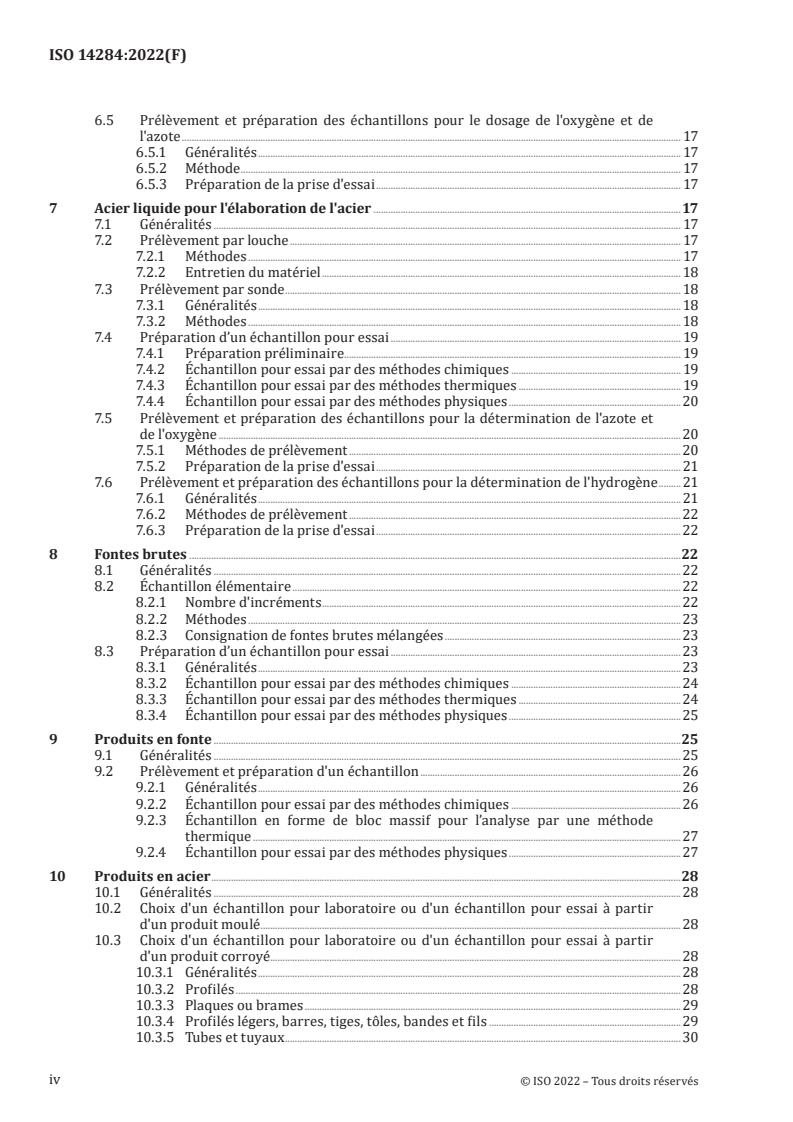
Sommaire Page
Avant-propos . vi
1 Domaine d'application .1
2 Références normatives .1
3 Termes et définitions . 1
4 Exigences pour le prélèvement et la préparation des échantillons .4
4.1 Généralités . 4
4.2 Échantillon . 4
4.2.1 Qualité . . 4
4.2.2 Dimensions . 5
4.2.3 Identification . 5
4.2.4 Conservation de l’échantillon . 5
4.2.5 Echantillons pour arbitrage . 5
4.3 Prélèvement . 6
4.3.1 Échantillon prélevé à partir d'un bain de fusion . 6
4.3.2 Échantillon prélevé à partir d'un produit . 6
4.4 Préparation d'un échantillon . 6
4.4.1 Préparation préliminaire d'un échantillon . 6
4.4.2 Échantillon pour essai sous la forme de copeaux . 7
4.4.3 Échantillon pour essai sous la forme de fragments . 7
4.4.4 Échantillon pour essai en forme de bloc massif . 8
4.4.5 Préparation d’un échantillon pour essai par refusion . 9
4.5 Mesures de sécurité . 9
4.5.1 Protection du personnel . 9
4.5.2 Machines . 9
4.5.3 Substances dangereuses . 9
5 Fonte liquide pour l'élaboration de l'acier et la production de fonte brute .10
5.1 Généralités . 10
5.2 Prélèvement par louche . 10
5.2.1 Méthodes . 10
5.2.2 Entretien du matériel . 11
5.3 Prélèvement par sonde . 11
5.3.1 Généralités . 11
5.3.2 Méthodes . 12
5.4 Préparation d’un échantillon pour essai .12
5.4.1 Préparation préliminaire.12
5.4.2 Échantillon pour essai par une méthode chimique .12
5.4.3 Échantillon pour essai par une méthode thermique .12
5.4.4 Échantillon pour essai par une méthode physique.12
6 Fonte liquide pour la production de fonte .13
6.1 Généralités .13
6.2 Prélèvement par louche . 13
6.2.1 Généralités .13
6.2.2 Méthodes . 14
6.2.3 Échantillon en coquille. 14
6.2.4 Échantillon non trempé .15
6.2.5 Entretien du matériel .15
6.3 Prélèvement par sonde . 15
6.4 Préparation d’un échantillon pour essai . 15
6.4.1 Préparation préliminaire. 15
6.4.2 Échantillon pour essai par des méthodes chimiques .15
6.4.3 Échantillon pour essai par des méthodes thermiques . 16
6.4.4 Échantillon pour essai par des méthodes physiques . 16
iii
6.5 Prélèvement et préparation des échantillons pour le dosage de l'oxygène et de
l'azote . 17
6.5.1 Généralités . 17
6.5.2 Méthode . 17
6.5.3 Préparation de la prise d'essai . 17
7 Acier liquide pour l'élaboration de l'acier .17
7.1 Généralités . 17
7.2 Prélèvement par louche . 17
7.2.1 Méthodes . 17
7.2.2 Entretien du matériel . 18
7.3 Prélèvement par sonde . 18
7.3.1 Généralités . 18
7.3.2 Méthodes . 18
7.4 Préparation d’un échantillon pour essai . 19
7.4.1 Préparation préliminaire. 19
7.4.2 Échantillon pour essai par des méthodes chimiques . 19
7.4.3 Échantillon pour essai par des méthodes thermiques . 19
7.4.4 Échantillon pour essai par des méthodes physiques .20
7.5 Prélèvement et préparation des échantillons pour la détermination de l'azote et
de l'oxygène . 20
7.5.1 Méthodes de prélèvement . 20
7.5.2 Préparation de la prise d'essai . 21
7.6 Prélèvement et préparation des échantillons pour la détermination de l'hydrogène . 21
7.6.1 Généralités . 21
7.6.2 Méthodes de prélèvement . 22
7.6.3 Préparation de la prise d'essai . 22
8 Fontes brutes .22
8.1 Généralités .22
8.2 Échantillon élémentaire . 22
8.2.1 Nombre d'incréments . 22
8.2.2 Méthodes .23
8.2.3 Consignation de fontes brutes mélangées . 23
8.3 Préparation d’un échantillon pour essai . 23
8.3.1 Généralités .23
8.3.2 Échantillon pour essai par des méthodes chimiques . 24
8.3.3 Échantillon pour essai par des méthodes thermiques . 24
8.3.4 Échantillon pour essai par des méthodes physiques . 25
9 Produits en fonte .25
9.1 Généralités . 25
9.2 Prélèvement et préparation d'un échantillon . 26
9.2.1 Généralités . 26
9.2.2 Échantillon pour essai par des méthodes chimiques . 26
9.2.3 Échantillon en forme de bloc massif pour l’analyse par une méthode
thermique . 27
9.2.4 Échantillon pour essai par des méthodes physiques . 27
10 Produits en acier .28
10.1 Généralités .28
10.2 Choix d'un échantillon pour laboratoire ou d'un échantillon pour essai à partir
d'un produit moulé .28
10.3 Choix d'un échantillon pour laboratoire ou d'un échantillon pour essai à partir
d'un produit corroyé .28
10.3.1 Généralités .28
10.3.2 Profilés .28
10.3.3 Plaques ou brames .29
10.3.4 Profilés légers, barres, tiges, tôles, bandes et fils .29
10.3.5 Tubes et tuyaux . 30
iv
10.4 Préparation d’un échantillon pour essai .30
10.4.1 Généralités .30
10.4.2 Échantillon pour essai en forme de copeaux . 31
10.4.3 Échantillon pour essai en forme de bloc massif . 31
10.5 Prélèvement sur des aciers de décolletage . 31
10.6 Prélèvement et préparation des échantillons pour la détermination de l'oxygène . 32
10.6.1 Généralités . 32
10.6.2 Méthodes de prélèvement . 32
10.6.3 Préparation d'une prise d'essai . 32
10.7 Prélèvement et préparation des échantillons pour la détermination de l'hydrogène .33
10.7.1 Généralités . 33
10.7.2 Méthodes de prélèvement . 33
10.7.3 Préparation d'une prise d'essai .34
Annexe A (informative) Sondes de prélèvement utilisées avec la fonte et l'acier liquides .35
Annexe B (informative) Sondes de prélèvement utilisées avec l'acier liquide pour la
détermination de l'hydrogène . 44
Bibliographie .48
v
Avant-propos
L'ISO (Organisation internationale de normalisation) est une fédération mondiale d'organismes
nationaux de normalisation (comités membres de l'ISO). L'élaboration des Normes internationales est
en général confiée aux comités techniques de l'ISO. Chaque comité membre intéressé par une étude
a le droit de faire partie du comité technique créé à cet effet. Les organisations internationales,
gouvernementales et non gouvernementales, en liaison avec l'ISO participent également aux travaux.
L'ISO collabore étroitement avec la Commission électrotechnique internationale (IEC) en ce qui
concerne la normalisation électrotechnique.
Les procédures utilisées pour élaborer le présent document et celles destinées à sa mise à jour sont
décrites dans les Directives ISO/IEC, Partie 1. Il convient, en particulier, de prendre note des différents
critères d'approbation requis pour les différents types de documents ISO. Le présent document a
été rédigé conformément aux règles de rédaction données dans les Directives ISO/IEC, Partie 2 (voir
www.iso.org/directives).
L'attention est attirée sur le fait que certains des éléments du présent document peuvent faire l'objet de
droits de propriété intellectuelle ou de droits analogues. L'ISO ne saurait être tenue pour responsable
de ne pas avoir identifié de tels droits de propriété et averti de leur existence. Les détails concernant
les références aux droits de propriété intellectuelle ou autres droits analogues identifiés lors de
l'élaboration du document sont indiqués dans l'Introduction et/ou dans la liste des déclarations de
brevets reçues par l'ISO (voir www.iso.org/brevets).
Les appellations commerciales éventuellement mentionnées dans le présent document sont données
pour information, par souci de commodité, à l’intention des utilisateurs et ne sauraient constituer un
engagement.
Pour une explication de la nature volontaire des normes, la signification des termes et expressions
spécifiques de l'ISO liés à l'évaluation de la conformité, ou pour toute information au sujet de l'adhésion
de l'ISO aux principes de l’Organisation mondiale du commerce (OMC) concernant les obstacles
techniques au commerce (OTC), voir www.iso.org/avant-propos.
Le présent document a été élaboré par le comité technique ISO/TC 17, Acier, sous-comité SC 1, Méthodes
de détermination de la composition chimique, en collaboration avec le comité technique CEN/TC 459/
SC 2, Méthodes d'analyses chimiques pour le fer et l'acier, du Comité européen de normalisation (CEN)
conformément à l’Accord de coopération technique entre l’ISO et le CEN (Accord de Vienne).
Cette deuxième édition annule et remplace la première édition (ISO 14284:1996), qui a fait l’objet d’une
révision technique. Les principales modifications sont les suivantes:
— mise à jour des figures ;
— mise à jour de l’Article 3 ;
— mise à jour du texte ;
— ajout de nouvelles sondes de prélèvement ;
— les unités sont exprimées selon le système SI.
Il convient que l’utilisateur adresse tout retour d’information ou toute question concernant le présent
document à l’organisme national de normalisation de son pays. Une liste exhaustive desdits organismes
se trouve à l’adresse www.iso.org/fr/members.html.
vi
NORME INTERNATIONALE ISO 14284:2022(F)
Aciers et fontes — Prélèvement et préparation des
échantillons pour la détermination de la composition
chimique
1 Domaine d'application
Le présent document spécifie les méthodes de prélèvement et de préparation des échantillons pour la
détermination de la composition chimique des fontes brutes, des fontes moulées et des aciers.
Ces méthodes sont spécifiées à la fois pour le métal liquide et le métal solide.
2 Références normatives
Le présent document ne contient aucune référence normative.
3 Termes et définitions
Pour les besoins du présent document, les termes et définitions suivants s’appliquent.
L’ISO et l’IEC tiennent à jour des bases de données terminologiques destinées à être utilisées en
normalisation, consultables aux adresses suivantes:
— ISO Online browsing platform: disponible à l’adresse https:// www .iso .org/ obp
— IEC Electropedia: disponible à l’adresse https:// www .electropedia .org/
3.1
méthode d'analyse chimique
méthode de détermination de la composition chimique dans laquelle l'échantillon pour essai (3.16) ou la
prise d’essai (3.17) est soumis à des réactions chimiques
3.2
méthode d'analyse physique
méthode physique
méthode de détermination de la composition chimique dans laquelle la détermination est effectuée
sans soumettre l'échantillon pour essai (3.16) à des réactions chimiques
EXEMPLE Méthode spectrométrique d'émission optique (SEO) ou méthode spectrométrique par
fluorescence de rayons X (FRX).
3.3
méthode d'analyse thermique
méthode thermique
méthode de détermination de la composition chimique dans laquelle l'échantillon pour essai (3.16) est
soumis à un procédé de chauffage, de combustion ou de fusion
3.4
bain de fusion
métal liquide dans lequel un échantillon (3.25) est prélevé
3.5
prélèvement par louche
méthode par laquelle un échantillon (3.25) est prélevé dans le bain de fusion (3.4), ou lors de la coulée du
bain de fusion, au moyen d'une louche à long manche, puis coulé dans un petit moule
3.6
échantillon de louche
échantillon (3.25) obtenu par la méthode de prélèvement par louche (3.5)
3.7
prélèvement par sonde
méthode par laquelle un échantillon (3.25) est prélevé dans le bain de fusion (3.4) au moyen d'une sonde
de prélèvement, disponible dans le commerce, immergée dans le bain
3.8
échantillon de sonde
échantillon (3.25) obtenu par prélèvement par sonde (3.7)
3.9
prélèvement par aspiration
méthode de prélèvement par sonde (3.7) par laquelle la sonde est immergée dans le bain de fusion (3.4)
et où la chambre pour échantillon de la sonde se remplit par aspiration
3.10
prélèvement à la coulée
méthode de prélèvement par sonde (3.7) par laquelle la sonde est introduite dans un jet de métal liquide
et où la chambre pour échantillon de la sonde est remplit par la force exercée par l'écoulement du métal
3.11
prélèvement par immersion
méthode de prélèvement par sonde (3.7) par laquelle la sonde est immergée dans le bain de fusion (3.4)
et où la chambre pour échantillon de la sonde se remplit par pression ferrostatique ou par gravité.
3.12
produit moulé
produit en acier ou en fonte qui n'a pas été soumis à déformation
EXEMPLE Un lingot, un produit semi-fini obtenu par coulée continue, une pièce moulée.
3.13
produit corroyé
produit soumis à des processus de déformation plastique à chaud et/ou à froid tels que l’extrusion, le
forgeage, le laminage à chaud, le laminage à froid ou l’étirage, utilisés seuls ou combinés
EXEMPLE Tiges, barres, fils, tubes, profilés, tôles, bandes, pièces forgées.
3.14
échantillon d’un lot
quantité suffisante de fonte, de fonte brute ou d’acier sélectionnée dans un lot de produit afin d’obtenir
un ou plusieurs échantillons pour laboratoire (3.15)
3.15
échantillon pour laboratoire
partie d’un échantillon (3.25) traitée de manière à pouvoir être envoyée au laboratoire afin d’obtenir un
ou plusieurs échantillons pour essai (3.16)
3.16
échantillon pour essai
partie d’un échantillon d’un lot (3.14) ou partie d’un échantillon pour laboratoire (3.15) prélevée dans un
échantillon d’un lot, ou partie d’un échantillon (3.25) prélevée dans le bain de fusion (3.4), et préparée
selon les conditions requises pour être soumise à l’analyse
Note 1 à l'article: L’échantillon pour essai peut également être l’échantillon d’un lot lui-même ou un échantillon
prélevé dans le bain de fusion
Note 2 à l'article: Les catégories d’échantillons pour essai sont les suivantes :
— échantillon en forme de bloc massif;
— échantillon obtenu par refusion;
— échantillon sous forme de copeaux préparé par usinage;
— échantillon sous forme de fragments obtenus par concassage (3.19);
— échantillon sous forme de poudre obtenue par broyage (3.18).
3.17
prise d'essai
partie d’un échantillon pour essai (3.16) ou partie d’un échantillon (3.25) prélevée dans le bain de fusion
(3.4), soumise à l'analyse
Note 1 à l'article: Dans certains cas, la prise d'essai peut être sélectionnée sur l’échantillon d’un lot (3.14) lui-même
Note 2 à l'article: Les types de prises d’essai se présentant sous forme d’échantillon de blocs massifs sont les
suivants:
— petit disque, le plus souvent désigné par «pastille», obtenu par poinçonnage;
— petit appendice, le plus souvent désigné par «languette»;
— tige de petit diamètre, le plus souvent désignée par «crayon», obtenue par découpage.
3.18
broyage
opération consistant à réduire la taille des particules par concassage (3.19) ou meulage (3.21)
3.19
concassage
réduction mécanique de la taille des particules d’un matériau obtenue en cassant de grands morceaux
en plusieurs petits morceaux
3.20
polissage
méthode de préparation d'un échantillon (3.25) de métal pour une méthode d'analyse physique (3.2),
dans laquelle la surface de l'échantillon pour essai (3.16) est abrasée par la rotation en continu d'un
disque ou d'une bande recouvert d’un matériau abrasif
3.21
meulage
méthode de préparation d'un échantillon (3.25) de métal pour une méthode d'analyse physique (3.2),
dans laquelle la surface de l'échantillon pour essai (3.16) est abrasée au moyen d'une meule
3.22
fraisage
méthode de préparation de copeaux ou de la surface d'un échantillon (3.25) pour une méthode d'analyse
physique (3.2) dans laquelle la surface de l'échantillon est usinée à l'aide d'un outil de coupe rotatif
multicoupe
3.23
consignation
quantité de métal livrée en une seule fois
3.24
échantillon élémentaire
quantité de métal obtenue en une seule fois par prélèvement sur une consignation (3.23)
3.25
échantillon
portion de matériau choisie parmi une plus grande quantité de matériau
4 Exigences pour le prélèvement et la préparation des échantillons
4.1 Généralités
Le présent article couvre les exigences générales relatives au prélèvement ainsi qu'à l’échantillon et à la
préparation des échantillons de fonte et d'acier liquides. Des exigences spéciales s'appliquent à chaque
catégorie de métaux liquide et solide; elles sont développées dans les paragraphes correspondants.
La séquence de prélèvement et de préparation des échantillons de fonte et d'acier liquides ainsi que
des produits en fonte brute, fonte moulée et en acier est représentée à la Figure 1. Des considérations
spéciales s'appliquent aux fontes brutes (voir Article 8).
a) Fonte et acier liquides b) Produits en fonte brute, en fonte et en acier
Figure 1 — Séquence de prélèvement et de préparation des échantillons
4.2 Échantillon
4.2.1 Qualité
Les modes de prélèvement doivent permettre de fournir un échantillon pour essai représentatif de la
composition chimique moyenne du bain de fusion ou de l’échantillon d’un lot.
L'échantillon pour essai doit être suffisamment homogène au niveau de sa composition chimique de
sorte que l'hétérogénéité n'ait pas d’impact significatif sur l’incertitude des résultats de l'analyse.
Cependant, dans le cas d'un échantillon prélevé dans un bain de fusion, une certaine variabilité dans
l'analyse, aussi bien dans un même échantillon qu'entre plusieurs échantillons pour essai, peut s'avérer
inévitable. Cette variabilité fait partie intégrante de l’exactitude de l'analyse.
L'échantillon pour essai ne doit pas comporter de revêtement de surface et doit être exempt d’humidité,
de poussière et de toute autre forme de souillure.
Dans la mesure du possible, il convient que l'échantillon pour essai soit exempt de soufflures, de fissures
et de porosités, ainsi que de bavures, de peaux ou autres imperfections de surface.
Un soin particulier doit être apporté lors de la sélection et de la préparation de l'échantillon pour essai
lorsqu'on s'attend à ce que l'échantillon prélevé dans un bain de métal soit hétérogène ou pollué d'une
façon ou d'une autre. L’échantillon doit être rejeté s’il présente de telles incohérences.
Un échantillon prélevé dans un bain de fusion doit être refroidi de telle sorte que sa composition
chimique et sa microstructure métallurgique soient les mêmes d'un échantillon à l'autre.
L'analyse par certaines méthodes physiques peut être influencée par la microstructure métallurgique de
l'échantillon, notamment dans le cas des fontes moulées (même si elles présentent une microstructure
blanche) et des aciers moulés ou corroyés.
4.2.2 Dimensions
Les dimensions d'un échantillon pour laboratoire se présentant sous forme de bloc massif doivent être
suffisantes pour permettre le prélèvement d'échantillons supplémentaires pour effectuer d’autres
analyses.
La masse des échantillons pour essai doit permettre d’effectuer d’autres analyses. En règle générale,
une masse de 100 g convient pour un échantillon sous forme de copeaux ou de poudre.
La forme et les dimensions des échantillons sont principalement déterminées de façon à assurer:
— l’homogénéité entre échantillons;
— l’acceptabilité en tant que représentatifs de la composition du bain de fusion;
— une microstructure adaptée aux techniques d’analyse des échantillons massifs.
Dans le cas des méthodes spectrométriques d'émission optique et de fluorescence de rayons X, la forme
et les dimensions de l'échantillon pour essai seront déterminées en fonction des dimensions de la
chambre pour échantillon.
4.2.3 Identification
Une identification unique doit être attribuée à chaque échantillon pour essai de manière à tracer le
bain de fusion dans lequel il a été prélevé et, si nécessaire, les conditions du procédé de fusion ou
l'emplacement de l'échantillon pour laboratoire ou de l'échantillon pour essai dans l’échantillon d’un lot.
Une identification unique doit être attribuée à chaque échantillon pour essai de fonte brute de manière
à tracer la consignation ou une partie de la consignation et l'échantillon élémentaire sur lequel il a été
prélevé.
L'étiquetage ou un mode équivalent de marquage doivent être utilisés pour que l'identification attribuée
demeure associée à l'échantillon pour essai.
L'identification, l'état et la présentation de l'échantillon doivent être enregistrés afin d'éliminer tout
risque de confusion sur l'identité de l'élément auquel l'analyse et les enregistrements se réfèrent.
4.2.4 Conservation de l’échantillon
Des moyens de conservation adaptés doivent être prévus pour isoler et protéger l'échantillon pour
essai. Pendant et après sa préparation, l'échantillon pour essai doit être entreposé de telle sorte qu'il
soit à l'abri de toute contamination ou altération chimique.
Il est admis de conserver l'échantillon pour laboratoire sous la forme d’un bloc massif et un échantillon
pour essai peut être alors préparé quand cela s'avère nécessaire.
L'échantillon pour essai ou l'échantillon pour laboratoire sous la forme massive doit être conservé
suffisamment de temps dans le laboratoire à des fins d’audits et/ou de contre-essais.
4.2.5 Echantillons pour arbitrage
Dans le cas d'échantillons destinés à l'arbitrage, les échantillons d'essai doivent être préparés
conjointement par le fournisseur et l'acheteur ou leurs représentants. Un enregistrement des méthodes
utilisées pour préparer les échantillons pour essai doit être conservé.
Les conteneurs renfermant les échantillons pour essai destinés à un arbitrage doivent être scellés
par les deux parties ou par leurs représentants. Sauf accord contraire, ces conteneurs doivent être
conservés par les représentants de chaque partie responsable de la préparation des échantillons.
4.3 Prélèvement
4.3.1 Échantillon prélevé à partir d'un bain de fusion
Les bains de fusion sont échantillonnés aux différentes étapes du procédé de fabrication à des fins de
surveillance et de maîtrise du procédé. Des échantillons peuvent être prélevés à la coulée du bain de
fusion afin de vérifier si la composition chimique est conforme aux spécifications du produit coulé.
Dans le cas du métal liquide destiné à la fabrication d'une pièce moulée, l'échantillon pour essai peut
être prélevé à partir de barres ou de blocs pour essai spécialement coulés avec le même métal que celui
de la pièce moulée à des fins d'essais mécaniques, conformément à la norme relative au produit.
Les modes de prélèvement dans des bains de fusion doivent permettre d'obtenir des échantillons
pendant un processus de fabrication particulier conformément aux exigences relatives à la qualité de
l'échantillon (voir 4.2.1). L'échantillon obtenu à partir d'un bain de fusion se présente généralement
sous forme d'un petit lingot, d'un bloc cylindrique ou rectangulaire, d'un disque coulé en coquille, d’un
crayon ou d’une combinaison de disques munis d'un ou de plusieurs crayons. Dans certains cas, de
petites languettes sont fixées à un disque.
NOTE Des sondes de prélèvement utilisées avec la fonte et l'acier liquides peuvent être obtenues auprès de
plusieurs fournisseurs. Les principales caractéristiques de plusieurs types de sondes sont indiquées à l’Annexe A
et Annexe B.
4.3.2 Échantillon prélevé à partir d'un produit
L'échantillon pour laboratoire ou l'échantillon pour essai peut être choisi à partir de l’échantillon d’un
lot à l'emplacement indiqué dans la spécification relative au produit pour le choix de la matière pour les
essais mécaniques, lorsqu'elle est disponible.
Dans le cas d'une pièce moulée en fonte, l'échantillon pour essai peut être prélevé à partir d'une barre
ou d'un bloc attenant à la pièce.
Dans le cas d'une pièce forgée, l'échantillon pour essai peut être prélevé sur le matériau d'origine à
partir duquel le forgeage a été effectué, ou à partir des parties prolongées des pièces forgées ou de
forgeages supplémentaires.
À défaut d'exigences données dans la norme relative au produit, ou de spécifications à la commande du
produit, l'échantillon pour essai peut être prélevé à partir de l'échantillon destiné aux essais mécaniques
ou de l'éprouvette, ou bien directement sur l’échantillon d’un lot.
L’échantillon pour laboratoire ou l’échantillon pour essai peut être obtenu à partir de l’échantillon d’un
lot par usinage ou par tout autre moyen approprié. Des considérations particulières s'appliquent en cas
de prélèvement destiné à la détermination de certains éléments.
4.4 Préparation d'un échantillon
4.4.1 Préparation préliminaire d'un échantillon
Si une partie quelconque de l'échantillon risque de ne pas être représentative au niveau de la composition
chimique, par exemple en raison de son oxydation, on peut accepter, après enquête établissant la nature
et l'étendue de l'altération de sa composition, d'éliminer de l'échantillon les parties qui se sont trouvées
modifiées. Après cette opération, l'échantillon doit être protégé pour éviter toute altération de sa
composition.
Si nécessaire, la surface du métal doit être mise entièrement à nu à l’emplacement de l'usinage par tout
moyen approprié afin d'éliminer le revêtement éventuellement appliqué au cours de la fabrication. Si
nécessaire, la surface du métal doit être dégraissée au moyen d’un solvant approprié. Il faut faire en
sorte que le procédé de dégraissage n’ait pas d’impact sur l’exactitude de l’analyse.
4.4.2 Échantillon pour essai sous la forme de copeaux
L'échantillon pour essai doit se présenter sous forme de copeaux de taille et de forme régulières. Ceux-ci
peuvent être obtenus par des méthodes telles que perçage, fraisage ou tournage. Les copeaux ne doivent
pas être prélevés sur une partie de l'échantillon qui a été affectée par la chaleur d’un outil de coupe.
Les outils, machines et conteneurs utilisés au cours de la préparation de l'échantillon doivent être
nettoyés au préalable de manière à éviter toute contamination de l'échantillon pour essai.
L'usinage doit être effectué de telle sorte que les copeaux ne soient pas soumis à une surchauffe, mise en
évidence par un changement dans leur couleur (bleuissement ou noircissement). La coloration inévitable
des copeaux obtenue sur certains types d'aciers alliés, par exemple sur des aciers au manganèse et des
aciers austénitiques, peut être minimisée en choisissant des outils et des vitesses de coupe appropriés.
Selon la technique d’analyse, un traitement thermique en atmosphère ou environnement appropriés
(pour garantir que la composition chimique n’est pas altérée) peut être réalisé pour adoucir l’échantillon
avant son usinage, à condition que le produit ait été soumis au même traitement thermique. Dans
certains cas, notamment pour la détermination du carbone ou de l’oxygène, le traitement thermique
n’est pas autorisé.
L'utilisation de liquides de refroidissement pendant l'usinage n'est admis que dans des cas exceptionnels;
les copeaux doivent ensuite être nettoyés au moyen d'un solvant approprié qui ne laisse aucun dépôt.
Les copeaux doivent être soigneusement mélangés avant de peser la prise d'essai. Pour la plupart des
applications, il est recommandé de mélanger les copeaux en faisant rouler le conteneur sur une surface
horizontale et/ou en le faisant osciller modérément.
4.4.3 Échantillon pour essai sous la forme de fragments
Lorsque le perçage de l'échantillon pour obtenir des copeaux est irréalisable, l'échantillon doit être
coupé ou brisé en morceaux. Les fragments doivent être broyés au moyen d'un mortier à percussion ou
d'un broyeur vibrant, connu également sous le nom de broyeur à disques ou à anneaux, afin d'obtenir
un échantillon pour essai en forme de petits fragments passant enti
...
Questions, Comments and Discussion
Ask us and Technical Secretary will try to provide an answer. You can facilitate discussion about the standard in here.
Loading comments...