

ISO 12122-1:2014
(Main)Timber structures — Determination of characteristic values — Part 1: Basic requirements
General Information
- Abstract
ISO 12122-1:2014 gives methods for the determination of characteristic values for a defined population of timber products, calculated from test values. It presents methods for the determination of: characteristic value of mean-based properties; and characteristic value of 5th percentile-based properties.
- Status
- Published
- Publication Date
- 24-Feb-2014
- Technical Committee
- ISO/TC 165 - Timber structures
- Drafting Committee
- ISO/TC 165/WG 10 - Characteristic values and design specifications
- Current Stage
- 9093 - International Standard confirmed
- Start Date
- 11-Apr-2025
- Completion Date
- 29-Aug-2026
Buy Documents


ISO 12122-1:2014 - Timber structures -- Determination of characteristic values

ISO 12122-1:2014 - Timber structures — Determination of characteristic values — Part 1: Basic requirements/25/2014
Overview
ISO 12122-1:2014 - Timber structures: Determination of characteristic values - Part 1: Basic requirements - defines a consistent framework for deriving characteristic values (representative strength and stiffness properties) for a defined population of timber products from test data. It covers methods to determine both mean-based characteristic values and 5th‑percentile‑based characteristic values with a prescribed level of confidence, and establishes the basic requirements for sampling, specimen conditioning, testing, statistical analysis and reporting.
Key technical topics and requirements
- Reference population definition - Fully describe the population (product standard, species, grade, size range, moisture/treatment, production period) so sampled specimens represent the intended grouping.
- Sampling - Use documented, bias‑minimizing sampling methods; sample size must be sufficient to capture population variability and allow statistically significant results.
- Sample conditioning - Ensure moisture content and temperature at test match the population definition or adjust test data appropriately.
- Test data and test methods - Apply appropriate standardized test methods; consider failure‑mode discrimination and adjust for test variables (loading configuration, specimen preparation) when needed.
- Evaluation of characteristic values - Two approaches:
- Mean-based properties (mean or mean with 75% confidence - multipliers provided in Annex A/Tables);
- 5th‑percentile‑based properties (5th percentile with 75% confidence - statistical methods for full distribution or tail‑fit given).
- Statistical analysis - Annex A details methods for pooling subsets, assessing coefficient of variation (V), calculating confidence intervals and acceptance criteria. Annex C provides worked examples; Annex B provides explanatory commentary.
- Reporting - Reports must document population description, sampling, test methods, analysis methods, adjustments applied and reported characteristic values.
Practical applications and who would use this standard
ISO 12122-1 is used by:
- Structural timber manufacturers (sawn timber, glulam, SCL, I‑beams, poles, panels) to establish product characteristic values for product data sheets or certification.
- Testing laboratories performing normative mechanical tests and generating statistically robust property estimates.
- Structural engineers and designers who rely on characteristic values for material selection and design checks.
- Standards bodies and certification agencies for harmonizing test procedures and acceptance criteria.
- Researchers analyzing variability and reliability of timber products.
Use cases include establishing design values, supporting product standards, verifying conformance to specifications, and informing limit state or reliability‑based design.
Related standards
- ISO 12122‑2 (Sawn timber)
- Normative references cited: AS/NZS 4063.2, ASTM D2915, EN 14358
Keywords: ISO 12122-1, timber structures, characteristic values, 5th percentile, mean-based properties, structural timber testing, sampling, reference population, statistical analysis.
Buy Documents
ISO 12122-1:2014 - Timber structures -- Determination of characteristic values
ISO 12122-1:2014 - Timber structures — Determination of characteristic values — Part 1: Basic requirements/25/2014
Get Certified
Connect with accredited certification bodies for this standard

DIBt (Deutsches Institut für Bautechnik)
German Institute for Building Technology.
DIN CERTCO
DIN Group product certification.

Aboma Certification B.V.
Specialized in construction, metal, and transport sectors.
Sponsored listings
Frequently Asked Questions
ISO 12122-1:2014 is a standard published by the International Organization for Standardization (ISO). Its full title is "Timber structures — Determination of characteristic values — Part 1: Basic requirements". This standard covers: ISO 12122-1:2014 gives methods for the determination of characteristic values for a defined population of timber products, calculated from test values. It presents methods for the determination of: characteristic value of mean-based properties; and characteristic value of 5th percentile-based properties.
ISO 12122-1:2014 gives methods for the determination of characteristic values for a defined population of timber products, calculated from test values. It presents methods for the determination of: characteristic value of mean-based properties; and characteristic value of 5th percentile-based properties.
ISO 12122-1:2014 is classified under the following ICS (International Classification for Standards) categories: 91.080.20 - Timber structures. The ICS classification helps identify the subject area and facilitates finding related standards.
ISO 12122-1:2014 is available in PDF format for immediate download after purchase. The document can be added to your cart and obtained through the secure checkout process. Digital delivery ensures instant access to the complete standard document.
Standards Content (Sample)
INTERNATIONAL ISO
STANDARD 12122-1
First edition
2014-03-01
Timber structures — Determination
of characteristic values —
Part 1:
Basic requirements
Structures en bois — Détermination des valeurs caractéristiques —
Partie 1: Exigences de base
Reference number
©
ISO 2014
© ISO 2014
All rights reserved. Unless otherwise specified, no part of this publication may be reproduced or utilized otherwise in any form
or by any means, electronic or mechanical, including photocopying, or posting on the internet or an intranet, without prior
written permission. Permission can be requested from either ISO at the address below or ISO’s member body in the country of
the requester.
ISO copyright office
Case postale 56 • CH-1211 Geneva 20
Tel. + 41 22 749 01 11
Fax + 41 22 749 09 47
E-mail copyright@iso.org
Web www.iso.org
Published in Switzerland
ii © ISO 2014 – All rights reserved
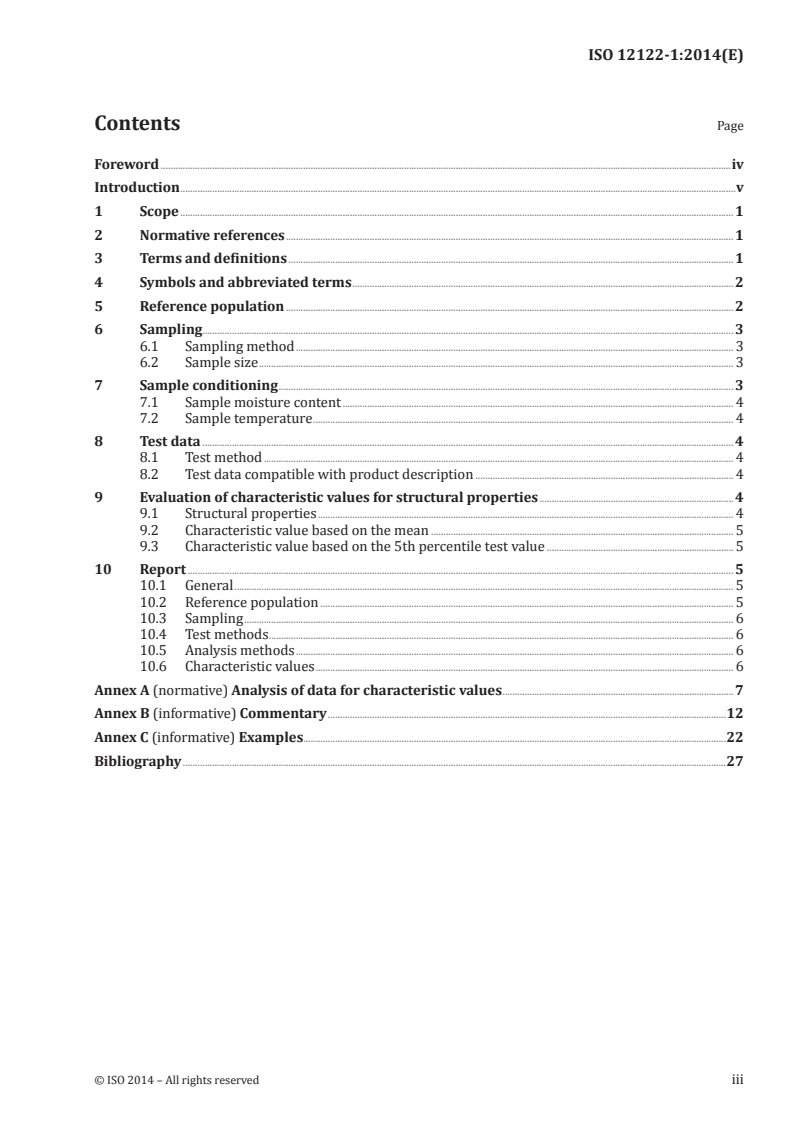
Contents Page
Foreword .iv
Introduction .v
1 Scope . 1
2 Normative references . 1
3 Terms and definitions . 1
4 Symbols and abbreviated terms . 2
5 Reference population . 2
6 Sampling . 3
6.1 Sampling method . 3
6.2 Sample size . 3
7 Sample conditioning . 3
7.1 Sample moisture content . 4
7.2 Sample temperature . 4
8 Test data . 4
8.1 Test method . 4
8.2 Test data compatible with product description . 4
9 Evaluation of characteristic values for structural properties . 4
9.1 Structural properties . 4
9.2 Characteristic value based on the mean . 5
9.3 Characteristic value based on the 5th percentile test value . 5
10 Report . 5
10.1 General . 5
10.2 Reference population . 5
10.3 Sampling . 6
10.4 Test methods . 6
10.5 Analysis methods . 6
10.6 Characteristic values . 6
Annex A (normative) Analysis of data for characteristic values . 7
Annex B (informative) Commentary .12
Annex C (informative) Examples .22
Bibliography .27
Foreword
ISO (the International Organization for Standardization) is a worldwide federation of national standards
bodies (ISO member bodies). The work of preparing International Standards is normally carried out
through ISO technical committees. Each member body interested in a subject for which a technical
committee has been established has the right to be represented on that committee. International
organizations, governmental and non-governmental, in liaison with ISO, also take part in the work.
ISO collaborates closely with the International Electrotechnical Commission (IEC) on all matters of
electrotechnical standardization.
The procedures used to develop this document and those intended for its further maintenance are
described in the ISO/IEC Directives, Part 1. In particular the different approval criteria needed for the
different types of ISO documents should be noted. This document was drafted in accordance with the
editorial rules of the ISO/IEC Directives, Part 2 (see www.iso.org/directives).
Attention is drawn to the possibility that some of the elements of this document may be the subject of
patent rights. ISO shall not be held responsible for identifying any or all such patent rights. Details of
any patent rights identified during the development of the document will be in the Introduction and/or
on the ISO list of patent declarations received (see www.iso.org/patents).
Any trade name used in this document is information given for the convenience of users and does not
constitute an endorsement.
For an explanation on the meaning of ISO specific terms and expressions related to conformity
assessment, as well as information about ISO’s adherence to the WTO principles in the Technical Barriers
to Trade (TBT) see the following URL: Foreword - Supplementary information
The committee responsible for this document is ISO/TC 165, Structural Timber.
ISO 12122 consists of the following parts, under the general title Timber structures — Determination of
characteristic values:
— Part 1: Basic requirements
— Part 2: Sawn timber
iv © ISO 2014 – All rights reserved
Introduction
This International Standard sets out a framework to establish characteristic values from test results on
a sample drawn from a clearly defined reference population. The characteristic value is an estimate of
the property of the reference population with a consistent level of confidence prescribed in this part of
ISO 12122.
It is the intention that this part of ISO 12122 can be used on any structural product including but not
limited to: sawn timber, glulam, structural composite lumber, I-beams, wood-based panels, poles, and
round timber. Whenever it is used, this part of ISO 12122 alerts the user to the basic requirements
for the determination of consistent characteristic values, but for some classes of products, additional
requirements set out in other parts or Annexes to this part give further mandatory detail and explanation.
It permits the evaluation of characteristic values on testing of commercial sized specimens.
In some cases, characteristic values determined in accordance with this part of ISO 12122 may be
modified to become a design value.
This part of ISO 12122 has the following Annexes:
Annex A presents detail on a number of statistical methods that may be used in the evaluation of
characteristic values.
Annex B presents a commentary on the provisions in this part of ISO 12122.
Annex C presents examples of the use of the statistical methods.
INTERNATIONAL STANDARD ISO 12122-1:2014(E)
Timber structures — Determination of characteristic
values —
Part 1:
Basic requirements
1 Scope
This International Standard gives methods for the determination of characteristic values for a defined
population of timber products, calculated from test values.
It presents methods for the determination of
a) characteristic value of mean-based properties, and
b) characteristic value of 5th percentile-based properties.
2 Normative references
The following documents, in whole or in part, are normatively referenced in this document and are
indispensable for its application. For dated references, only the edition cited applies. For undated
references, the latest edition of the referenced document (including any amendments) applies.
AS/NZS 4063.2, Characterisation of structural timber — Part 2: Determination of characteristic values
ASTM D2915, Sampling and data-analysis for structural wood and wood-based products
EN 14358, Timber structures — Calculation of characteristic 5th percentile values and acceptance criteria
for a sample
3 Terms and definitions
For the purposes of this document, the following terms and definitions apply.
3.1
characteristic value
value of a property taken to represent the property of a designated population using a process of
sampling, testing of specimens, and analysis
3.2
characteristic value of mean-based property
two alternative presentations of characteristic value for mean-based properties are possible:
a) the mean property obtained from results of tests on the defined product;
b) the mean property with 75 % confidence obtained from results of tests on the defined product
3.3
characteristic value of 5th percentile-based strength property
5th percentile value with 75 % confidence strength property obtained from results of tests on the
defined product
3.4
population
all of the structural timber product that meets the description of the population
Note 1 to entry: See Annex B for some examples of the use of the term population.
3.5
sample
number of single members of the population, selected to represent the population
Note 1 to entry: See Annex B for some examples of the use of the term sample.
3.6
specimen
single element used in a test; the element may be a complete member, a member that has been trimmed
to length, or a part of a member fabricated for a specific test
Note 1 to entry: See Annex B for some examples of the use of the term specimen.
4 Symbols and abbreviated terms
Symbols defined in the relevant ISO product or test standard shall be used.
In addition, the following apply:
f is the characteristic bending strength
m
k is a multiplier to give the mean property with 75 % confidence and is given in Table A1
mean, 0,75
k is a multiplier to give the 5th percentile value with 75 % confidence for a 5th percen-
0,05, 0,75
tile-based property and is given in Table A2
M is the moment capacity
n is the number of specimens in the test data
V is the coefficient of variation of the test data
X is the target difference between the reported characteristic value and the test result
Δ
5th percentile
X is a generalized test value
i
X is the average of the individual test values (X )
mean i
X is the mean property with 75 % confidence
mean, 0,75
X is the 5th percentile value from the test data
0,05
X is the 5th percentile value with 75 % confidence
0,05, 0,75
Z is the section modulus
5 Reference population
The population to which the characteristic value applies shall be fully described. The description shall
reference all of the attributes that may affect either the strength or stiffness and restrict the pieces to
the grouping for which the characteristic value is required. These include but are not limited to:
a) reference to the relevant product standard or specification;
2 © ISO 2014 – All rights reserved
b) species or species grouping;
c) designation of grade of the product;
d) size or size range of the product;
e) moisture condition of the product;
f) treatment of the product;
g) period in which the product was manufactured.
The reference population shall be a grouping from which it is possible to draw a representative sample,
and on which it is possible to perform tests on specimens to characterize the required properties.
6 Sampling
6.1 Sampling method
The sampling method shall aim to produce a sample that is representative of the variants in the defined
reference population that may affect the tested properties. The sampling shall minimize selection bias,
and shall be appropriate to the purpose of the characteristic value and the nature of the reference
population.
The sampling method shall be documented. The documentation shall include details of the steps taken
to ensure that each of the variants listed in the population as described in Clause 5 is included in the
representative sample.
6.2 Sample size
The sample shall be large enough to cover variants of the product that impact on the tested properties,
and give statistical significance to the result.
NOTE 1 Materials with larger assumed or assigned population coefficient of variation, (V), of the tested
properties should have a larger sample size.
NOTE 2 Some product standards may define a minimum number of tests that must be undertaken to determine
characteristic values to be used with described products.
NOTE 3 Annex B gives some guidance on selecting sample size.
NOTE 4 For some populations, a number of different sub-groups within the population may need to be sampled
(e.g. different cross-sectional sizes). In these cases, the size of each of the sub-groups may have to be sufficient to
allow meaningful pooling of the results as indicated in Annex A.
NOTE 5 Where characteristic values are to support limit states (or LRFD) design, the sample size should be
appropriate for the statistical method selected to determine the 5th percentile value strength (full distribution
or tail-fit). However, where the data are used to support a full reliability design method, the sample size should be
appropriate to also enable the full statistical distribution of the property to be defined.
7 Sample conditioning
Test data from the samples shall be compatible with the definition of the population by
a) compliance with the specification of the reference population at the time of testing in accordance
with 7.1 and 7.2, or
b) adjustment of test data in accordance with 8.2 where compliance with 7.1 or 7.2 is not achieved.
7.1 Sample moisture content
The sample shall be stored so that the moisture content at the time of test is appropriate to the description
of the reference population as detailed in Clause 5.
7.2 Sample temperature
The sample shall be stored and tested so that the temperature at the time of test is appropriate to the
description of the reference population as detailed in Clause 5.
8 Test data
8.1 Test method
The test data shall be derived in accordance with an appropriate test method for the properties and for
the reference population.
NOTE 1 For tests on some product types, discrimination of results on the basis of failure mode may be required
to ensure that the results are compatible with objectives of the test program and the property being determined.
NOTE 2 Test methods involve many variables that may affect results including loading configuration and rates,
specimen positioning and measurement methods. The selection of these variables must be appropriate to the
objectives of the testing, and may require some adjustments specified in 8.2.
8.2 Test data compatible with product description
Where the characteristic value is applicable to a standard size or moisture content, adjustments to
the raw test data may be required. Any adjustment shall be in accordance with appropriate behaviour
models and shall be detailed in the report.
NOTE Annex B gives examples of the types of adjustment that may be necessary in response to variation of
the specimens from the description of the reference population.
Where test data from a number of different data subsets are to be combined, the basis for the combination
shall satisfy the following requirements:
a) The data shall be derived from similar subsets that are standardized using the same adjustment
models, and shall satisfy statistical tests for combining the subsets into a single data set;
b) Transformation methods shall be in accordance with appropriate behaviour models and shall be
detailed in the report.
NOTE Annex A gives requirements for combining or pooling of data from a number of different test programs.
9 Evaluation of characteristic values for structural properties
9.1 Structural properties
Characteristic values for properties shall be reported in one of two ways according to the use of the
product:
a) Material properties — where the determined property is multiplied by a geometric parameter to
give a component capacity, or component stiffness;
b) Component properties — where the determined property is a component capacity or component
stiffness.
Characteristic values for structural properties shall be classified as those based on the mean of test
results and those based on the 5th percentile of test results in accordance with 3.2 and 3.3.
4 © ISO 2014 – All rights reserved
9.2 Characteristic value based on the mean
The mean value of the test values shall be evaluated as either a) or b):
a) the arithmetic average of the test values as
X
∑ i
X = (1)
mean
n
where
X is the average of the individual test values (X );
mean i
X is a generalized test value;
i
n is the number of test values.
b) the mean value of a statistical distribution fitted through the test data
For mean-based strength characteristic values, the mean property with 75 % confidence obtained from
results of tests shall be evaluated.
NOTE Suitable methods for estimating the mean with 75 % confidence are presented in Annex A.
The characteristic values for modulus of elasticity or modulus of rigidity shall be the mean value.
9.3 Characteristic value based on the 5th percentile test value
The 5th percentile value of the test values shall be evaluated as
a) the non-parametric estimate of the 5th percentile of the test data found by ranking the test data and
from the cumulative frequency of the test data selecting the interpolated value at the 5th percentile
(see A.2.1 and A.2.2), or
b) the estimate of the 5th percentile of the test data found by fitting an accepted statistical distribution
through the test data and selecting the 5th percentile point from the fitted distribution (see A.2.3).
The 5th percentile value with 75 % confidence shall be evaluated.
NOTE Suitable methods for estimating the 5th percentile value with 75 % confidence are presented in
Annex A.
10 Report
10.1 General
The report shall include details of the reference population definition, sampling program, description
of test pieces, the test method and analysis methods used, and the characteristic values in accordance
with 10.2 to 10.6.
10.2 Reference population
The reference population shall be defined as given in Clause 5. Each attribute used to define the reference
population shall be detailed in the report. Each of the attributes in the reference population that may
affect either the strength or stiffness shall be presented in the report.
10.3 Sampling
The sampling method used to select the test sample shall be described.
The justification of the sample size selected shall be presented. (See 6.2.)
10.4 Test methods
Reporting of testing methods shall either
a) refer to the test standard used, or
b) fully document the test procedures used.
Reporting of test specimen preparation shall include a statistical summary of the characteristics of the
sample (e.g. moisture content, temperature, grade marks). This data shall be in sufficient detail to enable
the data to be adjusted to different conditions if required.
The test results shall be presented in the report in enough detail to enable the statistical analysis to
be checked or repeated. Any adjustment of the test results to ensure compatibility with the product
description shall be fully documented, together with references for the modification methods and
factors used.
Where applicable for the reference population and the tests undertaken, failure modes in strength tests
shall be reported.
10.5 Analysis methods
The analysis method shall be described in detail. For characteristic strength values, the method for
estimation of the 5th percentile value with 75 % confidence shall be referenced.
Where pooled data are used, the method of combination of the data shall be described.
Where a distribution is fitted to the test data, all of the defining parameters of the fitted distribution
shall be reported, together with goodness of fit parameters.
10.6 Characteristic values
The characteristic values shall be reported together with the V of the data that led to their calculation.
6 © ISO 2014 – All rights reserved
Annex A
(normative)
Analysis of data for characteristic values
A.1 Evaluation of mean value with 75 % confidence
Where required, the lower single sided 75 % confidence limit on a mean property shall be found by
kV
mean,,075
XX=−1 (A.1)
mean,,075 mean
n
where
X is the characteristic value expressed as the mean value with 75 % confidence;
mean, 0,75
X is the average of the individual test values (X );
mean i
k is a multiplier to give mean value with 75 % confidence and shall be the value obtained
mean, 0,75
in Table A1;
V is the coefficient of variation of the test data found by dividing the standard deviation
of the test data by the average of the test data;
n is the number of specimens in the test data.
Table A.1 — k
mean, 0,75
Number of specimens
k
mean, 0.75
n
3 0,82
5 0,74
10 0,70
30 0,68
50 0,68
100 0,68
>100 0,67
A.2 Evaluation of 5th percentile value with 75 % confidence
A.2.1 Use of non-parametric data analysed using ASTM D2915
Where this method is used, the estimation of the 5th percentile value with 75 % confidence using the
non-parametric method of ASTM D2915 shall be used without modification.
A.2.2 Use of non-parametric data analysed using AS/NZS 4063.2
Where this method is used, the 5th percentile of the test data shall be evaluated by ranking the test data
and determining the 5th percentile of the ranked data. The 5th percentile value with 75 % confidence
shall be evaluated from Formula (A.2).
kV
00,,50,75
XX=−1 (A.2)
00,,50,,75 005
n
where
n is the number of test values;
X is the 5th percentile value with 75 % confidence;
0,05, 0,75
X is the 5th percentile from the test data interpolated between the data ranks as neces-
0,05
sary;
k is a multiplier to give the 5th percentile value with 75 % confidence and is given in
0,05, 0,75
Table A2;
V is the coefficient of variation of the test data found by dividing the standard deviation of
the test data by the average of the test data.
Table A.2 — k
0,05, 0,75
Number of specimens k
0,05, 0,75
n
a
5 —
a
10 —
30 2,01
50 1,94
100 1,85
>100 1,76
NOTE Method of analysis: non-parametric AS/NZS 4063.
a
There are difficulties obtaining a reliable estimate of the 5th percentile value from small
data sets.
A.2.3 Evaluation by fitting data to a distribution
Where this method is used, the 5th percentile value with 75 % confidence shall be evaluated from
the 5th percentile value of the test data by fitting a distribution through the test data and applying
Formula (A.2) with V found by dividing the standard deviation of the test data by the average of the test
data.
For this analysis, k is the multiplier to give the 5th percentile value with 75 % confidence and
0,05, 0,75
is given in Table A3. The result will only be valid if the distribution is a good fit to the data. Where a
distribution is fitted to the data, goodness of fit parameters shall be evaluated in accordance with A.3.
8 © ISO 2014 – All rights reserved
Table A.3 — k
0,05, 0,75
Method of analysis Log-normal Normal
Number of specimens n k k
0,05, 0,75 0,05, 0,75
a
5 1,34 2,05
a
10 1,28 2,04
30 1,18 2,01
50 1,13 1,97
100 1,07 1,91
>100 1,05 1,90
NOTE 1 Other distributions may be used as long as the values of k can be justified.
0,05, 0,75
NOTE 2 For the log normal distribution, V is the standard deviation of the original data
divided by the mean of the original data, not the ratio of the standard deviation of the
logarithms to the mean of the logarithms.
NOTE 3 The data presented in this table is sourced from PN 05.2024 FWPA Australia. The
data for the log-normal distribution was calibrated for V ranging from 5 % to 55 % and
for the normal distribution for V ranging from 5 % to 20 %. The log-normal factors give
equivalent results to the non-central student t-distribution presented in EN 14358 and US
practice within 1 % for sample sizes of 10 or more.
a
There are difficulties obtaining a reliable estimate of the 5th percentile value from small
data sets.
A.3 Goodness of fit tests for fitted distributions
A distribution is deemed to be a good fit to test data where the Kolmogorov-Smirnov goodness of fit test
is significant at the 0,05 or better level.
NOTE Where the data are not shown to be a good fit to the distribution or the data are a collection from a
number of distributions, an alternative distribution, or a non-parametric method should be used.
A.4 Pooling of data for analysis
A.4.1 General
Pooling involves the aggregation of data from a number of discrete data sets to capture sources of
variation that may not be present within a single subset. Such aggregations may include data from
different species of timber, different production methods, or different sized products.
In this clause, the term subset data refers to test data from a single size, grade, product test sample.
Pooled data are the sum of all valid subsets as represented in Figure A1.
Figure A.1 — Venn diagram for nomenclature for pooling (see Annex B)
A.4.2 Conditions for pooling
Pooling of data are only valid for data from tests on:
a) the same product description (e.g. seasoned sawn timber);
b) the same grade (e.g. stress grade);
c) similar species (e.g. softwoods).
A.4.3 Standardising data
Where the characteristic value is applicable to a standard size or moisture content, adjustments shall
use the same models for each data subset. The models shall be appropriate for the material that was
tested and shall be detailed in the report.
NOTE For example, where pooling data from timber with non-standard moisture contents, the same moisture
content adjustment calculation should be used for all data subsets contributing to the pooled data set.
A.4.4 Requirements for pooling
The pooled subsets shall have
a) similar statistical distributions,
b) similar V,
c) reversibility (if a subset is removed, the characteristics of the pooled data do not change significantly),
and
d) convergence (the pooled data have similar characteristics to very large samples of the subsets).
Standard statistical practices shall be used to accept standardized subsets and validate the pooled data.
NOTE An example of some acceptance and validation tests is given in Annex B.
A.4.5 Report
Where pooling is used, the report shall detail
a) the definition of the pooled data,
b) the models of standardizing or adjusting subset data,
10 © ISO 2014 – All rights reserved
c) the justification of pooled subsets including characteristics of statistical distributions, coefficient of
variation, reversibility and convergence,
d) the statistical tests and validation, and
e) the author and date of report.
Annex B
(informative)
Commentary
B.1 Commentary on scope
This part of ISO 12122 presents basic requirements for determining characteristic values for structural
properties of structural timber products. Other parts in the same series present the detail required for
different types of structural timber products.
It gives the overall strategy for determining characteristic values for any timber structural product:
— the products to which the characteristic values apply are described in Clause 5 Reference population;
— a test sample is taken as described in Clause 6;
— if appropriate it is conditioned as described in Clause 7;
— testing is performed and the test data are checked against the requirements for the product as
described in the reference population as described in Clause 8;
— an analysis of the test data is performed to evaluate the characteristic properties as described in
Clause 9.
This part of part of ISO 12122 presents a uniform methodology for the evaluation of characteristic
values. The characteristic values are said to represent the properties of the reference population and
in general take into account the statistically expected errors in estimating the properties of a large
population from a randomly drawn sample.
Characteristic values for design purposes are generally selected from characteristic values obtained
from test results, but may also incorporate safety factors to account for any or all of the following factors:
— Expected changes in product or product properties over a long period: These changes could be due
to variations in timber resource quality, production methods or quality of other raw materials;
— Complexity of the reference product: For example, where the reference product has a large number
of producers who draw their resource over a large area, then the sampling may not effectively catch
all possible combinations of resource quality and production methods. In this way, the sample may
not be truly representative and a safety factor may be applied to allow for that;
— Complexity of failure modes: If there are a number of different possible failure modes, or if it is
believed that the test may not have fully explored all of them, then there may be reason to use an
additional safety factor.
B.2 Commentary on normative references
No commentary.
B.3 Commentary on terms and definitions
All strength characteristic values are an estimate of the population value based on the value from sample
tests. Whenever a sample is taken, normal sampling error may mean that the results of the sample
may not give exactly the same result as if every piece in the population was tested. Hence, a standard
correction to the test result is made to give 75 % confidence.
12 © ISO 2014 – All rights reserved
Most strength characteristic values are based on the 5th percentile strength of the population, so
the test data are used to estimate the 5th percentile value and this value is used to estimate the 5th
percentile value with 75 % confidence. The two percentiles in the definitions have different meanings.
The 5th percentile strength is the strength value that 5 % of the population will be lower than. The
75 % confidence recognizes that the strength calculated as the 5th percentile from a sample may not
be the same as the value found if every single piece in the population was tested. The value with 75 %
confidence is the value that would have a chance of 75 % of being exceeded if the entire population was
to be tested.
For modulus of elasticity, the characteristic value is simply the mean of the test data. This in effect is a
50 % confidence in the estimate of the population mean.
Some strength characteristic values (e.g. bearing strengths) are based on the mean of the test data. For
these properties, the mean of the strength test data is used.
It is recommended that the detail of the calculation of the confidence limit for all characteristic values be
reported to enable the data to be used to establish values for design or approval purposes.
The collective nouns used to describe groups of timber are as follows.
— Population refers to the all of the timber to which the characteristic value applies. It includes all of
the tested material and untested material that meets the definition of the reference population. (See
B.5 for further detail on the definition of reference population.)
— Sample refers to the pieces of the reference population taken to represent the reference population.
A sample is a number of whole pieces taken from the population and is intended to reflect all of the
variants that make up the population. The population is characterized by the sample, so considerable
care is required to ensure that the sample is representative. (See B.6 for further detail on sampling
and sample size.)
— Specimen refers to a single item that is subjected to test. Specimens are usually cut out of single
pieces of timber with one specimen per piece in the sample. In some cases more than one test
may be performed on a specimen, e.g. a bending stiffness test and a bending strength test may be
performed on the same specimen.
An example of these terms is as follows.
— A producer needs to characterize the bending strength of production of a single product from a
single mill during a one month period. The reference population will be all of the products produced
by that mill in the one month period. This may typically be 100 000 pieces of timber.
— The sample size is 120 pieces, and this sample will be drawn at random from the reference population
over the one month period. The sample rate is a little over 1 in 1 000 pieces of product, and the
sample will be the 120 pieces of timber taken from the reference population.
— Each piece of timber in the sample will be cut into a single test specimen in accordance with the test
method requirements. Thus, there will be 120 bending test specimens prepared from the sampled
timber. After testing there will be 120 data items, one for each test specimen. The single population
has had a single sample of 120 pieces taken and yielded 120 test specimens and 120 data points.
B.4 Commentary on symbols
No commentary.
B.5 Commentary on reference population
Characteristic values represent the properties of the material from which the sample was taken. The
reference population is a statement of the population from which the sample was taken and hence is
directly linked to the characteristic values.
The context for the testing and the use of the characteristic value may affect the way in which the
reference population is selected and defined, as shown in the following examples.
— Where the results of testing product drawn from a vast region or a nation are to be used to
establish the design characteristics of that product, then the definition of the reference population
is necessarily very broad. It will be useful to incorporate as many variations in growing region,
production type and even species or species grouping within the definition of the stress-grade as
possible. In this case the reference population is the entire production of the defined product for the
region or nation.
— Where the results of testing are to be used to check the performance of a single manufacturing
unit, then the reference population will only be taken from that manufacturing unit and the value
obtained will relate to the manufacture during the sampling period. The reference population will
be a selected product or product range from the manufacturing unit.
— Where the results of testing are to be used to verify properties of a single batch then the reference
population is taken from one production line over the period in which the batch was produced.
— Different statistical processes must be used for marketplace surveillance so it is not possible to treat
a single pack of timber as a reference population. If a whole pack of timber is treated as a reference
population and is tested, effectively the sample is the reference population and characteristic value
calculations are not appropriate.
A reasonable amount of detail on the reference population is required to enable the structural properties
reported as characteristic values to be related to all of the factors that may have influenced them in the
production of the material tested.
The list is an example, but the text of the clause indicates that anything in the manufacture of the product
that may affect the structural properties must be included in the description.
— The product standard or specification is central to the description of the reference population. In
many cases, the specification gives detail on the aspects of production that may affect its structural
properties. This would include methods used for seasoning, machining, and grading if appropriate.
It also may limit the species that can be used for the product.
— The species from which the sample was drawn constitute the species of the reference population.
Where a number of species can be used for a particular product, it is important that all those species
are represented in the sample so that they can all be part of the reference population.
— The grade of a product is the direct link with the design structural properties used. It is a very
important descriptor.
— Most timber products have size effects, so any statement of properties needs to be associated with
particular sizes. In some cases, a characteristic value will be size-specific, and in others, it will be
normalized to a standard size. In either case, the cross-sectional dimension that was used as the
basis for the characteristic value is important.
— Structural properties (especially the modulus of elasticity) are affected by moisture content in the
timber at the time of testing. The moisture content and its relationship with the specification for
the product need to be known. Where the product is specified as unseasoned, it is enough to know
that the moisture content was above fibre saturation point at the time of testing. Where the product
is specified as seasoned, the allowable moisture content range within the definition of the term
“seasoned” is part of the definition of reference population.
— It is widely accepted that some treatments have an effect on structural properties. For example,
heat treatments can increase density and modulus of elasticity. Thus, where a treatment is applied,
some detail about the treatment will be required. Again, where the treatment is a heat treatment,
the temperature and duration of the treatment may both be crucial. Where the treatment is an
impregnation process, then the pressure of application and the temperature of any redrying may be
important.
14 © ISO 2014 – All rights reserved
— Properties of logs and hence, the timber produced from them can change over time. Some of these
variations may be seasonal, and others may reflect different silvicultural practices at the time the
logs were grown. It is important that the sampling period be a part of the definition of the reference
population.
B.6 Commentary on sampling
The key to this requirement is that the sample should be representative of all of the variants in the
defined product. For products that are obtained from widely varying geographic regions, or a number
of different species, then there may be many combinations of growing environment, species, and
production method in the reference population. Each of these combinations must have a large enough
sample so that the range of properties in each combination is adequately represented.
B.6.1 Commentary on sampling method
Some testing bodies use stratified sampling to enable all variants in the reference population to be
represented. Others use a large sample size randomly obtained to include all of the combinations.
Samples must be randomly taken to avoid any unintended or deliberate bias.
— Unintended bias may be introduced by restricting specimen characteristics. (For example, where
longer lengths only are sampled, product obtained by docking is excluded from the sample though
it may be part of the reference population.)
— Deliberate bias may be introduced by only sampling from one part of the grade. (For example, if only
the specimens with high grading parameters are selected, then features in products that have low
grading parameters are not part of the sample, though they may be part of the reference population.)
B.6.2 Commentary on sample size
The key to ensuring a representative sample is to have a large number of pieces. However, a compromise
inevitably has to be made between obtaining adequate representation of the reference population and
the cost of sampling and testing a large number of pieces.
Evaluation of characteristic streng
...
INTERNATIONAL ISO
STANDARD 12122-1
First edition
2014-03-01
Timber structures — Determination
of characteristic values —
Part 1:
Basic requirements
Structures en bois — Détermination des valeurs caractéristiques —
Partie 1: Exigences de base
Reference number
©
ISO 2014
© ISO 2014
All rights reserved. Unless otherwise specified, no part of this publication may be reproduced or utilized otherwise in any form
or by any means, electronic or mechanical, including photocopying, or posting on the internet or an intranet, without prior
written permission. Permission can be requested from either ISO at the address below or ISO’s member body in the country of
the requester.
ISO copyright office
Case postale 56 • CH-1211 Geneva 20
Tel. + 41 22 749 01 11
Fax + 41 22 749 09 47
E-mail copyright@iso.org
Web www.iso.org
Published in Switzerland
ii © ISO 2014 – All rights reserved
Contents Page
Foreword .iv
Introduction .v
1 Scope . 1
2 Normative references . 1
3 Terms and definitions . 1
4 Symbols and abbreviated terms . 2
5 Reference population . 2
6 Sampling . 3
6.1 Sampling method . 3
6.2 Sample size . 3
7 Sample conditioning . 3
7.1 Sample moisture content . 4
7.2 Sample temperature . 4
8 Test data . 4
8.1 Test method . 4
8.2 Test data compatible with product description . 4
9 Evaluation of characteristic values for structural properties . 4
9.1 Structural properties . 4
9.2 Characteristic value based on the mean . 5
9.3 Characteristic value based on the 5th percentile test value . 5
10 Report . 5
10.1 General . 5
10.2 Reference population . 5
10.3 Sampling . 6
10.4 Test methods . 6
10.5 Analysis methods . 6
10.6 Characteristic values . 6
Annex A (normative) Analysis of data for characteristic values . 7
Annex B (informative) Commentary .12
Annex C (informative) Examples .22
Bibliography .27
Foreword
ISO (the International Organization for Standardization) is a worldwide federation of national standards
bodies (ISO member bodies). The work of preparing International Standards is normally carried out
through ISO technical committees. Each member body interested in a subject for which a technical
committee has been established has the right to be represented on that committee. International
organizations, governmental and non-governmental, in liaison with ISO, also take part in the work.
ISO collaborates closely with the International Electrotechnical Commission (IEC) on all matters of
electrotechnical standardization.
The procedures used to develop this document and those intended for its further maintenance are
described in the ISO/IEC Directives, Part 1. In particular the different approval criteria needed for the
different types of ISO documents should be noted. This document was drafted in accordance with the
editorial rules of the ISO/IEC Directives, Part 2 (see www.iso.org/directives).
Attention is drawn to the possibility that some of the elements of this document may be the subject of
patent rights. ISO shall not be held responsible for identifying any or all such patent rights. Details of
any patent rights identified during the development of the document will be in the Introduction and/or
on the ISO list of patent declarations received (see www.iso.org/patents).
Any trade name used in this document is information given for the convenience of users and does not
constitute an endorsement.
For an explanation on the meaning of ISO specific terms and expressions related to conformity
assessment, as well as information about ISO’s adherence to the WTO principles in the Technical Barriers
to Trade (TBT) see the following URL: Foreword - Supplementary information
The committee responsible for this document is ISO/TC 165, Structural Timber.
ISO 12122 consists of the following parts, under the general title Timber structures — Determination of
characteristic values:
— Part 1: Basic requirements
— Part 2: Sawn timber
iv © ISO 2014 – All rights reserved
Introduction
This International Standard sets out a framework to establish characteristic values from test results on
a sample drawn from a clearly defined reference population. The characteristic value is an estimate of
the property of the reference population with a consistent level of confidence prescribed in this part of
ISO 12122.
It is the intention that this part of ISO 12122 can be used on any structural product including but not
limited to: sawn timber, glulam, structural composite lumber, I-beams, wood-based panels, poles, and
round timber. Whenever it is used, this part of ISO 12122 alerts the user to the basic requirements
for the determination of consistent characteristic values, but for some classes of products, additional
requirements set out in other parts or Annexes to this part give further mandatory detail and explanation.
It permits the evaluation of characteristic values on testing of commercial sized specimens.
In some cases, characteristic values determined in accordance with this part of ISO 12122 may be
modified to become a design value.
This part of ISO 12122 has the following Annexes:
Annex A presents detail on a number of statistical methods that may be used in the evaluation of
characteristic values.
Annex B presents a commentary on the provisions in this part of ISO 12122.
Annex C presents examples of the use of the statistical methods.
INTERNATIONAL STANDARD ISO 12122-1:2014(E)
Timber structures — Determination of characteristic
values —
Part 1:
Basic requirements
1 Scope
This International Standard gives methods for the determination of characteristic values for a defined
population of timber products, calculated from test values.
It presents methods for the determination of
a) characteristic value of mean-based properties, and
b) characteristic value of 5th percentile-based properties.
2 Normative references
The following documents, in whole or in part, are normatively referenced in this document and are
indispensable for its application. For dated references, only the edition cited applies. For undated
references, the latest edition of the referenced document (including any amendments) applies.
AS/NZS 4063.2, Characterisation of structural timber — Part 2: Determination of characteristic values
ASTM D2915, Sampling and data-analysis for structural wood and wood-based products
EN 14358, Timber structures — Calculation of characteristic 5th percentile values and acceptance criteria
for a sample
3 Terms and definitions
For the purposes of this document, the following terms and definitions apply.
3.1
characteristic value
value of a property taken to represent the property of a designated population using a process of
sampling, testing of specimens, and analysis
3.2
characteristic value of mean-based property
two alternative presentations of characteristic value for mean-based properties are possible:
a) the mean property obtained from results of tests on the defined product;
b) the mean property with 75 % confidence obtained from results of tests on the defined product
3.3
characteristic value of 5th percentile-based strength property
5th percentile value with 75 % confidence strength property obtained from results of tests on the
defined product
3.4
population
all of the structural timber product that meets the description of the population
Note 1 to entry: See Annex B for some examples of the use of the term population.
3.5
sample
number of single members of the population, selected to represent the population
Note 1 to entry: See Annex B for some examples of the use of the term sample.
3.6
specimen
single element used in a test; the element may be a complete member, a member that has been trimmed
to length, or a part of a member fabricated for a specific test
Note 1 to entry: See Annex B for some examples of the use of the term specimen.
4 Symbols and abbreviated terms
Symbols defined in the relevant ISO product or test standard shall be used.
In addition, the following apply:
f is the characteristic bending strength
m
k is a multiplier to give the mean property with 75 % confidence and is given in Table A1
mean, 0,75
k is a multiplier to give the 5th percentile value with 75 % confidence for a 5th percen-
0,05, 0,75
tile-based property and is given in Table A2
M is the moment capacity
n is the number of specimens in the test data
V is the coefficient of variation of the test data
X is the target difference between the reported characteristic value and the test result
Δ
5th percentile
X is a generalized test value
i
X is the average of the individual test values (X )
mean i
X is the mean property with 75 % confidence
mean, 0,75
X is the 5th percentile value from the test data
0,05
X is the 5th percentile value with 75 % confidence
0,05, 0,75
Z is the section modulus
5 Reference population
The population to which the characteristic value applies shall be fully described. The description shall
reference all of the attributes that may affect either the strength or stiffness and restrict the pieces to
the grouping for which the characteristic value is required. These include but are not limited to:
a) reference to the relevant product standard or specification;
2 © ISO 2014 – All rights reserved
b) species or species grouping;
c) designation of grade of the product;
d) size or size range of the product;
e) moisture condition of the product;
f) treatment of the product;
g) period in which the product was manufactured.
The reference population shall be a grouping from which it is possible to draw a representative sample,
and on which it is possible to perform tests on specimens to characterize the required properties.
6 Sampling
6.1 Sampling method
The sampling method shall aim to produce a sample that is representative of the variants in the defined
reference population that may affect the tested properties. The sampling shall minimize selection bias,
and shall be appropriate to the purpose of the characteristic value and the nature of the reference
population.
The sampling method shall be documented. The documentation shall include details of the steps taken
to ensure that each of the variants listed in the population as described in Clause 5 is included in the
representative sample.
6.2 Sample size
The sample shall be large enough to cover variants of the product that impact on the tested properties,
and give statistical significance to the result.
NOTE 1 Materials with larger assumed or assigned population coefficient of variation, (V), of the tested
properties should have a larger sample size.
NOTE 2 Some product standards may define a minimum number of tests that must be undertaken to determine
characteristic values to be used with described products.
NOTE 3 Annex B gives some guidance on selecting sample size.
NOTE 4 For some populations, a number of different sub-groups within the population may need to be sampled
(e.g. different cross-sectional sizes). In these cases, the size of each of the sub-groups may have to be sufficient to
allow meaningful pooling of the results as indicated in Annex A.
NOTE 5 Where characteristic values are to support limit states (or LRFD) design, the sample size should be
appropriate for the statistical method selected to determine the 5th percentile value strength (full distribution
or tail-fit). However, where the data are used to support a full reliability design method, the sample size should be
appropriate to also enable the full statistical distribution of the property to be defined.
7 Sample conditioning
Test data from the samples shall be compatible with the definition of the population by
a) compliance with the specification of the reference population at the time of testing in accordance
with 7.1 and 7.2, or
b) adjustment of test data in accordance with 8.2 where compliance with 7.1 or 7.2 is not achieved.
7.1 Sample moisture content
The sample shall be stored so that the moisture content at the time of test is appropriate to the description
of the reference population as detailed in Clause 5.
7.2 Sample temperature
The sample shall be stored and tested so that the temperature at the time of test is appropriate to the
description of the reference population as detailed in Clause 5.
8 Test data
8.1 Test method
The test data shall be derived in accordance with an appropriate test method for the properties and for
the reference population.
NOTE 1 For tests on some product types, discrimination of results on the basis of failure mode may be required
to ensure that the results are compatible with objectives of the test program and the property being determined.
NOTE 2 Test methods involve many variables that may affect results including loading configuration and rates,
specimen positioning and measurement methods. The selection of these variables must be appropriate to the
objectives of the testing, and may require some adjustments specified in 8.2.
8.2 Test data compatible with product description
Where the characteristic value is applicable to a standard size or moisture content, adjustments to
the raw test data may be required. Any adjustment shall be in accordance with appropriate behaviour
models and shall be detailed in the report.
NOTE Annex B gives examples of the types of adjustment that may be necessary in response to variation of
the specimens from the description of the reference population.
Where test data from a number of different data subsets are to be combined, the basis for the combination
shall satisfy the following requirements:
a) The data shall be derived from similar subsets that are standardized using the same adjustment
models, and shall satisfy statistical tests for combining the subsets into a single data set;
b) Transformation methods shall be in accordance with appropriate behaviour models and shall be
detailed in the report.
NOTE Annex A gives requirements for combining or pooling of data from a number of different test programs.
9 Evaluation of characteristic values for structural properties
9.1 Structural properties
Characteristic values for properties shall be reported in one of two ways according to the use of the
product:
a) Material properties — where the determined property is multiplied by a geometric parameter to
give a component capacity, or component stiffness;
b) Component properties — where the determined property is a component capacity or component
stiffness.
Characteristic values for structural properties shall be classified as those based on the mean of test
results and those based on the 5th percentile of test results in accordance with 3.2 and 3.3.
4 © ISO 2014 – All rights reserved
9.2 Characteristic value based on the mean
The mean value of the test values shall be evaluated as either a) or b):
a) the arithmetic average of the test values as
X
∑ i
X = (1)
mean
n
where
X is the average of the individual test values (X );
mean i
X is a generalized test value;
i
n is the number of test values.
b) the mean value of a statistical distribution fitted through the test data
For mean-based strength characteristic values, the mean property with 75 % confidence obtained from
results of tests shall be evaluated.
NOTE Suitable methods for estimating the mean with 75 % confidence are presented in Annex A.
The characteristic values for modulus of elasticity or modulus of rigidity shall be the mean value.
9.3 Characteristic value based on the 5th percentile test value
The 5th percentile value of the test values shall be evaluated as
a) the non-parametric estimate of the 5th percentile of the test data found by ranking the test data and
from the cumulative frequency of the test data selecting the interpolated value at the 5th percentile
(see A.2.1 and A.2.2), or
b) the estimate of the 5th percentile of the test data found by fitting an accepted statistical distribution
through the test data and selecting the 5th percentile point from the fitted distribution (see A.2.3).
The 5th percentile value with 75 % confidence shall be evaluated.
NOTE Suitable methods for estimating the 5th percentile value with 75 % confidence are presented in
Annex A.
10 Report
10.1 General
The report shall include details of the reference population definition, sampling program, description
of test pieces, the test method and analysis methods used, and the characteristic values in accordance
with 10.2 to 10.6.
10.2 Reference population
The reference population shall be defined as given in Clause 5. Each attribute used to define the reference
population shall be detailed in the report. Each of the attributes in the reference population that may
affect either the strength or stiffness shall be presented in the report.
10.3 Sampling
The sampling method used to select the test sample shall be described.
The justification of the sample size selected shall be presented. (See 6.2.)
10.4 Test methods
Reporting of testing methods shall either
a) refer to the test standard used, or
b) fully document the test procedures used.
Reporting of test specimen preparation shall include a statistical summary of the characteristics of the
sample (e.g. moisture content, temperature, grade marks). This data shall be in sufficient detail to enable
the data to be adjusted to different conditions if required.
The test results shall be presented in the report in enough detail to enable the statistical analysis to
be checked or repeated. Any adjustment of the test results to ensure compatibility with the product
description shall be fully documented, together with references for the modification methods and
factors used.
Where applicable for the reference population and the tests undertaken, failure modes in strength tests
shall be reported.
10.5 Analysis methods
The analysis method shall be described in detail. For characteristic strength values, the method for
estimation of the 5th percentile value with 75 % confidence shall be referenced.
Where pooled data are used, the method of combination of the data shall be described.
Where a distribution is fitted to the test data, all of the defining parameters of the fitted distribution
shall be reported, together with goodness of fit parameters.
10.6 Characteristic values
The characteristic values shall be reported together with the V of the data that led to their calculation.
6 © ISO 2014 – All rights reserved
Annex A
(normative)
Analysis of data for characteristic values
A.1 Evaluation of mean value with 75 % confidence
Where required, the lower single sided 75 % confidence limit on a mean property shall be found by
kV
mean,,075
XX=−1 (A.1)
mean,,075 mean
n
where
X is the characteristic value expressed as the mean value with 75 % confidence;
mean, 0,75
X is the average of the individual test values (X );
mean i
k is a multiplier to give mean value with 75 % confidence and shall be the value obtained
mean, 0,75
in Table A1;
V is the coefficient of variation of the test data found by dividing the standard deviation
of the test data by the average of the test data;
n is the number of specimens in the test data.
Table A.1 — k
mean, 0,75
Number of specimens
k
mean, 0.75
n
3 0,82
5 0,74
10 0,70
30 0,68
50 0,68
100 0,68
>100 0,67
A.2 Evaluation of 5th percentile value with 75 % confidence
A.2.1 Use of non-parametric data analysed using ASTM D2915
Where this method is used, the estimation of the 5th percentile value with 75 % confidence using the
non-parametric method of ASTM D2915 shall be used without modification.
A.2.2 Use of non-parametric data analysed using AS/NZS 4063.2
Where this method is used, the 5th percentile of the test data shall be evaluated by ranking the test data
and determining the 5th percentile of the ranked data. The 5th percentile value with 75 % confidence
shall be evaluated from Formula (A.2).
kV
00,,50,75
XX=−1 (A.2)
00,,50,,75 005
n
where
n is the number of test values;
X is the 5th percentile value with 75 % confidence;
0,05, 0,75
X is the 5th percentile from the test data interpolated between the data ranks as neces-
0,05
sary;
k is a multiplier to give the 5th percentile value with 75 % confidence and is given in
0,05, 0,75
Table A2;
V is the coefficient of variation of the test data found by dividing the standard deviation of
the test data by the average of the test data.
Table A.2 — k
0,05, 0,75
Number of specimens k
0,05, 0,75
n
a
5 —
a
10 —
30 2,01
50 1,94
100 1,85
>100 1,76
NOTE Method of analysis: non-parametric AS/NZS 4063.
a
There are difficulties obtaining a reliable estimate of the 5th percentile value from small
data sets.
A.2.3 Evaluation by fitting data to a distribution
Where this method is used, the 5th percentile value with 75 % confidence shall be evaluated from
the 5th percentile value of the test data by fitting a distribution through the test data and applying
Formula (A.2) with V found by dividing the standard deviation of the test data by the average of the test
data.
For this analysis, k is the multiplier to give the 5th percentile value with 75 % confidence and
0,05, 0,75
is given in Table A3. The result will only be valid if the distribution is a good fit to the data. Where a
distribution is fitted to the data, goodness of fit parameters shall be evaluated in accordance with A.3.
8 © ISO 2014 – All rights reserved
Table A.3 — k
0,05, 0,75
Method of analysis Log-normal Normal
Number of specimens n k k
0,05, 0,75 0,05, 0,75
a
5 1,34 2,05
a
10 1,28 2,04
30 1,18 2,01
50 1,13 1,97
100 1,07 1,91
>100 1,05 1,90
NOTE 1 Other distributions may be used as long as the values of k can be justified.
0,05, 0,75
NOTE 2 For the log normal distribution, V is the standard deviation of the original data
divided by the mean of the original data, not the ratio of the standard deviation of the
logarithms to the mean of the logarithms.
NOTE 3 The data presented in this table is sourced from PN 05.2024 FWPA Australia. The
data for the log-normal distribution was calibrated for V ranging from 5 % to 55 % and
for the normal distribution for V ranging from 5 % to 20 %. The log-normal factors give
equivalent results to the non-central student t-distribution presented in EN 14358 and US
practice within 1 % for sample sizes of 10 or more.
a
There are difficulties obtaining a reliable estimate of the 5th percentile value from small
data sets.
A.3 Goodness of fit tests for fitted distributions
A distribution is deemed to be a good fit to test data where the Kolmogorov-Smirnov goodness of fit test
is significant at the 0,05 or better level.
NOTE Where the data are not shown to be a good fit to the distribution or the data are a collection from a
number of distributions, an alternative distribution, or a non-parametric method should be used.
A.4 Pooling of data for analysis
A.4.1 General
Pooling involves the aggregation of data from a number of discrete data sets to capture sources of
variation that may not be present within a single subset. Such aggregations may include data from
different species of timber, different production methods, or different sized products.
In this clause, the term subset data refers to test data from a single size, grade, product test sample.
Pooled data are the sum of all valid subsets as represented in Figure A1.
Figure A.1 — Venn diagram for nomenclature for pooling (see Annex B)
A.4.2 Conditions for pooling
Pooling of data are only valid for data from tests on:
a) the same product description (e.g. seasoned sawn timber);
b) the same grade (e.g. stress grade);
c) similar species (e.g. softwoods).
A.4.3 Standardising data
Where the characteristic value is applicable to a standard size or moisture content, adjustments shall
use the same models for each data subset. The models shall be appropriate for the material that was
tested and shall be detailed in the report.
NOTE For example, where pooling data from timber with non-standard moisture contents, the same moisture
content adjustment calculation should be used for all data subsets contributing to the pooled data set.
A.4.4 Requirements for pooling
The pooled subsets shall have
a) similar statistical distributions,
b) similar V,
c) reversibility (if a subset is removed, the characteristics of the pooled data do not change significantly),
and
d) convergence (the pooled data have similar characteristics to very large samples of the subsets).
Standard statistical practices shall be used to accept standardized subsets and validate the pooled data.
NOTE An example of some acceptance and validation tests is given in Annex B.
A.4.5 Report
Where pooling is used, the report shall detail
a) the definition of the pooled data,
b) the models of standardizing or adjusting subset data,
10 © ISO 2014 – All rights reserved
c) the justification of pooled subsets including characteristics of statistical distributions, coefficient of
variation, reversibility and convergence,
d) the statistical tests and validation, and
e) the author and date of report.
Annex B
(informative)
Commentary
B.1 Commentary on scope
This part of ISO 12122 presents basic requirements for determining characteristic values for structural
properties of structural timber products. Other parts in the same series present the detail required for
different types of structural timber products.
It gives the overall strategy for determining characteristic values for any timber structural product:
— the products to which the characteristic values apply are described in Clause 5 Reference population;
— a test sample is taken as described in Clause 6;
— if appropriate it is conditioned as described in Clause 7;
— testing is performed and the test data are checked against the requirements for the product as
described in the reference population as described in Clause 8;
— an analysis of the test data is performed to evaluate the characteristic properties as described in
Clause 9.
This part of part of ISO 12122 presents a uniform methodology for the evaluation of characteristic
values. The characteristic values are said to represent the properties of the reference population and
in general take into account the statistically expected errors in estimating the properties of a large
population from a randomly drawn sample.
Characteristic values for design purposes are generally selected from characteristic values obtained
from test results, but may also incorporate safety factors to account for any or all of the following factors:
— Expected changes in product or product properties over a long period: These changes could be due
to variations in timber resource quality, production methods or quality of other raw materials;
— Complexity of the reference product: For example, where the reference product has a large number
of producers who draw their resource over a large area, then the sampling may not effectively catch
all possible combinations of resource quality and production methods. In this way, the sample may
not be truly representative and a safety factor may be applied to allow for that;
— Complexity of failure modes: If there are a number of different possible failure modes, or if it is
believed that the test may not have fully explored all of them, then there may be reason to use an
additional safety factor.
B.2 Commentary on normative references
No commentary.
B.3 Commentary on terms and definitions
All strength characteristic values are an estimate of the population value based on the value from sample
tests. Whenever a sample is taken, normal sampling error may mean that the results of the sample
may not give exactly the same result as if every piece in the population was tested. Hence, a standard
correction to the test result is made to give 75 % confidence.
12 © ISO 2014 – All rights reserved
Most strength characteristic values are based on the 5th percentile strength of the population, so
the test data are used to estimate the 5th percentile value and this value is used to estimate the 5th
percentile value with 75 % confidence. The two percentiles in the definitions have different meanings.
The 5th percentile strength is the strength value that 5 % of the population will be lower than. The
75 % confidence recognizes that the strength calculated as the 5th percentile from a sample may not
be the same as the value found if every single piece in the population was tested. The value with 75 %
confidence is the value that would have a chance of 75 % of being exceeded if the entire population was
to be tested.
For modulus of elasticity, the characteristic value is simply the mean of the test data. This in effect is a
50 % confidence in the estimate of the population mean.
Some strength characteristic values (e.g. bearing strengths) are based on the mean of the test data. For
these properties, the mean of the strength test data is used.
It is recommended that the detail of the calculation of the confidence limit for all characteristic values be
reported to enable the data to be used to establish values for design or approval purposes.
The collective nouns used to describe groups of timber are as follows.
— Population refers to the all of the timber to which the characteristic value applies. It includes all of
the tested material and untested material that meets the definition of the reference population. (See
B.5 for further detail on the definition of reference population.)
— Sample refers to the pieces of the reference population taken to represent the reference population.
A sample is a number of whole pieces taken from the population and is intended to reflect all of the
variants that make up the population. The population is characterized by the sample, so considerable
care is required to ensure that the sample is representative. (See B.6 for further detail on sampling
and sample size.)
— Specimen refers to a single item that is subjected to test. Specimens are usually cut out of single
pieces of timber with one specimen per piece in the sample. In some cases more than one test
may be performed on a specimen, e.g. a bending stiffness test and a bending strength test may be
performed on the same specimen.
An example of these terms is as follows.
— A producer needs to characterize the bending strength of production of a single product from a
single mill during a one month period. The reference population will be all of the products produced
by that mill in the one month period. This may typically be 100 000 pieces of timber.
— The sample size is 120 pieces, and this sample will be drawn at random from the reference population
over the one month period. The sample rate is a little over 1 in 1 000 pieces of product, and the
sample will be the 120 pieces of timber taken from the reference population.
— Each piece of timber in the sample will be cut into a single test specimen in accordance with the test
method requirements. Thus, there will be 120 bending test specimens prepared from the sampled
timber. After testing there will be 120 data items, one for each test specimen. The single population
has had a single sample of 120 pieces taken and yielded 120 test specimens and 120 data points.
B.4 Commentary on symbols
No commentary.
B.5 Commentary on reference population
Characteristic values represent the properties of the material from which the sample was taken. The
reference population is a statement of the population from which the sample was taken and hence is
directly linked to the characteristic values.
The context for the testing and the use of the characteristic value may affect the way in which the
reference population is selected and defined, as shown in the following examples.
— Where the results of testing product drawn from a vast region or a nation are to be used to
establish the design characteristics of that product, then the definition of the reference population
is necessarily very broad. It will be useful to incorporate as many variations in growing region,
production type and even species or species grouping within the definition of the stress-grade as
possible. In this case the reference population is the entire production of the defined product for the
region or nation.
— Where the results of testing are to be used to check the performance of a single manufacturing
unit, then the reference population will only be taken from that manufacturing unit and the value
obtained will relate to the manufacture during the sampling period. The reference population will
be a selected product or product range from the manufacturing unit.
— Where the results of testing are to be used to verify properties of a single batch then the reference
population is taken from one production line over the period in which the batch was produced.
— Different statistical processes must be used for marketplace surveillance so it is not possible to treat
a single pack of timber as a reference population. If a whole pack of timber is treated as a reference
population and is tested, effectively the sample is the reference population and characteristic value
calculations are not appropriate.
A reasonable amount of detail on the reference population is required to enable the structural properties
reported as characteristic values to be related to all of the factors that may have influenced them in the
production of the material tested.
The list is an example, but the text of the clause indicates that anything in the manufacture of the product
that may affect the structural properties must be included in the description.
— The product standard or specification is central to the description of the reference population. In
many cases, the specification gives detail on the aspects of production that may affect its structural
properties. This would include methods used for seasoning, machining, and grading if appropriate.
It also may limit the species that can be used for the product.
— The species from which the sample was drawn constitute the species of the reference population.
Where a number of species can be used for a particular product, it is important that all those species
are represented in the sample so that they can all be part of the reference population.
— The grade of a product is the direct link with the design structural properties used. It is a very
important descriptor.
— Most timber products have size effects, so any statement of properties needs to be associated with
particular sizes. In some cases, a characteristic value will be size-specific, and in others, it will be
normalized to a standard size. In either case, the cross-sectional dimension that was used as the
basis for the characteristic value is important.
— Structural properties (especially the modulus of elasticity) are affected by moisture content in the
timber at the time of testing. The moisture content and its relationship with the specification for
the product need to be known. Where the product is specified as unseasoned, it is enough to know
that the moisture content was above fibre saturation point at the time of testing. Where the product
is specified as seasoned, the allowable moisture content range within the definition of the term
“seasoned” is part of the definition of reference population.
— It is widely accepted that some treatments have an effect on structural properties. For example,
heat treatments can increase density and modulus of elasticity. Thus, where a treatment is applied,
some detail about the treatment will be required. Again, where the treatment is a heat treatment,
the temperature and duration of the treatment may both be crucial. Where the treatment is an
impregnation process, then the pressure of application and the temperature of any redrying may be
important.
14 © ISO 2014 – All rights reserved
— Properties of logs and hence, the timber produced from them can change over time. Some of these
variations may be seasonal, and others may reflect different silvicultural practices at the time the
logs were grown. It is important that the sampling period be a part of the definition of the reference
population.
B.6 Commentary on sampling
The key to this requirement is that the sample should be representative of all of the variants in the
defined product. For products that are obtained from widely varying geographic regions, or a number
of different species, then there may be many combinations of growing environment, species, and
production method in the reference population. Each of these combinations must have a large enough
sample so that the range of properties in each combination is adequately represented.
B.6.1 Commentary on sampling method
Some testing bodies use stratified sampling to enable all variants in the reference population to be
represented. Others use a large sample size randomly obtained to include all of the combinations.
Samples must be randomly taken to avoid any unintended or deliberate bias.
— Unintended bias may be introduced by restricting specimen characteristics. (For example, where
longer lengths only are sampled, product obtained by docking is excluded from the sample though
it may be part of the reference population.)
— Deliberate bias may be introduced by only sampling from one part of the grade. (For example, if only
the specimens with high grading parameters are selected, then features in products that have low
grading parameters are not part of the sample, though they may be part of the reference population.)
B.6.2 Commentary on sample size
The key to ensuring a representative sample is to have a large number of pieces. However, a compromise
inevitably has to be made between obtaining adequate representation of the reference population and
the cost of sampling and testing a large number of pieces.
Evaluation of characteristic streng
...