


ISO/IEC 23200-2:2023
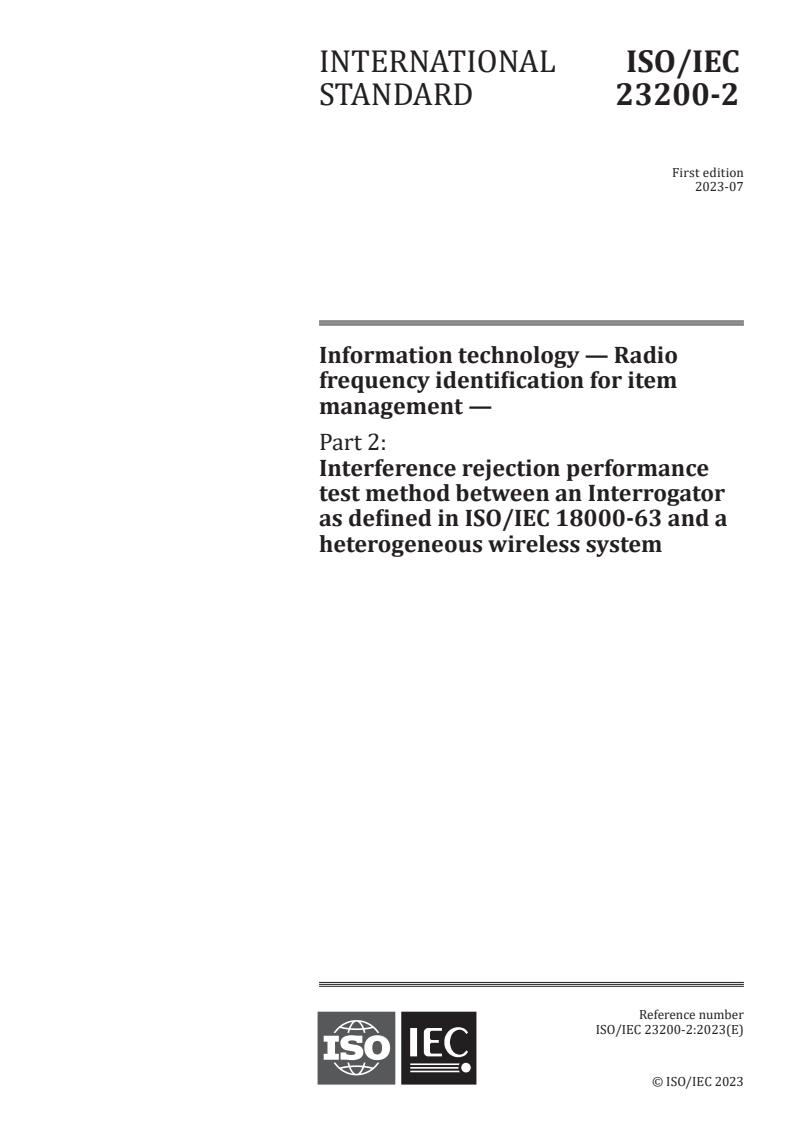
(Main)Information technology — Radio frequency identification for item management — Part 2: Interference rejection performance test method between an Interrogator as defined in ISO/IEC 18000-63 and a heterogeneous wireless system
Information technology — Radio frequency identification for item management — Part 2: Interference rejection performance test method between an Interrogator as defined in ISO/IEC 18000-63 and a heterogeneous wireless system
This document specifies a test method to evaluate the interference rejection performance of UHF RFID interrogators covered by ISO/IEC 18000-63, and specifies the general requirements and test requirements of that test method. NOTE The interference rejection test method of this document is different to the one in ISO/IEC 18046-3:2020, 8.5. This document covers interference effects between the tags and a heterogeneous (diverse content) wireless system. ISO/IEC 18046-3 covers interference effect between tags and homogeneous (same content) wireless systems. This test method enables the comparison of the relative interference rejection performance among UHF RFID interrogators under a single wireless interference environment. In addition, this document can be used in a benchmarking test, according to requirements in a given application or service.
General Information
- Status
- Published
- Publication Date
- 03-Jul-2023
- Technical Committee
- ISO/IEC JTC 1/SC 31 - Automatic identification and data capture techniques
- Drafting Committee
- ISO/IEC JTC 1/SC 31/WG 4 - Radio communications
- Current Stage
- 6060 - International Standard published
- Start Date
- 04-Jul-2023
- Due Date
- 06-Jan-2025
- Completion Date
- 04-Jul-2023
Overview
ISO/IEC 23200-2:2023 specifies a laboratory test method to evaluate the interference rejection performance of UHF RFID interrogators (readers) defined in ISO/IEC 18000-63. The standard focuses on how an interrogator’s receiver sensitivity and read performance are affected by a heterogeneous wireless system - i.e., coexisting wireless technologies (LoRaWAN, Wi‑Fi‑HaLow, NB‑IoT, LTE‑M, Sigfox, etc.) that share the same RF bands but use diverse protocols and power levels. The method enables comparative measurement and benchmarking of interrogators under a single controlled interference environment.
Key topics and technical requirements
- Scope and purpose: Defines a reproducible test method to compare relative interference rejection among UHF RFID interrogators and to support benchmarking for specific applications or services.
- Test environment: Recommended anechoic chamber for propagative tag testing; ambient conditions of 23 °C ± 3 °C and 40–60 % relative humidity.
- Pre‑conditioning: Devices under test (DUTs) are conditioned to the test environment for 24 hours when required.
- RF setup and equipment:
- Use of a tag emulator or compliant test equipment (TE) that follows ISO/IEC 18000-63 parameters and permits controlled variation of the backscatter‑link frequency (BLF).
- Contactless and contact test setups are defined; far‑field distances are recommended unless near‑field testing is explicitly noted.
- Optional equipment: phase shifters, signal generators and defined interference waveforms.
- Test sequences: Reader sequences such as Query – Various Commands – ACK – ReqRN or Query – Various Commands – ACK are specified to evaluate successful tag responses.
- Measurement and reporting:
- Receiver sensitivity measured under non‑interference and interference environments; the interference rejection metric (iRej) quantifies performance difference.
- Default tolerance of ±5 % for equipment and procedural parameters.
- Total measurement uncertainty must be reported; test reports should include DUT identification and may include min/max/mean and standard deviation for statistical evaluation.
Practical applications and users
- RFID equipment manufacturers - validate and compare reader designs for robustness to coexisting wireless systems.
- Independent test laboratories and certification bodies - provide consistent benchmarking and performance claims.
- System integrators and solution providers - assess reader suitability for IoT and logistics deployments where heterogeneous wireless coexistence is expected.
- Regulators and spectrum managers - evaluate coexistence impacts in shared frequency bands.
Related standards
- ISO/IEC 18000-63 - air interface parameters for UHF RFID (860–960 MHz).
- ISO/IEC 18046-2:2020 - interrogator performance test methods.
- ISO/IEC 18046-3:2020 - covers interference testing with homogeneous wireless systems; ISO/IEC 23200-2:2023 addresses heterogeneous systems.
Keywords: ISO/IEC 23200-2:2023, UHF RFID, interference rejection test, interrogator performance, ISO/IEC 18000-63, heterogeneous wireless coexistence, benchmarking, receiver sensitivity.
Buy Documents


ISO/IEC 23200-2:2023 - Information technology — Radio frequency identification for item management — Part 2: Interference rejection performance test method between an Interrogator as defined in ISO/IEC 18000-63 and a heterogeneous wireless system Released:4. 07. 2023
Get Certified
Connect with accredited certification bodies for this standard

BSI Group
BSI (British Standards Institution) is the business standards company that helps organizations make excellence a habit.

NYCE
Mexican standards and certification body.
Sponsored listings
Frequently Asked Questions
ISO/IEC 23200-2:2023 is a standard published by the International Organization for Standardization (ISO). Its full title is "Information technology — Radio frequency identification for item management — Part 2: Interference rejection performance test method between an Interrogator as defined in ISO/IEC 18000-63 and a heterogeneous wireless system". This standard covers: This document specifies a test method to evaluate the interference rejection performance of UHF RFID interrogators covered by ISO/IEC 18000-63, and specifies the general requirements and test requirements of that test method. NOTE The interference rejection test method of this document is different to the one in ISO/IEC 18046-3:2020, 8.5. This document covers interference effects between the tags and a heterogeneous (diverse content) wireless system. ISO/IEC 18046-3 covers interference effect between tags and homogeneous (same content) wireless systems. This test method enables the comparison of the relative interference rejection performance among UHF RFID interrogators under a single wireless interference environment. In addition, this document can be used in a benchmarking test, according to requirements in a given application or service.
This document specifies a test method to evaluate the interference rejection performance of UHF RFID interrogators covered by ISO/IEC 18000-63, and specifies the general requirements and test requirements of that test method. NOTE The interference rejection test method of this document is different to the one in ISO/IEC 18046-3:2020, 8.5. This document covers interference effects between the tags and a heterogeneous (diverse content) wireless system. ISO/IEC 18046-3 covers interference effect between tags and homogeneous (same content) wireless systems. This test method enables the comparison of the relative interference rejection performance among UHF RFID interrogators under a single wireless interference environment. In addition, this document can be used in a benchmarking test, according to requirements in a given application or service.
ISO/IEC 23200-2:2023 is classified under the following ICS (International Classification for Standards) categories: 35.040.50 - Automatic identification and data capture techniques. The ICS classification helps identify the subject area and facilitates finding related standards.
ISO/IEC 23200-2:2023 is available in PDF format for immediate download after purchase. The document can be added to your cart and obtained through the secure checkout process. Digital delivery ensures instant access to the complete standard document.
Standards Content (Sample)
INTERNATIONAL ISO/IEC
STANDARD 23200-2
First edition
2023-07
Information technology — Radio
frequency identification for item
management —
Part 2:
Interference rejection performance
test method between an Interrogator
as defined in ISO/IEC 18000-63 and a
heterogeneous wireless system
Reference number
© ISO/IEC 2023
© ISO/IEC 2023
All rights reserved. Unless otherwise specified, or required in the context of its implementation, no part of this publication may
be reproduced or utilized otherwise in any form or by any means, electronic or mechanical, including photocopying, or posting on
the internet or an intranet, without prior written permission. Permission can be requested from either ISO at the address below
or ISO’s member body in the country of the requester.
ISO copyright office
CP 401 • Ch. de Blandonnet 8
CH-1214 Vernier, Geneva
Phone: +41 22 749 01 11
Email: copyright@iso.org
Website: www.iso.org
Published in Switzerland
ii
© ISO/IEC 2023 – All rights reserved
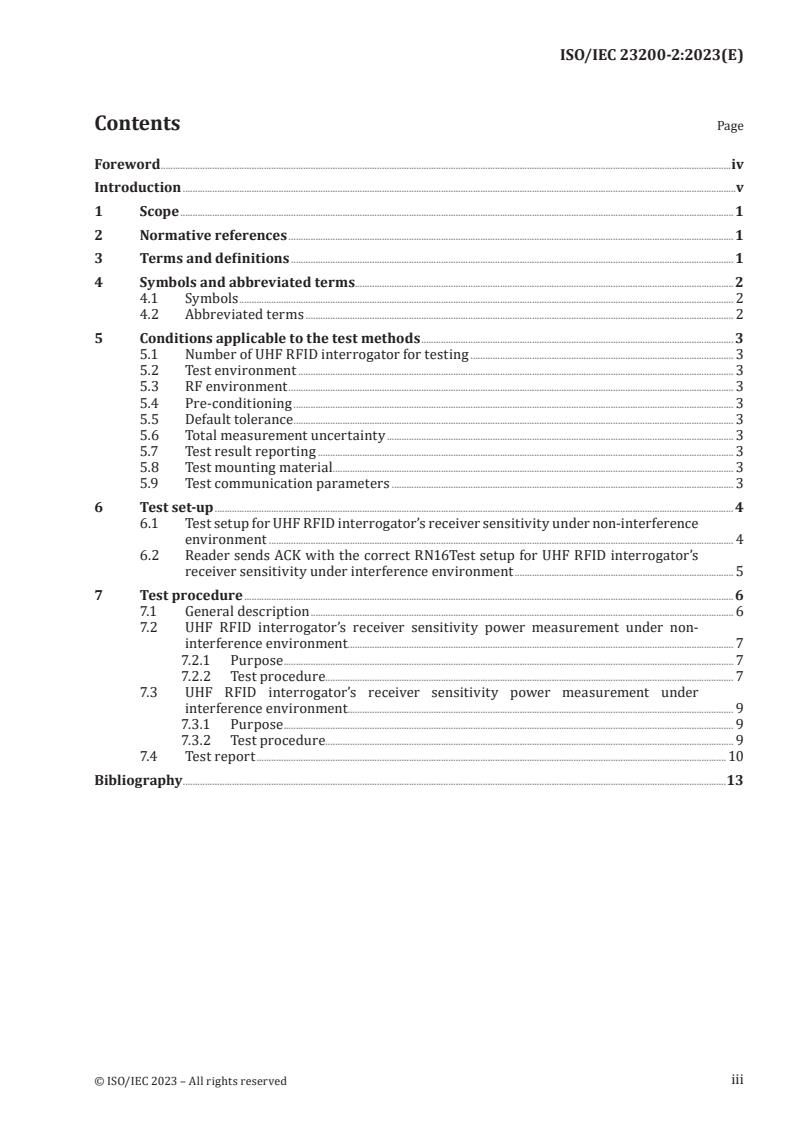
Contents Page
Foreword .iv
Introduction .v
1 Scope . 1
2 Normative references . 1
3 Terms and definitions . 1
4 Symbols and abbreviated terms.2
4.1 Symbols . 2
4.2 Abbreviated terms . 2
5 Conditions applicable to the test methods . 3
5.1 Number of UHF RFID interrogator for testing . 3
5.2 Test environment . 3
5.3 RF environment . 3
5.4 Pre-conditioning . 3
5.5 Default tolerance . 3
5.6 Total measurement uncertainty . 3
5.7 Test result reporting . 3
5.8 Test mounting material. 3
5.9 Test communication parameters . 3
6 Test set-up . 4
6.1 Test setup for UHF RFID interrogator’s receiver sensitivity under non-interference
environment . 4
6.2 Reader sends ACK with the correct RN16Test setup for UHF RFID interrogator’s
receiver sensitivity under interference environment . 5
7 Test procedure .6
7.1 General description . 6
7.2 UHF RFID interrogator’s receiver sensitivity power measurement under non-
interference environment. 7
7.2.1 Purpose . 7
7.2.2 Test procedure. 7
7.3 UHF RFID interrogator’s receiver sensitivity power measurement under
interference environment. 9
7.3.1 Purpose . 9
7.3.2 Test procedure. 9
7.4 Test report . 10
Bibliography .13
iii
© ISO/IEC 2023 – All rights reserved
Foreword
ISO (the International Organization for Standardization) is a worldwide federation of national standards
bodies (ISO member bodies). The work of preparing International Standards is normally carried out
through ISO technical committees. Each member body interested in a subject for which a technical
committee has been established has the right to be represented on that committee. International
organizations, governmental and non-governmental, in liaison with ISO, also take part in the work.
ISO collaborates closely with the International Electrotechnical Commission (IEC) on all matters of
electrotechnical standardization.
The procedures used to develop this document and those intended for its further maintenance are
described in the ISO/IEC Directives, Part 1. In particular, the different approval criteria needed for the
different types of ISO document should be noted. This document was drafted in accordance with the
editorial rules of the ISO/IEC Directives, Part 2 (see www.iso.org/directives).
ISO draws attention to the possibility that the implementation of this document may involve the use
of (a) patent(s). ISO takes no position concerning the evidence, validity or applicability of any claimed
patent rights in respect thereof. As of the date of publication of this document, ISO had not received
notice of (a) patent(s) which may be required to implement this document. However, implementers are
cautioned that this may not represent the latest information, which may be obtained from the patent
database available at www.iso.org/patents. ISO shall not be held responsible for identifying any or all
such patent rights.
Any trade name used in this document is information given for the convenience of users and does not
constitute an endorsement.
For an explanation of the voluntary nature of standards, the meaning of ISO specific terms and
expressions related to conformity assessment, as well as information about ISO's adherence to
the World Trade Organization (WTO) principles in the Technical Barriers to Trade (TBT), see
www.iso.org/iso/foreword.html.
This document was prepared by Joint Technical Committee ISO/IEC JTC 1, Information technology,
Subcommittee SC 31, Automatic identification and data capture techniques.
A list of all parts in the ISO/IEC 23200 series can be found on the ISO website.
Any feedback or questions on this document should be directed to the user’s national standards body. A
complete listing of these bodies can be found at www.iso.org/members.html.
iv
© ISO/IEC 2023 – All rights reserved
Introduction
Ultra-high-frequency (UHF) radio frequency identification (RFID) is a wireless technology that connects
billions of everyday items to the Internet of Things (IoT), enabling consumers and businesses to identify,
locate, authenticate and engage each item. IoT applications require a data connection between the
physical and digital world, and UHF RFID is the ideal technology to bridge these realms, with the ability
to bring low cost, unique identification to everyday items. Low-power wide-area networks (LoRaWAN)
operate at long read ranges of 2 km to 3 km. While LoRaWAN devices have a very slow data-transfer
rate, they are useful for transmitting sensor data. For example, LoRaWAN, WiFi-Halow (802.11ah),
Sigfox, NB-IoT, WB-IoT, and LTE-M are representative technologies.
The frequencies used by LoRaWAN systems differ by region and country, as do the frequency bands
designated for UHF RFID systems. In particular, LoRaWAN and RFID systems use different power levels
and heterogeneous protocols in shared frequency bands. They are susceptible to interference generated
by other wireless systems. This harsh signal propagation environment, combined with interference
from coexisting wireless technologies, can lead to a degradation of the systems performance or even
application failures.
v
© ISO/IEC 2023 – All rights reserved
INTERNATIONAL STANDARD ISO/IEC 23200-2:2023(E)
Information technology — Radio frequency identification
for item management —
Part 2:
Interference rejection performance test method between
an Interrogator as defined in ISO/IEC 18000-63 and a
heterogeneous wireless system
1 Scope
This document specifies a test method to evaluate the interference rejection performance of UHF
RFID interrogators covered by ISO/IEC 18000-63, and specifies the general requirements and test
requirements of that test method.
NOTE The interference rejection test method of this document is different to the one in ISO/IEC 18046-3:2020,
8.5. This document covers interference effects between the tags and a heterogeneous (diverse content) wireless
system. ISO/IEC 18046-3 covers interference effect between tags and homogeneous (same content) wireless
systems.
This test method enables the comparison of the relative interference rejection performance among UHF
RFID interrogators under a single wireless interference environment. In addition, this document can be
used in a benchmarking test, according to requirements in a given application or service.
2 Normative references
The following documents are referred to in the text in such a way that some or all of their content
constitutes requirements of this document. For dated references, only the edition cited applies. For
undated references, the latest edition of the referenced document (including any amendments) applies.
ISO/IEC 19762, Information technology — Automatic identification and data capture (AIDC) techniques —
Harmonized vocabulary
ISO/IEC 18046-2:2020, Information technology — Radio frequency identification device performance test
methods — Part 2: Test methods for interrogator performance
ISO/IEC 18000-63, Information technology — Radio frequency identification for item management — Part
63: Parameters for air interface communications at 860 MHz to 960 MHz Type C
3 Terms and definitions
For the purposes of this document, the terms and definitions given in ISO/IEC 19762 and the following
apply.
ISO and IEC maintain terminology databases for use in standardization at the following addresses:
— ISO Online browsing platform: available at https:// www .iso .org/ obp
— IEC Electropedia: available at https:// www .electropedia .org/
© ISO/IEC 2023 – All rights reserved
3.1
heterogeneous wireless system
wireless system using different access technologies which share the same radio frequency band
EXAMPLE RFID, cell phone networks.
4 Symbols and abbreviated terms
4.1 Symbols
BLF backscatter-link frequency (BLF = 1/T = DR/TRcal)
pri
P interrogator receiver sensitivity power level
rcv
P interrogator receiver sensitivity power level under a single wireless interference
rcv_under_int
environment
P interference rejection power difference between a UHF RFID interrogator and other
iRej
wireless systems performance indicator
G antenna gain
dBi
D distance between the tag and the antenna
R receiver
X
T transmitter
X
4.2 Abbreviated terms
DUT device under test
CSS chirp spread spectrum
FHSS frequency-hopping spread spectrum
SG signal generator
TE test equipment (RFID tag emulator)
ASK amplitude shift keying
PSK phase shift keying
FSK frequency shift keying
GFSK Gaussian frequency shift keying
BPSK binary phase shift keying
QAM quadrature amplitude modulation
OFDM orthogonal frequency division multiplexing
RHCP right hand circular polarization
LHCP left hand circular polarization
CW continuous wave
© ISO/IEC 2023 – All rights reserved
5 Conditions applicable to the test methods
5.1 Number of UHF RFID interrogator for testing
Unless otherwise specif
...
Questions, Comments and Discussion
Ask us and Technical Secretary will try to provide an answer. You can facilitate discussion about the standard in here.
Loading comments...