


ISO/IEC 8211:1994
(Main)Information technology — Specification for a data descriptive file for information interchange
Information technology — Specification for a data descriptive file for information interchange
Cancels and replaces the first edition (1985). Specifies an interchange format to facilitate the moving of files or parts of files containing data records between computer systems. Specifies: media-independent file and data record descriptions for information interchange; the description of data elements, vectors, arrays and hierarchies containing character strings, bit strings and numeric forms; a data descriptive file; a data descriptive record; three levels of complexity of file and record structure; FTAM unstructured and structured document types.
Technologies de l'information — Spécifications pour fichier de données descriptif pour l'échange d'information
General Information
- Status
- Published
- Publication Date
- 28-Sep-1994
- Technical Committee
- ISO/IEC JTC 1 - Information technology
- Drafting Committee
- ISO/IEC JTC 1 - Information technology
- Current Stage
- 9093 - International Standard confirmed
- Start Date
- 21-Jun-2000
- Completion Date
- 14-Feb-2026
Relations
- Effective Date
- 15-Apr-2008
Overview
ISO/IEC 8211:1994 - "Information technology - Specification for a data descriptive file for information interchange" - defines a media‑independent interchange format to support moving files or parts of files containing data records between computer systems. The standard specifies the structure and semantics of a data descriptive file (DDF) and its data descriptive record (DDR) to describe user data fields, arrays, vectors and hierarchical structures containing character strings, bit strings and numeric data. It replaces the 1985 edition and includes support for FTAM document types.
Key topics and technical requirements
- File and logical record structure: clear separation of media records, interchange logical records, leaders, directories and field areas to enable robust parsing across platforms.
- Logical record leader fields: mandatory leader elements such as record length, leader identifier, version number, base address of field area, and entry map (sizes for field length/position/tag).
- Directory and field areas: directory entries that identify field tags, lengths and positions; field areas that contain DDR and data records (DRs).
- Data descriptive fields: multi‑level descriptions (three interchange complexity levels) that define elementary and compound fields, array descriptors, subfield/vector labels, and format controls.
- Data types and structures: standardized description of character strings, bit strings and numeric forms, including storage order and concatenated structures.
- Character set handling: mechanisms to announce and use coded character sets (ISO 2022 extensions and ISO/IEC 10646), including file‑wise and field‑wise defaults and announcer sequences.
- FTAM integration and ASN.1: Annexes register abstract/transfer syntaxes and define FTAM document types (unstructured and structured), with implementation guidance for operations such as EXTEND and REPLACE.
- Conformance and application controls: reserved tags, special field tags (file control, record identifier, user application), and field control lengths for interoperability.
Applications and who should use it
ISO/IEC 8211 is practical for organizations and professionals who need reliable, platform‑independent data interchange:
- Software developers and systems integrators building import/export tools or middleware for heterogeneous systems.
- Data architects and engineers who must describe complex record formats (arrays, nested structures, vectors).
- Archivists and data custodians exchanging structured datasets between archival and operational environments.
- Standards implementers working with FTAM (ISO 8571) or with international character encodings (ISO 2022, ISO/IEC 10646).
Related standards
- ISO 2022 - coded character set extension mechanisms referenced for multi‑byte and escape‑based encodings.
- ISO/IEC 10646 - universal character set support announced by ISO/IEC 8211.
- ISO 8571 (FTAM) - FTAM document types and operations are described for interoperability with ISO/IEC 8211.
- ASN.1 registrations and FTAM mappings are provided in the standard’s annexes for implementers.
Keywords: ISO/IEC 8211:1994, data descriptive file, data interchange format, DDR, logical record, ISO 2022, ISO/IEC 10646, FTAM, data descriptor.
Get Certified
Connect with accredited certification bodies for this standard

BSI Group
BSI (British Standards Institution) is the business standards company that helps organizations make excellence a habit.

BSCIC Certifications Pvt. Ltd.
Established 2006, accredited by NABCB, JAS-ANZ, EIAC, IAS. CDSCO Notified Body.

Intertek India Pvt. Ltd.
Delivers Assurance, Testing, Inspection & Certification since 1993 with 26 labs and 32 offices.
Sponsored listings
Frequently Asked Questions
ISO/IEC 8211:1994 is a standard published by the International Organization for Standardization (ISO). Its full title is "Information technology — Specification for a data descriptive file for information interchange". This standard covers: Cancels and replaces the first edition (1985). Specifies an interchange format to facilitate the moving of files or parts of files containing data records between computer systems. Specifies: media-independent file and data record descriptions for information interchange; the description of data elements, vectors, arrays and hierarchies containing character strings, bit strings and numeric forms; a data descriptive file; a data descriptive record; three levels of complexity of file and record structure; FTAM unstructured and structured document types.
Cancels and replaces the first edition (1985). Specifies an interchange format to facilitate the moving of files or parts of files containing data records between computer systems. Specifies: media-independent file and data record descriptions for information interchange; the description of data elements, vectors, arrays and hierarchies containing character strings, bit strings and numeric forms; a data descriptive file; a data descriptive record; three levels of complexity of file and record structure; FTAM unstructured and structured document types.
ISO/IEC 8211:1994 is classified under the following ICS (International Classification for Standards) categories: 35.080 - Software. The ICS classification helps identify the subject area and facilitates finding related standards.
ISO/IEC 8211:1994 has the following relationships with other standards: It is inter standard links to ISO 8211:1985. Understanding these relationships helps ensure you are using the most current and applicable version of the standard.
ISO/IEC 8211:1994 is available in PDF format for immediate download after purchase. The document can be added to your cart and obtained through the secure checkout process. Digital delivery ensures instant access to the complete standard document.
Standards Content (Sample)
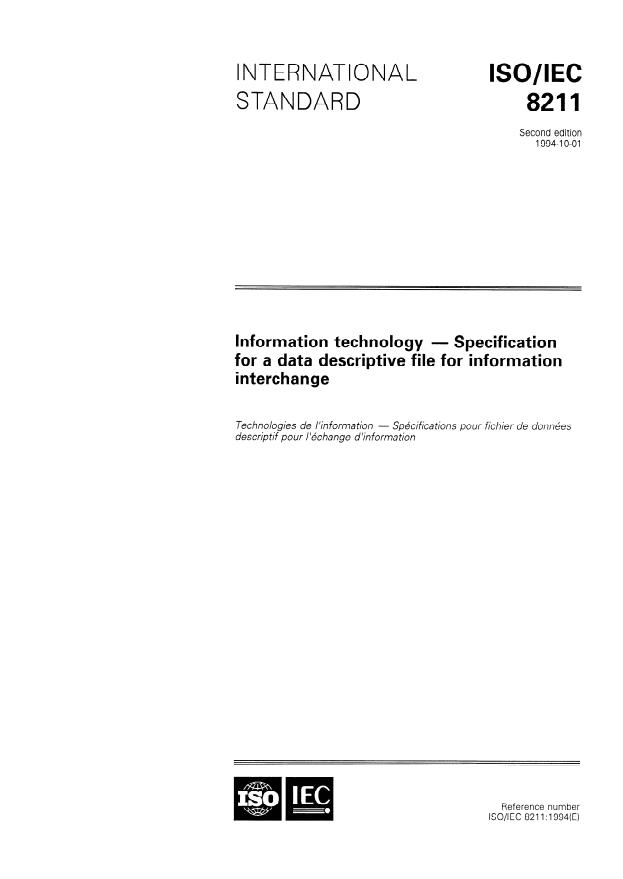
INTERNATIONAL
lSO/IEC
STANDARD
Second edition
1994-I o-01
Information technology - Specification
for a data descriptive file for information
interchange
Technologies de I’informa tion
- Spkifications pour fichier de don&es
descriptif pour I’kchange d ’information
Reference number
lSO/IEC 8211 :I 994(E)
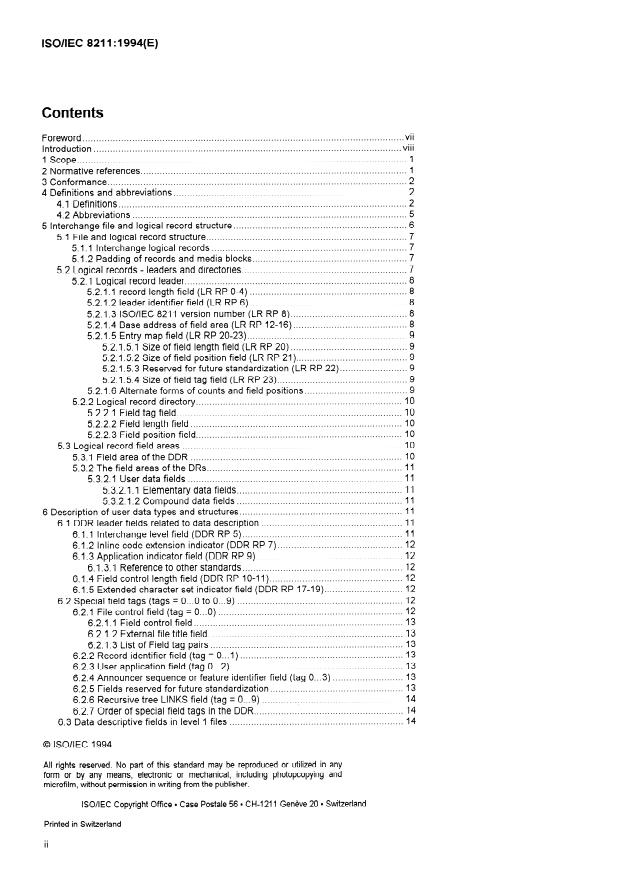
ISO/IEC 8211: 1994(E)
Contents
............................. vii
.........................................................................................
Foreword
...
............................ VIII
Introduction . .
.............................
1 Scope .
........ 1
.................................................... ......................................
2 Normative references
...........................................
3 Conformance. .
....... 2
.............................................................................
4 Definitions and abbreviations.
........ 2
4.1 Definitions. .
................................................................... ..................................
4.2 Abbreviations
.......................... 6
......................................
5 Interchange file and logical record structure
............................................... ........................... 7
5.1 File and logical record structure
.................. 7
....................................................
5.1 .I Interchange logical records.
...................................................... 7
5.1.2 Padding of records and media blocks.
...........................................................
5.2 Logical records - leaders and directories.
........................ 8
5.2.1 Logical record leader .
..........................................................
5.2.1.1 record length field (LR RP O-4)
.......................................................... 8
5.2.1.2 leader identifier field (LR RP 6)
.......................................... 8
5.2.1.3 ISO/IEC 8211 version number (LR RP 8).
......................................... 8
5.2.1.4 Base address of field area (LR RP 12-16).
.......................................................... 9
5.2.1.5 Entry map field (LR RP 20-23).
........ 9
...................................
5.2.1.5.1 Size of field length field (LR RP 20)
........................................ 9
5.2.1.5.2 Size of field position field (LR RP 21).
........................ 9
5.2.1.5.3 Reserved for future standardization (LR RP 22).
............................................... 9
5.2.1.5.4 Size of field tag field (LR RP 23).
.................................... 9
5.2.1.6 Alternate forms of counts and field positions.
.......................................................................... 10
5.2.2 Logical record directory.
................................................................................. 10
5.2.2.1 Field tag field.
.............................................................................. 10
5.2.2.2 Field length field
............................................................................ 10
5.2.2.3 Field position field
..................................................... ............................
5.3 Logical record field areas
................ 10
5.3.1 Field area of the DDR .
...................................................................... 11
5.3.2 The field areas of the DRs.
............................................................................... 11
User data fields
5.3.2.1
............................................................. 11
5.3.2.1.1 Elementary data fields
........... 11
5.3.2.1.2 Compound data fields .
.......................................................... 11
6 Description of user data types and structures.
.................................................... 11
6.1 DDR leader fields related to data description
.......................................................... 11
6.1.1 Interchange level field (DDR RP 5).
............................................. 12
6.1.2 lnline code extension indicator (DDR RP 7).
..................................................... 12
indicator field (DDR RP 9).
6.1.3 Application
......................................................... 12
6.1.3.1 Reference to other standards.
................................................ 12
6.1.4 Field control length field (DDR RP 1 O-l 1).
............................ 12
6.1.5 Extended character set indicator field (DDR RP 17-l 9).
6.2 Special field tags (tags = 0. . . to 0.9) .
.. -0) .................................................................... 12
6.2.1 File control field (tag = 0
.............................................................................
Field control field 13
6.2.1.1
............................
6.2.1.2 External file title field. .
.......................................................................
6.2.1.3 List of Field tag pairs
.. ............................................................ 13
6.2.2 Record identifier field (tag = 0 .I )
...............................................................
6.2.3 User application field (tag 0.2).
.......................... 13
6.2.4 Announcer sequence or feature identifier field (tag 0.3)
...............................................
6.25 Fields reserved for future standardization.
.................................................... 14
6.2.6 Recursive tree LINKS field (tag = 0.9)
. . 14
6.2.7 Order of special field tags in the DDR .
files .
6.3 Data descriptive fields in level 1
0 ISO/IEC 1994
All rights reserved. No part of this standard may be reproduced or utilized in any
form or by any means, electronic or mechanical, including photopcopying and
microfilm, without permission in writing from the publisher.
lSO/IEC Copyright Office . Case Postale 56 l CH-1211 Gen&ve 20 0 Switzerland
Printed in Switzerland
ii
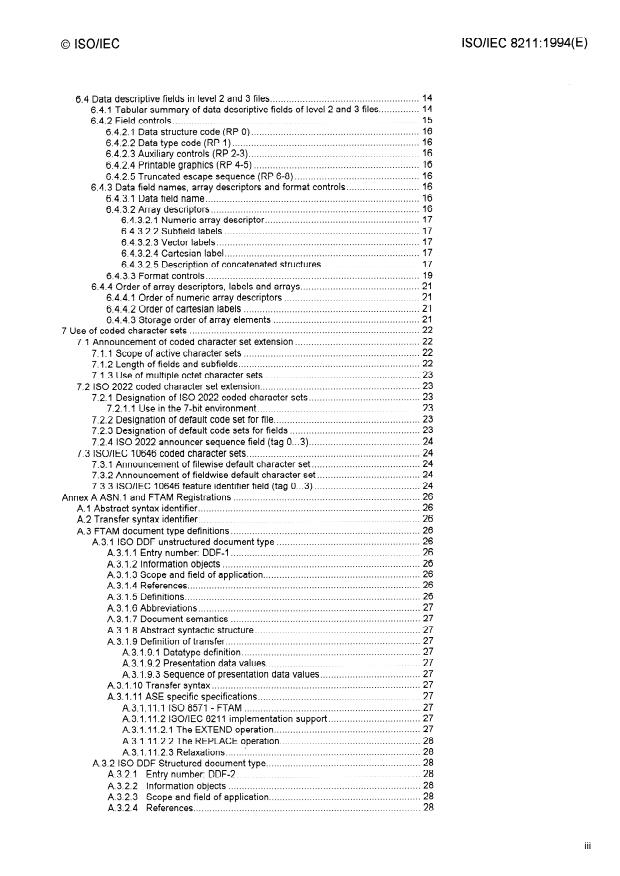
ISOAEC 8211 :I 994(E)
o ISOAEC
6.4 Data descriptive fields in level 2 and 3 files .
............. 14
6.4.1 Tabular summary of data descriptive fields of level 2 and 3 files.
................................................ ...........................................
6.4.2 Field controls
.............................................................. 16
6.4.2.1 Data structure code (RP 0)
..................................................................... 16
6.4.2.2 Data type code (RP 1)
6.4.2.3 Auxiliary controls (RP 2-3) .
............................................................. 16
6.4.2.4 Printable graphics (RP 4-5)
6.4.2.5 Truncated escape sequence (RP 6-8) .
........................... 16
6.4.3 Data field names, array descriptors and format controls
............................................................................... 16
6.4.3.1 Data field name
6.4.3.2 Array descriptors .
6.4.3.2.1 Numeric array descriptor .
........................................................................ 17
6.4.3.2.2 Subfield labels
6.4.3.2.3 Vector labels . 17
6.4.3.2.4 Cartesian label .
6.4.3.2.5 Description of concatenated structures . 17
6.4.3.3 Format controls .
............................................ 21
6.4.4 Order of array descriptors, labels and arrays
..................................................
6.4.4.1 Order of numeric array descriptors
6.4.4.2 Order of Cartesian labels .
...................................................... 21
6.4.4.3 Storage order of array elements
...................................... 22
7 Use of coded character sets .
.............................................. 22
7.1 Announcement of coded character set extension
................................................................. 22
7.1.1 Scope of active character sets
................................................................... 22
7.12 Length of fields and subfields
7.1.3 Use of multiple octet character sets .
........................................................... 23
7.2 IS0 2022 coded character set extension
....................................... 23
7.2-l Designation of IS0 2022 coded character sets.
7.2.1.1 Use in the 7-bit environment .
...................................................... 23
7.2.2 Designation of default code set for file
................................................ 23
7.2.3 Designation of default code sets for fields
........................................ 24
7.2.4 IS0 2022 announcer sequence field (tag 0.3).
................................................................ 24
7.3 ISO/IEC 10646 coded character sets
7.3.1 Announcement of filewise default character set .
...................................... 24
7.3.2 Announcement of fieldwise default character set
7.3.3 ISO/IEC 10646 feature identifier field (tag 0.3) .
......................................... ............................ 26
Annex A ASN. 1 and FTAM Registrations
..................................................................................
A. 1 Abstract syntax identifier
A.2 Transfer syntax identifier .
...................................................................... 26
A.3 FTAM document type definitions
A.3.1 IS0 DDF unstructured document type .
...................................................................... 26
A.3.1 .I Entry number: DDF-1
A.3.1.2 Information objects . 26
.......................................................... 26
A.3.1.3 Scope and field of application
A.3.1.4 References .
A.3.1.5 Definitions . .
A.3.1.6 Abbreviations. . 27
A.3.1.7 Document semantics .
............................................................. 27
A.3.1.8 Abstract syntactic structure
A.3.1.9 Definition of transfer .
.................................................................. 27
A.3.1.9.1 Datatype definition
A.3.1.9.2 Presentation data values . 27
............................... ...... 27
A.3.1.9.3 Sequence of presentation data values
................................................... .......................... 27
A.3. I. 10 Transfer syntax
............................. 27
A. 3.1.11 ASE specific specifications .
.......... ..................................................... 27
A.3.1.11.1 IS0 8571 - FTAM.
A.3.1.11.2 ISO/IEC 8211 implementation support .
...................................................... 27
A.3.1.11.2.1 The EXTEND operation
A.3.1.11.2.2 The REPLACE operation . 28
A-3.1.11.2.3 Relaxations. . .:. . .
......................................................... 28
A.3.2 IS0 DDF Structured document type
A.3.2.1 Entry number: DDF-2 . .
A. 3.2.2 Information objects .
...................................................... 28
A.3.2.3 Scope and field of application.
A.3.2.4 References .
A. 3.2.5 Definitions . . 28
A. 3.2.6 Abbreviations . . . 28
I
A.3.2.7 Document semantics . . 29
A.3.2.8 Abstract syntactic structure .
A.3.2.9 Definition of transfer . 29
A.3.2.9.1 Datatype definition. . 29
...................................................... 29
A.3.2.9.2 Presentation data values
A.3.2.9.3 Sequence of presentation data values .
A. 3.2.10 Transfer syntax . 29
A. 3.2.11 ASE specific specifications .
A-3.2.1 1. I IS0 8571 - FTAM . 30
A.3.2.11.2 ISO/IEC 8211 implementation support . 30
.................................................... 30
A.3.2.11.2.1 The EXTEND operation
.................................................. 30
A.3.2.11.2.2 The REPLACE operation
A.3.2.11.2.3 Relaxations . . . 30
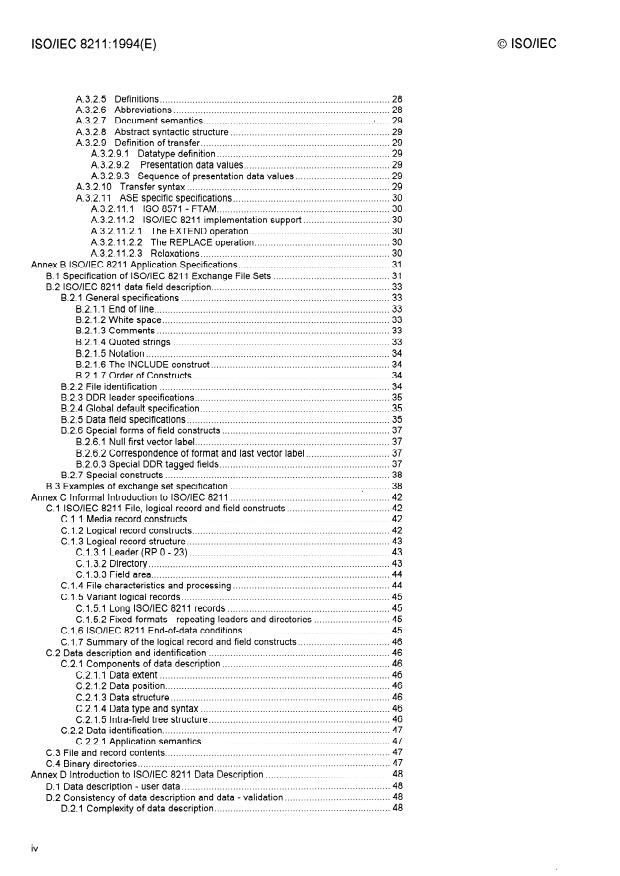
Annex B ISO/IEC 8211 Application Specifications .
B.1 Specification of ISO/lEC 8211 Exchange File Sets . 31
B.2 ISO/IEC 8211 data field description . 33
8.2.1 General specifications . 33
B.2.1.1 End of line . 33
B.2.1.2 White space . 33
B.2.1.3 Comments . . 33
8.2.1.4 Quoted strings .
B.2.1.5 Notation . 34
B.2.1.6 The INCLUDE construct . 34
B-2.1.7 Order of Constructs . 34
B.2.2 File identification . 34
........................................................................ 35
B.2.3 DDR leader specifications
B.2.4 Global default specification . 35
........................................................................... 35
B.2.5 Data field specifications
B.2.6 Special forms of field constructs . 37
B.2.6.1 Null first vector label .
B.2.6.2 Correspondence of format and last vector label . 37
B-2.6.3 Special DDR tagged fields . 37
........................... 38
8.2.7 Special constructs .
B.3 Examples of exchange set specification . 38
,
Annex C Informal Introduction to ISO/IEC 8211 .
C.1 ISO/IEC 8211 File, logical record and field constructs . 42
C. 1. I Media record constructs .
C. 1.2 Logical record constructs . 42
........................................................................... 43
C. 1.3 Logical record structure
C.l.3.1 Leader (RP 0 - 23) . 43
C. 1.3.2 Directory . . 43
...................................................................................... 44
C.1.3.3 Field area . .
C. 1.4 File characteristics and processing . 44
C. 1.5 Variant logical records . .
............................................................ 45
C.1.5.1 Long ISO/IEC 8211 records
C. 1.5.2 Fixed-formats - repeating leaders and directories . 45
C. 1.6 ISO/IEC 8211 End-of-data conditions . . .
.................................. 46
C. 1.7 Summary of the logical record and field constructs
C.2 Data description and identification . 46
C.2.1 Components of data description .
C.2.1.1 Data extent. . 46
................................ 46
C.2.1.2 Data position. .
........................................... ...................................... 46
C.2.1.3 Data structure
C.2.1.4 Data type and syntax . 46
................................................................. 46
C.2.1.5 Intra-field tree structure.
C.2.2 Data identification . . 47
.......................... 47
C.2.2.1 Application semantics .
C.3 File and record contents . 47
C.4 Binary directories .
............................................ 48
Annex D Introduction to ISO/IEC 8211 Data Description.
D.1 Data description - user data .
....................................... 48
D.2 Consistency of data description and data - validation
................................................................. 48
0.2.1 Complexity of data description
0 ISOAEC ISOAEC 8211:1994(E)
0.2.2 Level 1 data description . . . . . . . . . . . . . . . . . . . . . . . . . . . . . . . . . . . . . . . . . . . . . . . . . . . . . . . . . . . . . . . . . . . . . . . . . . . 49
0.2.3 Level 2 and 3 data description . . . . . . . . . . . . . . . . . . . . . . . . . . . . . . . . . . . . . . . . . . . . . . . . . . . . . . . . . . . . . . . . . 49
description constructs . . . . . . . . . . . . . . . . . . . . . . . . . . . . . . . . . . . . . . . . . . . . . . . . . . . . . . . . . . . . . . . . . . . . . . . . . . . . . . 50
0.3 Data
D.3.1 Subfield extents . . . . . . . . . . . . . . . . . . . . . . . . . . . . . . . . . . . . . . . . . . . . . . . . . . . . . . . . . . . . . . . . . . . . . . . . . . . . . . . . . . . . . . . 50
0.3.2 Data types . . . . . . . . . . . . . . . . . . . . . . . . . . . . . . . . . . . . . . . . . . . . . . . . . . . . . . . . . . . . . . . . . . . . . . . . . . . . . . . . . . . . . . . . . . . . . . . 50
D.3.3 Field identification . . . . . . . . . . . . . . . . . . . . . . . . . . . . . . . . . . . . . . . . . . . . . . . . . . . . . . . . . . . . . . . . . . . . . . . . . . . . . . . . . . . 50
D.3.4 Data structure without subfield identification . . . . . . . . . . . . . . . . . . . . . . . . . . . . . . . . . . . . . . . . . . . . 50
D-3.5 Data structure with subfield identification . . . . . . . . . . . . . . . . . . . . . . . . . . . . . . . . . . . . . . . . . . . . . . . . . 51
D.4 Large application data structures . 51
D.5 Intra-record tree structures . 51
D.6 Coded character set extensions . 51
Annex E Examples of Data Description .
E.l Leader and file title field . 53
E.2 Examples of formats . 54
E.2.1 Elementary data fields . 54
E.2.2 Linear structures . 54
E.2.3 Multi-dimensioned arrays . 54
E.3 Examples of bit fields . 55
E.4 Examples of binary forms . 56
E.5 Examples of subfield labelling . 56
E-5.1 Redundant elementary field label . 56
E.5.2 Vector labels . 56
E.5.3 Cartesian labels . 57
E.5.4 Concatenated data structures . . . 57
Annex F DDF Hierarchical and Network Data Structures. . 58
F. 1 DDF hierarchical data structures . . 58
F. 1.1 Forests . 58
F.2 Conversion to corresponding binary tree. . 58
F.3 Network data structures . 61
................................................................................ 62
Annex G Database Data Transfer
G.l Essential features of data base management systems . 62
G. 1.1 Relational data base management systems . 62
G. 1.2 Hierarchical data base management systems . 63
G. 1.3 Network data base management systems . 63
G.2 Reduction to relational forms . 63
Annex H Relationship to Other OSI Work . 64
H.l OSI basic reference model .
H. 1.1 Other presentation layer considerations . 64
H. 1.2 Remote versus local processing considerations .
H.2 Relationship to FTAM virtual filestore model. . 65
H.2.1 Correspondence of ISO/IEC 8211 file constructs to fTAM . 66
H.2.2 ISO/IEC 8211 access methodology .
H.2.3 Relationship of documents to files . 67
H.2.4 File naming .
Rela onship 67
H.3 ti to other syntax notations .
H.3.1 Abstra ct syntax notation one . . . . . 67
H.3.2 Transfer Syntax Description Notation .
H.4 Relationship to data base management models . 68
H.5 Bibliography . 68
H.6 Summary of data types in other projects . 69
List of figures
Figure 1 - Schematic of ISO/IEC 8211 File and Logical Records . 6
Figure 2 - File Schematic Representation .
Figure 3 - Logical Record Schematic . 7
Figure 4 - LR Leader Schematic .
....... 9
Figure 5 - LR Entry Map Schematic .
Figure 6 - LR Directory Entry Schematic . 10
Figure 7 - File Control Field Schematic .
Figure 8 - Schematic of Level 2 and 3 Data Descriptive Fields . 15
Figure F.1 - Examples of Ordered Rooted Trees .
........ 59
Figure F.2 - Generic Structure of a Logical Record .
Figure F.3 - Instance of a User Data Tree based on F.2 . 60
...... 61
Figure F.4 - Corresponding Binary Tree to the Tree of F.2 .
ISOAEC 8211:1994(E) 0 ISOAEC
List of tables
Table 1 - Delimiters and Their Uses . . . 15
Table 2 - Data Descriptive Field Components . 15
........................................................ 20
Table 3 - Extensions of Bitfield Data Descriptions
. q Information Objects in the Unstructured Text Document Type . 26
........................ 28
Table A,2 Information Objects in the Structured Text Document Type.
o ISOAEC
lSO/IEC 8211:1994(E)
Foreword
IS0 (the international Organization for Standardization) and IEC (the
International Electrotechnical Commission) form the specialized system for
worldwide standardization. National bodies that are members of IS0 or IEC
participate in the development of International Standards through technical
committees established by the respective organization to deal with particular
fields of technical activity. IS0 and IEC technical committees collaborate in fields
of mutual interest. Other international organizations, governmental and non-
governmental, in liaison with IS0 and IEC, also take part in the work.
In the field of information technology, IS0 and IEC have established a joint
technical committee, ISOIIEC JTC 1. Draft International Standards adopted by
the joint technical committee are circulated to the national bodies for voting.
Publication as an International Standard requires approval by at least 75 % of the
national bodies casting a vote.
lntemationa% Standard lSO/IEC 821 I was prepared by Joint Technical Committee
ISOWX JTC 1, ,Wo~-bnafjon fechnotogy, Subcommittee SC 21, Open systems
in%erconnenc%ion, data management and open distributed processing.
This second edition cancels and replaces the first edition (IS0 8217: q 985) which
has been technically revised.
The substantive changes made to produce this edition of ISO/IEC 8211 are the
foIlowing additions:
1. Binary forms for numeric values.
2. Binary leaders and directories.
3. Support for ISO/IEC 10646.
4. Definition of FTAM unstructured and structured document types.
5. Concatenated regular structures.
6. Recursive tree description.
7. A human-readable, alternate form of data field description.
The second edition is backwards compatible with the first edition.
An nex A forms an integral part of this International Standard. Annexes B to H are
for information only.
vii
Introduction
This International Standard has been produced in response to an identified need for a mechanism to allow data structures to
be easily moved from one computer system to another, independent of architecture. Data structures required to be inter-
changed can vary significantly in complexity and size, and a common method to accomplish these interchanges is desirable.
It is also desirable that any medium such as a communication line, a magnetic tape, a disk pack, a flexible disk etc., should
be able to be used for the physical interchange, and that all information necessary to successfully recreate the structure in the
target system should be contained within the information transported on the medium.
To meet these needs this International Standard specifies medium-independent and system-independent file and data record
formats for the interchange of information between computer systems. This International Standard is intended for use with
physical recorded media as well as with communications media. The contents in the user data structure can be of any
internationally recognized character set and coding and are interchanged in a transparent fashion. The intermediate structure
through which the information passes is designed for interchange purposes. It can also be used for some forms of general
processing and is amenable to direct access methods on high volume, direct access interchange media.
This International Standard is a concrete transfer syntax and encoding standard and provides a tool for the description of files
containing user data but does not specify the content or order of user data fields or user data records. It does specify a com-
prehensive generic form for such records and fields which can accommodate a wide variety of user needs for both simple and
complex user data. An application must design its own instance of a conforming interchange file and all conforming files, both
data and data description, will be processable to the field or subfield level by the same software. A user must, of course,
complete the interface to their own application system.
The approach used is to define an interchange format into which most information structures and their content can be trans-
formed without loss of information, and from which the original structure and content can be retrieved. The interchange format
is suitable both for recording on physical media and transport through a communication system.
The data structures supported by the interchange format are elementary data, vectors, arrays and hierarchies. The file struc-
tures that can be transformed into the interchange format include sequential, hierarchical and relational. Network structures
are not directly supported and additional pre-processing and post-processing are necessary in this case to preserve logical
linkages.
This International Standard is media independent. It assumes, at a minimum, that the supporting transport system can
process fixed length octet strings. It requires a computer processing capability to map the user file or database data to the
interchange file. This mapping function has to provide the necessary data and structure conversions. The parameters required
to define the selection and conversion of these data items and structures into the formats specified by this International
Standard are outside the scope of the standard. This International Standard requires the use of a basic character set based on
IS0 8859-l and ISO/IEC 6429 in control fields and permits the use of additional character sets in user data fields. This
International Standard provides for three interchange levels from which the users may choose based on the complexity of their
data structures. The first interchange level supports multiple fields containing simple, unstructured character strings. The
second level supports the first level and multiple fields containing structured user data comprising a variety of data types. The
third level supports the second level and hierarchical data structures.
The experience of implementing ISO/IEC 8211 for a variety of applications revealed the need for the changes introduced in
this version. Many of the changes give ISO/IEC 821 I increased versatility and more effective interchange capabilities. Many
other changes were made to improve clarity and user acceptance. Technical changes in the standardized interchange
supporting this International Standard and changes in the organizational responsibility for this International Standard have led
to other extensions. This version provides the user with an improved interchange tool in keeping with the user ’s increasing
needs and well integrated into the OSI environment.
The retrieval of archived files may require the use of computer systems which are different from the original archiving sys-
tems. The operational problems are identical to those involved in the transport of files between computers at different sites
and this International Standard provides a facility for this application.
ISO/IEC 8211 is based on IS0 2709 having the same record structure but different data description components. IS0 2709
based systems for file transfer and random file access had been in use since at least 1970 and their use is now extensive. The
nomenclature of ISO/IEC 8211 conforms to its predecessor, IS0 2709. Its hierarchical, logical data constructs are files,
variable-length records, variable-length fields and subfields. In several programming languages, the equivalent of an ISO/IEC
8211 field is a record and specific applications will transport their records as ISO/IEC 821 q fields with related records
aggregated into ISO/lEC 8211 records.
. . .
VIII
0 ISOAEC
lSO/IEC 8211:1994(E)
Organization of the Standard
The contents of this standard are organized as follows:
1) Clause 5 describes the specifications of the contents of leaders, directories and field areas common to all logical records
and necessary to the import of logical records and complete fields.
2) Clause 6 describes the specification of the data description necessary to import user data at the subfield level. Subclause
6.1 specifies further subfields in the DDR leader which contain information pertinent to data description.
3) Clause 7 describes the use of extended character sets.
4) Annex A describes the FTAM registrations.
5) Annex B describes a methodology for specifying ISOIIEC 8211 file design and data descriptions.
6) Annexes C through H provide tutorial information on the methodology. The reader may wish to read Annex C prior to
studying Clause 5 and Annex D prior to studying Clause 6.
This page intentionally left blank
INTERNATIONAL STANDARD @ ‘SOJEc ISO/IEC 8211:1994(E)
Information technology - Specification for a data
descriptive file for information interchange
1 Scope
This International Standard specifies an interchange format to facilitate the moving of files or parts of files containing data
records between computer systems. The interchange format is not intended as a record format for the indigenous files of any
specific system but may be used for this purpose. The standard defines a generalized structure which can be used to transmit,
between systems, files or records containing a wide variety of data types and data structures. It specifies the means for the
description of the contents of data records but does not specify their application semantics although these semantics can be
included as a part of the transmission. The interchange format may also be used to transport individual records, individual
data fields or individual subfields with their description.
This International Standard specifies:
media-independent file and data record descriptions for information interchange;
the description of data elements, vectors, arrays and hierarchies containing character strings, bit strings and numeric
forms;
a data descriptive file composed of a data descriptive record and companion data records that enable interchange to
occur wifh minimal specific external description;
the data descriptive record that describes %he characteristics of each data field within the companion data records;
three levels of complexity of file and record structure;
FTAM unstructured and structured document types
2 Normative references
The following standards contain provisions which, through reference in the text, constitute provisions of this International
Standard. At the time of its publication, the editions indicated were valid. All standards are subject to revision, and parties to
agreements based on this International Standard are encouraged to investigate the possibility of applying the most recent
editions of the standards indicated below. Members of IEC and IS0 maintain registers of currently valid International
Standards.
ISOIIEC 646: 1991, Information technology - IS0 ?-bit coded character set for information interchange
IS0 2022: 1986, Information processing - IS0 7-bit and %-bit coded character sets - Code extension techniques
IS0 6093: 1985, Informafion processing - Representation of numerical values in character strings for information interchange
ISO/IEC 6429: 1992, Information technology - Control functions for coded character sets
File Transfer, Access and Management -
IS0 8571-l : 1988, Information processing systems - Open Systems Interconnection -
Part 7: General introduction
ISO/l EC 8824: 1990, Information technology - Open Systems Interconnection - Specification of Abstract Syntax Notation One
(ASN. I)
information processing - 8-bit single-byte coded graphic character sets - Par% 1: Latin alphabet No. 7
IS0 8859-l : 1987,
0 ISOAEC
lSO/IEC 8211:1994(E)
ISO/IEC 9834-2:-l 993, Information technology - Open Systems Interconnection - Procedures for operation of OSI
Registration Authorities: Part 2: Registration procedures for OSI document types
ISO/IEC 10646-I : 1993, information technology - Universal Multiple-Octet Coded Character Set (KS) - Part ?: Architecture
and Basic Mulitlingual Plane
IEC 559: 1989, Binary floating point arithmetic for microprocessor systems (also ANSI/IEEE 754: 1985( RI 991))
The following document is also relevant to this International Standard:
IS0 International register of coded character sets to be used with escape sequences
3 Conformance
Interchange files conform to this International Standard when all of the data descriptive records and data records conform to
the specifications of this International Standard. A statement of conformance shall specify the version number and
interchange level to which the contents of files conform.
This International Standard does not specify requirements for processing and implementation, therefore such processing and
implementation cannot itself conform to this I nternational Stan dard.
4 Definitions and abbreviations
4.1 Definitions
For the purposes of this International Standard the following definitions apply:
4.1 .l alphanumeric character: A character occurring in columns 2 to 7 inclusive (except position (7/15)) of the Basic
Character Set or the corresponding characters of lSO/IEC 10646 Table 1 - Row 00: Basic Latin. These characters correspond
to those of ISO/IEC 646 IRV.
NOTE 1 - The characters specified in this International Standard are represented by their position (column/row) in the coded character set table or by
their acronym or name, e. g., ESC, SPACE and DIGIT ZERO or “0 ”. Alphanumeric characters which are explicitly specified in a control field are
enclosed in double quotes, e.g., “1 ”. The special lSO/IEC 8211 delimiters unit terminator(1 /I S) and field terminator(Vl4) are represented by UT and
FT respectively.
4.1.2 array: A data structure of two or more dimensions.
4.1.3 array descriptor: A Cartesian label or numeric array descriptor which provides a description of the dimension and
extents of an array.
4.1.4 base address of data: A data element the value of which is equal to the octet count up to but not including the first
octet of the first data field following the field terminator of the directory, where the specified origin (0) is the first octet of the
leader.
4.1.5 basic character set; BCS: A character set comprising: a) IS0 8859-l including SPACE as the GO and Gl sets and
b) ISO/IEC 6429 as the CO and Cl sets.
compatible with row 00 of the lSO/IEC 10646 Basic Multilingual Plane and should greatly reduce any dependence on
NOTE 2 - This set is
variant character sets. However there currently are differences in the allowed uses of the Cl set between I SO/IEC 6429 and lSO/IEC 10646.
4.1.6 binary form: A binary form is a sequence of one or more octets having a specified format and meaning. The octets of
a binary form may be recorded in order of decreasing significance with the most significant octet first (MSOF) or the reverse
order, least significant octet first (LSOF). The bits within an octet are always recorded in order of decreasing significance.
4.1.7 binary tree : A rooted tree in which each node has zero subtrees or, at most, two subtrees known as the left subtree
and the right subtree. In the absence of either the left or right subtree, the remaining subtree retains its identity as a left or
right subtree. See annex F.
d comprising only binary dig its. When it is neces #sary to complete an octet, it is filled on the right
41 8 bit field: A data fiel
with’ binary zeros. See also character mode bit string.
0 ISOAEC lSO/IEC 8211:1994(E)
4.1.9 Cartesian label: An array of identifiers formed by the Cartesian product of the elements of two (or more) vector labels.
The array elements have the same order as the elements of the direct product such that if a and b are the vector labels, where
a = (a(1) . . . . a(n)) and b = (b(1) . . . . b(m)), then the Cartesian label, a*b = (a(l)b(l), a(l)b(
...
Questions, Comments and Discussion
Ask us and Technical Secretary will try to provide an answer. You can facilitate discussion about the standard in here.
Loading comments...