

ISO 24031
(Main)Biotechnology — General requirements for nucleic acid- and protein-based bio-devices
- Abstract
This document defines terms, gives guidance for classification and establishes requirements for nucleic acid- and protein-based bio-devices. This document is applicable to bio-devices incorporating natural, modified and synthetically derived nucleic acid and/or protein. This document does not apply to medical devices or products.
- Status
- Not Published
- Technical Committee
- ISO/TC 276 - Biotechnology
- Drafting Committee
- ISO/TC 276/WG 6 - Nucleic acid- and protein-based devices
- Current Stage
- 6000 - International Standard under publication - 60 Publication
- Start Date
- 29-Oct-2026
Buy Documents

ISO/FDIS 24031 - Biotechnology — General requirements for nucleic acid- and protein-based bio-devices
REDLINE ISO/FDIS 24031 - Biotechnology — General requirements for nucleic acid- and protein-based bio-devices
ISO 24031 is an ISO standard for biotechnology that sets general requirements for nucleic acid- and protein-based bio-devices (NA/P-based bio-devices). It defines terms, gives guidance for classification, and covers design, construction, evaluation, optimization, and transport and storage for devices built from natural, modified, or synthetically derived nucleic acid and/or protein. ISO 24031 applies to these bio-devices and excludes medical devices and products.
What does ISO 24031 specify?
ISO 24031 specifies a framework for classifying NA/P-based bio-devices and for managing their full development path from design to storage. Clause 1 sets the scope, Clause 2 lists the referenced standards, Clause 3 defines the key vocabulary, and Clauses 4 to 10 cover classification, general requirements, design, construction, evaluation, optimization, and transport and storage.
The document is organized so that a team can move from concept to execution in a controlled way. That matters in practice because a developer, manufacturer, or buyer can use the clause structure to check whether a device has a defined purpose, documented design steps, controlled construction, and documented performance evidence.
| Annex | What it covers |
|---|---|
| Annex A | Example database and design tools for NA/P-based device design, including registries, software applications, design tools, and AI design tools |
| Annex B | Examples of NA/P-based device performance criteria, such as detection limit, sensitivity, response time, accuracy, and reproducibility |
What are the key requirements of ISO 24031?
ISO 24031 requires that an NA/P-based bio-device have a defined purpose or function and that the procedures for design, construction, and evaluation be planned and documented. In practice, this gives teams a traceable path from the intended application to the evidence that the device was built and checked against that intent.
How does ISO 24031 frame classification and design?
Clause 4 classifies NA/P-based bio-devices into biofunctional based bio-device and biomimetic based bio-device. The first uses biological properties directly, while the second imitates biological systems or structures; this helps a team describe the design principle clearly and choose the right development approach.
Clause 6 says design comes before construction and should follow a documented workflow. The design process should also include life cycle management, which matters because the standard expects the device to be considered beyond the first build, including later use and handling.
Clause 6.2 asks the design to address effectiveness, stability, biosafety, and traceability. In practice, that means the design should account for accuracy, sensitivity, specificity, consistency, robustness, user feedback, controlled performance limits, risk control across the lifecycle, sequence screening for nucleic acid sequences, assessment of protein immunogenic potential where relevant, and records that connect the device to its development and distribution history.
What does ISO 24031 require during construction and integration?
Clause 6.3.2 requires the selection of suitable biological materials, with options such as registries, reference papers, software applications, and AI design tools. The clause also allows redesign and simulation of biological materials where needed, which helps teams justify why a chosen sequence or protein form fits the intended function.
Clause 7 requires construction to stay consistent with the design principles. Biological materials must be fit for purpose, described and characterized, and their source and quality verified; where the source is unclear or the quality is not well described, the document points to verification methods such as PCR (polymerase chain reaction), sequencing, mass spectrometry, HPLC (high-performance liquid chromatography), X-ray crystallography, NMR (nuclear magnetic resonance), CD (circular dichroism), UV (ultraviolet)-visible spectroscopy, electron microscopy, atomic force microscopy, dynamic light scattering, and SEC/FFF-MALS (size-exclusion chromatography or field-flow fractionation coupled to multi-angle light scattering).
The same clause also covers other supporting materials and integration. That means the physical parts around the biological function - such as mechanical support, structural stability, interfaces, and assembly methods - must also be selected, documented, and checked, not just the biomolecules themselves.
How does ISO 24031 handle evaluation and claims?
Clause 8 requires assessment of effectiveness, stability, safety and biosecurity, and traceability. Performance evaluation must match the designed functionality criteria and use validated and verified analytical methods, which matters because the results are meant to support real use, not just laboratory interest.
Clause 8 also calls for toxicity testing in high-risk areas or where biological materials are released, while low-risk or closed-use devices are handled by risk assessment. The evaluation results and the related claims must be documented and made available to users, aligned with the FAIR guiding principles, so that the data can be found, accessed, shared, and reused.
What does ISO 24031 require for optimization and storage?
Clause 9 treats optimization as an iterative process based on evaluation results and stakeholder feedback. Updates to design, materials, or protocols should stay aligned with the original design intent and relevant quality management practices, and AI/software design tool outputs should be checked against experimental results at regular intervals.
Clause 10 covers transport and storage. It calls for planning on packing, labelling, environmental conditions, handling instructions, transport methods, personnel training, and contingency planning, and it requires time and date records in the ISO 8601-1 format. That is important for maintaining traceability and keeping device performance and integrity intact after manufacture.
What terms does ISO 24031 define?
- bio-device - A device that incorporates or is fundamentally derived from biomolecules and relies mainly on their inherent properties to perform an intended function.
- biological material - A substance found in or derived from a living organism.
- biomolecule - An organic molecule from biological material that performs biological functions or is a basic component of living systems, whether natural or synthetically derived.
- biosafety - Practices and controls that reduce the risk of unintentional exposure, toxicity, or release of biological materials.
- classification - An exhaustive set of mutually exclusive categories used to group data at a prescribed level for a specific purpose.
- NA/P-based bio-device - A functional unit composed primarily of nucleic acid(s) and/or protein(s), optionally combined with supporting materials and/or electronic components, engineered for a designed purpose or application.
- other supporting material - Non-biological material that provides mechanical support, structural stability, or functionality for the bio-device.
- traceability - The ability to track and verify the device history and lifecycle use from development through manufacturing, distribution, use, and possible post-market monitoring.
Who uses ISO 24031?
ISO 24031 is used by biotechnology developers, synthetic biology teams, device designers, manufacturers, quality managers, and evaluation laboratories working on NA/P-based bio-devices. It is also relevant to biobank operators, biosafety staff, and logistics teams because the standard covers source verification, risk control, documentation, and transport/storage.
In practice, these users apply it when they classify a device, choose biological materials, define performance criteria, build verification protocols, document traceability, or prepare storage and shipping instructions. It is especially relevant where the device is used for analysis, intervention, biosensing, molecular detection, sequencing, data storage, or other biotechnology applications.
Which standards are used with ISO 24031?
ISO 24031 lists two normative references:
- ISO 8601-1 - used for date and time representation in transport and storage documentation.
- ISO 20688-2 - used for sequence screening and for production and quality control of synthesized gene fragments, genes, and genomes.
The document also points to other standards and related documents in specific clauses or in the bibliography:
- ISO 20688-1 - used where nucleic acid provider practices are relevant.
- ISO 20387 - used when biological material comes from a biobank.
- ISO 35001 - used in the biosafety and biorisk-management context.
- ISO 45001 - used as part of the occupational health and safety context.
- ISO 13849-1 and IEC 61010-1 - used when the physical or electrical design of the device has safety implications.
- ISO 9001 - used as a quality management reference for improvement and update activities.
What does the ISO 24031 document contain?
ISO 24031 contains a workflow figure for NA/P-based bio-devices, starting from purpose definition and moving through design, construction, evaluation, optimization, and transport/storage. Annex A provides an example list of databases, software applications, design tools, and AI design tools that can support design work.
Annex B gives example performance criteria for different applications, including pathogen detection, DNA-based data storage, and sequencing systems. The examples are grouped by performance topic such as detection limit, sensitivity, response time, accuracy, and reproducibility, which helps teams frame test plans and compare results.
The main clauses also describe methods and procedures for selecting biological materials, verifying their quality, assembling devices, assessing performance, and documenting claims. For a buyer or quality manager, that means the standard is useful not only for design review but also for checking whether a supplier has a defensible development and evaluation record.
Buy Documents
ISO/FDIS 24031 - Biotechnology — General requirements for nucleic acid- and protein-based bio-devices
REDLINE ISO/FDIS 24031 - Biotechnology — General requirements for nucleic acid- and protein-based bio-devices
Frequently Asked Questions
ISO 24031 is a draft published by the International Organization for Standardization (ISO). Its full title is "Biotechnology — General requirements for nucleic acid- and protein-based bio-devices". This standard covers: This document defines terms, gives guidance for classification and establishes requirements for nucleic acid- and protein-based bio-devices. This document is applicable to bio-devices incorporating natural, modified and synthetically derived nucleic acid and/or protein. This document does not apply to medical devices or products.
This document defines terms, gives guidance for classification and establishes requirements for nucleic acid- and protein-based bio-devices. This document is applicable to bio-devices incorporating natural, modified and synthetically derived nucleic acid and/or protein. This document does not apply to medical devices or products.
ISO 24031 is classified under the following ICS (International Classification for Standards) categories: 07.080 - Biology. Botany. Zoology. The ICS classification helps identify the subject area and facilitates finding related standards.
ISO 24031 is available in PDF format for immediate download after purchase. The document can be added to your cart and obtained through the secure checkout process. Digital delivery ensures instant access to the complete standard document.
Standards Content (Sample)
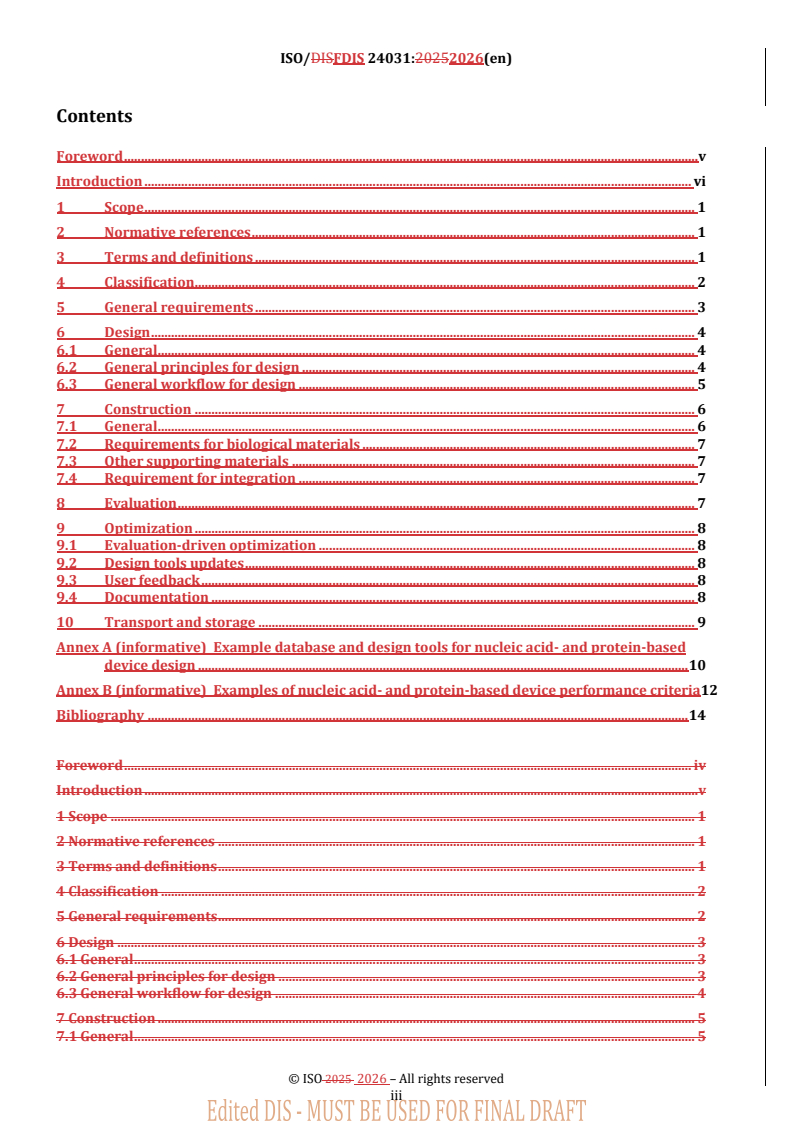
Contents
- Introduction
- 1 Scope
- 2 Normative references
- 3 Terms and definitions
- 3.1 bio-device
- 3.2 biological material
- 3.3 biomolecule
- 3.4 biosafety
- 3.5 classification
- 3.6 effectiveness
- 3.7 nucleic acid- and protein-based bio-device
- 3.8 other supporting material
- 3.9 stability
- 3.10 traceability
- 4 Classification
- 5 General requirements
- 6 Design
- 6.1 General
- 6.2 General principles for design
- 6.3 General workflow for design
- 7 Construction
- 7.1 General
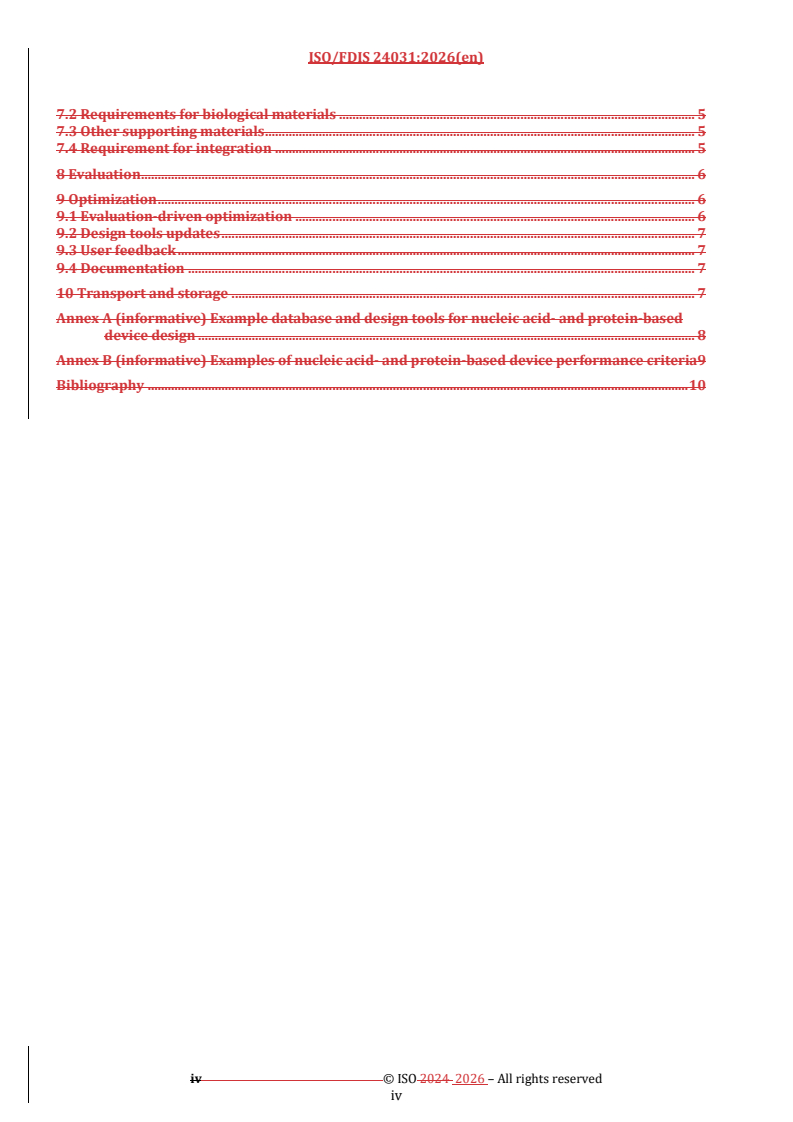
- 7.2 Requirements for biological materials
- 7.3 Other supporting materials
- 7.4 Requirement for integration
- 8 Evaluation
- 9 Optimization
- 9.1 Evaluation-driven optimization
- 9.2 Design tools updates
- 9.3 User feedback
- 9.4 Documentation
- 10 Transport and storage
- Annex A
- Annex B
- Bibliography
Introduction
Bio-devices are innovative tools that leverage the biological properties of biomolecules to perform specific functions, often for advancing industrial processes, environmental monitoring, and biotechnology by providing sensitive, specific, and versatile platforms for analysis and intervention. Among all types of biomolecules, nucleic acids and proteins are two representative molecules that have been widely used for developing bio-devices, such as biosensors, molecular detection tools, single molecule sequencing, DNA- based data storage, etc.
Nucleic acid- and protein-based bio-device (NA/P-based bio-device) applications cover many fields and industries. Their nature is both complicated and complex. Facilitating the development and growth in the number of NA/P-based bio-device applications available to biotechnology is an important goal of standardization. This document covers biological, bioprocess, bio-evaluation method and quality control standardization, that ensures biosafety, reliability, and consistency of NA/P-based bio-device. This document provides guidance for NA/P-based bio-devices including terminology, definition, classification and general requirements for the whole development process, fostering a unified ontology across the NA/P- based bio-device industry.
FINAL DRAFT International Standard ISO/FDIS 24031:2026(en) Biotechnology — General requirements for nucleic acid- and protein-based bio-devices
1 Scope
This document gives guidance for classification and establishes requirements for nucleic acid- and proteinbased bio-devices. This document is applicable to bio-devices incorporating natural, modified and synthetically derived nucleic acid and/or protein.
This document does not apply to medical devices or products.
2 Normative references
The following documents are referred to in the text in such a way that some or all of their content constitutes requirements of this document. For dated references, only the edition cited applies. For undated references, the latest edition of the referenced document (including any amendments) applies. ISO 8601-1, Date and time — Representations for information interchange — Part 1: Basic rules ISO 20688-2, Biotechnology — Nucleic acid synthesis — Part 2: Requirements for the production and quality control of synthesized gene fragments, genes, and genomes
3 Terms and definitions
For the purposes of this document, the following terms and definitions apply. ISO and IEC maintain terminology databases for use in standardization at the following addresses:
- ISO Online browsing platform: available at https:// www .iso .org/ obp
- IEC Electropedia: available at https:// www .electropedia .org/
3.1 bio-device
device that incorporates or is fundamentally derived from biomolecules, relying primarily on their inherent properties to achieve a specific intended function
3.2 biological material
substance found in or derived from a living organism
3.3 biomolecule
organic molecule from biological material that performs biological functions or is a fundamental component of living systems, whether naturally occurring or synthetically derived Note 1 to entry: The examples of organic molecule are nucleic acid, protein, carbohydrate, lipid, and their modified or synthetic analogues.
ISO/FDIS 24031:2026(en)
3.4 biosafety
practices and controls that reduce the risk of unintentional exposure, toxicity and/or release of biological materials [SOURCE: ISO 35001:2019, 3.22, modified – added “toxicity and/”]
3.5 classification
exhaustive set of mutually exclusive categories to aggregate data at a pre-prescribed level of specialization for a specific purpose [SOURCE: ISO/TS 17117-2:2022, 3.3]
3.6 effectiveness
ability to perform the intended functions and properties accurately and reliably
3.7 nucleic acid- and protein-based bio-device
NA/P-based bio-device functional unit composed primarily of nucleic acid(s) and/or protein(s), optionally integrated with supporting materials and/or electronic components, engineered for designed purpose or application
3.8 other supporting material
non-biological materials which provide the necessary support for bio-device, such as mechanical support, structural stability and functionality
3.9 stability
state (e.g. period of time) under recommended conditions (e.g. temperature) where a bio-device maintains its performance and/or integrity without compromise
3.10 traceability
ability to track and verify the history, application of the bio-device throughout its lifecycle, which includes its development, manufacturing, distribution, usage, and potential post-market monitoring
4 Classification
Based on the design principle for either utilizing or replicating the biological function, NA/P-based biodevices can be categorized into the following two types:
a) Biofunctional based bio-device: designed by utilizing specific biological functions or properties inherent in the chosen biomolecules to leverage biochemical activities for specific applications. EXAMPLE Biosensor for air quality monitoring that utilizes the natural ability of certain plant proteins or enzymes, such as chlorophyll or nitrogenase, to detect and react with specific air pollutants like [8] carbon monoxide (CO) or nitrogen oxides (NO ) .
b) Biomimetic based bio-device: draws inspiration from biological systems and create systems that mimic natural behaviors or structures to achieve similar performance. EXAMPLE 1 Bio-device for data storage that imitate the nature that DNA serves as genetic [9] information carrier and reprogram it to store digital information . EXAMPLE 2 Silk-based artificial fibers that mimic the natural hierarchical structure and self-assembly process of spider silk to create biomimetic structural matrices with high mechanical [10] strength .
ISO/FDIS 24031:2026(en) NOTE NA/P-based bio-devices incorporating both mechanisms can be classified by their primary functional principle.
5 General requirements
A NA/P-based bio-device shall have a defined purpose or function that either uses natural biological functions directly or imitates biological structures or processes to achieve similar outcomes. Procedures for the design, construction and evaluation of a NA/P-based bio-device shall be planned and documented. Figure 1 shows a recommended workflow.
Figure 1 — Workflow for nucleic acid- and protein-based bio-devices
6 Design
6.1 General
Design of NA/P-based bio-device shall be performed before its construction as shown in Figure 1. During the design process, general workflow and principles for NA/P-based bio-device design shall be followed and documented. Life cycle management of NA/P-based bio-device should be incorporated in the design process.
6.2 General principles for design
6.2.1 Effectiveness
The designed NA/P-based bio-device shall perform the intended functions accurately and reliably. According to the designed application scenario, the design should take into account key factors, such as:
a) accuracy; b) sensitivity; c) specificity; d) consistency; e) robustness; f) user feedback.
ISO/FDIS 24031:2026(en)
6.2.2 Stability
The design shall address the stability of the NA/P-based bio-device so that its function(s) remain within specified limits in accordance with its intended use.
6.2.3 Biosafety
Risks associated with non-medical hazards shall be identified, assessed, controlled and monitored during the design, construction, evaluation, operation, transportation and storage of a NA/P-based bio-device, adhering to existing risk management systems and standards, such as ISO 35001, ISO 45001, World Health [11] Organization's (WHO's) Laboratory Biosafety Manual and the WHO's Global guidance framework for [12] the responsible use of the life sciences . A sequence screening mechanism shall be used to evaluate the designed nucleic acid sequences in accordance with ISO 20688-2. The immunogenic potential of protein [13,14] components with potential human or animal contact shall be assessed (e.g., via in silico and/or experimental evaluation).
6.2.4 Traceability
The design shall incorporate key aspects of traceability, including but not limited to:
a) documentation of software design tools; b) documentation of development; c) material traceability; d) manufacturing records; e) labelling and serialization; f) distribution tracking; g) user monitoring; h) post-market surveillance; i) conformance with standards.
6.3 General workflow for design
6.3.1 Definition of the purpose and functionality
The application or problem that NA/P-based bio-device aims to address (e.g., biomimetic material and structure, biomimetic robotics) shall be defined and documented. The desired functionality criteria, such as sensitivity, specificity, accuracy, and operation range, and information security (where applicable), shall be established.
...
Contents
- Introduction
- 1 Scope
- 2 Normative references
- 3 Terms and definitions
- 3.3 biomolecules
- 3.3 biomolecule
- 4 Classification
- 5 General requirements
- 6 Design
- 6.1 General
- 6.2 General principles for design
- 6.3 General workflow for design
- 7 Construction
- 7.1 General
- 7.2 Requirements for biological materials
- 7.3 Other supporting materials
- 7.4 Requirement for integration
- 8 Evaluation
- 9 Optimization
- 9.1 Evaluation-driven optimization
- 9.2 Design tools updates
- 9.3 User feedback
- 9.4 Documentation
- 10 Transport and storage
- Annex A
- Annex B
- Bibliography
Introduction
Bio-devices are innovative tools that leverage the biological properties of biomolecules to perform specific functions, often for advancing industrial processes, environmental monitoring, and biotechnology by providing sensitive, specific, and versatile platforms for analysis and intervention. Among all types of biomolecules, nucleic acids and proteins are two representative molecules that have been widely used for developing bio-devices, such as biosensors, molecular detection tools, single molecule sequencing, DNA-based data storage, etc.
Nucleic acid- and protein-based bio-device (NA/P-based bio-device) applications cover many fields and industries. Their nature is both complicated and complex. Facilitating the development and growth in the number of NA/P-based bio-device applications available to biotechnology is an important goal of standardization. This document covers biological, bioprocess, bio-evaluation method and quality control standardization, that ensures biosafety, reliability, and consistency of NA/P-based bio-device. This document provides guidance for NA/P-based bio-devices including terminology, definition, classification and general requirements for the whole development process, fostering a unified ontology across the NA/P- based bio-device industry.
DRAFT International Standard ISO/DIS 24031:2025(en)
Biotechnology — General requirements for nucleic acid- and proteinbased bio-devices
1 Scope
This document gives guidance for classification and establishes requirements for nucleic acid- and proteinbased bio-devices. This document is applicable to bio-devices incorporating natural, modified and synthetically derived nucleic acid and/or protein.
This document does not apply to medical devices or products.
2 Normative references
The following documents are referred to in the text in such a way that some or all of their content constitutes requirements of this document. For dated references, only the edition cited applies. For undated references, the latest edition of the referenced document (including any amendments) applies. ISO 8601--1, Date and time — Representations for information interchange — Part 1: Basic rules ISO 20688--2, Biotechnology — Nucleic acid synthesis — Part 2: Requirements for the production and quality control of synthesized gene fragments, genes, and genomes
3 Terms and definitions
For the purposes of this document, the following terms and definitions apply. ISO and IEC maintain terminology databases for use in standardization at the following addresses:
- — ISO Online browsing platform: available at https://www.iso.org/obphttps://www.iso.org/obp
- — IEC Electropedia: available at https://www.electropedia.org/https://www.electropedia.org/ 3.1 3.1 bio-device device that incorporates or is fundamentally derived from biomolecules, relying primarily on their inherent properties to achieve a specific intended function 3.2 3.2 biological material substance found in or derived from a living organism
3.3 biomolecules
3.3 biomolecule
organic molecule from biological material that performs biological functions or is a fundamental component of living systems, whether naturally occurring or synthetically derived
ISO/FDIS 24031:2026(en) Note 1 to entry: The examples of organic molecule are nucleic acid, protein, carbohydrate, lipid, and their modified or synthetic analogues.
3.33.4 3.4 biosafety practices and controls that reduce the risk of unintentional exposure, toxicity and/or release of biological materials [SOURCE: ISO 35001:2019, 3.22, modified – added “toxicity and/”] 3.43.5 3.5 classification exhaustive set of mutually exclusive categories to aggregate data at a pre-prescribed level of specialization for a specific purpose [SOURCE: ISO/TS 17117-2:2022, 3.3] 3.53.6 3.6 effectiveness ability to perform the intended functions and properties accurately and reliably 3.63.7 3.7 nucleic acid- and protein-based bio-device NA/P-based bio-device functional unit composed primarily of nucleic acid(s) and/or protein(s), optionally integrated with supporting materials and/or electronic components, engineered for designed purpose or application 3.73.8 3.8 other supporting material non-biological materials which provide the necessary support for bio-device, such as mechanical support, structural stability and functionality 3.83.9 3.9 stability state (e.g. period of time) under recommended conditions (e.g. temperature) where a bio-device maintains its performance and/or integrity without compromise 3.93.10 3.10 traceability ability to track and verify the history, application of the bio-device throughout its lifecycle, which includes its development, manufacturing, distribution, usage, and potential post-market monitoring
4 Classification
Based on the design principle for either utilizing or replicating the biological function, NA/P-based bio-devices can be categorized into the following two types:
a) a) Biofunctional based bio-device: designed by utilizing specific biological functions or properties inherent in the chosen biomolecules to leverage biochemical activities for specific applications. EXAMPLE Biosensor for air quality monitoring that utilizes the natural ability of certain plant proteins or enzymes, such as chlorophyll or nitrogenase, to detect and react with specific air pollutants like carbon [8] monoxide (CO) or nitrogen oxides (NO ) .)[8].
ISO/DISFDIS 24031:20252026(en) b) b) Biomimetic based bio-device: draws inspiration from biological systems and create systems that mimic natural behaviors or structures to achieve similar performance. EXAMPLE 1 Bio-device for data storage that imitate the nature that DNA serves as genetic [9] information carrier and reprogram it to store digital information. [9]. EXAMPLE 2 Silk-based artificial fibers that mimic the natural hierarchical structure and selfassembly process of spider silk to create biomimetic structural matrices with high mechanical [10] strength. [10].
NOTE NA/P-based bio-devices incorporating both mechanisms can be classified by their primary functional principle.
5 General requirements
A NA/P-based bio-device shall have a defined purpose or function that either uses natural biological functions directly or imitates biological structures or processes to achieve similar outcomes. Procedures for the design, construction and evaluation of a NA/P-based bio-device shall be planned and documented. Figure 1Figure 1 shows a recommended workflow.
ISO/FDIS 24031:2026(en)
Figure 1 — Workflow for nucleic acid- and protein-based bio-devices
6 Design
6.1 General
Design of NA/P-based bio-device shall be performed before its construction as shown in Figure 1.Figure 1 . During the design process, general workflow and principles for NA/P-based bio-device design shall be followed and documented. Life cycle management of NA/P-based bio-device should be incorporated in the design process.
6.2 General principles for design
6.2.1 Effectiveness
The designed NA/P-based bio-device shall perform the intended functions accurately and reliably. According to the designed application scenario, the design should take into account key factors, such as:
ISO/DISFDIS 24031:20252026(en) a) a) accuracy; b) b) sensitivity; c) c) specificity; d) d) consistency; e) e) robustness; f) f) user feedback.
6.2.2 Stability
The design shall address the stability of the NA/P-based bio-device so that its function(s) remain within specified limits in accordance with its intended use.
6.2.3 Biosafety
Risks associated with non-medical hazards shall be identified, assessed, controlled and monitored during the design, construction, evaluation, operation, transportation and storage of a NA/P-based bio-device, adhering to existing risk management systems and standards, such as ISO 35001, ISO 45001, World Health [11] Organization's (WHO's) Laboratory Biosafety Manual [11] and the WHO's Global guidance framework for [12] the responsible use of the life sciences. [12]. A sequence screening mechanism shall be used to evaluate the designed nucleic acid sequences in accordance with ISO 20688-2. The immunogenic potential of protein [13, 14] , components [13] [14] with potential human or animal contact shall be assessed (e.g., via in silico and/or experimental evaluation).
6.2.4 Traceability
The design shall incorporate key aspects of traceability, including but not limited to:
a) a) documentation of software design tools; b) b) documentation of development; c) c) material traceability; d) d) manufacturing records; e) e) labelling and serialization; f) f) distribution tracking; g) g) user monitoring; h) h) post-market surveillance; i) i) conformance with standards.
6.3 General workflow for design
6.3.1 Definition of the purpose and functionality
The application or problem that NA/P-based bio-device aims to address (e.g., biomimetic material and structure, biomimetic robotics) shall be defined and documented. The desired functionality criteria, such as
ISO/FDIS 24031:2026(en) sensitivity, specificity, accuracy, and operation range, and information security (where applicable), shall be established.
...