

ISO 6930:2019
(Main)High yield strength steel plates and wide flats for cold forming — Delivery conditions
General Information
- Abstract
This document specifies the requirements for weldable high yield strength plates and wide flats for cold forming. It does not apply to weldable structural steels, whether or not of special quality, which are covered by other International Standards, namely: — structural steels: ISO 630 (all parts); — high yield strength flat steel products: ISO 4950-1, ISO 4950-2 and ISO 4950-3; — hot-rolled steel sheet of higher yield strength with improved formability: ISO 5951; — sheet and strip: refer to ISO/TC 17, Steel, SC 12, Continuous mill flat rolled products; — tubular products; refer to ISO/TC 5, Ferrous metal pipes and metallic fittings, SC 1, Steel tubes.
- Status
- Published
- Publication Date
- 21-Jul-2019
- Technical Committee
- ISO/TC 17/SC 3 - Steels for structural purposes
- Drafting Committee
- ISO/TC 17/SC 3 - Steels for structural purposes
- Current Stage
- 9093 - International Standard confirmed
- Start Date
- 09-Apr-2026
- Completion Date
- 29-Aug-2026
Buy Documents


ISO 6930:2019 - High yield strength steel plates and wide flats for cold forming -- Delivery conditions
ISO 6930:2019 - High yield strength steel plates and wide flats for cold forming — Delivery conditions/22/2019
Overview
ISO 6930:2019 - "High yield strength steel plates and wide flats for cold forming - Delivery conditions" specifies delivery requirements for weldable high-yield-strength plates and wide flats intended for cold forming. The standard defines classification, designation, delivery conditions (normalized, normalized-rolled, thermomechanically rolled, as-rolled), required technical and inspection provisions, and the grades covered in three normative annexes (A, B and C). It excludes products already covered by other ISO standards for structural steels, sheet/strip, and tubular products.
Key topics and requirements
- Scope and product types: Applies to hot-rolled plates and wide flats for cold forming. A wide flat is defined as width >150 mm and ≤1 250 mm, generally thickness >4 mm.
- Thickness limits: For grades in Annexes A and B: thickness ≤ 20 mm; for Annex C: thickness 4–50 mm.
- Classification & designation: Steel grades are classified as non‑alloy or alloy quality per ISO 4948 and designated using ISO/TS 4949 conventions. Twenty steel grades are specified (examples: S260NC, S315MC, S355MC, S460MC, up to S960MC; see Annexes A–C).
- Delivery conditions: Defines permitted delivery states - normalized, normalized-rolled, thermomechanically rolled or as-rolled - depending on grade.
- Chemical and mechanical properties: Heat analysis limits and product analysis tolerances are specified in the annex tables; mechanical properties include tensile, impact and bending requirements.
- Technical production requirements: Covers steelmaking, deoxidation (fully killed steels), grain practice, and production process discretion with purchaser notification options.
- Inspection & testing: Details test units, sampling, testing methods (tensile, Charpy impact, bend tests), ultrasonic testing for internal soundness, retests, inspection documents and marking requirements.
- Mandatory purchaser information: Quantity, product type, nominal dimensions and tolerances, steel grade, required options and inspection documents.
Applications
ISO 6930:2019 is used where high yield strength, weldable plates and wide flats are required for cold forming and welded fabrication. Typical applications include:
- Cold-formed structural components
- Fabricated welded assemblies in construction and civil engineering
- Heavy machinery frames and supports
- Transport and industrial equipment requiring high-strength, formable plate
Who uses this standard
- Steel producers and rolling mills (product specification and quality control)
- Purchasing and procurement teams (order and inspection requirements)
- Design and structural engineers (material selection for cold-formed parts)
- Fabricators, welders and QA/inspection personnel (testing, acceptance criteria)
- Certification bodies and standards committees
Related standards
ISO 6930 references and works alongside standards such as ISO 6892-1 (tensile testing), ISO 148-1 (Charpy impact), ISO 17577 (ultrasonic testing) and ISO/TS 4949 (steel naming). Use ISO 6930:2019 when specifying delivery conditions for high-yield-strength, cold-formable steel plates and wide flats.
Relations
- Effective Date
- 04-Nov-2015
- Effective Date
- 04-Nov-2015
- Effective Date
- 04-Nov-2015
Buy Documents
ISO 6930:2019 - High yield strength steel plates and wide flats for cold forming -- Delivery conditions
ISO 6930:2019 - High yield strength steel plates and wide flats for cold forming — Delivery conditions/22/2019
Get Certified
Connect with accredited certification bodies for this standard

Element Materials Technology
Materials testing and product certification.

Inštitut za kovinske materiale in tehnologije
Institute of Metals and Technology. Materials testing, metallurgical analysis, NDT.
Sponsored listings
Frequently Asked Questions
ISO 6930:2019 is a standard published by the International Organization for Standardization (ISO). Its full title is "High yield strength steel plates and wide flats for cold forming — Delivery conditions". This standard covers: This document specifies the requirements for weldable high yield strength plates and wide flats for cold forming. It does not apply to weldable structural steels, whether or not of special quality, which are covered by other International Standards, namely: — structural steels: ISO 630 (all parts); — high yield strength flat steel products: ISO 4950-1, ISO 4950-2 and ISO 4950-3; — hot-rolled steel sheet of higher yield strength with improved formability: ISO 5951; — sheet and strip: refer to ISO/TC 17, Steel, SC 12, Continuous mill flat rolled products; — tubular products; refer to ISO/TC 5, Ferrous metal pipes and metallic fittings, SC 1, Steel tubes.
This document specifies the requirements for weldable high yield strength plates and wide flats for cold forming. It does not apply to weldable structural steels, whether or not of special quality, which are covered by other International Standards, namely: — structural steels: ISO 630 (all parts); — high yield strength flat steel products: ISO 4950-1, ISO 4950-2 and ISO 4950-3; — hot-rolled steel sheet of higher yield strength with improved formability: ISO 5951; — sheet and strip: refer to ISO/TC 17, Steel, SC 12, Continuous mill flat rolled products; — tubular products; refer to ISO/TC 5, Ferrous metal pipes and metallic fittings, SC 1, Steel tubes.
ISO 6930:2019 is classified under the following ICS (International Classification for Standards) categories: 77.140.50 - Flat steel products and semi-products. The ICS classification helps identify the subject area and facilitates finding related standards.
ISO 6930:2019 has the following relationships with other standards: It is inter standard links to ISO 6930-1:2001, ISO 6930:1983, ISO 6930-2:2004. Understanding these relationships helps ensure you are using the most current and applicable version of the standard.
ISO 6930:2019 is available in PDF format for immediate download after purchase. The document can be added to your cart and obtained through the secure checkout process. Digital delivery ensures instant access to the complete standard document.
Standards Content (Sample)
INTERNATIONAL ISO
STANDARD 6930
Second edition
2019-07
High yield strength steel plates and
wide flats for cold forming — Delivery
conditions
Produits plats en acier à haute limite d'élasticité pour formage à
froid — Conditions de livraison
Reference number
©
ISO 2019
© ISO 2019
All rights reserved. Unless otherwise specified, or required in the context of its implementation, no part of this publication may
be reproduced or utilized otherwise in any form or by any means, electronic or mechanical, including photocopying, or posting
on the internet or an intranet, without prior written permission. Permission can be requested from either ISO at the address
below or ISO’s member body in the country of the requester.
ISO copyright office
CP 401 • Ch. de Blandonnet 8
CH-1214 Vernier, Geneva
Phone: +41 22 749 01 11
Fax: +41 22 749 09 47
Email: copyright@iso.org
Website: www.iso.org
Published in Switzerland
ii © ISO 2019 – All rights reserved
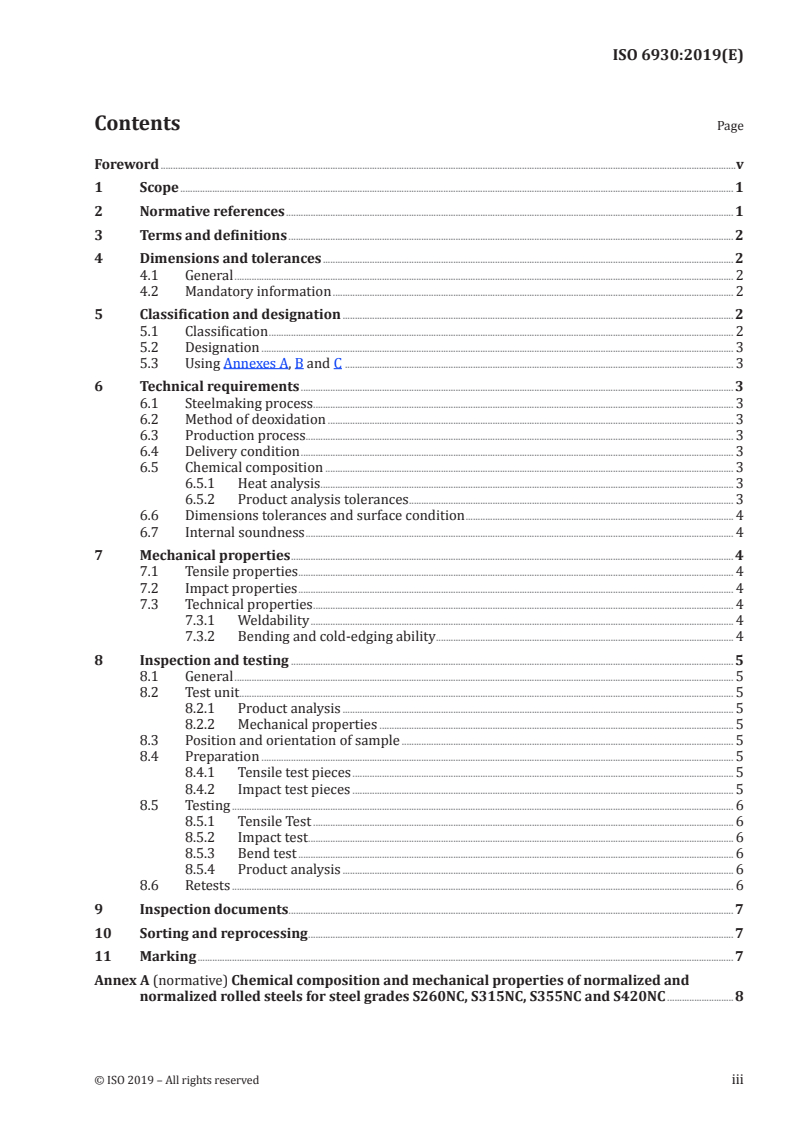
Contents Page
Foreword .v
1 Scope . 1
2 Normative references . 1
3 Terms and definitions . 2
4 Dimensions and tolerances . 2
4.1 General . 2
4.2 Mandatory information . 2
5 Classification and designation . 2
5.1 Classification . 2
5.2 Designation . 3
5.3 Using Annexes A, B and C . 3
6 Technical requirements . 3
6.1 Steelmaking process . 3
6.2 Method of deoxidation . 3
6.3 Production process . . 3
6.4 Delivery condition . 3
6.5 Chemical composition . 3
6.5.1 Heat analysis . . 3
6.5.2 Product analysis tolerances . 3
6.6 Dimensions tolerances and surface condition . 4
6.7 Internal soundness . 4
7 Mechanical properties . 4
7.1 Tensile properties . 4
7.2 Impact properties . 4
7.3 Technical properties . 4
7.3.1 Weldability . 4
7.3.2 Bending and cold-edging ability . 4
8 Inspection and testing . 5
8.1 General . 5
8.2 Test unit . . 5
8.2.1 Product analysis . 5
8.2.2 Mechanical properties . 5
8.3 Position and orientation of sample . 5
8.4 Preparation . 5
8.4.1 Tensile test pieces . 5
8.4.2 Impact test pieces . 5
8.5 Testing . 6
8.5.1 Tensile Test . 6
8.5.2 Impact test . 6
8.5.3 Bend test . 6
8.5.4 Product analysis . 6
8.6 Retests . 6
9 Inspection documents . 7
10 Sorting and reprocessing . 7
11 Marking . 7
Annex A (normative) Chemical composition and mechanical properties of normalized and
normalized rolled steels for steel grades S260NC, S315NC, S355NC and S420NC .8
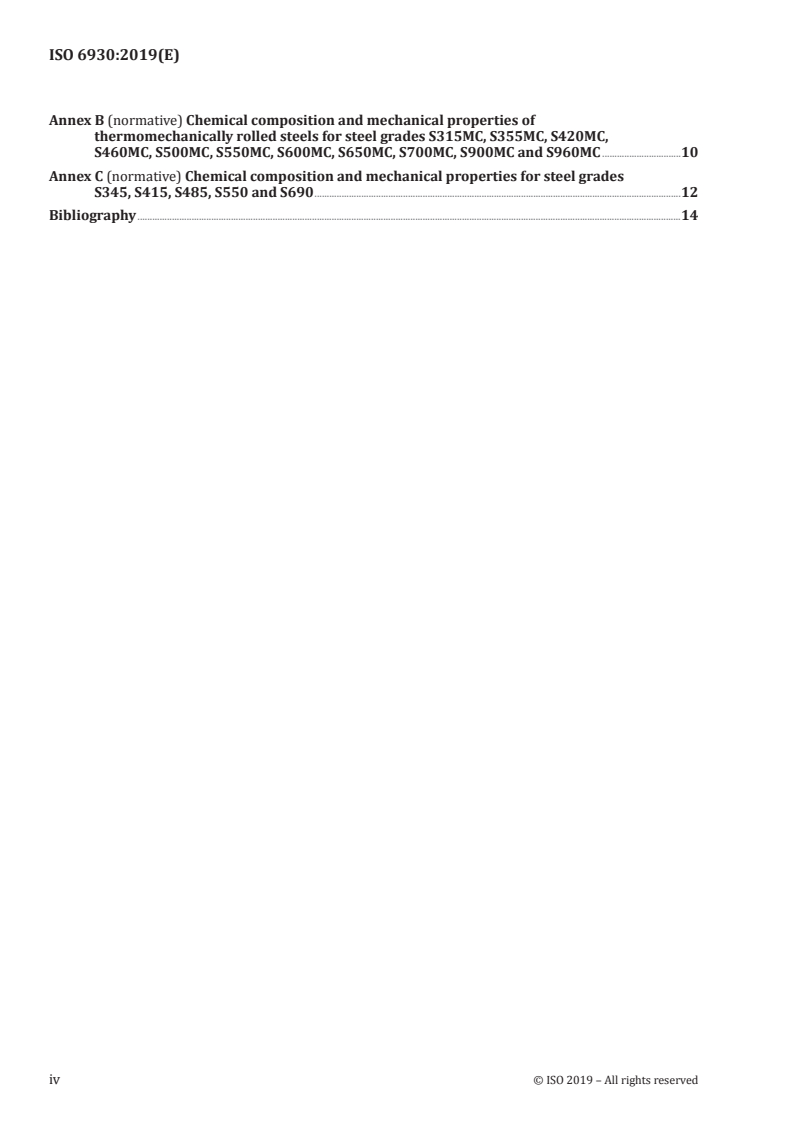
Annex B (normative) Chemical composition and mechanical properties of
thermomechanically rolled steels for steel grades S315MC, S355MC, S420MC,
S460MC, S500MC, S550MC, S600MC, S650MC, S700MC, S900MC and S960MC .10
Annex C (normative) Chemical composition and mechanical properties for steel grades
S345, S415, S485, S550 and S690 .12
Bibliography .14
iv © ISO 2019 – All rights reserved
Foreword
ISO (the International Organization for Standardization) is a worldwide federation of national standards
bodies (ISO member bodies). The work of preparing International Standards is normally carried out
through ISO technical committees. Each member body interested in a subject for which a technical
committee has been established has the right to be represented on that committee. International
organizations, governmental and non-governmental, in liaison with ISO, also take part in the work.
ISO collaborates closely with the International Electrotechnical Commission (IEC) on all matters of
electrotechnical standardization.
The procedures used to develop this document and those intended for its further maintenance are
described in the ISO/IEC Directives, Part 1. In particular the different approval criteria needed for the
different types of ISO documents should be noted. This document was drafted in accordance with the
editorial rules of the ISO/IEC Directives, Part 2 (see www .iso .org/directives).
Attention is drawn to the possibility that some of the elements of this document may be the subject of
patent rights. ISO shall not be held responsible for identifying any or all such patent rights. Details of
any patent rights identified during the development of the document will be in the Introduction and/or
on the ISO list of patent declarations received (see www .iso .org/patents).
Any trade name used in this document is information given for the convenience of users and does not
constitute an endorsement.
For an explanation on the voluntary nature of standards, the meaning of ISO specific terms and
expressions related to conformity assessment, as well as information about ISO’s adherence to the
World Trade Organization (WTO) principles in the Technical Barriers to Trade (TBT) see the following
URL: www .iso .org/iso/foreword .html.
This document was prepared by Technical Committee ISO/TC 17, Steel, Subcommittee SC 3, Steels for
structural purposes.
This second edition cancels and replaces ISO 6930-1:2001 and ISO 6930-2:2004, which have been
technically revised.
Any feedback or questions on this document should be directed to the user’s national standards body. A
complete listing of these bodies can be found at www .iso .org/members .html.
INTERNATIONAL STANDARD ISO 6930:2019(E)
High yield strength steel plates and wide flats for cold
forming — Delivery conditions
1 Scope
This document specifies the requirements for weldable high yield strength plates and wide flats for
cold forming.
It does not apply to weldable structural steels, whether or not of special quality, which are covered by
other International Standards, namely:
— structural steels: ISO 630 (all parts);
— high yield strength flat steel products: ISO 4950-1, ISO 4950-2 and ISO 4950-3;
— hot-rolled steel sheet of higher yield strength with improved formability: ISO 5951;
— sheet and strip: refer to ISO/TC 17, Steel, SC 12, Continuous mill flat rolled products;
— tubular products; refer to ISO/TC 5, Ferrous metal pipes and metallic fittings, SC 1, Steel tubes.
2 Normative references
The following documents are referred to in the text in such a way that some or all of their content
constitutes requirements of this document. For dated references, only the edition cited applies. For
undated references, the latest edition of the referenced document (including any amendments) applies.
ISO 148-1, Metallic materials — Charpy pendulum impact test — Part 1: Test method
ISO 377, Steel and steel products — Location and preparation of samples and test pieces for mechanical testing
ISO 404, Steel and steel products — General technical delivery requirements
ISO 2566-1, Steel — Conversion of elongation values — Part 1: Carbon and low alloy steels
ISO 4885, Ferrous materials — Heat treatments — Vocabulary
ISO 4948-1, Steels — Classification — Part 1: Classification of steels into unalloyed and alloy steels based
on chemical composition
ISO 4948-2, Steels — Classification — Part 2: Classification of unalloyed and alloy steels according to main
quality classes and main property or application characteristics
ISO/TS 4949, Steel names based on letter symbols
ISO 6892-1, Metallic materials — Tensile testing — Part 1: Method of test at room temperature
ISO 6929, Steel products — Vocabulary
ISO 7438, Metallic materials — Bend test
ISO 7452, Hot-rolled steel plates — Tolerances on dimensions and shape
ISO 7788, Steel — Surface finish of hot-rolled plates and wide flats — Delivery requirements
ISO 9034, Hot-rolled structural steel wide flats — Tolerances on dimensions and shape
ISO/TR 9769, Steel and iron — Review of available methods of analysis
ISO 10474, Steel and steel products — Inspection documents
ISO 14284, Steel and iron — Sampling and preparation of samples for the determination of chemical
composition
ISO 17577, Steel — Ultrasonic testing of steel flat products of thickness equal to or greater than 6 mm
3 Terms and definitions
For the purposes of this document, the terms and definitions given in ISO 6929 and ISO 4885 and the
following apply.
ISO and IEC maintain terminological databases for use in standardization at the following addresses:
— ISO Online browsing platform: available at https: //www .iso .org/obp
— IEC Electropedia: available at http: //www .electropedia .org/
3.1
wide flat
flat product of width over 150 mm up to and including 1 250 mm and thickness generally over 4 mm,
supplied in lengths, i.e. not coiled, and the edges are square, i.e. hot-rolled on all four sides (or in box passes)
4 Dimensions and tolerances
4.1 General
This document applies to plates and wide-flats, hot-rolled on reversing mills, of a thickness ≤20 mm for
grades specified in Annexes A and B and of a thickness between 4 mm and 50 mm (inclusive) for grades
specified in Annex C.
4.2 Mandatory information
The following information shall be supplied by the purchaser at the time of enquiry and order:
a) the quantity required;
b) the type of product;
c) the nominal dimensions and tolerances on dimensions and shape of the product;
d) the number of this document, i.e. ISO 6930;
e) the steel name (grade);
f) all required options;
g) inspection document to be issued.
5 Classification and designation
5.1 Classification
The steel grades specified in this document shall be classified as non-alloy or alloy quality steels in
accordance with ISO 4948-1, ISO 4948-2 and ISO/TS 4949 depending on the steel-grade chemical
composition and heat treatment condition.
2 © ISO 2019 – All rights reserved
5.2 Designation
Designation shall be carried out in accordance with ISO/TS 4949.
This document specifies twenty (20) steel grades.
Grades S260NC, S315NC, S355NC, and S420NC are specified in Annex A.
Grades S315MC, S355MC, S420MC, S460MC, S500MC, S550MC, S600MC, S650MC, S700MC, S900MC and
S960MC are specified in Annex B.
Grades S345, S415, S485, S550 and S690 are specified in Annex C.
5.3 Using Annexes A, B and C
The requirements of Annexes A, B and C shall be regarded separately. Each is independent of the other
...
INTERNATIONAL ISO
STANDARD 6930
Second edition
2019-07
High yield strength steel plates and
wide flats for cold forming — Delivery
conditions
Produits plats en acier à haute limite d'élasticité pour formage à
froid — Conditions de livraison
Reference number
©
ISO 2019
© ISO 2019
All rights reserved. Unless otherwise specified, or required in the context of its implementation, no part of this publication may
be reproduced or utilized otherwise in any form or by any means, electronic or mechanical, including photocopying, or posting
on the internet or an intranet, without prior written permission. Permission can be requested from either ISO at the address
below or ISO’s member body in the country of the requester.
ISO copyright office
CP 401 • Ch. de Blandonnet 8
CH-1214 Vernier, Geneva
Phone: +41 22 749 01 11
Fax: +41 22 749 09 47
Email: copyright@iso.org
Website: www.iso.org
Published in Switzerland
ii © ISO 2019 – All rights reserved
Contents Page
Foreword .v
1 Scope . 1
2 Normative references . 1
3 Terms and definitions . 2
4 Dimensions and tolerances . 2
4.1 General . 2
4.2 Mandatory information . 2
5 Classification and designation . 2
5.1 Classification . 2
5.2 Designation . 3
5.3 Using Annexes A, B and C . 3
6 Technical requirements . 3
6.1 Steelmaking process . 3
6.2 Method of deoxidation . 3
6.3 Production process . . 3
6.4 Delivery condition . 3
6.5 Chemical composition . 3
6.5.1 Heat analysis . . 3
6.5.2 Product analysis tolerances . 3
6.6 Dimensions tolerances and surface condition . 4
6.7 Internal soundness . 4
7 Mechanical properties . 4
7.1 Tensile properties . 4
7.2 Impact properties . 4
7.3 Technical properties . 4
7.3.1 Weldability . 4
7.3.2 Bending and cold-edging ability . 4
8 Inspection and testing . 5
8.1 General . 5
8.2 Test unit . . 5
8.2.1 Product analysis . 5
8.2.2 Mechanical properties . 5
8.3 Position and orientation of sample . 5
8.4 Preparation . 5
8.4.1 Tensile test pieces . 5
8.4.2 Impact test pieces . 5
8.5 Testing . 6
8.5.1 Tensile Test . 6
8.5.2 Impact test . 6
8.5.3 Bend test . 6
8.5.4 Product analysis . 6
8.6 Retests . 6
9 Inspection documents . 7
10 Sorting and reprocessing . 7
11 Marking . 7
Annex A (normative) Chemical composition and mechanical properties of normalized and
normalized rolled steels for steel grades S260NC, S315NC, S355NC and S420NC .8
Annex B (normative) Chemical composition and mechanical properties of
thermomechanically rolled steels for steel grades S315MC, S355MC, S420MC,
S460MC, S500MC, S550MC, S600MC, S650MC, S700MC, S900MC and S960MC .10
Annex C (normative) Chemical composition and mechanical properties for steel grades
S345, S415, S485, S550 and S690 .12
Bibliography .14
iv © ISO 2019 – All rights reserved
Foreword
ISO (the International Organization for Standardization) is a worldwide federation of national standards
bodies (ISO member bodies). The work of preparing International Standards is normally carried out
through ISO technical committees. Each member body interested in a subject for which a technical
committee has been established has the right to be represented on that committee. International
organizations, governmental and non-governmental, in liaison with ISO, also take part in the work.
ISO collaborates closely with the International Electrotechnical Commission (IEC) on all matters of
electrotechnical standardization.
The procedures used to develop this document and those intended for its further maintenance are
described in the ISO/IEC Directives, Part 1. In particular the different approval criteria needed for the
different types of ISO documents should be noted. This document was drafted in accordance with the
editorial rules of the ISO/IEC Directives, Part 2 (see www .iso .org/directives).
Attention is drawn to the possibility that some of the elements of this document may be the subject of
patent rights. ISO shall not be held responsible for identifying any or all such patent rights. Details of
any patent rights identified during the development of the document will be in the Introduction and/or
on the ISO list of patent declarations received (see www .iso .org/patents).
Any trade name used in this document is information given for the convenience of users and does not
constitute an endorsement.
For an explanation on the voluntary nature of standards, the meaning of ISO specific terms and
expressions related to conformity assessment, as well as information about ISO’s adherence to the
World Trade Organization (WTO) principles in the Technical Barriers to Trade (TBT) see the following
URL: www .iso .org/iso/foreword .html.
This document was prepared by Technical Committee ISO/TC 17, Steel, Subcommittee SC 3, Steels for
structural purposes.
This second edition cancels and replaces ISO 6930-1:2001 and ISO 6930-2:2004, which have been
technically revised.
Any feedback or questions on this document should be directed to the user’s national standards body. A
complete listing of these bodies can be found at www .iso .org/members .html.
INTERNATIONAL STANDARD ISO 6930:2019(E)
High yield strength steel plates and wide flats for cold
forming — Delivery conditions
1 Scope
This document specifies the requirements for weldable high yield strength plates and wide flats for
cold forming.
It does not apply to weldable structural steels, whether or not of special quality, which are covered by
other International Standards, namely:
— structural steels: ISO 630 (all parts);
— high yield strength flat steel products: ISO 4950-1, ISO 4950-2 and ISO 4950-3;
— hot-rolled steel sheet of higher yield strength with improved formability: ISO 5951;
— sheet and strip: refer to ISO/TC 17, Steel, SC 12, Continuous mill flat rolled products;
— tubular products; refer to ISO/TC 5, Ferrous metal pipes and metallic fittings, SC 1, Steel tubes.
2 Normative references
The following documents are referred to in the text in such a way that some or all of their content
constitutes requirements of this document. For dated references, only the edition cited applies. For
undated references, the latest edition of the referenced document (including any amendments) applies.
ISO 148-1, Metallic materials — Charpy pendulum impact test — Part 1: Test method
ISO 377, Steel and steel products — Location and preparation of samples and test pieces for mechanical testing
ISO 404, Steel and steel products — General technical delivery requirements
ISO 2566-1, Steel — Conversion of elongation values — Part 1: Carbon and low alloy steels
ISO 4885, Ferrous materials — Heat treatments — Vocabulary
ISO 4948-1, Steels — Classification — Part 1: Classification of steels into unalloyed and alloy steels based
on chemical composition
ISO 4948-2, Steels — Classification — Part 2: Classification of unalloyed and alloy steels according to main
quality classes and main property or application characteristics
ISO/TS 4949, Steel names based on letter symbols
ISO 6892-1, Metallic materials — Tensile testing — Part 1: Method of test at room temperature
ISO 6929, Steel products — Vocabulary
ISO 7438, Metallic materials — Bend test
ISO 7452, Hot-rolled steel plates — Tolerances on dimensions and shape
ISO 7788, Steel — Surface finish of hot-rolled plates and wide flats — Delivery requirements
ISO 9034, Hot-rolled structural steel wide flats — Tolerances on dimensions and shape
ISO/TR 9769, Steel and iron — Review of available methods of analysis
ISO 10474, Steel and steel products — Inspection documents
ISO 14284, Steel and iron — Sampling and preparation of samples for the determination of chemical
composition
ISO 17577, Steel — Ultrasonic testing of steel flat products of thickness equal to or greater than 6 mm
3 Terms and definitions
For the purposes of this document, the terms and definitions given in ISO 6929 and ISO 4885 and the
following apply.
ISO and IEC maintain terminological databases for use in standardization at the following addresses:
— ISO Online browsing platform: available at https: //www .iso .org/obp
— IEC Electropedia: available at http: //www .electropedia .org/
3.1
wide flat
flat product of width over 150 mm up to and including 1 250 mm and thickness generally over 4 mm,
supplied in lengths, i.e. not coiled, and the edges are square, i.e. hot-rolled on all four sides (or in box passes)
4 Dimensions and tolerances
4.1 General
This document applies to plates and wide-flats, hot-rolled on reversing mills, of a thickness ≤20 mm for
grades specified in Annexes A and B and of a thickness between 4 mm and 50 mm (inclusive) for grades
specified in Annex C.
4.2 Mandatory information
The following information shall be supplied by the purchaser at the time of enquiry and order:
a) the quantity required;
b) the type of product;
c) the nominal dimensions and tolerances on dimensions and shape of the product;
d) the number of this document, i.e. ISO 6930;
e) the steel name (grade);
f) all required options;
g) inspection document to be issued.
5 Classification and designation
5.1 Classification
The steel grades specified in this document shall be classified as non-alloy or alloy quality steels in
accordance with ISO 4948-1, ISO 4948-2 and ISO/TS 4949 depending on the steel-grade chemical
composition and heat treatment condition.
2 © ISO 2019 – All rights reserved
5.2 Designation
Designation shall be carried out in accordance with ISO/TS 4949.
This document specifies twenty (20) steel grades.
Grades S260NC, S315NC, S355NC, and S420NC are specified in Annex A.
Grades S315MC, S355MC, S420MC, S460MC, S500MC, S550MC, S600MC, S650MC, S700MC, S900MC and
S960MC are specified in Annex B.
Grades S345, S415, S485, S550 and S690 are specified in Annex C.
5.3 Using Annexes A, B and C
The requirements of Annexes A, B and C shall be regarded separately. Each is independent of the other
...