


ISO 16478:2023
(Main)Thermal insulation products — Vacuum insulation panels (VIPs) — Specification
Thermal insulation products — Vacuum insulation panels (VIPs) — Specification
This document: — defines requirements for vacuum insulation panels (VIPs) with silica or glass fibre core, which are used for thermal insulation of buildings; — outlines required product properties, their performance, test methods and rules for conformity evaluations, identification and labelling; — provides a test method to determine ageing factors and the influence of the linear thermal bridges at the edges. This document is applicable to all types of silica and glass fibre core VIPs, independent of the type of envelope. In the case of a glass fibre core VIP, it is only applicable to VIPs with desiccants whose service life is ≥ 25 years. This document is not applicable to: — any specific installation and application requirements; — products intended to be used for the insulation of building equipment and industrial installations.
Titre manque
General Information
- Status
- Published
- Publication Date
- 30-Nov-2023
- Technical Committee
- ISO/TC 163/SC 3 - Thermal insulation products, components and systems
- Drafting Committee
- ISO/TC 163/SC 3/WG 11 - Vacuum insulation panels
- Current Stage
- 6060 - International Standard published
- Start Date
- 01-Dec-2023
- Due Date
- 21-Dec-2022
- Completion Date
- 30-Nov-2023
Overview
ISO 16478:2023 - "Thermal insulation products - Vacuum insulation panels (VIPs) - Specification" sets international requirements for vacuum insulation panels (VIPs) with silica or glass fibre cores used in the thermal insulation of buildings. The standard defines required product properties, performance criteria, test methods, conformity evaluation rules, and labelling/identification. It also provides specific test procedures to determine ageing factors and the effect of linear thermal bridges at VIP edges. Note: for glass fibre core VIPs, ISO 16478:2023 applies only where desiccants give a service life ≥ 25 years. The standard does not cover installation details or products for building equipment and industrial installations.
Key topics and requirements
- Scope and definitions: terminology for VIP components (core, envelope, adsorbent/desiccant), inner pressure, COP (centre of panel) and edge effect.
- Thermal performance: requirements and test methods for initial and aged thermal resistance and thermal conductivity, including size-dependent values.
- Ageing and durability: laboratory procedures to determine expected mean thermal conductivity at 25 years and the relationship between inner pressure and thermal performance.
- Edge effects / linear thermal transmittance: methods to quantify thermal bridging at panel edges and how it impacts whole-panel performance.
- Dimensional and mechanical properties: rules and tests for length, width, squareness, flatness, thickness and dimensional stability.
- Sampling, conformity and factory controls: sampling plans, product type determination (PTD), factory production control (FPC) and conformity evaluation procedures.
- Identification and labelling: required marking to communicate declared thermal properties, dimensions and ageing data.
- Annexes: normative methods for linear thermal transmittance, aged value determination for silica and glass fibre cores, and informative guidance on additional properties and pressure measurement.
Applications and practical value
ISO 16478:2023 is intended for use where high-performance thermal insulation is required in building envelopes - for example walls, roofs and floors - and where space-saving insulation solutions are sought. It helps:
- Manufacturers certify VIP product performance and declare long-term thermal behaviour.
- Test laboratories apply standardized methods to measure initial and aged thermal properties.
- Architects, specifiers and building engineers compare and select VIPs with reliable performance data.
- Regulators and certification bodies evaluate conformity and labelling for building products.
Who should use this standard
- VIP manufacturers and R&D teams
- Accredited test laboratories and third‑party certifiers
- Building product compliance officers and procurement teams
- Architects, façade engineers and building energy modelers
Related standards
ISO 16478 references thermal and fire test standards commonly used with VIPs, for example ISO 8301/8302 (thermal resistance measurement), ISO 10211 (thermal bridges), ISO 10456 (hygrothermal properties) and relevant reaction-to-fire standards (ISO 1182, ISO 11925-2, EN 13501‑1).


Get Certified
Connect with accredited certification bodies for this standard

ICC Evaluation Service
Building products evaluation and certification.

QAI Laboratories
Building and construction product testing and certification.

Aboma Certification B.V.
Specialized in construction, metal, and transport sectors.
Sponsored listings
Frequently Asked Questions
ISO 16478:2023 is a standard published by the International Organization for Standardization (ISO). Its full title is "Thermal insulation products — Vacuum insulation panels (VIPs) — Specification". This standard covers: This document: — defines requirements for vacuum insulation panels (VIPs) with silica or glass fibre core, which are used for thermal insulation of buildings; — outlines required product properties, their performance, test methods and rules for conformity evaluations, identification and labelling; — provides a test method to determine ageing factors and the influence of the linear thermal bridges at the edges. This document is applicable to all types of silica and glass fibre core VIPs, independent of the type of envelope. In the case of a glass fibre core VIP, it is only applicable to VIPs with desiccants whose service life is ≥ 25 years. This document is not applicable to: — any specific installation and application requirements; — products intended to be used for the insulation of building equipment and industrial installations.
This document: — defines requirements for vacuum insulation panels (VIPs) with silica or glass fibre core, which are used for thermal insulation of buildings; — outlines required product properties, their performance, test methods and rules for conformity evaluations, identification and labelling; — provides a test method to determine ageing factors and the influence of the linear thermal bridges at the edges. This document is applicable to all types of silica and glass fibre core VIPs, independent of the type of envelope. In the case of a glass fibre core VIP, it is only applicable to VIPs with desiccants whose service life is ≥ 25 years. This document is not applicable to: — any specific installation and application requirements; — products intended to be used for the insulation of building equipment and industrial installations.
ISO 16478:2023 is classified under the following ICS (International Classification for Standards) categories: 91.100.60 - Thermal and sound insulating materials. The ICS classification helps identify the subject area and facilitates finding related standards.
ISO 16478:2023 is available in PDF format for immediate download after purchase. The document can be added to your cart and obtained through the secure checkout process. Digital delivery ensures instant access to the complete standard document.
Standards Content (Sample)
INTERNATIONAL ISO
STANDARD 16478
First edition
2023-11
Thermal insulation products —
Vacuum insulation panels (VIPs) —
Specification
Reference number
© ISO 2023
All rights reserved. Unless otherwise specified, or required in the context of its implementation, no part of this publication may
be reproduced or utilized otherwise in any form or by any means, electronic or mechanical, including photocopying, or posting on
the internet or an intranet, without prior written permission. Permission can be requested from either ISO at the address below
or ISO’s member body in the country of the requester.
ISO copyright office
CP 401 • Ch. de Blandonnet 8
CH-1214 Vernier, Geneva
Phone: +41 22 749 01 11
Email: copyright@iso.org
Website: www.iso.org
Published in Switzerland
ii
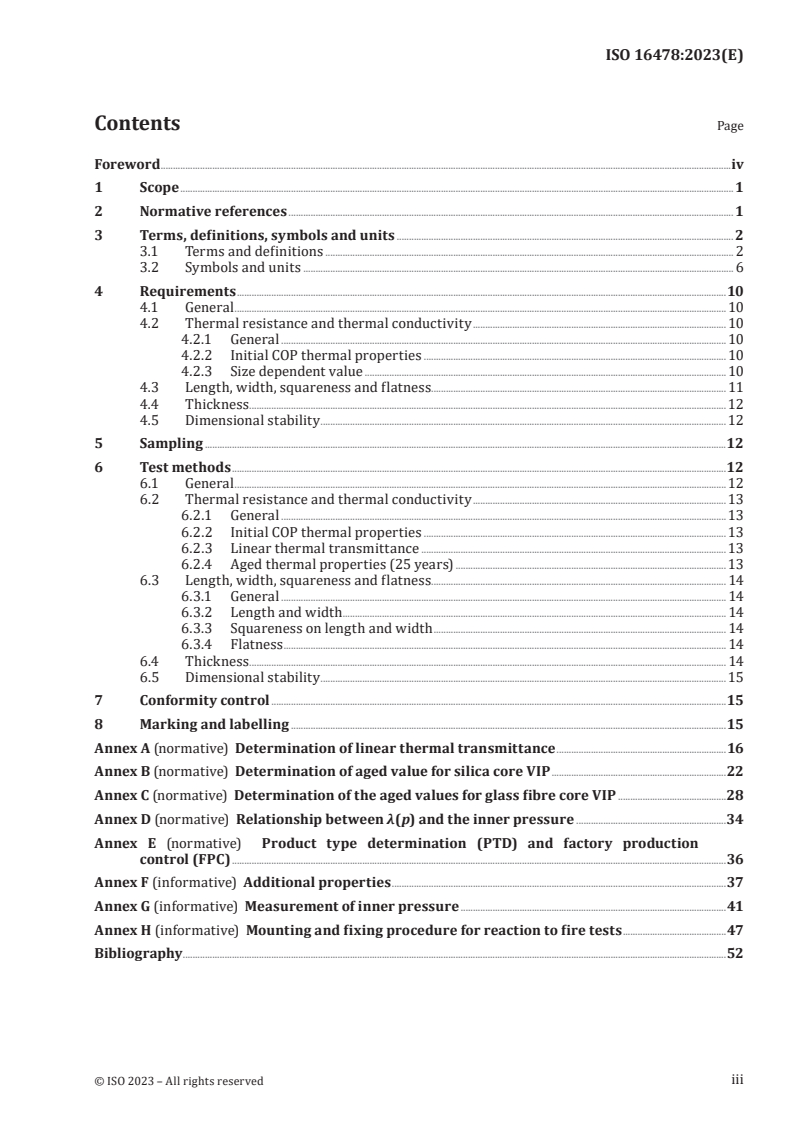
Contents Page
Foreword .iv
1 Scope . 1
2 Normative references . 1
3 Terms, definitions, symbols and units . 2
3.1 Terms and definitions . 2
3.2 Symbols and units . 6
4 Requirements .10
4.1 General . 10
4.2 Thermal resistance and thermal conductivity . 10
4.2.1 General . 10
4.2.2 Initial COP thermal properties . 10
4.2.3 Size dependent value . 10
4.3 Length, width, squareness and flatness. 11
4.4 Thickness .12
4.5 Dimensional stability . 12
5 Sampling .12
6 Test methods .12
6.1 General .12
6.2 Thermal resistance and thermal conductivity . 13
6.2.1 General .13
6.2.2 Initial COP thermal properties . 13
6.2.3 Linear thermal transmittance . 13
6.2.4 Aged thermal properties (25 years) . 13
6.3 Length, width, squareness and flatness. 14
6.3.1 General . 14
6.3.2 Length and width . . 14
6.3.3 Squareness on length and width . 14
6.3.4 Flatness . 14
6.4 Thickness . 14
6.5 Dimensional stability . 15
7 Conformity control .15
8 Marking and labelling .15
Annex A (normative) Determination of linear thermal transmittance .16
Annex B (normative) Determination of aged value for silica core VIP .22
Annex C (normative) Determination of the aged values for glass fibre core VIP .28
Annex D (normative) Relationship between λ(p) and the inner pressure .34
Annex E (normative) Product type determination (PTD) and factory production
control (FPC) .36
Annex F (informative) Additional properties .37
Annex G (informative) Measurement of inner pressure .41
Annex H (informative) Mounting and fixing procedure for reaction to fire tests .47
Bibliography .52
iii
Foreword
ISO (the International Organization for Standardization) is a worldwide federation of national standards
bodies (ISO member bodies). The work of preparing International Standards is normally carried out
through ISO technical committees. Each member body interested in a subject for which a technical
committee has been established has the right to be represented on that committee. International
organizations, governmental and non-governmental, in liaison with ISO, also take part in the work.
ISO collaborates closely with the International Electrotechnical Commission (IEC) on all matters of
electrotechnical standardization.
The procedures used to develop this document and those intended for its further maintenance are
described in the ISO/IEC Directives, Part 1. In particular, the different approval criteria needed for the
different types of ISO document should be noted. This document was drafted in accordance with the
editorial rules of the ISO/IEC Directives, Part 2 (see www.iso.org/directives).
ISO draws attention to the possibility that the implementation of this document may involve the use
of (a) patent(s). ISO takes no position concerning the evidence, validity or applicability of any claimed
patent rights in respect thereof. As of the date of publication of this document, ISO had not received
notice of (a) patent(s) which may be required to implement this document. However, implementers are
cautioned that this may not represent the latest information, which may be obtained from the patent
database available at www.iso.org/patents. ISO shall not be held responsible for identifying any or all
such patent rights.
Any trade name used in this document is information given for the convenience of users and does not
constitute an endorsement.
For an explanation of the voluntary nature of standards, the meaning of ISO specific terms and
expressions related to conformity assessment, as well as information about ISO's adherence to
the World Trade Organization (WTO) principles in the Technical Barriers to Trade (TBT), see
www.iso.org/iso/foreword.html.
This document was prepared by Technical Committee ISO/TC 163, Thermal performance and energy use
in the built environment, Subcommittee SC 3, Thermal insulation products, components and systems.
Any feedback or questions on this document should be directed to the user’s national standards body. A
complete listing of these bodies can be found at www.iso.org/members.html.
iv
INTERNATIONAL STANDARD ISO 16478:2023(E)
Thermal insulation products — Vacuum insulation panels
(VIPs) — Specification
1 Scope
This document:
— defines requirements for vacuum insulation panels (VIPs) with silica or glass fibre core, which are
used for thermal insulation of buildings;
— outlines required product properties, their performance, test methods and rules for conformity
evaluations, identification and labelling;
— provides a test method to determine ageing factors and the influence of the linear thermal bridges
at the edges.
This document is applicable to all types of silica and glass fibre core VIPs, independent of the type of
envelope. In the case of a glass fibre core VIP, it is only applicable to VIPs with desiccants whose service
life is ≥ 25 years.
This document is not applicable to:
— any specific installation and application requirements;
— products intended to be used for the insulation of building equipment and industrial installations.
2 Normative references
The following documents are referred to in the text in such a way that some or all of their content
constitutes requirements of this document. For dated references, only the edition cited applies. For
undated references, the latest edition of the referenced document (including any amendments) applies.
ISO 1182, Reaction to fire tests for products — Non-combustibility test
ISO 1716, Reaction to fire tests for products — Determination of the gross heat of combustion (calorific
value)
ISO 3529-1, Vacuum technology — Vocabulary — Part 1: General terms
ISO 3529-2, Vacuum technology — Vocabulary — Part 2: Vacuum pumps and related terms
ISO 3529-3, Vacuum technology — Vocabulary — Part 3: Total and partial pressure vacuum gauges
ISO 8301, Thermal insulation — Determination of steady-state thermal resistance and related properties —
Heat flow meter apparatus
ISO 8302, Thermal insulation — Determination of steady-state thermal resistance and related properties —
Guarded hot plate apparatus
ISO 8990, Thermal insulation — Determination of steady-state thermal transmission properties —
Calibrated and guarded hot box
ISO 10211, Thermal bridges in building construction — Heat flows and surface temperatures — Detailed
calculations
ISO 10456, Building materials and products — Hygrothermal properties — Tabulated design values and
procedures for determining declared and design thermal values
ISO 11925-2, Reaction to fire tests — Ignitability of products subjected to direct impingement of flame —
Part 2: Single-flame source test
ISO 12136, Reaction to fire tests — Measurement of material properties using a fire propagation apparatus
ISO 12567-1, Thermal performance of windows and doors — Determination of thermal transmittance by
the hot-box method — Part 1: Complete windows and doors
ISO 12576-1:2001, Thermal insulation — Insulating materials and products for buildings — Conformity
control systems — Part 1: Factory-made products
ISO 29465, Thermal insulating products for building applications — Determination of length and width
ISO 29466, Thermal insulating products for building applications — Determination of thickness
ISO 29467, Thermal insulating products for building applications — Determination of squareness
ISO 29468, Thermal insulating products for building applications — Determination of flatness
ISO 29472, Thermal insulating products for building applications — Determination of dimensional stability
under specified temperature and humidity conditions
EN 13501-1, Fire classification (Euroclasses) of construction products and building elements —
Classification using test data from reaction to fire tests
EN 13823, Reaction to fire tests for building products — Building products excluding floorings exposed to
the thermal attack by a single burning item
3 Terms, definitions, symbols and units
For the purposes of this document, the following terms and definitions apply.
ISO and IEC maintain terminology databases for use in standardization at the following addresses:
— ISO Online browsing platform: available at https:// www .iso .org/ obp
— IEC Electropedia: available at https:// www .electropedia .org/
3.1 Terms and definitions
3.1.1
vacuum insulation panel
VIP
insulation element containing open porous core material (3.1.4) and an adsorbent (3.1.8) within an
envelope (3.1.5), where the inner pressure (3.1.10) inside the envelope is significantly lower, close to the
vacuum (i.e. zero pressure), than the ambient air pressure
Note 1 to entry: A schematic view of a VIP is shown in Figure 1.
Key
1 core material
2 envelope
3 adsorbent
d thickness (3.1.17)
l working length (3.1.11)
w
Figure 1 — Schematic view of VIP
3.1.2
silica core VIP
vacuum insulation panel (VIP) (3.1.1) using fumed silica or other comparable silica powders as core
material (3.1.4)
3.1.3
glass fibre core VIP
vacuum insulation panel (VIP) (3.1.1) using glass fibre as core material (3.1.4), and generally containing
an adsorbent (3.1.8)
3.1.4
core material
open porous insulation material constituting the main component inside the vacuum insulation panel
(VIP) (3.1.1) envelope (3.1.5)
3.1.5
envelope
barrier layer(s) of the vacuum insulation panel (VIP) (3.1.1) resisting gas or vapour permeation into and
securing the vacuum inside the VIP
3.1.6
metallized film
MF
laminated film containing a high barrier performance metallic thin layer produced by chemical/
physical deposition
3.1.7
aluminium foil laminated film
AF
laminated film containing aluminium foil as a gas barrier layer
3.1.8
adsorbent
material adsorbing either water vapour or dry air, or both, physically or chemically
3.1.9
desiccant
material added inside the envelope (3.1.5) for the purpose of adsorbing water vapour
EXAMPLE CaO.
3.1.10
inner pressure
total gas pressure within the vacuum insulation panel (VIP) (3.1.1)
3.1.11
working length
l
w
longer linear dimension of the major surface of the test specimen
Note 1 to entry: See Figure 2.
3.1.12
working width
w
w
shorter linear dimension of the major surface of the test specimen, measured at right angles to the
working length (3.1.11)
Note 1 to entry: See Figure 2.
3.1.13
core length
l
c
longer linear dimension of the core material (3.1.4) of the test specimen
Note 1 to entry: See Figure 2.
3.1.14
core width
w
c
shorter linear dimension of the core material (3.1.4) of the test specimen, measured at right angles to
the core length (3.1.13)
3.1.15
length of edge seal
l
longer linear dimension of the edge seal of the test specimen
Note 1 to entry: See Figure 2.
3.1.16
width of edge seal
w
shorter linear dimension of the edge seal of the test specimen, measured at right angles to the edge seal
length (3.1.19)
Note 1 to entry: See Figure 2.
3.1.17
thickness
d
linear dimension measured perpendicularly to the length and width plane
3.1.18
surface area
A
sur
area of gas permeation plane of the test specimen
Note 1 to entry A shall be determined by Formulae (1) or (2).
sur
metallized film (MF) (3.1.6) on both sides:
A = l × w × 2 (1)
sur 2 2
MF on single side:
A = l × w (2)
sur 2 2
3.1.19
edge seal length
l
es
total length of the edge seal of the test specimen
Note 1 to entry: l shall be determined by Formula (3).
es
l = l × 2 + w × 2 (3)
es 2 2
a) b)
c) d)
Key
1 core material (3.1.4)
2 envelope (3.1.5)
3 adsorbent or desiccant
4 edge seal
l core length (3.1.13)
c
l working length (3.1.11)
w
l length of edge seal (3.1.15)
w working width (3.1.12)
w
w width of edge seal (3.1.16)
Figure 2 — Dimensions of a VIP
3.1.20
centre of panel
COP
area of the vacuum insulation panel (VIP) (3.1.1) not affected by the edge effect (3.1.21)
3.1.21
edge effect
thermal bridging along the edge due to higher thermal conductivity of the outer envelope (3.1.5)
compared to the core material (3.1.4)
3.1.22
aged value
expected mean thermal conductivity value at 25 years in specified laboratory conditions
3.2 Symbols and units
A surface area of the VIP m
A metering area of the GHP or HFM apparatus used for m
m
measurement
A nominal surface area of the VIP m
N
A area of the specimen measured by hot box method m
sp
A surface area of gas permeation plane of the product m
sur
A surface area of gas permeation plane of the specimen m
sur,sp
C capacity of the desiccant g/g
des
C capacity of the desiccant including a safety margin of 20 % g/g
des,20 %
d thickness m
d thickness of the ventilated VIP m
ambient
d nominal thickness of the product m
N
d thickness of the VIP m
VIP
f acceleration factor for dry air of the envelope -
air
f acceleration factor for water vapour of the VIP envelope -
v
k factor related to the number of test results available -
l length m
l core length m
c
l length of edge seal m
l working length m
w
l length of the joints within the metering area m
ψ
m initial water amount of core material g
m amount of adsorbed water vapour g
m water vapour amount adsorbed over 25 years g
25a
m mass of desiccant g
des
m mass of the desiccant after test g
des,1a
m sufficient amount of desiccant g
des,1d
m mass of the desiccant before acceleration test g
des,2a
m mass of the desiccant after acceleration test g
des,2c
m mass of the fully dried desiccant g
des,0
m mass of the saturated desiccant g
des,sat
m’ inner dry air mass increase rate at 23 °C, 50 % relative humidity g/day
t,air, 23/50
(RH)
m’ water vapour mass increase rate at 23 °C, 50 % RH g/day
t,v, 23/50
N number of test results -
3 2
P air permeability of the VIP envelope m ·Pa/(m ·s)
air
P air permeability of the VIP envelope of the product at 23 °C, g/(day·Pa)
air,total,23/50
50 % RH
P air permeability of the VIP envelope of the specimen at 23 °C, g/(day·Pa)
air,total,sp,23/50
50 % RH
P air permeability of the film surface at 23 °C, 50 % RH g/(m ·day·Pa)
air,A,23/50
P air permeability of the edge seal at 23 °C, 50 % RH g/(m·day·Pa)
air,l,23/50
P water intake rate of the VIP envelope kg/(m ·s)
v
p air pressure inside the VIP Pa
air
p atmospheric pressure Pa
air,atm
p maximum value of the inner pressure measured at least Pa
lim
24 hours after production
p water vapour pressure inside the VIP Pa
v
p atmospheric water vapour pressure Pa
v,out
p initial value of the inner pressure Pa
inner pressure of VIP, where λ increases by 1/2 of the thermal
p Pa
1/2
conductivity of still air
p’ inner pressure increase rate at 23 °C, 50 % RH Pa/day
t,air,23/50
p’ inner pressure increase rate at 40 °C Pa/day
t,air,40
p’ inner pressure increase rate at 60 °C Pa/day
t,air,60
p’ inner pressure increase rate at 80 °C Pa/day
t,air,80
R thermal resistance of the auxiliary material m ·K/W
aux
R declared thermal resistance m ·K/W
D
R thermal resistance obtained by assuming the entire surface m ·K/W
eq
to be homogeneous calculated by the thermal transmittance
R total surface thermal resistance m ·K/W
s,t
R mean thermal resistance m ·K/W
mean
R thermal resistance of VIP plus auxiliary material m ·K/W
tot
R 90 % fractile with a confidence level of 90 % for the thermal m ·K/W
90/90
resistance
S top surface area (working length x working width) of the VIP m
S deviation from squareness on width or length mm/m
b
S deviation from flatness mm
MAX
S nominal perimeter of the product m
N
s estimate of the standard deviation of the thermal conductivity W/(m·K)
λ
T temperature K
t time s
t lifetime of desiccant a
des
U thermal transmittance W/(m ·K)
V core volume of the product m
V core volume of the specimen m
sp
V void volume of core m
void
w width m
w core width m
c
w width of edge seal
w working width m
w
X water content inside the VIP mass-%
λ thermal conductivity of still air W/(m·K)
air
λ thermal conductivity of a ventilated VIP at centre of the panel W/(m·K)
ambient
λ thermal conductivity for centre of panel W/(m·K)
cop
λ (25 years) average value of thermal conductivity over 25 years in use W/(m·K)
cop,mean
at centre of panel
λ λ at centre of panel plus ageing W/(m·K)
cop,90/90,aged 90/90
λ declared thermal conductivity W/(m·K)
D
λ thermal conductivity including edge effect W/(m·K)
eq
λ equivalent thermal conductivity including edge effect W/(m·K)
eq,ja
λ mean value of thermal conductivity W/(m·K)
mean
λ one test result of thermal conductivity W/(m·K)
i
λ thermal conductivity in the evacuated state W/(m·K)
λ’ change of thermal conductivity with pressure W/(m·K·Pa)
p
λ’ change of thermal conductivity with time W/(m·K·s)
t
λ thermal conductivity of the VIP W/(m·K)
VIP
λ’ change of thermal conductivity with humidity W/(m·K)/mass-%
X
λ 90 % fractile with a confidence level of 90 % of thermal W/(m·K)
90/90
conductivity
λ’ change of thermal conductivity with time at 23 °C 50 % RH W/(m·K·s)
t,23/50
λ’ change of thermal conductivity with time at 50 °C 70 % RH W/(m·K·s)
t,50/70
λ (t) time-dependent thermal conductivity value W/(m·K)
cop
λ(t) time-dependent value of thermal conductivity at 23 °C 50 % RH W/(m·K·s)
,23/50
λ(t) time-dependent value of thermal conductivity at 50 °C 70 % RH W/(m·K·s)
,50/70
*
λ (t = 0) interpolated initial thermal conductivity W/(m·K)
σ tensile strength perpendicular to faces kPa
mt
σ compressive stress at 10 % deformation kPa
φ RH inside the VIP %
φ’ change of RH inside the VIP as function of water (rel.
x
content humidity-%)
/(mass-%)
Φ quantity of heat generated in the hot box W
in
Φ quantity of heat loss from the hot box W
l
Φ quantity of heat flow through the surround panel W
sur
ψ linear thermal transmittance W/(m·K)
ψ linear thermal transmittance for the joints in the metering area W/(m·K)
m
Δθ environmental temperature difference between both sides K
n
of the specimen
4 Requirements
4.1 General
Products shall be assessed in accordance with Clause 6 and meet the requirements as outlined in
Clause 4.
All characteristics defined in Clause 4, if declared, shall be subject to product type determination (PTD)
in accordance with Annex E. The minimum frequencies of tests in the factory production control (FPC)
shall be in accordance with Annex E.
NOTE The manufacturer can choose to give information for additional properties (see Annex F).
4.2 Thermal resistance and thermal conductivity
4.2.1 General
Requirements of thermal resistance and thermal conductivity are given in Table 1.
Table 1 — Thermal resistance and thermal conductivity
Thermal resistance Thermal conductivity
Property R λ
2+
m K/W W/(m·K)
Initial value of centre of panel (COP) (λ , R ) > 1,6 < 0,005
cop,90/90 cop,90/90
Initial value including thermal bridging (λ ) – Declare
D
Aged value of COP (λ , R ) > 0,8 < 0,010
cop,90/90,aged cop,90/90,aged
Aged value including thermal bridging (λ ) – Declare
90/90,aged
4.2.2 Initial COP thermal properties
The initial value of COP, R and λ shall be determined by using Formulae (4) and (5) and
cop,90/90 cop,90/90
shall not exceed the limits given in Table 1.
λλ=+ks× (4)
cop,90/90 mean λ
d
N
R = (5)
cop,90/90
λ
cop,90/90
4.2.3 Size dependent value
4.2.3.1 General
Edge effect and ageing effect depends on the size of VIP.
The value, including thermal bridging and aged value, shall be declared according to Method A. In
addition, for better comparison between different products, the thermal resistance and thermal
conductivity shall be declared according to Method B for panels when at least one of their dimensions
(length or width) is smaller than 250 mm.
Method A: Respective panel size of VIP as placed on the market;
Method B: Following a set of reference dimensions (length × width × thickness) of VIP:
a) 0,3 m × 0,3 m × 0,01 m;
b) 1,0 m × 0,5 m × 0,01 m;
c) 0,3 m × 0,3 m × 0,03 m;
d) 1,0 m × 0,5 m × 0,03 m.
More details regarding initial values including thermal bridging, aged value of COP and aged value
including thermal bridging are provided in 4.2.3.2, 4.2.3.3 and 4.2.3.4, respectively.
4.2.3.2 Initial value including thermal bridging
Thermal conductivity, including thermal bridging along edges, λ , shall be determined by using
D
Formulae (6) and (7) and shall be declared.
λλ=+Δλ (6)
Dcop,90/90 edge
S
N
Δλψ=×d × (7)
edge N
S
4.2.3.3 Aged COP thermal properties
Aged value of COP, λ and R , shall be determined by using Formulae (8) and (9) and
90/90, aged cop,90/90,aged
shall not exceed the limits provided in Table 1.
λλ=+Δλ (25 years) (8)
cop,90/90,aged cop,90/90 cop,mean
d
N
R = (9)
cop,90/90,aged
λ
cop,90/90,aged
4.2.3.4 Aged value including thermal bridging
Aged value including thermal bridging, λ , shall be determined by using Formula (10) and shall
90/90,aged
be declared.
λλ=+Δλ (25 years) (10)
90/90,aged Dcop,mean
4.3 Length, width, squareness and flatness
The tolerance of core length, core width, squareness and flatness for silica core VIP and for glass fibre
core VIP shall not exceed the limits given in Tables 2 and 3 respectively.
Table 2 — Tolerances of length, width, squareness and flatness for silica core VIP
Tolerance
Squareness on
Core length and core width Flatness
length and width
500 mm ≤ (l ,w )
c c
(l ,w ) < 500 mm (l ,w ) > 1 000 mm S S
c c c c b max
≤ 1 000 mm
mm mm/m mm
±4 ±5 ±6 5 6
Table 3 — Tolerances of length, width, squareness and flatness for glass fibre core VIP
Tolerance
Squareness on
Core length and core width Flatness
length and width
500 mm ≤ (l ,w )
c c
(l ,w ) < 500 mm (l ,w ) > 1 000 mm S S
c c c c b max
≤ 1 000 mm
mm mm/m mm
±5 ±5 ±6 10 6
4.4 Thickness
The tolerance of thickness shall not exceed the limits given in Table 4.
Table 4 — Tolerances of thickness
Tolerance
Thickness
mm
mm
Silica core VIP Glass fibre core VIP
≤ 10 ±0,5 ±1
10 < d ≤ 20 ±1 ±2
N
20 < d ≤ 30 ±1,5 ±3
N
> 30 ±2 ±4
4.5 Dimensional stability
The relative changes in length and width shall not exceed 1 %, and the relative change in thickness
shall not exceed 3 %.
5 Sampling
The laboratory conducting the testing shall be responsible for random sampling of VIP.
6 Test methods
6.1 General
One test result for a product property is the average of the measured values on the number of test
specimens mentioned in Table 5.
Unlike other insulating materials, VIPs cannot be cut to the size required by the test standards. They
shall be produced in the sizes stated in Table 5.
Table 5 — Test methods and test specimens
Minimum number
Clause number in ISO 16478 Test specimen length
Test method of measurements
a
(this document) and width
to get one test result
6.2.1 ISO 8301 or ISO 8302 ≥ 300 10
6.2.2 Annex A ≥ 300 1
Annex B ≥ 300 2 per condition
6.2.3
Annex C ≥ 300 3 per condition
6.3 6.3.1 Full-size 3
6.3 6.3.2 Full-size 3
6.3 6.3.3 Full-size 3
6.4 6.4 Full-size 3
6.5 ISO 29472 ≥ 200 3
a
Full-size product thickness when the limits of the test methods are exceeded.
6.2 Thermal resistance and thermal conductivity
6.2.1 General
The thermal conductivity and the thermal resistance shall be rounded upwards in steps of 0,000 5 W/
(m·K) and downwards to the nearest 0,05 m ·K/W, respectively.
6.2.2 Initial COP thermal properties
Thermal resistance and thermal conductivity within 2 d to 30 d after production shall be determined in
accordance with ISO 8301 or ISO 8302 under the following conditions:
— at a mean reference temperature of 10 °C or 23 °C;
— after conditioning the test specimen at (23 ± 2) °C and (50 ± 5) % relative humidity (RH) for at least
24 h.
λ shall represent at least 90 % of the production, determined with a confidence level of 90 % in
cop,90/90
accordance with ISO 10456.
The measurement shall be carried out directly on the VIP, or, for uneven surfaces, to avoid air gaps.
The measurement shall be carried out with the VIP positioned between two flexible contact sheets
of another insulation material of known thermal conductivity (“auxiliary material”). The thermal
conductivity λ can be calculated from the total thermal resistance R of the composites, the thermal
VIP tot
resistance of the auxiliary material R and the measured thickness of VIP using Formula (11).
aux
d
N
λ = (11)
VIP
RR−
totaux
6.2.3 Linear thermal transmittance
Linear thermal transmittance, ψ, shall be determined in accordance with Annex A.
6.2.4 Aged thermal properties (25 years)
Aged ∆λ (25 years) for silica core VIP and for glass fibre core VIP shall be determined in
cop,mean
accordance with Annexes B and C, respectively.
6.3 Length, width, squareness and flatness
6.3.1 General
Length, l, and width, w, shall be determined in accordance with ISO 29465. The seams and folded
edges or ends shall not be included in the measurement. The deviation from squareness on length and
width, S , shall be determined in accordance with ISO 29467. The deviation from flatness, S , shall be
b max
determined in accordance with ISO 29468.
6.3.2 Length and width
ISO 29465 applies with the following recommendation:
— Considering the welding or folding of the envelope of the product, it is recommended to pinch the
panel with a flat bar and measure the distance between them.
6.3.3 Squareness on length and width
— ISO 29467 is normally applicable to products with straight edges. ISO 29467 stipulates that it can be
adapted accordingly for products of other shapes such as profiles edges.
— The determination of the squareness for length and width shall be done by measuring the deviation
on all sides of the test specimen, the test specimen laying on a flat surface. Therefore, there are
four points to be measured, one for each side. The 4 values of linearity deviation for each side shall
be recorded.
— If the squareness concerns a field having a welding or folding of the envelope, the measurements
shall be carried out twice by turning the test specimen upside down on the flat side. In this case, the
number of measurements rises from four values to eight values.
— The test report shall include all individual values measured for deviation from squareness for length
and width and from linearity, specifying if the measurements are made on the short or the long
edge.
— If the summit to be measured has an angle greater than 90°, the measurement cannot be done (it
will be obtained by turning the panel over on the other side), the indication “angle > 90” shall be
mentioned in the test report (different from 0).
— All of the measurements shall be recorded in the test report.
6.3.4 Flatness
ISO 29468 applies with the following recommendations:
— The panel shall be laid down on the opposite side of any welding or folding of the envelope of the
products.
— The measuring points as stated in the standard shall exclude the welding or folding areas of the
envelopes of the products.
6.4 Thickness
If there is neither folding nor welding of the envelope on both measured sides, ISO 29466 applies, with
a load plate of 250 Pa.
If the products show welding or folding of the envelope on at least one of the areas being measured,
these shall be measured while applying different load plates.
The selected load plates for this test can be either:
— dimensions (mm): 200 × 200, pressure applied to the test specimen: 1 kPa;
— dimensions (mm): 600 × 600, pressure applied to the test specimen: 1,5 kPa.
In the case of applying the 600 × 600 plate, the measuring points shall be carried out in accordance
with ISO 29466, in relation to their location on the 600 × 600 plate.
The pressure to be applied should allow the folds or any irregularity of the envelope to be flattened
enough (their impact being assessed elsewhere, in particular during the determination of the thermal
bridges).
The seams and folded edges or ends and adsorbent shall not be included in the measurement.
6.5 Dimensional stability
Dimensional stability under specified temperature or under specified temperature and humidity
conditions shall be determined in accordance with ISO 29472. The test shall be carried out at 70 °C and
90 % RH.
7 Conformity control
The manufacturer or authorised representative shall be responsible for the conformity of the product
in accordance with ISO 12576-1:2001, Clause 4.
All characteristics defined in Clause 4, if declared, shall be subject to PTD in accordance with Annex E.
The minimum frequencies of tests in the FPC shall be in accordance with Annex E.
8 Marking and labelling
Products conforming to this document shall be marked clearly, either on the product or on the label or
the packaging, with the following information:
— reference to this document, i.e. ISO 16478:20—;
— product name or other identifying characteristics;
— name or identifying mark and address of the manufacturer or authorised representative;
— initial value of COP (λ ,R );
cop,90/90 cop,90/90
— initial value including thermal bridging (λ );
D
— aged value of COP (λ ,R );
cop,90/90, aged cop,90/90,aged
— aged value including thermal bridging (λ );
90/90,aged
— thickness (d );
N
— working length (l );
w
— working width (w );
w
— squareness on length and width (S );
b
— flatness (S );
max
— dimensional stability;
— number of pieces and area in the package, as appropriate.
Annex A
(normative)
Determination of linear thermal transmittance
A.1 General
The linear thermal transmittance shall be determined by numerical simulation or by either hot plate
method or hot box method.
Numerical simulation is described in A.2. The hot plate method and hot box method are described in
A.3 and A.4, respectively.
A.2 Numerical simulation
The determination of the linear thermal transmittance value shall be carried out by numerical
simulations according to ISO 10211. It is recommended to use the finite difference method because of
better accuracy and greater tolerance on the size and shape of numerical cells when simulating the
thin component layers of the envelope material between two panels. The used details and boundary
conditions shall be documented carefully.
A.3 Hot plate method
A.3.1 Procedure
The determination of the linear thermal transmittance values shall be done by measurement in the
guarded hot plate (GHP) or heat-flow meter (HFM) as well, if additional measures take the non-uniform
temperature distribution within the surfaces of the VIP assembly with joints into account. Therefore,
two VIPs are assembled within the GHP or HFM apparatus so that their joint is within the metering
area (see Figure A.1), and the ratio of specimen area to metering area should be given. The flatness
and thickness of two nominally identical specimens should be within tolerances specified in Tables 2,
3 and 4. Temperature sensors shall be placed directly on the joint (area strongly influenced by thermal
bridge), in the area slightly influenced by the edge effect and in the undisturbed area (COP) as well.
Key
1 metering area
2 guarded area
3 test specimen
4 joint between two panels to be measured
T to T temperature sensors for COP area
1 6
T to T temperature sensors for area slightly influenced by the thermal bridging effect of the joint
7 9
T to T temperature sensors for area strongly influenced by the thermal bridging effect of the joint
10 12
a
Size of metering area.
b
Size of apparatus.
c
Area strongly influenced by the thermal bridging effect of the joint.
d
Area slightly influenced by the thermal bridging effect of the joint.
Figure A.1 — Joint assembly configuration for GHP or HFM measurement
The width of the influenced areas depends strongly on the cross conduction within the barrier layers of
the envelope and possible cover-layers on the surfaces of the VIP. The sizes of the VIP shall be selected
large enough to assure a significant unaffected area (i.e. COP) within the metering area. Reasonable
values for the influenced areas and the minimum panel sizes can be determined by numerical
simulations of the assembly.
The measured temperature differences on the different areas shall be area weighted and averaged
before calculating the equivalent thermal conductivity result for the VIP. The measurement shall be
documented carefully.
When using the HFM-method, special precautions shall be taken to avoid an over-assessment of the
thermal bridging effect of the joint due to accidentally arranged thermopile sensors parallel to the joint.
This can be eliminated by arranging the HFM non-parallel to the joint, e.g. at an angle of 20°.
When using the GHP-method, special precautions shall be made to avoid an over-assessment of the
thermal bridging effect of the joint due to cross conduction within the heating plate and the cooling
plate. This can strongly be reduced by using flexible contact layers on the specimens.
A.3.2 Calculation
The linear thermal transmittance ψ can be determined by comparison of a GHP or HFM measurement
in the centre of a panel and the GHP or HFM measurement of the joint assembly on panels of identical
thickness by applying Formula (A.1). The surface resistances can be omitted for this calculation of the
GHP and HFM setups, as it is assumed that the heating and cooling plates are in perfect thermal contact
with the specimens.
A
ψ = ×−()λλ (A.1)
meq, jacop
dl×
ψ
Linear thermal transmittance values for joints of two panels refer to the length of the joint. Linear
thermal transmittance values for panel edges refer to the perimeter length of the panel. If a linear
thermal transmittance value for a joint is used to calculate the equivalent thermal conductivity of a
panel, it shall be divided by 2, before the multiplication with the perimeter length of the panel.
A.4 Hot box method
A.4.1 General
The linear thermal transmittance values shall be determined by the measurements in the hot box
method, described in this subclause.
NOTE The measurement accuracy depends on the dimension of the apparatus and the specification of VIP.
A.4.2 Test apparatus
The test apparatus shall be in conformance with the calibrated hot box method. A typical configuration
is shown in Figure A.2. The configuration and functions of the test apparatus shall be as specified in
A.4.3 to A.4.5 according to ISO 8990, except for containing hot box’s opening with an area of 3,6 m or
more.
The location of temperature sensors and baffle shall be as specified in ISO 12567-1. An airflow blower
shall be installed on the low-temperature chamber side.
Key
1 low-temperature chamber 8 hot box
2 high-temperature chamber 9 thermocouple
3 surround panel 10 heater
4 specimen 11 fan
5 baffle 12 data logger
6 airflow blower 13 watt meter
7 specimen mounting frame
Figure A.2 — Calibrated hot box apparatus
A.4.3 Surround panel
A surround panel shall be used to fill the space between a specimen mounting frame and a specimen
and shall conform to the following requirements:
a) The surround panel shall be almost of the same thickness as the specimen.
b) The material that is used for the surround panel shall be homogeneous. The thermal conductivity
of the surround panel shall be stable and similar to that of the calibration panel. The thermal
resistance or thermal conductivity of the surround panel shall be measured according to ISO 8301
or ISO 8302 at the mean temperature (the mean of both air temperatures of the surround panel in
the steady state).
A.4.4 Specimen
A specimen shall be composed of VIPs and auxiliary materials, which are covered on both sides of
the VIPs, as shown in Figure A.3. The thermal resistance of the auxiliary materials shall be measured
according to ISO 8301 or ISO 8302.
The specimen shall be the same size as placed on the market (Method A in 4.2.3.1) or the most suitable
size for the hot box apparatus.
Key
1 VIP
2 auxiliary material: sponge rubber or silicone foam
3 auxili
...
Questions, Comments and Discussion
Ask us and Technical Secretary will try to provide an answer. You can facilitate discussion about the standard in here.
Loading comments...