

ISO/FDIS 787-1
(Main)General methods of test for pigments and extenders — Part 1: Comparison of colour of pigments
- Abstract
Procedure for comparing the colour of a coloured pigment with that of an agreed sample. The procedures described in this document are acceptable but the method using an automatic muller is the reference method. The binder is not specified. It shall be agreed between the interested parties. If no binder is agreed, linseed oil, complying with the specification in ISO 150, should be used. - Replaces ISO/R 787/1:1968.
- Status
- Not Published
- Technical Committee
- ISO/TC 256 - Pigments, dyestuffs and extenders
- Drafting Committee
- ISO/TC 256/WG 3 - General test methods for colorants and extenders
- Current Stage
- 5020 - FDIS ballot initiated: 2 months. Proof sent to secretariat
- Start Date
- 28-Aug-2026
- Completion Date
- 28-Aug-2026
Buy Documents
ISO/FDIS 787-1 - General methods of test for pigments and extenders — Part 1: Comparison of colour of pigments
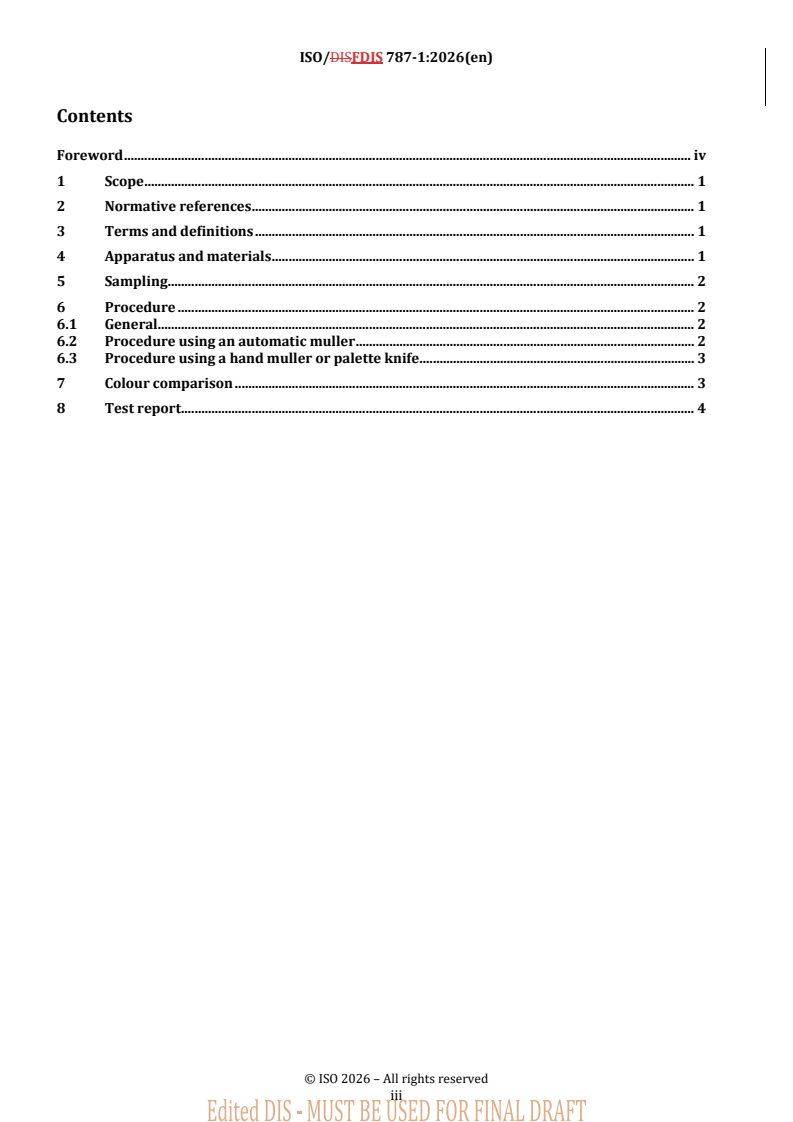
REDLINE ISO/FDIS 787-1 - General methods of test for pigments and extenders — Part 1: Comparison of colour of pigments
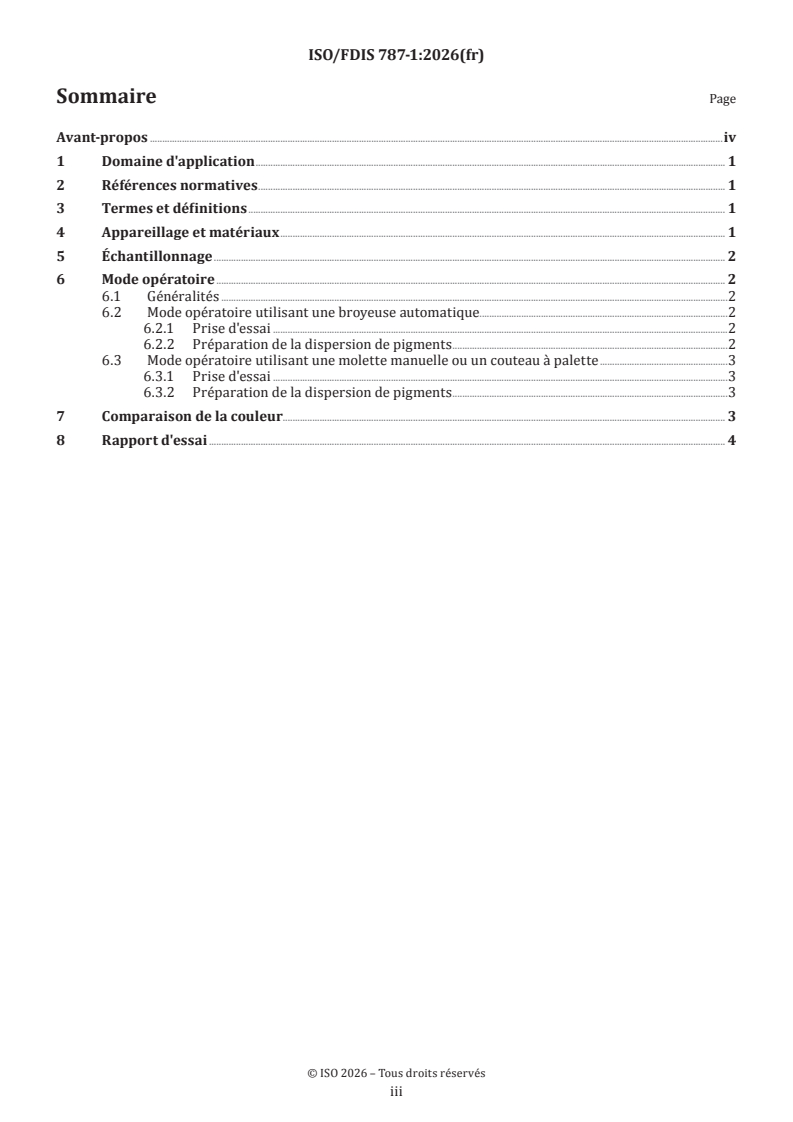
ISO/FDIS 787-1 - Méthodes générales d'essai des pigments et matières de charge — Partie 1: Comparaison de la couleur des pigments
ISO/FDIS 787-1 is an ISO document in the General methods of test for pigments and extenders series. It specifies a laboratory method for comparing the colour of a coloured pigment with that of an agreed sample, and the automatic muller route is the reference method. The standard is written for the parties who need to agree a binder and a comparison procedure for pigment colour matching.
What does ISO/FDIS 787-1 specify?
ISO/FDIS 787-1 specifies a general test method for comparing the colour of a coloured pigment with an agreed sample. In practice, it gives a common way to prepare pigment pastes and compare them visually, or by colorimeter by agreement, so different parties can check whether two pigments match closely enough for their purpose.
The document is organized into these main clauses:
- Clause 1 - Scope
- Clause 2 - Normative references
- Clause 3 - Terms and definitions
- Clause 4 - Apparatus and materials
- Clause 5 - Sampling
- Clause 6 - Procedure
- Clause 7 - Colour comparison
- Clause 8 - Test report
The binder is agreed between the interested parties. If no binder is agreed, acid-refined linseed oil complying with ISO 150 is used. That matters because binder choice affects how the pigment disperses and how the colour appears.
What are the key requirements of ISO/FDIS 787-1?
Sample preparation and materials
ISO/FDIS 787-1 requires a representative pigment sample, taken according to ISO 15528, and a set of basic laboratory tools: a palette knife, a suitable substrate, a burette, and either an automatic muller or a hand muller. The substrate must be chosen to suit the binder and the comparison method, and a glass panel, if used, must be clear and colourless.
The binder is part of the test agreement. If the parties do not choose one, the document directs users to acid-refined linseed oil meeting ISO 150, with the Gardner colour below the stated limit in that standard. In practice, this gives users a default medium when they have not negotiated one in advance.
Dispersion method
Clause 6 states that both described procedures are acceptable, but the automatic muller method is the reference method. That means results prepared with the automatic muller are the primary basis for comparison when reproducibility matters.
For the automatic muller procedure, the test portion is weighed to the nearest 1 mg, mixed with binder, and ground in stages. The same force and number of stages are used for the test pigment and the agreed sample. This matters because the colour result must reflect the pigment, not differences in preparation.
For the hand muller or palette knife procedure, the test portion is weighed to the nearest 1 mg and the paste is rubbed out in repeated passes until it is homogeneous. The same consistency is then prepared for the agreed sample. This gives a practical alternative when an automatic muller is not available.
Colour comparison and reporting
Clause 7 requires the two prepared pastes to be spread in the same direction on the substrate as opaque strips with touching edges. The comparison is made in diffuse daylight, or through the glass if the interested parties agree, and artificial daylight is preferred for repeatability. The visual assessment is guided by ISO 3668, including the hue, chroma and lightness scheme.
ISO/FDIS 787-1 also allows a colorimeter by agreement. When that route is used, ISO 18314-1 applies for the comparison procedure, ISO/CIE 11664-4 is used for colour-difference calculation in the Lab* space, and a total colour difference may be calculated using ISO/CIE 11664-6 or ISO 18314-5.
Clause 8 requires the report to identify the pigment, binder, procedure used, comparison details, result, deviations, anomalies and test date. If the colorimeter route is used, the report also records the colour differences in hue, chroma and lightness.
What terms does ISO/FDIS 787-1 define?
ISO/FDIS 787-1 uses the terms and definitions from ISO 18451-1, the general terminology standard for pigments, dyestuffs and extenders.
- Agreed sample - the reference pigment sample chosen by the interested parties for the colour comparison.
- Binder - the liquid medium mixed with the pigment to make a paste for milling and comparison.
- Automatic muller - the machine used as the reference method to grind the pigment paste under controlled force and revolutions.
- Hand muller - the manual device used as an alternative to the automatic muller for preparing the paste.
- Substrate - the surface on which the two pastes are spread for visual comparison.
- Colorimeter - an instrument that may be used by agreement to compare colour objectively instead of only by eye.
Who uses ISO/FDIS 787-1?
ISO/FDIS 787-1 is used by pigment and extender manufacturers, test laboratories, quality control teams, and buyers or suppliers who need an agreed way to compare colour. It is relevant wherever a coloured pigment has to be checked against a reference sample before release, acceptance, or dispute resolution.
It is also useful in paint and varnish-related work, because the comparison procedure and viewing conditions connect directly with established colour-comparison practice.
What changed in ISO/FDIS 787-1 from the previous edition?
ISO/FDIS 787-1 cancels and replaces ISO 787-1:1982, and the scope also states replacement of ISO/R 787/1:1968. The foreword lists these changes:
- Clause 3 on terms and definitions was added.
- Clause 7 adds the colorimeter method for colour measurement and colour comparison.
- The normative references were updated.
Which standards are used with ISO/FDIS 787-1?
ISO/FDIS 787-1 relies on several referenced standards to complete the method:
- ISO 150:2018 - gives the specification for linseed oil when no binder is agreed.
- ISO 3668 - gives the procedure for visual comparison of colour and the preferred rating approach.
- ISO 15528 - gives the sampling method for the pigment sample.
- ISO 18314-1 - gives the practical colorimetric comparison procedure.
- ISO 18314-5 - gives a procedure for colour differences in equidistant colour spaces.
- ISO 18451-1 - supplies the terms and definitions used in the document.
- ISO/CIE 11664-4 - gives the CIE 1976 Lab* colour space for calculating differences.
- ISO/CIE 11664-6 - gives the CIEDE2000 colour-difference formula.
What does the ISO/FDIS 787-1 document contain?
The document contains the full test workflow from sampling through reporting. Clause 4 describes the apparatus and materials, including the muller types, palette knife, substrate and burette. Clause 6 sets out the preparation of pigment dispersions, with separate procedures for the automatic muller and the hand muller or palette knife. Clause 7 describes how to compare the prepared strips visually or by colorimeter, and Clause 8 sets out what has to go in the test report.
It is a practical laboratory method rather than a theory document. The main task is to prepare comparable pastes in a controlled way so the colour match can be judged consistently.
Relations
- Effective Date
- 12-Feb-2026
- Effective Date
- 07-Jan-2025
Buy Documents
ISO/FDIS 787-1 - General methods of test for pigments and extenders — Part 1: Comparison of colour of pigments
REDLINE ISO/FDIS 787-1 - General methods of test for pigments and extenders — Part 1: Comparison of colour of pigments
ISO/FDIS 787-1 - Méthodes générales d'essai des pigments et matières de charge — Partie 1: Comparaison de la couleur des pigments
Frequently Asked Questions
ISO/FDIS 787-1 is a draft published by the International Organization for Standardization (ISO). Its full title is "General methods of test for pigments and extenders — Part 1: Comparison of colour of pigments". This standard covers: Procedure for comparing the colour of a coloured pigment with that of an agreed sample. The procedures described in this document are acceptable but the method using an automatic muller is the reference method. The binder is not specified. It shall be agreed between the interested parties. If no binder is agreed, linseed oil, complying with the specification in ISO 150, should be used. - Replaces ISO/R 787/1:1968.
Procedure for comparing the colour of a coloured pigment with that of an agreed sample. The procedures described in this document are acceptable but the method using an automatic muller is the reference method. The binder is not specified. It shall be agreed between the interested parties. If no binder is agreed, linseed oil, complying with the specification in ISO 150, should be used. - Replaces ISO/R 787/1:1968.
ISO/FDIS 787-1 is classified under the following ICS (International Classification for Standards) categories: 87.060.10 - Pigments and extenders. The ICS classification helps identify the subject area and facilitates finding related standards.
ISO/FDIS 787-1 has the following relationships with other standards: It is inter standard links to FprEN ISO 787-1, ISO 787-1:1982. Understanding these relationships helps ensure you are using the most current and applicable version of the standard.
ISO/FDIS 787-1 is available in PDF format for immediate download after purchase. The document can be added to your cart and obtained through the secure checkout process. Digital delivery ensures instant access to the complete standard document.
Standards Content (Sample)
FINAL DRAFT
International
Standard
ISO/TC 256
General methods of test for
Secretariat: DIN
pigments and extenders —
Voting begins on:
2026-08-28
Part 1:
Comparison of colour of pigments
Voting terminates on:
2026-10-23
Méthodes générales d'essai des pigments et matières de charge —
Partie 1: Comparaison de la couleur des pigments
RECIPIENTS OF THIS DRAFT ARE INVITED TO SUBMIT,
WITH THEIR COMMENTS, NOTIFICATION OF ANY
RELEVANT PATENT RIGHTS OF WHICH THEY ARE AWARE
AND TO PROVIDE SUPPOR TING DOCUMENTATION.
IN ADDITION TO THEIR EVALUATION AS
BEING ACCEPTABLE FOR INDUSTRIAL, TECHNO-
ISO/CEN PARALLEL PROCESSING LOGICAL, COMMERCIAL AND USER PURPOSES, DRAFT
INTERNATIONAL STANDARDS MAY ON OCCASION HAVE
TO BE CONSIDERED IN THE LIGHT OF THEIR POTENTIAL
TO BECOME STAN DARDS TO WHICH REFERENCE MAY BE
MADE IN NATIONAL REGULATIONS.
Reference number
FINAL DRAFT
International
Standard
ISO/TC 256
General methods of test for
Secretariat: DIN
pigments and extenders —
Voting begins on:
Part 1:
Comparison of colour of pigments
Voting terminates on:
Méthodes générales d'essai des pigments et matières de charge —
Partie 1: Comparaison de la couleur des pigments
RECIPIENTS OF THIS DRAFT ARE INVITED TO SUBMIT,
WITH THEIR COMMENTS, NOTIFICATION OF ANY
RELEVANT PATENT RIGHTS OF WHICH THEY ARE AWARE
AND TO PROVIDE SUPPOR TING DOCUMENTATION.
© ISO 2026
IN ADDITION TO THEIR EVALUATION AS
All rights reserved. Unless otherwise specified, or required in the context of its implementation, no part of this publication may
BEING ACCEPTABLE FOR INDUSTRIAL, TECHNO-
ISO/CEN PARALLEL PROCESSING
LOGICAL, COMMERCIAL AND USER PURPOSES, DRAFT
be reproduced or utilized otherwise in any form or by any means, electronic or mechanical, including photocopying, or posting on
INTERNATIONAL STANDARDS MAY ON OCCASION HAVE
the internet or an intranet, without prior written permission. Permission can be requested from either ISO at the address below
TO BE CONSIDERED IN THE LIGHT OF THEIR POTENTIAL
or ISO’s member body in the country of the requester.
TO BECOME STAN DARDS TO WHICH REFERENCE MAY BE
MADE IN NATIONAL REGULATIONS.
ISO copyright office
CP 401 • Ch. de Blandonnet 8
CH-1214 Vernier, Geneva
Phone: +41 22 749 01 11
Email: copyright@iso.org
Website: www.iso.org
Published in Switzerland Reference number
ii
Contents Page
Foreword .iv
1 Scope . 1
2 Normative references . 1
3 Terms and definitions . 1
4 Apparatus and materials . 1
5 Sampling . 2
6 Procedure . 2
6.1 General .2
6.2 Procedure using an automatic muller.2
6.2.1 Test portion .2
6.2.2 Preparation of pigment dispersion .2
6.3 Procedure using a hand muller or palette knife .3
6.3.1 Test portion .3
6.3.2 Preparation of pigment dispersion .3
7 Colour comparison . 3
8 Test report . 3
iii
Foreword
ISO (the International Organization for Standardization) is a worldwide federation of national standards
bodies (ISO member bodies). The work of preparing International Standards is normally carried out through
ISO technical committees. Each member body interested in a subject for which a technical committee
has been established has the right to be represented on that committee. International organizations,
governmental and non-governmental, in liaison with ISO, also take part in the work. ISO collaborates closely
with the International Electrotechnical Commission (IEC) on all matters of electrotechnical standardization.
The procedures used to develop this document and those intended for its further maintenance are described
in the ISO/IEC Directives, Part 1. In particular, the different approval criteria needed for the different types
of ISO document should be noted. This document was drafted in accordance with the editorial rules of the
ISO/IEC Directives, Part 2 (see www.iso.org/directives).
ISO draws attention to the possibility that the implementation of this document may involve the use of (a)
patent(s). ISO takes no position concerning the evidence, validity or applicability of any claimed patent
rights in respect thereof. As of the date of publication of this document, ISO had not received notice of (a)
patent(s) which may be required to implement this document. However, implementers are cautioned that
this may not represent the latest information, which may be obtained from the patent database available at
www.iso.org/patents. ISO shall not be held responsible for identifying any or all such patent rights.
Any trade name used in this document is information given for the convenience of users and does not
constitute an endorsement.
For an explanation of the voluntary nature of standards, the meaning of ISO specific terms and expressions
related to conformity assessment, as well as information about ISO's adherence to the World Trade
Organization (WTO) principles in the Technical Barriers to Trade (TBT), see www.iso.org/iso/foreword.html.
This document was prepared by Technical Committee ISO/TC 256, Pigments, dyestuffs and extenders, in
collaboration with the European Committee for Standardization (CEN) Technical Committee CEN/TC 298,
Pigments and extenders, in accordance with the Agreement on technical cooperation between ISO and CEN
(Vienna Agreement).
This second edition cancels and replaces the first edition (ISO 787-1:1982), which has been technically
revised.
The main changes are as follows:
— Clause 3 on terms and definitions has been added;
— in Clause 7, the colorimeter method has been added for colour measurement and colour comparison;
— the normative references have been updated.
A list of all parts in the ISO 787 series can be found on the ISO website.
Any feedback or questions on this document should be directed to the user’s national standards body. A
complete listing of these bodies can be found at www.iso.org/members.html.
iv
FINAL DRAFT Internationa
...
ISO/DISFDIS 787-1:2026(en)
ISO/TC 256
Secretariat: DIN
Date: 2026-06-0908-13
General methods of test for pigments and extenders —
Part 1:
Comparison of colour of pigments
Méthodes générales d'essai des pigments et matières de charge —
Partie 1: Comparaison de la couleur des pigments
FDIS stage
TTTTTThhhhhhiiiiiissssss d d d d d drrrrrraftaftaftaftaftaft i i i i i issssss s s s s s suuuuuubbbbbbmmmmmmiiiiiittttttttttttedededededed t t t t t toooooo a pa pa pa pa pa pararararararallel vallel vallel vallel vallel vallel vooooootttttte e e e e e iiiiiinnnnnn I I I I I ISSSSSSOOOOOO,,,,,, C C C C C CEEEEEENNNNNN.
All rights reserved. Unless otherwise specified, or required in the context of its implementation, no part of this publication
may be reproduced or utilized otherwise in any form or by any means, electronic or mechanical, including photocopying,
or posting on the internet or an intranet, without prior written permission. Permission can be requested from either ISO
at the address below or ISO’s member body in the country of the requester.
ISO copyright office
CP 401 • Ch. de Blandonnet 8
CH-1214 Vernier, Geneva
Phone: + 41 22 749 01 11
EmailE-mail: copyright@iso.org
Website: www.iso.org
Published in Switzerland
© ISO #### 2026 – All rights reserved
ii
ISO/DISFDIS 787-1:2026(en)
Contents
Foreword . iv
1 Scope . 1
2 Normative references . 1
3 Terms and definitions . 1
4 Apparatus and materials . 1
5 Sampling . 2
6 Procedure . 2
6.1 General. 2
6.2 Procedure using an automatic muller . 2
6.3 Procedure using a hand muller or palette knife . 3
7 Colour comparison . 3
8 Test report . 4
iii
Foreword
ISO (the International Organization for Standardization) is a worldwide federation of national standards
bodies (ISO member bodies). The work of preparing International Standards is normally carried out through
ISO technical committees. Each member body interested in a subject for which a technical committee has been
established has the right to be represented on that committee. International organizations, governmental and
non-governmental, in liaison with ISO, also take part in the work. ISO collaborates closely with the
International Electrotechnical Commission (IEC) on all matters of electrotechnical standardization.
The procedures used to develop this document and those intended for its further maintenance are described
in the ISO/IEC Directives, Part 1. In particular, the different approval criteria needed for the different types of
ISO document should be noted. This document was drafted in accordance with the editorial rules of the
ISO/IEC Directives, Part 2 (see www.iso.org/directives).
ISO draws attention to the possibility that the implementation of this document may involve the use of (a)
patent(s). ISO takes no position concerning the evidence, validity or applicability of any claimed patent rights
in respect thereof. As of the date of publication of this document, ISO had not received notice of (a) patent(s)
which may be required to implement this document. However, implementers are cautioned that this may not
represent the latest information, which may be obtained from the patent database available at
www.iso.org/patents. ISO shall not be held responsible for identifying any or all such patent rights.
Any trade name used in this document is information given for the convenience of users and does not
constitute an endorsement.
For an explanation of the voluntary nature of standards, the meaning of ISO specific terms and expressions
related to conformity assessment, as well as information about ISO's adherence to the World Trade
Organization (WTO) principles in the Technical Barriers to Trade (TBT), see www.iso.org/iso/foreword.html.
This document was prepared by Technical Committee ISO/TC 256, Pigments, dyestuffs and extenders, in
collaboration with the European Committee for Standardization (CEN) Technical Committee CEN/TC 298,
Pigments and extenders, in accordance with the Agreement on technical cooperation between ISO and CEN
(Vienna Agreement).
This second edition cancels and replaces the first edition (ISO 787-1:1982), which has been technically
revised.
The main changes are as follows:
— Clause 3— Clause 3 on terms and definitions has been added;
— — in Clause 7Clause 7,, the colorimeter method has been added for colour measurement and colour
comparison;
— — the normative references have been updated.
A list of all parts in the ISO 787 series can be found on the ISO website.
Any feedback or questions on this document should be directed to the user’s national standards body. A
complete listing of these bodies can be found at www.iso.org/members.html.
© ISO #### 2026 – All rights reserved
iv
DRAFT International Standard ISO/DIS 787-1:2026(en)
General methods of test for pigments and extenders —
Part 1:
Comparison of colour of pigments
1 Scope
This document specifies a general method of test for comparing the colour of a coloured pigment with that of
an agreed sample.
2 Normative references
The following documents are referred to in the text in such a way that some or all of their content constitutes
requirements of this document. For dated references, only the edition cited applies. For undated references,
the latest edition of the referenced document (including any amendments) applies.
ISO 150:2018, Raw, refined and boiled linseed oil for paints and varnishes — Specifications and methods of test
ISO 3668, Paints and varnishes — Visual comparison of colour of paints
ISO 15528, Paints, varnishes and raw materials for paints and varnishes — Sampling
ISO 18314--1, Analytical colorimetry — Part 1: Practical colour measurement
ISO 18314--5, Analytical colorimetry — Part 5: Procedure for colorimetric determination of colour differences
of object colours according to equidistant colour spaces
ISO 18451--1, Pigments, dyestuffs and extenders — Terminology — Part 1: General terms
ISO/CIE 11664--4, Colorimetry — Part 4: CIE 1976 L*a*b* colour space
ISO/CIE 11664--6, Colorimetry — Part 6: CIEDE2000 colour-difference formula
3 Terms and
...
PROJET FINAL
Norme
internationale
ISO/TC 256
Méthodes générales d'essai des
Secrétariat: DIN
pigments et matières de charge —
Début de vote:
2026-08-28
Partie 1:
Comparaison de la couleur des
Vote clos le:
2026-10-23
pigments
General methods of test for pigments and extenders —
Part 1: Comparison of colour of pigments
LES DESTINATAIRES DU PRÉSENT PROJET SONT
INVITÉS À PRÉSENTER, AVEC LEURS OBSERVATIONS,
NOTIFICATION DES DROITS DE PROPRIÉTÉ DONT ILS
AURAIENT ÉVENTUELLEMENT CONNAISSANCE ET À
FOURNIR UNE DOCUMENTATION EXPLICATIVE.
OUTRE LE FAIT D’ÊTRE EXAMINÉS POUR
ÉTABLIR S’ILS SONT ACCEPTABLES À DES FINS
INDUSTRIELLES, TECHNOLOGIQUES ET COM-MERCIALES,
AINSI QUE DU POINT DE VUE DES UTILISATEURS, LES
PROJETS DE NORMES
TRAITEMENT PARALLÈLE ISO/CEN
INTERNATIONALES DOIVENT PARFOIS ÊTRE CONSIDÉRÉS
DU POINT DE VUE DE LEUR POSSI BILITÉ DE DEVENIR DES
NORMES POUVANT
SERVIR DE RÉFÉRENCE DANS LA RÉGLEMENTATION
NATIONALE.
Numéro de référence
PROJET FINAL
Norme
internationale
ISO/TC 256
Méthodes générales d'essai des
Secrétariat: DIN
pigments et matières de charge —
Début de vote:
Partie 1: 2026-08-28
Comparaison de la couleur des
Vote clos le:
2026-10-23
pigments
General methods of test for pigments and extenders —
Part 1: Comparison of colour of pigments
LES DESTINATAIRES DU PRÉSENT PROJET SONT
INVITÉS À PRÉSENTER, AVEC LEURS OBSERVATIONS,
NOTIFICATION DES DROITS DE PROPRIÉTÉ DONT ILS
AURAIENT ÉVENTUELLEMENT CONNAISSANCE ET À
FOURNIR UNE DOCUMENTATION EXPLICATIVE.
DOCUMENT PROTÉGÉ PAR COPYRIGHT
OUTRE LE FAIT D’ÊTRE EXAMINÉS POUR
ÉTABLIR S’ILS SONT ACCEPTABLES À DES FINS
© ISO 2026 INDUSTRIELLES, TECHNOLOGIQUES ET COM-MERCIALES,
AINSI QUE DU POINT DE VUE DES UTILISATEURS, LES
Tous droits réservés. Sauf prescription différente ou nécessité dans le contexte de sa mise en œuvre, aucune partie de cette
PROJETS DE NORMES
TRAITEMENT PARALLÈLE ISO/CEN
INTERNATIONALES DOIVENT PARFOIS ÊTRE CONSIDÉRÉS
publication ne peut être reproduite ni utilisée sous quelque forme que ce soit et par aucun procédé, électronique ou mécanique,
DU POINT DE VUE DE LEUR POSSI BILITÉ DE DEVENIR DES
y compris la photocopie, ou la diffusion sur l’internet ou sur un intranet, sans autorisation écrite préalable. Une autorisation peut
NORMES POUVANT
être demandée à l’ISO à l’adresse ci-après ou au comité membre de l’ISO dans le pays du demandeur.
SERVIR DE RÉFÉRENCE DANS LA RÉGLEMENTATION
NATIONALE.
ISO copyright office
Case postale 401 • Ch. de Blandonnet 8
CH-1214 Vernier, Genève
Tél.: +41 22 749 01 11
E-mail: copyright@iso.org
Web: www.iso.org
Publié en Suisse Numéro de référence
ii
Sommaire Page
Avant-propos .iv
1 Domaine d'application . 1
2 Références normatives . 1
3 Termes et définitions . 1
4 Appareillage et matériaux . 1
5 Échantillonnage . 2
6 Mode opératoire . 2
6.1 Généralités .2
6.2 Mode opératoire utilisant une broyeuse automatique .2
6.2.1 Prise d'essai .2
6.2.2 Préparation de la dispersion de pigments .2
6.3 Mode opératoire utilisant une molette manuelle ou un couteau à palette .3
6.3.1 Prise d'essai .3
6.3.2 Préparation de la dispersion de pigments .3
7 Comparaison de la couleur. 3
8 Rapport d'essai . 4
iii
Avant-propos
L'ISO (Organisation internationale de normalisation) est une fédération mondiale d'organismes nationaux
de normalisation (comités membres de l'ISO). L'élaboration des Normes internationales est en général
confiée aux comités techniques de l'ISO. Chaque comité membre intéressé par une étude a le droit de faire
partie du comité technique créé à cet effet. Les organisations internationales, gouvernementales et non
gouvernementales, en liaison avec l'ISO participent également aux travaux. L'ISO collabore étroitement avec
la Commission électrotechnique internationale (IEC) en ce qui concerne la normalisation électrotechnique.
Les procédures utilisées pour élaborer le présent document et celles destinées à sa mise à jour sont
décrites dans les Directives ISO/IEC, Partie 1. Il convient, en particulier, de prendre note des différents
critères d'approbation requis pour les différents types de documents ISO. Le présent document
a été rédigé conformément aux règles de rédaction données dans les Directives ISO/IEC, Partie 2
(voir www.iso.org/directives).
L'ISO attire l'attention sur le fait que la mise en application du présent document peut entraîner l'utilisation
d'un ou de plusieurs brevets. L'ISO ne prend pas position quant à la preuve, à la validité et à l'applicabilité
de tout droit de propriété revendiqué à cet égard. À la date de publication du présent document, l'ISO
n’avait pas reçu notification qu'un ou plusieurs brevets pouvaient être nécessaires à sa mise en application.
Toutefois, il y a lieu d'avertir les responsables de la mise en application du présent document que des
informations plus récentes sont susceptibles de figurer dans la base de données de brevets, disponible à
l'adresse www.iso.org/brevets. L'ISO ne saurait être tenue pour responsable de ne pas avoir identifié de tels
droits de brevet.
Les appellations commerciales éventuellement mentionnées dans le présent document sont données pour
information, par souci de commodité, à l'intention des utilisateurs et ne sauraient constituer un engagement.
Pour une explication de la nature volontaire des normes, la signification des termes et expressions
spécifiques de l'ISO liés à l'évaluation de la conformité, ou pour toute information au sujet de l'adhésion de
l'ISO aux principes de l'Organisation mondiale du commerce (OMC) concernant les obstacles techniques au
commerce (OTC), voir le lien suivant: www.iso.org/avant-propos.
Le présent document a été élaboré par le comité technique ISO/TC 256, Pigments, colorants et matières de
charge, en collaboration avec le comité technique CEN/TC 298, Pigments et matières de charge du Comité
européen de normalisation (CEN), conformément à l'Accord de coopération technique entre l'ISO et le CEN
(Accord de Vienne).
Cette seconde édition annule et remplace la première édition (ISO 787-1:1982), qui a fait l’objet d’une révision
technique.
Les principales modifications sont les suivantes:
— l’Article 3, Termes et définitions, a été ajouté;
— à l'Article 7, la méthode du colorimètre a été ajoutée pour le mesurage et la comparaison des couleurs;
— les références normatives ont été mises à jour.
Une liste de toutes les parties de la série ISO 787 se trouve sur le site web de l’ISO.
Il convient que l’utilisateur adresse tout retour d’information ou toute question concernant le présent
document à l’organisme national de normalisation de son pays. Une liste exhaustive desdits organismes se
trouve à l’adresse www.iso.org/members.html.
iv
PROJET FINAL Norme internationale ISO/FDIS 787-1:2026(fr)
Méthodes générales d'essai des pigments et matières de
charge —
Partie 1:
Comparaison de la couleur des pigments
1 Domaine d'application
Le présent document spécifie une méthode générale d'essai permettant de comparer la couleur d'un pigment
de couleur avec celle d'un échantillon agréé.
2 Références normatives
Les documents suivants sont cités dans le texte de s
...