

ISO/IEC TR 22512:2017
(Main)Information technology — Telecommunications and information exchange between systems — Guidelines for the implementation of ISO/IEC 17982:2012
General Information
- Abstract
ISO/IEC TR 22512:2017 provides guidance for the implementation of ISO/IEC 17982.
- Status
- Published
- Publication Date
- 05-Dec-2017
- Drafting Committee
- ISO/IEC JTC 1/SC 6/WG 1 - Physical and data link layers
- Current Stage
- 6060 - International Standard published
- Start Date
- 06-Dec-2017
- Due Date
- 09-Feb-2020
- Completion Date
- 09-Feb-2020
Buy Documents
ISO/IEC TR 22512:2017 - Information technology — Telecommunications and information exchange between systems — Guidelines for the implementation of ISO/IEC 17982:2012 Released:12/6/2017
ISO/IEC TR 22512:2017 - Information technology — Telecommunications and information exchange between systems — Guidelines for the implementation of ISO/IEC 17982:2012/6/2017
Overview
ISO/IEC TR 22512:2017 is a technical report published by the International Organization for Standardization (ISO) and the International Electrotechnical Commission (IEC). This report offers detailed guidelines for the implementation of ISO/IEC 17982:2012, which defines the Close Capacitive Coupling Communication Physical Layer (CCCC PHY) used in telecommunications and information exchange between systems.
The document is essential for engineers, system integrators, and developers seeking to ensure highly compatible and interoperable CCCC PHY implementations. By following its guidance, organizations can achieve reliable, efficient physical layer communications for various applications in information technology and telecommunication systems.
Key Topics
TDS Number and Sequence Number
Explains how payload bytes are transmitted, the use of TDS (Time Division Scheme) numbers, and sequence numbering for data packets. Tables illustrate the binary and decimal notation to assist with correct packet sequencing.CRC (Cyclic Redundancy Check)
Details the CRC calculation method as per ITU-T V.41 standards to ensure error detection in data transmissions. The document includes specific bit settings and ordering examples to implement CRC accurately.Segmentation and Reassembly
Provides approaches for dividing larger data packets into segments for transmission and reassembling them at the receiver, improving data integrity and reliability.RFU (Reserved for Future Use) Handling
Discusses the distinction between standard and proprietary handling of RFU bits. It clarifies that RFU areas should not be used for proprietary features when maintaining compliance with the standard for interoperability.Collision Avoidance
Offers strategies to minimize data collisions during association procedures between devices, including recommended time delays for response transmissions.Identifying P-PDUs (Physical Protocol Data Units)
Describes the classification of P-PDUs into multiple types (e.g., Association Request/Response, Null P-PDU, Data P-PDU) and the use of entropy bits to distinguish them, supported by a state machine model.PHY User Role
Defines the responsibilities of the PHY User in managing Service Data Units (SDU) and controlling physical layer operations while maintaining backward compatibility.
Applications
ISO/IEC TR 22512:2017 serves as an indispensable resource in the following areas:
Telecommunications System Development
Assists in the design and deployment of communication systems using the CCCC PHY, ensuring standardized physical-layer interoperability.Hardware and Module Implementation
Guides manufacturers in producing compliant physical layer devices and modules that conform to ISO/IEC 17982 requirements, thus reducing market fragmentation.Customized Application Systems
Supports integrators in adapting standard-compliant devices for specific use cases without sacrificing system compatibility or performance.Error Control and Reliable Data Exchange
Enables implementation of robust error-checking mechanisms such as CRC to guarantee data integrity in close capacitive coupling communication scenarios.Collision Management in Networked Devices
Helps in structuring time-slot assignment and retransmission strategies to prevent data collisions, enhancing communication efficiency.
Related Standards
- ISO/IEC 17982:2012 – Defines the Close Capacitive Coupling Communication Physical Layer, the core standard that ISO/IEC TR 22512:2017 helps to implement.
- ITU-T V.41 – Specifies the code-independent error-control system, which is referenced for CRC calculation methods in this technical report.
- ISO/IEC JTC 1/SC 6 – The technical committee responsible for this document, focusing on telecommunications and information exchange standards.
By adhering to ISO/IEC TR 22512:2017, organizations working in information technology, telecommunications, and system interoperability can ensure compliant, reliable, and efficient implementation of the CCCC PHY. This enhances device compatibility, reduces integration risks, and fosters innovation in physical layer communication technologies.
Buy Documents
ISO/IEC TR 22512:2017 - Information technology — Telecommunications and information exchange between systems — Guidelines for the implementation of ISO/IEC 17982:2012 Released:12/6/2017
ISO/IEC TR 22512:2017 - Information technology — Telecommunications and information exchange between systems — Guidelines for the implementation of ISO/IEC 17982:2012/6/2017
Get Certified
Connect with accredited certification bodies for this standard

BSI Group
BSI (British Standards Institution) is the business standards company that helps organizations make excellence a habit.

NYCE
Mexican standards and certification body.
Sponsored listings
Frequently Asked Questions
ISO/IEC TR 22512:2017 is a technical report published by the International Organization for Standardization (ISO). Its full title is "Information technology — Telecommunications and information exchange between systems — Guidelines for the implementation of ISO/IEC 17982:2012". This standard covers: ISO/IEC TR 22512:2017 provides guidance for the implementation of ISO/IEC 17982.
ISO/IEC TR 22512:2017 provides guidance for the implementation of ISO/IEC 17982.
ISO/IEC TR 22512:2017 is classified under the following ICS (International Classification for Standards) categories: 35.100.10 - Physical layer. The ICS classification helps identify the subject area and facilitates finding related standards.
ISO/IEC TR 22512:2017 is available in PDF format for immediate download after purchase. The document can be added to your cart and obtained through the secure checkout process. Digital delivery ensures instant access to the complete standard document.
Standards Content (Sample)
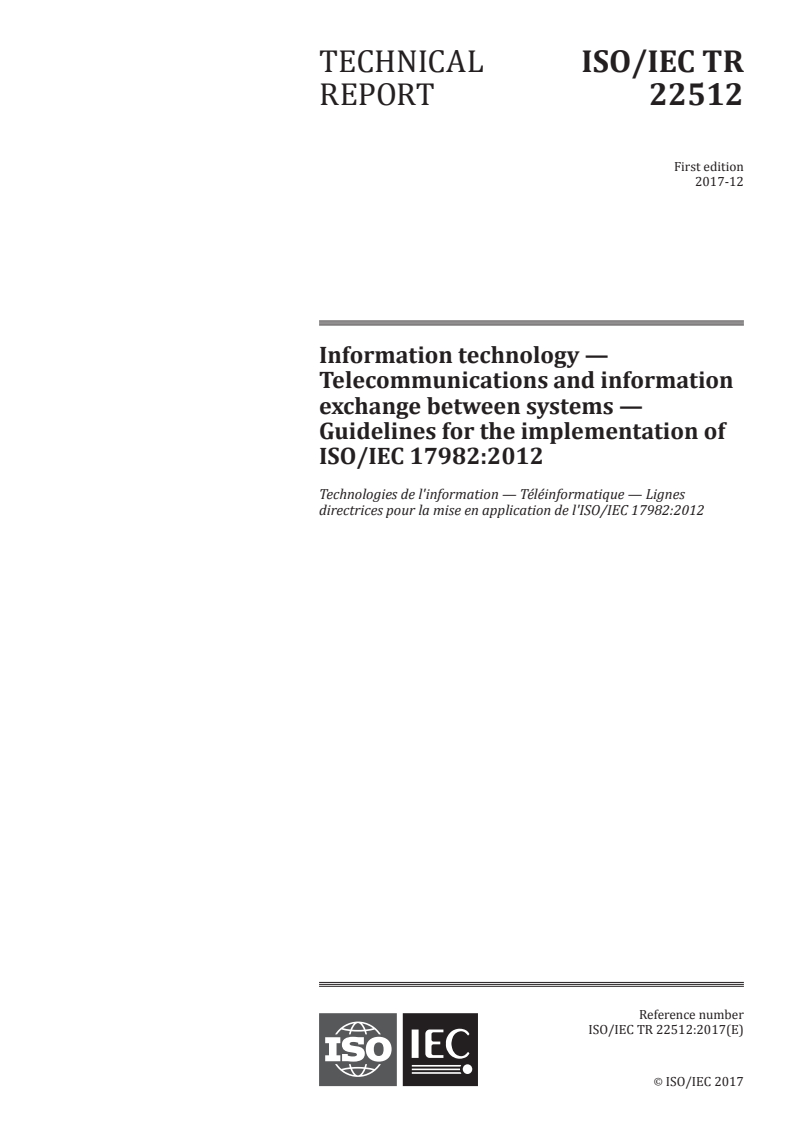
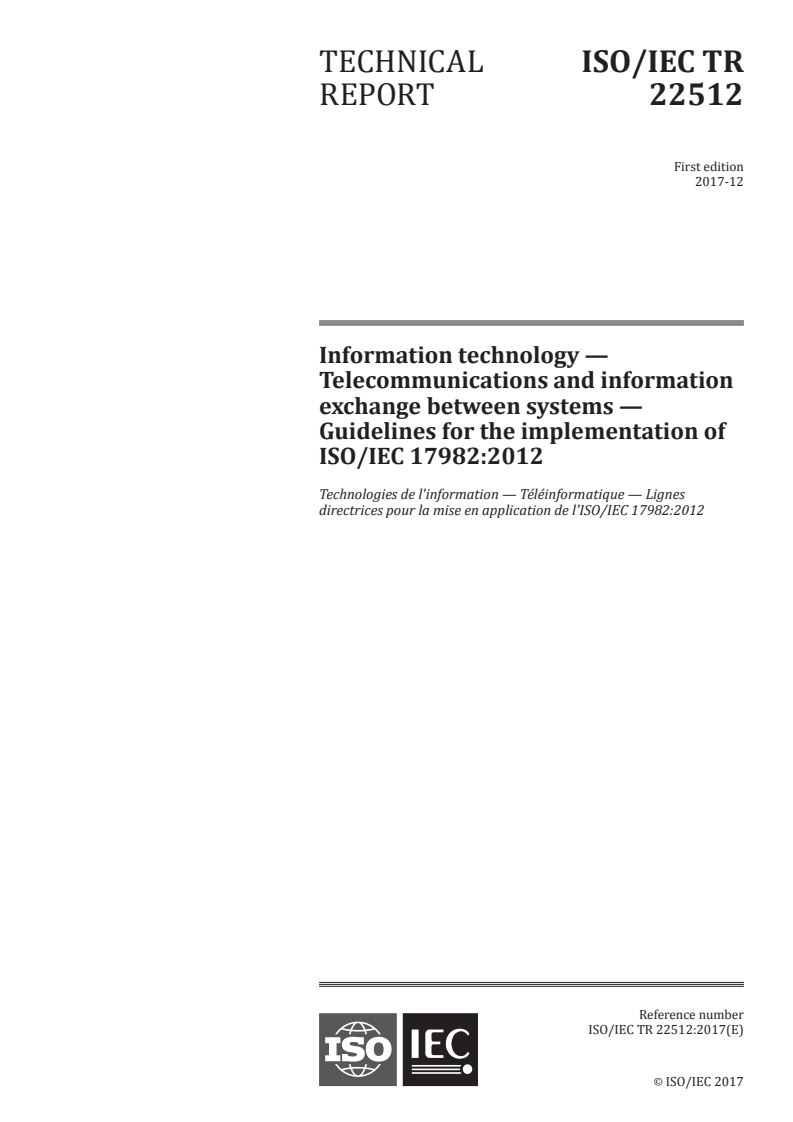
TECHNICAL ISO/IEC TR
REPORT 22512
First edition
2017-12
Information technology —
Telecommunications and information
exchange between systems —
Guidelines for the implementation of
ISO/IEC 17982:2012
Technologies de l'information — Téléinformatique — Lignes
directrices pour la mise en application de l'ISO/IEC 17982:2012
Reference number
©
ISO/IEC 2017
© ISO/IEC 2017, Published in Switzerland
All rights reserved. Unless otherwise specified, no part of this publication may be reproduced or utilized otherwise in any form
or by any means, electronic or mechanical, including photocopying, or posting on the internet or an intranet, without prior
written permission. Permission can be requested from either ISO at the address below or ISO’s member body in the country of
the requester.
ISO copyright office
Ch. de Blandonnet 8 • CP 401
CH-1214 Vernier, Geneva, Switzerland
Tel. +41 22 749 01 11
Fax +41 22 749 09 47
copyright@iso.org
www.iso.org
ii © ISO/IEC 2017 – All rights reserved
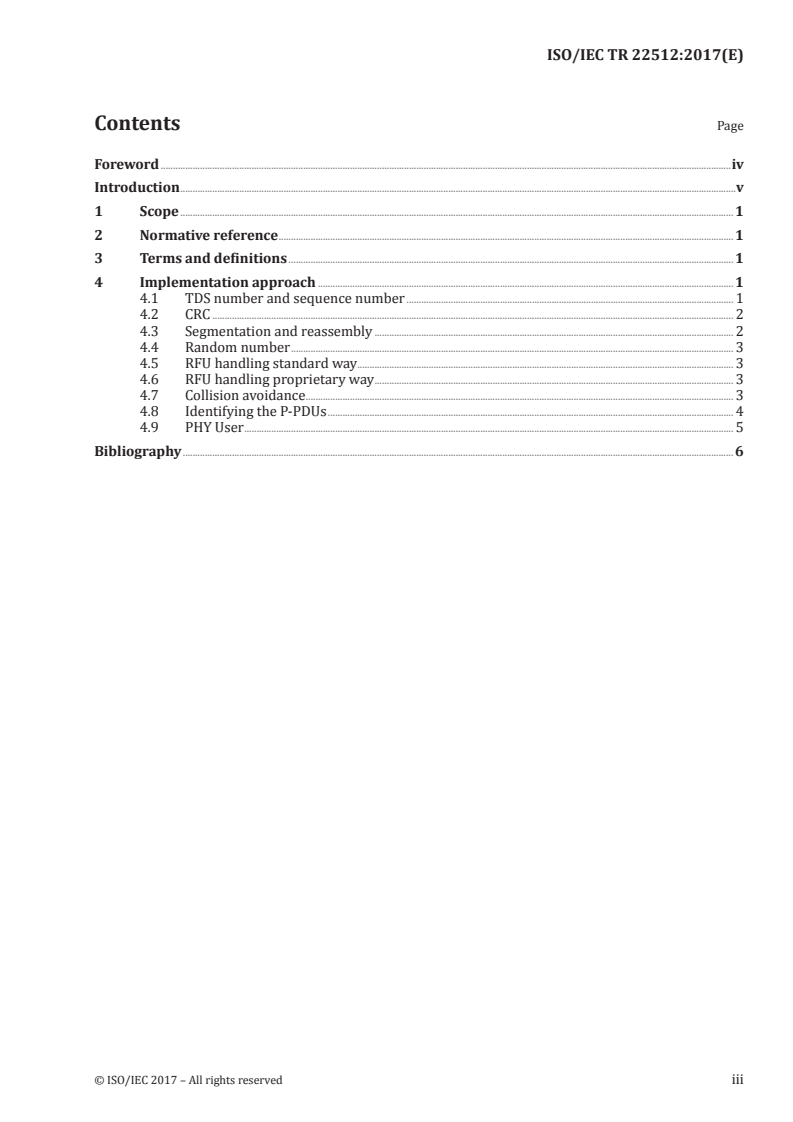
Contents Page
Foreword .iv
Introduction .v
1 Scope . 1
2 Normative reference . 1
3 Terms and definitions . 1
4 Implementation approach . 1
4.1 TDS number and sequence number . 1
4.2 CRC . 2
4.3 Segmentation and reassembly . 2
4.4 Random number . 3
4.5 RFU handling standard way . 3
4.6 RFU handling proprietary way . 3
4.7 Collision avoidance . 3
4.8 Identifying the P-PDUs . 4
4.9 PHY User . 5
Bibliography . 6
© ISO/IEC 2017 – All rights reserved iii
Foreword
ISO (the International Organization for Standardization) and IEC (the International Electrotechnical
Commission) form the specialized system for worldwide standardization. National bodies that are
members of ISO or IEC participate in the development of International Standards through technical
committees established by the respective organization to deal with particular fields of technical
activity. ISO and IEC technical committees collaborate in fields of mutual interest. Other international
organizations, governmental and non-governmental, in liaison with ISO and IEC, also take part in the
work. In the field of information technology, ISO and IEC have established a joint technical committee,
ISO/IEC JTC 1.
The procedures used to develop this document and those intended for its further maintenance are
described in the ISO/IEC Directives, Part 1. In particular the different approval criteria needed for
the different types of document should be noted. This document was drafted in accordance with the
editorial rules of the ISO/IEC Directives, Part 2 (see www.iso.org/directives).
Attention is drawn to the possibility that some of the elements of this document may be the subject
of patent rights. ISO and IEC shall not be held responsible for identifying any or all such patent
rights. Details of any patent rights identified during the development of the document will be in the
Introduction and/or on the ISO list of patent declarations received (see www.iso.org/patents).
Any trade name used in this document is information given for the convenience of users and does not
constitute an endorsement.
For an explanation on the voluntary nature of standards, the meaning of ISO specific terms and
expressions related to conformity assessment, as well as information about ISO's adherence to the
World Trade Organization (WTO) principles in the Technical Barriers to Trade (TBT) see the following
URL: www.iso.org/iso/foreword.html.
This document was prepared by Technical Committee ISO/IEC JTC 1, Information technology,
Subcommittee SC 6, Telecommunications and information exchange between systems.
iv © ISO/IEC 2017 – All rights reserved
Introduction
ISO/IEC 17982 specifies minimum requirements for interoperable CCCC PHY technology. This
document provides guidance for the implementation of ISO/IEC 17982 in order to realize highly
compatible CCCC PHY.
© ISO/IEC 2017 – All rights reserved v
TECHNICAL REPORT ISO/IEC TR 22512:2017(E)
Information technology — Telecommunications and
information exchange between systems — Guidelines for
the implementation of ISO/IEC 17982:2012
1 Scope
This document provides guidance for the implementation of ISO/IEC 17982.
2 Normative reference
The following documents are referred to in the text in such a way that some or all of their content
constitutes requirements of this document. For dated references, only the edition cited applies. For
undated references, the latest edition of the referenced document (including any amendments) applies
...
TECHNICAL ISO/IEC TR
REPORT 22512
First edition
2017-12
Information technology —
Telecommunications and information
exchange between systems —
Guidelines for the implementation of
ISO/IEC 17982:2012
Technologies de l'information — Téléinformatique — Lignes
directrices pour la mise en application de l'ISO/IEC 17982:2012
Reference number
©
ISO/IEC 2017
© ISO/IEC 2017, Published in Switzerland
All rights reserved. Unless otherwise specified, no part of this publication may be reproduced or utilized otherwise in any form
or by any means, electronic or mechanical, including photocopying, or posting on the internet or an intranet, without prior
written permission. Permission can be requested from either ISO at the address below or ISO’s member body in the country of
the requester.
ISO copyright office
Ch. de Blandonnet 8 • CP 401
CH-1214 Vernier, Geneva, Switzerland
Tel. +41 22 749 01 11
Fax +41 22 749 09 47
copyright@iso.org
www.iso.org
ii © ISO/IEC 2017 – All rights reserved
Contents Page
Foreword .iv
Introduction .v
1 Scope . 1
2 Normative reference . 1
3 Terms and definitions . 1
4 Implementation approach . 1
4.1 TDS number and sequence number . 1
4.2 CRC . 2
4.3 Segmentation and reassembly . 2
4.4 Random number . 3
4.5 RFU handling standard way . 3
4.6 RFU handling proprietary way . 3
4.7 Collision avoidance . 3
4.8 Identifying the P-PDUs . 4
4.9 PHY User . 5
Bibliography . 6
© ISO/IEC 2017 – All rights reserved iii
Foreword
ISO (the International Organization for Standardization) and IEC (the International Electrotechnical
Commission) form the specialized system for worldwide standardization. National bodies that are
members of ISO or IEC participate in the development of International Standards through technical
committees established by the respective organization to deal with particular fields of technical
activity. ISO and IEC technical committees collaborate in fields of mutual interest. Other international
organizations, governmental and non-governmental, in liaison with ISO and IEC, also take part in the
work. In the field of information technology, ISO and IEC have established a joint technical committee,
ISO/IEC JTC 1.
The procedures used to develop this document and those intended for its further maintenance are
described in the ISO/IEC Directives, Part 1. In particular the different approval criteria needed for
the different types of document should be noted. This document was drafted in accordance with the
editorial rules of the ISO/IEC Directives, Part 2 (see www.iso.org/directives).
Attention is drawn to the possibility that some of the elements of this document may be the subject
of patent rights. ISO and IEC shall not be held responsible for identifying any or all such patent
rights. Details of any patent rights identified during the development of the document will be in the
Introduction and/or on the ISO list of patent declarations received (see www.iso.org/patents).
Any trade name used in this document is information given for the convenience of users and does not
constitute an endorsement.
For an explanation on the voluntary nature of standards, the meaning of ISO specific terms and
expressions related to conformity assessment, as well as information about ISO's adherence to the
World Trade Organization (WTO) principles in the Technical Barriers to Trade (TBT) see the following
URL: www.iso.org/iso/foreword.html.
This document was prepared by Technical Committee ISO/IEC JTC 1, Information technology,
Subcommittee SC 6, Telecommunications and information exchange between systems.
iv © ISO/IEC 2017 – All rights reserved
Introduction
ISO/IEC 17982 specifies minimum requirements for interoperable CCCC PHY technology. This
document provides guidance for the implementation of ISO/IEC 17982 in order to realize highly
compatible CCCC PHY.
© ISO/IEC 2017 – All rights reserved v
TECHNICAL REPORT ISO/IEC TR 22512:2017(E)
Information technology — Telecommunications and
information exchange between systems — Guidelines for
the implementation of ISO/IEC 17982:2012
1 Scope
This document provides guidance for the implementation of ISO/IEC 17982.
2 Normative reference
The following documents are referred to in the text in such a way that some or all of their content
constitutes requirements of this document. For dated references, only the edition cited applies. For
undated references, the latest edition of the referenced document (including any amendments) applies
...