

ISO 16927:2014
(Main)Paints and varnishes — Determination of the overcoatability and recoatability of a coating
General Information
- Abstract
ISO 16927:2014 specifies a method for testing the overcoatability and recoatability of unaged single-coat or multi-coat systems using a coating material which is intended for repairing damaged areas during or after installation. Since the testing of overcoatability and recoatability can be conducted under different conditions, this International Standard only specifies one procedure and indicates the basic parameters. The existing single-coat or multi-coat system is indicated as coating A and the new single-coat or multi-coat system as coating B. The same applies analogously for the respective coating material.
- Status
- Published
- Publication Date
- 20-Jan-2014
- Technical Committee
- ISO/TC 35/SC 9 - General test methods for paints and varnishes
- Drafting Committee
- ISO/TC 35/SC 9/WG 31 - Properties after application
- Current Stage
- 9093 - International Standard confirmed
- Start Date
- 24-Jun-2026
- Completion Date
- 29-Aug-2026
Buy Documents

ISO 16927:2014 - Paints and varnishes — Determination of the overcoatability and recoatability of a coating Released:1/21/2014
ISO 16927:2014 - Peintures et vernis — Évaluation des possibilités d'application d'une couche supplémentaire du meme produit ou d'un autre produit de peinture Released:1/21/2014
ISO 16927:2014 - Paints and varnishes — Determination of the overcoatability and recoatability of a coating Released:6/30/2016
Overview
ISO 16927:2014 establishes a standardized method for determining the overcoatability and recoatability of paints and varnishes applied as single-coat or multi-coat systems. This international standard specifies a testing procedure for evaluating the ability of an existing coating (referred to as coating A) to accept an additional layer of the same or a different coating material (referred to as coating B). The scope primarily addresses unaged, non-used coatings aimed at repairing damaged sections during or after installation. By defining fundamental parameters and a unified testing protocol, ISO 16927:2014 facilitates consistent quality assessment and communication between manufacturers, contractors, and clients.
Key Topics
Purpose and Scope
ISO 16927:2014 focuses on testing the feasibility of applying an additional paint or varnish layer on pre-existing coatings without aging effects, ensuring compatibility and optimal repair results.Overcoatability vs. Recoatability
- Overcoatability relates to applying a subsequent coating layer of a different product, such as finishing a multi-layer system.
- Recoatability refers to applying an additional layer of the same coating product, commonly used in refurbishment or spot repairs.
Sample Preparation and Testing Methodology
- Representative samples are selected and prepared following ISO 15528 and ISO 1513.
- Coating A is applied on the appropriate substrate, cleaned, and optionally sanded with specified grit paper.
- Coating B is applied immediately after cleaning, followed by a drying or curing process as agreed upon.
Evaluation Procedures
- Visual inspection during and after application for defects such as blistering, wrinkling, wrinkling, color changes, or poor wetting.
- Standard mechanical and optical tests, including:
- Cross-cut adhesion test (ISO 2409)
- Buchholz indentation test (ISO 2815)
- Impact resistance via embossing test (ISO 1520)
- Measurement of gloss levels (ISO 2813)
- Color comparison (ISO 3668)
- Thickness measurements of coatings A and B using ISO 2808 methods.
Test Reporting
Reports must document product identification, substrate preparation, application methods, drying conditions, observed defects with timestamps, thickness data, and any deviations from the standard procedure.
Applications
ISO 16927:2014 is critical for industries requiring reliable and consistent quality assurance of coatings:
Construction and Building Maintenance
Assessing the possibility to repair or extend protective paint layers on structures during installation or renovation.Automotive and Transportation
Verifying compatibility and adhesion of touch-up paints or new coatings applied over finished surfaces.Industrial Equipment and Machinery
Ensuring layered coating systems maintain integrity when additional layers are applied in the manufacturing or maintenance stages.Marine and Offshore Structures
Evaluating the effectiveness of repair coatings on corrosion-protection systems before and after installation.
By delivering a standardized testing approach, ISO 16927:2014 supports improved durability, aesthetic quality, and performance of paint coatings in practical operational settings.
Related Standards
ISO 16927:2014 references and complements several other international standards in paint and varnish testing:
- ISO 1513 – Sampling and preparation of paint test specimens
- ISO 1514 – Standard panels for testing paints and varnishes
- ISO 1520 – Impact resistance (embossing) test
- ISO 2409 – Cross-cut adhesion test
- ISO 2808 – Measurement of paint film thickness
- ISO 2813 – Gloss measurement of non-metallic paint films
- ISO 2815 – Buchholz indentation test for hardness
- ISO 3668 – Visual comparison of paint color
- ISO 9117-5 – Drying tests for paints and varnishes
- ISO 15528 – Paint and varnish sampling
Implementing ISO 16927:2014 alongside these standards enables comprehensive quality control for paints and varnishes, enhancing product reliability and lifecycle performance.
Keywords: ISO 16927:2014, overcoatability, recoatability, paint testing, varnish, coating repair, layer compatibility, paint thickness measurement, adhesion testing, paint system evaluation, industrial coatings standards, protective coatings, surface preparation.
Relations
- Effective Date
- 12-Feb-2026
Buy Documents
ISO 16927:2014 - Paints and varnishes — Determination of the overcoatability and recoatability of a coating Released:1/21/2014
ISO 16927:2014 - Peintures et vernis — Évaluation des possibilités d'application d'une couche supplémentaire du meme produit ou d'un autre produit de peinture Released:1/21/2014
ISO 16927:2014 - Paints and varnishes — Determination of the overcoatability and recoatability of a coating Released:6/30/2016
Frequently Asked Questions
ISO 16927:2014 is a standard published by the International Organization for Standardization (ISO). Its full title is "Paints and varnishes — Determination of the overcoatability and recoatability of a coating". This standard covers: ISO 16927:2014 specifies a method for testing the overcoatability and recoatability of unaged single-coat or multi-coat systems using a coating material which is intended for repairing damaged areas during or after installation. Since the testing of overcoatability and recoatability can be conducted under different conditions, this International Standard only specifies one procedure and indicates the basic parameters. The existing single-coat or multi-coat system is indicated as coating A and the new single-coat or multi-coat system as coating B. The same applies analogously for the respective coating material.
ISO 16927:2014 specifies a method for testing the overcoatability and recoatability of unaged single-coat or multi-coat systems using a coating material which is intended for repairing damaged areas during or after installation. Since the testing of overcoatability and recoatability can be conducted under different conditions, this International Standard only specifies one procedure and indicates the basic parameters. The existing single-coat or multi-coat system is indicated as coating A and the new single-coat or multi-coat system as coating B. The same applies analogously for the respective coating material.
ISO 16927:2014 is classified under the following ICS (International Classification for Standards) categories: 87.040 - Paints and varnishes. The ICS classification helps identify the subject area and facilitates finding related standards.
ISO 16927:2014 has the following relationships with other standards: It is inter standard links to EN ISO 16927:2014. Understanding these relationships helps ensure you are using the most current and applicable version of the standard.
ISO 16927:2014 is available in PDF format for immediate download after purchase. The document can be added to your cart and obtained through the secure checkout process. Digital delivery ensures instant access to the complete standard document.
Standards Content (Sample)
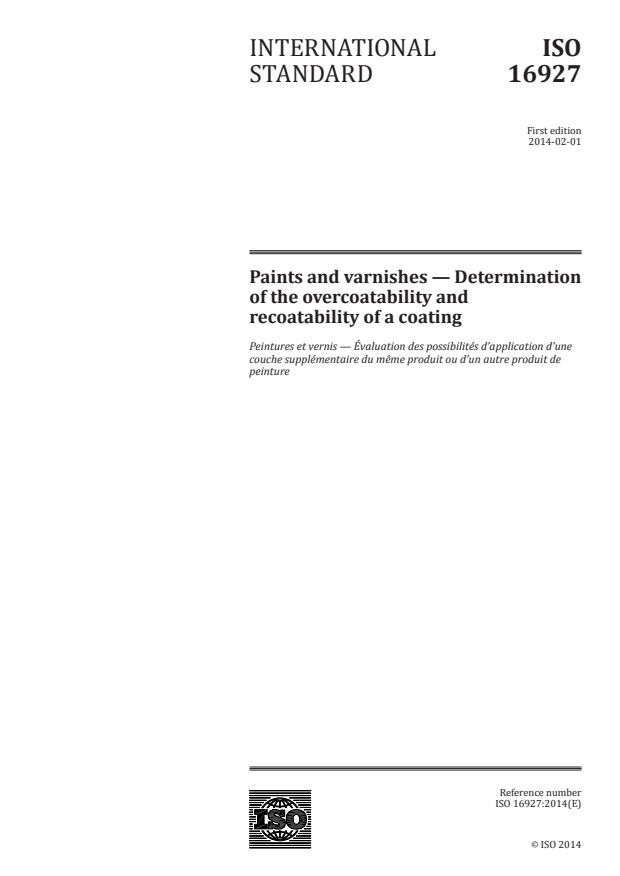
INTERNATIONAL ISO
STANDARD 16927
First edition
2014-02-01
Paints and varnishes — Determination
of the overcoatability and
recoatability of a coating
Peintures et vernis — Évaluation des possibilités d’application d’une
couche supplémentaire du même produit ou d’un autre produit de
peinture
Reference number
©
ISO 2014
© ISO 2014
All rights reserved. Unless otherwise specified, no part of this publication may be reproduced or utilized otherwise in any form
or by any means, electronic or mechanical, including photocopying, or posting on the internet or an intranet, without prior
written permission. Permission can be requested from either ISO at the address below or ISO’s member body in the country of
the requester.
ISO copyright office
Case postale 56 • CH-1211 Geneva 20
Tel. + 41 22 749 01 11
Fax + 41 22 749 09 47
E-mail copyright@iso.org
Web www.iso.org
Published in Switzerland
ii © ISO 2014 – All rights reserved
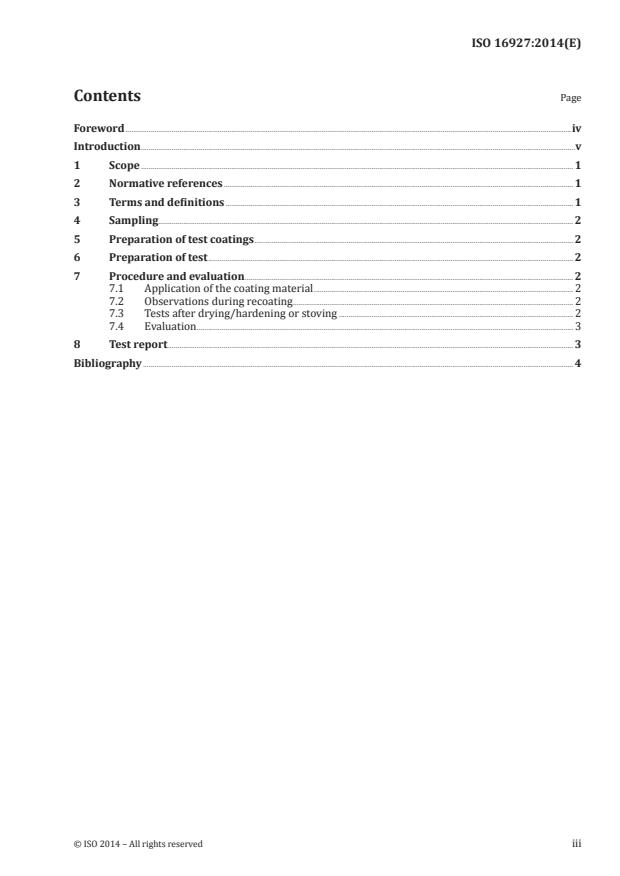
Contents Page
Foreword .iv
Introduction .v
1 Scope . 1
2 Normative references . 1
3 Terms and definitions . 1
4 Sampling . 2
5 Preparation of test coatings . 2
6 Preparation of test . 2
7 Procedure and evaluation . 2
7.1 Application of the coating material . 2
7.2 Observations during recoating . . 2
7.3 Tests after drying/hardening or stoving . 2
7.4 Evaluation . 3
8 Test report . 3
Bibliography . 4
Foreword
ISO (the International Organization for Standardization) is a worldwide federation of national standards
bodies (ISO member bodies). The work of preparing International Standards is normally carried out
through ISO technical committees. Each member body interested in a subject for which a technical
committee has been established has the right to be represented on that committee. International
organizations, governmental and non-governmental, in liaison with ISO, also take part in the work.
ISO collaborates closely with the International Electrotechnical Commission (IEC) on all matters of
electrotechnical standardization.
The procedures used to develop this document and those intended for its further maintenance are
described in the ISO/IEC Directives, Part 1. In particular the different approval criteria needed for the
different types of ISO documents should be noted. This document was drafted in accordance with the
editorial rules of the ISO/IEC Directives, Part 2 (see www.iso.org/directives).
Attention is drawn to the possibility that some of the elements of this document may be the subject of
patent rights. ISO shall not be held responsible for identifying any or all such patent rights. Details of any
patent rights identified during the development of the document will be in the Introduction and/or on
the ISO list of patent declarations received (see www.iso.org/patents).
Any trade name used in this document is information given for the convenience of users and does not
constitute an endorsement.
For an explanation on the meaning of ISO specific terms and expressions related to conformity
assessment, as well as information about ISO’s adherence to the WTO principles in the Technical Barriers
to Trade (TBT) see the following URL: Foreword - Supplementary information
The committee responsible for this document is ISO/TC 35, Paints and varnishes, Subcommittee SC 9,
General test methods for paints and varnishes.
iv © ISO 2014 – All rights reserved
Introduction
The terms “overcoatability” and “recoatability” are used differently. Hence, there are numerous different
test methods. Aiming for a standardization and facilitation of communication between contractor
and customer, in this International Standard a test method has been prepared which determines the
procedure for testing the overcoatability and/or recoatability of a coating.
“Overcoatability” is applicable to the multi-coat system in manufacture, e.g. applying a top coat to the
priming coat.
“Recoatability” is applicable to repairing or recoating of already completed constructions, e.g. during or
immediately after installation.
It was impossible to specify a suitable test method for all indicated cases and to combine them in a
International Standard.
The limitation to “unaged” coatings should be understood as coatings not yet exposed to corrosion stress
or similar stress which might influence the recoatability performance. In the case of arising difficulties
concerning the interpretation of the term, e.g. in regard to priming coats as protection for intermediate
storage or transport when it takes some time before another coating material is applied, the contr
...
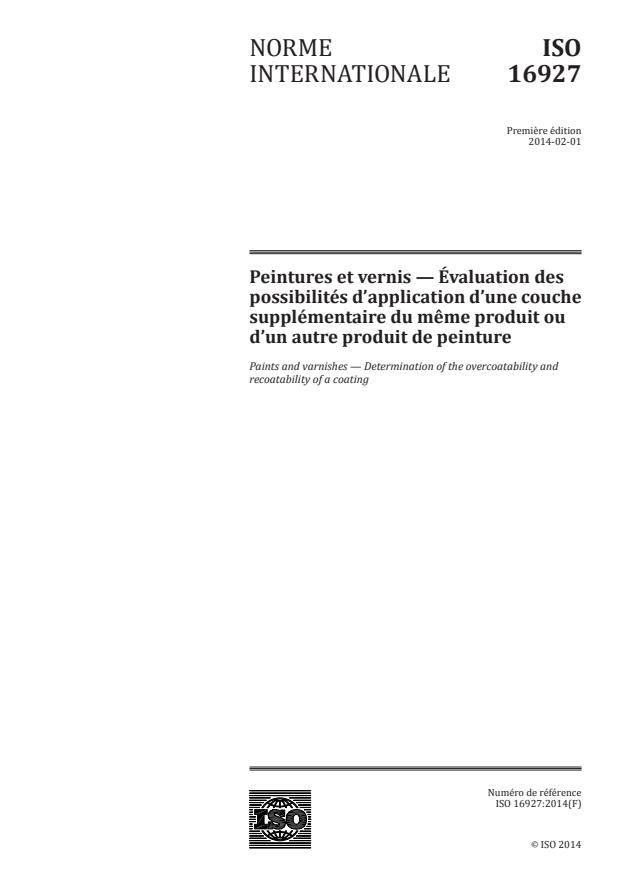
NORME ISO
INTERNATIONALE 16927
Première édition
2014-02-01
Peintures et vernis — Évaluation des
possibilités d’application d’une couche
supplémentaire du même produit ou
d’un autre produit de peinture
Paints and varnishes — Determination of the overcoatability and
recoatability of a coating
Numéro de référence
©
ISO 2014
DOCUMENT PROTÉGÉ PAR COPYRIGHT
© ISO 2014
Droits de reproduction réservés. Sauf indication contraire, aucune partie de cette publication ne peut être reproduite ni utilisée
sous quelque forme que ce soit et par aucun procédé, électronique ou mécanique, y compris la photocopie, l’affichage sur
l’internet ou sur un Intranet, sans autorisation écrite préalable. Les demandes d’autorisation peuvent être adressées à l’ISO à
l’adresse ci-après ou au comité membre de l’ISO dans le pays du demandeur.
ISO copyright office
Case postale 56 • CH-1211 Geneva 20
Tel. + 41 22 749 01 11
Fax + 41 22 749 09 47
E-mail copyright@iso.org
Web www.iso.org
Publié en Suisse
ii © ISO 2014 – Tous droits réservés
Sommaire Page
Avant-propos .iv
Introduction .v
1 Domaine d’application . 1
2 Références normatives . 1
3 Termes et définitions . 1
4 Échantillonnage . 2
5 Préparation du revêtement à soumettre à essai . 2
6 Préparation de l’essai . 2
7 Mode opératoire et évaluation . 2
7.1 Application du produit de peinture . 2
7.2 Observations effectuées pendant l’application de la couche supplémentaire du même
produit de peinture . 2
7.3 Essais après séchage/durcissement ou étuvage . 3
7.4 Évaluation . 3
8 Rapport d’essai . 3
Bibliographie . 5
Avant-propos
L’ISO (Organisation internationale de normalisation) est une fédération mondiale d’organismes
nationaux de normalisation (comités membres de l’ISO). L’élaboration des Normes internationales est
en général confiée aux comités techniques de l’ISO. Chaque comité membre intéressé par une étude
a le droit de faire partie du comité technique créé à cet effet. Les organisations internationales,
gouvernementales et non gouvernementales, en liaison avec l’ISO participent également aux travaux.
L’ISO collabore étroitement avec la Commission électrotechnique internationale (CEI) en ce qui concerne
la normalisation électrotechnique.
Les procédures utilisées pour élaborer le présent document et celles destinées à sa mise à jour sont
décrites dans les Directives ISO/CEI, Partie 1. Il convient, en particulier de prendre note des différents
critères d’approbation requis pour les différents types de documents ISO. Le présent document a été
rédigé conformément aux règles de rédaction données dans les Directives ISO/CEI, Partie 2 (voir www.
iso.org/directives).
L’attention est appelée sur le fait que certains des éléments du présent document peuvent faire l’objet de
droits de propriété intellectuelle ou de droits analogues. L’ISO ne saurait être tenue pour responsable
de ne pas avoir identifié de tels droits de propriété et averti de leur existence. Les détails concernant les
références aux droits de propriété intellectuelle ou autres droits analogues identifiés lors de l’élaboration
du document sont indiqués dans l’Introduction et/ou sur la liste ISO des déclarations de brevets reçues
(voir www.iso.org/brevets).
Les éventuelles appellations commerciales utilisées dans le présent document sont données pour
information à l’intention des utilisateurs et ne constituent pas une approbation ou une recommandation.
Pour une explication de la signification des termes et expressions spécifiques de l’ISO liés à l’évaluation
de la conformité, aussi bien que pour des informations au sujet de l’adhésion de l’ISO aux principes de
l’OMC concernant les obstacles techniques au commerce (OTC) voir le lien suivant: Avant-propos —
Informations supplémentaires.
Le comité chargé de l’élaboration du présent document est l’ISO/TC 35, Peintures et vernis, sous-comité
SC 9, Méthodes générales d’essais des peintures et vernis.
iv © ISO 2014 – Tous droits réservés
Introduction
Les expressions «possibilité d’application d’une couche supplémentaire d’un autre produit de peinture»
et «possibilité d’application d’une couche supplémentaire du même produit de peinture» sont utilisées
dans des acceptions différentes. Il existe donc différentes méthodes d’essai. Dans une optique de
normalisation et dans le but de faciliter la communication entre contractant et client, la présente Norme
internationale décrit une méthode d’essai permettant de déterminer la possibilité d’application d’une
couche supplémentaire du même produit ou d’un autre produit de peinture.
La possibilité d’application d’une couche supplémentaire d’un autre produit de peinture s’applique aux
systèmes multicouches, par exemple en cas d’application d’une couche de finition sur la couche primaire.
La possibilité d’application d’une couche supplémentaire du même produit de peinture s’applique à la
réparation ou au ravalement de constructions terminées, par exemple pendant ou immédiatement après
l’installation.
Il était impossible de spécifier une méthode d’essai convenant à tous les cas et de les combiner en une
Norme internationale.
Seuls sont concernés les revêtements «non usagés», c’est-à-dire n’ayant pas été exposés à la corrosion
ou à d’autres contraintes similaires susceptibles d’influer sur la possibilité d’application d’une couche
supplémentaire du même produit. En cas de difficultés d’interprétation, par exemple concernant les
couches primaires de protection pour le stockage intermédiaire ou le transport, lorsqu’il s’écoule un
certain temps avant l’application d’un autre produit de peinture, il convient que les parties contractantes
s’accordent sur la marche à suivre.
Il est à noter que, pour certains produits de peinture, la possibilité d’application d’une couche
supplémentaire du même produit peut varier avec le temps. En outre, si un séchage/durcissement
intermédiaire est spécifié ou convenu avant l’application du revêtement suppléme
...
МЕЖДУНАРОДНЫЙ ISO
СТАНДАРТ 16927
Первое издание
2014-02-01
Краски и лаки. Определение способности
к нанесению многослойных и повторных
покрытий
Paints and varnishes — Determination of the overcoatability and
recoatability of a coating
Ответственность за подготовку русской версии несёт GOST R
(Российская Федерация) в соответствии со статьёй 18.1 Устава ISO
Ссылочный номер
©
ISO 2014
ДОКУМЕНТ ЗАЩИЩЕН АВТОРСКИМ ПРАВОМ
© ISO 2014
Все права сохраняются. Если не указано иное, никакую часть настоящей публикации нельзя копировать или использовать в
какой-либо форме или каким-либо электронным или механическим способом, включая фотокопии и микрофильмы, без
предварительного письменного согласия ISO, которое должно быть получено после запроса о разрешении, направленного по
адресу, приведенному ниже, или в комитет-член ISO в стране запрашивающей стороны.
ISO copyright office
Case postale 56 CH-1211 Geneva 20
Tel. + 41 22 749 01 11
Fax + 41 22 749 09 47
E-mail copyright@iso.org
Web www.iso.org
Опубликовано в Швейцарии
ii © ISO 2014 — Все права сохраняются
Содержание Страница
Предисловие . iv
Введение . v
1 Область применения . 1
2 Нормативные ссылки . 1
3 Термины и определения . 2
4 Отбор проб . 2
5 Приготовление испытательных покрытий . 2
6 Подготовка испытания . 2
7 Процедура и оценка . 2
7.1 Нанесение материала покрытия . 2
7.2 Наблюдения во время нанесения повторного покрытия . 3
7.3 Испытания после сушки/отверждения или горячей сушки . 3
7.4 Оценка . 3
8 Протокол испытания . 3
Библиография . 5
Предисловие
Международная организация по стандартизации (ISO) является Всемирной федерацией национальных
организаций по стандартизации (комитетов-членов ISO). Разработка международных стандартов обычно
осуществляется техническими комитетами ISO. Каждый комитет-член, заинтересованный в деятельности,
для которой был создан технический комитет, имеет право быть представленным в этом комитете.
Международные правительственные и неправительственные организации, имеющие связи с ISO, также
принимают участие в работах. Что касается стандартизации в области электротехники, ISO работает в
тесном сотрудничестве с Международной электротехнической комиссией (IEC).
Процедуры, используемые для разработки этого документа и для его дальнейшего ведения, описаны в
Части 1 Директив ISO/IEC. В частности, следует отметить различные критерии, необходимые для
одобрения различных типов документов ISO. Настоящий документ был подготовлен в соответствии с
редакционными правилами, указанными в Части 2 Директив ISO/IEC (см. www.iso.org/directives).
Обращается внимание на то, что некоторые элементы данного документа могут быть объектом патентных
прав. ISO не несет ответственности за идентификацию какого-либо одного или всех таких патентных прав.
Детали любых патентных прав, идентифицированных при разработке настоящего документа, будут указаны
во введении и/или в списке патентных заявок, полученных ISO (см. www.iso.org/patents).
Любое фирменное название, используемое в этом документе, указывается только как информация для
удобства пользователей и не является рекомендацией.
Объяснение значения специфических терминов ISO и выражений, относящихся к оценке соответствия, а
также информацию о строгом соблюдении ISO принципов WTO относительно Технических барьеров в
торговле (ТВТ) см. по URL: Foreword — Supplementary information.
Ответственным за этот документ является комитет ISO/TC 35, Краски и лаки, Подкомитет ПК 9, Общие
методы испытаний для красок и лаков.
iv © ISO 2014 — Все права сохраняются
16927:2014(R)
Введение
Термины “способность к нанесению многослойных покрытий” и “способность к нанесению повторных
покрытий” используются по-разному. Отсюда наличие многочисленных, различных методов испытания. В
целях стандартизации и обеспечения связи между поставщиком и покупателем в настоящем
международном стандарте разработан метод, который определяет процедуру для испытаний способности к
нанесению многослойных покрытий и/или повторных покрытий.
“Способность к нанесению многослойных покрытий” относится к изготовлению системы из нескольких
покрытий, например нанесение верхнего покрытия на первичный слой.
“Способность к нанесению повторных покрытий” относится к ремонту или повторному покрытию уже
законченных конструкций, например во время установки или непосредственно после.
Невозможно было определить подходящий метод для всех указанных случаев и объединить их в
международном стандарте.
Ограничение только “несостаренными покрытиями” означает, что испытываются покрытия, еще не
подверженные коррозионным или аналогичным напряжениям, которые могли бы повлиять на способность к
повторному нанесению. В случае возникновения трудностей относительно интерпретации термина,
например, для первичных слоев, применяемых в качестве защитных покрытий при промежуточном
хранении или транспортировке, когда требуется некоторое время перед нанесением материала другого
покрытия, участвующие стороны должны специально договариваться о подходе к процедуре.
Отмечается, что характеристики способности некоторых материалов к нанесению повторных покрытий
могут зависеть от времени. Также рекомендуется промежуточную процедуру сушки/отвердевания
приводить в соответствие с требуемыми условиями, если такая процедура устанавливается или
согласовывается перед нанесением повторного покрытия.
Настоящий международный стандарт оставляет гораздо больше разнообразных аспектов для дальнейшего
согласования, чем это принято в других стандартах. Однако такой подход возможен только при широкой
применимости данной процедуры.
МЕЖДУНАРОДНЫЙ СТАНДАРТ ISO 1
...