

ISO 23705:2026
(Main)Space systems — Identifying, evaluating and avoiding collisions between orbiting objects
- Abstract
This document provides the workflow and technical requirements for perceiving, evaluating and avoiding collisions among orbiting objects, data requirements for these tasks, identifies techniques that can be used to estimate either the probability or the consequence of collisions, or both, and provides requirements and guidance for executing collision avoidance manoeuvres.
- Status
- Published
- Publication Date
- 07-Jun-2026
- Technical Committee
- ISO/TC 20/SC 14 - Space systems and operations
- Drafting Committee
- ISO/TC 20/SC 14 - Space systems and operations
- Current Stage
- 6060 - International Standard published
- Start Date
- 08-Jun-2026
- Due Date
- 30-Oct-2026
- Completion Date
- 08-Jun-2026
ISO 23705:2026 is an International Standard from ISO on identifying, evaluating and avoiding collisions between orbiting objects. It specifies the workflow, data requirements, assessment techniques and collision avoidance manoeuvre guidance used by space situational awareness (SSA) systems, SSA service providers and spacecraft operators when managing conjunction risk.
What does ISO 23705:2026 specify?
ISO 23705:2026 sets out how collision assessment and collision avoidance are organized for orbiting objects. It covers the overall process from detecting a threatening close approach, through estimating collision probability or consequence, to planning and carrying out a collision avoidance manoeuvre (CAM).
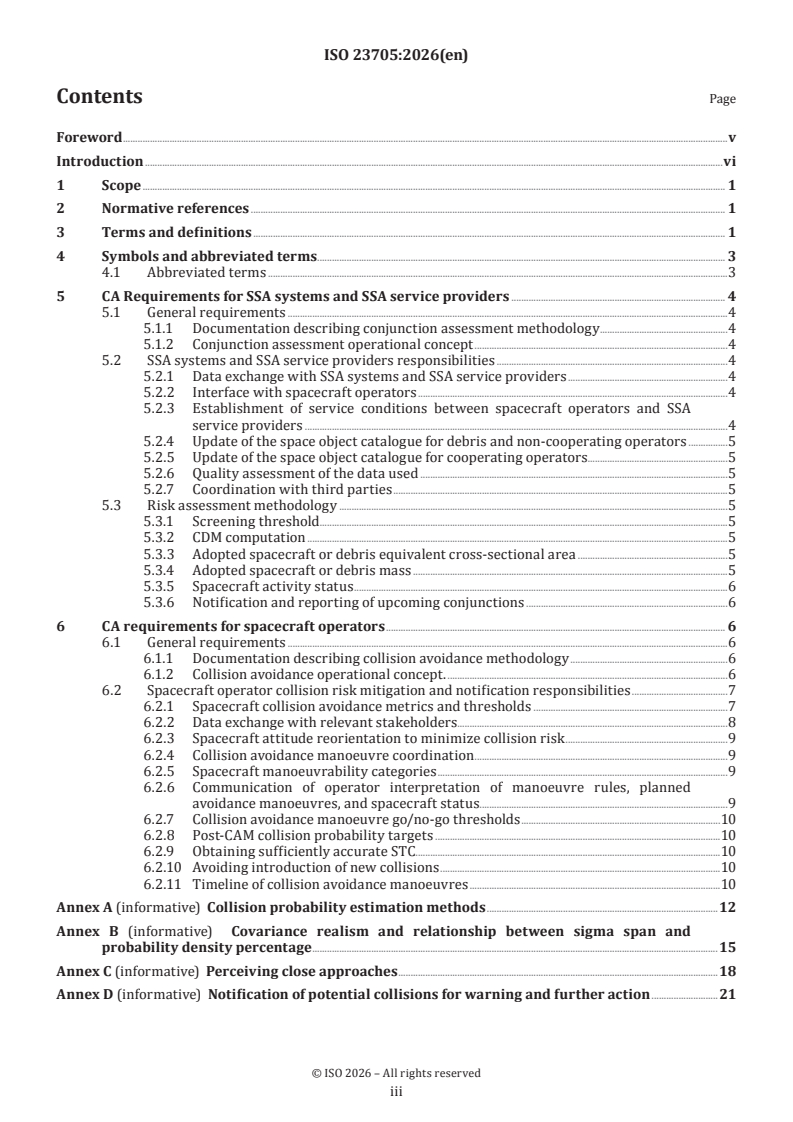
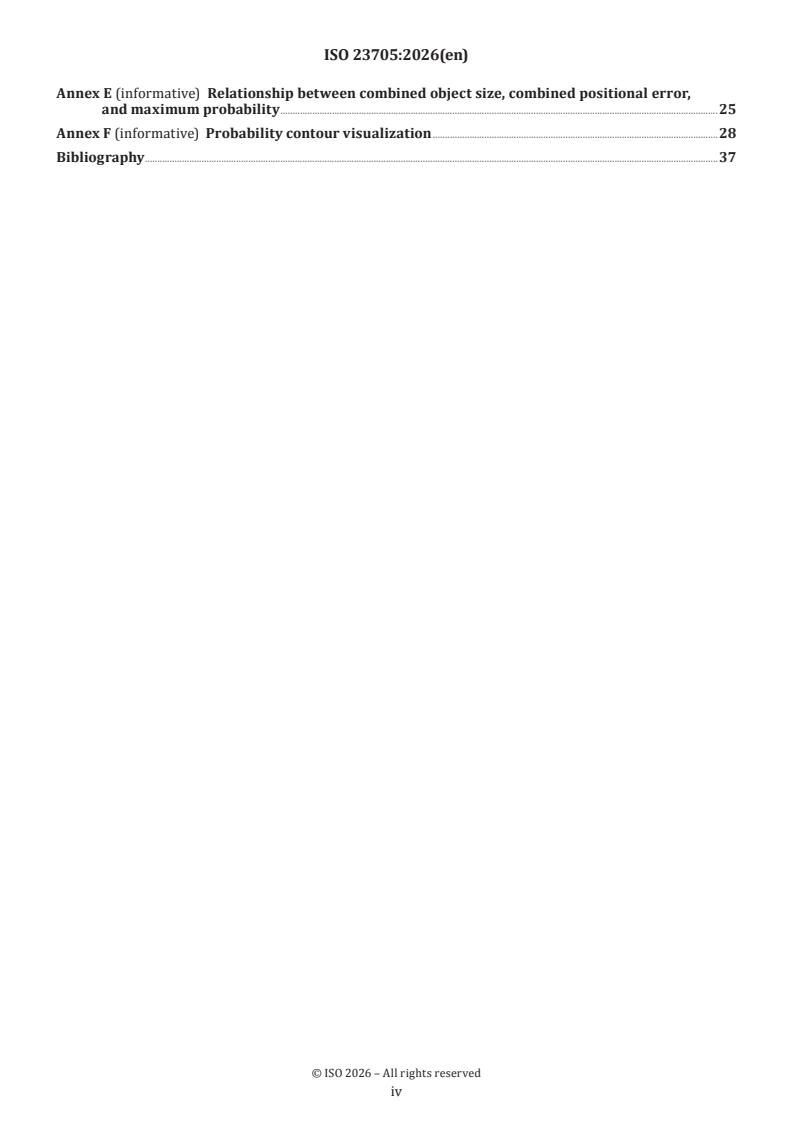
The document is organised into a short front matter, Clause 1 Scope, Clause 2 Normative references, Clause 3 Terms and definitions, Clause 4 Symbols and abbreviated terms, Clause 5 requirements for conjunction assessment (CA) in SSA systems and SSA service providers, Clause 6 requirements for CA in spacecraft operators, and informative Annexes A to F.
| Annex | What it covers |
|---|---|
| Annex A | Collision probability estimation methods |
| Annex B | Covariance realism and the link between sigma span and probability density percentage |
| Annex C | Perceiving close approaches |
| Annex D | Notification of potential collisions for warning and further action |
| Annex E | Relationship between combined object size, combined positional error, and maximum probability |
| Annex F | Probability contour visualization |
In practice, this structure helps readers see where the document separates system-side CA work from operator-side CA work, and where the annexes provide supporting methods and visual tools.
What are the key requirements of ISO 23705:2026?
ISO 23705:2026 divides the work into two main responsibility areas - SSA systems and SSA service providers in Clause 5, and spacecraft operators in Clause 6. The practical message is that collision avoidance is not only a flight-dynamics task: it also depends on what data are exchanged, how alerts are screened, and how decisions are coordinated.
Clause 5 - SSA systems and SSA service providers
Clause 5 requires documentation of the conjunction assessment methodology and the operational concept. That matters because users need to know how the assessment was built, what assumptions were used, and how the service is intended to operate before they rely on its outputs.
Clause 5 also assigns responsibilities for data exchange, interfaces with spacecraft operators, service conditions, space object catalogue updates, data quality assessment and coordination with third parties. In practice, this means the SSA provider has to maintain a usable picture of the space environment and keep the information flow traceable.
Clause 5.3 sets out the risk assessment methodology, including the screening threshold, conjunction data message (CDM) computation, adopted equivalent cross-sectional area, adopted mass and spacecraft activity status. These items matter because collision screening is only as good as the physical and orbital data used to judge which encounters deserve attention.
Clause 5.3.6 covers notification and reporting of upcoming conjunctions. That gives operators the warning they need to refine orbit data, review risk and decide whether to escalate to manoeuvre planning.
Clause 6 - spacecraft operators
Clause 6 requires spacecraft operators to document their collision avoidance methodology and operational concept. This is the operator-side equivalent of the SSA provider documentation in Clause 5, so that internal teams and outside partners can work from the same logic.
Clause 6.2 requires operators to define collision avoidance metrics and thresholds, exchange data with relevant stakeholders, share spacecraft physical and manoeuvrability characteristics, share ephemerides and manage service agreements with SSA systems and SSA service providers. In practice, this means operators must provide enough information for others to assess risk accurately and enough context to interpret the result.
Clause 6.2.3 to 6.2.5 address attitude reorientation, collision avoidance manoeuvre coordination and manoeuvrability categories. These points matter because a spacecraft may reduce risk not only by manoeuvring but also by changing attitude, and the feasible options depend on the vehicle’s capability.
Clause 6.2.6 to 6.2.11 deal with communication of manoeuvre rules, go/no-go thresholds, post-CAM collision probability targets, obtaining sufficiently accurate STC, avoiding the introduction of new collisions, and timing of manoeuvres. The practical effect is to make sure that a manoeuvre is timely, coordinated and effective, rather than simply reactive.
Guidance carried in the annexes
Annex A discusses collision probability estimation methods for short- and long-term encounters, including linear, asymmetric-body and nonlinear formulations. Annex B explains covariance realism, including sigma-span relationships, which matters when an analyst has to judge whether uncertainty data are believable enough for decision-making.
Annex C gives a screening workflow and suggests screening durations and time steps by orbit regime. Annex D describes warning and alert logic and the types of thresholds used to trigger further action. Annex E and Annex F provide ways to relate miss distance, object size, covariance and maximum probability, including nomogram and contour-based visualizations that help analysts and operators interpret the data quickly.
What terms does ISO 23705:2026 define?
ISO 23705:2026 defines the main collision-assessment vocabulary used throughout the document.
- Collision - one object striking another object.
- Collision probability - the likelihood that two space objects will impact each other during a conjunction event.
- Conjunction - a close approach where the separation reaches a local minimum and meets a distance, probability or combined-risk criterion.
- Covariance - a measure of how variables change together, used here to represent positional uncertainty.
- Encounter plane - the plane normal to the relative velocity at the time of closest approach.
- Ephemeris - the time history of position and velocity state information, and optionally acceleration and covariance.
- Scaled P - a collision probability estimated from covariance matrices that have been numerically adjusted by a scaling factor.
- Space traffic coordination (STC) - cooperative planning, data sharing and synchronization of space activities to avoid collision and radio frequency interference.
Who uses ISO 23705:2026?
ISO 23705:2026 is intended for people who assess conjunction risk and decide whether to warn, wait, coordinate or manoeuvre. That includes SSA service providers, spacecraft operators, flight dynamics staff (FDS), owners/operators (O/O), and teams responsible for mission operations and safety analysis.
It is also relevant to spacecraft designers and manufacturers because Clause 6 links collision avoidance to manoeuvring capability, attitude control and the ability to avoid creating new collisions. In practice, the standard supports day-to-day tasks such as catalogue maintenance, ephemeris exchange, screening, risk ranking, warning generation and manoeuvre planning.
Which standards are used with ISO 23705:2026?
ISO 23705:2026 stands on its own, and its introduction and bibliography point to related standards and documents that support its data exchange and safety context.
- ISO 26900 - provides the orbit data messages referenced in the introduction as the standardized way to share positional information and related metadata.
- ISO 9490 - covers space traffic coordination content that the introduction separates from collision avoidance content.
- ISO 21740 - covers launch collision avoidance, which the introduction identifies as a related but separate discipline.
- ISO 19389 - provides the conjunction data message (CDM) standard named in the bibliography.
- ISO 15388 - supplies the interface control document definition quoted in the terms and definitions clause.
- ISO 17666 - appears in the bibliography as a space systems risk management reference.
- ISO 14950 - appears in the bibliography as a related space systems document on unmanned spacecraft operability.
What does the ISO 23705:2026 document contain?
ISO 23705:2026 contains the top-level workflow for collision avoidance, the CA responsibilities for SSA systems and spacecraft operators, and a set of informative annexes that explain methods and interpretation tools. The annexes are used for operational analysis, data screening, manoeuvre planning and visual review of conjunction risk.
It includes formulas for collision probability estimation, covariance realism and probability relationships, plus examples and graphical methods such as nomograms and contour plots. Annex C and Annex D are especially useful for operational screening and alerting because they link analysis outputs to practical timing and response choices.
The document also includes tables that show screening durations, time steps, warning and alert thresholds, and the division of space safety content between related ISO documents. For readers building procedures or reviewing a service, these tables and figures show how the standard expects information to move from orbit data to a decision about action.
Get Certified
Connect with accredited certification bodies for this standard

BUREAU VERITAS Certification Germany
Bureau Veritas certification in Germany.

Element Materials Technology
Materials testing and product certification.

AQMS Ltd.
AQMS provides ISO certification to SMEs across the UK.
Sponsored listings
Frequently Asked Questions
ISO 23705:2026 is a standard published by the International Organization for Standardization (ISO). Its full title is "Space systems — Identifying, evaluating and avoiding collisions between orbiting objects". This standard covers: This document provides the workflow and technical requirements for perceiving, evaluating and avoiding collisions among orbiting objects, data requirements for these tasks, identifies techniques that can be used to estimate either the probability or the consequence of collisions, or both, and provides requirements and guidance for executing collision avoidance manoeuvres.
This document provides the workflow and technical requirements for perceiving, evaluating and avoiding collisions among orbiting objects, data requirements for these tasks, identifies techniques that can be used to estimate either the probability or the consequence of collisions, or both, and provides requirements and guidance for executing collision avoidance manoeuvres.
ISO 23705:2026 is classified under the following ICS (International Classification for Standards) categories: 49.140 - Space systems and operations. The ICS classification helps identify the subject area and facilitates finding related standards.
ISO 23705:2026 is available in PDF format for immediate download after purchase. The document can be added to your cart and obtained through the secure checkout process. Digital delivery ensures instant access to the complete standard document.
Standards Content (Sample)
International
Standard
ISO 23705
First edition
Space systems — Identifying,
2026-06
evaluating and avoiding collisions
between orbiting objects
Systèmes spatiaux — Identification, évaluation et évitement des
collisions entre objets en orbite
Reference number
© ISO 2026
All rights reserved. Unless otherwise specified, or required in the context of its implementation, no part of this publication may
be reproduced or utilized otherwise in any form or by any means, electronic or mechanical, including photocopying, or posting on
the internet or an intranet, without prior written permission. Permission can be requested from either ISO at the address below
or ISO’s member body in the country of the requester.
ISO copyright office
CP 401 • Ch. de Blandonnet 8
CH-1214 Vernier, Geneva
Phone: +41 22 749 01 11
Email: copyright@iso.org
Website: www.iso.org
Published in Switzerland
ii
Contents Page
Foreword .v
Introduction .vi
1 Scope . 1
2 Normative references . 1
3 Terms and definitions . 1
4 Symbols and abbreviated terms. 3
4.1 Abbreviated terms .3
5 CA Requirements for SSA systems and SSA service providers . 4
5.1 General requirements .4
5.1.1 Documentation describing conjunction assessment methodology .4
5.1.2 Conjunction assessment operational concept .4
5.2 SSA systems and SSA service providers responsibilities .4
5.2.1 Data exchange with SSA systems and SSA service providers .4
5.2.2 Interface with spacecraft operators .4
5.2.3 Establishment of service conditions between spacecraft operators and SSA
service providers .4
5.2.4 Update of the space object catalogue for debris and non-cooperating operators .5
5.2.5 Update of the space object catalogue for cooperating operators.5
5.2.6 Quality assessment of the data used .5
5.2.7 Coordination with third parties .5
5.3 Risk assessment methodology .5
5.3.1 Screening threshold.5
5.3.2 CDM computation .5
5.3.3 Adopted spacecraft or debris equivalent cross-sectional area .5
5.3.4 Adopted spacecraft or debris mass .5
5.3.5 Spacecraft activity status .6
5.3.6 Notification and reporting of upcoming conjunctions .6
6 CA requirements for spacecraft operators . 6
6.1 General requirements .6
6.1.1 Documentation describing collision avoidance methodology .6
6.1.2 Collision avoidance operational concept. .6
6.2 Spacecraft operator collision risk mitigation and notification responsibilities .7
6.2.1 Spacecraft collision avoidance metrics and thresholds .7
6.2.2 Data exchange with relevant stakeholders . .8
6.2.3 Spacecraft attitude reorientation to minimize collision risk .9
6.2.4 Collision avoidance manoeuvre coordination .9
6.2.5 Spacecraft manoeuvrability categories .9
6.2.6 Communication of operator interpretation of manoeuvre rules, planned
avoidance manoeuvres, and spacecraft status.9
6.2.7 Collision avoidance manoeuvre go/no-go thresholds .10
6.2.8 Post-CAM collision probability targets .10
6.2.9 Obtaining sufficiently accurate STC . .10
6.2.10 Avoiding introduction of new collisions .10
6.2.11 Timeline of collision avoidance manoeuvres .10
Annex A (informative) Collision probability estimation methods .12
Annex B (informative) Covariance realism and relationship between sigma span and
probability density percentage .15
Annex C (informative) Perceiving close approaches .18
Annex D (informative) Notification of potential collisions for warning and further action .21
iii
Annex E (informative) Relationship between combined object size, combined positional error,
and maximum probability .25
Annex F (informative) Probability contour visualization .28
Bibliography .37
iv
Foreword
ISO (the International Organization for Standardization) is a worldwide federation of national standards
bodies (ISO member bodies). The work of preparing International Standards is normally carried out through
ISO technical committees. Each member body interested in a subject for which a technical committee
has been established has the right to be represented on that committee. International organizations,
governmental and non-governmental, in liaison with ISO, also take part in the work. ISO collaborates closely
with the International Electrotechnical Commission (IEC) on all matters of electrotechnical standardization.
The procedures used to develop this document and those intended for its further maintenance are described
in the ISO/IEC Directives, Part 1. In particular, the different approval criteria needed for the different types
of ISO document should be noted. This document was drafted in accordance with the editorial rules of the
ISO/IEC Directives, Part 2 (see www.iso.org/directives).
ISO draws attention to the possibility that the implementation of this document may involve the use of (a)
patent(s). ISO takes no position concerning the evidence, validity or applicability of any claimed patent
rights in respect thereof. As of the date of publication of this document, ISO had not received notice of (a)
patent(s) which may be required to implement this document. However, implementers are cautioned that
this may not represent the latest information, which may be obtained from the patent database available at
www.iso.org/patents. ISO shall not be held responsible for identifying any or all such patent rights.
Any trade name used in this document is information given for the convenience of users and does not
constitute an endorsement.
For an explanation of the voluntary nature of standards, the meaning of ISO specific terms and expressions
related to conformity assessment, as well as information about ISO's adherence to the World Trade
Organization (WTO) principles in the Technical Barriers to Trade (TBT), see www.iso.org/iso/foreword.html.
This document was prepared by Technical Committee ISO/TC 20, Aircraft and space vehicles, Subcommittee
SC 14, Space systems and operations.
Any feedback or questions on this document should be directed to the user’s national standards body. A
complete listing of these bodies can be found at www.iso.org/members.html.
v
Introduction
The process for perceiving, evaluating and avoiding collisions among orbiting objects begins in stage 1 as
shown in the top-level workflow contained in Figure 1. In this stage, the best possible positional information
[1]
on all potentially conjuncting objects is obtained from a combination of either spacecraft operators or STC
[2]
systems or both. A standardized way to share such information is specified in ISO 26900 . Spacecraft
positional information can be provided by collaborating spacecraft operators and from observers who are
capable of viewing spacecraft. This data can then be compared with each other to discern physically feasible
approaches that could result in collisions. The trajectories so revealed can then be examined more closely to
estimate the probability of collision. It is also important to know the nature of each object if possible. This
information includes the size, mass, geometry, and the operational state (e.g. active or inactive). Collision
probability estimates consider the inevitable imprecision associated with orbit determination and other
hypotheses and measurements. This information then allows analysts in stage 2 to screen for threatening
close approaches. Where the possibility of a collision has been identified which violates the thresholds
established by a spacecraft operator, the spectrum of feasible manoeuvres is examined in stage 3 to take an
effective course of action.
Figure 1 — Top-level collision avoidance workflow
There are several different approaches to conjunction assessment. All have merits and deficiencies. Many
focus on how closely spacecraft approach each other. This is often very uncertain since changes in spacecraft
orbits under the influence of non-conservative forces, as a rule:
a) evolve more rapidly than observations of spacecraft in orbit can be acquired; and
b) cannot be modelled accurately enough to obtain credible results of propagation even when the initial
orbit determination is accurate.
Spacecraft operators require the fullness of orbit data to judge the credibility and quality of conjunction
perception.
This information includes the moment in time of the last elaboration of orbit (the epoch) and the standard
time scale employed, positional ephemerides or orbit state vector values or elements at that moment in
time, the coordinate system description that presents the orbital data, the forces model description that is
used for orbital predictions, and information about the estimated positional errors associated with those
[2]
predictions. Essential elements of information for this purpose are specified in ISO 26900 .
vi
There are also diverse approaches to estimating the probability that a close approach can result in a
collision. This is a statistical process very similar to weather forecasting. Meteorologists no longer make
definitive predictions. They provide the probability of precipitation, not whether it will rain. All conjunction
assessment approaches are in some way founded in probabilities. Probability of collision is also a highly
desirable element of data. It can be accompanied by metadata that allows operators to interpret the
information within their own operational procedures.
How near two spacecraft can be to each other and the probability they can collide if they were that close are
only two discriminants of potentially catastrophic events. Since the objective is that the spacecraft survives
despite many potential close approaches, cumulative probability of survival is also important information.
Responding precipitously to the close approach nearest at hand can only delay the demise of the spacecraft
or even contribute to a subsequent more serious event. The evolution of close approaches is thus also
important.
Finally, the state of each of the conjunction partners, their ability to manoeuvre or otherwise avoid contact,
and the outcomes of past events that are similar guide courses of action.
The space flight safety-relevant topics of space traffic coordination, on-orbit collision avoidance, and launch
collision avoidance are closely related. To minimize duplication and maximize document consistency, the
various content that serve as the basis for these three disciplines is divided up as shown in Table 1.
[1]
Table 1 — Division of space safety operations content between ISO 9490, ISO 23705 and
[3]
ISO 21740
ISO 9490: STC ISO 23705: Avoid collision ISO 21740: LCOLA
— STC terminology — Conjunction assessment and collision — LCOLA terminology:
avoidance terminology safety LCOLA and mission
— STC system, QC, IS, reliability
assurance LCOLA
— Risk mitigation strategies
— STC roles/responsibilities for
— LCOLA launch window
launch providers, S/C operators, — Suggested collision miss distance and
screening process
and SSA providers probability/risk metrics and associated
minimum thresholds — LCOLA products
— STC and SSA services
— Mathematical techniques: — Launch range
— Orbit determination, required
coordination
accuracy, timeliness — Conjunction assessment
— LCOLA data exchange
— Manoeuvrability RotR/ — Collision probability
(LDM)
— Manoeuvre recommendations — Linear, non-linear,
— LCOLA mathematical
techniques
— Data exchange and launch, — Asymmetric, max prob
manoeuvre, anomaly, and
— CAM planning, optimize
fragmentations notifications
— CA nomograms
— STC mathematical techniques
vii
International Standard ISO 23705:2026(en)
Space systems — Identifying, evaluating and avoiding
collisions between orbiting objects
1 Scope
This document provides the workflow and technical requirements for perceiving, evaluating and avoiding
collisions among orbiting objects, data requirements for these tasks, identifies techniques that can be used
to estimate either the probability or the consequence of collisions, or both, and provides requirements and
guidance for executing collision avoidance manoeuvres.
2 Normative references
There are no normative references in this document.
3 Terms and definitions
For the purposes of this document, the following terms and definitions apply.
ISO and IEC maintain terminology databases for use in standardization at the following addresses:
— ISO Online browsing platform: available at https:// www .iso .org/ obp
— IEC Electropedia: available at https:// www .electropedia .org/
3.1
collision
instance of one object striking another
3.2
collision probability
quantification of the likelihood of two space objects impacting each other during a conjunction (3.3) event
3.3
conjunction
event where the positional separation between two objects is at a local minimum and that minimum is either
a) closer than a specified minimum distance threshold;
b) the estimated probability of collision (3.1) at this local minimum exceeds a specified collision probability
(3.2) threshold; or
c) a combination of miss distance, probability and/or other metrics (e.g. “risk”)
3.4
covariance
measure of how much variables change together
Note 1 to entry: For multiple dependent variables, covariance is a square, symmetric, positive definite matrix of
dimensionality N × N, where N is the number of variables.
3.5
encounter plane
plane normal to the relative velocity at the time of closest approach
3.6
ephemeris
time history of positional and velocity (and optionally acceleration and covariance (3.4)) state information
3.7
false alarm
statistical error, when a statistical test fails to reject a false null hypothesis
3.8
interface control document
specification that describes the characteristics that must be controlled at the boundaries between systems,
subsystems and other elements
[SOURCE: ISO 15388:2022, 3.1.22, modified — The abbreviated term "ICD" has been removed.]
3.9
orbital elements
parameters that describe the evolution of the trajectory and which can be used to estimate the trajectory in
the future
3.10
scaled P
c
scaled collision probability
collision probability (3.2) that is estimated using covariance (3.4) matrices that have been numerically
adjusted by the square of a scaling factor
3.11
space situational awareness
SSA
knowledge and characterization of the space environment to facilitate decisions that support safe, stable,
and sustainable space activities
Note 1 to entry: SSA includes all artificial space objects (spacecraft, rocket bodies, mission-related objects and
fragments), natural objects, asteroids (including near-Earth objects or NEOs), comets and meteoroids, effects from
[35]
space weather, including solar activity and its radiation. Assessed risks include potential risks to humans and
property in space, on the ground and in the air space due to accidental or intentional re-entries, on-orbit explosions
and release events, on-orbit collisions (3.1), radio frequency interference, and occurrences that can disrupt missions
and services.
Note 2 to entry: This definition is adopted from Reference [4].
3.12
SSA service provider
space situational awareness service provider
entity that operates a space situational awareness (SSA) (3.11) system to maintain an operational picture of
the space environment and potential risks
Note 1 to entry: SSA services can be provided by a combination of one or more commercial, governmental, non-
governmental, or international entities, as well as by a mandated or delegated entity assigned by applicable national
regulation.
3.13
SSA system
space situational awareness system
set of information gathering and exchange protocols enabling the characterization of the space environment
and dissemination of its knowledge
3.14
space surveillance and tracking
SST
detection, observation, monitoring, cataloguing and prediction of the movement of space objects and the
identification and alerting of derived risks
Note 1 to entry: Space surveillance and tracking is generally accomplished through the operation and calibration of
ground-based or space-based tracking sensors using radar, optical, or passive RF technology.
3.15
space traffic coordination
STC
cooperative planning, harmonization, data and information sharing, and synchronization of space activities
to avoid collision (3.1) and radio frequency interference during spacecraft and launch vehicle operations in
space
Note 1 to entry: This definition is adopted from Reference [4].
4 Symbols and abbreviated terms
4.1 Abbreviated terms
ANSI American National Standards Institute
AIAA American Institute of Aeronautics and Astronautics
CA conjunction assessment
CAM collision avoidance manoeuvre
CCSDS Consultative Committee for Space Data Systems
CDM conjunction data message
COLA collision avoidance
ESA European Space Agency
FDS flight dynamics staff
GEO geostationary Earth orbit
LCOLA "launch collision avoidance" or "launch COLA"
LEO low Earth orbit
MEO medium Earth orbit
O/O owner/operator
NASA National Aeronautics and Space Administration
PDF probability distribution function
RCS radar cross section
SANA Space Assigned Numbers Authority
S/C spacecraft
SSA space situational awareness
SST space surveillance and tracking
STC space traffic coordination
TCA time of closest approach
UTC Coordinated Universal Time
5 CA Requirements for SSA systems and SSA service providers
5.1 General requirements
5.1.1 Documentation describing conjunction assessment methodology
SSA systems and SSA service providers shall create and maintain documentation describing their own
catalogue update strategies (including detection of new objects), update of external orbits (ephemerides
from spacecraft operators, catalogue maintained by other SSA entities), assessment of the quality of the data
used, conjunctions detection, risks assessment and mitigation strategy provision.
NOTE These data requirements enable a well-understood workflow and interactions among the potentially
multiple organizations involved in mitigating the potential consequences of conjunctions and collisions.
5.1.2 Conjunction assessment operational concept
SSA systems and SSA service providers shall develop and maintain an operational concept that describes the
roles, relationships, tasks, processes, and information flows amongst stakeholders and the way systems and
processes will be used to provide conjunction assessment to spacecraft operators.
5.2 SSA systems and SSA service providers responsibilities
5.2.1 Data exchange with SSA systems and SSA service providers
SSA systems and SSA service providers shall have the capability to exchange orbits and measurements with
other SSA systems and SSA service providers, and with SST service providers.
Where applicable, machine-to-machine interfaces adhering to CCSDS standards such as ISO 26900 orbit
data message, ISO 19389 conjunction data message, and CCSDS attitude data message, along with their
accompanying SANA registry normative content, should be used.
5.2.2 Interface with spacecraft operators
SSA service providers shall provide an interface to operators to receive input data (such as ephemerides)
and generate CDMs.
5.2.3 Establishment of service conditions between spacecraft operators and SSA service providers
Exact service conditions shall be established between the satellite operator and the SSA service provider(s)
before the start of the service. The liability of the SSA systems and SSA service providers shall be clarified.
Unless specified otherwise, the owners and operators shall be responsible for deciding mitigating courses of
action.
NOTE Such conditions can already be established for all participants in a common definition of services document,
adopted data exchange formats, and definition of liability. In cases where these are not established by default or if not
well-suited for a particular spacecraft operator, an interface control document can be established to delineate such
terms as agreed between SSA service providers and spacecraft operators (see 6.2.2).
5.2.4 Update of the space object catalogue for debris and non-cooperating operators
SSA service providers shall obtain or maintain the most current, complete, timely, and accurate SSA
catalogue data on debris and non-cooperating actively manoeuvring spacecraft, either by building their own
catalogue or by acquiring data from an external entity, or both.
5.2.5 Update of the space object catalogue for cooperating operators
The SSA system or SSA service provider shall keep up to date their database of orbits shared by spacecraft
operators.
5.2.6 Quality assessment of the data used
SSA service providers shall check the consistency and accuracy of external data before use, by performing
comparisons with statistical analysis, with measurements or with other orbits sources.
SSA service providers should notify spacecraft operators if the ephemerides or covariances provided does
not pass the quality checks.
5.2.7 Coordination with third parties
In case of a conjunction between two or more active S/C, organizations shall have the capability to describe
their risk assessment process, methodology and analysis results to any parties unfamiliar with them.
5.3 Risk assessment methodology
5.3.1 Screening threshold
SSA service providers shall use the risk assessment methodology, screening metrics and associated
thresholds as specified by their decision authority.
Minimum metrics and thresholds should be selected in accordance with Annex C and Annex D.
NOTE See Reference [6] and Clause D.2 for representative metrics and thresholds used by commercial spacecraft
operators.
5.3.2 CDM computation
SSA service providers should be able to identify which orbit source is the most adequate for a given
conjunction at a given time. SSA service providers shall clearly indicate the data source (O/O ephemerides,
own catalogue, external catalogues) used for the primary and secondary objects in the generated CDMs.
5.3.3 Adopted spacecraft or debris equivalent cross-sectional area
SSA service providers shall use sources for estimated “equivalent cross-sectional area” for spacecraft and
debris objects deemed most reliable.
NOTE 1 Generally, the following prioritization order can be used: data provided by the spacecraft operator or
debris originator, values computed from geometry available on open-source information, default values derived from
RCS or optical magnitude information, or a default value when no other information is available.
NOTE 2 Default values can be derived from statistical median “typical” values of other objects of known cross-
sections within a mission type, orbit class or category, ballistic coefficient estimates, or year of manufacture.
5.3.4 Adopted spacecraft or debris mass
SSA service providers shall obtain or define the estimated mass of either the spacecraft or the debris object,
or both, involved in the conjunction based on the following priority order: data provided by the spacecraft
operator or debris originator, open-source information available, default values derived from RCS or optical
magnitude information, or a default value when no information is available.
5.3.5 Spacecraft activity status
SSA service providers shall obtain the operational status of any spacecraft involved in a conjunction.
5.3.6 Notification and reporting of upcoming conjunctions
SSA service providers shall alert operators of conjunctions that exceed predefined metric thresholds as
specified by their respective decision authority.
NOTE 1 Examples of conjunction metrics and thresholds are provided in Annex D. Such thresholds typically support
the identification of three separate phases of the analysis: a) initial screening; b) warning associated with the adopted
reporting criteria; and c) exceedance of the go/no-go avoidance manoeuvre threshold.
NOTE 2 The notification can contain recommended mitigation actions for a few standard cases (such as a chemical
manoeuvre performed 0,5 orbits before TCA) to help the spacecraft operator select and define their mitigation
strategy.
6 CA requirements for spacecraft operators
6.1 General requirements
6.1.1 Documentation describing collision avoidance methodology
Spacecraft operators shall create and maintain documentation describing their collision avoidance detection,
evaluation and mitigation strategies.
NOTE These data requirements enable a well-understood workflow and interactions among the potentially
multiple organizations involved in mitigating the potential consequences of conjunctions and collisions.
6.1.2 Collision avoidance operational concept.
Spacecraft operators shall develop and maintain an operational concept that describes the roles,
relationships, tasks, processes and information flows amongst stakeholders and the way systems and
processes will be used to perform collision avoidance actions.
NOTE 1 Since conjunction and collision assessment involves multiple stakeholders, providers and action recipients,
a commonly understood, normative operational concept is essential. Figure 3 and Figure 4 provide a representative
operational concept depicting each of the elements in the collision avoidance workflow.
[7] [8] [9]
NOTE 2 See, for example, ISO 14950, ISO 17666 and ISO 19971 for guidance on developing and maintaining
operational concepts.
Figure 3 — Representative collision avoidance operational concept
Figure 4 provides details for the “Select and execute course of action” box from Figure 3, including
[10]
consequence assessment .
Figure 4 — Diagram detailing components of selecting and executing a course of action
6.2 Spacecraft operator collision risk mitigation and notification responsibilities
6.2.1 Spacecraft collision avoidance metrics and thresholds
Spacecraft operators shall mitigate collision risk which exceeds their respective decision authority’s
specified collision avoidance metrics and associated thresholds.
Collision risk mitigation measures should take priority over the mission of the spacecraft.
NOTE 1 See Reference [6], 5.3.1 and Clause D.2 for representative metrics and thresholds used by commercial
spacecraft operators.
NOTE 2 See Annex E and Annex F for information relating to, and visualizations of, the relationship between
combined object size, combined positional error, and maximum probability.
6.2.2 Data exchange with relevant stakeholders
6.2.2.1 Sharing of spacecraft physical characteristics
Spacecraft operators should provide sufficient spacecraft size, dimensions, equivalent cross-sectional area,
and geometry and attitude/orientation to other relevant spacecraft operators, SSA service providers, and
stakeholders in accordance with ISO 26900 and its underlying SANA registry normative content to permit
the recipient’s independent assessment of collision risk.
6.2.2.2 Sharing of spacecraft manoeuvrability characteristics and planned manoeuvres
Spacecraft operators should provide spacecraft manoeuvrability characteristics as well as any planned
manoeuvres to conjunction partners and any relevant stakeholders in accordance with ISO 26900 and its
underlying SANA registry normative content.
6.2.2.3 Sharing of ephemerides
As directed by their approving agent, spacecraft operators shall, either directly or by a proxy SSA service
provider, generate and regularly share spacecraft ephemerides, inclusive of planned manoeuvres (for
manoeuvrable spacecraft) and associated realistic covariance time histories for their S/C (see Annex B for
discussion of covariance realism).
When associated covariance information is not available directly from the SSA service provider, suitable
equivalents should be obtained to enable operators to evaluate collision probabilities and assess collision
risk. An example of such an approach to estimate covariance time histories is provided in Reference [101].
6.2.2.4 Ephemeris screening duration and time step
Shared spacecraft ephemerides shall employ an appropriate duration and time-step as specified by their
approving agent. Sample screening durations and time steps are provided in Annex C.
6.2.2.5 Service agreement with SSA systems and SSA service providers
As directed by their approving agent and prior to providing the service, spacecraft operators shall establish
an agreement with an SSA system or SSA service provider that levies requirements for the provision of SSA
and space safety services, which shall contain the following information:
— operational points of contacts;
— S/C to be monitored;
— S/C attributes: hard body radius (i.e. radius of the sphere englobing the S/C) or an upper bound value,
and the operability and current category of a spacecraft’s manoeuvring system; other S/C attributes may
also be provided such as mass, surface, drag coefficient, and solar radiation pressure coefficient;
— description of the format of ephemerides and manoeuvre plan (if provided);
— severity threshold (e.g. ALERT, WARNING);
— preferred strategies for collision risk mitigation;
— post-mitigation action threshold.
NOTE In cases where these are not established by default or if not well-suited for a particular spacecraft operator,
an interface control document can be established to delineate such terms as agreed between SSA service providers
and spacecraft operators.
6.2.3 Spacecraft attitude reorientation to minimize collision risk
Spacecraft operators should reorient their spacecraft to minimize collision risk where possible.
NOTE 1 Collision risk is a direct function of the effective cross-sectional area of the spacecraft parallel to the
conjunction encounter plane. The attitude can be changed with minimal energy expenditure to present the smallest
cross-section to the relative velocity vector at the time of closest approach.
NOTE 2 Large spacecraft likely have large solar panels. Most of the solar panel cross section can have low spatial
density, which is therefore less likely to fragment but more likely to remain in orbit.
NOTE 3 Reorientation can be especially useful in cases where it enables the operator to meet the risk reduction
target specified in 6.2.8.
6.2.4 Collision avoidance manoeuvre coordination
Collision avoidance manoeuvres shall be coordinated with all known spacecraft operators of active
[1]
spacecraft that may conjunct with an operator’s spacecraft, as required in ISO 9490 .
NOTE This can be accomplished either in real time or via bilaterally or multilaterally negotiated coordination
protocol or agreement and implemented as applicable.
6.2.5 Spacecraft manoeuvrability categories
Spacecraft shall be categorized into the following six manoeuvrability categories:
a) non-manoeuvrable: total inability to make flight safety-relevant orbital changes;
b) minimally manoeuvrable robotic: only able to perturb one’s orbit to a very small degree (i.e. mitigation
measure cannot be completed within one orbital revolution);
c) manoeuvrable robotic: able to easily alter the spacecraft course within one orbital revolution using
available propellant to mitigate the risk of collision;
d) automated on-ground collision avoidance (COLA) manoeuvrable capability (robotic spacecraft)
performing manoeuvres based on on-ground automation (i.e. computation of the manoeuvre on-
ground);
e) automated on-board collision avoidance (COLA) manoeuvrable capability (robotic spacecraft), where
the automated in-space decision can only be inferred based upon ground simulation or understanding;
f) inhabitable (presumed manoeuvrable): an inhabitable space station that can alter its path to avoid
collision.
NOTE These categories can change over time for a spacecraft, e.g. if its manoeuvring system or attitude control
system degrade or fail.
Spacecraft that rely solely on differential-drag control shall be categorised as minimally manoeuvrable
robotic.
6.2.6 Communication of operator interpretation of manoeuvre rules, planned avoidance
manoeuvres, and spacecraft status
Spacecraft operators should communicate, at least once, their interpretation of manoeuvre rules and their
avoidance manoeuvre plans with other spacecraft operators involved in the conjunction for close approaches
exceeding the operator’s collision risk threshold and with known relevant STC entities for all predicted close
approaches, even if the other spacecraft is/are un-manoeuvrable or minimally manoeuvrable.
NOTE In the case of several collocated spacecraft constellations, this requirement can be met by the initial sharing
of each other’s mitigation action plans for any future conjunctions.
6.2.7 Collision avoidance manoeuvre go/no-go thresholds
Collision avoidance manoeuvres (CAMs) (or equivalently effective mitigation strategies achieved by
cancelling or adjusting existing planned station-keeping manoeuvres, etc.) shall be conducted for predicted
encounters having an estimated probability of collision or miss distance exceeding the minimum thresholds
specified by their approving agent, unless more stringent bilaterally agreed spacecraft operator thresholds
necessitate the use of more conservative keep out or probability thresholds.
NOTE 1 Example avoidance manoeuvre thresholds are provided in Annex D.
NOTE 2 A mitigation action can be impossible in some cases such as reception of degraded SSA product,
impossibility to perform a mitigation action without raising the risk level of other conjunctions or incompatibility
between the required mitigation action and the S/C constraints.
NOTE 3 Go/no-go thresholds for crewed space stations can be much more stringent than for robotic spacecraft or
debris.
6.2.8 Post-CAM collision probability targets
CAMs shall be designed to reduce collision risk to the degree specified by their approving agent, unless the
resulting manoeuvre would cause significant degradation to S/C operations or exceed the S/C capability.
In that case, the spacecraft operator should implement a manoeuvre that decreases the risk to the greatest
extent possible.
At a minimum, the collision probability target of conducted collision avoidance manoeuvres should be a
[11]
factor of at least 10 below the applicable collision probability threshold .
6.2.9 Obtaining sufficiently accurate STC
When planning for a collision avoidance manoeuvre, operators shall obtain STC information that is of
[11]
sufficient accuracy to support the collision probability and miss distance metrics and thresholds used,
such that when predicted forward to an upcoming close approach, effective avoidance manoeuvres can be
made.
Analysts shall use a validated, accepted collision probability assessment method to generate STC products.
NOTE Information on a variety of suitable collision probability assessment methods is provided in Annex A.
6.2.10 Avoiding introduction of new collisions
When planning for a collision avoidance manoeuvre, spacecraft operators and responsible SSA service
providers shall use avoidance manoeuvre plan optimization techniques (i.e. to minimize fuel usage,
mission downtime, or mission risk) or conduct secondary CA screening to ensure that selected avoidance
manoeuvres do not introduce serious collision risk with the secondary object or with other space objects
within the minimum timeframe specified by the approving agent.
6.2.11 Timeline of collision avoidance manoeuvres
6.2.11.1 Avoidance manoeuvre execution times
Spacecraft operators shall consider typical collision avoidance manoeuvre execution times as directed by
their conjunction assessment approving agent.
NOTE 1 Typical manoeuvre execution times are shown in Annex C.
NOTE 2 The typical sequence of events when conducting collision avoidance manoeuvres is as follows:
a) The relevant SSA and STC systems detect and notify the operator(s) of the impending collision threat.
b) Spacecraft flight dynamics staff study the conjunction and plan a suitable avoidance manoeuvre (specifying
manoeuvre time, direction, magnitude).
c) FDS either make a recommendation to management or jointly decide with the management, or both, whether to
conduct the avoidance manoeuvre.
d) FDS obtain management approval.
e) The avoidance manoeuvre is conducted.
f) The passage of time allows the effect of the avoidance manoeuvre to effectively mitigate collision risk. Manoeuvres
typically must be conducted at least half an orbital revolution prior to TCA for maximum effectiveness.
g) The spacecraft remains in the collision avoidance phase (or “avoidance orbit”).
NOTE 3 Regarding avoidance manoeuvre strategies, some operators act as early as possible to mitigate the risk
of close approach well before this risk results in a high probability of collision, while other operators wait as long as
[11]
possible to refine the available data and get a better estimate of the geometry of the encounter and its risk level .
NOTE 4 The time required to plan, implement and conduct avoidance manoeuvres, and the time required for those
manoeuvres to be effective, varies widely depending upon the operator’s selected avoidance strategy, orbital regime,
quality of SSA information, remaining spacecraft manoeuvring fuel or consum
...