

ISO 17516:2026
(Main)Cosmetics — Microbiology — Microbiological limits
- Abstract
This document specifies the acceptable quantitative and qualitative microbiological limits in finished cosmetic products. It is applicable to all cosmetics, and assists interested parties in the assessment of the microbiological quality of cosmetic products.
- Status
- Published
- Publication Date
- 05-Nov-2026
- Technical Committee
- ISO/TC 217 - Cosmetics
- Drafting Committee
- ISO/TC 217/WG 1 - Microbiological standards and limits
- Current Stage
- 6060 - International Standard published - 60 Publication
- Start Date
- 06-Nov-2026
- Due Date
- 06-Nov-2026
- Completion Date
- 06-Nov-2026
Buy Documents
ISO 17516:2026 - Cosmetics — Microbiology — Microbiological limits
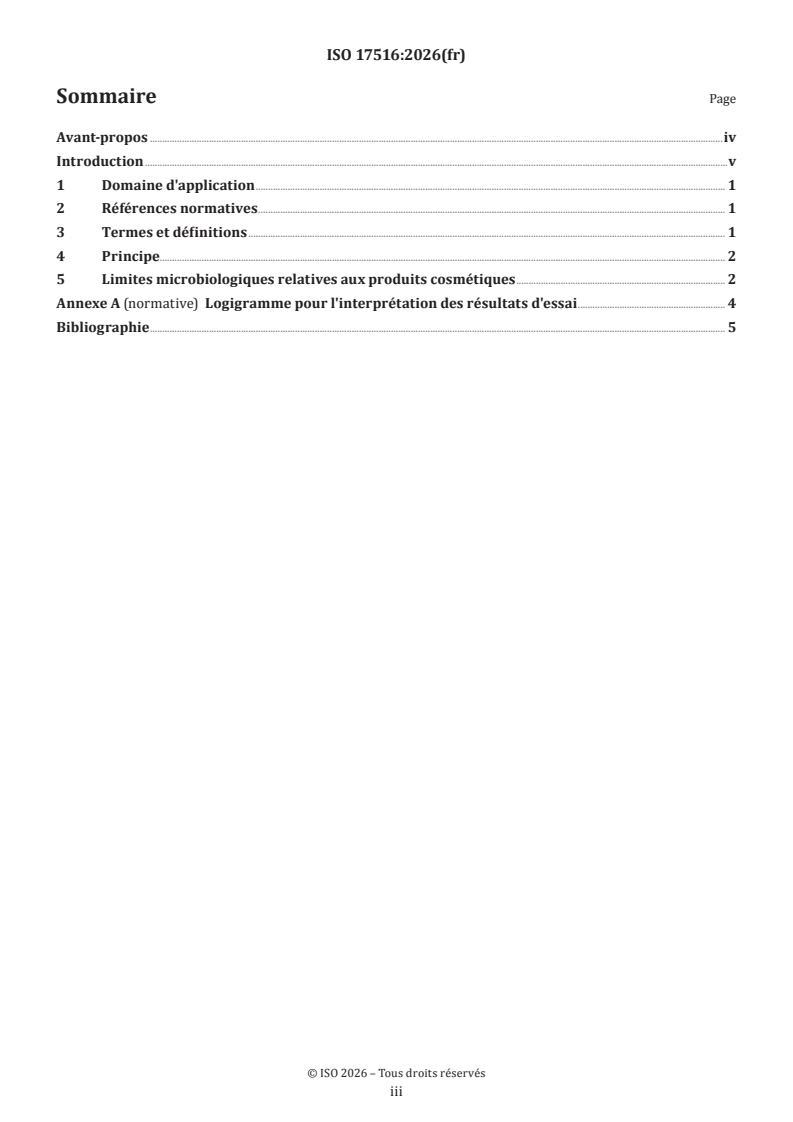
ISO 17516:2026 - Cosmétiques — Microbiologie — Limites microbiologiques
ISO 17516:2026 is an ISO standard for the microbiological limits of finished cosmetic products. It specifies the acceptable quantitative and qualitative limits for all cosmetics and helps manufacturers, laboratories, and other interested parties assess microbiological quality and consumer safety.
What does ISO 17516:2026 specify?
ISO 17516:2026 sets the microbiological acceptance limits for finished cosmetic products and explains how to interpret test results against those limits. The document applies to all cosmetics and is organized into clauses 1 to 5, with one normative annex.
| Annex | What it covers |
|---|---|
| Annex A | Flowchart for interpretation of test results |
Clause 1 states the scope, Clause 3 defines the key microbiological terms, Clause 4 gives the principle behind the limits, and Clause 5 sets the limits themselves. Annex A supports day-to-day interpretation in the laboratory or quality function, where borderline or out-of-limit results need a consistent decision path.
What are the key requirements of ISO 17516:2026?
ISO 17516:2026 requires finished cosmetic products to meet both quantitative limits for general microbial load and qualitative limits for specified microorganisms. In practice, the standard is about showing that a product is microbiologically controlled for normal use, not about making cosmetics sterile.
Product safety and the principle behind the limits
Clause 4 states that cosmetics are not expected to be sterile, but their microorganisms must not harm consumer safety or product quality during intended or foreseeable use. This matters because the acceptance decision is based on risk to the user, not on sterility.
Different limits by product type
Clause 5 distinguishes between two product groups: products for general use and products specifically intended for children under three years of age, the eye area, or mucous membranes. The practical message is that the standard treats these higher-sensitivity uses more strictly, so product classification matters before testing and release.
Specified microorganisms shall be absent
Clause 5 requires absence of Escherichia coli, Pseudomonas paraeruginosa (also known as Pseudomonas aeruginosa), Staphylococcus aureus, and Candida albicans. For a manufacturer or buyer, this means the release decision is not only a count result - it also depends on checking for these named organisms.
Non-specified microorganisms are assessed by growth potential
Clause 5 allows non-specified microorganisms to be acceptable if they do not have the ability to grow in the product. In practice, this usually means supporting the decision with a risk assessment, preservative efficacy evidence, or proof that the formulation cannot support microbial growth.
Interpretation of counts needs method awareness
Clause 4 and Clause 5 note that out-of-limit results must be interpreted with the inherent variability of the plate count method in mind. That matters because a single result close to the limit should be read through the standard’s interpretation path, not treated as a simple yes/no number without context.
Annex A supports the result decision
Annex A provides a flowchart for interpreting test results. Laboratories and quality teams use it to turn microbiological data into a consistent acceptance decision, especially when results are borderline or unexpected.
What terms does ISO 17516:2026 define?
ISO 17516:2026 defines the main microbiological terms used to apply the limits.
- Product - the portion of an identified cosmetic product received in the laboratory for testing.
- Aerobic mesophilic microorganisms - mesophilic bacteria, yeast, and mould that grow aerobically under the conditions used in the referenced methods.
- Specified microorganism - an aerobic mesophilic bacterium or yeast considered undesirable because it can indicate hygienic failure or pose a skin or eye infection risk.
- Escherichia coli - the gram-negative rod used as one of the specified absence checks.
- Pseudomonas paraeruginosa - the organism also known as Pseudomonas aeruginosa, included as a specified microorganism.
- Staphylococcus aureus - the gram-positive coccus included among the specified absence checks.
- Candida albicans - the yeast included among the specified absence checks.
Who uses ISO 17516:2026?
ISO 17516:2026 is used by cosmetic manufacturers, contract laboratories, quality assurance teams, and buyers who need a microbiological acceptance basis for finished products. It is also relevant to teams deciding whether a product needs routine microbiological testing, how to classify the product for limits, and how to document release decisions. The document is especially useful where hygiene control, product safety, and shelf-life assessment meet.
What changed in ISO 17516:2026 from the previous edition?
ISO 17516:2026 is the second edition and cancels and replaces ISO 17516:2014. The changes stated in the document are that Clause 2 was added, the subsequent clauses were renumbered, and the bibliography was updated.
Which standards are used with ISO 17516:2026?
ISO 17516:2026 points readers to related ISO standards for risk assessment, GMP, sample preparation, enumeration, and organism detection.
- ISO 29621 - supports the risk assessment and identification of microbiologically low-risk products.
- ISO 22716 - provides Good Manufacturing Practices (GMP) guidance for cosmetic manufacture.
- ISO 21148 - gives general instructions for microbiological examination.
- ISO 21149 and ISO 16212 - support enumeration of aerobic mesophilic bacteria, yeast, and mould.
- ISO 18415, ISO 18416, ISO 21150, ISO 22717, and ISO 22718 - support detection of the specified microorganisms named in Clause 5.
- ISO 11930 - supports preservative efficacy studies used in risk-based justification.
What does the ISO 17516:2026 document contain?
ISO 17516:2026 contains a short, application-focused framework for microbiological limits in cosmetics. Clause 4 explains the principle behind the limits, and Clause 5 presents the limits for the two product categories and the specified organisms. Table 1 compares the limits by product group, while Annex A provides a flowchart for interpreting test results. The bibliography points to related standards and pharmacopoeial methods used in testing, counting, and result interpretation.
Relations
- Effective Date
- 12-Feb-2026
- Effective Date
- 27-Dec-2025
- Effective Date
- 13-Dec-2025
Buy Documents
ISO 17516:2026 - Cosmetics — Microbiology — Microbiological limits
ISO 17516:2026 - Cosmétiques — Microbiologie — Limites microbiologiques
Frequently Asked Questions
ISO 17516:2026 is a standard published by the International Organization for Standardization (ISO). Its full title is "Cosmetics — Microbiology — Microbiological limits". This standard covers: This document specifies the acceptable quantitative and qualitative microbiological limits in finished cosmetic products. It is applicable to all cosmetics, and assists interested parties in the assessment of the microbiological quality of cosmetic products.
This document specifies the acceptable quantitative and qualitative microbiological limits in finished cosmetic products. It is applicable to all cosmetics, and assists interested parties in the assessment of the microbiological quality of cosmetic products.
ISO 17516:2026 is classified under the following ICS (International Classification for Standards) categories: 07.100.40 - Cosmetics microbiology. The ICS classification helps identify the subject area and facilitates finding related standards.
ISO 17516:2026 has the following relationships with other standards: It is inter standard links to EN ISO 17516:2026, ISO 21219-21:2025, ISO 17516:2014. Understanding these relationships helps ensure you are using the most current and applicable version of the standard.
ISO 17516:2026 is available in PDF format for immediate download after purchase. The document can be added to your cart and obtained through the secure checkout process. Digital delivery ensures instant access to the complete standard document.
Standards Content (Sample)
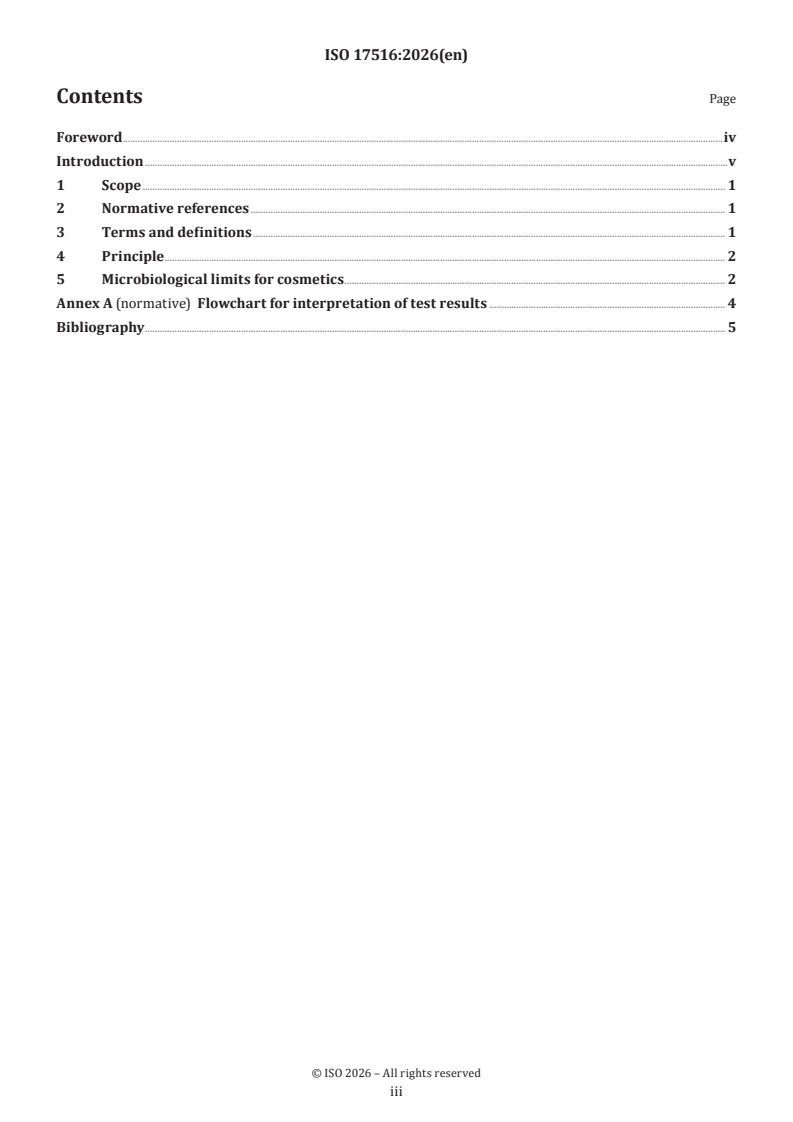
Contents
- Introduction
- 1 Scope
- 2 Normative references
- 3 Terms and definitions
- 3.1 product
- 3.2 aerobic mesophilic microorganisms
- 3.3 specified microorganism
- 3.4 Escherichia coli
- 3.5 Pseudomonas paraeruginosa
- 3.6 Staphylococcus aureus
- 3.7 Candida albicans
- 4 Principle
- 5 Microbiological limits for cosmetics
- Annex A
- Bibliography
Introduction
Every cosmetic manufacturer has a responsibility relative to the microbiological safety and quality of its products to ensure that they have been produced under hygienic conditions. Cosmetic products are not expected to be sterile. However, they shall not contain excessive amounts of microorganisms nor specified microorganisms that have the potential to affect the product quality or consumer safety. Moreover, some [1] cosmetic products which are considered to have low microbiological risk (see ISO 29621 ) may not need to be subjected to routine microbiological testing, and manufacturers can decide not to test if they can ensure products meet this standard.
[2] The manufacturer should follow the Good Manufacturing Practices described in ISO 22716 and take the necessary precautions to limit the introduction of microorganisms from raw materials, processing and [3] [4] packaging. When necessary, microbiological testing may be performed using ISO 21148 , ISO 21149 , [5] [6] [7] [8] [9] [10] ISO 16212 , ISO 18415 , ISO 18416 , ISO 21150 , ISO 22717 and ISO 22718 .
International Standard ISO 17516:2026(en) Cosmetics — Microbiology — Microbiological limits
1 Scope
This document specifies the acceptable quantitative and qualitative microbiological limits in finished cosmetic products. It is applicable to all cosmetics, and assists interested parties in the assessment of the microbiological quality of cosmetic products.
2 Normative references
There are no normative references in this document.
3 Terms and definitions
For the purposes of this document, the following terms and definitions apply. ISO and IEC maintain terminology databases for use in standardization at the following addresses:
- ISO Online browsing platform: available at https:// www .iso .org/ obp
- IEC Electropedia: available at https:// www .electropedia .org/
3.1 product
portion of an identified cosmetic product received in the laboratory for testing
3.2 aerobic mesophilic microorganisms
[4] mesophilic bacteria, yeast and mould growing aerobically under the conditions specified in ISO 21149 and [5] ISO 16212
3.3 specified microorganism
aerobic mesophilic bacteria or yeast that is undesirable in a cosmetic product because it can cause skin or eye infection or is an indication of hygienic failure [11] [SOURCE: ISO 18415:2017 , 3.6 — modified «terminology has changed».]
3.4 Escherichia coli
gram-negative rod, motile, smooth colonies [12] [SOURCE: ISO 21150:2015 , 3.6]
3.5 Pseudomonas paraeruginosa
Pseudomonas aeruginosa gram-negative rod, motile; smooth colonies pigmented brown or greenish [13] [SOURCE: ISO 22717:2015 , 3.6]
ISO 17516:2026(en)
...
Contents
- Introduction
- 1 Domaine d'application
- 2 Références normatives
- 3 Termes et définitions
- 3.1 produit
- 3.2 micro-organisme mésophile aérobie
- 3.3 micro-organismes spécifié,nom
- 3.4 Escherichia coli
- 3.5 Pseudomonas aeruginosa
- 3.6 Staphylococcus aureus
- 3.7 Candida albicans
- 4 Principe
- 5 Limites microbiologiques relatives aux produits cosmétiques
- Annexe A
- Bibliographie
Introduction
Chaque fabricant de produits cosmétiques est responsable de la sécurité microbiologique et de la qualité de ses produits et doit s’assurer qu’ils ont été produits dans des conditions hygiéniques. Les produits cosmétiques ne sont pas censés être stériles. Toutefois, ils ne doivent pas contenir de quantités excessives de micro-organismes ni de micro-organismes spécifiés susceptibles d’affecter la qualité du produit ou la sécurité du consommateur. De plus, il peut ne pas être nécessaire de soumettre certains produits [1] cosmétiques considérés comme présentant un faible risque microbiologique (voir l’ISO 29621 ) à des essais microbiologiques de routine et les fabricants peuvent choisir de ne pas les soumettre à essai s’ils peuvent assurer que leurs produits satisfont aux caractéristiques énoncées dans la présente norme. [2] Il convient que les fabricants respectent les bonnes pratiques de fabrication décrites dans l’ISO 22716 et prennent les précautions nécessaires pour limiter l’introduction de micro-organismes issus des matières premières, de la fabrication et du conditionnement. Si nécessaire, des essais microbiologiques peuvent être [3] [4] [5] [6] [7] [8] effectués en utilisant l'ISO 21148, l'ISO 21149, l'ISO 16212, l'ISO 18415, l'ISO 18416, l'ISO 21150, [9] [10] l'ISO 22717 et l'ISO 22718 .
Norme internationale ISO 17516:2026(fr) Cosmétiques — Microbiologie — Limites microbiologiques
1 Domaine d'application
Le présent document spécifie les limites microbiologiques quantitatives et qualitatives acceptables dans les produits cosmétiques finis. Il est applicable à tous les produits cosmétiques et aide les parties intéressées à évaluer la qualité microbiologique des produits cosmétiques.
2 Références normatives
Le présent document ne contient aucune référence normative.
3 Termes et définitions
Pour les besoins du présent document, les termes et définitions suivants s'appliquent. L'ISO et l'IEC tiennent à jour des bases de données terminologiques destinées à être utilisées en normalisation, consultables aux adresses suivantes:
- ISO Online browsing platform: disponible à l'adresse https:// www .iso .org/ obp
- IEC Electropedia: disponible à l'adresse https:// www .electropedia .org/
3.1 produit
portion d’un produit cosmétique identifié, reçue au laboratoire pour essais
3.2 micro-organisme mésophile aérobie
bactérie, levure et moisissure mésophiles se développant en aérobiose dans les conditions spécifiées dans [4] [5] l’ISO 21149 et l’ISO 16212
3.3 micro-organismes spécifié,nom
bactérie aérobie mésophile ou levure dont la présence dans un produit cosmétique est indésirable parce qu'elle peut causer une infection cutanée ou oculaire ou peut être considérée comme un indicateur de défaillance de l’hygiène [11] [SOURCE: ISO 18415:2017, 3.6 — modifié “la terminologie a changé”.]
3.4 Escherichia coli
bacille Gram négatif, mobile, formant des colonies lisses [12] [SOURCE: ISO 21150:2015, 3.6]
3.5 Pseudomonas aeruginosa
bacille Gram négatif mobile, formant des colonies lisses pigmentées de couleur marron ou verdâtre [13] [SOURCE: ISO 22717:2015, 3.6]
...