

ISO 12584:2013
(Main)Aerospace — Hydraulic fluid components — Expression of particulate contamination levels
General Information
- Abstract
ISO 12584:2013 defines the method of reporting and communicating the contamination (or cleanliness) level of components used in aerospace fluid systems. It also presents a coding system which allows cleanliness data to be reported, both in a shortened manner and in a complete manner, when communicating for reporting contamination level measurement results and for specifying cleanliness requirements.
- Status
- Published
- Publication Date
- 03-Nov-2013
- Technical Committee
- ISO/TC 20/SC 10 - Aerospace fluid systems and components
- Drafting Committee
- ISO/TC 20/SC 10/WG 8 - Hydraulic fluids and fluid contamination control
- Current Stage
- 9060 - Close of review
- Completion Date
- 04-Jun-2031

Overview
ISO 12584:2013 - "Aerospace - Hydraulic fluid components - Expression of particulate contamination levels" defines a consistent method for reporting and communicating particulate contamination (or component cleanliness) for components used in aerospace hydraulic fluid systems. The standard specifies how to extract and count particles, how to normalize results to a common reference volume (per 100 cm³ wetted volume), and provides the Component Cleanliness Code (CCC) - an alphanumeric coding system for succinct or complete reporting of cleanliness requirements and measurement results.
Key topics and requirements
- Scope and terminology: Defines component, component cleanliness, particulate contamination, wetted surface, and wetted volume (Vc) - the basis for reporting.
- Wetted volume determination: Two permitted approaches:
- Experimental filling method (dry interior, controlled fill, measure volume used), or
- Calculation from component geometry or CAD drawings.
- Particle extraction and analysis: Extraction must follow validated methods (see ISO 18413) and the extraction liquid is analyzed for particle counts across defined size classes. Use of calibrated automatic particle counters should conform to ISO 11171.
- Normalization of results: Particle counts are converted to numbers per 100 cm³ of wetted volume to enable consistent comparison across components.
- Component Cleanliness Code (CCC): A standardized code (e.g., CCC = (B9/C11/D10/EF8) or CCC = (11) for single-class reporting) that maps particle-size classes to maximum allowable counts (see Table 1 in the standard).
- Reporting flexibility: CCC can include all or a subset of size classes, or a single overall class when appropriate.
- Annex guidance: Annex A provides V/A (volume-to-surface area) relationships for converting surface-based cleanliness measures to volume-based measures. Annex B gives a sample analysis report format.
Applications and who uses it
ISO 12584:2013 is intended for:
- Aerospace manufacturers and suppliers specifying and verifying cleanliness of hydraulic pumps, valves, actuators, filters, and other fluid-system components.
- Quality, inspection and test laboratories performing particulate extraction and particle counting.
- Maintenance and overhaul organizations documenting acceptance criteria for reconditioned components.
- Design and reliability engineers defining cleanliness requirements to protect system performance and longevity.
Practical benefits include standardized cleanliness specifications, clearer supplier communication, reduced ambiguity in acceptance testing, and improved reliability of hydraulic systems by controlling particulate contamination at component-level.
Related standards
- ISO 18413 - Cleanliness of parts/components; contaminant collection, extraction and reporting principles.
- ISO 11171 - Calibration of automatic particle counters for liquids (relevant for APC use referenced in ISO 12584).
Keywords: ISO 12584:2013, component cleanliness, aerospace hydraulic, particulate contamination, wetted volume, Component Cleanliness Code, CCC, particle counting, ISO 18413, ISO 11171.
Get Certified
Connect with accredited certification bodies for this standard

BUREAU VERITAS Certification Germany
Bureau Veritas certification in Germany.

Element Materials Technology
Materials testing and product certification.

AQMS Ltd.
AQMS provides ISO certification to SMEs across the UK.
Sponsored listings
Frequently Asked Questions
ISO 12584:2013 is a standard published by the International Organization for Standardization (ISO). Its full title is "Aerospace — Hydraulic fluid components — Expression of particulate contamination levels". This standard covers: ISO 12584:2013 defines the method of reporting and communicating the contamination (or cleanliness) level of components used in aerospace fluid systems. It also presents a coding system which allows cleanliness data to be reported, both in a shortened manner and in a complete manner, when communicating for reporting contamination level measurement results and for specifying cleanliness requirements.
ISO 12584:2013 defines the method of reporting and communicating the contamination (or cleanliness) level of components used in aerospace fluid systems. It also presents a coding system which allows cleanliness data to be reported, both in a shortened manner and in a complete manner, when communicating for reporting contamination level measurement results and for specifying cleanliness requirements.
ISO 12584:2013 is classified under the following ICS (International Classification for Standards) categories: 49.080 - Aerospace fluid systems and components. The ICS classification helps identify the subject area and facilitates finding related standards.
ISO 12584:2013 is available in PDF format for immediate download after purchase. The document can be added to your cart and obtained through the secure checkout process. Digital delivery ensures instant access to the complete standard document.
Standards Content (Sample)
INTERNATIONAL ISO
STANDARD 12584
First edition
2013-11-01
Aerospace — Hydraulic fluid
components — Expression of
particulate contamination levels
Aéronautique et espace — Composants pour fluides hydrauliques —
Expression des niveaux de contamination particulaire
Reference number
©
ISO 2013
© ISO 2013
All rights reserved. Unless otherwise specified, no part of this publication may be reproduced or utilized otherwise in any form
or by any means, electronic or mechanical, including photocopying, or posting on the internet or an intranet, without prior
written permission. Permission can be requested from either ISO at the address below or ISO’s member body in the country of
the requester.
ISO copyright office
Case postale 56 • CH-1211 Geneva 20
Tel. + 41 22 749 01 11
Fax + 41 22 749 09 47
E-mail copyright@iso.org
Web www.iso.org
Published in Switzerland
ii © ISO 2013 – All rights reserved
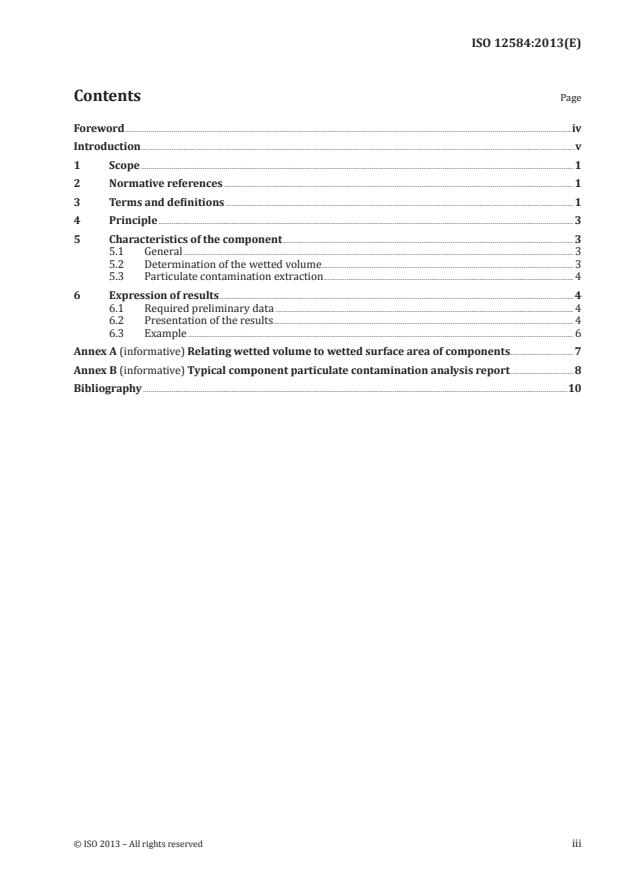
Contents Page
Foreword .iv
Introduction .v
1 Scope . 1
2 Normative references . 1
3 Terms and definitions . 1
4 Principle . 3
5 Characteristics of the component . 3
5.1 General . 3
5.2 Determination of the wetted volume . 3
5.3 Particulate contamination extraction . 4
6 Expression of results . 4
6.1 Required preliminary data . 4
6.2 Presentation of the results . 4
6.3 Example . 6
Annex A (informative) Relating wetted volume to wetted surface area of components.7
Annex B (informative) Typical component particulate contamination analysis report .8
Bibliography .10
Foreword
ISO (the International Organization for Standardization) is a worldwide federation of national standards
bodies (ISO member bodies). The work of preparing International Standards is normally carried out
through ISO technical committees. Each member body interested in a subject for which a technical
committee has been established has the right to be represented on that committee. International
organizations, governmental and non-governmental, in liaison with ISO, also take part in the work.
ISO collaborates closely with the International Electrotechnical Commission (IEC) on all matters of
electrotechnical standardization.
The procedures used to develop this document and those intended for its further maintenance are
described in the ISO/IEC Directives, Part 1. In particular the different approval criteria needed for the
different types of ISO documents should be noted. This document was drafted in accordance with the
editorial rules of the ISO/IEC Directives, Part 2. www.iso.org/directives
Attention is drawn to the possibility that some of the elements of this document may be the subject of
patent rights. ISO shall not be held responsible for identifying any or all such patent rights. Details of
any patent rights identified during the development of the document will be in the Introduction and/or
on the ISO list of patent declarations received. www.iso.org/patents
Any trade name used in this document is information given for the convenience of users and does not
constitute an endorsement.
The committee responsible for this document is ISO/TC 20, Aircraft and space vehicles, Subcommittee
SC 10, Aerospace fluid systems and components.
iv © ISO 2013 – All rights reserved
Introduction
The reliability of fluid circuits depends largely on the quantity and size of the particles conveyed by the fluid.
The cleanliness of the operating fluid is obtained and maintained by filtration at a level consistent
with the sensitivity of the system components to particulate contamination and the life and reliability
required by the operator of the system.
The cleanliness of the system at start-up is dependent on the cleanliness of the components as delivered,
the amount of contamination added during the build process, the cleanliness of the hydraulic liquid
used to fill the system, and how successful the liquid was in penetrating the clearances. The amount of
contamination added from these processes must be controlled to minimize the damage to the system
during the initial running period. Cleanliness specifications are fundamental to this.
This International Standard defines the terminology used in and the method of reporting and
communicating the cleanliness of components used in aerospace fluid systems. This will ensure
consistent and unambiguous reporting.
It also presents a coding system which allows cleanliness data to be reported either in a shortened
manner or in a complete manner for communication purposes or for specifying cleanliness requirements.
INTERNATIONAL STANDARD ISO 12584:2013(E)
Aerospace — Hydraulic fluid components — Expression of
particulate contamination levels
1 Scope
This International Standard defines the method of reporting and communicating the contamination (or
cleanliness) level of components used in aerospace fluid systems.
It also presents a coding system which allows cleanliness data to be reported, both in a shortened manner
and in a complete manner, when communicating for reporting contamination level measurement results
and for specifying cleanliness requirements.
2 Normative references
The following documents, in whole or in part, are normatively referenced in this document and are
indispensable for its application. For dated references, only the edition cited applies. For undated
references, the latest edition of the referenced document (including any amendments) applies.
ISO 11171, Hydraulic fluid power — Calibration of automatic particle counters for liquids
ISO 18413, Hydraulic fluid power — Cleanliness of parts and components — Inspection document and
principles related to contaminant collection, analysis and data reporting
3 Terms and definitions
For the purposes of this document, the following terms and definitions apply.
3.1
component
general term to cover a part, a subassembly, or a part assembly used on an aerospace fluid system
3.2
component cleanliness
condition of a component characterized by a level of particulate contamination
Note 1 to entry: Expression to be used preferably to set a specification.
3.3
component cleanliness code
CCC
alphanumeric expression of the particulate contamination level of a component or part for fluid circuits
3.4
particulate contamination
all undesirable particles which are in and on a component
Note 1 to entry: Expression to be used preferably to report measurements.
3.5
wetted surfaces
surface area of the component that is exposed to system liquid
EXAMPLE Hydraulic gear pump (see Figure 1).
Note 1 to entry: The wetted surface of a gear pump is the sum of the internal surfaces of the pump body (2 plates
+ 1 gear housing with 2 ports) and of the external surface of the two gear wheels. The example shown gives a
simplified illustration and does not include all surfaces wetted by the hydraulic liquid.
Figure 1 — Diagrammatic representation of the wetted surfaces of a hydraulic gear pump
3.6
wetted volume
V
c
volume of fluid contained in the component during normal operation
EXAMPLE Hydraulic gear pump (see Figure 2).
Note 1 to entry: The wetted volume of a gear pump is the volume of the gear housing minus the volume of the two
gears. The example shown gives a simplified illustration and does not include all of the volumes filled with the
hydraulic liquid.
Figure 2 — Diagrammatic representation of the wetted volume of a hydraulic gear pump
2 © ISO 2013 – All rights reserved
4 Principle
The particulate contamination of a component is expressed by a level related to the number of particles in
various size ranges and related to the wetted volume of the component. It is measured by counting particles
after they have been extracted from the component by an appropriate extraction method (see ISO 18413).
5 Characteristics of the component
5.1 General
The fluid cleanliness code of ISO 11218 has served as a basis for the drawing up of the component
cleanliness code. This fluid cleanliness code quantifies the number of particles of given sizes present in
a given volume (100 cm ) of fluid being analysed.
By definition, the contamination of a component is only present on its surfaces. Damage to components
of the fluid circuit is caused o
...