

ISO/IEC DTR 22216
(Main)Information security, cybersecurity and privacy protection — Technical developments in the ISO/IEC 15408 series and ISO/IEC 18045
- Abstract
This document: — introduces the break down between the former ISO/IEC 15408 series (ISO/IEC 15408-1:2009, ISO/IEC 15408-2:2008) and ISO/IEC 15408-3:2008) and ISO/IEC 18045:2008 and the new parts introduced in the ISO/IEC 15408:2022 series and ISO/IEC 18045:2022; — presents the concepts newly introduced as well as the rationale for their inclusion; — proposes an evolution path and information on how to move from CC 3.1 and CEM 3.1 to the ISO/IEC 15408:2022 series and ISO/IEC 18045:2022, respectively; — maps the evolutions between the CC 3.1 and CEM 3.1 and the ISO/IEC 15408:2022 series and ISO/IEC 18045:2022, respectively.
- Status
- Not Published
- Current Stage
- 5020 - Proof sent to secretariat or FDIS ballot initiated: 8 weeks - 50 Approval
- Start Date
- 30-Oct-2026
- Due Date
- 30-Oct-2026
- Completion Date
- 30-Oct-2026
Buy Documents

ISO/IEC DTR 22216 - Information security, cybersecurity and privacy protection — Technical developments in the ISO/IEC 15408 series and ISO/IEC 18045
REDLINE ISO/IEC DTR 22216 - Information security, cybersecurity and privacy protection — Technical developments in the ISO/IEC 15408 series and ISO/IEC 18045
ISO/IEC DTR 22216 is an ISO technical report about the technical developments in the ISO/IEC 15408 series and ISO/IEC 18045. It compares those updated parts with CC 3.1 and CEM 3.1, explains the new concepts, and shows how users can move between the older and newer evaluation frameworks. It is written for people who specify, evaluate, procure, or maintain Common Criteria-style IT security requirements.
What does ISO/IEC DTR 22216 specify?
ISO/IEC DTR 22216 summarizes the evolution from CC 3.1 and CEM 3.1 to the ISO/IEC 15408:2022 and ISO/IEC 18045:2022 framework, with the 2026 editions reflected in the comparisons. The document explains what changed, why the new concepts were introduced, and how to use the newer series in practice.
Its scope is transitional and comparative. It covers the split from the former three-part ISO/IEC 15408 series and ISO/IEC 18045 into the newer five-part structure, then maps the changes between the old and new evaluation frameworks.
The document is organized as follows:
- Clause 4 gives an overview and explains how to use the report.
- Clause 5 describes the new concepts and the main changes.
- Clause 6 explains how to apply the ISO/IEC 15408 series and ISO/IEC 18045 for specific needs.
- Clause 7 summarizes the evolutions in ISO/IEC 15408-1, -2, -3, -4, -5 and ISO/IEC 18045.
What are the key requirements of ISO/IEC DTR 22216?
ISO/IEC DTR 22216 is not an evaluation standard itself; it explains the structure and use of the ISO/IEC 15408 series and ISO/IEC 18045. The most important points are the new modularity model, the new evaluation models, and the new way of handling conformance.
Modularity and packaging
Clause 5.2 explains how the newer framework lets users build requirements in reusable pieces. This matters because it lets communities define shared security content once and reuse it across Protection Profiles (PPs), PP-Modules, Security Targets (STs), and supporting documents.
- Optional security functional requirements can be elective or conditional, so a requirement can be included only when a selection or condition applies. In practice, this helps a PP or ST describe product variants without creating separate documents for every option.
- Packages are reusable sets of security components or requirements, either assurance packages or functional packages. In practice, a package can carry a named body of requirements that a community can validate and reuse.
- PP-Modules are used for TOE features that are not present in every product of a type. In practice, they let editors model optional modules or alternative architectures while keeping the base PP stable.
- PP-Configurations combine PPs and PP-Modules, and they can be single-assurance or multi-assurance. In practice, this gives editors a structured way to assemble a complete target with consistent dependencies.
Evaluation and assurance models
Clause 5.3 introduces several ways to evaluate complex products and different security needs. This matters because not every TOE fits one uniform assurance level or one simple development chain.
- Composite evaluation supports layered products, where a dependent component relies on a base component. In practice, this lets evaluators reuse earlier results instead of repeating all work for each layer.
- The document also describes composed evaluation through ACO and composite evaluation through COMP. In practice, these two models address different architectures and let a supply chain or layered product be assessed in a way that matches how it is built.
- Multi-assurance evaluation allows different parts of the same TOE, called sub-TSFs, to be assessed at different assurance levels. In practice, this is useful when one part, such as a secure key store, needs stronger assurance than the rest of the product.
- A formal TSF model is defined for cases where the TOE is described by a formal security model covering the complete set of SFRs. In practice, this supports design, implementation, and review when assurance depends on precise formal reasoning.
Conformance and specification style
Clause 5.4 introduces exact conformance in addition to demonstrable and strict conformance. This matters because it tightens what a conformant ST may claim.
- Exact conformance means the ST stays within the scope of the PP or PP-Configuration it claims to follow. In practice, the ST includes the same security problem definition, objectives, SFRs and SARs, with assignments and selections resolved.
- Clause 6.3 contrasts the attack-based approach with the specification-based approach. In practice, attack-based evaluations use evaluator-driven test planning, while specification-based evaluations rely on pre-defined tests and exact conformance.
- The specification-based approach is intended for cases where the required tests are known in advance. In practice, this helps procurement and certification when the buyer wants clearly defined pass/fail criteria before evaluation begins.
How requirements and methods are built
Clause 6.1 and 6.2 explain the tools used to define and adapt requirements. This matters because many evaluations need tailoring without breaking the Common Criteria structure.
- Refinement strengthens an existing requirement. In practice, a refined requirement still satisfies the original one.
- Extended components are used when the standard catalogues of SFRs or SARs do not cover a needed concept. In practice, this is the way to model missing functionality or assurance properties when standard components are not enough.
- Application notes add context without changing the meaning of a requirement. In practice, they help domain users interpret terms and adapt the framework to a specific technology.
- ISO/IEC 15408-4 provides a framework for derived evaluation methods and activities. In practice, this is used to define objective and reproducible evaluation steps for specific technology areas.
- Supporting documents are another way to define tailored methods. In practice, communities such as smart card and network-device groups can publish detailed evaluation guidance aligned with the framework.
What terms does ISO/IEC DTR 22216 define?
ISO/IEC DTR 22216 uses the terms and definitions from ISO/IEC 15408-1 and ISO/IEC 18045, and it relies on a small set of common abbreviations.
- Common Criteria (CC) - The security evaluation framework that underlies the older reference model discussed throughout the report.
- Common Evaluation Methodology (CEM) - The methodology framework for conducting IT security evaluations.
- Protection Profile (PP) - A reusable statement of security needs for a TOE type, used to guide STs and evaluations.
- Security Target (ST) - The security specification for a specific TOE, including its security problem, objectives, and requirements.
- Target of Evaluation (TOE) - The product, system, or component being evaluated.
- TOE Security Functionality (TSF) - The parts of the TOE that enforce the security requirements.
- Security Functional Requirement (SFR) - A requirement for security behavior or security enforcement.
- Security Assurance Requirement (SAR) - A requirement for evidence and evaluation confidence about how the TOE is developed and assessed.
Who uses ISO/IEC DTR 22216?
ISO/IEC DTR 22216 is used by people who need to understand the transition between CC 3.1/CEM 3.1 and the newer ISO/IEC 15408 and ISO/IEC 18045 parts. It is especially useful when a project must decide whether to keep an existing Common Criteria structure or move to the newer modular and exact-conformance concepts.
Typical users include:
- risk owners defining assurance needs and procurement expectations
- developers writing STs, PPs, PP-Modules, or PP-Configurations
- evaluators planning test activities and interpreting conformance claims
- PP editors and collaborative Technical Communities building reusable requirements
- certification and scheme stakeholders working with products such as smart cards, secure elements, payment terminals, IoT gateways, network devices, and full drive encryption solutions
What changed in ISO/IEC DTR 22216 from the previous edition?
ISO/IEC DTR 22216 is the second edition and it cancels and replaces ISO/IEC TR 22216:2022. The foreword lists these main changes:
- the EUCC scheme is referenced, including the relevant bibliography
- the comparison with CC 3.1 R5 now covers the two most recent editions of the ISO/IEC 15408 series and ISO/IEC 18045
- the comparison of the SFR and SAR catalogues now covers all components explicitly
Which standards are used with ISO/IEC DTR 22216?
ISO/IEC DTR 22216 normatively refers to two standards:
- ISO/IEC 15408-1:2026 - provides the introduction and general model, and supplies the terms and definitions used by this report
- ISO/IEC 18045:2026 - provides the requirements and methodology for IT security evaluation, which this report uses when explaining evaluation methods and activities
The bibliography also points to ISO/IEC 15408-2:2026, ISO/IEC 15408-3:2026, ISO/IEC 15408-4:2026 and ISO/IEC 15408-5:2026, along with CC 3.1 and CEM 3.1 references and several scheme or community documents.
What does the ISO/IEC DTR 22216 document contain?
ISO/IEC DTR 22216 contains comparative and explanatory material rather than a set of testable requirements. Table 1 introduces the main new concepts and changes, while Tables 2 to 16 compare the evolution of the main classes and families across the series.
The figures show how the framework is structured and used in practice. Early figures explain the relationship between the parts of ISO/IEC 15408 and ISO/IEC 18045, and later figures illustrate PPs, PP-Modules, PP-Configurations, ST content, and the two evaluation approaches.
Clause 7 is the most detailed comparison section. It tracks changes in the requirements and assurance classes, including APE, ACE, ASE, ADV, AGD, ALC, ATE, AVA and ACO, and it identifies the new families used for composite and multi-assurance evaluation.
Relations
- Effective Date
- 29-Mar-2025
Buy Documents
ISO/IEC DTR 22216 - Information security, cybersecurity and privacy protection — Technical developments in the ISO/IEC 15408 series and ISO/IEC 18045
REDLINE ISO/IEC DTR 22216 - Information security, cybersecurity and privacy protection — Technical developments in the ISO/IEC 15408 series and ISO/IEC 18045
Get Certified
Connect with accredited certification bodies for this standard

BSI Group
BSI (British Standards Institution) is the business standards company that helps organizations make excellence a habit.

Bureau Veritas
Bureau Veritas is a world leader in laboratory testing, inspection and certification services.

DNV
DNV is an independent assurance and risk management provider.
Sponsored listings
Frequently Asked Questions
ISO/IEC DTR 22216 is a draft published by the International Organization for Standardization (ISO). Its full title is "Information security, cybersecurity and privacy protection — Technical developments in the ISO/IEC 15408 series and ISO/IEC 18045". This standard covers: This document: — introduces the break down between the former ISO/IEC 15408 series (ISO/IEC 15408-1:2009, ISO/IEC 15408-2:2008) and ISO/IEC 15408-3:2008) and ISO/IEC 18045:2008 and the new parts introduced in the ISO/IEC 15408:2022 series and ISO/IEC 18045:2022; — presents the concepts newly introduced as well as the rationale for their inclusion; — proposes an evolution path and information on how to move from CC 3.1 and CEM 3.1 to the ISO/IEC 15408:2022 series and ISO/IEC 18045:2022, respectively; — maps the evolutions between the CC 3.1 and CEM 3.1 and the ISO/IEC 15408:2022 series and ISO/IEC 18045:2022, respectively.
This document: — introduces the break down between the former ISO/IEC 15408 series (ISO/IEC 15408-1:2009, ISO/IEC 15408-2:2008) and ISO/IEC 15408-3:2008) and ISO/IEC 18045:2008 and the new parts introduced in the ISO/IEC 15408:2022 series and ISO/IEC 18045:2022; — presents the concepts newly introduced as well as the rationale for their inclusion; — proposes an evolution path and information on how to move from CC 3.1 and CEM 3.1 to the ISO/IEC 15408:2022 series and ISO/IEC 18045:2022, respectively; — maps the evolutions between the CC 3.1 and CEM 3.1 and the ISO/IEC 15408:2022 series and ISO/IEC 18045:2022, respectively.
ISO/IEC DTR 22216 is classified under the following ICS (International Classification for Standards) categories: 35.030 - IT Security. The ICS classification helps identify the subject area and facilitates finding related standards.
ISO/IEC DTR 22216 has the following relationships with other standards: It is inter standard links to ISO/IEC TR 22216:2022. Understanding these relationships helps ensure you are using the most current and applicable version of the standard.
ISO/IEC DTR 22216 is available in PDF format for immediate download after purchase. The document can be added to your cart and obtained through the secure checkout process. Digital delivery ensures instant access to the complete standard document.
Standards Content (Sample)
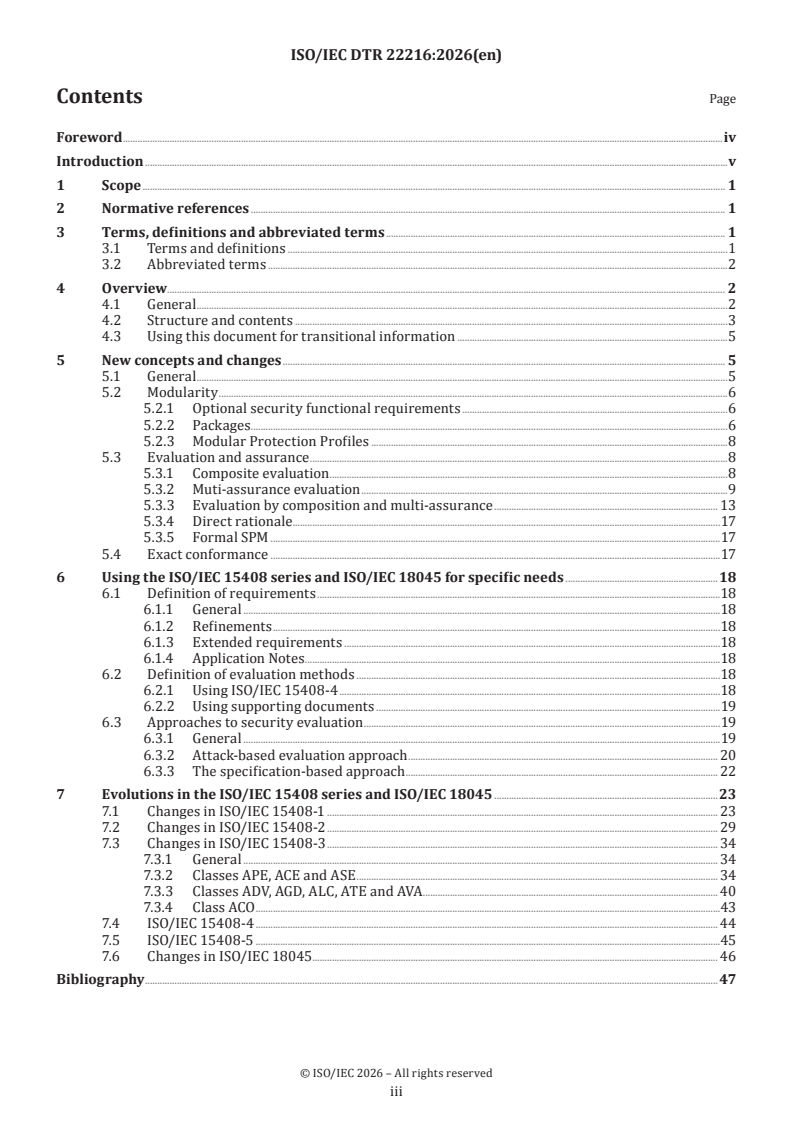
Contents
- Introduction
- 1 Scope
- 2 Normative references
- 3 Terms, definitions and abbreviated terms
- 3.1 Terms and definitions
- 3.2 Abbreviated terms
- 4 Overview
- 4.1 General
- 4.2 Structure and contents
- 4.3 Using this document for transitional information
- 5 New concepts and changes
- 5.1 General
- 5.2 Modularity
- 5.3 Evaluation and assurance
- 5.4 Exact conformance
- 6 Using the ISO/IEC 15408 series and ISO/IEC 18045 for specific needs
- 6.1 Definition of requirements
- 6.2 Definition of evaluation methods
- 6.3 Approaches to security evaluation
- 5.1 Overview
- 5.2 Specification of an Evaluation Method
- 6.1 Overview
- 6.2 Specification of an evaluation activity
- Bibliography
- 1.1 [21] EUCC — Minimum Site Security Requirements, version 2
Introduction
This document describes the main technical developments (e.g. new concepts, changes and improvements) 1) of the ISO/IEC 15408 series and ISO/IEC 18045 compared to Common Criteria v3.1 Revision 5 (CC 3.1) and 2) Common Evaluation Methodology v3.1 Revision 5 (CEM 3.1) .
3) Substantial changes to CC 3.1 and CEM 3.1 were introduced in ISO/IEC 15408-1:2022 , 4) 5) 6) 7) ISO/IEC 15408-2:2022 , ISO/IEC 15408-3:2022 , ISO/IEC 15408-4:2022 , ISO/IEC 15408-5:2022 and 8) ISO/IEC 18045:2022 to cover complex products, meet the needs of CC users within the framework of the [15] [16] Common Criteria Recognition Arrangement (CCRA) and the EUCC scheme, and align with existing processes and supporting documents. ISO/IEC 15408-1:2026, ISO/IEC 15408-2:2026, ISO/IEC 15408-3:2026, ISO/IEC 15408-4:2026, ISO/IEC 15408-5:2026 and ISO/IEC 18045:2026 include editorial improvements, clarifications and the correction of certain errors, but no significant changes. The purpose of this document is to provide information to users of the CC 3.1 and CEM 3.1 standards, as well as to users of the ISO/IEC 15408 series and ISO/IEC 18045, in the context of the transition to or from these evaluation frameworks.
It is assumed that readers of this document are familiar with CC 3.1 and CEM 3.1, or the ISO/IEC 15408 series and ISO/IEC 18045.
1) The CC 3.1 is based on the third edition of the ISO/IEC 15408 series. 2) The CEM 3.1 is based on the third edition of ISO/IEC 18045. 3) Cancelled and replaced by ISO/IEC 15408-1:2026.
4) Cancelled and replaced by ISO/IEC 15408-2:2026.
5) Cancelled and replaced by ISO/IEC 15408-3:2026.
6) Cancelled and replaced by ISO/IEC 15408-4:2026.
7) Cancelled and replaced by ISO/IEC 15408-5:2026.
8) Cancelled and replaced by ISO/IEC 18405:2026.
FINAL DRAFT Technical Report ISO/IEC DTR 22216:2026(en) Information security, cybersecurity and privacy protection — Technical developments in the ISO/IEC 15408 series and ISO/ IEC 18045
1 Scope
This document provides a summary of the technical developments in the ISO/IEC 15408 series and [1]-[3] [4] ISO/IEC 18045, compared to the CC 3.1 and CEM 3.1 standards.
This document:
- describes the break down between the CC 3.1 standard and the parts of the ISO/IEC 15408 series;
- presents the concepts that were introduced or updated in ISO/IEC 15408-1:2022, ISO/IEC 15408-2:2022, ISO/IEC 15408-3:2022, ISO/IEC 15408-4:2022, ISO/IEC 15408-5:2022, ISO/IEC 18045:2022;
- provides information on how to use the ISO/IEC 15408 series and ISO/IEC 18045;
- summarizes the technical changes between the CC 3.1 and CEM 3.1 on one hand, and the ISO/IEC 15408 series and ISO/IEC 18045 on the other hand.
2 Normative references
The following documents are referred to in the text in such a way that some or all of their content constitutes requirements of this document.
ISO/IEC 15408-1:2026, Information security, cybersecurity and privacy protection — Evaluation criteria for IT security — Part 1: Introduction and general model ISO/IEC 18045:2026, Information security, cybersecurity and privacy protection — Evaluation criteria for IT security — Requirements and methodology for IT security evaluation
3 Terms, definitions and abbreviated terms
3.1 Terms and definitions
For the purposes of this document, the terms and definitions given in ISO/IEC 15408-1 and ISO/IEC 18045 apply.
ISO and IEC maintain terminology databases for use in standardization at the following addresses:
- ISO Online browsing platform: available at https:// www .iso .org/ obp
- IEC Electropedia: available at https:// www .electropedia .org/
ISO/IEC DTR 22216:2026(en)
3.2 Abbreviated terms
CC Common Criteria CCRA Common Criteria Recognition Arrangement CEM Common Evaluation Methodology cPP collaborative PP EAL evaluation assurance level EUCC European Common Criteria iTC international Technical Community POI Point of Interaction PP Protection Profile SAR security assurance requirement SFR security functional requirement ST Security Target TOE target of evaluation TSF TOE security functionality
4 Overview
4.1 General
This document helps primarily users of CC 3.1 and CEM 3.1 to understand the new or updated concepts, and how they can adapt the use of the ISO/IEC 15408 series and ISO/IEC 18045 to their needs (e.g. by defining supporting documents, refinements, application notes or extended requirements in packages, PPs, PP- Modules and STs).
This document also helps users of the ISO/IEC 15408 series and ISO/IEC 18045 to trace back to the original elements in CC 3.1 and CEM 3.1 where applicable, e.g. to facilitate the use of CC 3.1-conformant packages, PPs, PP-Modules and PP-Configurations.
This document is organized as follows:
- 4.2 describes the structure of the ISO/IEC 15408 series and ISO/IEC 18045;
- 4.3 describes how to use this document;
- Clause 5 presents the major new and updated concepts of the ISO/IEC 15408 series and ISO/IEC 18045 and previous editions (i.e. ISO/IEC 15408-1:2022, ISO/IEC 15408-2:2022, ISO/IEC 15408-3:2022, ISO/IEC 15408-4:2022, ISO/IEC 15408-5:2022, and ISO/IEC 18045:2022) compared to CC 3.1 and CEM 3.1;
- Clause 6 provides information for applying the ISO/IEC 15408 series and ISO/IEC 18045 for specific needs;
- Clause 7 summarizes the changes of the ISO/IEC 15408 series and ISO/IEC 18045 and previous editions (i.e. ISO/IEC 18045:2022, ISO/IEC 15408-1:2022, ISO/IEC 15408-2:2022, ISO/IEC 15408-3:2022, ISO/IEC 15408-4:2022, ISO/IEC 15408-5:2022) compared to CC 3.1 and CEM 3.1.
ISO/IEC DTR 22216:2026(en)
4.2 Structure and contents
The ISO/IEC 15408 series comprises five parts, compared to three parts in the CC 3.1. The additional part ISO/IEC 15408-4 defines a framework for deriving evaluation methods and activities from the evaluation methodology defined in ISO/IEC 18045. These derived evaluation methods and activities can potentially be included in packages, PPs, PP-Modules, STs and any documents supporting them. The additional part ISO/IEC 15408-5 provides pre-defined security requirements identified as relevant for supporting common stakeholder use cases. It contains the definition of EALs (evaluation assurance levels) and CAPs (composed assurance packages) that were previously given in CC 3.1 Part 3 and some additional packages.
Figure 1 illustrates the structure of the ISO/IEC 15408 series and ISO/IEC 18045, and their relationship to the CC 3.1 parts and CEM 3.1.
Figure 1 — Structure of ISO/IEC 15408 series and ISO/IEC 18045 Table 1 presents the main new concepts and changes in the ISO/IEC 15408 series and ISO/IEC 18045 compared to CC 3.1 and CEM 3.1.
ISO/IEC DTR 22216:2026(en) Table 1 — Main new concepts and changes New concepts Document Description Impacted standards and changes ISO/IEC 15408- Exact A new hierarchical relationship is established between ISO/IEC 15408-3:2022 1:2022 a PP or a PP-Configuration and an ST whereby all the conformance ISO/IEC 18045:2022 requirements in the ST are drawn from the PP or the
PP-Configuration, respectively. An ST is permitted to ISO/IEC 15408- ISO/IEC 15408-3:2026 claim exact conformance to exactly one PP-Configu- 1:2026 ISO/IEC 18045:2026 ration; it is permitted to claim exact conformance to one or more PPs.
If a PP/PP-Configuration states that exact conformance is required, the ST will conform to it in an exact manner, i.e. it will contain SPD and objectives identical to the ones in the PP, and the same set of SFRs as the PP/PP-Configuration with all the assignments and selections resolved.
Direct rationale A construct allowing for an alternative method to de- ISO/IEC 15408-3:2022 rive the SFRs is established. The SFRs are specified by ISO/IEC 18045:2022 direct mapping from the SPD; security objectives for
the TOE are not included, although security objectives ISO/IEC 15408-3:2026 for the operational environment can be specified.
ISO/IEC 18045:2026 This approach can be used with PPs, PP-Modules, STs and/or functional packages, allowing for a PP-Configuration that adopts a direct rationale approach to be specified.
PP-Modules PP-Modules constitute internally consistent sets of ISO/IEC 15408-3:2022 SPD-elements, security objectives for the TOE and ISO/IEC 18045:2022 the operational environment, security functional
requirements and security assurance requirements, ISO/IEC 15408-3:2026 defined in the context of one or more specific base ISO/IEC 18045:2026 PPs and possibly of other PP-Modules.
They are meant for addressing specific security features of a given TOE type that cannot be imposed uniformly for all products of that type.
They are used only in conjunction with PP-Configurations.
Multi-assurance A new evaluation paradigm is created, which ISO/IEC 15408-3:2022 evaluation ISO/IEC 18045:2022 - allows heterogeneous products or systems to be
evaluated in a consistent and coherent manner;
ISO/IEC 15408-3:2026 ISO/IEC 18045:2026 - offers the possibility of adapting the assurance level for a product in terms of the different assurance levels of its components.
Composite Some products have complex supply chains and are ISO/IEC 15408-3:2022 built by composition.
evaluation ISO/IEC 18045:2022 The composite evaluation method allows and facilitates
the evaluation by each actor involved in the supply ISO/IEC 15408-3:2026 chain. In the absence of the composite evaluation ISO/IEC 18045:2026 method, the evaluation of such products requires that evidence be provided to developers, which they possibly do not possess.
ISO/IEC DTR 22216:2026(en) TTabablele 1 1 ((ccoonnttiinnueuedd)) New concepts Document Description Impacted standards and changes ISO/IEC 15408- Complete formal Inadequacies in a TOE are frequently a consequence of ISO/IEC 18045:2022 3:2022 TSF model misunderstanding the security requirements which,
in turn leads to their flawed implementation.
ISO/IEC 18045:2026 A complete formal TSF model is a formal security model ISO/IEC 15408- encapsulating the important aspects of security and 3:2026 their relationship to the behaviour of the TOE. More specifically, it is a formal representation of the TSF as defined by the complete set of SFRs described in the ST and the set of its formal properties covers all the security objectives for the TOE.
The formal TSF model can provide support and precise information throughout the design, implementation and review processes, thereby providing an increased level of assurance that the SFRs and the security objectives of the ST are satisfied by the TOE.
4.3 Using this document for transitional information
From the point of view of risk owners, three main categories of needs are addressed in the ISO/IEC 15408 series and ISO/IEC 18045:
- ensuring that developers strictly adhere to a test plan defined or approved by the risk owner, rather than leaving it to the evaluators to draw up the plan (see the new specification-based evaluation approach in 6.3.3): this relies on exact conformance and specific evaluation methods and activities (see 5.4 and 6.2);
- allowing the evaluation of complex products: this translates into composite and multi-assurance evaluation (see 5.3.1 and 5.3.2);
- defining modular specifications of security requirements: this translates into optional requirements, packages, PP-Modules and PP-Configurations (see 5.2).
The ISO/IEC 15408 series and ISO/IEC 18045 continue supporting the evaluation approach where evaluations are conducted in accordance with state-of-the art test plans designed by evaluators and taking into account the characteristics of the specific target of evaluation (see the attack-based evaluation approach in 6.3.2). Risk owners often rely on PPs to express their specific security requirements in an unambiguous, implementation-independent manner. New PPs can follow either of the two evaluation approaches (see 6.3) and use new features such as composite evaluation and direct rationale PPs (see Clause 5). For existing PPs, Figure 16 illustrates the changes in the mandatory content with respect to CC 3.1. Developers can reuse the CC 3.1-conformant STs and PPs since the security functional and assurance requirements defined in CC 3.1 are compatible with ISO/IEC 15408-2:2026, ISO/IEC 15408-3:2026 and previous editions (i.e. ISO/IEC 15408-2:2022 and ISO/IEC 15408-3:2022). Furthermore, ISO/IEC 15408-2:2022 introduced new SFRs which eliminate or reduce the need for extended components, thereby simplifying the complexity of STs and PPs.
Finally, 7.2 presents the changes made to the SFRs defined in CC 3.1 Part 2, ISO/IEC 15408-2:2022 and ISO/IEC 15408-2:2026, and 7.3 presents the changes made to the SARs defined in CC 3.1 Part 3, ISO/IEC 15408-3:2022 and ISO/IEC 15408-3:2026.
5 New concepts and changes
5.1 General
This clause outlines the new concepts and changes defined in the ISO/IEC 15408 series and ISO/IEC 18045 compared to CC 3.1 and CEM 3.1, except for ISO/IEC 15408-4 which is covered in 6.2.1.
ISO/IEC DTR 22216:2026(en) The ISO/IEC 15408 series and ISO/IEC 18045 provide various mechanisms to facilitate the definition of requirements and the evaluation processes. Some of these mechanisms originate in CC 3.1 and CEM 3.1, and some are new.
The modularity mechanisms that aim to facilitate the decomposition and organization of the set of requirements that apply to a given type of TOE are outlined in 5.2. This includes:
- optional security functional requirements;
- functional and assurance packages (notably EALs);
- modular PPs, which provide additional means to define optional features and extended TOEs through PP-Modules and PPs combined in PP-Configurations.
NOTE Security functional requirements can be grouped into specific sections of documents such as a PP, in order to improve readability, without necessarily defining packages or PP-Modules. The mechanisms related to the evaluation and assurance type are outlined in 5.3. This includes:
- composite evaluation, to evaluate layered TOEs in an incremental way through specific _COMP assurance components. This type of evaluation is complementary to the evaluation of composed products by means of ACO assurance class;
- multi-assurance evaluation paradigm, which allows addressing heterogeneous products or systems;
- direct rationale PPs, PP-Modules and STs, which allow to derive security functional requirements directly from the SPD, and replace the notion of low assurance;
- evaluation of formal models of the TSF.
The exact conformance mechanism, presented in 5.4, is key to the specification-based evaluation approach. These mechanisms allow addressing problems such as:
- products where only the most critical assets are managed by a secure element can be candidates for multi-assurance evaluation;
- products where different vendors provide the software and hardware layers can be candidates for composite evaluation;
- specific procurement needs, which can give rise to ad hoc assurance packages, complementary to predefined EALs, in order to ensure consistency, comparability and sufficiency of evidence when evaluating the robustness of a product against a given class of attackers.
5.2 Modularity
5.2.1 Optional security functional requirements
A new feature of the ISO/IEC 15408 series is the possibility of addressing optional features of a TOE by means of optional SFRs at the level of packages, PPs and PP-Modules. Optional SFRs can be elective or conditional. Elective SFRs can be included or not in STs without impacting the conformity with the package/PP/PP-Module. Conditional SFRs must be included in STs that satisfy the condition. Conditional SFRs are classified as selection-based SFRs if their presence depends on the value of a selection operation.
5.2.2 Packages
Packages are sets of security components or requirements with specific characteristics:
- they are reusable (this is why they are uniquely identified);
ISO/IEC DTR 22216:2026(en) - they are typically written or validated by a community, e.g. the pre-defined EAL packages defined in ISO/IEC 15408-5; - therefore, they do not only improve readability but consist of sets of requirements that are “useful and effective in combination”, as explained in ISO/IEC 15408-1.
A package can be:
- a named assurance package, containing assurance requirements and no functional requirement; or
- a named functional package, containing functional requirements and no assurance requirement. The ISO/IEC 15408 series defines a richer package structure compared to CC 3.1, which includes:
- the package identification, comprising the package’s name, the version and date, the sponsor, and a reference to the edition of the ISO/IEC 15408 series that was used;
- the package type, i.e. assurance or functional package;
- the package overview describing the intent of the package;
- optional application notes containing information of particular interest to the package users;
- the package’s security components or requirements (either SARs or SFRs), as well as a rationale for their selection.
Additionally, the ISO/IEC 15408 series allows to define a security problem definition (SPD) and security objectives for the TOE and for the TOE operational environment in the functional packages. Furthermore, functional packages can optionally declare a set of SFRs that are required for the package to be used or included in an ST or PP. In this case, this set of SFRs can be seen as a mandatory dependency at the package level.
It is not mandatory for packages to include all the dependent components. However, a package-conformant ST or PP must consider the dependencies and justify any exclusion. Packages can also include evaluation methods and activities (see 6.2.1), associated with the relevant security requirements. Alternatively, the evaluation methods and activities can be provided in a separate document. EXAMPLE Packages can be defined with different purposes:
- package(s) driven by a selection that is operated in an SFR;
- packages including a consistent set of assurance requirements: pre-defined EAL1 to EAL7 are examples of widely used assurance packages;
- packages including a consistent set of functional requirements: a given community can decide to define, e.g. a functional package to cover specific security objectives, such as secure channels using a given proprietary protocol. The protocol can be broken down into several SFRs, e.g. authentication, information flow control policy, and corresponding cryptographic capacities. Such a package could then be reused within the community by referencing or copying it in different PPs, PP-Modules and STs;
- functional packages including an SPD: depending on the richness of the functionalities offered by the package, the editor can consider including a specific SPD which is covered by the SFRs. For example, a PP for an IPSec tunnel can include a key distribution package and a negotiation and key generation package, where each package defines its specific threats that in this case do not overlap with the other:
- in the key distribution package, assumptions can cover the interception threats during the distribution;
- in the negotiation and key generation package, threats can include key leakage or deduction. New assurance packages are defined in ISO/IEC 15408-5:
- package COMP (Composite product) facilitates the evaluation of composite products;
ISO/IEC DTR 22216:2026(en) - package PPA (Protection Profile assurance) provides assurance packages for PP evaluation, including direct rationale PPs; - package STA (Security Target assurance) provides assurance packages for ST evaluation, including direct rationale STs.
5.2.3 Modular Protection Profiles
Modular PPs provide an additional level of control for PP editors compared to functional packages:
...
Contents
- Introduction
- 1 Scope
- 2 Normative references
- 3 Terms, definitions and abbreviated terms
- 3.1 Terms and definitions
- 3.2 Abbreviated terms
- 4 Overview
- 4.1 General
- 4.2 Structure and contents
- 4.3 Using this document for transitional information
- 5 New concepts and changes
- 5.1 General
- 5.2 Modularity
- 5.3 Evaluation and assurance
- 5.4 Exact conformance
- 6 Using the standardISO/IEC 15408 series and ISO/IEC 18045 for specific needs
- 6.1 Definition of requirements
- 6.2 Definition of evaluation methods
- 6.3 Approaches to security evaluation
- 5.1 Overview
- 5.2 Specification of an Evaluation Method
- 6.1 Overview
- 6.2 Specification of an evaluation activity
- Bibliography
- 1.1 [21] EUCC — Minimum Site Security Requirements, version 2
Introduction
This document describes the main technical developments (e.g. new concepts, changes and improvements) of 11) the ISO/IEC 15408 series and ISO/IEC 18045 compared to Common Criteria v3.1 Revision 5 (CC 3.1) and 2 2) Common Evaluation Methodology v3.1 Revision 5 (CEM 3.1) . .
3 3) Substantial changes to CC 3.1 and CEM 3.1 were introduced in ISO/IEC 15408-1:2022 , , ISO/IEC 15408- 4 4) 5 5) 6 6) 77) 2:2022 , , ISO/IEC 15408-3:2022 , , ISO/IEC 15408-4:2022 , , ISO/IEC 15408-5:2022 and ISO/IEC 88) 18045:2022 to cover complex products, meet the needs of CC users within the framework of the Common [15] [16] Criteria Recognition Arrangement (CCRA) and the EUCC scheme,, and align with existing processes and supporting documents. The ISO/IEC 15408-1:2026, ISO/IEC 15408-2:2026, ISO/IEC 15408-3:2026, ISO/IEC 15408-4:2026, ISO/IEC 15408-5:2026 and ISO/IEC 18045:2026 include editorial improvements, clarifications and the correction of certain errors, but no significant changes. The purpose of this document is to provide information to users of the CC 3.1 and CEM 3.1 standards, as well as to users of the ISO/IEC 15408 series and ISO/IEC 18045, in the context of the transition to or from these evaluation frameworks.
It is assumed that readers of this document are familiar with CC 3.1 and CEM 3.1, or the ISO/IEC 15408 series and ISO/IEC 18045 standard. .
The CC 3.1 is based on the third edition of the ISO/IEC 15408 series. 1) The CC 3.1 is based on the third edition of the ISO/IEC 15408 series.
The CEM 3.1 is based on the third edition of the ISO/IEC 18045 standard. 2) The CEM 3.1 is based on the third edition of ISO/IEC 18045.
Cancelled and replaced by ISO/IEC 15408-1:2026.
3) Cancelled and replaced by ISO/IEC 15408-1:2026.
Cancelled and replaced by ISO/IEC 15408-2:2026.
4) Cancelled and replaced by ISO/IEC 15408-2:2026.
Cancelled and replaced by ISO/IEC 15408-3:2026.
5) Cancelled and replaced by ISO/IEC 15408-3:2026.
Cancelled and replaced by ISO/IEC 15408-4:2026.
6) Cancelled and replaced by ISO/IEC 15408-4:2026.
Cancelled and replaced by ISO/IEC 15408-5:2026.
7) Cancelled and replaced by ISO/IEC 15408-5:2026.
Cancelled and replaced by ISO/IEC 18045:2026.
8) Cancelled and replaced by ISO/IEC 18405:2026.
TECHNICAL REPORT ISO/IEC TR 22216:2026(E)
Information security, cybersecurity and privacy protection — Technical developments in the ISO/IEC 15408 (multi-part)series and ISO/IEC 18045
1 Scope
This document provides a summary of the technical developments in the ISO/IEC 15408 series and ISO/IEC [1] ]-[ [3] [4] 18045, compared to the CC 3.1 - and CEM 3.1 standards.
This document:
- describes the break down between the CC 3.1 standard and the parts of the ISO/IEC 15408 series;
- presents the concepts that were introduced or updated in the ISO/IEC 15408-1:2022, ISO/IEC 15408- 2:2022, ISO/IEC 15408-3:2022, ISO/IEC 15408-4:2022, ISO/IEC 15408-5:2022, ISO/IEC 18045:2022;
- provides information on how to use the ISO/IEC 15408 series and ISO/IEC 18045;
- summarisessummarizes the technical changes between the CC 3.1 and CEM 3.1 on one hand, and the ISO/IEC 15408 series and ISO/IEC 18045 on the other hand.
2 Normative references
The following documents are referred to in the text in such a way that some or all of their content constitutes requirements of this document.
ISO/IEC 15408--1:2026, Information security, cybersecurity and privacy protection — Evaluation criteria for IT security — Part 1: Introduction and general model ISO/IEC 18045:2026, Information security, cybersecurity and privacy protection — Evaluation criteria for IT security — MethodologyRequirements and methodology for IT security evaluation
3 Terms, definitions and abbreviated terms
3.1 Terms and definitions
For the purposes of this document, the terms and definitions given in ISO/IEC 15408-1 and ISO/IEC 18045 apply.
ISO and IEC maintain terminology databases for use in standardization at the following addresses:
- ISO Online browsing platform: available at https://www.iso.org/obp;
- IEC Electropedia: available at https://www.electropedia.org/.
3.2 Abbreviated terms
CC Common Criteria
ISO/IEC TRDTR 22216:2026(E:(en) CCRA Common Criteria Recognition Arrangement CEM Common Evaluation Methodology cPP collaborative PP EAL evaluation assurance level EUCC European Common Criteria iTC international Technical Community POI Point of Interaction PP Protection Profile SAR security assurance requirement SFR security functional requirement ST Security Target TOE target of evaluation TSF TOE security functionality
4 Overview
4.1 General
This document helps primarily users of CC 3.1 and CEM 3.1 to understand the new or updated concepts, and how they can adapt the use of the ISO/IEC 15408 series and ISO/IEC 18045 to their needs (e.g. by defining supporting documents, refinements, application notes or extended requirements in packages, PPs, PP- Modules and STs).
This document also helps users of the ISO/IEC 15408 series and ISO/IEC 18045 to trace back to the original elements in CC 3.1 and CEM 3.1 where applicable, e.g. to facilitate the use of CC 3.1-conformant packages, PPs, PP-Modules and PP-Configurations.
This document is organisedorganized as follows:
- 4.2Clause describes the structure of the ISO/IEC 15408 series and ISO/IEC 18045;
- 4.3Clause describes how to use this document;
- Clause 5Clause presents the major new and updated concepts of the ISO/IEC 15408 series and ISO/IEC 18045 and previous editions (i.e. ISO/IEC 15408-1:2022, ISO/IEC 15408-2:2022, ISO/IEC 15408-3:2022, ISO/IEC 15408-4:2022, ISO/IEC 15408-5:2022, and ISO/IEC 18045:2022) compared to CC 3.1 and CEM 3.1;
- Clause 6Clause provides information for applying the ISO/IEC 15408 series and ISO/IEC 18045 for specific needs;
- Clause 7Clause summarises summarizes the changes of the ISO/IEC 15408 series and ISO/IEC 18045 and previous editions (i.e. ISO/IEC 18045:2022, ISO/IEC 15408-1:2022, ISO/IEC 15408-2:2022, ISO/IEC 15408-3:2022, ISO/IEC 15408-4:2022, ISO/IEC 15408-5:2022) compared to CC 3.1 and CEM 3.1.
ISO/IEC TRDTR 22216:2026(E:(en)
4.2 Structure and contents
The ISO/IEC 15408 series includecomprises five parts, compared to three parts in the CC 3.1. The newadditional part ISO/IEC 15408-4 defines a framework for deriving evaluation methods and activities from the evaluation methodology defined in ISO/IEC 18045. These derived evaluation methods and activities can potentially be included in packages, PPs, PP-Modules, STs and any documents supporting them. The newadditional part ISO/IEC 15408-5 provides pre-defined security requirements identified as relevant for supporting common stakeholder use cases. It contains the definition of EALs (evaluation assurance levels) and CAPs (composed assurance packages) that waswere previously given in CC 3.1 Part 3 and some additional packages.
Figure 1 illustrates the structure of the ISO/IEC 15408 series and ISO/IEC 18045, and their relationship to the CC 3.1 parts and CEM 3.1.
Figure 1 — Structure of ISO/IEC 15408 series and ISO/IEC 18045 Table 1 presents the main new concepts and changes in the ISO/IEC 15408 series and ISO/IEC 18045 compared to CC 3.1 and CEM 3.1.
ISO/IEC TRDTR 22216:2026(E:(en) Table 1 — Main new concepts and changes New concepts ImpactImpacted Document Description and changes standards ISO/IEC 15408- Exact A new hierarchical relationship is established ISO/IEC 15408-3:2022 Split Cells 1:2022 between a PP or a PP-Configuration and an ST conformance ISO/IEC 18045:2022 whereby all the requirements in the ST are drawn
from the PP or the PP-Configuration, respectively.
ISO/IEC 15408- ISO/IEC 15408-3:2026 An ST is allowedpermitted to claim exact 1:2026 conformance to exactly one PP-Configuration; it is ISO/IEC 18045:2026 allowedpermitted to claim exact conformance to one or more PPs.
If a PP/PP-Configuration states that exact conformance is required, the ST will conform to it in an exact manner, i.e. it will contain SPD and objectives identical to the ones in the PP, and the same set of SFRs as the PP/PP-Configuration with all the assignments and selections resolved.
Direct rationale A construct allowing for an alternative method to ISO/IEC 15408-3:2022 derive the SFRs is established. The SFRs are ISO/IEC 18045:2022 specified by direct mapping from the SPD; security
objectives for the TOE are not included, although ISO/IEC 15408-3:2026 security objectives for the operational
environment can be specified. ISO/IEC 18045:2026 This approach can be used with PPs, PP-Modules, STs and/or functional packages, allowing for a PP- Configuration that adopts a direct rationale approach to be specified.
PP-Modules PP-Modules constitute internally consistent sets of ISO/IEC 15408-3:2022 SPD-elements, security objectives for the TOE and ISO/IEC 18045:2022 the operational environment, security functional
requirements and security assurance ISO/IEC 15408-3:2026 requirements, defined in the context of one or more specific base PPs and possibly of other PP- ISO/IEC 18045:2026
Modules.
They are meant for addressing specific security features of a given TOE type that cannot be imposed uniformly for all products of that type.
They are used only in conjunction with PP- Configurations.
Multi-assurance A new evaluation paradigm is created, which ISO/IEC 15408-3:2022 evaluation - allows evaluating heterogeneous products or ISO/IEC 18045:2022 systems to be evaluated in a consistent and
coherent manner; ISO/IEC 15408-3:2026
ISO/IEC 18045:2026 - offers the possibility of adapting the assurance level for a product in terms of the different assurance levels of its components.
Composite Some products have complex supply chains and ISO/IEC 15408-3:2022 are built by composition.
evaluation ISO/IEC 18045:2022
The composite evaluation method allows and
facilitates the evaluation by each actor involved in
ISO/IEC TRDTR 22216:2026(E:(en) New concepts ImpactImpacted Document Description and changes standards the supply chain. In the absence of the composite ISO/IEC 15408-3:2026 evaluation method, the evaluation of such products ISO/IEC 18045:2026 would require requires that evidence be provided to developers to provide evidence that , which they arepossibly do not in possession ofpossess.
ISO/IEC 15408- Complete formal Inadequacies in a TOE are frequently a ISO/IEC 18045:2022 3:2022 TSF model consequence of misunderstanding the security
requirements which, in turn leads to their flawed
ISO/IEC 18045:2026 implementation.
ISO/IEC 15408- A complete formal TSF model is a formal security 3:2026 model encapsulating the important aspects of security and their relationship to the behaviour of the TOE. More specifically, it is a formal representation of the TSF as defined by the complete set of SFRs described in the ST and the set of its formal properties covers all the security objectives for the TOE.
The formal TSF model can provide support and precise information throughout the design, implementation and review processes, thereby providing an increased level of assurance that the SFRs and the security objectives of the ST are satisfied by the TOE.
4.3 Using this document for transitional information
From the point of view of risk owners, three main categories of needs are addressed in the ISO/IEC 15408 series and ISO/IEC 18045:
- ensureensuring that developers strictly adhere to a test plan defined or approved by the risk owner, rather than leaving it to the evaluators to draw up the plan (see the new specification-based evaluation approach in 6.3.3): this relies on exact conformance and specific evaluation methods and activities (see 5.4 and 6.2);
- allowallowing the evaluation of complex products: this translates into composite and multi-assurance evaluation (see 5.3.1 and 5.3.2); Field Code Changed
- definedefining modular specifications of security requirements: this translates into optional requirements, packages, PP-Modules and PP-Configurations (see 5.2). Field Code Changed The ISO/IEC 15408 series and ISO/IEC 18045 continue supporting the evaluation approach where evaluations are conducted in accordance with state-of-the art test plans designed by evaluators and taking into account the characteristics of the specific target of evaluation (see the attack-based evaluation approach in 6.3.2). Risk owners often rely on PPs to express their specific security requirements in an unambiguous, implementation-independent manner. New PPs can follow either of the two evaluation approaches (see 6.3),) and use new features such as composite evaluation and direct rationale PPs (see Clause 5clause ). For existing PPs, Figure 16 illustrates the changes in the mandatory content with respect to CC 3.1. Developers can reuse the CC 3.1-conformant STs and PPs since the security functional and assurance requirements defined in CC 3.1 are compatible with ISO/IEC 15408-2:2026, ISO/IEC 15408-3:2026 and
ISO/IEC TRDTR 22216:2026(E:(en) previous editions (i.e. ISO/IEC 15408-2:2022 and ISO/IEC 15408-3:2022). Furthermore, ISO/IEC 15408- 2:2022 introduced new SFRs which eliminate or reduce the need for extended components, thereby simplifying the complexity of STs and PPs.
Finally, 7.2 presents the changes made to the SFRs defined in the CC 3.1 Part 2 in, ISO/IEC 15408-2:2022 and ISO/IEC 15408-2:2026, and 7.3 presents the changes made to the SARs defined in the CC 3.1 Part 3 in, ISO/IEC 15408-3:2022 and ISO/IEC 15408-3:2026.
5 New concepts and changes
5.1 General
This clause outlines the new concepts and changes defined in the ISO/IEC 15408 series and ISO/IEC 18045 compared to CC 3.1 and CEM 3.1, except for ISO/IEC 15408-4 which is covered in 6.2.1. . The ISO/IEC 15408 series and ISO/IEC 18045 provide various mechanisms to facilitate the definition of requirements and the evaluation processes. Some of these mechanisms originate in CC 3.1 and CEM 3.1, and some are new.
The modularity mechanisms that aim to facilitate the decomposition and organisationorganization of the set of requirements that apply to a given type of TOE are outlined in 5.2. This includes:
- optional security functional requirements;
- functional and assurance packages (notably EALs);
- modular PPs, which provide additional means to define optional features and extended TOEs through PP- Modules and PPs combined in PP-Configurations.
NOTE Security functional requirements can be grouped into specific sections of documents such as a PP, in order to improve readability, without necessarily defining packages or PP-Modules. The mechanisms related to the evaluation and assurance type are outlined in 5.3. This includes:
- composite evaluation, to evaluate layered TOEs in an incremental way through specific _COMP assurance components. This type of evaluation is complementary to the evaluation of composed products by means of ACO assurance class;
- multi-assurance evaluation paradigm, which allows addressing heterogeneous products or systems;
- direct rationale PPs, PP-Modules and STs, which allow to derive security functional requirements directly from the SPD, and replace the notion of low assurance;
- evaluation of formal models of the TSF.
The exact conformance mechanism, presented in 5.4, is key to the specification-based evaluation approach. These mechanisms allow addressing problems such as:
- products where only the most critical assets are managed by a secure element can be candidates for multiassurance evaluation;
ISO/IEC TRDTR 22216:2026(E:(en) - products where different vendors provide the software and hardware layers can be candidates for composite evaluation; - specific procurement needs, which can give rise to ad -hoc assurance packages, complementary to predefined EALs, in order to ensure consistency, comparability and sufficiency of evidence when evaluating the robustness of a product against a given class of attackers.
5.2 Modularity
5.2.1 Optional security functional requirements
A new feature of the ISO/IEC 15408 series is the possibility of addressing optional features of a TOE by means of optional SFRs at the level of packages, PPs and PP-Modules. Optional SFRs can be elective or conditional. Elective SFRs can be included or not in STs without impacting the conformity with the package/PP/PP-Module. Conditional SFRs must be included in STs that satisfy the condition. Conditional SFRs are classified as selection-based SFRs if their presence depends on the value of a selection operation.
5.2.2 Packages
Packages are sets of security components or requirements with specific characteristics:
- they are reusable (this is why they are uniquely identified);
- they are typically written or validated by a community, e.g. the pre-defined EAL packages defined in SOISO/IEC 15408-5;
- therefore, they do not only improve readability but consist of sets of requirements that are “useful and effective in combination”, as explained in ISO/IEC 15408-1.
A package can be:
- a named assurance package, containing assurance requirements and no functional requirement; or
- a named functional package, containing functional requirements and no assurance requirement. The ISO/IEC 15408 series definedefines a richer package structure compared to CC 3.1, which includes:
- the package identification, comprising the package’s name, the version and date, the sponsor, and a reference to the edition of the ISO/IEC 15408 series that was used;
- the package type, i.e. assurance or functional package;
- the package overview describing the intent of the package;
- optional application notes containing information of particular interest to the package users;
- the package’s security components or requirements (either SARs or SFRs), as well as a rationale for their selection.
Additionally, the ISO/IEC 15408 series allowallows to define a security problem definition (SPD) and security objectives for the TOE and for the TOE operational environment in the functional packages. Furthermore,
ISO/IEC TRDTR 22216:2026(E:(en) functional packages can optionally declare a set of SFRs that are required for the package to be used or included by another requirements specification.in an ST or PP. In this case, this set of SFRs can be seen as a mandatory dependency at the package level.
It is not mandatory for packages to include all the dependent components. However, a package-conformant ST or PP must consider the dependencies and justify any exclusion. Packages can also include evaluation methods and activities (see 6.2.1), associated with the relevant security requirements. Alternatively, the evaluation methods and activities can be provided in a separate document. EXAMPLE Packages can be defined with different purposes:
- package(s) driven by a selection that is operated in an SFR;
- packages including a consistent set of assurance requirements: pre-defined EAL1 to EAL7 are examples of widely used assurance packages.;
- packages including a consistent set of functional requirements: a given community can decide to define, e.g. a functional package to cover specific security objectives, such as secure channels using a given proprietary protocol. The protocol can be broken down into several SFRs, e.g. authentication, information flow control policy, and corresponding cryptographic capacities. Such a package could then be reused within the community by referencing or copying it in different PPs, PP-Modules and STs;
- functional packages including an SPD: depending on the richness of the functionalities offered by the package, the editor can consider including a specific SPD which is covered by the SFRs. E.g.For example, a PP for an IPSec tunnel can include a key distribution package and a negotiation and key generation package, where each package defines its specific threats that in this case do not overlap with the other:
...