

ISO 1530:2003
(Main)Fishing nets — Description and designation of knotted netting
General Information
- Abstract
ISO 1530:2003 specifies the principal characteristics of knotted netting for fishing nets, and specifies the items of information to be furnished when ordering the netting. It is intended to facilitate the exchange of information between purchasers and suppliers of knotted netting for fishing nets.
- Status
- Published
- Publication Date
- 07-Apr-2003
- Technical Committee
- ISO/TC 38 - Textiles
- Drafting Committee
- ISO/TC 38 - Textiles
- Current Stage
- 9093 - International Standard confirmed
- Start Date
- 14-Mar-2025
- Completion Date
- 29-Aug-2026
Overview - ISO 1530:2003 (Fishing nets - Knotted netting)
ISO 1530:2003 defines the principal characteristics and a standardized method for the description and designation of knotted netting used in fishing nets. Its primary purpose is to facilitate clear communication between purchasers and suppliers by specifying the items of information to be exchanged when ordering knotted netting, helping ensure orders, manufacture and delivery match intended use.
Key topics and technical requirements
- Manufacture systems
- Two-yarn system (typical machine-made): separate warp-like yarns and shuttle yarns used with knotting devices.
- Single-yarn system (often hand-made): a single yarn worked sequentially with a netting needle; can be flat or tubular.
- Knot types
- Standard knot forms are specified with customary designations (for example, weaver’s knot Z-type and S-type, double weaver’s knot, reef knot).
- Mesh construction
- Twisted mesh (all knots formed in same direction) and untwisted mesh (knots alternate direction).
- Direction of stretch
- N-stretch (depthwise) and T-stretch (lengthwise). Netting may be stabilized after stretching by chemical or thermal means.
- Size and mesh definition
- Size expressed as meshes long (ML) × meshes deep (MD), or as number of meshes in one direction and a measured length in the other direction. Mesh size may be specified as length of mesh side, length of mesh (preferred), or opening of mesh.
- Netting yarns
- Yarn size designation follows ISO 858 (Tex system). Material and construction (staple, filament, textured, etc.) must be stated when required.
- Information to be exchanged
- Purchaser should specify: intended use (gill-nets, trawl-nets, purse seines, etc.), manufacture type, knot type, direction of stretch/stabilization, netting size/mesh definition, yarn details, finishing (e.g., impregnated, dyed), and packing/make-up instructions.
Applications - who uses ISO 1530 and why
- Net manufacturers and suppliers: to produce and supply netting that meets purchaser specifications.
- Fisheries, vessel outfitters, procurement officers: to place unambiguous orders and ensure functional nets for specific fishing gear.
- Textile engineers and quality managers: to document materials, knotting method, mesh geometry and finishing for production and inspection.
- Standards bodies and regulators: to harmonize technical language and facilitate international trade in fishing gear.
Related standards
- EN ISO 1107:2003 / ISO 1107:2003 - Netting basic terms and definitions.
- ISO 858 - Designation of netting yarns in the Tex system.
Keywords: ISO 1530:2003, knotted netting, fishing nets, mesh size, netting yarns, knot types, N-stretch, T-stretch, netting designation.
Relations
- Consolidates
EN ISO 1530:2003 - Fishing nets - Description and designation of knotted netting (ISO 1530:2003) - Effective Date
- 12-Feb-2026
- Effective Date
- 06-Jun-2022
- Effective Date
- 12-May-2008
- Effective Date
- 15-Apr-2008
Get Certified
Connect with accredited certification bodies for this standard

Control Union Certifications
Global certification for agriculture and sustainability.

ECOCERT
Organic and sustainability certification.

FSC International
Forest Stewardship Council certification.
Sponsored listings
Frequently Asked Questions
ISO 1530:2003 is a standard published by the International Organization for Standardization (ISO). Its full title is "Fishing nets — Description and designation of knotted netting". This standard covers: ISO 1530:2003 specifies the principal characteristics of knotted netting for fishing nets, and specifies the items of information to be furnished when ordering the netting. It is intended to facilitate the exchange of information between purchasers and suppliers of knotted netting for fishing nets.
ISO 1530:2003 specifies the principal characteristics of knotted netting for fishing nets, and specifies the items of information to be furnished when ordering the netting. It is intended to facilitate the exchange of information between purchasers and suppliers of knotted netting for fishing nets.
ISO 1530:2003 is classified under the following ICS (International Classification for Standards) categories: 65.150 - Fishing and fish breeding. The ICS classification helps identify the subject area and facilitates finding related standards.
ISO 1530:2003 has the following relationships with other standards: It is inter standard links to EN ISO 1530:2003, ISO 5692:1979, SIST ISO 1530:1999, ISO 1530:1973. Understanding these relationships helps ensure you are using the most current and applicable version of the standard.
ISO 1530:2003 is available in PDF format for immediate download after purchase. The document can be added to your cart and obtained through the secure checkout process. Digital delivery ensures instant access to the complete standard document.
Standards Content (Sample)
INTERNATIONAL ISO
STANDARD 1530
Second edition
2003-04-01
Fishing nets — Description and
designation of knotted netting
Filets de pêche — Description et désignation des nappes de filet
nouées
Reference number
©
ISO 2003
PDF disclaimer
This PDF file may contain embedded typefaces. In accordance with Adobe's licensing policy, this file may be printed or viewed but
shall not be edited unless the typefaces which are embedded are licensed to and installed on the computer performing the editing. In
downloading this file, parties accept therein the responsibility of not infringing Adobe's licensing policy. The ISO Central Secretariat
accepts no liability in this area.
Adobe is a trademark of Adobe Systems Incorporated.
Details of the software products used to create this PDF file can be found in the General Info relative to the file; the PDF-creation
parameters were optimized for printing. Every care has been taken to ensure that the file is suitable for use by ISO member bodies. In
the unlikely event that a problem relating to it is found, please inform the Central Secretariat at the address given below.
© ISO 2003
All rights reserved. Unless otherwise specified, no part of this publication may be reproduced or utilized in any form or by any means,
electronic or mechanical, including photocopying and microfilm, without permission in writing from either ISO at the address below or
ISO's member body in the country of the requester.
ISO copyright office
Case postale 56 • CH-1211 Geneva 20
Tel. + 41 22 749 01 11
Fax + 41 22 749 09 47
E-mail copyright@iso.org
Web www.iso.org
Published in Switzerland
ii © ISO 2003 – All rights reserved
Foreword
ISO (the International Organization for Standardization) is a worldwide federation of national standards bodies
(ISO member bodies). The work of preparing International Standards is normally carried out through ISO
technical committees. Each member body interested in a subject for which a technical committee has been
established has the right to be represented on that committee. International organizations, governmental and
non-governmental, in liaison with ISO, also take part in the work. ISO collaborates closely with the
International Electrotechnical Commission (IEC) on all matters of electrotechnical standardization.
International Standards are drafted in accordance with the rules given in the ISO/IEC Directives, Part 2.
The main task of technical committees is to prepare International Standards. Draft International Standards
adopted by the technical committees are circulated to the member bodies for voting. Publication as an
International Standard requires approval by at least 75 % of the member bodies casting a vote.
Attention is drawn to the possibility that some of the elements of this document may be the subject of patent
rights. ISO shall not be held responsible for identifying any or all such patent rights.
ISO 1530 was prepared by the European Committee for Standardization (CEN) in collaboration with Technical
Committee ISO/TC 38, Textiles, in accordance with the Agreement on technical cooperation between ISO and
CEN (Vienna Agreement).
Throughout the text of this document, read ".this European Standard." to mean ".this International
Standard.".
This second edition cancels and replaces the first edition (ISO 1530:1973) which has been technically revised.
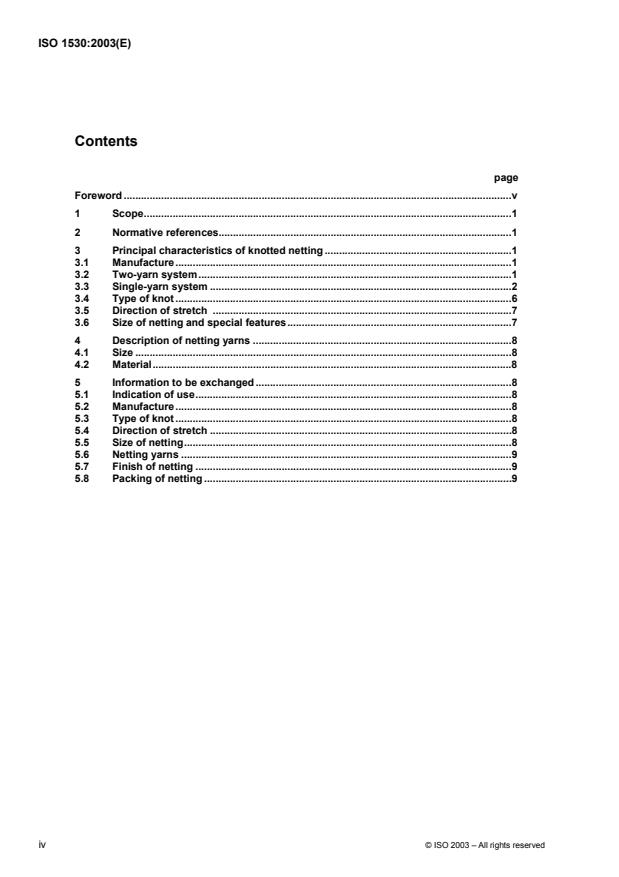
Contents
page
Foreword .v
1 Scope.1
2 Normative references.1
3 Principal characteristics of knotted netting .1
3.1 Manufacture.1
3.2 Two-yarn system.1
3.3 Single-yarn system .2
3.4 Type of knot.6
3.5 Direction of stretch .7
3.6 Size of netting and special features.7
4 Description of netting yarns .8
4.1 Size .8
4.2 Material.8
5 Information to be exchanged .8
5.1 Indication of use.8
5.2 Manufacture.8
5.3 Type of knot.8
5.4 Direction of stretch .8
5.5 Size of netting.8
5.6 Netting yarns .9
5.7 Finish of netting .9
5.8 Packing of netting .9
iv © ISO 2003 – All rights reserved
Foreword
This document (EN ISO 1530:2003) has been prepared by Technical Committee CEN /TC 248,
"Textiles and textile products", the secretariat of which is held by BSI, in collaboration with Technical
Committee ISO/TC 38 "Textiles".
This European Standard shall be given the status of a national standard, either by publication of an
identical text or by endorsement, at the latest by September 2003, and conflicting national standards
shall be withdrawn at the latest by September 2003.
According to the CEN/CENELEC Internal Regulations, the national standards organizations of the
following countries are bound to implement this European Standard: Austria, Belgium, Czech
Republic, Denmark, Finland, France, Germany, Greece, Iceland, Ireland, Italy, Luxembourg, Malta,
Netherlands, Norway, Portugal, Spain, Sweden, Switzerland and the United Kingdom.
1 Scope
This European Standard specifies the principal characteristics of knotted netting for fishing nets, and
specifies the items of information to be furnished when ordering the netting. It is intended to facilitate
the exchange of information between purchasers and suppliers of knotted netting for fishing nets.
NOTE It should be understood that a complete designation of knotted netting and its component yarns
...