


ISO 9563:2015
(Main)Belt drives - Electrical conductivity of antistatic endless synchronous belts - Characteristics and test method
Belt drives - Electrical conductivity of antistatic endless synchronous belts - Characteristics and test method
ISO 9563:2015 specifies the maximum and minimum electrical resistance of antistatic endless and open ended synchronous belts. This International Standard provides guidelines to allow testing of synchronous belts to prove their static conductive (dissipative) properties as well as a corresponding production control test method. The application of this International Standard is limited to new belts intended to be used in an explosive atmosphere or in situations where there is a fire risk. The test is intended to ensure that the belt is sufficiently conductive to dissipate charges of electricity which may form on it in service. In the case of a production control test, the decision is left to national standards or agreement between interested parties as to whether the test shall be carried out on each belt in a batch or on only a percentage of belts in a batch. For each proof test, the belt manufacturer shall determine which type of electrode and conductive coating material shall be used.
Transmissions par courroies — Conductibilité électrique des courroies synchrones sans fin, anti-électrostatiques — Spécification et méthode d'essai
ISO 9563:2015 spécifie la résistance électrique minimale et maximale d'une courroie synchrone sans fin anti-électrostatique. La présente Norme internationale donne des lignes directrices permettant de soumettre à essai des courroies synchrones afin de démontrer leurs propriétés (dissipatives) conductrices statiques ainsi que la méthode d'essai de contrôle de production correspondante. L'application de la présente Norme internationale est limitée aux courroies neuves destinées à être utilisées en atmosphère explosive ou dans les endroits où existe un risque d'incendie. L'essai est destiné à s'assurer que la courroie est suffisamment conductrice pour dissiper les charges d'électricité statique susceptibles de s'y former en service. Dans le cas d'un essai de contrôle de production, il est laissé aux normes nationales ou aux accords entre les parties intéressées le soin de décider si cet essai doit être effectué sur chaque courroie d'un lot ou sur un certain pourcentage de courroies du lot. Pour chaque essai de validation, le fabriquant de courroie doit déterminer quel type d'électrode et de matériau de revêtement doit être utilisé.
General Information
- Status
- Published
- Publication Date
- 13-Sep-2015
- Technical Committee
- ISO/TC 41/SC 4 - Synchronous belt drives
- Drafting Committee
- ISO/TC 41/SC 4 - Synchronous belt drives
- Current Stage
- 9093 - International Standard confirmed
- Start Date
- 22-Apr-2021
- Completion Date
- 13-Dec-2025
Relations
- Effective Date
- 03-Mar-2012
Overview
ISO 9563:2015 is an international standard published by the International Organization for Standardization (ISO) that specifies the electrical conductivity requirements and testing methods for antistatic endless synchronous belts used in safety-critical environments. The standard defines the maximum and minimum electrical resistance limits to ensure that these belts are sufficiently conductive to dissipate static electricity, minimizing the risk of sparks or fire hazards, especially in explosive atmospheres.
The scope of ISO 9563:2015 covers new antistatic endless and open-ended synchronous belts designed for use where static charge buildup could pose a fire or explosion risk. It provides detailed guidelines for laboratory and production testing to verify the belts’ static dissipative properties. This standard assists manufacturers and end users in ensuring compliance with safety requirements related to electrical resistance of belt drives in industrial applications.
Key Topics
Electrical Resistance Specification
ISO 9563:2015 sets quantitative limits on the electrical resistance of antistatic synchronous belts to ensure effective static charge dissipation. Resistance is measured in ohms (Ω) and must not exceed the calculated maximum value based on belt geometry.Test Methodology
The standard describes precise procedures for measuring electrical resistance using insulation testers with a nominal 500 V DC voltage. Testing involves applying electrodes to the belt surface and measuring resistance across the belt teeth area while maintaining consistent pressure.Electrode and Contact Requirements
Accurate resistance measurement requires electrodes designed to fit the belt’s tooth profile, covering specific teeth and grooves. The standard emphasizes using conductive materials that avoid surface oxidation and may include conductive coatings like silver lacquer or colloidal graphite to ensure optimal contact.Environmental Conditioning
Prior to testing, belts must be conditioned in a controlled atmosphere (23 ± 2 °C temperature and 50 ± 5 % relative humidity) to ensure reliable and reproducible electrical resistance measurements.Production Control Testing
ISO 9563:2015 outlines options for production testing strategies, allowing testing of either full batches or samples based on national standards or stakeholder agreement. It also provides guidance on the selection of appropriate test electrodes and coatings.
Applications
Explosive Atmospheres
Ensuring antistatic properties of synchronous belts is critical in industries such as chemical processing, oil and gas, and mining, where belts operate in potentially explosive environments.Fire Risk Environments
This standard supports safer belt drive systems in applications where static electricity could trigger fires, including electronics manufacturing, textile production, and powder processing.Industrial Belt Manufacturing
Manufacturers use ISO 9563:2015 as a benchmark for quality control and product certification, verifying that their belts meet the required resistance specifications before market release.Safety Compliance and Risk Mitigation
Employing this standard helps organizations comply with occupational safety regulations related to electrostatic discharge and reduces the risk of costly accidents caused by static sparks.
Related Standards
- ISO 1813 – Belt drives – Electrical conductivity of antistatic belts: Characteristics and test methods for V-ribbed belts and V-belts.
- ISO 5296 – Synchronous belt drives – Dimensions and pitch codes for metric and inch synchronous belts.
- ISO 9010 – Synchronous belt drives – Automotive belt specifications.
- ISO 13050 – Synchronous belt drives – Metric pitch curvilinear profile systems for belts and pulleys.
These complementary standards focus on related belt drive types and their mechanical and electrical properties, forming a comprehensive framework for belt drive system safety and performance.
By adhering to ISO 9563:2015, manufacturers and end users ensure that antistatic synchronous belts maintain proper electrical conductivity to dissipate static charges effectively, supporting industrial safety, reliability, and compliance in hazardous or sensitive environments.

ISO 9563:2015 - Belt drives -- Electrical conductivity of antistatic endless synchronous belts -- Characteristics and test method

ISO 9563:2015 - Transmissions par courroies -- Conductibilité électrique des courroies synchrones sans fin, anti-électrostatiques -- Spécification et méthode d'essai
Frequently Asked Questions
ISO 9563:2015 is a standard published by the International Organization for Standardization (ISO). Its full title is "Belt drives - Electrical conductivity of antistatic endless synchronous belts - Characteristics and test method". This standard covers: ISO 9563:2015 specifies the maximum and minimum electrical resistance of antistatic endless and open ended synchronous belts. This International Standard provides guidelines to allow testing of synchronous belts to prove their static conductive (dissipative) properties as well as a corresponding production control test method. The application of this International Standard is limited to new belts intended to be used in an explosive atmosphere or in situations where there is a fire risk. The test is intended to ensure that the belt is sufficiently conductive to dissipate charges of electricity which may form on it in service. In the case of a production control test, the decision is left to national standards or agreement between interested parties as to whether the test shall be carried out on each belt in a batch or on only a percentage of belts in a batch. For each proof test, the belt manufacturer shall determine which type of electrode and conductive coating material shall be used.
ISO 9563:2015 specifies the maximum and minimum electrical resistance of antistatic endless and open ended synchronous belts. This International Standard provides guidelines to allow testing of synchronous belts to prove their static conductive (dissipative) properties as well as a corresponding production control test method. The application of this International Standard is limited to new belts intended to be used in an explosive atmosphere or in situations where there is a fire risk. The test is intended to ensure that the belt is sufficiently conductive to dissipate charges of electricity which may form on it in service. In the case of a production control test, the decision is left to national standards or agreement between interested parties as to whether the test shall be carried out on each belt in a batch or on only a percentage of belts in a batch. For each proof test, the belt manufacturer shall determine which type of electrode and conductive coating material shall be used.
ISO 9563:2015 is classified under the following ICS (International Classification for Standards) categories: 21.220.10 - Belt drives and their components. The ICS classification helps identify the subject area and facilitates finding related standards.
ISO 9563:2015 has the following relationships with other standards: It is inter standard links to ISO 9563:1990. Understanding these relationships helps ensure you are using the most current and applicable version of the standard.
You can purchase ISO 9563:2015 directly from iTeh Standards. The document is available in PDF format and is delivered instantly after payment. Add the standard to your cart and complete the secure checkout process. iTeh Standards is an authorized distributor of ISO standards.
Standards Content (Sample)
INTERNATIONAL ISO
STANDARD 9563
Second edition
2015-09-01
Belt drives — Electrical conductivity of
antistatic endless synchronous belts
— Characteristics and test method
Transmissions par courroies — Conductibilité électrique des
courroies synchrones sans fin, anti-électrostatiques — Spécification
et méthode d’essai
Reference number
©
ISO 2015
© ISO 2015, Published in Switzerland
All rights reserved. Unless otherwise specified, no part of this publication may be reproduced or utilized otherwise in any form
or by any means, electronic or mechanical, including photocopying, or posting on the internet or an intranet, without prior
written permission. Permission can be requested from either ISO at the address below or ISO’s member body in the country of
the requester.
ISO copyright office
Ch. de Blandonnet 8 • CP 401
CH-1214 Vernier, Geneva, Switzerland
Tel. +41 22 749 01 11
Fax +41 22 749 09 47
copyright@iso.org
www.iso.org
ii © ISO 2015 – All rights reserved
Contents Page
Foreword .iv
1 Scope . 1
2 Normative references . 1
3 Electrical resistance — specification . 1
3.1 General . 1
3.2 Resistance value . 2
3.3 Minimum value of electrical resistance . 2
4 Selection and preparation of belts for test . 2
4.1 Laboratory test. 2
4.2 Production test . 2
5 Test method . 3
5.1 Apparatus — insulation tester . 3
5.2 Electrodes and contacts for laboratory and production tests . 3
5.3 Test procedures . 3
5.3.1 Laboratory test . 3
5.3.2 Production test . 3
5.3.3 Test timing . 3
5.3.4 Interpretation of results . 3
Annex A (informative) Electrical conductive coating . 5
Bibliography . 6
Foreword
ISO (the International Organization for Standardization) is a worldwide federation of national standards
bodies (ISO member bodies). The work of preparing International Standards is normally carried out
through ISO technical committees. Each member body interested in a subject for which a technical
committee has been established has the right to be represented on that committee. International
organizations, governmental and non-governmental, in liaison with ISO, also take part in the work.
ISO collaborates closely with the International Electrotechnical Commission (IEC) on all matters of
electrotechnical standardization.
The procedures used to develop this document and those intended for its further maintenance are
described in the ISO/IEC Directives, Part 1. In particular the different approval criteria needed for the
different types of ISO documents should be noted. This document was drafted in accordance with the
editorial rules of the ISO/IEC Directives, Part 2 (see www.iso.org/directives).
Attention is drawn to the possibility that some of the elements of this document may be the subject of
patent rights. ISO shall not be held responsible for identifying any or all such patent rights. Details of
any patent rights identified during the development of the document will be in the Introduction and/or
on the ISO list of patent declarations received (see www.iso.org/patents).
Any trade name used in this document is information given for the convenience of users and does not
constitute an endorsement.
For an explanation on the meaning of ISO specific terms and expressions related to conformity
assessment, as well as information about ISO’s adherence to the WTO principles in the Technical
Barriers to Trade (TBT) see the following URL: Foreword - Supplementary information
The committee responsible for this document is ISO/TC 41, Pulleys and belts (including veebelts),
Subcommittee SC 4, Synchronous belt drives.
This second edition cancels and replaces the first edition (ISO 9563:1990), which has been
technically revised.
iv © ISO 2015 – All rights reserved
INTERNATIONAL STANDARD ISO 9563:2015(E)
Belt drives — Electrical conductivity of antistatic endless
synchronous belts — Characteristics and test method
1 Scope
This International Standard specifies the maximum and minimum electrical resistance of antistatic
endless and open ended synchronous belts. This International Standard provides guidelines to allow
testing of synchronous belts to prove their static conductive (dissipative) properties as well as a
corresponding production control test method.
The application of this International Standard is limited to new belts intended to be used in an explosive
atmosphere or in situations where there is a fire risk. The test is intended to ensure that the belt is
sufficiently conductive to dissipate charges of electricity which may form on it in service.
In the case of a production control test, the decision is left to national standards or agreement between
interested parties as to whether the test shall be carried out on each belt in a batch or on
...
NORME ISO
INTERNATIONALE 9563
Deuxième édition
2015-09-01
Transmissions par courroies —
Conductibilité électrique des
courroies synchrones sans fin, anti-
électrostatiques — Spécification et
méthode d’essai
Belt drives — Electrical conductivity of antistatic endless synchronous
belts — Characteristics and test method
Numéro de référence
©
ISO 2015
DOCUMENT PROTÉGÉ PAR COPYRIGHT
© ISO 2015, Publié en Suisse
Droits de reproduction réservés. Sauf indication contraire, aucune partie de cette publication ne peut être reproduite ni utilisée
sous quelque forme que ce soit et par aucun procédé, électronique ou mécanique, y compris la photocopie, l’affichage sur
l’internet ou sur un Intranet, sans autorisation écrite préalable. Les demandes d’autorisation peuvent être adressées à l’ISO à
l’adresse ci-après ou au comité membre de l’ISO dans le pays du demandeur.
ISO copyright office
Ch. de Blandonnet 8 • CP 401
CH-1214 Vernier, Geneva, Switzerland
Tel. +41 22 749 01 11
Fax +41 22 749 09 47
copyright@iso.org
www.iso.org
ii © ISO 2015 – Tous droits réservés
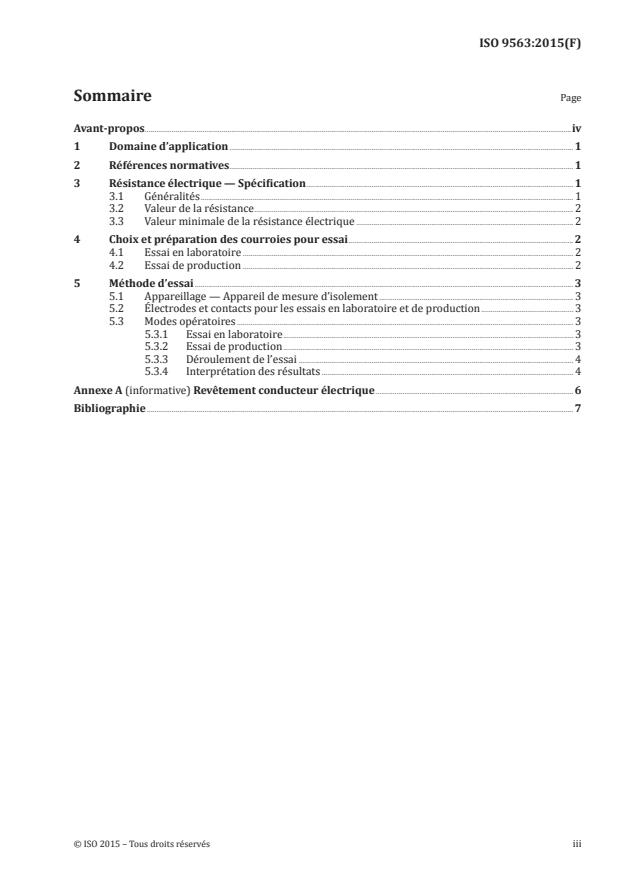
Sommaire Page
Avant-propos .iv
1 Domaine d’application . 1
2 Références normatives . 1
3 Résistance électrique — Spécification . 1
3.1 Généralités . 1
3.2 Valeur de la résistance . 2
3.3 Valeur minimale de la résistance électrique . 2
4 Choix et préparation des courroies pour essai . 2
4.1 Essai en laboratoire . 2
4.2 Essai de production . 2
5 Méthode d’essai . 3
5.1 Appareillage — Appareil de mesure d’isolement . 3
5.2 Électrodes et contacts pour les essais en laboratoire et de production . 3
5.3 Modes opératoires . 3
5.3.1 Essai en laboratoire . 3
5.3.2 Essai de production . 3
5.3.3 Déroulement de l’essai . 4
5.3.4 Interprétation des résultats . 4
Annexe A (informative) Revêtement conducteur électrique . 6
Bibliographie . 7
Avant-propos
L’ISO (Organisation internationale de normalisation) est une fédération mondiale d’organismes
nationaux de normalisation (comités membres de l’ISO). L’élaboration des Normes internationales est
en général confiée aux comités techniques de l’ISO. Chaque comité membre intéressé par une étude
a le droit de faire partie du comité technique créé à cet effet. Les organisations internationales,
gouvernementales et non gouvernementales, en liaison avec l’ISO participent également aux travaux.
L’ISO collabore étroitement avec la Commission électrotechnique internationale (IEC) en ce qui
concerne la normalisation électrotechnique.
Les procédures utilisées pour élaborer le présent document et celles destinées à sa mise à jour sont
décrites dans les Directives ISO/IEC, Partie 1. Il convient, en particulier de prendre note des différents
critères d’approbation requis pour les différents types de documents ISO. Le présent document a été
rédigé conformément aux règles de rédaction données dans les Directives ISO/IEC, Partie 2 (voir www.
iso.org/directives).
L’attention est appelée sur le fait que certains des éléments du présent document peuvent faire l’objet de
droits de propriété intellectuelle ou de droits analogues. L’ISO ne saurait être tenue pour responsable
de ne pas avoir identifié de tels droits de propriété et averti de leur existence. Les détails concernant
les références aux droits de propriété intellectuelle ou autres droits analogues identifiés lors de
l’élaboration du document sont indiqués dans l’Introduction et/ou dans la liste des déclarations de
brevets reçues par l’ISO (voir www.iso.org/brevets).
Les appellations commerciales éventuellement mentionnées dans le présent document sont données
pour information, par souci de commodité, à l’intention des utilisateurs et ne sauraient constituer
un engagement.
Pour une explication de la signification des termes et expressions spécifiques de l’ISO liés à
l’évaluation de la conformité, ou pour toute information au sujet de l’adhésion de l’ISO aux principes
de l’OMC concernant les obstacles techniques au commerce (OTC), voir le lien suivant: Avant-propos —
Informations supplémentaires.
Le comité chargé de l’élaboration du présent document est l’ISO/TC 41, Poulies et courroies (y compris les
courroies trapézoïdales), sous-comité SC 4, Transmissions synchrones par courroies.
Cette deuxième édition annule et remplace la première édition (ISO 9563:1990), qui fait l’objet d’une
révision technique.
iv © ISO 2015 – Tous droits réservés
NORME INTERNATIONALE ISO 9563:2015(F)
Transmissions par courroies — Conductibilité électrique
des courroies synchrones sans fin, anti-électrostatiques —
Spécification et méthode d’essai
1 Domaine d’application
La présente Norme internationale spécifie la résistance électrique minimale et maximale d’une
courroie synchrone sans fin anti-électrostatique. La présente Norme internationale donne des lignes
directrices permettant de soumettre à essai des courroies synchrones afin de démontrer leurs
propriétés (dissipatives) conductrices statiques ainsi que la méthode d’essai de contrôle de production
correspondante.
L’application de la présente Norme internationale est limitée aux courroies neuves destinées à être
utilisées en atmosphère explosive ou dans les endroits où existe un risque d’incendie. L’essai est destiné
à s’assurer que la courroie est suffisamment conductrice pour dissiper les charges d’électricité statique
susceptibles de s’y former en service.
Dans le cas d’un essai de contrôle de production, il est laissé aux normes nationales ou aux accords
entre les parties intéressées le soin de décider si cet essai doit être effectué sur chaque courroie d’un lot
ou sur un certain pourcentage de courroies du lot.
Pour chaque essai de validation, le fabriquant de courroie doit déterminer quel type d’électrode et de
matériau de revêtement doit être utilisé.
2 Références normatives
Les documents suivants, dans leur totalité ou partiellement, sont référencés normativement dans le
présent document et sont indispensables pour son application. Pour les références datées, seule l’édition
citée s’applique. Pour les références non datées, la dernière édition du document de référence s’applique
(y compris les é
...
ISO 9563:2015은 방전 동기식 벨트의 전기 전도성에 대한 최대값과 최소값을 규정하는 표준이다. 이 국제 표준은 방전성을 증명하기 위해 동기식 벨트에 대한 테스트를 허용하는 지침을 제공한다. 이 표준은 폭발 위험이 있는 환경이나 화재 위험이 있는 상황에서 사용되는 새로운 벨트에만 적용된다. 이 테스트는 벨트가 서비스 도중에 형성될 수 있는 전기 차지를 충분히 전도할 수 있는지 확인하기 위한 것이다. 생산 관리 테스트의 경우, 테스트를 각 벨트별로 수행할지, 일괄 생산된 벨트 중 일부 벨트에 대해서만 수행할지에 대한 결정은 각국의 표준 또는 이해 관계자 간의 합의에 따른다. 각 증명 테스트에 대해 벨트 제조업자는 사용할 전극 및 전도성 코팅 재료의 유형을 결정해야 한다.
ISO 9563:2015 is a standard that sets guidelines for the electrical conductivity of antistatic synchronous belts. It specifies the maximum and minimum electrical resistance for these belts and provides a test method to prove their static conductive properties. This standard is applicable to new belts used in explosive atmospheres or where there is a fire risk. The purpose of the test is to ensure that the belt can dissipate any charges of electricity that may form during its use. The decision on whether to carry out the test on each belt or a percentage of belts in a batch is determined by national standards or an agreement between parties involved. The belt manufacturer determines the type of electrode and conductive coating material to be used for each test.
ISO 9563:2015は、耐静電性無限同期ベルトの最大および最小電気抵抗を規定する国際規格です。この規格は、静電気を除去する(ダイシペイティブ)特性を証明するための同期ベルトのテストを行うためのガイドラインを提供します。この規格は、爆発性のある環境や火災のリスクがある状況で使用される新しいベルトに適用されます。テストの目的は、ベルトが使用中に発生することがある電荷を適切に除去できるかどうかを確認することです。生産管理テストの場合、テストをバッチごとの各ベルトに対して行うか、一部のベルトに対してのみ行うかは、国家規格または関係者間の合意によって決定されます。各テストについて、ベルトの製造業者が使用する電極および導電性コーティング材料のタイプを決定する必要があります。
Questions, Comments and Discussion
Ask us and Technical Secretary will try to provide an answer. You can facilitate discussion about the standard in here.
Loading comments...