

ISO 18273:2015
(Main)Welding consumables — Wire electrodes, wires and rods for welding of aluminium and aluminium alloys — Classification
General Information
- Abstract
ISO 18273:2015 specifies requirements for classification of solid wires and rods for fusion welding of aluminium and aluminium alloys. The classification of the solid wires and rods is based on their chemical composition.
- Status
- Published
- Publication Date
- 16-Nov-2015
- Technical Committee
- ISO/TC 44/SC 3 - Welding consumables
- Drafting Committee
- ISO/TC 44/SC 3 - Welding consumables
- Current Stage
- 9060 - Close of review
- Completion Date
- 02-Sep-2030
Buy Documents
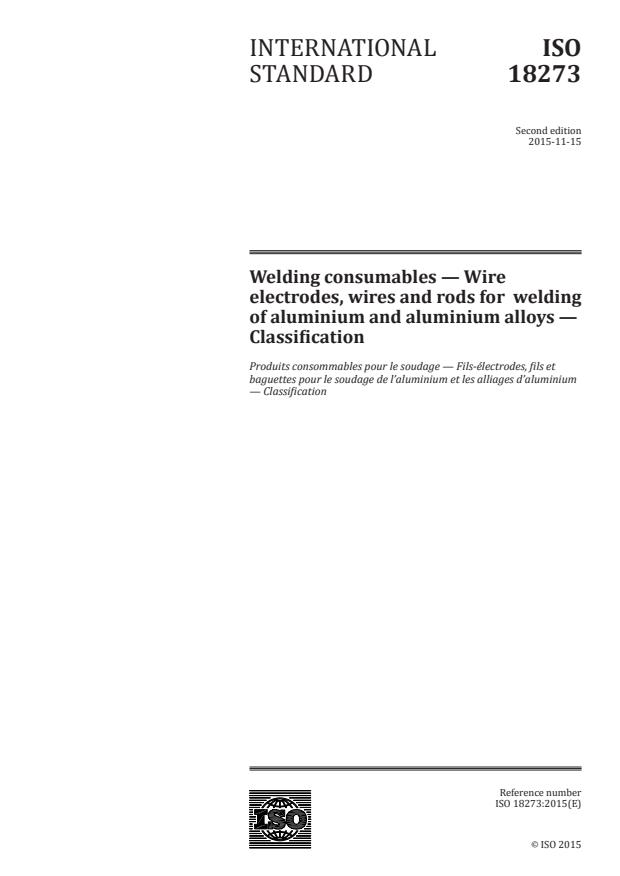
ISO 18273:2015 - Welding consumables -- Wire electrodes, wires and rods for welding of aluminium and aluminium alloys -- Classification
ISO 18273:2015 - Welding consumables — Wire electrodes, wires and rods for welding of aluminium and aluminium alloys — Classification/17/2015
ISO 18273:2015 - Produits consommables pour le soudage -- Fils-électrodes, fils et baguettes pour le soudage de l'aluminium et les alliages d'aluminium -- Classification
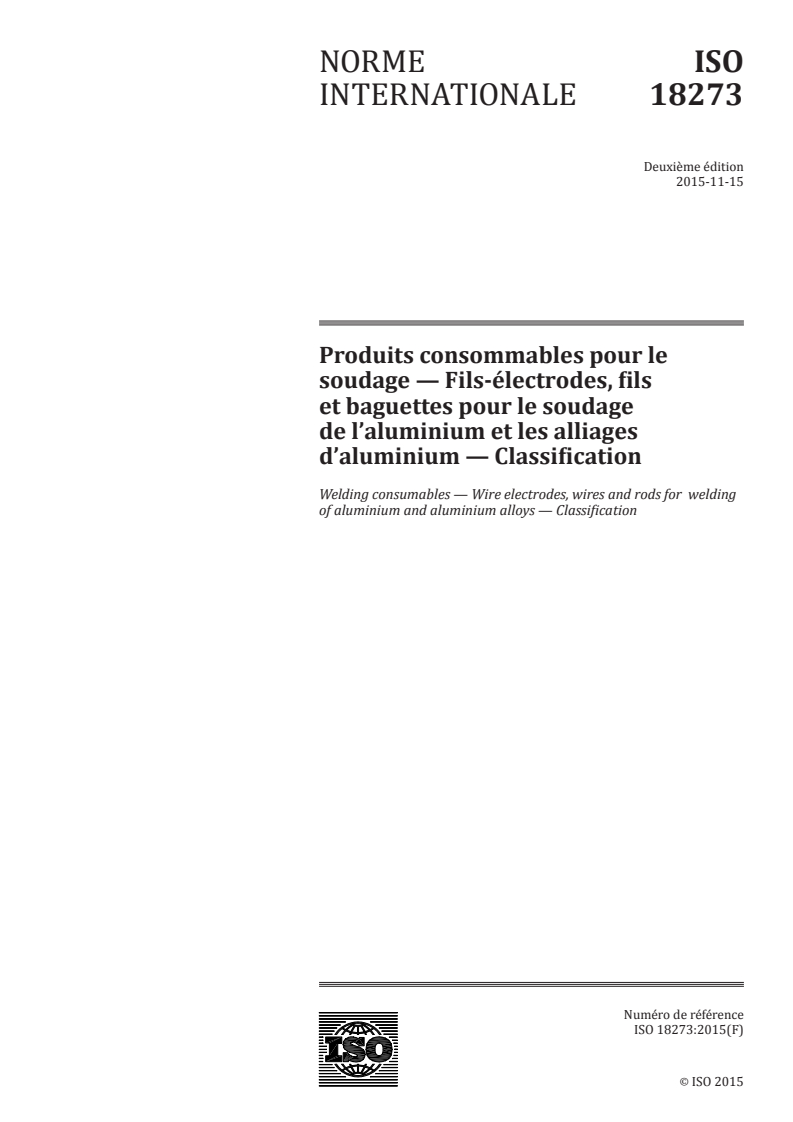
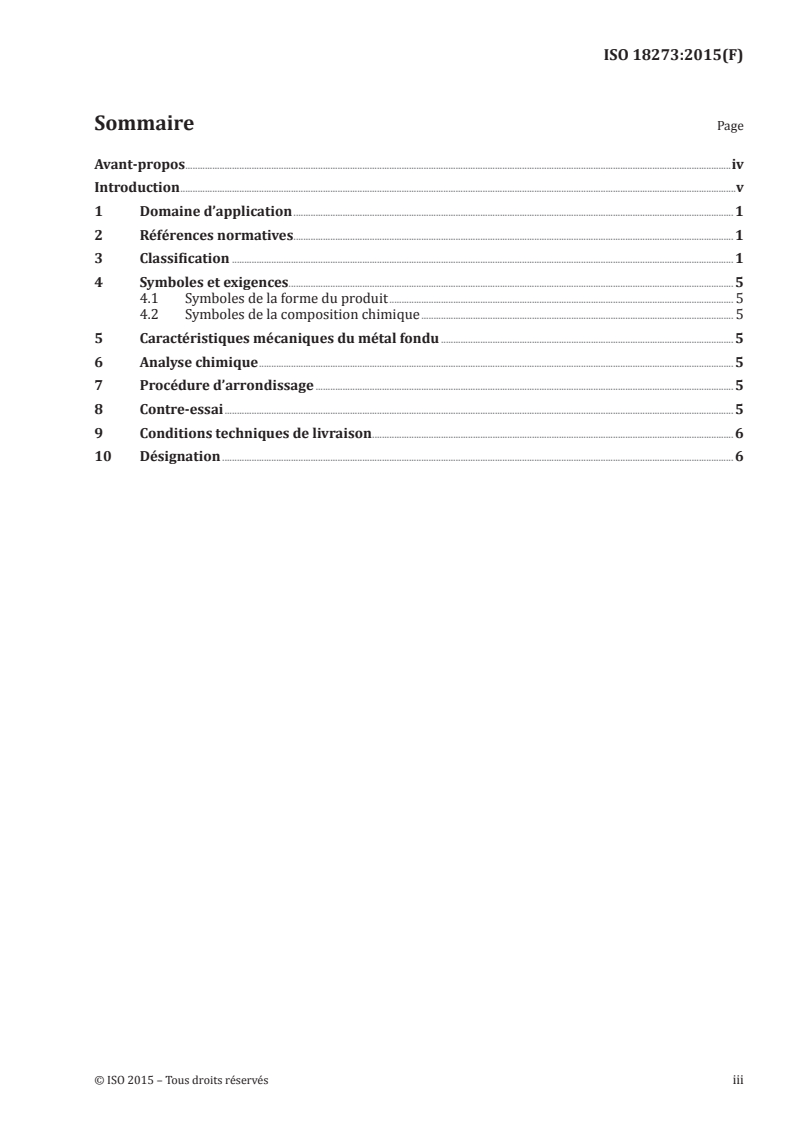
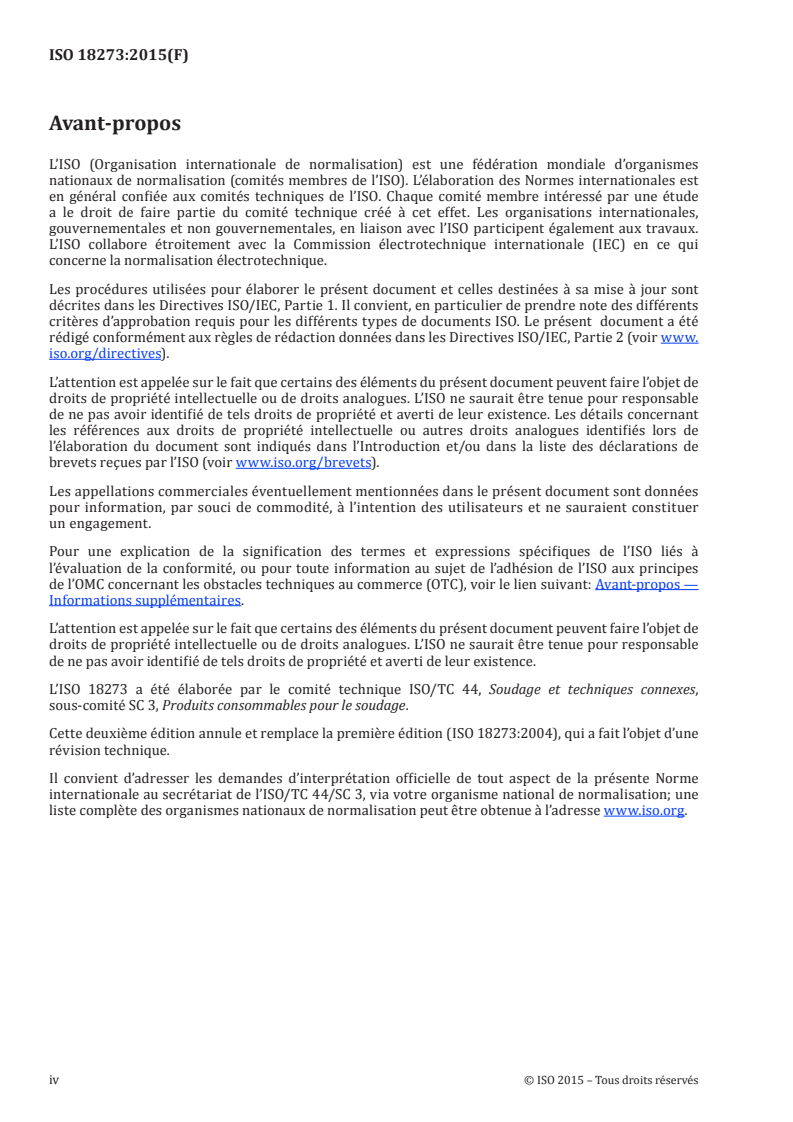
ISO 18273:2015 - Produits consommables pour le soudage — Fils-électrodes, fils et baguettes pour le soudage de l'aluminium et les alliages d'aluminium — Classification/17/2015
Overview
ISO 18273:2015 is an international standard that defines the classification system for welding consumables specifically for aluminium and aluminium alloys. This standard focuses on solid wire electrodes, wires, and rods used in fusion welding processes. The classification is primarily based on the chemical composition of these welding consumables. Published by the International Organization for Standardization (ISO), it provides manufacturers, suppliers, and users with a clear and consistent framework to identify and specify aluminium welding materials.
By ensuring all solid wires and rods conform to the composition ranges outlined in ISO 18273:2015, the standard facilitates compatibility, quality assurance, and reliability in industrial welding applications involving aluminium alloys.
Key Topics
Scope and Application
ISO 18273:2015 applies to solid wires and rods used in fusion welding of aluminium and its alloys. It does not restrict the classification to a single welding method, recognizing multiple applicable welding processes, including gas shielded metal arc welding and gas tungsten arc welding.Classification System
The classification has two main components:- Product Form Symbol: Represented by the letter 'S' for solid wire or rod.
- Chemical Composition Symbol: A numerical code based on precise elemental composition ranges, aligned with Aluminium Association registered alloy designations.
Chemical Composition Requirements
The standard specifies limits on elements such as Silicon (Si), Iron (Fe), Copper (Cu), Manganese (Mn), Magnesium (Mg), Chromium (Cr), Zinc (Zn), Titanium (Ti), Zirconium (Zr), and others depending on the alloy. This ensures that each welding consumable meets consistent alloy criteria.Designation Rules
Welding consumables are designated by combining the standard number, product form, and alloy symbol (e.g., ISO 18273 – S Al 4043). Optional additional alloy composition information can be appended for clarity.Chemical Analysis and Verification
Compliance is verified through chemical analysis using validated testing methods. Retesting procedures are outlined for quality control purposes in case of initial non-conformance.
Applications
Aluminium Welding in Manufacturing
ISO 18273:2015 is essential for industries involved in fabrication and manufacturing where aluminium components are welded. This includes aerospace, automotive, shipbuilding, and construction sectors.Quality Assurance in Welding Consumables Supply
Suppliers use this standard to classify and certify their wire electrodes, wires, and rods. It helps ensure consistency and traceability of welding materials based on composition.Process Flexibility
Because the standard supports solid wires and rods usable in multiple fusion welding techniques, it offers flexibility for engineers and technicians selecting the appropriate consumable for specific welding projects.
Related Standards
- ISO 544 – Specifies technical delivery conditions for welding filler materials and fluxes, including product types, dimensions, tolerances, and markings.
- ISO 14344 – Outlines procurement processes and requirements for filler materials and fluxes used in welding.
- ISO 80000-1 – Provides general rules for quantities and units, supporting proper rounding procedures in testing and analysis of welding consumables.
Together, these standards complement ISO 18273:2015 by ensuring consistent quality, proper labeling, and procurement procedures for aluminium welding consumables.
Keywords: ISO 18273:2015, aluminium welding consumables, welding wire classification, solid wire electrodes, welding rods, aluminium alloys, fusion welding, welding consumable classification, chemical composition welding standard, welding quality assurance
Relations
- Referred By
EN 4877-002:2023 - Aerospace series - Filler metals for welding - Part 002: Authorized filler metals - Effective Date
- 25-Aug-2026
- Effective Date
- 25-Feb-2026
- Effective Date
- 12-Feb-2026
- Effective Date
- 20-Jul-2013
Buy Documents
ISO 18273:2015 - Welding consumables -- Wire electrodes, wires and rods for welding of aluminium and aluminium alloys -- Classification
ISO 18273:2015 - Welding consumables — Wire electrodes, wires and rods for welding of aluminium and aluminium alloys — Classification/17/2015
ISO 18273:2015 - Produits consommables pour le soudage -- Fils-électrodes, fils et baguettes pour le soudage de l'aluminium et les alliages d'aluminium -- Classification
ISO 18273:2015 - Produits consommables pour le soudage — Fils-électrodes, fils et baguettes pour le soudage de l'aluminium et les alliages d'aluminium — Classification/17/2015
Get Certified
Connect with accredited certification bodies for this standard

DVS-ZERT GmbH
German welding certification society.
CARES (UK Certification Authority for Reinforcing Steels)
UK certification for reinforcing steels and construction.
EWF/IIW (European/International Welding Federation)
International welding personnel certification.
Sponsored listings
Frequently Asked Questions
ISO 18273:2015 is a standard published by the International Organization for Standardization (ISO). Its full title is "Welding consumables — Wire electrodes, wires and rods for welding of aluminium and aluminium alloys — Classification". This standard covers: ISO 18273:2015 specifies requirements for classification of solid wires and rods for fusion welding of aluminium and aluminium alloys. The classification of the solid wires and rods is based on their chemical composition.
ISO 18273:2015 specifies requirements for classification of solid wires and rods for fusion welding of aluminium and aluminium alloys. The classification of the solid wires and rods is based on their chemical composition.
ISO 18273:2015 is classified under the following ICS (International Classification for Standards) categories: 25.160.20 - Welding consumables. The ICS classification helps identify the subject area and facilitates finding related standards.
ISO 18273:2015 has the following relationships with other standards: It is inter standard links to EN 4877-002:2023, EN ISO 15614-2:2025, EN ISO 18273:2015, ISO 18273:2004. Understanding these relationships helps ensure you are using the most current and applicable version of the standard.
ISO 18273:2015 is available in PDF format for immediate download after purchase. The document can be added to your cart and obtained through the secure checkout process. Digital delivery ensures instant access to the complete standard document.
Standards Content (Sample)
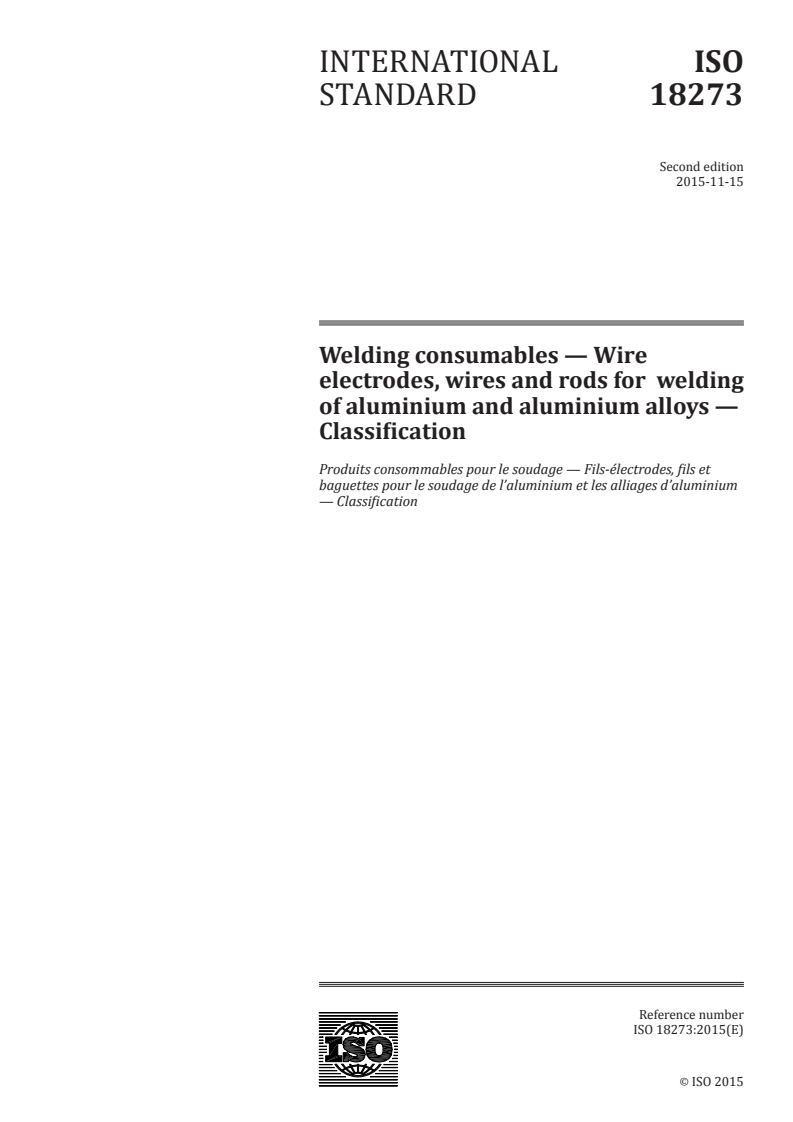
INTERNATIONAL ISO
STANDARD 18273
Second edition
2015-11-15
Welding consumables — Wire
electrodes, wires and rods for welding
of aluminium and aluminium alloys —
Classification
Produits consommables pour le soudage — Fils-électrodes, fils et
baguettes pour le soudage de l’aluminium et les alliages d’aluminium
— Classification
Reference number
©
ISO 2015
© ISO 2015, Published in Switzerland
All rights reserved. Unless otherwise specified, no part of this publication may be reproduced or utilized otherwise in any form
or by any means, electronic or mechanical, including photocopying, or posting on the internet or an intranet, without prior
written permission. Permission can be requested from either ISO at the address below or ISO’s member body in the country of
the requester.
ISO copyright office
Ch. de Blandonnet 8 • CP 401
CH-1214 Vernier, Geneva, Switzerland
Tel. +41 22 749 01 11
Fax +41 22 749 09 47
copyright@iso.org
www.iso.org
ii © ISO 2015 – All rights reserved
Contents Page
Foreword .iv
Introduction .v
1 Scope . 1
2 Normative references . 1
3 Classification . 1
4 Symbols and requirements . 5
4.1 Symbols for the product form . 5
4.2 Symbol for the chemical composition . 5
5 Mechanical properties of the weld metal . 5
6 Chemical analysis . 5
7 Rounding procedure . 5
8 Retest . 5
9 Technical delivery conditions . 6
10 Designation . 6
Foreword
ISO (the International Organization for Standardization) is a worldwide federation of national standards
bodies (ISO member bodies). The work of preparing International Standards is normally carried out
through ISO technical committees. Each member body interested in a subject for which a technical
committee has been established has the right to be represented on that committee. International
organizations, governmental and non-governmental, in liaison with ISO, also take part in the work.
ISO collaborates closely with the International Electrotechnical Commission (IEC) on all matters of
electrotechnical standardization.
The procedures used to develop this document and those intended for its further maintenance are
described in the ISO/IEC Directives, Part 1. In particular the different approval criteria needed for the
different types of ISO documents should be noted. This document was drafted in accordance with the
editorial rules of the ISO/IEC Directives, Part 2 (see www.iso.org/directives).
Attention is drawn to the possibility that some of the elements of this document may be the subject of
patent rights. ISO shall not be held responsible for identifying any or all such patent rights. Details of
any patent rights identified during the development of the document will be in the Introduction and/or
on the ISO list of patent declarations received (see www.iso.org/patents).
Any trade name used in this document is information given for the convenience of users and does not
constitute an endorsement.
For an explanation on the meaning of ISO specific terms and expressions related to conformity
assessment, as well as information about ISO’s adherence to the WTO principles in the Technical
Barriers to Trade (TBT) see the following URL: Foreword - Supplementary information
The committee responsible for this document is ISO/TC 44, Welding and allied processes, Subcommittee
SC 3, Welding consumables.
This second edition cancels and replaces the first edition (ISO 18273:2004), which has been
technically revised.
Requests for official interpretations of any aspect of this International Standard should be directed to
the Secretariat of ISO/TC 44/SC 3, through your national standards body, a complete listing of which
can be found at www.iso.org.
iv © ISO 2015 – All rights reserved
Introduction
For aluminium welding consumables, there is no unique relationship between the product form (solid
wire or rod) and the welding process used (e.g. gas shielded metal arc welding, gas tungsten arc
welding, plasma arc welding, or other welding processes). For this reason, the solid wires or rods can be
classified on the basis of any of the above product forms and can be used as appropriate for more than
one of the above processes.
INTERNATIONAL STANDARD ISO 18273:2015(E)
Welding consumables — Wire electrodes, wires and
rods for welding of aluminium and aluminium alloys —
Classification
1 Scope
This International Standard specifies requirements for classification of solid wires and rods for fusion
welding of aluminium and aluminium alloys. The classification of the solid wires and rods is based on
their chemical composition.
2 Normative references
The following documents, in whole or in part, are normatively referenced in this document and are
indispensable for its application. For dated references, only the edition cited applies. For undated
references, the latest edition of the referenced document (including any amendments) applies.
ISO 544, Welding consumables — Technical delivery conditions for filler materials and fluxes — Type of
product, dimensions, tolerances and markings
ISO 14344, Welding consumables — Procurement of filler materials and fluxes
ISO 80000-1:2009, Quantities and units — Part 1: General. Corrected by ISO 80000-1:2009/Cor 1:2011
3 Classification
The classification is divided into two parts.
a) The first part indicates the product form being solid wires or rods (see 4.1).
b) The second part gives a numerical symbol indicating the chemical composition of the solid wire or
rod (see Table 1).
The aluminium or aluminium alloy chemical composition limits specified are strictly identical to those
registered to the Aluminium Association, Washington, DC 20006, U.S.A. for the corresponding alloys.
2 © ISO 2015 – All rights reserved
Table 1 — Symbol for the chemical composition of solid wires and rods
a
Alloy symbol Chemical composition in % (m/m)
Numerical Chemical Si Fe Cu Mn Mg Cr Zn Ga, V Ti Zr Al Be Other Other
(min.) each total
ALUMINIUM-LOW ALLOYED
Al 1070 Al99,7 0,20 0,25 0,04 0,03 0,03 – 0,04 V 0,05 0,03 – 99,70 0,000 3 0,03 –
Al 1080A Al99,8(A) 0,15 0,15 0,03 0,02 0,02 – 0,06 Ga 0,03 0,02 – 99,80 0,000 3 0,02 –
Al 1188 Al99,88 0,06 0,06 0,005 0,01 0,01 – 0,03 Ga 0,03 0,01 – 99,88 0,000 3 0,01 –
V 0,05
Al 1100 Al99,0Cu Si + Fe 0,95 0,05 to 0,20 0,05 – – 0,10 – – – 99,00 0,000 3 0,05 0,15
Al 1200 Al99,0 Si + Fe 1,00 0,05 0,05 – – 0,10 – 0,05 – 99,00 0,000 3 0,05 0,15
Al 1450 Al99,5Ti 0,25 0,40 0,05 0,05 0,05 – 0,07 – 0,10 to 0,20 – 99,50 0,000 3 0,03 –
ALUMINIUM-COPPER
Al 2319 AlCu6MnZrTi 0,20 0,30 5,8 to 6,8 0,20 to 0,40 0,02 – 0,10 V 0,05 to 0,15 0,10 to 0,20 0,10 to Rem 0,0003 0,
...
INTERNATIONAL ISO
STANDARD 18273
Second edition
2015-11-15
Welding consumables — Wire
electrodes, wires and rods for welding
of aluminium and aluminium alloys —
Classification
Produits consommables pour le soudage — Fils-électrodes, fils et
baguettes pour le soudage de l’aluminium et les alliages d’aluminium
— Classification
Reference number
©
ISO 2015
© ISO 2015, Published in Switzerland
All rights reserved. Unless otherwise specified, no part of this publication may be reproduced or utilized otherwise in any form
or by any means, electronic or mechanical, including photocopying, or posting on the internet or an intranet, without prior
written permission. Permission can be requested from either ISO at the address below or ISO’s member body in the country of
the requester.
ISO copyright office
Ch. de Blandonnet 8 • CP 401
CH-1214 Vernier, Geneva, Switzerland
Tel. +41 22 749 01 11
Fax +41 22 749 09 47
copyright@iso.org
www.iso.org
ii © ISO 2015 – All rights reserved
Contents Page
Foreword .iv
Introduction .v
1 Scope . 1
2 Normative references . 1
3 Classification . 1
4 Symbols and requirements . 5
4.1 Symbols for the product form . 5
4.2 Symbol for the chemical composition . 5
5 Mechanical properties of the weld metal . 5
6 Chemical analysis . 5
7 Rounding procedure . 5
8 Retest . 5
9 Technical delivery conditions . 6
10 Designation . 6
Foreword
ISO (the International Organization for Standardization) is a worldwide federation of national standards
bodies (ISO member bodies). The work of preparing International Standards is normally carried out
through ISO technical committees. Each member body interested in a subject for which a technical
committee has been established has the right to be represented on that committee. International
organizations, governmental and non-governmental, in liaison with ISO, also take part in the work.
ISO collaborates closely with the International Electrotechnical Commission (IEC) on all matters of
electrotechnical standardization.
The procedures used to develop this document and those intended for its further maintenance are
described in the ISO/IEC Directives, Part 1. In particular the different approval criteria needed for the
different types of ISO documents should be noted. This document was drafted in accordance with the
editorial rules of the ISO/IEC Directives, Part 2 (see www.iso.org/directives).
Attention is drawn to the possibility that some of the elements of this document may be the subject of
patent rights. ISO shall not be held responsible for identifying any or all such patent rights. Details of
any patent rights identified during the development of the document will be in the Introduction and/or
on the ISO list of patent declarations received (see www.iso.org/patents).
Any trade name used in this document is information given for the convenience of users and does not
constitute an endorsement.
For an explanation on the meaning of ISO specific terms and expressions related to conformity
assessment, as well as information about ISO’s adherence to the WTO principles in the Technical
Barriers to Trade (TBT) see the following URL: Foreword - Supplementary information
The committee responsible for this document is ISO/TC 44, Welding and allied processes, Subcommittee
SC 3, Welding consumables.
This second edition cancels and replaces the first edition (ISO 18273:2004), which has been
technically revised.
Requests for official interpretations of any aspect of this International Standard should be directed to
the Secretariat of ISO/TC 44/SC 3, through your national standards body, a complete listing of which
can be found at www.iso.org.
iv © ISO 2015 – All rights reserved
Introduction
For aluminium welding consumables, there is no unique relationship between the product form (solid
wire or rod) and the welding process used (e.g. gas shielded metal arc welding, gas tungsten arc
welding, plasma arc welding, or other welding processes). For this reason, the solid wires or rods can be
classified on the basis of any of the above product forms and can be used as appropriate for more than
one of the above processes.
INTERNATIONAL STANDARD ISO 18273:2015(E)
Welding consumables — Wire electrodes, wires and
rods for welding of aluminium and aluminium alloys —
Classification
1 Scope
This International Standard specifies requirements for classification of solid wires and rods for fusion
welding of aluminium and aluminium alloys. The classification of the solid wires and rods is based on
their chemical composition.
2 Normative references
The following documents, in whole or in part, are normatively referenced in this document and are
indispensable for its application. For dated references, only the edition cited applies. For undated
references, the latest edition of the referenced document (including any amendments) applies.
ISO 544, Welding consumables — Technical delivery conditions for filler materials and fluxes — Type of
product, dimensions, tolerances and markings
ISO 14344, Welding consumables — Procurement of filler materials and fluxes
ISO 80000-1:2009, Quantities and units — Part 1: General. Corrected by ISO 80000-1:2009/Cor 1:2011
3 Classification
The classification is divided into two parts.
a) The first part indicates the product form being solid wires or rods (see 4.1).
b) The second part gives a numerical symbol indicating the chemical composition of the solid wire or
rod (see Table 1).
The aluminium or aluminium alloy chemical composition limits specified are strictly identical to those
registered to the Aluminium Association, Washington, DC 20006, U.S.A. for the corresponding alloys.
2 © ISO 2015 – All rights reserved
Table 1 — Symbol for the chemical composition of solid wires and rods
a
Alloy symbol Chemical composition in % (m/m)
Numerical Chemical Si Fe Cu Mn Mg Cr Zn Ga, V Ti Zr Al Be Other Other
(min.) each total
ALUMINIUM-LOW ALLOYED
Al 1070 Al99,7 0,20 0,25 0,04 0,03 0,03 – 0,04 V 0,05 0,03 – 99,70 0,000 3 0,03 –
Al 1080A Al99,8(A) 0,15 0,15 0,03 0,02 0,02 – 0,06 Ga 0,03 0,02 – 99,80 0,000 3 0,02 –
Al 1188 Al99,88 0,06 0,06 0,005 0,01 0,01 – 0,03 Ga 0,03 0,01 – 99,88 0,000 3 0,01 –
V 0,05
Al 1100 Al99,0Cu Si + Fe 0,95 0,05 to 0,20 0,05 – – 0,10 – – – 99,00 0,000 3 0,05 0,15
Al 1200 Al99,0 Si + Fe 1,00 0,05 0,05 – – 0,10 – 0,05 – 99,00 0,000 3 0,05 0,15
Al 1450 Al99,5Ti 0,25 0,40 0,05 0,05 0,05 – 0,07 – 0,10 to 0,20 – 99,50 0,000 3 0,03 –
ALUMINIUM-COPPER
Al 2319 AlCu6MnZrTi 0,20 0,30 5,8 to 6,8 0,20 to 0,40 0,02 – 0,10 V 0,05 to 0,15 0,10 to 0,20 0,10 to Rem 0,0003 0,
...
NORME ISO
INTERNATIONALE 18273
Deuxième édition
2015-11-15
Produits consommables pour le
soudage — Fils-électrodes, fils
et baguettes pour le soudage
de l’aluminium et les alliages
d’aluminium — Classification
Welding consumables — Wire electrodes, wires and rods for welding
of aluminium and aluminium alloys — Classification
Numéro de référence
©
ISO 2015
DOCUMENT PROTÉGÉ PAR COPYRIGHT
© ISO 2015, Publié en Suisse
Droits de reproduction réservés. Sauf indication contraire, aucune partie de cette publication ne peut être reproduite ni utilisée
sous quelque forme que ce soit et par aucun procédé, électronique ou mécanique, y compris la photocopie, l’affichage sur
l’internet ou sur un Intranet, sans autorisation écrite préalable. Les demandes d’autorisation peuvent être adressées à l’ISO à
l’adresse ci-après ou au comité membre de l’ISO dans le pays du demandeur.
ISO copyright office
Ch. de Blandonnet 8 • CP 401
CH-1214 Vernier, Geneva, Switzerland
Tel. +41 22 749 01 11
Fax +41 22 749 09 47
copyright@iso.org
www.iso.org
ii © ISO 2015 – Tous droits réservés
Sommaire Page
Avant-propos .iv
Introduction .v
1 Domaine d’application . 1
2 Références normatives . 1
3 Classification . 1
4 Symboles et exigences. 5
4.1 Symboles de la forme du produit . 5
4.2 Symboles de la composition chimique . 5
5 Caractéristiques mécaniques du métal fondu . 5
6 Analyse chimique . 5
7 Procédure d’arrondissage . 5
8 Contre-essai . 5
9 Conditions techniques de livraison . 6
10 Désignation . 6
Avant-propos
L’ISO (Organisation internationale de normalisation) est une fédération mondiale d’organismes
nationaux de normalisation (comités membres de l’ISO). L’élaboration des Normes internationales est
en général confiée aux comités techniques de l’ISO. Chaque comité membre intéressé par une étude
a le droit de faire partie du comité technique créé à cet effet. Les organisations internationales,
gouvernementales et non gouvernementales, en liaison avec l’ISO participent également aux travaux.
L’ISO collabore étroitement avec la Commission électrotechnique internationale (IEC) en ce qui
concerne la normalisation électrotechnique.
Les procédures utilisées pour élaborer le présent document et celles destinées à sa mise à jour sont
décrites dans les Directives ISO/IEC, Partie 1. Il convient, en particulier de prendre note des différents
critères d’approbation requis pour les différents types de documents ISO. Le présent document a été
rédigé conformément aux règles de rédaction données dans les Directives ISO/IEC, Partie 2 (voir www.
iso.org/directives).
L’attention est appelée sur le fait que certains des éléments du présent document peuvent faire l’objet de
droits de propriété intellectuelle ou de droits analogues. L’ISO ne saurait être tenue pour responsable
de ne pas avoir identifié de tels droits de propriété et averti de leur existence. Les détails concernant
les références aux droits de propriété intellectuelle ou autres droits analogues identifiés lors de
l’élaboration du document sont indiqués dans l’Introduction et/ou dans la liste des déclarations de
brevets reçues par l’ISO (voir www.iso.org/brevets).
Les appellations commerciales éventuellement mentionnées dans le présent document sont données
pour information, par souci de commodité, à l’intention des utilisateurs et ne sauraient constituer
un engagement.
Pour une explication de la signification des termes et expressions spécifiques de l’ISO liés à
l’évaluation de la conformité, ou pour toute information au sujet de l’adhésion de l’ISO aux principes
de l’OMC concernant les obstacles techniques au commerce (OTC), voir le lien suivant: Avant-propos —
Informations supplémentaires.
L’attention est appelée sur le fait que certains des éléments du présent document peuvent faire l’objet de
droits de propriété intellectuelle ou de droits analogues. L’ISO ne saurait être tenue pour responsable
de ne pas avoir identifié de tels droits de propriété et averti de leur existence.
L’ISO 18273 a été élaborée par le comité technique ISO/TC 44, Soudage et techniques connexes,
sous-comité SC 3, Produits consommables pour le soudage.
Cette deuxième édition annule et remplace la première édition (ISO 18273:2004), qui a fait l’objet d’une
révision technique.
Il convient d’adresser les demandes d’interprétation officielle de tout aspect de la présente Norme
internationale au secrétariat de l’ISO/TC 44/SC 3, via votre organisme national de normalisation; une
liste complète des organismes nationaux de normalisation peut être obtenue à l’adresse www.iso.org.
iv © ISO 2015 – Tous droits réservés
Introduction
Pour les produits consommables destinés au soudage de l’aluminium, il n’existe pas de relation absolue
entre la forme du produit (fil plein ou baguette pleine) et le procédé de soudage utilisé (par exemple
soudage à l’arc avec électrode fusible sous protection gazeuse, soudage TIG, soudage plasma ou autres
procédés de soudage). C’est pourquoi les fils pleins ou les baguettes pleines peuvent être classés d’après
leur forme et être utilisés, selon le cas, dans plusieurs procédés parmi ceux énoncés ci-dessus.
NORME INTERNATIONALE ISO 18273:2015(F)
Produits consommables pour le soudage — Fils-électrodes,
fils et baguettes pour le soudage de l’aluminium et les
alliages d’aluminium — Classification
1 Domaine d’application
La présente Norme internationale spécifie les exigences pour la classification des fils pleins et des
baguettes pleines pour le soudage par fusion de l’aluminium et des alliages d’aluminium. La classification
des fils pleins et des baguettes pleines est basée sur leur composition chimique.
2 Références normatives
Les documents suivants, en totalité ou en partie, sont référencés de manière normative dans le présent
document et sont indispensables pour son application. Pour les références datées, seule l’édition citée
s’applique. Pour les références non datées, la dernière édition du document de référence s’applique (y
compris les éventuels amendements).
ISO 544, Produits consommables pour le soudage — Conditions techniques de livraison des métaux d’apport
et des flux — Type de produit, dimensions, tolérances et marquage
ISO 14344, Produits consommables pour le soudage — Approvisionnement en matériaux d’apport et flux
ISO 80000-1:2009, Grandeurs et unités — Partie 1: Généralités. Corrigé par ISO 80000‑1:2009/Cor 1:2011
3 Classification
La classification est divisée en deux parties:
a) La première partie indique la forme du produit, soit fil plein ou baguette pleine (voir 4.1).
b) La deuxième partie donne le symbole numérique indiquant la composition chimique du fil plein ou
de la baguette pleine, (voir Tableau 1).
Les limites spécifiées pour la composition chimique de l’aluminium ou des alliages d’aluminium sont
rigoureusement identiques à celles déposées à l’Aluminium Association, Washington DC 20006, U.S.A.
pour les alliages correspondants.
2 © ISO 2015 – Tous droits réservés
Tableau 1 — Symboles utilisés pour la composition chimique des fils pleins et baguettes pleines
a
Symbole de l’alliage Composition chimique en % (m/m) (m/m)
Cha-
Total
cun
des
Al des
Numérique Chimique Si Fe Cu Mn Mg Cr Zn Ga, V Ti Zr Be autres
(min.) autres
élé-
élé-
ments
ments
ALUMINIUM‑FAIBLEMENT ALLIE
Al 1070 Al99,7 0,20 0,25 0,04 0,03 0,03 – 0,04 V 0,05 0,03 – 99,70 0,000 3 0,03 –
Al 1080A Al99,8(A) 0,15 0,15 0,03 0,02 0,02 – 0,06 Ga 0,03 0,02 – 99,80 0,000 3 0,02 –
Al 1188 Al99,88 0,06 0,06 0,005 0,01 0,01 – 0,03 Ga 0,03 0,01 – 99,88 0,000 3 0,01 –
V 0,05
Al 1100 Al99,0Cu Si + Fe 0,95 0,05 à 0,20 0,05 – – 0,10 – – – 99,00 0,000 3 0,05 0,15
Al 1200 Al99,0 Si + Fe 1,00 0,05 0,05 – – 0,10 – 0,05 – 99,00 0,000 3 0,05 0,15
Al 1450 Al99,5Ti 0,25 0,40 0,05 0,05 0,05 – 0,07 – 0,10 à 0,20 – 99,50 0,000 3 0,03 –
ALUMINIUM‑CUIVRE
Al 2319 AlCu6MnZrTi 0,20 0,30 5,8 à 6,8 0,20 à 0,40 0,02 – 0,10 V 0,05 à 0,15 0,10 à 0,20 0,10 to Solde 0,0003 0,05 0,15
0,25
ALUMINIUM‑MANGANESE
Al 3103 AlMn1
...
NORME ISO
INTERNATIONALE 18273
Deuxième édition
2015-11-15
Produits consommables pour le
soudage — Fils-électrodes, fils
et baguettes pour le soudage
de l’aluminium et les alliages
d’aluminium — Classification
Welding consumables — Wire electrodes, wires and rods for welding
of aluminium and aluminium alloys — Classification
Numéro de référence
©
ISO 2015
DOCUMENT PROTÉGÉ PAR COPYRIGHT
© ISO 2015, Publié en Suisse
Droits de reproduction réservés. Sauf indication contraire, aucune partie de cette publication ne peut être reproduite ni utilisée
sous quelque forme que ce soit et par aucun procédé, électronique ou mécanique, y compris la photocopie, l’affichage sur
l’internet ou sur un Intranet, sans autorisation écrite préalable. Les demandes d’autorisation peuvent être adressées à l’ISO à
l’adresse ci-après ou au comité membre de l’ISO dans le pays du demandeur.
ISO copyright office
Ch. de Blandonnet 8 • CP 401
CH-1214 Vernier, Geneva, Switzerland
Tel. +41 22 749 01 11
Fax +41 22 749 09 47
copyright@iso.org
www.iso.org
ii © ISO 2015 – Tous droits réservés
Sommaire Page
Avant-propos .iv
Introduction .v
1 Domaine d’application . 1
2 Références normatives . 1
3 Classification . 1
4 Symboles et exigences. 5
4.1 Symboles de la forme du produit . 5
4.2 Symboles de la composition chimique . 5
5 Caractéristiques mécaniques du métal fondu . 5
6 Analyse chimique . 5
7 Procédure d’arrondissage . 5
8 Contre-essai . 5
9 Conditions techniques de livraison . 6
10 Désignation . 6
Avant-propos
L’ISO (Organisation internationale de normalisation) est une fédération mondiale d’organismes
nationaux de normalisation (comités membres de l’ISO). L’élaboration des Normes internationales est
en général confiée aux comités techniques de l’ISO. Chaque comité membre intéressé par une étude
a le droit de faire partie du comité technique créé à cet effet. Les organisations internationales,
gouvernementales et non gouvernementales, en liaison avec l’ISO participent également aux travaux.
L’ISO collabore étroitement avec la Commission électrotechnique internationale (IEC) en ce qui
concerne la normalisation électrotechnique.
Les procédures utilisées pour élaborer le présent document et celles destinées à sa mise à jour sont
décrites dans les Directives ISO/IEC, Partie 1. Il convient, en particulier de prendre note des différents
critères d’approbation requis pour les différents types de documents ISO. Le présent document a été
rédigé conformément aux règles de rédaction données dans les Directives ISO/IEC, Partie 2 (voir www.
iso.org/directives).
L’attention est appelée sur le fait que certains des éléments du présent document peuvent faire l’objet de
droits de propriété intellectuelle ou de droits analogues. L’ISO ne saurait être tenue pour responsable
de ne pas avoir identifié de tels droits de propriété et averti de leur existence. Les détails concernant
les références aux droits de propriété intellectuelle ou autres droits analogues identifiés lors de
l’élaboration du document sont indiqués dans l’Introduction et/ou dans la liste des déclarations de
brevets reçues par l’ISO (voir www.iso.org/brevets).
Les appellations commerciales éventuellement mentionnées dans le présent document sont données
pour information, par souci de commodité, à l’intention des utilisateurs et ne sauraient constituer
un engagement.
Pour une explication de la signification des termes et expressions spécifiques de l’ISO liés à
l’évaluation de la conformité, ou pour toute information au sujet de l’adhésion de l’ISO aux principes
de l’OMC concernant les obstacles techniques au commerce (OTC), voir le lien suivant: Avant-propos —
Informations supplémentaires.
L’attention est appelée sur le fait que certains des éléments du présent document peuvent faire l’objet de
droits de propriété intellectuelle ou de droits analogues. L’ISO ne saurait être tenue pour responsable
de ne pas avoir identifié de tels droits de propriété et averti de leur existence.
L’ISO 18273 a été élaborée par le comité technique ISO/TC 44, Soudage et techniques connexes,
sous-comité SC 3, Produits consommables pour le soudage.
Cette deuxième édition annule et remplace la première édition (ISO 18273:2004), qui a fait l’objet d’une
révision technique.
Il convient d’adresser les demandes d’interprétation officielle de tout aspect de la présente Norme
internationale au secrétariat de l’ISO/TC 44/SC 3, via votre organisme national de normalisation; une
liste complète des organismes nationaux de normalisation peut être obtenue à l’adresse www.iso.org.
iv © ISO 2015 – Tous droits réservés
Introduction
Pour les produits consommables destinés au soudage de l’aluminium, il n’existe pas de relation absolue
entre la forme du produit (fil plein ou baguette pleine) et le procédé de soudage utilisé (par exemple
soudage à l’arc avec électrode fusible sous protection gazeuse, soudage TIG, soudage plasma ou autres
procédés de soudage). C’est pourquoi les fils pleins ou les baguettes pleines peuvent être classés d’après
leur forme et être utilisés, selon le cas, dans plusieurs procédés parmi ceux énoncés ci-dessus.
NORME INTERNATIONALE ISO 18273:2015(F)
Produits consommables pour le soudage — Fils-électrodes,
fils et baguettes pour le soudage de l’aluminium et les
alliages d’aluminium — Classification
1 Domaine d’application
La présente Norme internationale spécifie les exigences pour la classification des fils pleins et des
baguettes pleines pour le soudage par fusion de l’aluminium et des alliages d’aluminium. La classification
des fils pleins et des baguettes pleines est basée sur leur composition chimique.
2 Références normatives
Les documents suivants, en totalité ou en partie, sont référencés de manière normative dans le présent
document et sont indispensables pour son application. Pour les références datées, seule l’édition citée
s’applique. Pour les références non datées, la dernière édition du document de référence s’applique (y
compris les éventuels amendements).
ISO 544, Produits consommables pour le soudage — Conditions techniques de livraison des métaux d’apport
et des flux — Type de produit, dimensions, tolérances et marquage
ISO 14344, Produits consommables pour le soudage — Approvisionnement en matériaux d’apport et flux
ISO 80000-1:2009, Grandeurs et unités — Partie 1: Généralités. Corrigé par ISO 80000‑1:2009/Cor 1:2011
3 Classification
La classification est divisée en deux parties:
a) La première partie indique la forme du produit, soit fil plein ou baguette pleine (voir 4.1).
b) La deuxième partie donne le symbole numérique indiquant la composition chimique du fil plein ou
de la baguette pleine, (voir Tableau 1).
Les limites spécifiées pour la composition chimique de l’aluminium ou des alliages d’aluminium sont
rigoureusement identiques à celles déposées à l’Aluminium Association, Washington DC 20006, U.S.A.
pour les alliages correspondants.
2 © ISO 2015 – Tous droits réservés
Tableau 1 — Symboles utilisés pour la composition chimique des fils pleins et baguettes pleines
a
Symbole de l’alliage Composition chimique en % (m/m) (m/m)
Cha-
Total
cun
des
Al des
Numérique Chimique Si Fe Cu Mn Mg Cr Zn Ga, V Ti Zr Be autres
(min.) autres
élé-
élé-
ments
ments
ALUMINIUM‑FAIBLEMENT ALLIE
Al 1070 Al99,7 0,20 0,25 0,04 0,03 0,03 – 0,04 V 0,05 0,03 – 99,70 0,000 3 0,03 –
Al 1080A Al99,8(A) 0,15 0,15 0,03 0,02 0,02 – 0,06 Ga 0,03 0,02 – 99,80 0,000 3 0,02 –
Al 1188 Al99,88 0,06 0,06 0,005 0,01 0,01 – 0,03 Ga 0,03 0,01 – 99,88 0,000 3 0,01 –
V 0,05
Al 1100 Al99,0Cu Si + Fe 0,95 0,05 à 0,20 0,05 – – 0,10 – – – 99,00 0,000 3 0,05 0,15
Al 1200 Al99,0 Si + Fe 1,00 0,05 0,05 – – 0,10 – 0,05 – 99,00 0,000 3 0,05 0,15
Al 1450 Al99,5Ti 0,25 0,40 0,05 0,05 0,05 – 0,07 – 0,10 à 0,20 – 99,50 0,000 3 0,03 –
ALUMINIUM‑CUIVRE
Al 2319 AlCu6MnZrTi 0,20 0,30 5,8 à 6,8 0,20 à 0,40 0,02 – 0,10 V 0,05 à 0,15 0,10 à 0,20 0,10 to Solde 0,0003 0,05 0,15
0,25
ALUMINIUM‑MANGANESE
Al 3103 AlMn1
...