

ISO/IEC 18000-63
(Main)Information technology — Radio frequency identification for item management — Part 63: Parameters for air interface communications at 860 MHz to 930 MHz Type C
- Abstract
This document defines the air interface for radio frequency identification (RFID) devices operating in the 860 MHz to 960 MHz industrial, scientific, and medical (ISM) band used in item management applications. It provides a common technical specification for RFID devices that can be used to develop RFID application standards. This document is intended to allow for compatibility and to encourage inter-operability of products for the growing RFID market in the international marketplace. It defines the forward and return link parameters for technical attributes including, but not limited to, operating frequency, operating channel accuracy, occupied channel bandwidth, maximum effective isotropic radiated power (EIRP), spurious emissions, modulation, duty cycle, data coding, bit rate, bit rate accuracy, bit transmission order, and, where appropriate, operating channels, frequency hop rate, hop sequence, spreading sequence, and chip rate. It further defines the communications protocol used in the air interface. This document specifies the physical and logical requirements for a passive-backscatter, Interrogator-Talks-First (ITF) systems. The system comprises Interrogators, also known as readers, and tags, also known as labels. An Interrogator receives information from a tag by transmitting a continuous-wave (CW) RF signal to the tag; the tag responds by modulating the reflection coefficient of its antenna, thereby backscattering an information signal to the Interrogator. The system is ITF, i.e. a tag modulates its antenna reflection coefficient with an information signal only after being directed to do so by an Interrogator. This document specifies — physical interactions (the signalling layer of the communication link) between Interrogators and tags; — logical operating procedures and commands between Interrogators and Tags; — the collision arbitration scheme used to identify a specific tag in a multiple-tag environment; — optional security commands that allow the use of crypto suites of ISO/IEC 29167.
- Status
- Not Published
- Technical Committee
- ISO/IEC JTC 1/SC 31 - Automatic identification and data capture techniques
- Current Stage
- 6000 - International Standard under publication
- Start Date
- 26-Aug-2026
- Completion Date
- 10-Oct-2026
Buy Documents

ISO/IEC FDIS 18000-63 - Information technology — Radio frequency identification for item management — Part 63: Parameters for air interface communications at 860 MHz to 930 MHz Type C
REDLINE ISO/IEC FDIS 18000-63 - Information technology — Radio frequency identification for item management — Part 63: Parameters for air interface communications at 860 MHz to 930 MHz Type C
ISO/IEC 18000-63 is the ISO/IEC standard for the RAIN air interface used by passive-backscatter radio frequency identification (RFID) systems in item management. It specifies how interrogators, also called readers, and tags, also called labels, communicate in the 860 MHz to 930 MHz range, including link parameters, commands, collision handling, and optional security. The standard is written for implementers who need interoperable RFID equipment and for users who need to check whether devices follow the same protocol.
What does ISO/IEC 18000-63 specify?
ISO/IEC 18000-63 specifies the air interface for RFID devices used in item management and describes the physical and logical rules for Interrogator-Talks-First (ITF) communication. It is a common technical specification that application standards can build on, so different products can work together in the same RFID environment.
The document is organized into:
- clauses for scope, references, terms, notation, conformance, the core protocol, and two optional extensions
- normative annexes for bit vectors, state machines, command-response tables, channelized signaling, error codes, slot counter operation, and sensor record structures
- informative annexes with examples, tutorials, calculation guidance, and background material
| Annex | What it covers |
|---|---|
| A | Extensible bit vectors |
| B | State-transition tables |
| C | Command-response tables |
| D | Example slot-count parameter and Q selection |
| E | Example tag inventory and access |
| F | CRC-5 and CRC-16 calculation examples |
| G | Multiple- and dense-Interrogator channelized signaling |
| H | Interrogator-to-Tag link modulation waveforms |
| I | Tag error codes and their usage |
| J | Slot counter operation |
| K | Example data-flow exchange |
| L | Optional Tag features |
| M | Cryptographic suite checklist |
| N | Battery assisted Tag-to-Interrogator synchronization |
| O | Simple Sensors Data Block |
| P | Record structures and commands for Ported Simple Sensors |
| Q | BAP PIE and Manchester mode tutorial guide |
| R | Manchester mode RF power control |
| S | Additional information about RAIN |
What are the key requirements of ISO/IEC 18000-63?
ISO/IEC 18000-63 defines a complete passive-backscatter protocol for tags and interrogators, including inventory, access, security, battery-assisted operation, and sensor extensions. In practice, this means a product must match the protocol timing, command formats, memory behavior, and optional feature rules if it claims conformance.
Conformance and extensibility
Clause 5 requires a device claiming conformance to follow all non-optional clauses and the associated conformance document, ISO/IEC 18047-63. It also notes that local radio regulations can limit the permitted operating parameters, so a product may still need regional regulatory review.
Clause 5.3 and 5.4 define how the protocol is extended. Mandatory, optional, proprietary, and custom commands are separated, and RFU values are reserved for future use and are not to be used for proprietary purposes. This matters because implementers need to avoid taking over reserved fields that future versions may assign.
Physical link and inventory operation
Clause 6 defines the physical layer and the operating procedure. The system uses half-duplex backscatter: the interrogator sends a continuous-wave (CW) field, and the tag answers by changing its antenna reflection coefficient. In practice, the interrogator powers the tag and also sets the timing and modulation that the tag must follow.
The inventory commands are Query, QueryX, QueryY, QueryAdjust, QueryRep, ACK, and NAK. Query and QueryX start an inventory round, and the fields DR, M, TRext, Sel, Session, Target, and Q control link rate, preamble behavior, selection, session, inventoried flag target, and slot count. This is the core of singulation: the interrogator controls how tags share the channel, and the tag responds only in its assigned slot.
Clause 6 also requires MSB-first transmission, CRC-16 and CRC-5 use for integrity, and fixed modulation, encoding, and data rate during an inventory round. The RTcal and TRcal timing symbols are used to determine symbol decisions and the backscatter link frequency (BLF). In practice, the device must decode timing correctly or it will not interpret commands and replies reliably.
Clause 6.3.1.4 and 6.3.1.7 also describe delayed replies and in-process replies. That is important for longer tag operations, because the tag may need to keep the interrogator informed while it is still processing a command.
Memory, access, and locking
Clause 6.3.2 defines the logical interface. The tag memory banks include Reserved, UII, TID, and User memory, and write operations are word-based. A Write uses link cover-coding and must be preceded by Req_RN so the interrogator can obscure the data with the fresh RN16 from the tag.
Locking is central to item-management use. Lock can lock or permanently lock passwords and memory areas such as the UII memory bank, TID memory bank, and File_0 of User memory. BlockPermalock permanently locks individual blocks in User memory. In practice, this lets a system decide which data can still be changed after commissioning and which data must stay fixed.
Clause 6 also defines ReadVar, ReadBuffer, FileOpen, FileList, FileSetup, and related commands. ReadBuffer is tied to the ResponseBuffer, which is used for certain longer replies and is read-only to the interrogator.
Security and protected communication
Clause 5.5 and clause 6.3.2.13.3 define the security model. The standard supports optional Authenticate, AuthComm, SecureComm, KeyUpdate, TagPrivilege, and Untraceable commands, and the Challenge and Authenticate commands use a cryptographic suite indicator (CSI). This lets a tag support one or more crypto suites and choose a specific one per command.
These commands support tag authentication, interrogator authentication, mutual authentication, authenticated communication, secure communication, key updating, and privilege control. Untraceable can hide memory, change the tag’s operating range, or do both when the interrogator has the required privilege. In practice, security is not a single feature - it is a set of commands that control identity checking, data confidentiality, and what the interrogator can see.
Optional BAP operation
Clause 7 adds battery assisted passive (BAP) operation. If a device supports any clause 7 feature, it must support the mandatory BAP behavior in that clause. BAP PIE improves sensitivity and robustness, and Battery Saver Mode can duty-cycle the tag receiver to save power.
Clause 7 also defines modified inventoried-flag persistence, signal-loss tolerance using INACT_T, and timeout behavior. It includes Manchester mode battery-assisted operation, Activation and Deactivation commands, Multirate_Reset, and op register access. For users, this means battery-assisted tags are not just passive tags with a battery - they follow additional state and timing rules.
Optional sensor support
Clause 8 adds sensor support for tags. It covers Snapshot Sensor, Simple Sensor, and Full Function Sensor behavior, and it uses XPC_W1 and the SA indicator for sensor-related status. Snapshot Sensors can measure on power-up or on demand, Simple Sensors append Simple Sensor Data (SSD) to the tag reply, and Full Function Sensors use the Sensor Directory System (SDS).
Clause 8 also defines the RTC, HandleSensor, and the record structures for ported simple sensors. In practice, this section is for tags that must carry sensor readings, expose alarm state, or support more structured sensor access.
What terms does ISO/IEC 18000-63 define?
- Air interface - the complete communication link between an interrogator and a tag, including the physical layer, collision arbitration, commands, responses, and data coding.
- Interrogator-Talks-First (ITF) - a communication mode where the tag responds only after the interrogator directs it to do so.
- Backscatter link frequency (BLF) - the frequency at which a tag modulates the backscattered signal.
- Inventory round - the period started by Query or QueryX and ended by a later Query, QueryX, Select, or Challenge.
- Handle - a 16-bit tag identifier used in access operations after singulation.
- Cryptographic Suite Indicator (CSI) - the field in Challenge and Authenticate that selects one cryptographic suite.
- Untraceable - a state or privilege that limits the identifying information a tag exposes, or limits its operating range, or both.
- Battery assisted passive (BAP) - a tag mode that uses a battery to improve operation while still using the RFID air interface.
Who uses ISO/IEC 18000-63?
ISO/IEC 18000-63 is used by RFID tag and interrogator manufacturers, protocol and firmware engineers, test laboratories, and system integrators building item-management systems. It is also relevant to quality teams and buyers who need to verify that different products can share the same air interface.
The standard matters wherever tags must be inventoried, selected, read, written, locked, authenticated, hidden, or extended with battery-assisted or sensor functions. It is especially useful when a project needs interoperable RAIN RFID behavior rather than a vendor-specific protocol.
What changed in ISO/IEC 18000-63 from the previous edition?
ISO/IEC 18000-63 is the fourth edition and it replaces ISO/IEC 18000-63:2021. The foreword lists these main changes:
- improved tag selection process
- a method to ensure tags are sufficiently energized before selection and communication
- a method for tag data reading
- QueryX and QueryY added to make the selection process more useful and robust
- ReadVar and the Read-User-Memory-bit (RUM) added to automate access to item attributes and the TID
- ResponseBuffer made optional
Which standards are used with ISO/IEC 18000-63?
- ISO/IEC 15961-1 - application interface for RFID item-management data
- ISO/IEC 15961-2 - registration of RFID data constructs
- ISO/IEC 15961-3 - RFID data constructs
- ISO/IEC 15962 - data encoding rules and logical memory functions
- ISO/IEC 15963-1 - unique identification for RF tags numbering systems
- ISO/IEC 18047-63 - conformance test methods for this air interface
- ISO/IEC 19762:2025 - vocabulary used for the terms and definitions
- ISO/IEC 29143 and ISO/IEC 29143:2011 - air interface specification for mobile RFID interrogators
- GS1 EPC Tag Data Standard (TDS) - reference for GS1 EPC tag data and the Extended Tag identifier (XTID)
What does the ISO/IEC 18000-63 document contain?
ISO/IEC 18000-63 contains command tables, reply formats, state-machine descriptions, timing rules, and link masks for the RAIN air interface. It also contains tables for memory-bank structure, XPC fields, error codes, CRC behavior, and sensor-related records.
The normative annexes provide the implementation data that engineers need when they code a reader or tag, while the informative annexes show examples, calculations, and tutorials. Annex B and Annex C are especially important for implementation and test work because they define state transitions and command-response behavior.
The document also includes figures and formulas for the RF envelopes, preambles, timing symbols, BLF relationships, and transmit masks used in single, multiple, and dense-interrogator environments. That makes it useful not only for protocol implementation, but also for validation, certification testing, and interoperability debugging.
Relations
- Effective Date
- 03-Jun-2023
Buy Documents
ISO/IEC FDIS 18000-63 - Information technology — Radio frequency identification for item management — Part 63: Parameters for air interface communications at 860 MHz to 930 MHz Type C
REDLINE ISO/IEC FDIS 18000-63 - Information technology — Radio frequency identification for item management — Part 63: Parameters for air interface communications at 860 MHz to 930 MHz Type C
Get Certified
Connect with accredited certification bodies for this standard

BSI Group
BSI (British Standards Institution) is the business standards company that helps organizations make excellence a habit.

NYCE
Mexican standards and certification body.
Sponsored listings
Frequently Asked Questions
ISO/IEC 18000-63 is a draft published by the International Organization for Standardization (ISO). Its full title is "Information technology — Radio frequency identification for item management — Part 63: Parameters for air interface communications at 860 MHz to 930 MHz Type C". This standard covers: This document defines the air interface for radio frequency identification (RFID) devices operating in the 860 MHz to 960 MHz industrial, scientific, and medical (ISM) band used in item management applications. It provides a common technical specification for RFID devices that can be used to develop RFID application standards. This document is intended to allow for compatibility and to encourage inter-operability of products for the growing RFID market in the international marketplace. It defines the forward and return link parameters for technical attributes including, but not limited to, operating frequency, operating channel accuracy, occupied channel bandwidth, maximum effective isotropic radiated power (EIRP), spurious emissions, modulation, duty cycle, data coding, bit rate, bit rate accuracy, bit transmission order, and, where appropriate, operating channels, frequency hop rate, hop sequence, spreading sequence, and chip rate. It further defines the communications protocol used in the air interface. This document specifies the physical and logical requirements for a passive-backscatter, Interrogator-Talks-First (ITF) systems. The system comprises Interrogators, also known as readers, and tags, also known as labels. An Interrogator receives information from a tag by transmitting a continuous-wave (CW) RF signal to the tag; the tag responds by modulating the reflection coefficient of its antenna, thereby backscattering an information signal to the Interrogator. The system is ITF, i.e. a tag modulates its antenna reflection coefficient with an information signal only after being directed to do so by an Interrogator. This document specifies — physical interactions (the signalling layer of the communication link) between Interrogators and tags; — logical operating procedures and commands between Interrogators and Tags; — the collision arbitration scheme used to identify a specific tag in a multiple-tag environment; — optional security commands that allow the use of crypto suites of ISO/IEC 29167.
This document defines the air interface for radio frequency identification (RFID) devices operating in the 860 MHz to 960 MHz industrial, scientific, and medical (ISM) band used in item management applications. It provides a common technical specification for RFID devices that can be used to develop RFID application standards. This document is intended to allow for compatibility and to encourage inter-operability of products for the growing RFID market in the international marketplace. It defines the forward and return link parameters for technical attributes including, but not limited to, operating frequency, operating channel accuracy, occupied channel bandwidth, maximum effective isotropic radiated power (EIRP), spurious emissions, modulation, duty cycle, data coding, bit rate, bit rate accuracy, bit transmission order, and, where appropriate, operating channels, frequency hop rate, hop sequence, spreading sequence, and chip rate. It further defines the communications protocol used in the air interface. This document specifies the physical and logical requirements for a passive-backscatter, Interrogator-Talks-First (ITF) systems. The system comprises Interrogators, also known as readers, and tags, also known as labels. An Interrogator receives information from a tag by transmitting a continuous-wave (CW) RF signal to the tag; the tag responds by modulating the reflection coefficient of its antenna, thereby backscattering an information signal to the Interrogator. The system is ITF, i.e. a tag modulates its antenna reflection coefficient with an information signal only after being directed to do so by an Interrogator. This document specifies — physical interactions (the signalling layer of the communication link) between Interrogators and tags; — logical operating procedures and commands between Interrogators and Tags; — the collision arbitration scheme used to identify a specific tag in a multiple-tag environment; — optional security commands that allow the use of crypto suites of ISO/IEC 29167.
ISO/IEC 18000-63 is classified under the following ICS (International Classification for Standards) categories: 35.040.50 - Automatic identification and data capture techniques. The ICS classification helps identify the subject area and facilitates finding related standards.
ISO/IEC 18000-63 has the following relationships with other standards: It is inter standard links to ISO/IEC 18000-63:2021. Understanding these relationships helps ensure you are using the most current and applicable version of the standard.
ISO/IEC 18000-63 is available in PDF format for immediate download after purchase. The document can be added to your cart and obtained through the secure checkout process. Digital delivery ensures instant access to the complete standard document.
Standards Content (Sample)
FINAL DRAFT
International
Standard
ISO/IEC
FDIS
18000-63
ISO/IEC JTC 1/SC 31
Information technology — Radio
Secretariat: ANSI
frequency identification for item
Voting begins on:
management —
2026-06-30
Part 63:
Voting terminates on:
2026-08-25
Parameters for air interface
communications at 860 MHz to 930
MHz Type C
Technologies de l'information — Identification par
radiofréquence (RFID) pour la gestion d'objets —
Partie 63: Paramètres de communications d'une interface radio
entre 860 MHz et 930 MHz, Type C
RECIPIENTS OF THIS DRAFT ARE INVITED TO SUBMIT,
WITH THEIR COMMENTS, NOTIFICATION OF ANY
RELEVANT PATENT RIGHTS OF WHICH THEY ARE AWARE
AND TO PROVIDE SUPPOR TING DOCUMENTATION.
IN ADDITION TO THEIR EVALUATION AS
BEING ACCEPTABLE FOR INDUSTRIAL, TECHNO
LOGICAL, COMMERCIAL AND USER PURPOSES, DRAFT
INTERNATIONAL STANDARDS MAY ON OCCASION HAVE
TO BE CONSIDERED IN THE LIGHT OF THEIR POTENTIAL
TO BECOME STAN DARDS TO WHICH REFERENCE MAY BE
MADE IN NATIONAL REGULATIONS.
Reference number
ISO/IEC FDIS 1800063:2026(en) © ISO/IEC 2026
ISO/IEC FDIS 18000-63:2026(en)
© ISO/IEC 2026
All rights reserved. Unless otherwise specified, or required in the context of its implementation, no part of this publication may
be reproduced or utilized otherwise in any form or by any means, electronic or mechanical, including photocopying, or posting on
the internet or an intranet, without prior written permission. Permission can be requested from either ISO at the address below
or ISO’s member body in the country of the requester.
ISO copyright office
CP 401 • Ch. de Blandonnet 8
CH-1214 Vernier, Geneva
Phone: +41 22 749 01 11
Email: copyright@iso.org
Website: www.iso.org
Published in Switzerland
© ISO/IEC 2026 – All rights reserved
ii
ISO/IEC FDIS 18000-63:2026(en)
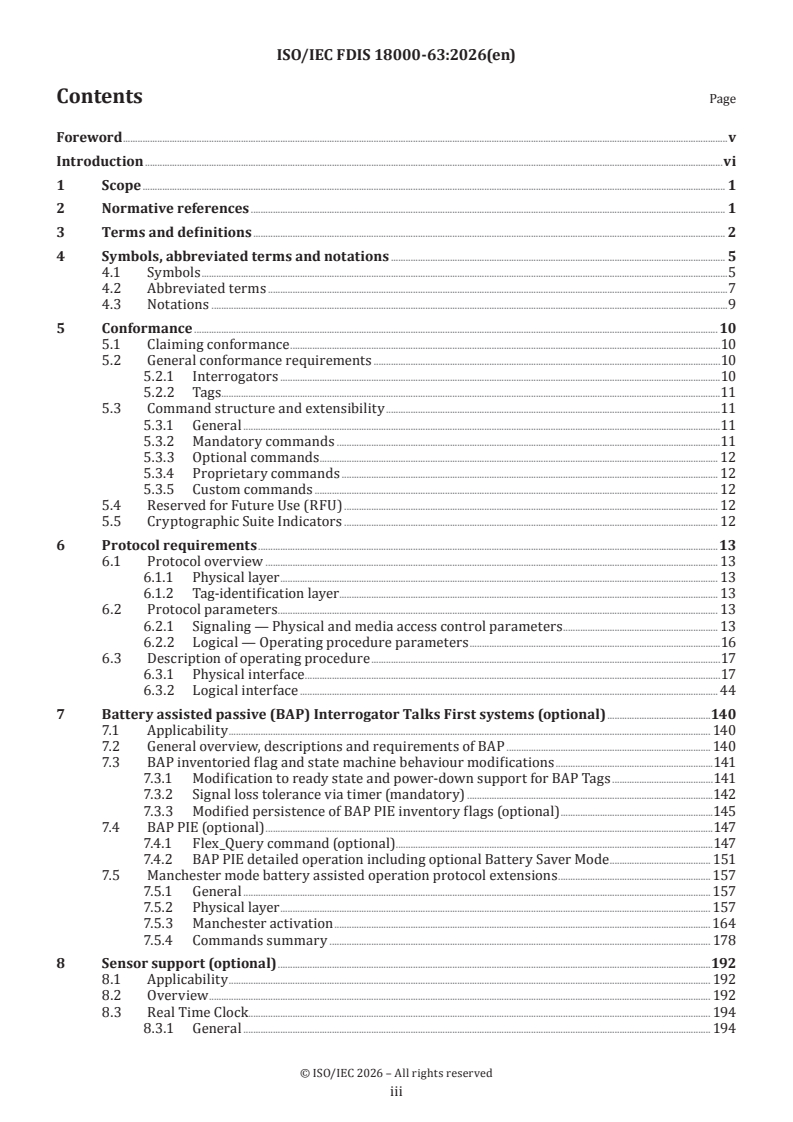
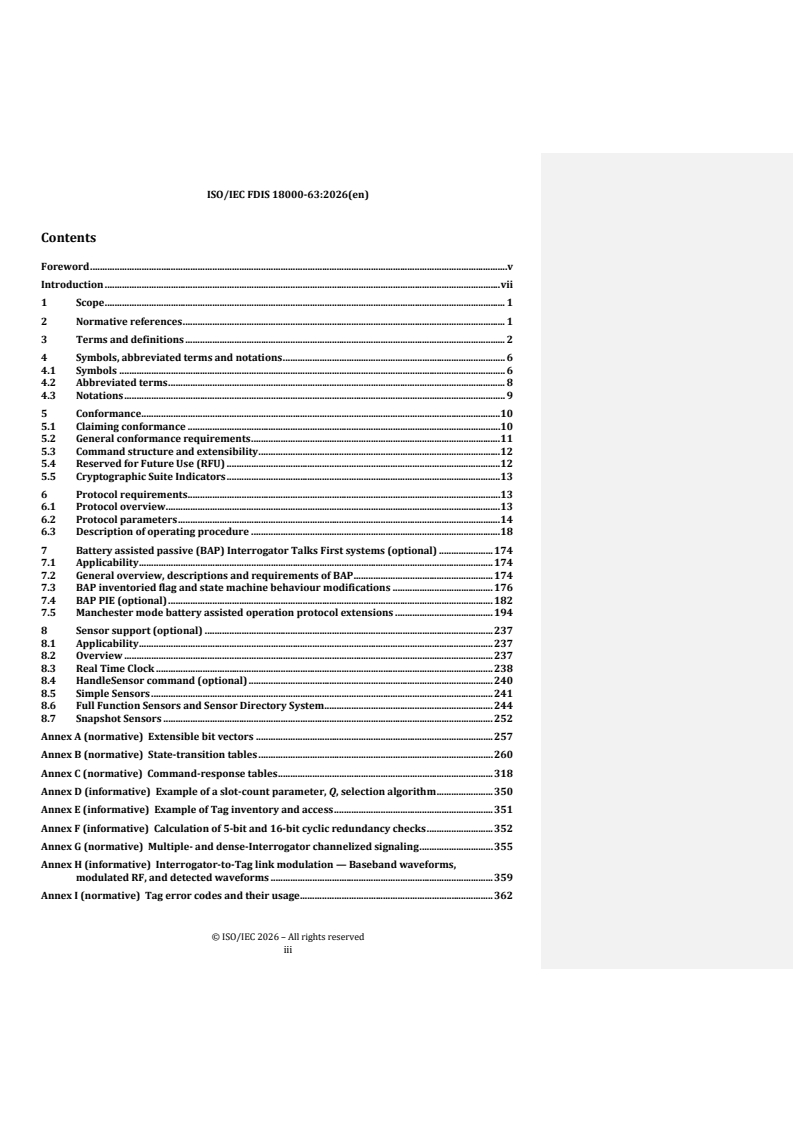
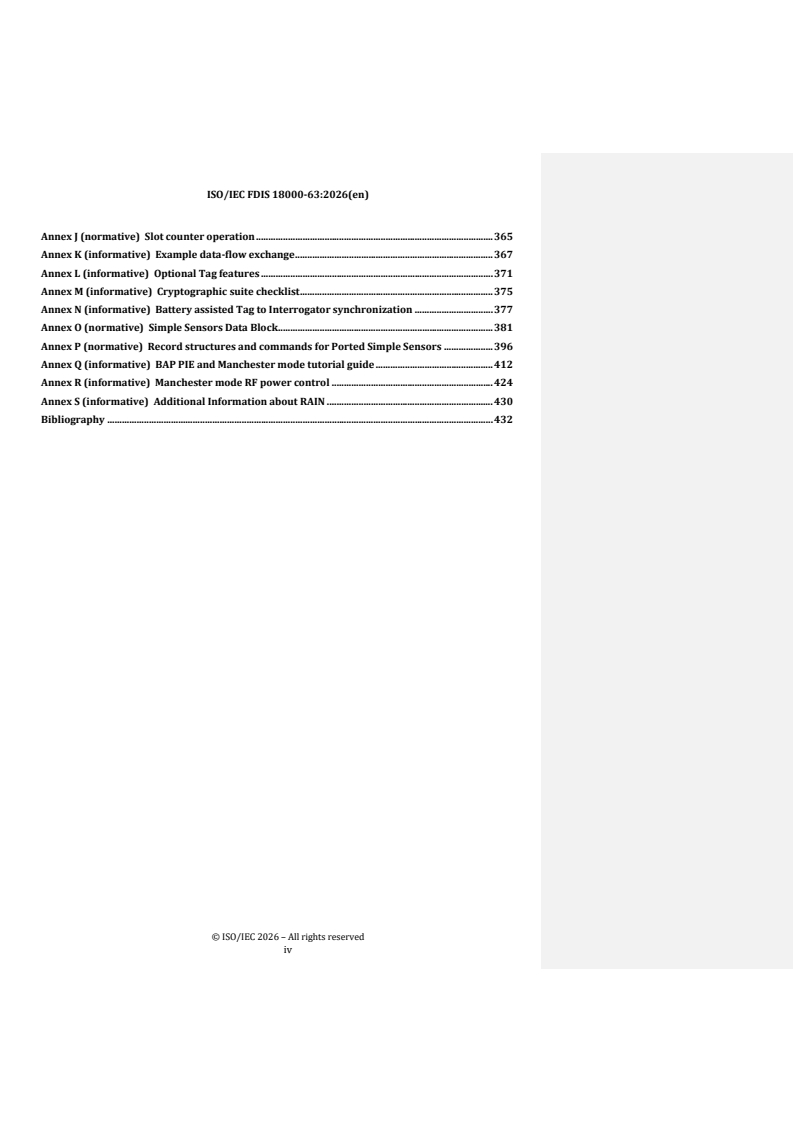
Contents Page
Foreword .v
Introduction .vi
1 Scope . 1
2 Normative references . 1
3 Terms and definitions . 2
4 Symbols, abbreviated terms and notations . 5
4.1 Symbols .5
4.2 Abbreviated terms .7
4.3 Notations .9
5 Conformance . 10
5.1 Claiming conformance .10
5.2 General conformance requirements .10
5.2.1 Interrogators .10
5.2.2 Tags.11
5.3 Command structure and extensibility .11
5.3.1 General .11
5.3.2 Mandatory commands .11
5.3.3 Optional commands . . 12
5.3.4 Proprietary commands . 12
5.3.5 Custom commands . 12
5.4 Reserved for Future Use (RFU) . 12
5.5 Cryptographic Suite Indicators . 12
6 Protocol requirements .13
6.1 Protocol overview . 13
6.1.1 Physical layer . 13
6.1.2 Tag-identification layer . 13
6.2 Protocol parameters . 13
6.2.1 Signaling — Physical and media access control parameters . 13
6.2.2 Logical — Operating procedure parameters .16
6.3 Description of operating procedure .17
6.3.1 Physical interface .17
6.3.2 Logical interface . 44
7 Battery assisted passive (BAP) Interrogator Talks First systems (optional) .140
7.1 Applicability . 140
7.2 General overview, descriptions and requirements of BAP . 140
7.3 BAP inventoried flag and state machine behaviour modifications .141
7.3.1 Modification to ready state and power-down support for BAP Tags .141
7.3.2 Signal loss tolerance via timer (mandatory) .142
7.3.3 Modified persistence of BAP PIE inventory flags (optional) .145
7.4 BAP PIE (optional) .147
7.4.1 Flex_Query command (optional) . .147
7.4.2 BAP PIE detailed operation including optional Battery Saver Mode . 151
7.5 Manchester mode battery assisted operation protocol extensions . 157
7.5.1 General . 157
7.5.2 Physical layer . 157
7.5.3 Manchester activation . 164
7.5.4 Commands summary . 178
8 Sensor support (optional) .192
8.1 Applicability . 192
8.2 Overview . 192
8.3 Real Time Clock . . . 194
8.3.1 General . 194
© ISO/IEC 2026 – All rights reserved
iii
ISO/IEC FDIS 18000-63:2026(en)
8.3.2 Setting the RTC . 194
8.3.3 BroadcastSync command (optional) . 194
8.3.4 Time synchronisation . 195
8.4 HandleSensor command (optional) . 196
8.5 Simple Sensors . 197
8.5.1 General . 197
8.5.2 Simple Sensor implementation . 197
8.6 Full Function Sensors and Sensor Directory System . 199
8.6.1 General . 199
8.6.2 Sensor Access — General approach. 199
8.7 Snapshot Sensors .204
8.7.1 General .204
8.7.2 Initiating Snapshot Sensor measurements . 206
8.7.3 Reporting Snapshot Sensor Information . 207
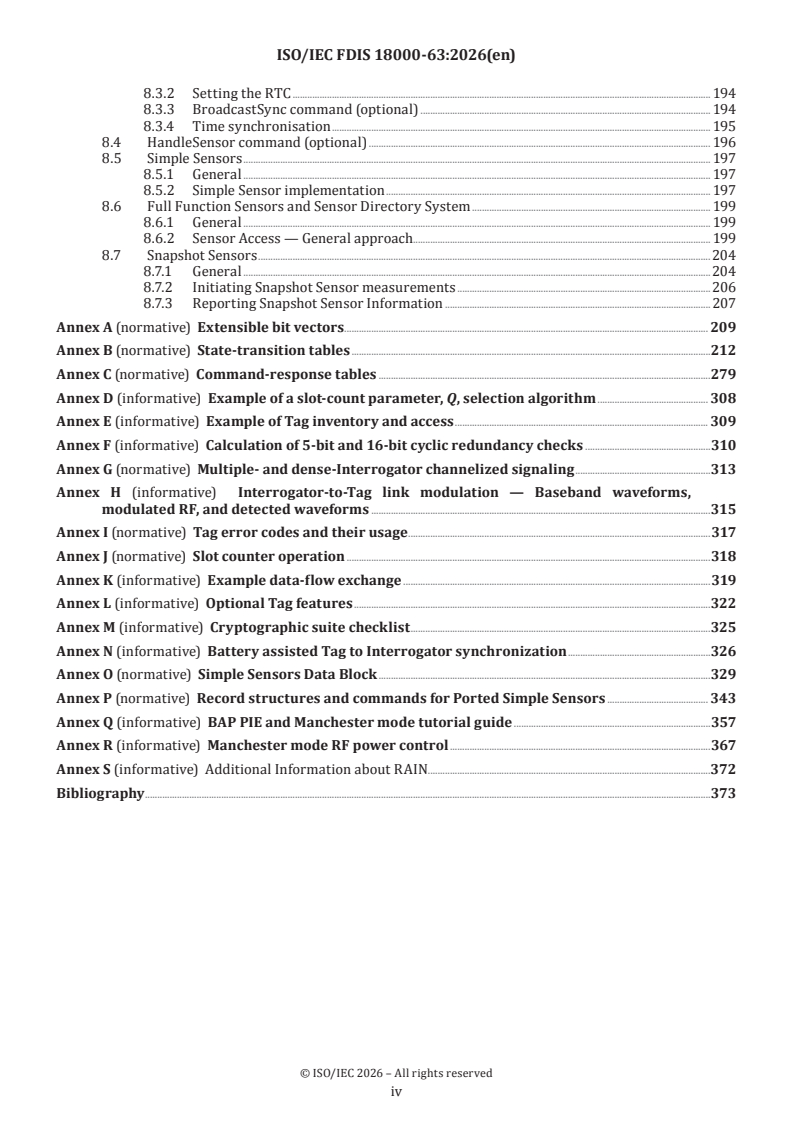
Annex A (normative) Extensible bit vectors . . 209
Annex B (normative) State-transition tables .212
Annex C (normative) Command-response tables .279
Annex D (informative) Example of a slot-count parameter, Q, selection algorithm . 308
Annex E (informative) Example of Tag inventory and access . 309
Annex F (informative) Calculation of 5-bit and 16-bit cyclic redundancy checks .310
Annex G (normative) Multiple- and dense-Interrogator channelized signaling .313
Annex H (informative) Interrogator-to-Tag link modulation — Baseband waveforms,
modulated RF, and detected waveforms .315
Annex I (normative) Tag error codes and their usage .317
Annex J (normative) Slot counter operation .318
Annex K (informative) Example data-flow exchange .319
Annex L (informative) Optional Tag features .322
Annex M (informative) Cryptographic suite checklist .325
Annex N (informative) Battery assisted Tag to Interrogator synchronization .326
Annex O (normative) Simple Sensors Data Block .329
Annex P (normative) Record structures and commands for Ported Simple Sensors . 343
Annex Q (informative) BAP PIE and Manchester mode tutorial guide .357
Annex R (informative) Manchester mode RF power control .367
Annex S (informative) Additional Information about RAIN.372
Bibliography .373
© ISO/IEC 2026 – All rights reserved
iv
ISO/IEC FDIS 18000-63:2026(en)
Foreword
ISO (the International Organization for Standardization) and IEC (the International Electrotechnical
Commission) form the specialized system for worldwide standardization. National bodies that are
members of ISO or IEC participate in the development of International Standards through technical
committees established by the respective organization to deal with particular fields of technical activity.
ISO and IEC technical committees collaborate in fields of mutual interest. Other international organizations,
governmental and non-governmental, in liaison with ISO and IEC, also take part in the work.
The procedures used to develop this document and those intended for its further maintenance are described
in the ISO/IEC Directives, Part 1. In particular, the different approval criteria needed for the different types
of document should be noted. This document was drafted in accordance with the editorial rules of the ISO/
IEC Directives, Part 2 (see www.iso.org/directives or www.iec.ch/members_experts/refdocs).
ISO and IEC draw attention to the possibility that the implementation of this document may involve the
use of (a) patent(s). ISO and IEC take no position concerning the evidence, validity or applicability of any
claimed patent rights in respect thereof. As of the date of publication of this document, ISO and IEC had
received notice of (a) patent(s) which may be required to implement this document. However, implementers
are cautioned that this may not represent the latest information, which may be obtained from the patent
database available at www.iso.org/patentsand https://patents.iec.ch. ISO and IEC shall not be held
responsible for identifying any or all such patent rights.
Any trade name used in this document is information given for the convenience of users and does not
constitute an endorsement.
For an explanation of the voluntary nature of standards, the meaning of ISO specific terms and expressions
related to conformity assessment, as well as information about ISO's adherence to the World Trade
Organization (WTO) principles in the Technical Barriers to Trade (TBT) see www.iso.org/iso/foreword.html.
In the IEC, see www.iec.ch/understanding-standards.
This document was prepared by Joint Technical Committee ISO/IEC JTC 1, Information technology,
Subcommittee SC 31, Automatic identification and data capture techniques.
This fourth edition cancels and replaces the third edition (ISO/IEC 18000-63:2021), which has been
technically revised.
The main changes are as follows:
— improved tag selection of process has been improved;
— a method to ensure tags are sufficiently energized before selection and communication has been added;
— a method for tag data reading has been provided;
— QueryX and QueryY has been added to make the selection process more topics useful and robust;
— ReadVar and Read-User-Memory-bit (RUM) automate the access to item attributes and the Tag Identifier
(TID);
— ResponseBuffer has been made optional.
A list of all parts in the ISO/IEC 18000 series can be found on the ISO and IEC websites.
Any feedback or questions on this document should be directed to the user’s national standards
body. A complete listing of these bodies can be found at www.iso.org/members.html and
www.iec.ch/national-committees.
© ISO/IEC 2026 – All rights reserved
v
ISO/IEC FDIS 18000-63:2026(en)
Introduction
A radio frequency identification (RFID) system comprises:
— Interrogators, also known as radio identification (RAIN) Readers, and
— RAIN Tags, also known as RAIN Labels or RAIN Transponders.
This document is also referred as RAIN Air Interface.
A RAIN Interrogator transmits information to a RAIN Tag by modulating an RF signal in the 860 MHz to
930 MHz frequency range. The Tag receives both information and operating energy from this RF signal. Tags
are passive, which means that they receive all of their operating energy from the Interrogator’s RF signal.
A RAIN Interrogator receives information from a RAIN Tag by transmitting a continuous wave (CW) RF signal
to the Tag; the Tag responds by modulating the reflection coefficient of its antenna, thereby backscattering
an information signal to the Interrogator. The system is Interrogator-talks-first (ITF), which means that a
Tag modulates its antenna reflection coefficient with an information signal only after being directed to do so
by an Interrogator.
Interrogators and Tags are not required to talk simultaneously; rather, communications are half-duplex, i.e.
Interrogators talk and Tags listen, or vice versa.
The backscatter RFID system described in this document supports the following system capabilities:
— identification and communication with multiple tags in the field;
— selection of a subgroup of tags for identification or with which to communicate;
— reading from and writing to or rewriting data many times to individual tags;
— user-controlled permanently lockable memory;
— data integrity protection;
— Interrogator-to-Tag communications link with error detection;
— Tag-to-Interrogator communications link with error detection;
— support for both passive back-scatter tags with or without batteries.
© ISO/IEC 2026 – All rights reserved
vi
FINAL DRAFT International Standard ISO/IEC FDIS 18000-63:2026(en)
Information technology — Radio frequency identification for
item management —
Part 63:
Parameters for air interface communications at 860 MHz to
930 MHz Type C
1 Scope
This document establishes the air interface for radio frequency identification (RFID) devices operating in the
860 MHz to 930 MHz industrial, scientific and medical (ISM) band used in item management applications.
This document specifies a common technical specification for RFID devices that can be used to develop
standards for applications using this radio identification (RAIN) air interface. This document is intended
to improve compatibility and encourage inter-operability of products for the growing RFID market in the
international marketplace.
This document establishes the forward and return link parameters for technical attributes including, but
not limited to, operating frequency, operating channel accuracy, occupied channel bandwidth, maximum
effective isotropic radiated power (EIRP), spurious emissions, modulation, duty cycle, data coding, bit rate,
bit rate accuracy, bit transmission order, and, where appropriate, operating channels, frequency hop rate,
hop sequence, spreading sequence, and chip rate. This document further specifies the communications
protocol used in the air interface.
This document describes the physical and logical requirements for a passive backscatter, Interrogator-talks-
first (ITF), radio frequency identification system operating in the 860 MHz to 930 MHz frequency range.
This document specifies:
— physical interactions (the signalling layer of the communication link) between Interrogators and Tags;
— logical operating procedures and commands between Interrogators and Tags;
— the collision arbitration scheme used to identify a specific tag in a multiple-tag environment;
[1]
— optional security commands that allow the use of crypto suites of ISO/IEC 29167-1:2014 .
2 Normative references
The following documents are referred to in the text in such a way that some or all of their content constitutes
requirements of this document. For dated references, only the edition cited applies. For undated references,
the latest edition of the referenced document (including any amendments) applies.
ISO/IEC 15961-1, Information technology — Data protocol for radio frequency identification (RFID) for item
management — Part 1: Application interface
ISO/IEC 15961-2, Information technology — Data protocol for radio frequency identification (RFID) for item
management — Part 2: Registration of RFID data constructs
ISO/IEC 15961-3, Information technology — Data protocol for radio frequency identification (RFID) for item
management — Part 3: RFID data constructs
© ISO/IEC 2026 – All rights reserved
ISO/IEC FDIS 18000-63:2026(en)
ISO/IEC 15962, Information technology — Radio frequency identification (RFID) for item management — Data
protocol: data encoding rules and logical memory functions
ISO/IEC 15963-1, Information technology — Radio frequency identification for item management — Part 1:
Unique identification for RF tags numbering systems
ISO/IEC 18047-63, Information technology — Radio frequency identification device conformance test methods
— Part 63: Test methods for air interface communications at 860 MHz to 960 MHz
ISO/IEC 19762:2025, Information technology — Automatic identification and data capture (AIDC) techniques
— Vocabulary
ISO/IEC 29143, Information technology — Automatic identification and data capture techniques — Air interface
specification for Mobile RFID interrogators
GS1 EPC Tag Data Standard (TDS), available at: https:// www .gs1 .org/ standards/ epc -rfid/ tds
3 Terms and definitions
For the purposes of this document, the terms and definitions given in ISO/IEC 19762:2025 and the following
apply.
ISO and IEC maintain terminology databases for use in standardization at the following addresses:
— ISO Online browsing platform: available at https:// www .iso .org/ obp
— IEC Electropedia: available at https:// www .electropedia .org/
3.1
air interface, noun
complete communication link between an Interrogator and a Tag including the physical layer, collision-
arbitration algorithm, command and response structure and data-coding methodology
3.2
authenticated communication, noun
communication in which message integrity is protected
3.3
backscatter link frequency
frequency at which a Tag modulates the backscattered signal
3.4
battery assisted mode, noun
working mode of battery assisted tags with non-empty battery
3.5
cover coding
method by which an Interrogator obscures information that it is transmitting to a Tag
Note 1 to entry: To cover-code data or a password, an Interrogator first requests a random number from the Tag.
The Interrogator then performs a bitwise exclusive OR (XOR) of the data or password with this random number, and
transmits the cover-coded string to the Tag. The Tag uncovers the data or password by performing a bitwise XOR of
the received cover-coded string with the original random number.
3.6
Extended Tag identifier, noun
XTID, noun
memory construct that defines a Tag’s capabilities and which can include a Tag serial number
Note 1 to entry: More information on XTID is provided in GS1 EPC Tag Data Standard.
© ISO/IEC 2026 – All rights reserved
ISO/IEC FDIS 18000-63:2026(en)
3.7
extended temperature range, noun
temperature range that is from –40 °C to +65 °C
3.8
file type, noun
8-bit string that specifies a file’s designated type
3.9
file superuser, noun
access password or key with a 0011 secured-state file privilege value
3.10
full-duplex communication, noun
communication channel that carries data in both directions at once
Note 1 to entry: See half-duplex communications (3.12) for another option for bidirectional communication.
3.11
GS1 application ®
application whose usage denotes an acceptance of GS1 EPCglobal standards and policies
[2]
Note 1 to entry: Reference contains more details on GS1 application.
Note 2 to entry: See ISO application (3.17) for an alternative application option.
3.12
half-duplex communication, noun
communication channel that carries data in one direction at a time rather than in both directions at once
Note 1 to entry: See full-duplex communications (3.10) for another option for bidirectional communication.
3.13
handle, noun
16-bit tag identifier
3.14
hibernate, noun
state of energy saving when the device is not required to be used
3.15
interrogator authentication, noun
means for a Tag to determine, via cryptographic means, that an Interrogator’s identity is as claimed
3.16
inventory round, noun
period initiated by a Query command or a QueryX command and terminated by either a subsequent Query
command, a subsequent QueryX command, a Select command or a Challenge command
3.17
ISO application
application whose usage denotes an acceptance of ISO standards and policies
Note 1 to entry: See GS1 application (3.11) for an alternative application option.
3.18
keyID, noun
numerical designator for a single key
© ISO/IEC 2026 – All rights reserved
ISO/IEC FDIS 18000-63:2026(en)
3.19
MAC, noun
message authentication code, noun
code, computed over bits in a message, that an Interrogator or a Tag can use to verify the integrity of the
message
3.20
mutual authentication, noun
means for a Tag and an Interrogator to each determine, via cryptographic means, that the others’ identity is
as claimed
3.21
nominal temperature range, noun
temperature range that is from –25 °C to +40 °C
Note 1 to entry: An extended temperature range (3.7) also exists.
3.22
non-removable Tag, noun
Tag that a consumer cannot physically detach from an item without special equipment or without
compromising the item’s intended functionality
Note 1 to entry: In addition to a non-removeable tag, a removable Tag (3.25) also exists.
3.23
password, noun
secret value sent by an Interrogator to a Tag to enable restricted Tag operations
Note 1 to entry: Passwords are not keys.
Note 2 to entry: The only passwords defined by the protocol defined in this document are the kill and access passwords.
3.24
Q, noun
parameter that an Interrogator uses to regulate the probability of Tag response
Note 1 to entry: An Interrogator instructs Tags in an inventory round to load a Q-bit random (or pseudo-random)
number into their slot counter; the Interrogator can also command Tags to decrement their slot counter. Tags reply
when the value in their slot counter, i.e. their slot (3.30), is zero. Q is an integer in the range (0 to 15); the corresponding
0 –15
Tag-response probabilities range from 2 = 1 to 2 = 0,000031.
3.25
removable Tag, noun
Tag that a consumer can physically detach from an item without special equipment and without
compromising the item’s intended functionality
Note 1 to entry: In addition to a removable Tag, a non-removable Tag (3.22) also exists.
3.26
secure communication, noun
communication in which message confidentiality is protected
3.27
security, noun
degree of protection against threats identified in a security policy
Note 1 to entry: A system is secure if it is protected to the degree specified in the security policy.
3.28
session key, noun
temporary key generated by one or both of Tag and Interrogator and typically used for both authenticated
and secure communications
© ISO/IEC 2026 – All rights reserved
ISO/IEC FDIS 18000-63:2026(en)
3.29
Simple Sensor functionality, noun
functionality whereby a sensor provides a valid simple sensor data address and transmits simple sensor
data subsequent to the UII as part of the reply to the ACK command
3.30
slot, noun
point in an inventory round (3.16) at which a Tag can respond
Note 1 to entry: Slot is the value output by a Tag’s slot counter; Tags reply when their slot (i.e. the value in their slot
counter) is zero.
Note 2 to entry: See Q (3.24) for the for the maximum number of slots.
3.31
snapshot sensor, noun
sensor that makes a measurement during power-up or on demand from an Interrogator
3.32
Tag authentication, noun
means for an Interrogator to determine, via cryptographic means, that a Tag’s identity is as claimed
3.33
traceable, adj
not restricting the identifying information that a Tag exposes or the Tag’s operating range, or both
Note 1 to entry: To view the definition of the opposite term, refer to untraceable (3.36).
3.34
untraceable privilege, noun
privilege given to the access password or to a key that grants an Interrogator using the access password or
key the right to access untraceably hidden memory (3.35) or to issue an untraceable (3.36) command, or both
3.35
untraceably hidden memory, noun
memory that an untraceable Tag hides from Interrogators with a de-asserted untraceable privilege (3.34)
3.36
untraceable, adj
restricting the identifying information that a Tag exposes or the Tag’s operating range, or both
Note 1 to entry: To view the definition of the opposite term, refer to traceable (3.33).
4 Symbols, abbreviated terms and notations
4.1 Symbols
A numodulated field strength
A adjusted unmodulated field strength
adj
B modulated field strength
B adjusted modulated field strength
adj
C computed-response indicator
F file-services indicator (whether a Tag supports the FileOpen command)
f backscatter link frequency
BLF
© ISO/IEC 2026 – All rights reserved
ISO/IEC FDIS 18000-63:2026(en)
FrT frequency tolerance
FS full function sensor indicator
H hazmat indicator
INACT_T inactivity threshold
K killable indicator
M number of subcarrier cycles per symbol
M RF field adjust downwards
adjd
M RF field adjust upwards
adju
M RF envelope ripple adjusted (overshoot)
adjh
M RF envelope ripple adjusted (undershoot)
adjl
M RF signal envelope ripple (overshoot)
h
M RF signal envelope ripple (undershoot)
l
M RF signal level when OFF
s
n divide ratio
DR
NR non-removable Tag indicator
Q slot-count parameter that is an integer in the range of 0 to 15
R=>T interrogator-to-tag (reader-to-tag)
RTcal interrogator-to-tag (reader-to-tag) calibration symbol
S security-services indicator
SA sensor alarm indictor
SLI SL indicator
SN snapshot sensor indicator
SS simple sensor indicator
T numbering system identifier
T=>R tag-to-Interrogator (tag-to-reader)
T time from Interrogator transmission to Tag response for an immediate Tag reply
T time from tag response to Interrogator transmission
T time an Interrogator waits, after T , before it issues another command
3 1
T minimum time between Interrogator commands
T time from Interrogator transmission to Tag response for a delayed Tag reply
T time from Interrogator transmission to first Tag response for an in-process Tag reply
© ISO/IEC 2026 – All rights reserved
ISO/IEC FDIS 18000-63:2026(en)
T time between Tag responses for an in-process Tag reply
T time from end of QueryX or QueryY command to beginning of a subsequent QueryY
T time before command, power-up
cp
t RF signal envelope fall time
f,10-90 %
T fall time, power-down
fp
t RF adjust lag time
lag
t RF adjust lead time
lead
TN tag-notification indicator
T backscatter link pulse-repetition interval
pri
T or T RF signal envelope rise time
r r,10-90 %
T time between Interrogator command and Tag backscattered
REPLY
T rise time, power-up
rp
T settling time, power-up
sp
T time duration of RTcal
RTcal
T time duration of TRcal
TRcal
TRcal tag-to-Interrogator (tag-to-reader) calibration symbol
U untraceability indicator
RUM read user memory indicator
X XTID indicator (whether a Tag implements an XTID)
XEB XPC_W2 indicator
x floating-point value
fp
XI XPC_W1 indicator
xxxx binary notation
xxxx hexadecimal notation
h
4.2 Abbreviated terms
AC activation code
AFI application family identifier
AM amplitude modulation
ASIC application specific integrated circuit
BAM battery assisted mode
BAP battery assisted passive
© ISO/IEC 2026 – All rights reserved
ISO/IEC FDIS 18000-63:2026(en)
BAT battery assisted tag
BLF backscatter link frequency
CSI cryptographic suite identifier
CW continuous wave
dBch decibels referenced to the integrated power in the reference channel
DBLF digital backscatter link frequency
DBR dead battery response
DR divide ratio
FDM frequency-division multiplexing
LPR low power receive
MAC message authentication code
MDID mask designer identifier
MSB most significant bit
NA not applicable
NoS number of sensors
NRZ Non-Return-to-Zero
OTP one-time programmable
PC protocol control
PIE pulse interval encoding
pivot decision threshold differentiating an R=>T data-0 symbol from a data-1 symbol
PM passive mode
ppm parts per million
PW pulse width
pwd password
R/W read or write
RAIN radio identification
RNG random or pseudo-random number generator
RO read only
RTC real time clock
SDS sensor directory system
SS simple sensor
© ISO/IEC 2026 – All rights reserved
ISO/IEC FDIS 18000-63:2026(en)
SSB-ASK single-sideband amplitude-shift keying
SSD simple sensor data
TEDS transducer electronic data sheet
RUM read user memory indicator
UTC universal coordinated time
UWC User word count
XOR exclusive OR
XPC_W1 XPC word 1
XPC_W2 XPC word 2
XTID extended tag identifier
4.3 Notations
This document uses the following notational conventions.
— States and flags are denoted in bold. Some command parameters are also flags; a command parameter
used as a flag is denoted in bold.
EXAMPLE 1 ready.
— Command and Tag reply parameters are underlined. Some flags are also command parameters; a flag
used as a command parameter is underlined.
EXAMPLE 2 Pointer.
— Command parameters are capitalized and Tag reply parameters are given in lower case.
EXAMPLE 3 Pointer and handle.
— Commands are denoted in italics.
NOTE As variables are also denoted in italics, where there can be confusion between commands and
variables, an explicit statement is added.
EXAMPLE 4 Query.
— For logical negation, labels are preceded by "~".
EXAMPLE 5 If flag is true, then ~flag is false.
— The symbol "⊗" refers to XOR.
— The symbol "||" refers to concatenation.
— The symbol "≠" refers to not equal.
— The symbol, "R=>T", refers to commands or signaling from an Interrogator to a Tag (Reader-to-Tag).
— The symbol, "T=>R", refers to commands or signaling from a Tag to an Interrogator (Tag-to-Reader).
— The numbering base is denoted with a subscript. Binary numbers are denoted with a subscript 2 (xxxx )
and hexadecimal numbers are denoted with a subscript h (xxxx ); the absence of a subscript denotes
h
decimal numbering system.
— The symbol "&" refers to bitwise Boolean and operation.
© ISO/IEC 2026 – All rights reserved
ISO/IEC FDIS 18000-63:2026(en)
— The following term given in upper case "AND" refers to logical (true/false) and operation.
— The following term given in upper case "OR" refers to logical (true/false) or operation.
— When used in conditions, three or more logical conditions separated the symbol ";" share the same logical
operation.
EXAMPLE 6 A condition represented as “condition 1; condition 2; AND condition 3” is true if “condition 1 AND
condition 2 AND condition 3” is true.
The symbol ";" also represents three or more separate actions.
EXAMPLE 7 “action 1; action 2; and action 3” represents invoking of action 1, action 2 and action 3.
— The symbol "( and )" is used to clarify the order of evaluation for more complex conditions or actions.
EXAMPLE 8 A condition represented as “(condition 1 OR condition 2) AND condition3” is true if either
“condition 1 AND condition 3” or “condition 2 AND condition 3” is true.
— The term “address” is used as a synonym for “bit address”. All addresses specified are bit-addresses,
unless specified differently (e.g. by adding an according prefix such as “word” in “word address”).
The same applies for figures, where all shown addresses shall be interpreted as bit-addresses, unless
specified differently.
— The term “word” always refers to a 16-bit word.
5 Conformance
5.1 Claiming conformance
A device shall not claim conformance with this protocol unless the device is in accordance with
— all clauses in this protocol (except those marked as optional), and
— the conformance document associated with this protocol.
NOTE Local radio regulations can apply and can further limit some parameters defined in this document.
[3] [4]
Relevant conformance test methods are provided in ISO/IEC 18047-6 and ISO/IEC 18047-63 .
A device claiming conformance shall pass the conformance tests the conformance document
ISO/IEC 18047-63.
Conformance can also require a license from the owner of any intellectual property utilized by said device.
[5] [6]
Optional performance test methods are provided in ISO/IEC 18046-1:2011 ,ISO/IEC 18046-3:2020 and
[7]
ISO/IEC 18046-2:2020 .
5.2 General conformance requirements
5.2.1 Interrogators
To conform to this document, an Interrogator shall:
— meet the requirements of this document;
— implement the mandatory commands defined in this document;
— modulate (transmit) and demodulate (receive) a sufficient set of the electrical signals defined in the
signaling layer of this protocol to communicate with conformant Tags.
© ISO/IEC 2026 – All rights reserved
ISO/IEC FDIS 18000-63:2026(en)
Optionally, an Interrogator can:
— implement any subset of the optional commands defined in this document;
— implement any proprietary or custom commands, or both, in accordance with this document.
To conform to this document, an Interrogator shall not:
— implement any command that conflicts with this document, or ISO/IEC 18000-61, ISO/IEC 18000-62 and
ISO/IEC 18000-64;
— require using an optional, proprietary or custom command to meet the requirements of this protocol.
5.2.2 Tags
To conform to this document, a Tag shall:
— meet the requirements of this document;
— implement the mandatory commands defined in this document;
— modulate a backscatter signal only after receiving the requisite command from an Interrogator.
Optionally, a Tag can:
— implement any of the optional Tag features in Clause 7, Clause 8 and Annex L;
— implement any subset of the optional commands defined in this document;
— implement any proprietary or custom, or both commands as defined in 5.3.4 and 5.3.5, respectively.
To conform to this document, a Tag shall not:
— implement any command that conflicts with this document, or ISO/IEC 18000-61, ISO/IEC 18000-62 and
ISO/IEC 18000-64;
— require using an optional, proprietary, or custom command to meet the requirements of this protocol;
— modulate a backscatter signal unless commanded to do so by an Interrogator using the signaling layer
defined in this document.
5.3 Command structure and extensibility
5.3.1 General
This document allows four command types:
a) mandatory,
b) optional,
c) proprietary, and
d) custom.
Subclause 6.3.2.13 and Table 6-29 define the structure of the command
...
ISO/IEC DISFDIS 18000-63
ISO/IEC JTC 1/SC 31
Secretariat: ANSI
Date: 2026-02-1906-16
Information technology — Radio frequency identification for item
management —
Part 63:
Parameters for RAIN air interface communications at 860 MHz to 930
MHz Type C
DISTechnologies de l'information — Identification par radiofréquence (RFID) pour la gestion d'objets —
Partie 63: Paramètres de communications d'une interface radio entre 860 MHz et 930 MHz, Type C
FDIS stage
VotVotVotVoting bing bing bing begiegiegiegins ons ons ons on: 202n: 202n: 202n: 2025555----07070707----00007 7 7 7
VotVotVotVoting ting ting ting terererermimimiminanananates on: tes on: tes on: tes on: 2020202025252525----09090909----29292929
ISO/IEC FDIS 18000-63:2026(en)
All rights reserved. Unless otherwise specified, or required in the context of its implementation, no part of this publication
may be reproduced or utilized otherwise in any form or by any means, electronic or mechanical, including photocopying,
or posting on the internet or an intranet, without prior written permission. Permission can be requested from either ISO
at the address below or ISO’s member body in the country of the requester.
ISO copyright office
CP 401 • Ch. de Blandonnet 8
CH-1214 Vernier, Geneva
Phone: + 41 22 749 01 11
E-mail: copyright@iso.org
Website: www.iso.org
Published in Switzerland
© ISO/IEC 2026 – All rights reserved
ii
ISO/IEC FDIS 18000-63:2026(en)
Contents
Foreword . v
Introduction . vii
1 Scope . 1
2 Normative references . 1
3 Terms and definitions . 2
4 Symbols, abbreviated terms and notations . 6
4.1 Symbols . 6
4.2 Abbreviated terms . 8
4.3 Notations . 9
5 Conformance . 10
5.1 Claiming conformance . 10
5.2 General conformance requirements . 11
5.3 Command structure and extensibility . 12
5.4 Reserved for Future Use (RFU) . 12
5.5 Cryptographic Suite Indicators . 13
6 Protocol requirements . 13
6.1 Protocol overview . 13
6.2 Protocol parameters . 14
6.3 Description of operating procedure . 18
7 Battery assisted passive (BAP) Interrogator Talks First systems (optional) . 174
7.1 Applicability . 174
7.2 General overview, descriptions and requirements of BAP . 174
7.3 BAP inventoried flag and state machine behaviour modifications . 176
7.4 BAP PIE (optional) . 182
7.5 Manchester mode battery assisted operation protocol extensions . 194
8 Sensor support (optional) . 237
8.1 Applicability . 237
8.2 Overview . 237
8.3 Real Time Clock . 238
8.4 HandleSensor command (optional) . 240
8.5 Simple Sensors . 241
8.6 Full Function Sensors and Sensor Directory System . 244
8.7 Snapshot Sensors . 252
Annex A (normative) Extensible bit vectors . 257
Annex B (normative) State-transition tables . 260
Annex C (normative) Command-response tables . 318
Annex D (informative) Example of a slot-count parameter, Q, selection algorithm . 350
Annex E (informative) Example of Tag inventory and access . 351
Annex F (informative) Calculation of 5-bit and 16-bit cyclic redundancy checks . 352
Annex G (normative) Multiple- and dense-Interrogator channelized signaling . 355
Annex H (informative) Interrogator-to-Tag link modulation — Baseband waveforms,
modulated RF, and detected waveforms . 359
Annex I (normative) Tag error codes and their usage. 362
© ISO/IEC 2026 – All rights reserved
iii
ISO/IEC FDIS 18000-63:2026(en)
Annex J (normative) Slot counter operation . 365
Annex K (informative) Example data-flow exchange . 367
Annex L (informative) Optional Tag features . 371
Annex M (informative) Cryptographic suite checklist . 375
Annex N (informative) Battery assisted Tag to Interrogator synchronization . 377
Annex O (normative) Simple Sensors Data Block . 381
Annex P (normative) Record structures and commands for Ported Simple Sensors . 396
Annex Q (informative) BAP PIE and Manchester mode tutorial guide . 412
Annex R (informative) Manchester mode RF power control . 424
Annex S (informative) Additional Information about RAIN . 430
Bibliography . 432
© ISO/IEC 2026 – All rights reserved
iv
ISO/IEC FDIS 18000-63:2026(en)
Foreword
ISO (the International Organization for Standardization) and IEC (the International Electrotechnical
Commission) form the specialized system for worldwide standardization. National bodies that are members
of ISO or IEC participate in the development of International Standards through technical committees
established by the respective organization to deal with particular fields of technical activity. ISO and IEC
technical committees collaborate in fields of mutual interest. Other international organizations, governmental
and non-governmental, in liaison with ISO and IEC, also take part in the work.
The procedures used to develop this document and those intended for its further maintenance are described
in the ISO/IEC Directives, Part 1. In particular, the different approval criteria needed for the different types of
document should be noted. This document was drafted in accordance with the editorial rules of the ISO/IEC
Directives, Part 2 (see www.iso.org/directives or www.iec.ch/members_experts/refdocs).
Attention is drawnISO and IEC draw attention to the possibility that some of the elementsimplementation of
this document may beinvolve the subjectuse of (a) patent(s). ISO and IEC take no position concerning the
evidence, validity or applicability of any claimed patent rights in respect thereof. As of the date of publication
of this document, ISO and IEC had received notice of (a) patent(s) which may be required to implement this
document. However, implementers are cautioned that this may not represent the latest information, which
may be obtained from the patent database available at www.iso.org/patentsand https://patents.iec.ch. ISO
and IEC shall not be held responsible for identifying any or all such patent rights. Details of any patent rights
identified during the development of the document will be in the Introduction and/or on the ISO list of patent
declarations received (see ) or the IEC list of patent declarations received (see ).
Any trade name used in this document is information given for the convenience of users and does not
constitute an endorsement.
For an explanation of the voluntary nature of standards, the meaning of ISO specific terms and expressions
related to conformity assessment, as well as information about ISO's adherence to the World Trade
Organization (WTO) principles in the Technical Barriers to Trade (TBT) see www.iso.org/iso/foreword.html.
In the IEC, see www.iec.ch/understanding-standards.
This document was prepared by Joint Technical Committee ISO/IEC JTC 1, Information technology,
Subcommittee SC 31, Automatic identification and data capture techniques.
This fourth edition cancels and replaces the third edition (ISO/IEC 18000-63:2021), which has been
technically revised.
The main changes are as follows:
— Improvedimproved tag selection of process. has been improved;
— Addeda method to ensuringensure tags are sufficiently energized before selection and communication.
has been added;
— Providing a method for tag data reading has been provided;
— Added QueryX and QueryY has been added to make the selection process more topics useful and robust.;
— ReadVar and the Read-User-Memory-bit (RUM) automate the access of be addedto item attributes and the
Tag Identifier (TID).);
— ResponseBuffer has been made optional.
A list of all parts in the ISO/IEC 18000 series can be found on the ISO and IEC websites.
© ISO/IEC 2026 – All rights reserved
v
ISO/IEC FDIS 18000-63:2026(en)
Any feedback or questions on this document should be directed to the user’s national standards body. A
complete listing of these bodies can be found at www.iso.org/members.html and www.iec.ch/national-
committees.
© ISO/IEC 2026 – All rights reserved
vi
ISO/IEC FDIS 18000-63:2026(en)
Introduction
This document describes the physical and logical requirements for a passive-backscatter, Interrogator-talks-
first (ITF),A radio frequency identification system operating in the 860 MHz to 930 MHz frequency range.
The(RFID) system comprises:
— Interrogators, also known as radio identification (RAIN) Readers, and
— RAIN Tags, also known as RAIN Labels or RAIN Transponders.
This document is also referred as RAIN (RAdio frequency IdentificatioN) Air Interface.
A RAIN Interrogator transmits information to a RAIN Tag by modulating an RF signal in the 860 MHz to
930 MHz frequency range. The Tag receives both information and operating energy from this RF signal. Tags
are passive, meaningwhich means that they receive all of their operating energy from the Interrogator’s RF
signal.
A RAIN Interrogator receives information from a RAIN Tag by transmitting a continuous wave (CW) RF signal
to the Tag; the Tag responds by modulating the reflection coefficient of its antenna, thereby backscattering an
information signal to the Interrogator. The system is Interrogator-talks-first (ITF, meaning), which means that
a Tag modulates its antenna reflection coefficient with an information signal only after being directed to do so
by an Interrogator.
Interrogators and Tags are not required to talk simultaneously; rather, communications are half-duplex, i.e.
Interrogators talk and Tags listen, or vice versa.
The described backscatter radio frequency identification (RFID) system thatdescribed in this document
supports the following system capabilities:
— identification and communication with multiple tags in the field;
— selection of a subgroup of tags for identification or with which to communicate;
— reading from and writing to or rewriting data many times to individual tags;
— user-controlled permanently lockable memory;
— data integrity protection;
— Interrogator-to-Tag communications link with error detection;
— Tag-to-Interrogator communications link with error detection;
— support for both passive back-scatter tags with or without batteries.
© ISO/IEC 2026 – All rights reserved
vii
ISO/IEC FDIS 18000-63:2026(en)
Information technology — Radio frequency identification for item
management —
Part 63:
Parameters for RAIN air interface communications at 860 MHz to 930
MHz Type C
1 Scope
This document establishes the air interface for radio frequency identification (RFID) devices operating in the
860 MHz to 930 MHz industrial, scientific and medical (ISM) band used in item management applications.
This document specifies a common technical specification for RFID devices that can be used to develop
standards for applications utilisingusing this radio identification (RAIN) air interface. This document is
intended to allow forimprove compatibility and to encourage inter-operability of products for the growing
RFID market in the international marketplace.
This document establishes the forward and return link parameters for technical attributes including, but not
limited to, operating frequency, operating channel accuracy, occupied channel bandwidth, maximum effective
isotropic radiated power (EIRP), spurious emissions, modulation, duty cycle, data coding, bit rate, bit rate
accuracy, bit transmission order, and, where appropriate, operating channels, frequency hop rate, hop
sequence, spreading sequence, and chip rate. This document further specifies the communications protocol
used in the air interface.
This document specifiesdescribes the physical and logical requirements for a passive -backscatter,
Interrogator-Talks-Firsttalks-first (ITF) systems), radio frequency identification system operating in the 860
MHz to 930 MHz frequency range.
This document specifies:
— physical interactions (the signalling layer of the communication link) between Interrogators and tagsTags;
— logical operating procedures and commands between Interrogators and Tags;
— the collision arbitration scheme used to identify a specific tag in a multiple-tag environment;
— optional security commands that allow the use of crypto suites of Error! Reference source not found.
2 Normative references
The following documents are referred to in the text in such a way that some or all of their content constitutes
requirements of this document. For dated references, only the edition cited applies. For undated references,
the latest edition of the referenced document (including any amendments) applies.
ISO/IEC 15961-1, Information technology — Data protocol for radio frequency identification (RFID) for item
management — Part 1: Application interface
ISO/IEC 15961-2, Information technology — Data protocol for radio frequency identification (RFID) for item
management — Part 2: Registration of RFID data constructs
ISO/IEC 15961-3, Information technology — Data protocol for radio frequency identification (RFID) for item
management — Part 3: RFID data constructs
© ISO/IEC 2026 – All rights reserved
ISO/IEC FDIS 18000-63:2026(en)
ISO/IEC 15962, Information technology — Radio frequency identification (RFID) for item management — Data
protocol: data encoding rules and logical memory functions
ISO/IEC 15963-1, Information technology — Radio frequency identification for item management — Part 1:
Unique identification for RF tags numbering systems
ISO/IEC 18047-63, Information technology — Radio frequency identification device conformance test methods
— Part 63: Test methods for air interface communications at 860 MHz to 960 MHz
ISO/IEC 19762:2025, Information technology — Automatic identification and data capture (AIDC) techniques
— Vocabulary
ISO/IEC 29143, Information technology — Automatic identification and data capture techniques — Air interface
specification for Mobile RFID interrogators
ISO/IEC 29143:2011, Information technology — Automatic identification and data capture techniques — Air
interface specification for Mobile RFID interrogators
GS1 EPC Tag Data Standard (TDS)), available at: https://www.gs1.org/standards/epc-rfid/tds
3 Terms and definitions
For the purposes of this document, the terms and definitions given in ISO/IEC 19762:2025 and the following
apply.
ISO and IEC maintain terminology databases for use in standardization at the following addresses:
— ISO Online browsing platform: available at https://www.iso.org/obp
— IEC Electropedia: available at https://www.electropedia.org/
3.1
air interface, noun
complete communication link between an Interrogator and a Tag including the physical layer, collision-
arbitration algorithm, command and response structure and data-coding methodology
3.2
authenticated communication, noun
communication in which message integrity is protected
3.3
backscatter link frequency
frequency at which a Tag modulates the backscattered signal
3.4
battery assisted mode, noun
working mode of battery assisted tags with non-empty battery
3.5
cover coding
method by which an Interrogator obscures information that it is transmitting to a Tag
Note 1 to entry: To cover-code data or a password, an Interrogator first requests a random number from the Tag. The
Interrogator then performs a bitwise XOR (exclusive OR (XOR) of the data or password with this random number, and
transmits the cover-coded string to the Tag. The Tag uncovers the data or password by performing a bitwise XOR of the
received cover-coded string with the original random number.
© ISO/IEC 2026 – All rights reserved
ISO/IEC FDIS 18000-63:2026(en)
3.6
Extended Tag identifier (XTID), noun
XTID, noun
memory construct that defines a Tag’s capabilities and which can include a Tag serial number
Note 1 to entry: More information on XTID is provided in GS1 EPC Tag Data Standard.
3.7
extended temperature range, noun
temperature range betweenthat is from –40 °C to +65 °C
3.8
file type, noun
8-bit string that specifies a file’s designated type
3.9
file superuser, noun
access password or key with a 0011 secured-state file privilege value
3.10
full-duplex communication, noun
communication channel that carries data in both directions at once
Note 1 to entry: See half-duplex communications (3.12) as otherfor another option for bidirectional communication.
3.11
GS1 Applicationapplication ®
application whose usage denotes an acceptance of GS1 EPCglobal standards and policies (see ISO Application
as the alternative option for application)
Note 1 to entry: Reference 0 contains more details on thisGS1 application.
Note 2 to entry: See ISO application (3.17) for an alternative application option.
3.12
half-duplex communication, noun
communication channel that carries data in one direction at a time rather than in both directions at once
Note 1 to entry: See full-duplex communications (3.10) as otherfor another option for bidirectional communication.
3.13
handle, noun
16-bit tag identifier
3.14
hibernate, noun
state of energy saving when the device is not required to be used
3.15
interrogator authentication, noun
means for a Tag to determine, via cryptographic means, that an Interrogator’s identity is as claimed
3.16
inventory round, noun
period initiated by a Query command or a QueryX command and terminated by either a subsequent Query
command, a subsequent QueryX command, a Select command, or a Challenge command
© ISO/IEC 2026 – All rights reserved
ISO/IEC FDIS 18000-63:2026(en)
3.17
ISO application
application whose usage denotes an acceptance of ISO standards and policies (see GS1 EPCglobal Application
as the alternative option for application)
Note 1 to entry: See GS1 application (3.11) for an alternative application option.
3.18
keyID, noun
numerical designator for a single key
3.19
MAC, noun
message authentication code, noun
code, computed over bits in a message, that an Interrogator or a Tag can use to verify the integrity of the
message
3.20
mutual authentication, noun
means for a Tag and an Interrogator to each determine, via cryptographic means, that the others’ identity is
as claimed
3.21
nominal temperature range, noun
temperature range betweenthat is from –25 °C to +40 °C
Note 1 to entry: SeeAn extended temperature range (3.7).) also exists.
3.22
nonremovablenon-removable Tag, noun
Tag that a consumer cannot physically detach from an item without special equipment or without
compromising the item’s intended functionality
Note 1 to entry: SeeIn addition to a non-removeable tag, a removable Tag (3.25).) also exists.
3.23
password, noun
secret value sent by an Interrogator to a Tag to enable restricted Tag operations
Note 1 to entry: Passwords are not keys.
Note 2 to entry: The only passwords defined by the protocol defined in this document are the kill and access passwords.
3.24
Q, noun
parameter that an Interrogator uses to regulate the probability of Tag response
Note 1 to entry: An Interrogator instructs Tags in an inventory round to load a Q-bit random (or pseudo-random) number
into their slot counter; the Interrogator can also command Tags to decrement their slot counter. Tags reply when the
value in their slot counter, i.e. their slot (3.30), is zero. Q is an integer in the range (0, to 15); the corresponding Tag-
0 –15
response probabilities range from 2 = 1 to 2 = 0,000031.
3.25
removable Tag, noun
Tag that a consumer can physically detach from an item without special equipment and without compromising
the item’s intended functionality
© ISO/IEC 2026 – All rights reserved
ISO/IEC FDIS 18000-63:2026(en)
Note 1 to entry: See nonremovableIn addition to a removable Tag, a non-removable Tag (3.19).) also exists.
3.26
secure communication, noun
communication in which message confidentiality is protected
3.27
security, noun
degree of protection against threats identified in a security policy
Note 1 to entry: A system is secure if it is protected to the degree specified in the security policy (). .
Note 2 to entry: See security policy ().
3.28
security policy
determinations, either explicit or implicit, of the threats a system is intended to address
Note 1 to entry: See security ().
3.293.28
session key, noun
temporary key generated by one or both of Tag and Interrogator and typically used for both authenticated and
secure communications
3.303.29
simple sensor Simple Sensor functionality, noun
functionality whereby a sensor provides a valid Simple Sensor simple sensor data address and transmits
Simple Sensorsimple sensor data subsequent to the UII as part of the reply to the ACK command
3.313.30
slot, noun
point, in an inventory round (3.16,) at which a Tag maycan respond
Note 1 to entry: Slot is the value output by a Tag’s slot counter; Tags reply when their slot (i.e. the value in their slot
counter) is zero.
Note 2 to entry: See Q (3.24).) for the for the maximum number of slots.
3.323.31
snapshot sensor, noun
sensor that makes a measurement during power-up or on demand from an Interrogator
3.333.32
Tag authentication, noun
means for an Interrogator to determine, via cryptographic means, that a Tag’s identity is as claimed
3.343.33
traceable, adj
not restricting the identifying information that a Tag exposes or the Tag’s operating range, or both
Note 1 to entry: SeeTo view the definition of the opposite term, refer to untraceable (3.36).
Field Code Changed
© ISO/IEC 2026 – All rights reserved
ISO/IEC FDIS 18000-63:2026(en)
3.353.34
untraceable privilege, noun
privilege given to the access password or to a key that grants an Interrogator using the access password or
key the right to access untraceably hidden memory (3.35) or to issue an untraceable (3.36Untraceable)
command, or both
3.363.35
untraceably hidden memory, noun
memory that an untraceable Tag hides from Interrogators with a deassertedde-asserted untraceable privilege
(3.34)
3.373.36
untraceable, adj
restricting the identifying information that a Tag exposes or the Tag’s operating range, or both
Note 1 to entry: SeeTo view the definition of the opposite term, refer to traceable (3.33).
Field Code Changed
4 Symbols, abbreviated terms and notationnotations
4.1 Symbols
A numodulated field strength
A adjusted unmodulated field strength
adj
B modulated field strength
B adjusted modulated field strength
adj
C computed-response indicator
F file-services indicator (whether a Tag supports the FileOpen command)
fBLF backscatter link frequency
FrT frequency tolerance
FS full function sensor indicator
H hazmat indicator
INACT_T inactivity threshold
K killable indicator
M number of subcarrier cycles per symbol
Madjd RF field adjust downdownwards
M RF field adjust upupwards
adju
M RF envelope ripple adjusted (overshoot)
adjh
M RF envelope ripple adjusted (undershoot)
adjl
Mh RF signal envelope ripple (overshoot)
M RF signal envelope ripple (undershoot)
l
M RF signal level when OFF
s
n divide ratio
DR
NR nonremovablenon-removable Tag indicator
Q slot-count parameter. Q that is an integer in the range (of 0, to 15)
© ISO/IEC 2026 – All rights reserved
ISO/IEC FDIS 18000-63:2026(en)
R=>T interrogator-to-tag (reader-to-tag)
RTcal interrogator-to-tag (reader-to-tag) calibration symbol
S security-services indicator (whether a Tag supports the Challenge or Authenticate
commands), or both
SA sensor alarm indictor
SLI SL indicator
SN snapshot sensor indicator
SS simple sensor indicator
T numbering system identifier
T=>R tag-to-Interrogator (tag-to-reader)
T1 time from Interrogator transmission to Tag response for an immediate Tag reply
T time from tag response to Interrogator transmission
T time an Interrogator waits, after T , before it issues another command
3 1
T minimum time between Interrogator commands
T5 time from Interrogator transmission to Tag response for a delayed Tag reply
T time from Interrogator transmission to first Tag response for an in-process Tag reply
T time between Tag responses for an in-process Tag reply
T Timetime from end of QueryX or QueryY command to beginning of a subsequent QueryY
Tcp Timetime before command, power-up
t RF signal envelope fall time
f,10-90 %
T Fallfall time, power-down
fp
t RF adjust lag time
lag
t RF adjust lead time
lead
TN tag-notification indicator
T backscatter link pulse-repetition interval
pri
Tr or Tr,10-90 % RF signal envelope rise time
T Timetime between Interrogator command and Tag backscattered
REPLY
T Riserise time, power-up
rp
T Settlingsettling time, power-up
sp
TRTcal time duration of RTcal
T time duration of TRcal
TRcal
TRcal tag-to-Interrogator (tag-to-reader) calibration symbol
U untraceability indicator
RUM Readread user memory indicator
X XTID indicator (whether a Tag implements an XTID)
XEB XPC_W2 indicator
x floating-point value
fp
© ISO/IEC 2026 – All rights reserved
ISO/IEC FDIS 18000-63:2026(en)
XI XPC_W1 indicator
xxxx binary notation
xxxx hexadecimal notation
h
4.2 Abbreviated terms
AC activation code
AFI application family identifier
AM amplitude modulation
ASIC application specific integrated circuit
BAM battery assisted mode
BAP battery assisted passive
BAT battery assisted tag
BLF backscatter link frequency
CSI cryptographic suite identifier
CW continuous wave
dBch decibels referenced to the integrated power in the reference channel
DBLF digital backscatter link frequency
DBR dead battery response
DR divide ratio
FDM Frequency-Division Multiplexingfrequency-division multiplexing
LPR low power receive
MAC message authentication code
MDID mask designer identifier
MSB most significant bit
NA not applicable
NoS number of sensors
NRZ Non-Return-to-Zero
OTP one-time programmable
PC protocol control
PIE pulse interval encoding
pivot decision threshold differentiating an R=>T data-0 symbol from a data-1 symbol
PM passive mode
ppm parts per million
PW pulse width
pwd password
R/W read or write
RAIN an acronym derived from RAdio IdentificatioNradio identification
© ISO/IEC 2026 – All rights reserved
ISO/IEC FDIS 18000-63:2026(en)
RNG random or pseudo-random number generator
RO read only
RTC real time clock
SDS sensor directory system
SS simple sensor
SSB-ASK single-sideband amplitude-shift keying
SSD simple sensor data
TEDS transducer electronic data sheet
RUM read user memory indicator
UTC universal coordinated time
UWC User word count
XOR exclusive OR
XPC_W1 XPC word 1
XPC_W2 XPC word 2
XTID extended tag identifier
4.3 Notation
4.3 Notations
This document uses the following notational conventions.
— States and flags are denoted in bold. Some command parameters are also flags; a command parameter
used as a flag will beis denoted in bold.
EXAMPLE 1 ready.
— Command and Tag reply parameters are underlined. Some flags are also command parameters; a flag used
as a command parameter will beis underlined.
EXAMPLE 2 Example: Pointer.
— Command parameters are uppercasecapitalized and Tag reply parameters are lowercasegiven in lower
case.
EXAMPLE 3 Example: Pointer and handle.
— Commands are denoted in italics. Variables
NOTE As variables are also denoted in italics. Where, where there can be confusion between commands and
variables, this protocol will make an explicit statement is added.
EXAMPLE 4 Example: Query.
— For logical negation, labels are preceded by ‘~’. Example: "~".
EXAMPLE 5 If flag is true, then ~flag is false.
— The symbol, ⊗, "⊗" refers to XOR.
© ISO/IEC 2026 – All rights reserved
ISO/IEC FDIS 18000-63:2026(en)
— The symbol, ||, "||" refers to concatenation.
— The symbol, ≠, "≠" refers to not equal.
— The symbol, "R=>T,", refers to commands or signaling from an Interrogator to a Tag (Reader-to-Tag).
— The symbol, "T=>R,", refers to commands or signaling from a Tag to an Interrogator (Tag-to-Reader).
— The numbering base is denoted with a subscript. Binary numbers are denoted with a subscript 2 (xxxx )
and hexadecimal numbers are denoted with a subscript h (xxxx ); the absence of a subscript denotes
h
decimal numbering system.
— The symbol, &, "&" refers to bitwise Boolean and operation.
— The capitalized following term given in upper case "AND" refers to logical (true/false) and operation.
— The capitalized following term given in upper case "OR" refers to logical (true/false) or operation.
— When used in conditions, three or more logical conditions separated the symbol, ;, share the same logical
operation. For example, a condition represented as “condition1; condition2; AND condition3” is true if
“condition1 AND condition2 AND condition3” is true. The symbol, ;, also represents three or more separate
actions. For example, “action1; action2; and action3” represent invoking of action1, action2, and action3
";" share the same logical operation.
EXAMPLE 6 A condition represented as “condition 1; condition 2; AND condition 3” is true if “condition 1 AND
condition 2 AND condition 3” is true.
The symbols, (symbol ";" also represents three or more separate actions.
EXAMPLE 7 “action 1; action 2; and ), areaction 3” represents invoking of action 1, action 2 and action 3.
— The symbol "( and )" is used to clarify the order of evaluation for more complex conditions or actions. For
example, a
EXAMPLE 8 A condition represented as “(condition1condition 1 OR condition 2) AND condition3” is true if either
“condition1condition 1 AND condition3condition 3” or “condition2condition 2 AND condition3condition 3” is true.
— The term “address” is used as a synonym for “bit address”. All addresses specified are bit-addresses, unless
specified differently (e.g. by adding an according prefix such as “word” in “word address”). The same
applies for figures, where all shown addresses are toshall be interpreted as bit-addresses, unless specified
differently.
— The term “word” always refers to a 16-bit word.
5 Conformance
5.1 Claiming conformance
A device shall not claim conformance with this protocol unless the device is in accordance with
— all clauses in this protocol (except those marked as optional), and
— the conformance document associated with this protocol.
NOTE Local radio regulations can apply and can further limit some parameters defined in this document.
© ISO/IEC 2026 – All rights reserved
ISO/IEC FDIS 18000-63:2026(en)
Relevant conformance test methods are provided in Error! Reference source not found. and Error!
Reference source not found.ISO/IEC 18047-63 .
A device claiming conformance shall pass the conformance tests the conformance document ISO/IEC 18047-
63.
Conformance can also require a license from the owner of any intellectual property utilized by said device.
Optional performance test methods are provided in Error! Reference source not found.,,Error! Reference
source not found. and Error! Reference source not found.
5.2 General conformance requirements
5.2.1 Interrogators
To conform to this document, an Interrogator shall:
— meet the requirements of this document;
— implement the mandatory commands defined in this document;
— modulate (transmit) and demodulate (receive) a sufficient set of the electrical signals defined in the
signaling layer of this protocol to communicate with conformant Tags.
To conform to this documentOptionally, an Interrogator maycan:
— implement any subset of the optional commands defined in this document;
— implement any proprietary or custom commands, or both, in conformanceaccordance with this document.
To conform to this document, an Interrogator shall not:
— implement any command that conflicts with this document, or ISO/IEC 18000-61, ISO/IEC 18000-62 and
ISO/IEC 18000-64;
— require using an optional, proprietary or custom command to meet the requirements of this protocol.
5.2.2 Tags
To conform to this document, a Tag shall:
— meet the requirements of this document;
— implement the mandatory commands defined in this document;
— modulate a backscatter signal only after receiving the requisite command from an Interrogator.
To conform to this protocolOptionally, a Tag maycan:
— implement any of the optional Tag features in 7, 8, and Annex L;
— implement any subset of the optional commands defined in this document;
— implement any proprietary or custom, or both commands as defined in 5.3.4 and 5.3.5, respectively.
To conform to this document, a Tag shall not:
© ISO/IEC 2026 – All rights reserved
ISO/IEC FDIS 18000-63:2026(en)
— implement any command that conflicts with this document, or ISO/IEC 18000-61, ISO/IEC 18000-62 and
ISO/IEC 18000-64;
— require using an optional, proprietary, or custom command to meet the requirements of this protocol;
— modulate a backscatter signal unless commanded to do so by an Interrogator using the signaling layer
defined in this document.
5.3 Command structure and extensibility
5.3.1 General
This document allows four command types:
a) mandatory,
b) optional,
c) proprietary, and
d) custom.
Subclause 6.3.2.13 and Table 6-29 define the structure of the command codes used by Interrogators and Tags
for each of the four types, as well as the availability of future extensions. All commands defined by this protocol
are either mandatory or optional. Proprietary or custom commands are manufacturer-defined.
5.3.2 Mandatory commands
Conforming Tags shall support all mandatory commands. Conforming Interrogators shall support all
mandatory commands.
5.3.3 Optional commands
Conforming Tags maycan choose whether or may not to support optional commands. Conforming
Interrogators maycan choose whether or may not supportto optional commands. If a Tag or an Interrogator
implements an optional command, then it shall implement it in the manner specified in this protocol.
5.3.4 Proprietary commands
Proprietary commands may be enabled in conformance with this protocol but are not specified herein. All
proprietary commands shall be capable of being permanently disabled. Proprietary commands are intended
for manufacturing purposes and shall not be used in field-deployed RFID systems.
5.3.5 Custom commands
Custom commands may be enabled in conformance with this protocol but are not specified herein. An
Interrogator shall issue a custom command only after first singulating a Tag, and then reading (or having prior
knowledge of) the Tag manufacturer’s identification in the Tag’s TID memory. An Interrogator shall use a
custom command only in accordance with the specifications of the Tag manufacturer identified in the TID. A
custom command shall not solely duplicate the functionality of any mandatory or optional command defined
in this protocol by a different method.
5.4 Reserved for Future Use (RFU)
This document denotes some Tag memory addresses, Interrogator command codes, and bit fields within
Interrogator commands as RFU.
© ISO/IEC 2026 – All rights reserved
ISO/IEC FDIS 18000-63:2026(en)
RFU values are reserved for future extensibility. Third parties, including but not limited to solution providers
and end users, shall not use these RFU values for proprietary purposes.
NOTE Due to the wide use of this document, the use of RFU values is communicated to GS1.
5.5 Cryptographic Suite Indicators
A Tag may support one or more cryptographic suites. The Challenge and Authenticate commands include a CSI
field that specifies a single cryptographic suite. CSI is an 8-bit field with bit values defined below.as follows:
— Fourfour most-significant bits: Cryptographica cryptographic suite assigningthat assigns authority, as
follows:
— 0000 to 0011 : Error! Reference source not found.
2 2
— 0100 to 1100 : RFU
2 2
— 1101 : Tag manufacturer
— 1110 : GS1
— 1111 : RFU
— Fourfour least-significant bits: Oneone of 16 cryptographic suites that the assigning authority maycan
assign.
EXAMPLE CSI=00000000 is the first and CSI=00000001 is the second suite that Error! Reference source not
2 2
found. may assign.
6 Protocol requirements
6.1 Protocol overview
6.1.1 Physical layer
An Interrogator sends information to one or more Tags by modulating an RF carrier using double-sideband
amplitude shift keying (DSB-ASK), single-sideband amplitude shift keying (SSB-ASK), or phase-reversal
amplitude shift keying (PR-ASK) using a pulse-interval encoding (PIE) format. Tags receive their operating
energy from this same modulated RF carrier.
An Interrogator receives information from a Tag by transmitting an unmodulated RF carrier and listening for
a backscattered reply. Tags communicate information by backscatter modulating the amplitude or phase, or
both of the RF carrier. The encoding format, selected in response to Interrogator commands, is either FM0 or
Miller-modulated subcarrier. The communications link between Interrogators and Tags is half-duplex,
meaningwhich means that Tags shall not be required to demodulate Interrogator commands while
backscattering. A Tag shall not respond to a mandatory or optional command using full-duplex
communications.
6.1.2 Tag-identification layer
An Interrogator manages Tag populations using three basic operations:
a) Select: Choosing a Tag population. An Interrogator can use a Select command to select one or more Tags
based on a value or values in Tag memory, and can use a Challenge command to challenge one or more
Tags based on Tag support for the desired cryptographic suite and authentication type. An Interrogator
can subsequently inventory and access the chosen Tag(s). An Interrogator can also use QueryX command
© ISO/IEC 2026 – All rights reserved
ISO/IEC FDIS 18000-63:2026(en)
followed by zero or more QueryY commands to select a population of Tags based on a value or values in
Tag memory.
b) Inventory: Identifying individual Tags. An Interrogator begins an inventory round by transmitting a Query
command or a QueryX command followed by zero or more QueryY commands using one of four sessions
to initialize an inventory round. One or more Tags can reply. The Interrogator detects a single Tag reply
and requests the Tag’s UII or TID. Inventory comprises multiple commands. An inventory round operates
in one and only one session at a time.
c) Access: Communicating with an identified Tag. The Interrogator can perform: a core operatio
...