


ISO 15389:2023
(Main)Space systems — Flight-to-ground umbilicals
Space systems — Flight-to-ground umbilicals
This document defines the general criteria for the development of flight-to-ground umbilical systems used by a space system. These criteria apply to the service arms or equivalent mechanisms, umbilical carriers and plates, couplings, connectors, withdrawal and retract devices, handling mechanisms and control systems for mechanisms, as well as the prevention of accidental cross-connection.
Systèmes spatiaux — Ombilicaux bord-sol
La présente Norme internationale définit les critères généraux concernant le développement des systèmes ombilicaux bord-sol utilisés par un système spatial. Les critères spécifiés ici se limitent aux bras ou mécanismes équivalents, aux supports et plaques ombilicaux, aux raccords, aux connecteurs, aux dispositifs de retrait et de rétraction, aux mécanismes de manutention et aux systèmes de contrôle des mécanismes.
General Information
- Status
- Published
- Publication Date
- 21-Sep-2023
- Technical Committee
- ISO/TC 20/SC 14 - Space systems and operations
- Drafting Committee
- ISO/TC 20/SC 14 - Space systems and operations
- Current Stage
- 6060 - International Standard published
- Start Date
- 22-Sep-2023
- Due Date
- 24-Feb-2024
- Completion Date
- 22-Sep-2023
Relations
- Effective Date
- 27-Aug-2022
- Effective Date
- 27-Aug-2022
Overview - ISO 15389:2023 (Flight-to-ground umbilicals)
ISO 15389:2023 establishes the general criteria for the design, implementation and verification of flight-to-ground umbilical systems used by space systems. It covers the full set of ground support interfaces including service arms (or equivalent mechanisms), umbilical carriers and plates, fluid couplings, electrical connectors, withdrawal/retract devices, handling mechanisms and their control systems. A major focus of the standard is the prevention of accidental cross-connection of fluid and electrical lines during launch operations.
Key technical topics and requirements
The standard defines minimum requirements and recommended practices across these technical areas:
- Mating and interface behaviour - requirements for mating time, handling/engagement, alignment and verification, and materials selection for reliable coupling.
- Mechanical loads and mass - general, side and tracking loads that affect umbilical design and installation.
- Contamination control and purging - contamination prevention measures and purge requirements for sensitive lines.
- Leak detection and leakage disposal - methods for detecting and safely managing fluid leaks.
- Prevention of accidental cross-connection - design measures, distinctive marking (symbols, figures, letters, colours), configuration separation and fastening recommendations to avoid mis‑mating.
- Electrical considerations - connector requirements, grounding, electromagnetic compatibility (EMC) and lightning current paths.
- Environmental and operational conditions - natural, launch-induced, cryogenic and fire/explosion-hazard environments that influence component choice and layout.
- Maintainability and accessibility - requirements for inspection, position feedback, handling systems and control systems to support operations.
- Test and verification - static, dynamic and cryogenic tests, plus phased verification for connectors, couplings and complete umbilicals.
(These topics map to ISO 15389:2023 clauses, including general requirements, design guidelines and test/evaluation sections.)
Practical applications and who uses this standard
ISO 15389:2023 is practical for organizations and roles involved with launch vehicle and spacecraft ground interfaces, including:
- Space system designers and systems engineers specifying umbilical requirements
- Ground support equipment (GSE) designers and manufacturers
- Launch integrators and vehicle assembly teams
- Safety, quality assurance and operations personnel responsible for pre‑flight procedures
- Test laboratories performing static/dynamic/cryogenic verification
- Training and procedure authors who need unified symbols and identification conventions
Typical applications include fueling and pressurization lines, electrical power and data umbilicals, purge and vent systems, and service mast/plate designs for reusable launch vehicles and spacecraft.
Related standards and guidance
ISO 15389:2023 was prepared by ISO/TC 20/SC 14 (Space systems and operations) and aligns with ISO/IEC directives. For electrotechnical and EMC details, coordination with relevant IEC standards is advisable when implementing electrical aspects of umbilical systems.

Get Certified
Connect with accredited certification bodies for this standard

DEKRA North America
DEKRA certification services in North America.

Eagle Registrations Inc.
American certification body for aerospace and defense.

Element Materials Technology
Materials testing and product certification.
Sponsored listings
Frequently Asked Questions
ISO 15389:2023 is a standard published by the International Organization for Standardization (ISO). Its full title is "Space systems — Flight-to-ground umbilicals". This standard covers: This document defines the general criteria for the development of flight-to-ground umbilical systems used by a space system. These criteria apply to the service arms or equivalent mechanisms, umbilical carriers and plates, couplings, connectors, withdrawal and retract devices, handling mechanisms and control systems for mechanisms, as well as the prevention of accidental cross-connection.
This document defines the general criteria for the development of flight-to-ground umbilical systems used by a space system. These criteria apply to the service arms or equivalent mechanisms, umbilical carriers and plates, couplings, connectors, withdrawal and retract devices, handling mechanisms and control systems for mechanisms, as well as the prevention of accidental cross-connection.
ISO 15389:2023 is classified under the following ICS (International Classification for Standards) categories: 49.140 - Space systems and operations. The ICS classification helps identify the subject area and facilitates finding related standards.
ISO 15389:2023 has the following relationships with other standards: It is inter standard links to ISO 15389:2001, ISO 15389:2001/Amd 1:2005. Understanding these relationships helps ensure you are using the most current and applicable version of the standard.
ISO 15389:2023 is available in PDF format for immediate download after purchase. The document can be added to your cart and obtained through the secure checkout process. Digital delivery ensures instant access to the complete standard document.
Standards Content (Sample)
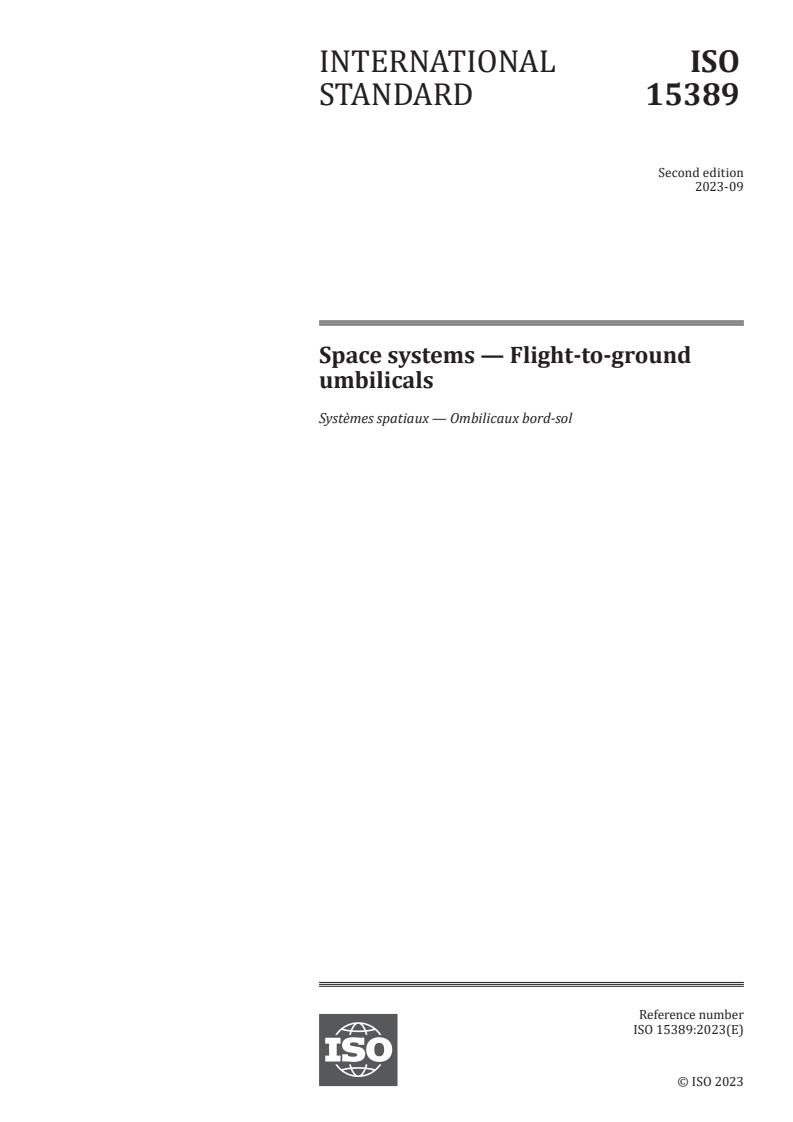
INTERNATIONAL ISO
STANDARD 15389
Second edition
2023-09
Space systems — Flight-to-ground
umbilicals
Systèmes spatiaux — Ombilicaux bord-sol
Reference number
© ISO 2023
All rights reserved. Unless otherwise specified, or required in the context of its implementation, no part of this publication may
be reproduced or utilized otherwise in any form or by any means, electronic or mechanical, including photocopying, or posting on
the internet or an intranet, without prior written permission. Permission can be requested from either ISO at the address below
or ISO’s member body in the country of the requester.
ISO copyright office
CP 401 • Ch. de Blandonnet 8
CH-1214 Vernier, Geneva
Phone: +41 22 749 01 11
Email: copyright@iso.org
Website: www.iso.org
Published in Switzerland
ii
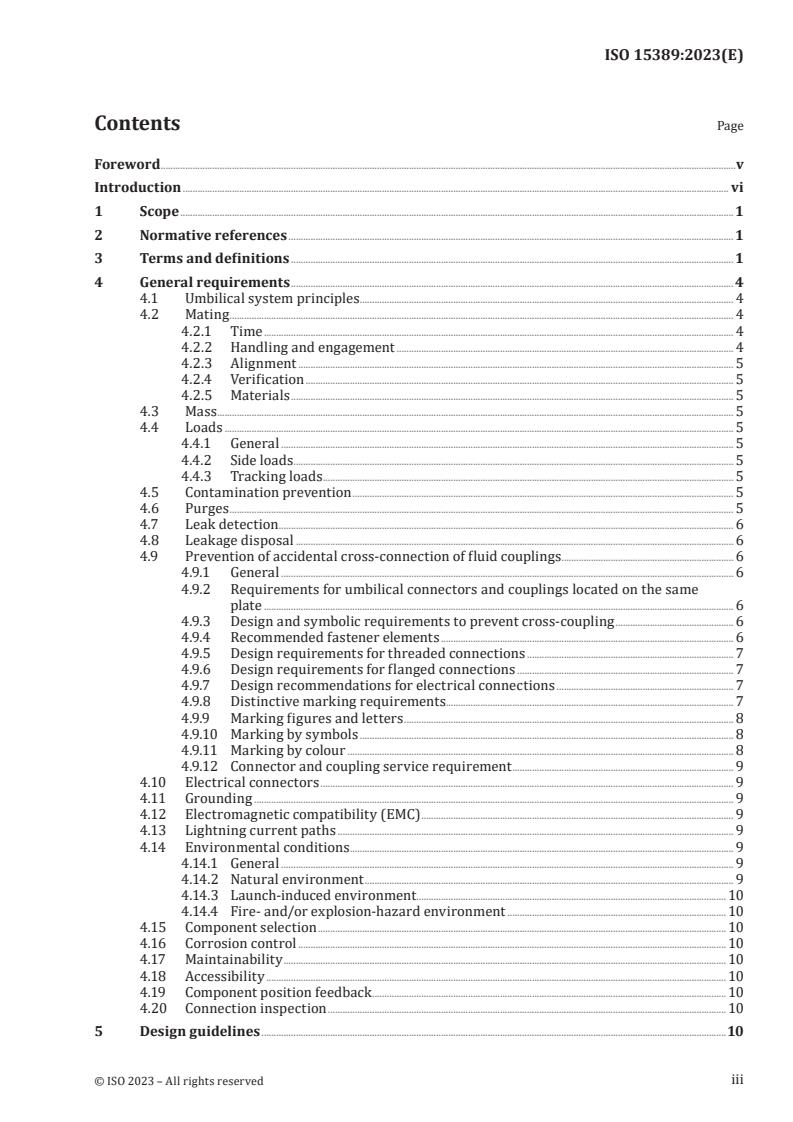
Contents Page
Foreword .v
Introduction . vi
1 Scope . 1
2 Normative references . 1
3 Terms and definitions . 1
4 General requirements . 4
4.1 Umbilical system principles . 4
4.2 Mating . 4
4.2.1 Time . 4
4.2.2 Handling and engagement . 4
4.2.3 Alignment . 5
4.2.4 Verification . 5
4.2.5 Materials . 5
4.3 Mass . 5
4.4 Loads . 5
4.4.1 General . 5
4.4.2 Side loads . 5
4.4.3 Tracking loads . 5
4.5 Contamination prevention . 5
4.6 Purges . 5
4.7 Leak detection . . 6
4.8 Leakage disposal . 6
4.9 Prevention of accidental cross-connection of fluid couplings. 6
4.9.1 General . 6
4.9.2 Requirements for umbilical connectors and couplings located on the same
plate . 6
4.9.3 Design and symbolic requirements to prevent cross-coupling . 6
4.9.4 Recommended fastener elements . 6
4.9.5 Design requirements for threaded connections . 7
4.9.6 Design requirements for flanged connections . 7
4.9.7 Design recommendations for electrical connections . 7
4.9.8 Distinctive marking requirements. 7
4.9.9 Marking figures and letters . 8
4.9.10 Marking by symbols . 8
4.9.11 Marking by colour . 8
4.9.12 Connector and coupling service requirement . 9
4.10 Electrical connectors . 9
4.11 Grounding . 9
4.12 Electromagnetic compatibility (EMC) . 9
4.13 Lightning current paths . 9
4.14 Environmental conditions . . 9
4.14.1 General . 9
4.14.2 Natural environment . 9
4.14.3 Launch-induced environment . 10
4.14.4 Fire- and/or explosion-hazard environment . 10
4.15 Component selection . 10
4.16 Corrosion control . 10
4.17 Maintainability . 10
4.18 Accessibility . 10
4.19 Component position feedback . 10
4.20 Connection inspection . 10
5 Design guidelines .10
iii
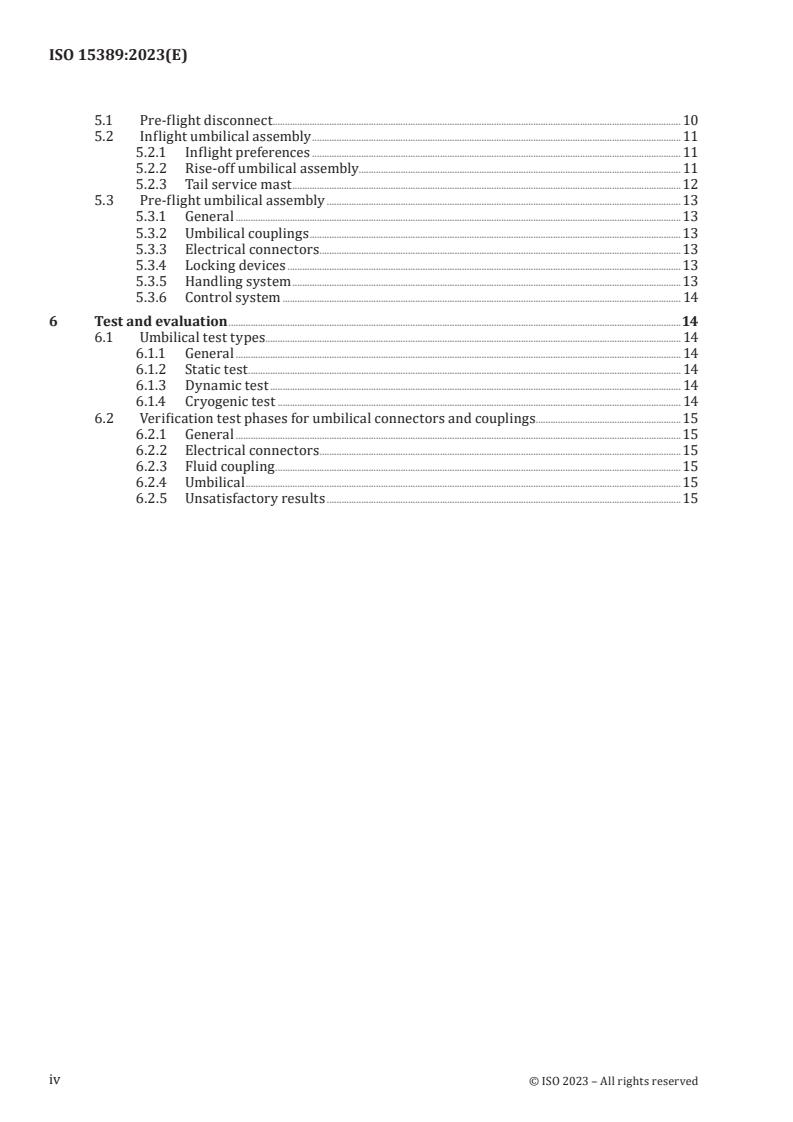
5.1 Pre-flight disconnect . 10
5.2 Inflight umbilical assembly . 11
5.2.1 Inflight preferences . 11
5.2.2 Rise-off umbilical assembly . . 11
5.2.3 Tail service mast .12
5.3 Pre-flight umbilical assembly . 13
5.3.1 General .13
5.3.2 Umbilical couplings . 13
5.3.3 Electrical connectors . .13
5.3.4 Locking devices . 13
5.3.5 Handling system .13
5.3.6 Control system . 14
6 Test and evaluation .14
6.1 Umbilical test types. 14
6.1.1 General . 14
6.1.2 Static test . 14
6.1.3 Dynamic test . 14
6.1.4 Cryogenic test . 14
6.2 Verification test phases for umbilical connectors and couplings .15
6.2.1 General .15
6.2.2 Electrical connectors . .15
6.2.3 Fluid coupling . 15
6.2.4 Umbilical . 15
6.2.5 Unsatisfactory results .15
iv
Foreword
ISO (the International Organization for Standardization) is a worldwide federation of national standards
bodies (ISO member bodies). The work of preparing International Standards is normally carried out
through ISO technical committees. Each member body interested in a subject for which a technical
committee has been established has the right to be represented on that committee. International
organizations, governmental and non-governmental, in liaison with ISO, also take part in the work.
ISO collaborates closely with the International Electrotechnical Commission (IEC) on all matters of
electrotechnical standardization.
The procedures used to develop this document and those intended for its further maintenance are
described in the ISO/IEC Directives, Part 1. In particular, the different approval criteria needed for the
different types of ISO document should be noted. This document was drafted in accordance with the
editorial rules of the ISO/IEC Directives, Part 2 (see www.iso.org/directives).
ISO draws attention to the possibility that the implementation of this document may involve the use
of (a) patent(s). ISO takes no position concerning the evidence, validity or applicability of any claimed
patent rights in respect thereof. As of the date of publication of this document, ISO had not received
notice of (a) patent(s) which may be required to implement this document. However, implementers are
cautioned that this may not represent the latest information, which may be obtained from the patent
database available at www.iso.org/patents. ISO shall not be held responsible for identifying any or all
such patent rights.
Any trade name used in this document is information given for the convenience of users and does not
constitute an endorsement.
For an explanation of the voluntary nature of standards, the meaning of ISO specific terms and
expressions related to conformity assessment, as well as information about ISO's adherence to
the World Trade Organization (WTO) principles in the Technical Barriers to Trade (TBT), see
www.iso.org/iso/foreword.html.
This document was prepared by Technical Committee ISO/TC 20, Aircraft and space vehicles,
Subcommittee SC 14, Space systems and operations.
This second edition cancels and replaces the first edition (ISO 15389:2001), which has been technically
revised. It also incorporates the Amendment ISO 15389:2001/Amd 1:2005 and the Technical
Corrigendum ISO 15389:2001/Cor 1:2006.
The main changes are as follows:
— addition of 4.9 on the prevention of accidental cross-connection.
Any feedback or questions on this document should be directed to the user’s national standards body. A
complete listing of these bodies can be found at www.iso.org/members.html.
v
Introduction
This document establishes the general requirements and criteria for flight-to-ground umbilical systems
used by space systems. The purpose of this document is to establish uniform engineering practices
and methods and to ensure the inclusion of essential requirements in the design of reusable flight-to-
ground umbilical systems that support the launch of space systems. This document is not intended to
define how to design umbilicals but to define the minimum requirements for umbilicals.
Prevention of accidental cross-connection of umbilical system connectors and couplings is extremely
important. Launch vehicle and spacecraft assemblies and features are often unique, requiring many
connectors and couplings to be in close proximity to each other. The accidental cross-connection of
service lines can result in very serious and even tragic consequences. For example:
— supplying other gas or fluids;
— supplying gas or fluid under other pressure;
— supplying the electric power with other parameters;
— supplying an error signal (command).
Therefore, differences in design of connectors and couplings that are located close to each other should
be significant. Such differences can be both in design and in marking for identification.
International cooperation in space engineering assumes international cooperation in design,
manufacture, and operation. The application of uniform methods increases the reliability of space
systems by minimizing the accidental cross-connection of connectors and couplings. The application of
unified symbols promotes mutual understanding and personnel training.
vi
INTERNATIONAL STANDARD ISO 15389:2023(E)
Space systems — Flight-to-ground umbilicals
1 Scope
This document defines the general criteria for the development of flight-to-ground umbilical systems
used by a space system. These criteria apply to the service arms or equivalent mechanisms, umbilical
carriers and plates, couplings, connectors, withdrawal and retract devices, handling mechanisms and
control systems for mechanisms, as well as the prevention of accidental cross-connection.
2 Normative references
The following documents are referred to in the text in such a way that some or all of their content
constitutes requirements of this document. For dated references, only the edition cited applies. For
undated references, the latest edition of the referenced document (including any amendments) applies.
ISO 14625, Space systems — Ground support equipment for use at launch, landing or retrieval sites —
General requirements
IEC 60364-5-54, Electrical installations of buildings — Part 5: Selection and erection of electrical
equipment — Chapter 54: Earthing arrangements and protective conductors
3 Terms and definitions
For the purposes of this document, the following terms and definitions apply.
ISO and IEC maintain terminology databases for use in standardization at the following addresses:
— ISO Online browsing platform: available at https:// www .iso .org/ obp
— IEC Electropedia: available at https:// www .electropedia .org/
3.1
carrier
device that groups coupling (3.3) and connector (3.2) halves together to provide a common means for
their positioning, retention, unlocking, and separation
Note 1 to entry: The term is commonly used in relation to the facility ground-side of umbilical interfaces (3.8).
3.2
connector
device, consisting of two halves, that permits engagement and disengagement of electrical circuits at an
interface (3.8)
3.3
coupling
device, consisting of two halves, that permits transfer of fluid across and disconnection at an interface
(3.8)
3.4
flanged connection
connection at which halves of connectors (3.2) or couplings (3.3) are mated by means of flanges
3.5
ground control
equipment, fluids, or signals, provided for command or control purposes, which are neither on board
nor originate on board the launch vehicle
3.6
handling mechanism
device used to provide positioning, manipulation, and physical dead-weight support of an object
3.7
inflight
term that denotes an occurrence or function after vehicle lift-off (3.10)
3.8
interface
mechanical, thermal, electrical, or operational common boundary between two elements of a system
EXAMPLE Ground-to-vehicle interface, physical interface, or responsibility interface.
3.9
launch processing system
operating consoles, data handling and display equipment, and the associated transmission system
configured to issue commands and analyse and display response data required in checkout and
operation of ground support equipment (GSE) and flight hardware
3.10
lift-off
instant of flight at which the vehicle's contact is terminated with all areas of hold-down and/or support
devices
Note 1 to entry: Lift-off is commonly called "first motion" of the vehicle.
3.11
nipple
half of a hydraulic or gas coupling (3.3) with an external sealing surface
3.12
plate
device that groups coupling and connector (3.2) halves together to provide a common means for
retention
Note 1 to entry: The plate is a passive device, containing cooperating but usually immobile portions of positioning,
locking, and separation machinery.
Note 2 to entry: The term is commonly used in relation to the vehicle side of umbilical interfaces (3.8) or with the
carrier (3.1).
EXAMPLE Carrier plate.
3.13
pre-flight
occurring before vehicle lift-off (3.10)
3.14
rise-off
actuated solely by a vehicle's vertical motion
3.15
service arm
retractable structure, usually attached to a tower used to provide either umbilical requirements,
personnel access, or both to the flight vehicle
Note 1 to entry: A service arm is commonly called access arm, umbilical arm, or swing arm, depending upon
whether it provides services for access only, umbilicals (3.19) only, or both, respectively.
Note 2 to entry: The service-arm retracting motion may be along an arc or in a vertical or horizontal plane.
3.16
T−0
time minus zero
last moment in the launch countdown, measured in seconds, at which time the launch vehicle lifts off
the ground
3.17
tail service mast
retractable structure used to provide umbilical requirements to the aft portion (tail) of a space vehicle
Note 1 to entry: Movement is usually a rotation about a pivot point away from the vehicle.
3.18
threaded connection
connection at which halves of connectors (3.2) or couplings (3.3) are mated by means of a thread on each
of the halves
3.19
umbilical
device that provides fluid (supply/return and purge) and electrical requirements at physical interfaces
(3.8) between ground facilities and various areas of a space vehicle
3.20
umbilical assembly
mated carrier (3.1) and plate (3.12) containing all couplings (3.3) and connectors (3.2) for a specified
umbilical region of the vehicle
3.21
umbilical service line
fluid line or electrical cable routed through an umbilical (3.19) such as a service arm (3.15) or equivalent
mechanism that is to be disconnected prior to engine ignition or at T−0 (3.16) or in flight
3.22
umbilical supply device
movable structure used to connect and/or disconnect the umbilical plates (3.12) at various locations on
a space vehicle
3.23
umbilical system
functional assembly of all items required for providing fluid and electrical servicing to a launch vehicle
and/or a payload
Note 1 to entry: This system usually includes the following:
— service arms (3.15) or equivalent umbilical supply device (3.22) mechanisms;
— umbilical carriers (3.1) and plates (3.12);
— couplings (3.3) and connectors (3.2), all separation, withdrawal, and retraction devices;
— control equipment;
— control fluids and electrical signals;
— all interconnecting lines across the service arms or the equivalent mechanism on the ground side.
Note 2 to entry: The mating-half interface (3.8) for the couplings/connectors and umbilical carrier should be
located on the exterior surface of the launch vehicle at an orientation compatible with the launch structure.
3.24
union
half of a hydraulic or gas coupling (3.3) with an internal sealing surface
4 General requirements
4.1 Umbilical system principles
The umbilical design shall not require reconnection of disconnected umbilical service lines to abort
safely on the launch pad. Passive umbilical systems disconnected at lift-off by gravity is the preferred
system as opposed to active systems to minimize failure modes and potential damage to the flight
hardware. Adequate safety margins and/or system redundancy shall be included in the design to
preclude premature umbilical disconnect that can jeopardize the flight hardware environment or
vehicle and/or personnel safety. System design shall be a balance between ensuring umbilicals remain
engaged and sealed under all static and dynamic pre-launch environments and safely disconnecting at
lift-off.
Disconnect after lift-off should have at least secondary and, if possible, tertiary modes to ensure vehicle
safety as the primary feature and protection of the ground systems under the launch environment as
a secondary feature. Umbilical failures shall not propagate into the flight vehicle system. Flight-to-
ground umbilical systems shall conform to the general requirements specified in ISO 14625.
4.2 Mating
4.2.1 Time
The time required to connect and verify an umbilical assembly shall be minimized. Factors that should
be considered include:
a) the number of steps required;
b) the number of component parts to be installed or manipulated in the connection process;
c) availability of, and accessibility with, mechanical handling aids;
d) available working space;
e) requirements for operating personnel;
f) safety requirements;
g) alignment requirements;
h) the adaptability to automated verification.
The goal for the time required to perform the mating operation is one work shift or less.
4.2.2 Handling and engagement
Rapid handling and engagement are necessary in order to minimize impact on the ground turnaround
and crew size for launch support. To provide ease with which an umbilical assembly is mated and
connected to a vehicle, consideration shall be given to mass, torque requirements, manual force required
for connection, and rigidity of electrical cables, flex lines, propellant flex lines, ducts for environmental
control systems, etc.
4.2.3 Alignment
The umbilical assembly shall be self-aligning. The design shall not require critical manual horizontal,
vertical, or parallel alignment for mating.
4.2.4 Verification
Mated umbilical assemblies shall allow quick and reliable verification of integrity.
4.2.5 Materials
Umbilical materials shall be compatible with service line media, shall be corrosion-resistant, and shall
meet flammability, odour, and off-gassing, or vacuum-stability requirements that may be required by
the flight hardware system.
4.3 Mass
Umbilical parts shall be as lightweight as feasible to minimize launch-induced loads and ground-
handling requirements.
4.4 Loads
4.4.1 General
Umbilical design shall accommodate all static and dynamic pre-launch loads, such as dead loads, fluid
pressure loads, and catenary loads imposed on all lines running from the
...
Questions, Comments and Discussion
Ask us and Technical Secretary will try to provide an answer. You can facilitate discussion about the standard in here.
Loading comments...