

ISO/IEC 18181-2:2026
(Main)Information technology — JPEG XL image coding system — Part 2: File format
General Information
- Abstract
This document specifies the transport and container formats for JPEG XL codestreams as specified in ISO/IEC 18181-1. This document specifies how to add metadata and extensions to JPEG XL codestreams. A file as described by this document is called a JPEG XL file.
- Status
- Published
- Publication Date
- 13-Apr-2026
- Current Stage
- 9092 - International Standard to be revised
- Start Date
- 14-Apr-2026
- Completion Date
- 29-Aug-2026
Overview
ISO/IEC 18181-2:2026, developed by ISO and IEC, specifies the official file format for the JPEG XL image coding system. As the second part of the JPEG XL series, this international standard defines how JPEG XL codestreams-outlined in ISO/IEC 18181-1-are transported, stored, and organized in files. The document provides comprehensive guidance on structuring JPEG XL files, managing image metadata, and supporting extensibility for various imaging applications. JPEG XL files offer a modern container format supporting metadata, extensions, and efficient image encoding, making them suitable for advanced imaging workflows and digital archiving.
Key Topics
Container Format Structure
The standard describes the box-based organization of JPEG XL files, specifying how each component-such as codestreams, metadata, and extensions-is encapsulated within distinct box structures.Metadata and Extensibility
JPEG XL files can include diverse types of metadata (Exif, XML) and allow extensions for future functional growth while remaining backward compatible.Codestream Handling
The specification details requirements for including the primary JPEG XL codestream, splitting codestreams across multiple partial boxes, and reconstructing images from these segments.Box Types and Organization
Various predefined box types are outlined, such as:- JPEG XL Signature box (JXL˽)
- File Type box (ftyp)
- Level box (jxll)
- JUMBF box (jumb) for universal metadata
- Exif and XML boxes for metadata
- Brotli-compressed boxes (brob)
- Frame Index box (jxli) for animations
- Codestream and partial codestream boxes (jxlc, jxlp)
- HDR Gain Map box (jhgm)
- JPEG Bitstream Reconstruction Data box (jbrd)
Data Types and Interoperability
Precise usage of data types, binary formats, and byte order is mandated to ensure interoperability among diverse encoders and decoders.
Applications
JPEG XL file format is engineered for applications requiring efficient, interoperable, and extensible image storage and transport:
Digital Imaging and Web Publishing
- Supports efficient loading, progressive rendering, and lossless/lossy compression for web images.
- Facilitates inclusion of metadata for search engine optimization and digital asset management.
Archival and Preservation
- Container format supports long-term preservation, encapsulating both the image data and its descriptive metadata.
Professional Photography and Media
- Enables the embedding of Exif data and HDR gain maps, critical for asset tracking, color management, and future-proof media workflows.
Animation and Advanced Graphics
- Frame Index boxes support animations and multi-frame images, crucial for media production and web animations.
Future-Proof Extensibility
- Box-based design allows seamless integration of new features and custom metadata without breaking compatibility or existing workflows.
Related Standards
- ISO/IEC 18181-1: JPEG XL image coding system - Core coding system. Specifies the codestream structure for JPEG XL images.
- ISO/IEC 19566-5: JPEG Universal Metadata Box Format (JUMBF) - Used for embedding a wide range of metadata into the JPEG XL file format.
- ISO 21496-1: Gain map metadata for dynamic range conversion - Referenced for the HDR Gain Map box contents.
- ISO/IEC 10918-1: Digital compression and coding of continuous-tone still images - Requirements for compatibility and reconstruction of legacy JPEG.
- IETF RFC 7932: Brotli Compressed Data Format - Used for the Brotli-compressed boxes in the JPEG XL file structure.
Keywords: JPEG XL file format, ISO/IEC 18181-2:2026, image container, box structure, metadata, codestream, Exif, XML, Brotli compression, animation support, HDR gain map, digital image archiving, imaging standard, JUMBF, interoperability, extensibility.
Relations
- Revises
ISO/IEC 18181-2:2024 - Information technology — JPEG XL image coding system — Part 2: File format - Effective Date
- 01-Feb-2025
Get Certified
Connect with accredited certification bodies for this standard

BSI Group
BSI (British Standards Institution) is the business standards company that helps organizations make excellence a habit.

NYCE
Mexican standards and certification body.
Sponsored listings
Frequently Asked Questions
ISO/IEC 18181-2:2026 is a standard published by the International Organization for Standardization (ISO). Its full title is "Information technology — JPEG XL image coding system — Part 2: File format". This standard covers: This document specifies the transport and container formats for JPEG XL codestreams as specified in ISO/IEC 18181-1. This document specifies how to add metadata and extensions to JPEG XL codestreams. A file as described by this document is called a JPEG XL file.
This document specifies the transport and container formats for JPEG XL codestreams as specified in ISO/IEC 18181-1. This document specifies how to add metadata and extensions to JPEG XL codestreams. A file as described by this document is called a JPEG XL file.
ISO/IEC 18181-2:2026 is classified under the following ICS (International Classification for Standards) categories: 35.040.30 - Coding of graphical and photographical information. The ICS classification helps identify the subject area and facilitates finding related standards.
ISO/IEC 18181-2:2026 has the following relationships with other standards: It is inter standard links to ISO/IEC 18181-2:2024. Understanding these relationships helps ensure you are using the most current and applicable version of the standard.
ISO/IEC 18181-2:2026 is available in PDF format for immediate download after purchase. The document can be added to your cart and obtained through the secure checkout process. Digital delivery ensures instant access to the complete standard document.
Standards Content (Sample)
International
Standard
ISO/IEC 18181-2
Third edition
Information technology — JPEG XL
2026-04
image coding system —
Part 2:
File format
Technologies de l'information — Systѐme de codage d'images
JPEG XL —
Partie 2: Format de fichiers
Reference number
© ISO/IEC 2026
All rights reserved. Unless otherwise specified, or required in the context of its implementation, no part of this publication may
be reproduced or utilized otherwise in any form or by any means, electronic or mechanical, including photocopying, or posting on
the internet or an intranet, without prior written permission. Permission can be requested from either ISO at the address below
or ISO’s member body in the country of the requester.
ISO copyright office
CP 401 • Ch. de Blandonnet 8
CH-1214 Vernier, Geneva
Phone: +41 22 749 01 11
Email: copyright@iso.org
Website: www.iso.org
Published in Switzerland
© ISO/IEC 2026 – All rights reserved
ii
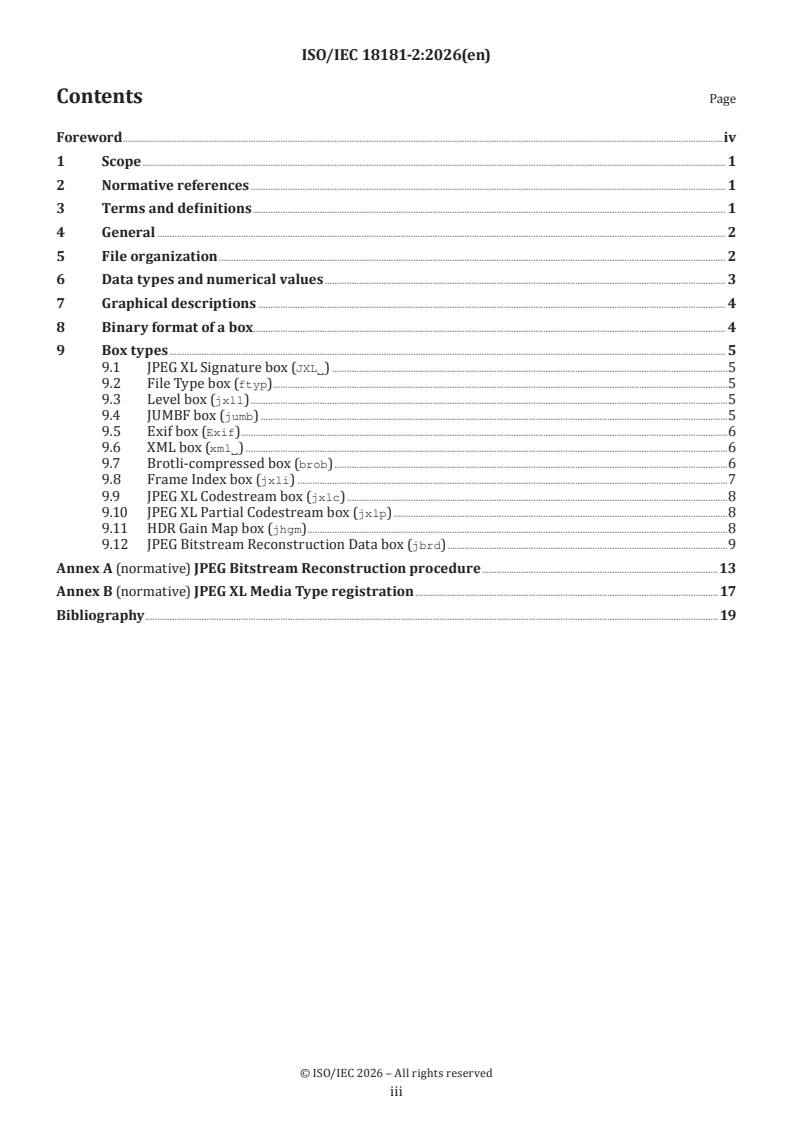
Contents Page
Foreword .iv
1 Scope . 1
2 Normative references . 1
3 Terms and definitions . 1
4 General . 2
5 File organization . 2
6 Data types and numerical values . 3
7 Graphical descriptions . 4
8 Binary format of a box . . 4
9 Box types . 5
9.1 JPEG XL Signature box (JXL˽) .5
9.2 File Type box (ftyp) . .5
9.3 Level box (jxll) .5
9.4 JUMBF box (jumb) .5
9.5 Exif box (Exif) .6
9.6 XML box (xml˽) .6
9.7 Brotli-compressed box (brob) .6
9.8 Frame Index box (jxli) .7
9.9 JPEG XL Codestream box (jxlc) .8
9.10 JPEG XL Partial Codestream box (jxlp) .8
9.11 HDR Gain Map box (jhgm) .8
9.12 JPEG Bitstream Reconstruction Data box (jbrd) .9
Annex A (normative) JPEG Bitstream Reconstruction procedure .13
Annex B (normative) JPEG XL Media Type registration . 17
Bibliography . 19
© ISO/IEC 2026 – All rights reserved
iii
Foreword
ISO (the International Organization for Standardization) and IEC (the International Electrotechnical
Commission) form the specialized system for worldwide standardization. National bodies that are
members of ISO or IEC participate in the development of International Standards through technical
committees established by the respective organization to deal with particular fields of technical activity.
ISO and IEC technical committees collaborate in fields of mutual interest. Other international organizations,
governmental and non-governmental, in liaison with ISO and IEC, also take part in the work.
The procedures used to develop this document and those intended for its further maintenance are described
in the ISO/IEC Directives, Part 1. In particular, the different approval criteria needed for the different types
of document should be noted. This document was drafted in accordance with the editorial rules of the ISO/
IEC Directives, Part 2 (see www.iso.org/directives or www.iec.ch/members_experts/refdocs).
ISO and IEC draw attention to the possibility that the implementation of this document may involve the
use of (a) patent(s). ISO and IEC take no position concerning the evidence, validity or applicability of any
claimed patent rights in respect thereof. As of the date of publication of this document, ISO and IEC had not
received notice of (a) patent(s) which may be required to implement this document. However, implementers
are cautioned that this may not represent the latest information, which may be obtained from the patent
database available at www.iso.org/patents and https://patents.iec.ch. ISO and IEC shall not be held
responsible for identifying any or all such patent rights.
Any trade name used in this document is information given for the convenience of users and does not
constitute an endorsement.
For an explanation of the voluntary nature of standards, the meaning of ISO specific terms and expressions
related to conformity assessment, as well as information about ISO's adherence to the World Trade
Organization (WTO) principles in the Technical Barriers to Trade (TBT) see www.iso.org/iso/foreword.html.
In the IEC, see www.iec.ch/understanding-standards.
This document was prepared by Joint Technical Committee ISO/IEC JTC 1, Information technology,
Subcommittee SC 29, Coding of audio, picture, multimedia and hypermedia information.
This third edition cancels and replaces the second edition (ISO/IEC 18181-2:2024), which has been
technically revised.
The main changes are as follows:
— 9.11 was added, specifying a new HDR gain map box;
— an informative note was added related to the combination of JUMBF and Brotli compression;
— clarifications were added to Annex A (JPEG bitstream reconstruction procedure).
A list of all parts in the ISO/IEC 18181 series can be found on the ISO and IEC websites.
Any feedback or questions on this document should be directed to the user’s national standards
body. A complete listing of these bodies can be found at www.iso.org/members.html and
www.iec.ch/national-committees.
© ISO/IEC 2026 – All rights reserved
iv
International Standard ISO/IEC 18181-2:2026(en)
Information technology — JPEG XL image coding system —
Part 2:
File format
1 Scope
This document specifies the transport and container formats for JPEG XL codestreams as specified in
ISO/IEC 18181-1. This document specifies how to add metadata and extensions to JPEG XL codestreams. A
file as described by this document is called a JPEG XL file.
2 Normative references
The following documents are referred to in the text in such a way that some or all of their content constitutes
requirements of this document. For dated references, only the edition cited applies. For undated references,
the latest edition of the referenced document (including any amendments) applies.
ISO/IEC 18181-1:2024, Information technology — JPEG XL image coding system — Part 1: Core coding system
ISO/IEC 10918-1:1994, Information technology — Digital compression and coding of continuous-tone still
images: Requirements and guidelines
ISO/IEC 19566-5, Information technologies — JPEG systems — Part 5: JPEG universal metadata box format
(JUMBF)
1)
IETF RFC 7932, J. Alakuijala, & Z. Szabadka. Brotli Compressed Data Format. RFC Series. Available from
ISO 21496-1, Digital photography — Gain map metadata for image conversion — Part 1: Dynamic range
conversion
3 Terms and definitions
For the purposes of this document, the following terms and definitions apply.
ISO and IEC maintain terminology databases for use in standardization at the following addresses:
— ISO Online browsing platform: available at https:// www .iso .org/ obp
— IEC Electropedia: available at https:// www .electropedia .org/
3.1
alternate image
image reconstructed from the baseline image (3.2) and the information in the HDR gain map box (3.3)
3.2
baseline image
image decoded from the primary JPEG XL codestream contained in a JPEG XL file (3.7), ignoring the
information in the HDR gain map box (3.3)
1) https:// www .rfc -editor .org/ info/ rfc7932.
© ISO/IEC 2026 – All rights reserved
3.3
box
structured collection of data describing the image or the image decoding process
3.4
box content
data wrapped within the box (3.3) structure
3.5
box type
kind of information stored within the box (3.3)
3.6
file format
set of data structures for the storage of metadata and extensions of a codestream
3.7
JPEG XL file
data file encoded in the file format (3.6) defined by this document
3.8
superbox
box (3.3) that carries other boxes as payload data
4 General
This document defines the file format of a JPEG XL file.
A JPEG XL file shall contain a codestream as specified in ISO/IEC 18181-1, and may contain additional
metadata and extensions. The IANA media type for JPEG XL files is image/jxl and it shall be registered in
accordance with Annex B.
A JPEG XL file shall come in one of the following forms:
— a box structure, as defined in Clause 5;
— a direct JPEG XL codestream without box structure.
The rest of this document only defines the box structure. The codestream without box structure is valid but
is completely specified in ISO/IEC 18181-1.
A JPEG XL file shall follow either the structure of a codestream without box structure, or it shall follow the
box structure as defined in Clause 5 and follow all box requirements in Clauses 6 to 9. A decoder can extract
the codestream from the box structure and decode the image from the codestream using the procedure
specified in ISO/IEC 18181-1, and can decode the contents of other boxes following their respective
specifications in this document.
NOTE A direct JPEG XL codestream without box structure is also a valid JPEG XL file. This allows, for example, a
more efficient encoding of images for the web, in cases where information encoded in other boxes than the codestream
is not required.
5 File organization
A JPEG XL file using the box structure is formed as a series of boxes. These boxes contain all data within the
file, including the initial signature required by the file format.
NOTE This box-based file format is based on the same syntax as described in ISO/IEC 15444-1:2024, Annex I or
ISO/IEC 15444-2:2023, Annex M, or ISO/IEC 21122-3. The binary format of a box is also described in Clause 8.
© ISO/IEC 2026 – All rights reserved
Boxes of different types contain different types of data, such as the file signature, metadata and the
codestream. Clause 9 defines box types that may appear in a JPEG XL file and their requirements. Boxes with
an unrecognized type shall be ignored and skipped by the decoder.
A JPEG XL file shall contain a JPEG XL codestream. The codestream can be split across multiple boxes: JPEG
XL partial codestream boxes. In this case, the codestream is formed by the concatenation of the content of all
those boxes.
Any boxes, content and codestreams present in a superbox, such as another JPEG XL file in a JUMBF superbox,
shall not be taken into account for the syntactic requirements of this document; they recursively follow their
applicable specification.
Tables 1 and 2 each show a conceptual box structure of a JPEG XL file, that is a possible series of different box
types that form the file, respectively with a single full codestream box and with multiple partial codestream
boxes. Boxes that may appear multiple times are indicated with ‘…’, optional boxes are indicated with
brackets and required boxes are indicated in bold. Tables 1 and 2 are only an indication and do not imply
any ordering or counting requirements for the boxes. The decoder shall not make any assumptions about the
ordering of any boxes after the first two, except where indicated.
Table 1 — Conceptual structure (example) of a JPEG XL file using a full codestream box
JXL˽: JPEG XL Signature box
ftyp: File Type box
jxlc: JPEG XL Codestream box
brobExif: (Brotli-compressed box containing Exif)
brobxml˽: (Brotli-compressed box containing XML)
jbrd: (JPEG Bitstream Reconstruction box)
Table 2 — Conceptual structure (example) of a JPEG XL file using partial codestream boxes
JXL˽: JPEG XL Signature box
ftyp: File Type box
jxll: Level box
jxlp: JPEG XL Partial Codestream box …
jxli: (JPEG XL Frame Index box)
jumb: (JUMBF box) …
jxlp: JPEG XL Partial Codestream box …
Exif: (Exif box)
jxlp: JPEG XL Partial Codestream box …
jxlp: JPEG XL Partial Codestream box …
xml˽: (XML box) …
6 Data types and numerical values
Data types used in this document shall be interpreted by the decoder as follows.
— u16_be: a 16-bit unsigned integer encoded in big endian order (2 bytes).
— u32_be: a 32-bit unsigned integer encoded in big endian order (4 bytes).
— u64_be: a 64-bit unsigned integer encoded in big endian order (8 bytes).
— Varint(): an unsigned integer value of up to 63 bits as a variable length integer in little endian order as
specified in ISO/IEC 18181-1:2024, E.4.2.
— U32(), u(n), Bool: as specified in ISO/IEC 18181-1:2024, B.2.
© ISO/IEC 2026 – All rights reserved
Numerical values for bytes are given as hexadecimal values, each individually prefixed by 0x. Hexadecimal
byte values are given in the order as they appear in the file. In some cases, these bytes spell out text in ASCII,
this is informatively indicated after the hexadecimal values.
7 Graphical descriptions
Box definitions contain graphical description tables to illustrate the structure of the box. These tables
should be interpreted as follows.
— A sequence of columns is used to indicate the fields of the box and their order (from left to right).
— Optional fields are indicated with brackets.
— Underline indicates a variable length field. Exact data types or sizes are indicated by name either in the
rectangle after the name of the field, or in a description of the fields outside of the table.
— Multi-column headers may show fields that are grouped in a larger named structure.
Table 3 shows an example of a box with 3 fields:
— A: a name given to a group of the three fields contained within.
— B: required field with a fixed length data type: the type u32_be
— C: optional field with a fixed length data type (e.g. u32_be, u64_be or a fixed amount of bytes)
— D: required field with a variable length data type (such as Varint(), or remaining amount of bytes)
Table 3 — Example of a graphical description of a box definition
A
B: u32_be (C) D
8 Binary format of a box
Each box shall have the structure indicated in Table 4. This structure consists of a header indicating size and
box type, and box content.
NOTE 1 This format is also specified in ISO/IEC 15444-1 and ISO/IEC 15444-2.
Table 4 — Binary format of a box
Box header Box content
LBox: u32_be TBox: 4 bytes ( XLBox: u64_be ) DBox: remaining bytes
The fields given in Table 4 are the following:
— LBox: has type u32_be. It gives the size of the box in bytes, including the box header fields. If the value is
1, then XLBox is used instead to indicate the size of the box. If the value is 0, then this box is the last box
of the file, and its data extends to the end of the file. If the value is not 0 or 1, it shall be at least 8.
— TBox: has 4 bytes (e.g. a FourCC code): box type, specifies the type of information found in the box
content, e.g. whether it is a JPEG XL Signature box, a File Type box, and so on.
— XLBox: has type u64_be. It is only present if LBox == 1. If present this field, instead of the LBox field,
indicates the size of the box in bytes. Its value shall be at least 16.
— DBox: has the remaining bytes. The box content (data). The content is formed by all the remaining bytes
of the box. The size of the content in bytes is the box size minus the size of the box header fields. The
© ISO/IEC 2026 – All rights reserved
format and meaning of this content is indicated by the box type, and Clause 9 defines the format of the
contents that may appear in a JPEG XL file.
NOTE 2 The box size is a multiple of bytes. This includes the JPEG XL codestream box. The JPEG XL codestream is
zero-padded at the end to align to a byte.
9 Box types
9.1 JPEG XL Signature box (JXL˽)
The JPEG XL signature box shall contain exactly the following 12 bytes, given as hexadecimal numbers:
— 0x00 0x00 0x00 0x0C
— 0x4A 0x58 0x4C 0x20 (the box type JXL˽ in ASCII)
— 0x0D 0x0A 0x87 0x0A
A JPEG XL file shall contain exactly one signature box. The signature box shall be the first box.
9.2 File Type box (ftyp)
The file type box shall contain exactly the following 20 bytes:
— 0x00 0x00 0x00 0x14
— 0x66 0x74 0x79 0x70 (the box type ftyp in ASCII)
— 0x6A 0x78 0x6C 0x20 (jxl˽ in ASCII)
— 0x00 0x00 0x00 0x00
— 0x6A 0x78 0x6C 0x20 (jxl˽ in ASCII)
A JPEG XL file shall contain exactly one file type box. The file type box shall be the second box. The profile of
the codestream box contained in this file is the Main profile.
9.3 Level box (jxll)
The type of this box shall be given by the 4 bytes 0x6A 0x78 0x6C 0x6C (jxll in ASCII).
Table 5 shows the contents of a Level box, excluding the box header.
Table 5 — Content of a Level box
level: u8
A JPEG XL file shall contain at most one Level box. If it is present, it shall be the third box, immediately after
the file type box.
If there is no Level box, the level is assumed to be 5. This level applies to the content of the JPEG XL codestream
box, as described in ISO/IEC 18181-1:2024, Annex M.
9.4 JUMBF box (jumb)
The type of this box shall be given by the 4 bytes 0x6A 0x75 0x6D 0x62 (jumb in ASCII). This box shall follow
the specification defined by ISO/IEC 19566-5.
© ISO/IEC 2026 – All rights reserved
A JUMBF box is a superbox that shall contain exactly one JUMBF Description box followed by one or more
Content Boxes.
NOTE While it is allowed to apply Brotli compression (9.7) to entire JUMBF boxes, encoders are encouraged to
leave the JUMBF Description box uncompressed and to apply compression at the level of the content boxes, in order to
facilitate identification of the JUMBF Type.
9.5 Exif box (Exif)
The type of this box shall be given by the 4 bytes 0x45 0x78 0x69 0x66 (Exif in ASCII).
Table 6 shows the contents of an Exif box, excluding the box header.
Table 6 — Content of an Exif box
tiff header offset: u32_be Exif payload: remaining bytes
The Exif payload is as described in JEITA CP-3451E or JEITA CP-3461B. The tiff header offset denotes, as
specified in JEITA CP-3461B, the number of bytes, counting from the first byte of the Exif payload to the first
byte of the TIFF header of the Exif metadata. The value is zero if the payload starts immediately with the
TIFF header.
NOTE The content of this box is exactly ExifDataBlock as defined in ISO/IEC 23008-12:2025, Annex A.2.
For any Exif fields that have equivalents within the codestream, a decoder shall consider the codestream to
take precedence. Encoders are encouraged to ensure the Exif and codestream fields are identical.
EXAMPLE Examples of such fields include orientation and pixel dimensions.
9.6 XML box (xml˽)
The type of this box shall be given by the 4 bytes 0x78 0x6D 0x6C 0x20 (xml˽ in ASCII).
The XML box contains a well-formed XML document as defined by W3C REC-xml-20081126.
Table 7 shows the content of an XML box.
Table 7 — Content of an XML box
XML data: all bytes
A JPEG XL file may contain multiple XML boxes.
NOTE This box follows the specification of XML Box in ISO/IEC 15444-2.
9.7 Brotli-compressed box (brob)
The type of this box shall be given by the 4 bytes 0x62 0x72 0x6F 0x62 (brob in ASCII).
Table 8 shows the contents of a Brotli-compressed box, excluding the box header.
Table 8 — Content of a Brotli-compressed box
payload box type: 4 bytes Brotli-compressed payload: remaining bytes
This box shall be treated as if it is a box of the type given by the first 4 bytes of its contents (the payload
box type), with a contents equal to the Brotli-decompressed data obtained from the remaining bytes. The
payload box type shall not be 0x62 0x72 0x6F 0x62 (brob) and shall not start with 0x6A 0x78 0x6C (jxl) nor
be equal to 0x6A 0x62 0x72 0x64 (jbrd).
Brotli-compressed data shall be decoded as specified in IETF RFC 7932.
© ISO/IEC 2026 – All rights reserved
9.8 Frame Index box (jxli)
The type of this box shall be given by the 4 bytes 0x6A 0x78 0x6C 0x69 (jxli in ASCII).
This box contains an index of animation frame offsets. This box is optional and allows a decoder to efficiently
seek the data of a frame based on time or frame order. Not all frames are necessarily listed in the index. All
frames listed in the index shall be “keyframes”. The first frame shall always be listed. Keyframes are defined
such that when a decoder seeks to the beginning of this frame, the result of decoding this frame and future
frames is the same as when the decoder starts from the beginning. This implies that the current frame does
not use earlier frames for features such as blending, patches or lf_level, and later frames can only refer to
this frame or later for these features. The JPEG XL codestream supports frames with a duration of 0 ticks.
These frames are not presented by the decoder but can be used to form composite frames such as through
blending. Such frames are not counted as frames for the purpose of the F fields listed in Table 9, but the
i
offset can point to such frames, as they are required for decoding the full composite frame and may form the
beginning of a composite keyframe.
The box content shall have the structure indicated in Table 9 and further described below. In this table, all
fields have type Varint() unless indicated otherwise.
Table 9 — Content of a Frame Index box
NF T : u32_be T : u32_be OFF T F … OFF T F
NUM DEN 0 0 0 NF-1 NF-1 NF-1
The fields in Table 9 shall be interpreted as follows:
— NF: has type Varint(): number of frames listed in the index.
— T : has type u32_be: numerator of tick unit.
NUM
— T : has type u32_be: denominator of tick unit. If this value is 0, the file is ill-formed.
DEN
— per frame i listed:
— OFF : has type Varint(): offset of start byte of this frame compared to start byte of previous frame
i
from this index in the JPEG XL codestream. For the first frame, this is the offset from the first byte of
the JPEG XL codestream.
— T : has type Varint(): duration in ticks between the start of this frame and the start of the next frame
i
in the index. If this is the last frame in the index, this is the duration in ticks between the start of this
frame and the end of the stream. A tick lasts T / T seconds.
NUM DEN
— F
...