

ISO 10424-1:2004
(Main)Petroleum and natural gas industries — Rotary drilling equipment — Part 1: Rotary drill stem elements
General Information
- Abstract
ISO 10424-1:2004 specifies requirements for the following drill stem elements: upper and lower kelly valves; square and hexagonal kellys; drill stem subs; standard steel and non-magnetic drill collars; drilling and coring bits. ISO 10424-1:2004 is not applicable to drill pipe and tool joints, rotary shouldered connection designs, thread gauging practice, or grand master, reference master and working gauges.
- Status
- Withdrawn
- Publication Date
- 05-Sep-2004
- Technical Committee
- ISO/TC 67/SC 4 - Drilling and production equipment
- Drafting Committee
- ISO/TC 67/SC 4/WG 1 - Drilling equipment
- Current Stage
- 9599 - Withdrawal of International Standard
- Start Date
- 04-Apr-2025
- Completion Date
- 29-Aug-2026
Overview
ISO 10424-1:2004 - "Petroleum and natural gas industries - Rotary drilling equipment - Part 1: Rotary drill stem elements" defines design, material and testing requirements for key rotary drill stem components used in onshore and offshore drilling. First published in 2004, the standard covers upper and lower kelly valves, square and hexagonal kellys, drill-stem subs, standard steel and non-magnetic drill collars, and drilling and coring bits. It ensures interchangeability, performance and traceable quality across manufacturers and rigs. Note: ISO 10424-1:2004 is not applicable to drill pipe and tool joints, rotary-shouldered connection designs, thread gauging practice, or master gauges.
Key topics and technical requirements
- Design and mechanical properties: Specifies minimum material properties, dimensional requirements, and mechanical performance for drill stem elements to ensure reliable service in rotary drilling operations.
- Testing and inspection: Requires hydrostatic testing, mechanical tests (tensile, hardness, impact), and non-destructive examination (NDE) methods (penetrant, magnetic particle, ultrasonic) with certified personnel per ISO 9712.
- Connections and dimensions: Defines sizes, connection types and gauging practices for kellys, subs and collars to support interchangeability.
- Special components: Includes requirements for non-magnetic drill collars and various drilling and coring bits (roller, blade drag, diamond and PDC types).
- Documentation, marking and records: Mandates marking, traceability and retention of quality records for manufactured items.
- Unit systems: Provides data in both SI and US customary units (separate tables and Annex A) to support global procurement and manufacturing.
- Materials in sour service: References ISO 15156 for material selection in H2S-containing environments.
Practical applications and users
ISO 10424-1 is used to:
- Develop procurement specifications and purchase orders for rotary drill stem elements.
- Guide manufacturers in design, material selection, NDE and quality control for kellys, subs, drill collars and bits.
- Support drilling contractors, rig operators and maintenance teams in equipment compatibility and inspection regimes.
- Provide QA/QC and inspection bodies with acceptance criteria and record-keeping requirements.
- Aid standards engineers and regulatory bodies aligning equipment to international practice.
Users include manufacturers, drilling contractors, oil & gas operators, inspection agencies, and procurement teams focused on rotary drilling equipment, drill stem elements, and rig interoperability.
Related standards
- ISO 10424-2 - Threading and gauging of rotary shouldered thread connections
- ISO 13535 - Swivel requirements
- ISO 11961 - Drill pipe with weld-on tool joints
- ISO 15156 series - Materials for H2S environments
- API Spec 7 / API RP 7G - Related API documents referenced in the standard
Keywords: ISO 10424-1:2004, rotary drill stem elements, kelly valves, drill collars, drill-stem subs, drilling and coring bits, rotary drilling equipment, NDE, oil and gas standards.
Relations
- Effective Date
- 25-Aug-2026
- Effective Date
- 25-Aug-2026
- Effective Date
- 25-Aug-2026
- Effective Date
- 25-Aug-2026
- Effective Date
- 12-Feb-2026
- Effective Date
- 28-Feb-2023
Get Certified
Connect with accredited certification bodies for this standard

Element Materials Technology
Materials testing and product certification.

ABS Group Brazil
ABS Group certification services in Brazil.

ABS Quality Evaluations Inc.
American Bureau of Shipping quality certification.
Sponsored listings
Frequently Asked Questions
ISO 10424-1:2004 is a standard published by the International Organization for Standardization (ISO). Its full title is "Petroleum and natural gas industries — Rotary drilling equipment — Part 1: Rotary drill stem elements". This standard covers: ISO 10424-1:2004 specifies requirements for the following drill stem elements: upper and lower kelly valves; square and hexagonal kellys; drill stem subs; standard steel and non-magnetic drill collars; drilling and coring bits. ISO 10424-1:2004 is not applicable to drill pipe and tool joints, rotary shouldered connection designs, thread gauging practice, or grand master, reference master and working gauges.
ISO 10424-1:2004 specifies requirements for the following drill stem elements: upper and lower kelly valves; square and hexagonal kellys; drill stem subs; standard steel and non-magnetic drill collars; drilling and coring bits. ISO 10424-1:2004 is not applicable to drill pipe and tool joints, rotary shouldered connection designs, thread gauging practice, or grand master, reference master and working gauges.
ISO 10424-1:2004 is classified under the following ICS (International Classification for Standards) categories: 75.180.10 - Exploratory, drilling and extraction equipment. The ICS classification helps identify the subject area and facilitates finding related standards.
ISO 10424-1:2004 has the following relationships with other standards: It is inter standard links to EN ISO 10424-2:2007, EN ISO 10407-2:2008, EN ISO 10423:2009, EN ISO 13628-4:2010, EN ISO 10424-1:2004, ISO/R 1148:1969. Understanding these relationships helps ensure you are using the most current and applicable version of the standard.
ISO 10424-1:2004 is available in PDF format for immediate download after purchase. The document can be added to your cart and obtained through the secure checkout process. Digital delivery ensures instant access to the complete standard document.
Standards Content (Sample)
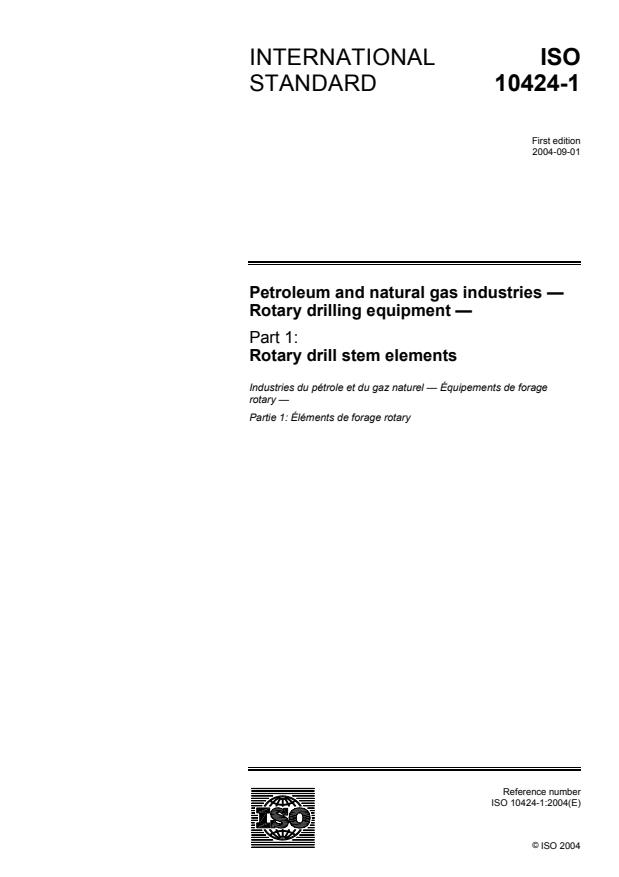
INTERNATIONAL ISO
STANDARD 10424-1
First edition
2004-09-01
Petroleum and natural gas industries —
Rotary drilling equipment —
Part 1:
Rotary drill stem elements
Industries du pétrole et du gaz naturel — Équipements de forage
rotary —
Partie 1: Éléments de forage rotary
Reference number
©
ISO 2004
PDF disclaimer
This PDF file may contain embedded typefaces. In accordance with Adobe's licensing policy, this file may be printed or viewed but
shall not be edited unless the typefaces which are embedded are licensed to and installed on the computer performing the editing. In
downloading this file, parties accept therein the responsibility of not infringing Adobe's licensing policy. The ISO Central Secretariat
accepts no liability in this area.
Adobe is a trademark of Adobe Systems Incorporated.
Details of the software products used to create this PDF file can be found in the General Info relative to the file; the PDF-creation
parameters were optimized for printing. Every care has been taken to ensure that the file is suitable for use by ISO member bodies. In
the unlikely event that a problem relating to it is found, please inform the Central Secretariat at the address given below.
© ISO 2004
All rights reserved. Unless otherwise specified, no part of this publication may be reproduced or utilized in any form or by any means,
electronic or mechanical, including photocopying and microfilm, without permission in writing from either ISO at the address below or
ISO's member body in the country of the requester.
ISO copyright office
Case postale 56 • CH-1211 Geneva 20
Tel. + 41 22 749 01 11
Fax + 41 22 749 09 47
E-mail copyright@iso.org
Web www.iso.org
Published in Switzerland
ii © ISO 2004 – All rights reserved
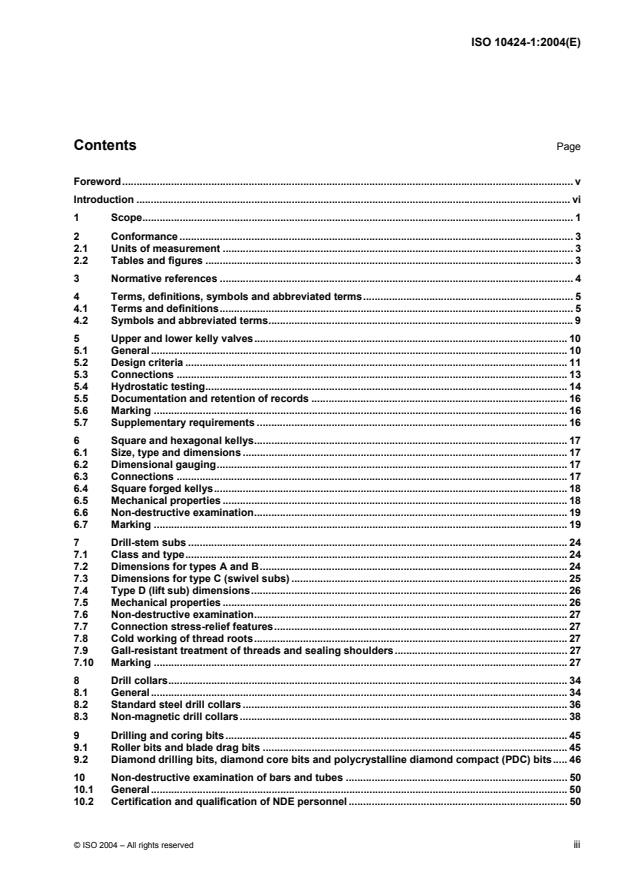
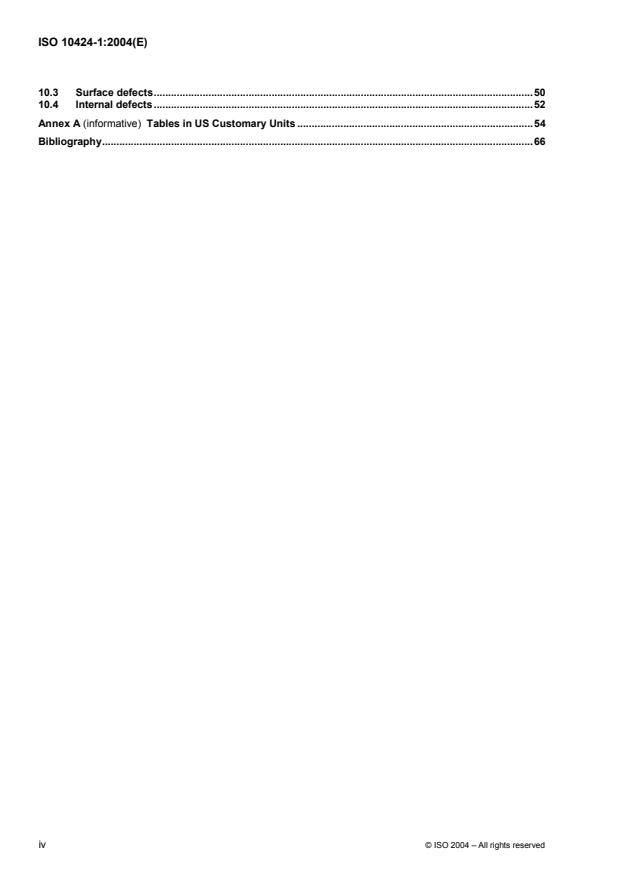
Contents Page
Foreword. v
Introduction . vi
1 Scope. 1
2 Conformance . 3
2.1 Units of measurement . 3
2.2 Tables and figures . 3
3 Normative references . 4
4 Terms, definitions, symbols and abbreviated terms. 5
4.1 Terms and definitions. 5
4.2 Symbols and abbreviated terms. 9
5 Upper and lower kelly valves. 10
5.1 General. 10
5.2 Design criteria . 11
5.3 Connections . 13
5.4 Hydrostatic testing. 14
5.5 Documentation and retention of records . 16
5.6 Marking . 16
5.7 Supplementary requirements . 16
6 Square and hexagonal kellys. 17
6.1 Size, type and dimensions . 17
6.2 Dimensional gauging. 17
6.3 Connections . 17
6.4 Square forged kellys. 18
6.5 Mechanical properties . 18
6.6 Non-destructive examination. 19
6.7 Marking . 19
7 Drill-stem subs . 24
7.1 Class and type. 24
7.2 Dimensions for types A and B. 24
7.3 Dimensions for type C (swivel subs) . 25
7.4 Type D (lift sub) dimensions. 26
7.5 Mechanical properties . 26
7.6 Non-destructive examination. 27
7.7 Connection stress-relief features. 27
7.8 Cold working of thread roots. 27
7.9 Gall-resistant treatment of threads and sealing shoulders. 27
7.10 Marking . 27
8 Drill collars. 34
8.1 General. 34
8.2 Standard steel drill collars . 36
8.3 Non-magnetic drill collars. 38
9 Drilling and coring bits. 45
9.1 Roller bits and blade drag bits . 45
9.2 Diamond drilling bits, diamond core bits and polycrystalline diamond compact (PDC) bits. 46
10 Non-destructive examination of bars and tubes . 50
10.1 General. 50
10.2 Certification and qualification of NDE personnel . 50
10.3 Surface defects.50
10.4 Internal defects.52
Annex A (informative) Tables in US Customary Units .54
Bibliography.66
iv © ISO 2004 – All rights reserved
Foreword
ISO (the International Organization for Standardization) is a worldwide federation of national standards bodies
(ISO member bodies). The work of preparing International Standards is normally carried out through ISO
technical committees. Each member body interested in a subject for which a technical committee has been
established has the right to be represented on that committee. International organizations, governmental and
non-governmental, in liaison with ISO, also take part in the work. ISO collaborates closely with the
International Electrotechnical Commission (IEC) on all matters of electrotechnical standardization.
International Standards are drafted in accordance with the rules given in the ISO/IEC Directives, Part 2.
The main task of technical committees is to prepare International Standards. Draft International Standards
adopted by the technical committees are circulated to the member bodies for voting. Publication as an
International Standard requires approval by at least 75 % of the member bodies casting a vote.
Attention is drawn to the possibility that some of the elements of this document may be the subject of patent
rights. ISO shall not be held responsible for identifying any or all such patent rights.
ISO 10424-1 was prepared by Technical Committee ISO/TC 67, Materials, equipment and offshore structures
for petroleum, petrochemical and natural gas industries, Subcommittee SC 4, Drilling and production
equipment.
ISO 10424 consists of the following parts, under the general title Petroleum and natural gas industries —
Rotary drilling equipment:
Part 1: Rotary drill stem elements
Part 2: Threading and gauging of rotary shouldered thread connections
Introduction
The function of this part of ISO 10424 is to define the design and the mechanical properties of the material
required for rotary drill stem elements. It also defines the testing required to verify compliance with these
requirements. As rotary drill stem elements are very mobile, moving from rig to rig, design control is an
important element required to ensure the interchangeability and performance of product manufactured by
different sources.
A major portion of this part of ISO 10424 is based upon API Spec 7, 40th edition, November 2001. However,
API Spec 7 does not define the nondestructive testing requirements of materials used to manufacture the drill
stem components covered by this part of ISO 10424. This part of ISO 10424 does address these
requirements.
Users of this part of ISO 10424 should be aware that further or differing requirements may be needed for
individual applications. This part of ISO 10424 is not intended to inhibit a vendor from offering, or the
purchaser from accepting, alternative equipment or engineering solutions for the individual application. This
may be particularly applicable where there is innovative or developing technology. Where an alternative is
offered, the vendor should identify any variations from this part of ISO 10424 and provide details.
In this part of ISO 10424, certain ISO and non-ISO standards provide the same technical result for a particular
provision, however there is a market need to retain the traditional non-ISO reference.
In the running text the provision is written in the form “……… in accordance with ISO xxx.
NOTE For the purposes of this provision, non-ISO Ref yyy is equivalent to ISO xxx.”
Application of a non-ISO reference cited in this manner will lead to the same results as the use of the
preceding ISO reference. These documents are thus considered interchangeable in practice. In recognition of
the migration of global standardization towards the use of ISO standards, it is intended that references to
these alternative documents be removed at the time of the first full revision of this part of ISO 10424.
vi © ISO 2004 – All rights reserved
INTERNATIONAL STANDARD ISO 10424-1:2004(E)
Petroleum and natural gas industries — Rotary drilling
equipment —
Part 1:
Rotary drill stem elements
1 Scope
This part of ISO 10424 specifies requirements for the following drill stem elements: upper and lower kelly
valves; square and hexagonal kellys; drill stem subs; standard steel and non-magnetic drill collars; drilling and
coring bits.
This part of 10424 is not applicable to drill pipe and tool joints, rotary shouldered connection designs, thread
gauging practice, or grand master, reference master and working gauges.
A typical drill stem assembly to which this part of 10424 is applicable is shown in Figure 1.
a) Upper section of assembly b) Lower section of assembly
Figure 1 — Typical drill stem assembly
2 © ISO 2004 – All rights reserved
Key
1 bit 7 pin tool joint 13 kelly drive section
2 rotary pin connection 8 drill pipe 14 upper kelly upset
3 rotary box connection 9 box tool joint 15 upper kelly valve
4 bit sub 10 protector rubber 16 swivel sub
5 drill collar 11 lower kelly valve or kelly saver sub 17 swivel stem
6 crossover sub 12 lower kelly upset 18 swivel
a
Requirements on swivels can be found in ISO 13535.
b
Requirements on drill pipe with weld-on tool joints can be found in ISO 11961.
NOTE 1 For the purposes of the provision in footnote a, API Specs 8A and 8C are equivalent to ISO 13535.
NOTE 2 For the purposes of the provision in footnote b, API Specs 5D and 7 are equivalent to ISO 11961.
NOTE 3 All connections between lower kelly upset and the bit are RH.
NOTE 4 All connections between upper kelly upset and swivel are LH.
Figure 1 — Typical drill stem assembly (continued)
2 Conformance
2.1 Units of measurement
In this International Standard, data are expressed in both the International System (SI) of units and the United
States Customary (USC) system of units. For a specific order item, it is intended that only one system of units
be used, without combining data expressed in the other system.
Products manufactured to specifications expressed in either of these unit systems shall be considered
equivalent and totally interchangeable. Consequently, compliance with the requirements of this International
Standard as expressed in one system provides compliance with requirements in the other system.
For data expressed in the SI, a comma is used as the decimal separator and a space as the thousands
separator. For data expressed in the USC system, a dot is used as the decimal separator and a space as the
thousands separator.
Data within the text of this International Standard are expressed in SI units followed by data in USC units in
parentheses.
2.2 Tables and figures
Separate tables for data expressed in SI units and in USC units are given. The tables containing data in SI
units are included in the text and the tables containing data in USC units are given in Annex A. For a specific
order item, only one unit system shall be used.
Figures are contained in the text of the clause concerning the particular product, and express data in both SI
and USC units.
3 Normative references
The following referenced documents are indispensable for the application of this document. For dated
references, only the edition cited applies. For undated references, the latest edition of the referenced
document (including any amendments) applies.
ISO 148, Steel — Charpy impact test (V notch)
ISO 3452, Non-destructive testing — Penetrant inspection — General principles
ISO 6506-1, Metallic materials — Brinell hardness test — Part 1: Test method
ISO 6892, Metallic materials — Tensile testing at ambient temperature
ISO 9303, Seamless and welded (except submerged arc-welded) steel tubes for pressure purposes — Full
peripheral ultrasonic testing for the detection of longitudinal imperfections
ISO 9934-1, Non-destructive testing — Magnetic particle testing — Part 1: General principles
ISO 9712, Non-destructive testing — Qualification and certification of personnel
ISO 13665, Seamless and welded steel tubes for pressure purposes — Magnetic particle inspection of the
tube body for the detection of surface imperfections
ISO 15156-1, Petroleum and natural gas industries — Materials for use in H S-containing environments in oil
and gas production — Part 1: General principles for selection of cracking-resistant materials
ISO 15156-2, Petroleum and natural gas industries — Materials for use in H S-containing environments in oil
and gas production — Part 2: Cracking-resistant carbon and low alloy steels, and the use of cast irons
ISO 15156-3, Petroleum and natural gas industries — Materials for use in H S-containing environments in oil
and gas production — Part 3: Cracking-resistant CRAs (corrosion-resistant alloys) and other alloys
1)
API RP 7G, Drill Stem Design and Operating Limits
API Spec 7, Rotary Drill Stem Elements
2)
ASTM A 262, Standard Practices for Detecting Susceptibility to Intergranular Attack in Austenitic Stainless
Steels
ASTM A 434, Standard Specification for Steel Bars, Alloy, Hot-Wrought or Cold-Finished, Quenched and
Tempered
ASTM E 587, Standard Practice for Ultrasonic Angle-Beam Examination by the Contact Method
1) American Petroleum Institute, 1220 L Street, N.W., Washington, D.C. 20005, USA
2) American Society for Testing and Materials, 100 Barr Harbor Drive, West Conshohocken, PA 19428, USA
4 © ISO 2004 – All rights reserved
4 Terms, definitions, symbols and abbreviated terms
4.1 Terms and definitions
For the purposes of this document, the following terms and definitions apply.
4.1.1
amplitude
vertical height of the A-scan received signal, measured from base to peak or peak to peak
4.1.2
A-scan display
ultrasonic instrument display in which the received signal is displayed as a vertical height or “pip” from the
horizontal-sweep time trace, while the horizontal distance between two signals represents the material
distance for time of travel between the two conditions causing the signals
4.1.3
back reflection
signal received from the back surface of a surface test object
4.1.4
bevel diameter
outer diameter of the contact face of the rotary shouldered connection
4.1.5
bit sub
sub, usually with two box connections, that is used to connect the bit to the drill stem
4.1.6
box connection
threaded connection on oilfield tubular goods (OCTG) that has internal (female) threads
4.1.7
bending strength ratio
BSR
ratio of the section modulus of a rotary shouldered box at the point in the box where the pin ends when made
up, to the section modulus of the rotary shouldered pin at the last engaged thread
4.1.8
calibration system
documented system of gauge calibration and control
4.1.9
cold working
plastic deformation of the thread roots of a rotary shouldered connection, of radii and of cylindrical sections at
a temperature low enough to ensure or cause permanent strain of the metal
4.1.10
decarburization
loss of carbon from the surface of a ferrous alloy as a result of heating in a medium that reacts with the carbon
at the surface
4.1.11
depth prove-up
act of grinding a narrow notch across a surface-breaking indication until the bottom of the indication is located
and then measuring the depth of the indication with a depth gauge for comparison to acceptance criteria
4.1.12
drift
gauge used to check minimum internal diameter of drill stem components
4.1.13
drill collar
thick-walled pipe used to provide stiffness and concentration of mass at or near the bit
4.1.14
drill pipe
length of tube, usually steel, to which special threaded connections called tool joints are attached
4.1.15
forge, verb
〈hammer〉 plastically deform metal, usually hot, into desired shapes by the use of compressive force, with or
without dies
4.1.16
forging, noun
〈product〉 shaped metal part formed by the forging method
4.1.17
full-depth thread
thread in which the thread root lies on the minor cone of an external thread or on the major cone of an internal
thread
4.1.18
gauge point
plane perpendicular to the thread axis in API rotary shouldered connections
NOTE The gauge point is located 15,9 mm (0.625 in) from the shoulder of the product pin.
4.1.19
gas-tight
capable of holding gas without leaking under the specified pressure for the specified length of time
4.1.20
heat, noun
metal produced by a single cycle of a batch melting process
4.1.21
H S trim
all components, except external valve body, meeting the H S service requirements of ISO 15156-2 and
ISO 15156-3
NOTE For the purposes of this provision, NACE MR0175 is equivalent to ISO 15156–2 and ISO 15156–3.
4.1.22
kelly
square or hexagonally shaped steel pipe connecting the swivel to the drill pipe that moves through the rotary
table and transmits torque to the drill stem
4.1.23
kelly saver sub
short rotary sub that is made up onto the bottom of the kelly to protect the pin end of the kelly from wear
during make-up and break-out operations
6 © ISO 2004 – All rights reserved
4.1.24
label
dimensionless designation for the size and style of a rotary shouldered connection
4.1.25
length of box thread
LBT
length of threads in the box measured from the make-up shoulder to the intersection of the non-pressure flank
and crest of the last thread with full thread depth
4.1.26
lot
pieces of steel, with the same nominal dimensions and from a single heat, which are subsequently heat-
treated as part of the same continuous operation (or batch)
4.1.27
low-stress steel stamps
steel stamps that do not contain any sharp protrusions on the marking face
4.1.28
lower kelly valve
kelly cock
essentially full-opening valve installed immediately below the kelly, with outside diameter equal to the tool joint
outside diameter, that can be closed to remove the kelly under pressure and can be stripped in the hole for
snubbing operations
4.1.29
make-up shoulder
sealing shoulder on a rotary shouldered connection
4.1.30
non-pressure flank – box
thread flank closest to the make-up shoulder where no axial load is induced from make-up of the connection
or from tensile load on the drill stem member
4.1.31
non-pressure flank – pin
thread flank farthest from the make-up shoulder where no axial load is induced from make-up of the
connection or from tensile load on the drill stem member
4.1.32
out-of-roundness
difference between the maximum and minimum diameters of the bar or tube, measured in the same cross-
section, and not including surface finish tolerances outlined in 8.1.4
4.1.33
pin end
external (male) threads of a threaded connection
4.1.34
process of quenching
hardening of a ferrous alloy by austenitizing and then cooling rapidly enough so that some or all of the
austenite transforms to martensite
4.1.35
process of tempering
reheating a quench-hardened or normalized ferrous alloy to a temperature below the transformation range
and then cooling to soften and remove stress
4.1.36
reference dimension
dimension that is a result of two or more other dimensions
4.1.37
rotary shouldered connection
connection used on drill stem elements, which has coarse, tapered threads and sealing shoulders
4.1.38
stress-relief features
modification performed on rotary shouldered connections by removing the unengaged threads on the pin or
box to make the joint more flexible and to reduce the likelihood of fatigue-cracking in highly stressed areas
4.1.39
sub
short drill stem members with different rotary shouldered connections at each end for the purposes of joining
unlike members of the drill stem
4.1.40
swivel
device at the top of the drill stem that permits simultaneous circulation and rotation
4.1.41
tensile strength
maximum tensile stress that a material is capable of sustaining that is calculated from the maximum load
during a tensile test carried to rupture and the original cross-sectional area of the specimen
4.1.42
tensile test
mechanical test used to determine the behaviour of material under axial loading
4.1.43
test pressure
pressure above working pressure used to demonstrate structural integrity of a pressure vessel
4.1.44
thread form
thread profile in an axial plane for a length of one pitch
4.1.45
tolerance
amount of variation permitted
4.1.46
tool joint
heavy coupling element for drill pipe having coarse, tapered threads and sealing shoulders
4.1.47
upper kelly valve
kelly cock
valve immediately above the kelly that can be closed to confine pressures inside the drill stem
4.1.48
working pressure
pressure to which a particular piece of equipment is subjected during normal operation
4.1.49
working temperature
temperature to which a particular piece of equipment is subjected during normal operation
8 © ISO 2004 – All rights reserved
4.2 Symbols and abbreviated terms
D outside diameter
D diameter baffle plate recess
BP
D distance across corners, forged kellys
c
D distance across corners, machined kellys
cc
D bevel diameter
F
D distance across flats on kellys
FL
D diameter float valve recess
FR
D diameter elevator groove
E
D outside diameter lift shoulder
L
D outside diameter, kelly lower upset
LR
D elevator recess diameter
P
D outside diameter, reduced section
R
D diameter slip groove
S
D outside diameter, upper kelly upper upset
U
d inside diameter
d inside bevel
b
L overall length
L length kelly drive section
D
L length float valve assembly
FV
L minimum length kelly sleeve gauge
G
L lower upset length kellys
L
L depth of float valve recess
R
L upper upset length kellys
U
l elevator groove recess depth
E
l slip recess groove depth
S
R radius
R corner radius forged kelly
c
R corner radius machined kelly
cc
R maximum fillet radius hexagonal kelly sleeve gauge
H
R maximum fillet radius square kelly sleeve gauge
S
T diameter of baffle plate recess
t minimum wall thickness
∠ α angle of run-out of elevator recess
∠ β angle of run-out of slip recess
AMMT American macaroni tubing style of thread design
AMT alternative abbreviation for the American macaroni tubing style of thread design
BSR bending strength ratio
dB decibel
FH API full-hole style of thread design
HBW Brinell hardness
LH left hand
MT magnetic particle testing
MT macaroni tubing style of thread design
NC API number style of thread design
NDT non-destructive testing
PT liquid penetrant testing
REG API regular style of thread design
RH right hand
UT ultrasonic testing
5 Upper and lower kelly valves
5.1 General
This part of ISO 10424 specifies the minimum design, material, inspection and testing requirements for upper
and lower kelly valves. This part of ISO 10424 also applies to drill-stem safety valves used with overhead
drilling systems. It applies to valves of all sizes with rated working pressures of 34,5 MPa through 103,5 MPa
(5 000 psi through 15 000 psi) used in normal service conditions (H S service conditions are addressed as a
supplemental requirement, see 5.7). Rated working temperatures are −20 °C (−4 °F) and above for valve
bodies; sealing system components may have other temperature limitations.
10 © ISO 2004 – All rights reserved
5.2 Design criteria
5.2.1 General
The manufacturer shall document the design criteria and analysis for each type of valve produced under this
part of ISO 10424. This documentation shall include loading conditions that will initiate material yield for the
valve body with minimum material properties and tolerances under combined loading, including tension,
internal pressure and torsion. Body material yield loading conditions shall be documented in either tabular
form or in graphical form. The minimum design yield safety factor shall be 1,0 at the shell test pressure found
in Table 1.
For the valve to have a useful fatigue life, loading conditions should be monitored to ensure they remain well
below manufacturer-supplied valve body material yield conditions. Endurance load conditions, below which
fatigue does not accumulate, will depend on the service conditions, primarily determined by the temperature
and corrosive nature of the fluids in contact with the valve.
Table 1 — Hydrostatic testing pressures
Maximum working pressure rating Hydrostatic shell test pressure
(new valves only)
MPa MPa
34,5 68,9
68,9 103,4
103,4 155,1
5.2.2 Material requirements
Where material requirements are not otherwise specified, material for equipment supplied to this part of
ISO 10424 may vary depending on the application but shall comply with the manufacturer’s written
specifications. Manufacturer specifications shall define the following:
a) chemical composition limits;
b) heat treatment conditions;
c) limits for the following mechanical properties:
1) tensile strength;
2) yield strength;
3) elongation;
4) hardness.
Minimum values for mechanical properties shall conform to material requirements for drill collars as specified
in Clause 8.
5.2.3 Impact strength
5.2.3.1 Test specimen
Three longitudinal impact test specimens per heat per heat treatment lot shall be tested in accordance with
ISO 148. Qualification test coupons may be integral with the components they represent, separate from the
components or a sacrificial production part. In all cases, test coupons shall be from the same heat as the
components which they qualify and shall be heat-treated with the components.
NOTE For the purposes of this provision, ASTM A 370 and ASTM E 23 are equivalent to ISO 148.
Test specimens shall be removed from integral or separate qualification test coupons such that their
longitudinal centreline axis is wholly within the centre 1/4-thickness envelope for a solid test coupon or within
3 mm (1/8 in) of the mid-thickness of the thickest section of a hollow test coupon.
Test specimens taken from sacrificial production parts shall be removed from the centre 1/4-thickness
envelope location of the thickest section of the part.
If the test coupon is obtained from a trepanned core or other portion removed from a production part, the test
coupon shall only qualify production parts that are identical in size and shape to the production part from
which it was removed.
5.2.3.2 Requirements
The average impact value of the three specimens shall not be less than 42 J (31 ft-lbs), with no single value
below 32 J (24 ft-lbs) when tested at −20 °C (−4 °F).
5.2.3.3 Subsize specimens
If it is necessary for subsize impact test specimens to be used, the acceptance criteria shall be multiplied by
the appropriate adjustment factor listed in Table 2. Subsize test specimens of width less than 5 mm (0.197 in)
shall not be permitted.
Table 2 — Adjustment factors for impact specimens
Specimen dimensions Adjustment factor
mm × mm
10 × 10 1,00
0,833
10 × 7,5
10 × 5 0,667
12 © ISO 2004 – All rights reserved
5.2.4 Pressure sealing performance requirements
Kelly valve and other drill-string safety valves (regardless of closure mechanism) shall be designed for either
surface-only or for surface and/or downhole service. Lower kelly valves and lower safety valves used with
overhead drilling systems should be designed for downhole service. The design performance requirements for
pressure sealing for each service class are shown in Table 3.
Table 3 — Service class definitions
Class number Service type Design performance requirements for pressure sealing
a
Surface only Body and any stem seal shall hold internal pressure equal to the
Class 1
b
shell test pressure
Closure seal shall hold pressure from below at a low pressure of
1,7 MPa and at a high pressure equal to the maximum rated
working pressure
Class 2 Surface and downhole Body and any stem seal shall hold internal pressure equal to the
b
shell test pressure
Stem seal shall hold external pressure at a low pressure of 1,7 MPa
c
and at a minimum high pressure of 13,8 MPa
Closure seal shall hold pressure from below at a low pressure of
1,7 MPa and at a high pressure equal to the maximum rated
working pressure
Closure seal shall hold pressure from above at a low pressure of
1,7 MPa and at a high pressure equal to the maximum rated
d
working pressure
e
Sealing temperature range verified by testing
a
Valves manufactured to the 39th and earlier editions of API Spec 7 qualify as Class 1 valves. To re-classify existing valves as
Class 2 shall require testing in accordance with the requirements of 5.4.3, 5.4.4 and 5.4.5.
b
Shell test only performed once, in accordance with the values given in Table 1, for each valve manufactured.
c
Stem seal performance verified once for each valve design, not for each valve manufactured.
d
Only applies to ball-type valves.
e
Sealing temperature range verified once for each valve design, not for each valve manufactured.
5.2.5 Basic performance requirements
Kelly valves and other drill-string safety valves (regardless of closure mechanism) shall be designed to be
capable of the following basic performance requirements:
a) repeated operation in drilling mud;
b) closing to shut off a mud flow from the drill string;
c) sealing over the design range of temperature and tension load conditions.
5.3 Connections
5.3.1 Size and type
For all valves covered by this part of ISO 10424, end connections shall be stated on the purchase order and
the corresponding bevel diameters specified for such connections shall be used.
In the case of upper and lower kelly valves, connections shall be of the size and type shown in Clause 6,
Table 5 or Table 7 unless otherwise stated on the purchase order. If such connections are employed, the
corresponding bevel diameters specified for such connections shall be used.
A gall-resistant treatment of zinc or manganese phosphate shall be applied to the threads and sealing
shoulders of all end connections of valves manufactured from standard steel. Application of the treatment
shall be after completion of all gauging. The treatment type shall be the option of the manufacturer.
Gall-resistant treatments are not readily available for non-magnetic drill collars, therefore are not required.
Cold working of threads is optional. But purchaser should consider specifying cold working of threads after
thread gauging. See 8.1.7.3 for further details.
Consult manufacturer for recommended make-up torques and combined load rating of end connections and
any service connections supplied (see API RP 7G Appendix A for combined loading calculations for API
connections).
5.3.2 Non-destructive examination
5.3.2.1 Coverage
End connections and any service connection shall be subjected to non-destructive examination for both
transverse and longitudinal defects.
5.3.2.2 Connections from standard steel
Connections manufactured from standard steel shall be examined by the wet magnetic-particle method. The
examination shall be performed according to a written procedure developed by the manufacturer. The
procedure shall be in accordance with ISO 9934-1 and shall be made available to the purchaser on request.
NOTE For the purposes of this provision, ASTM E 709 is equivalent to ISO 9934-1.
5.3.2.3 Connections from non-magnetic steel
Connections manufactured from non-magnetic steel shall be examined by liquid penetrant, using the visible or
fluorescent solvent-removable or water-washable method. The examination shall be performed according to a
written procedure developed by the manufacturer. The procedure shall be in accordance with ISO 3452 and
shall be made available to the purchaser on request.
NOTE For the purposes of this provision, ASTM E 1209, ASTM E 1219, ASTM E 1220 and ASTM E 1418 are
equivalent to ISO 3452.
5.4 Hydrostatic testing
5.4.1 General
Hydrostatic testing shall be conducted to the pressures as shown in Table 1. Testing shall be conducted at
ambient temperature with a suitable non-corrosive, low-viscosity, low-compressibility fluid. During the
pressure-holding period, timing shall start when pressure stabilization is achieved. During the test period, no
visually detectable leakage is permitted, and pressure drop shall be within manufacturer’s tolerance for a zero
leak rate.
5.4.2 Hydrostatic shell testing
Each new valve body shall be tested to the hydrostatic test pressure by the method outlined below.
Hydrostatic shell testing shall be conducted with the valve in the half-closed position. If there is a stem seal in
the valve body, a low pressure test to 1,7 MPa (250 psi) shall also be conducted. Both the low pressure and
high pressure tests shall be conducted in three parts:
a) initial pressure-holding period of 3 min;
14 © ISO 2004 – All rights reserved
b) reduction of pressure to zero;
c) final pressure-holding period of not less than 10 min.
5.4.3 Tests at working pressure
5.4.3.1 General
Each valve shall have appropriate working-pressure testing, depending on the class of service defined in
Table 3. This testing shall apply to all new valves and shall be conducted as specified in 5.4.3.2 and 5.4.3.3.
Working pressure test period shall be for a minimum of 5 min.
5.4.3.2 Tests at pressure from below
This testing applies to both Class 1 and Class 2 type valves.
Pressure shall be applied to the functional lower end of the valve (normally the pin end) with the valve in the
closed position. Low and high pressure tests shall be conducted. The low pressure test shall be at 1,7 MPa
(250 psi) and the high pressure test shall be at the maximum working-pressure rating. Open and close the
valve after the high pressure test to release any trapped pressure in cavities of valve.
5.4.3.3 Tests at pressure from above
This testing applies to Class 2 type valves only.
This testing applies to valves with ball-type closure mechanisms only.
Pressure shall be applied to the functional upper end of the valve (normally the box end) with the valve in the
closed position. Low and high pressure tests shall be conducted. The low pressure test shall be at 1,7 MPa
(250 psi) and the high pressure test shall be at the maximum working-pressure rating. Open and close the
valve after the high pressure test to release any trapped pressure in cavities of the valve, and then repeat the
low pressure test.
CAUTION — After working pressure tests are completed, check to ensure that the alignment of the
ball or flapper in the indicated “open position” is still within manufacturing tolerances, as
misalignment can cause fluid erosion problems in field applications.
5.4.4 Design verification test for stem-seal external pressure
Each Class 2 service valve design shall have appropriate stem-seal external pressure testing as outlined
below.
The test period shall be for a minimum of 5 min.
The stem-seal external pressure test applies to Class 2 type valves only, and is only required for design
verification purposes. Pressure shall be applied to the outside of the valve (e.g. through a high pressure
sleeve mounted over the stem seal area) with the valve in the half-open position. Low and high pressure
stem-seal tests shall be conducted. The low pressure test shall be at 1,7 MPa (250 psi) and the high pressure
test shall be a minimum of 13,8 MPa (2 000 psi) but may be higher, up to the rated working pressure, at the
manufacturer’s discretion.
5.4.5 Design verification test for sealing temperature range
This applies to Class 2 type valves only and is only required for design verification purposes.
Standard non-metallic seal systems are typically valid over the range −10 °C (14 °F) to 90 °C (194 °F), so
design verification testing shall be conducted with the valve and the test fluid at these temperature extremes,
unless the purchaser specifies otherwise. Pressure testing shall be performed in accordance with 5.4.3 and
5.4.4 at both low and high temperatures, using suitable testing fluids for extreme temperature conditions.
5.5 Documentation and retention of records
The manufacturer shall maintain, and provide on request to the purchaser, documentation of inspection
(dimensional, visual and non-destructive) and hydrostatic testing for each valve supplied. The manufacturer
shall maintain documentation of performance verification testing for a period not less than 7 years after the
last model is sold.
5.6 Marking
Kelly valves and other drill-stem safety valves manufactured in accordance with this part of ISO 10424 shall
be imprinted using low-stress steel stamps or a low-stress milling process as follows:
a) the manufacturer’s name or mark, “ISO 10424-1”, class of service, unique serial number, date of
manufacture (month/year) and maximum rated working pressure to be applied in milled recess;
b) the connection size and style, applied on the OD surface adjacent to connection;
c) as appropriate, indication of the rotation direction required to position valve in the closed position on the
OD surface adjacent to each valve-operating mechanism;
d) on Class 1 type valves, indication of normal mud flow direction marked with an arrow (→) and the word
“Flow”.
5.7 Supplementary requirements
5.7.1 General
The following supplementary requirements for kelly valves and other types of drill-string safety valves shall
apply by agreement between the purchaser and the manufacturer and when specified on the purchase order.
5.7.2 Supplemental requirement for gas-tight sealing
Kelly valves and other types of drill-stem safety valves have not historically b
...