

ISO 25164:2026
(Main)Physical vapor deposition coatings — Magnetron sputtering deposition of TiAlSiN thin films — Specification
- Abstract
This document specifies the technical requirements for TiAlSiN thin films deposited by magnetron sputtering. This document is also applicable to the deposition of TiN, TiAlN or TiSiN thin films.
- Status
- Published
- Publication Date
- 02-Aug-2026
- Technical Committee
- ISO/TC 107/SC 9 - Physical vapor deposition coatings
- Drafting Committee
- ISO/TC 107/SC 9 - Physical vapor deposition coatings
- Current Stage
- 6060 - International Standard published
- Start Date
- 03-Aug-2026
- Due Date
- 13-Jun-2027
- Completion Date
- 03-Aug-2026
Buy Documents
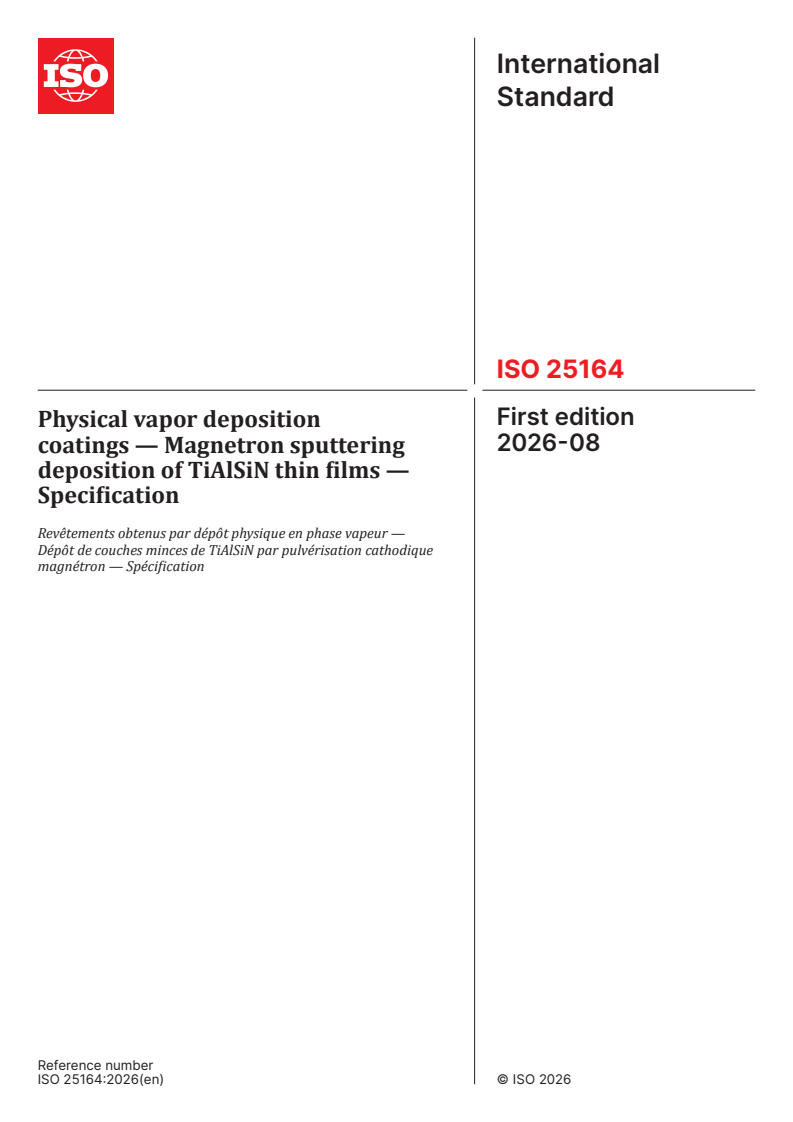


ISO 25164:2026 - Physical vapor deposition coatings — Magnetron sputtering deposition of TiAlSiN thin films — Specification
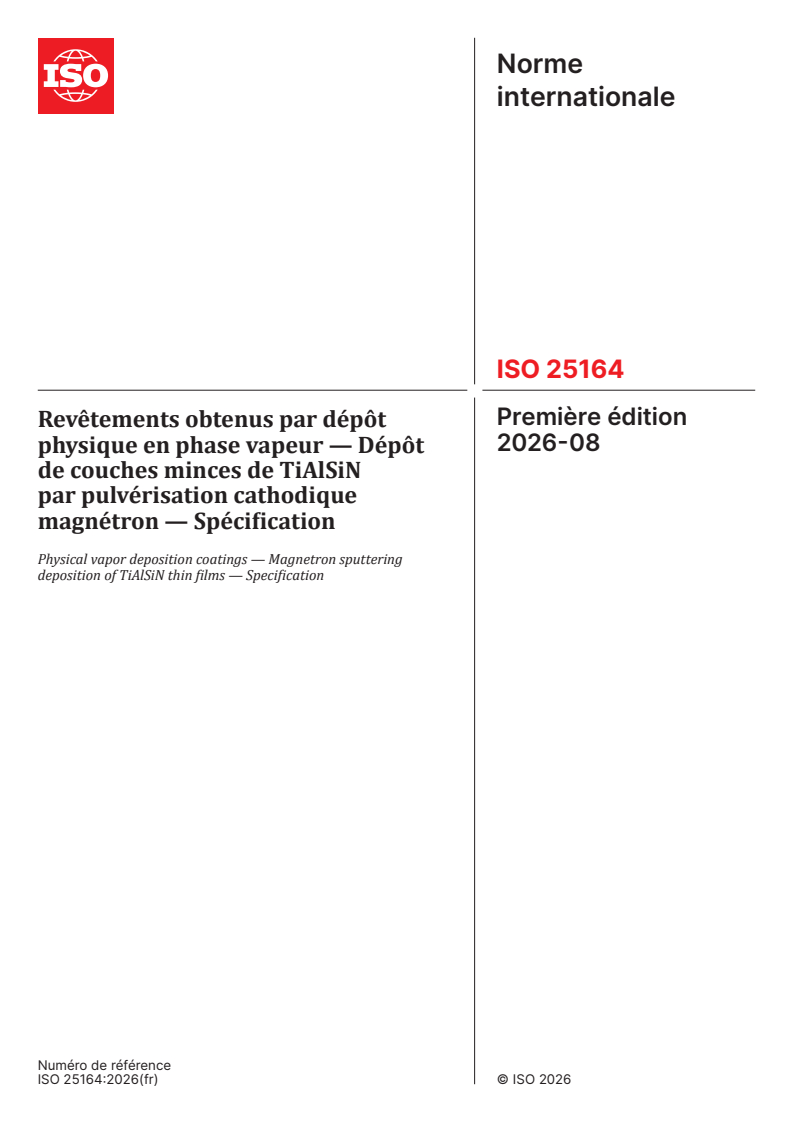
ISO 25164:2026 - Revêtements obtenus par dépôt physique en phase vapeur — Dépôt de couches minces de TiAlSiN par pulvérisation cathodique magnétron — Spécification
REDLINE ISO 25164:2026 - Revêtements obtenus par dépôt physique en phase vapeur — Dépôt de couches minces de TiAlSiN par pulvérisation cathodique magnétron — Spécification
ISO 25164:2026 is an International Standard from ISO for physical vapor deposition coatings. It specifies the technical requirements for TiAlSiN thin films deposited by magnetron sputtering, and it also applies to TiN, TiAlN and TiSiN thin films. The standard is intended for organizations that deposit, inspect, or specify these coatings, especially on cemented carbide workpieces.
What does ISO 25164:2026 specify?
ISO 25164:2026 specifies the technical requirements for TiAlSiN thin films deposited by magnetron sputtering. The document is organized into Scope, Normative references, Terms and definitions, Technical specifications, Performance and test methods, and Annex A on vacuum requirements.
The scope keeps the focus on deposition of the film system and on the process conditions that affect coating quality in practice. Annex A is the main annex and sets the vacuum-related requirements for the deposition process.
What are the key requirements of ISO 25164:2026?
ISO 25164:2026 brings together the process controls that matter most for getting a usable TiAlSiN coating: workpiece preparation, vacuum conditions, target quality, gas purity, and the tests used to check the finished film.
Workpieces need careful cleaning and handling
Clause 4.2 requires the workpiece to be thoroughly degreased and cleaned before coating, then mechanically polished. The cleaned surface should be smooth, free of cracks, burrs, scratches and rust, and it should not be touched by hand after cleaning.
In practice, this means contamination control is part of coating quality, not an extra step. The workpiece should also be stored in a vacuum chamber with humidity at or below 40 % and used within 24 h, so the surface stays ready for deposition.
Vacuum equipment must meet Annex A
Clause 4.3 points to Annex A for the vacuum equipment requirements, and Annex A sets the equipment indicators and operating conditions. It covers ambient temperature, humidity, cooling water, workplace cleanliness, exhaust of pump gases, vacuum monitoring, a regulating valve, and an observation window for discharge monitoring.
Annex A also defines two equipment classifications, A and B, with limits for ultimate pressure, pump time and pressure rise rate. In practice, this gives buyers and operators a way to compare whether a vacuum system is suitable for the coating task.
The target and gas purity are controlled
Clause 4.4 specifies that the sputtering target may be TiAlSi material, with the example composition 46:46:8, and the target component purity shall not be less than 99.5 %. The target cross-section must be free from cracks, pores, inclusions and other visible defects.
Clause 4.5 specifies high-purity argon and high-purity nitrogen, both at 99.999 %. This matters because argon supports the plasma and nitrogen forms the nitride compounds in the film.
Film quality is checked by defined test methods
Clause 5 uses named test methods for the finished coating. Composition may be measured by electron probe microanalysis (EPMA), thickness by ISO 4518 profiling or the microscopy method in ISO 1463, and crystalline structure by X-ray diffraction (XRD) according to ISO 22278.
Hardness is measured by nanoindentation under ISO 14577-1 and ISO 14577-4, with indentation depth limited to 10 % of film thickness. Adhesion is checked by scratch testing under ISO 20502, which helps users verify whether the coating will stay attached in service.
What terms does ISO 25164:2026 define?
- Ultimate pressure - the lowest stable pressure reached in a dry chamber while the vacuum system runs normally.
- Pump time - the time needed to pump an empty or dry loaded chamber from atmospheric pressure to a specified pressure.
- Pressure rise rate - the pressure increase per unit time after pumping stops at stable ultimate pressure.
- Target - the material source used as the sputtering electrode.
- Magnetron sputtering - a thin-film deposition process that uses perpendicular magnetic and electric fields to create plasma and deposit material from the target.
- Electron probe microanalysis (EPMA) - a method named in the document for determining thin-film composition.
- X-ray diffraction (XRD) - the method named in the document for determining the film’s crystalline structure.
Who uses ISO 25164:2026?
ISO 25164:2026 is used by coating producers, vacuum equipment operators, quality laboratories, and buyers or specifiers of coated parts. It is especially relevant in cutting tool processing fields such as automobiles, aerospace and general machinery.
In practice, process engineers use it to set deposition conditions, inspectors use it to verify film properties, and buyers use it to compare coating capability for cemented carbide products.
Which standards are used with ISO 25164:2026?
| Standard | What it contributes |
|---|---|
| ISO 4518 | Profilometric measurement of coating thickness |
| ISO 14577-1 | Instrumented indentation test for hardness and materials parameters |
| ISO 14577-4 | Instrumented indentation test for metallic and non-metallic coatings |
| ISO 20502 | Scratch testing for adhesion of ceramic coatings |
| ISO 22278 | XRD-based test method for crystalline quality of a single-crystal thin film |
| ISO 23833 | EPMA vocabulary used with composition measurement |
Clause 5.2 also points to ISO 1463 for microscopy-based thickness measurement.
What does the ISO 25164:2026 document contain?
ISO 25164:2026 contains process requirements, test methods, and a vacuum specification annex for magnetron sputtering of TiAlSiN thin films. It describes cleaning and storage of workpieces, target quality checks, gas purity, and the methods used to measure composition, thickness, crystalline structure, hardness and adhesion.
Annex A contains the vacuum technical indicators, operating environment requirements, and equipment features such as vacuum gauges, a vacuum regulating valve, and an observation window. The document therefore supports both process setup and post-deposition verification.
Buy Documents
ISO 25164:2026 - Physical vapor deposition coatings — Magnetron sputtering deposition of TiAlSiN thin films — Specification
ISO 25164:2026 - Revêtements obtenus par dépôt physique en phase vapeur — Dépôt de couches minces de TiAlSiN par pulvérisation cathodique magnétron — Spécification
REDLINE ISO 25164:2026 - Revêtements obtenus par dépôt physique en phase vapeur — Dépôt de couches minces de TiAlSiN par pulvérisation cathodique magnétron — Spécification
Get Certified
Connect with accredited certification bodies for this standard

DVS-ZERT GmbH
German welding certification society.
CARES (UK Certification Authority for Reinforcing Steels)
UK certification for reinforcing steels and construction.
EWF/IIW (European/International Welding Federation)
International welding personnel certification.
Sponsored listings
Frequently Asked Questions
ISO 25164:2026 is a standard published by the International Organization for Standardization (ISO). Its full title is "Physical vapor deposition coatings — Magnetron sputtering deposition of TiAlSiN thin films — Specification". This standard covers: This document specifies the technical requirements for TiAlSiN thin films deposited by magnetron sputtering. This document is also applicable to the deposition of TiN, TiAlN or TiSiN thin films.
This document specifies the technical requirements for TiAlSiN thin films deposited by magnetron sputtering. This document is also applicable to the deposition of TiN, TiAlN or TiSiN thin films.
ISO 25164:2026 is classified under the following ICS (International Classification for Standards) categories: 25.220.40 - Metallic coatings. The ICS classification helps identify the subject area and facilitates finding related standards.
ISO 25164:2026 is available in PDF format for immediate download after purchase. The document can be added to your cart and obtained through the secure checkout process. Digital delivery ensures instant access to the complete standard document.
Standards Content (Sample)
International
Standard
ISO 25164
First edition
Physical vapor deposition
2026-08
coatings — Magnetron sputtering
deposition of TiAlSiN thin films —
Specification
Revêtements obtenus par dépôt physique en phase vapeur —
Dépôt de couches minces de TiAlSiN par pulvérisation cathodique
magnétron — Spécification
Reference number
© ISO 2026
All rights reserved. Unless otherwise specified, or required in the context of its implementation, no part of this publication may
be reproduced or utilized otherwise in any form or by any means, electronic or mechanical, including photocopying, or posting on
the internet or an intranet, without prior written permission. Permission can be requested from either ISO at the address below
or ISO’s member body in the country of the requester.
ISO copyright office
CP 401 • Ch. de Blandonnet 8
CH-1214 Vernier, Geneva
Phone: +41 22 749 01 11
Email: copyright@iso.org
Website: www.iso.org
Published in Switzerland
ii
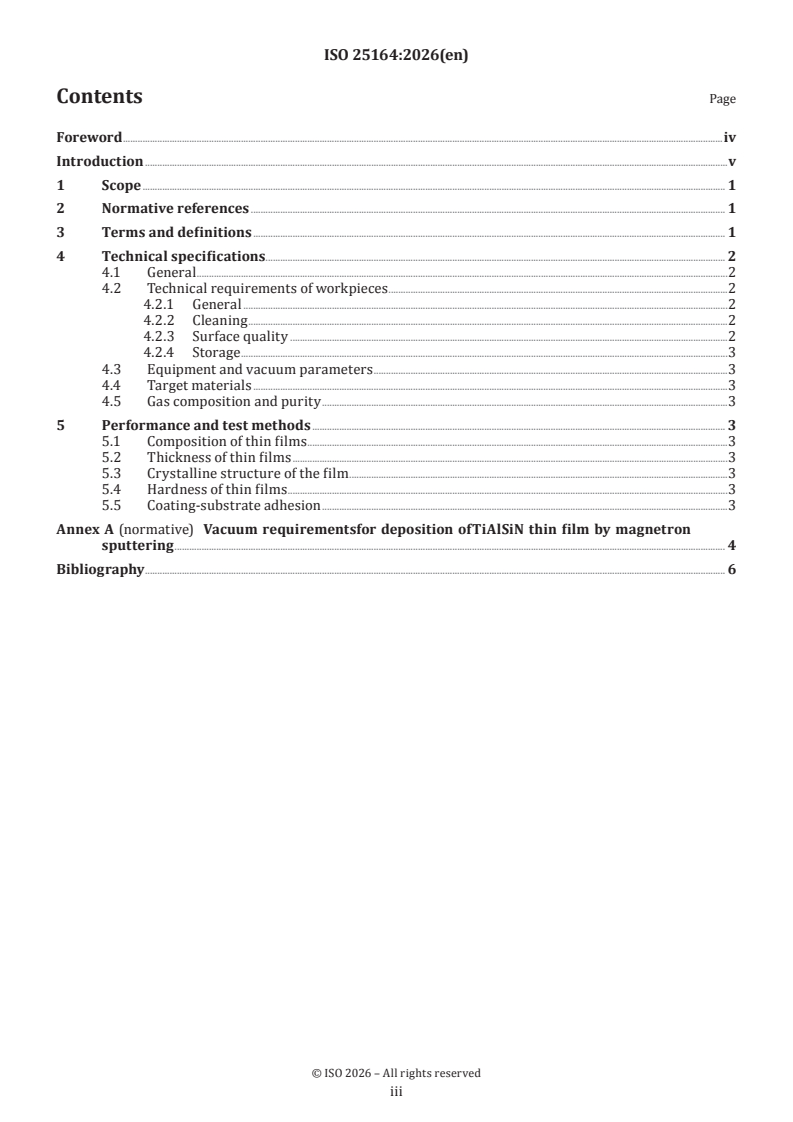
Contents Page
Foreword .iv
Introduction .v
1 Scope . 1
2 Normative references . 1
3 Terms and definitions . 1
4 Technical specifications. 2
4.1 General .2
4.2 Technical requirements of workpieces .2
4.2.1 General .2
4.2.2 Cleaning .2
4.2.3 Surface quality .2
4.2.4 Storage .3
4.3 Equipment and vacuum parameters .3
4.4 Target materials .3
4.5 Gas composition and purity .3
5 Performance and test methods . 3
5.1 Composition of thin films .3
5.2 Thickness of thin films .3
5.3 Crystalline structure of the film .3
5.4 Hardness of thin films .3
5.5 Coating-substrate adhesion .3
Annex A (normative) Vacuum requirementsfor deposition ofTiAlSiN thin film by magnetron
sputtering . 4
Bibliography . 6
iii
Foreword
ISO (the International Organization for Standardization) is a worldwide federation of national standards
bodies (ISO member bodies). The work of preparing International Standards is normally carried out through
ISO technical committees. Each member body interested in a subject for which a technical committee
has been established has the right to be represented on that committee. International organizations,
governmental and non-governmental, in liaison with ISO, also take part in the work. ISO collaborates closely
with the International Electrotechnical Commission (IEC) on all matters of electrotechnical standardization.
The procedures used to develop this document and those intended for its further maintenance are described
in the ISO/IEC Directives, Part 1. In particular, the different approval criteria needed for the different types
of ISO document should be noted. This document was drafted in accordance with the editorial rules of the
ISO/IEC Directives, Part 2 (see www.iso.org/directives).
ISO draws attention to the possibility that the implementation of this document may involve the use of (a)
patent(s). ISO takes no position concerning the evidence, validity or applicability of any claimed patent
rights in respect thereof. As of the date of publication of this document, ISO had not received notice of (a)
patent(s) which may be required to implement this document. However, implementers are cautioned that
this may not represent the latest information, which may be obtained from the patent database available at
www.iso.org/patents. ISO shall not be held responsible for identifying any or all such patent rights.
Any trade name used in this document is information given for the convenience of users and does not
constitute an endorsement.
For an explanation of the voluntary nature of standards, the meaning of ISO specific terms and expressions
related to conformity assessment, as well as information about ISO's adherence to the World Trade
Organization (WTO) principles in the Technical Barriers to Trade (TBT), see www.iso.org/iso/foreword.html.
This document was prepared by Technical Committee ISO/TC 107, Metallic and other inorganic coatings,
Subcommittee SC 9, Physical vapor deposition coatings.
Any feedback or questions on this document should be directed to the user’s national standards body. A
complete listing of these bodies can be found at www.iso.org/members.html.
iv
Introduction
TiAlSiN films have properties such as high hardness, wear resistance, corrosion resistance and high-
temperature oxidation resistance. These characteristics significantly enhance the performance, durability
and value of products. Consequently, TiAlSiN films have gained widespread industrial attention in cutting
tool processing fields, e.g. automobiles, aerospace and general machinery.
Magnetron sputtering is a preferred deposition technique for TiAlSiN films onto cemented carbide
substrates. This method provides several advantages, including rapid deposition rate, low substrate
temperature, minimal film damage, reduced stress, improved film-substrate integration, high purity,
excellent compactness and uniform film thickness. These characteristics make magnetron sputtering well-
suited for industrial-scale production of TiAlSiN coatings on large-area substrates.
v
International Standard ISO 25164:2026(en)
Physical vapor deposition coatings — Magnetron sputtering
deposition of TiAlSiN thin films — Specification
1 Scope
This document specifies the technical requirements for TiAlSiN thin films deposited by magnetron
sputtering.
This document is also applicable to the deposition of TiN, TiAlN or TiSiN thin films.
2 Normative references
The following documents are referred to in the text in such a way that some or all of their content constitutes
requirements of this document. For dated references, only the edition cited applies. For undated references,
the latest edition of the referenced document (including any amendments) applies.
ISO 4518, Metallic coatings — Measurement of coating thickness — Profilometric method
ISO 14577-1, Metallic materials — Instrumented indentation test for hardness and materials parameters — Part
1: Test method
ISO 14577-4, Metallic materials — Instrumented indentation test for hardness and materials parameters —
Part 4: Test method for metallic and non-metallic coatings
ISO 20
...
Norme
internationale
ISO 25164
Première édition
Revêtements obtenus par dépôt
2026-08
physique en phase vapeur — Dépôt
de couches minces de TiAlSiN
par pulvérisation cathodique
magnétron — Spécification
Physical vapor deposition coatings — Magnetron sputtering
deposition of TiAlSiN thin films — Specification
Numéro de référence
DOCUMENT PROTÉGÉ PAR COPYRIGHT
© ISO 2026
Tous droits réservés. Sauf prescription différente ou nécessité dans le contexte de sa mise en œuvre, aucune partie de cette
publication ne peut être reproduite ni utilisée sous quelque forme que ce soit et par aucun procédé, électronique ou mécanique,
y compris la photocopie, ou la diffusion sur l’internet ou sur un intranet, sans autorisation écrite préalable. Une autorisation peut
être demandée à l’ISO à l’adresse ci-après ou au comité membre de l’ISO dans le pays du demandeur.
ISO copyright office
Case postale 401 • Ch. de Blandonnet 8
CH-1214 Vernier, Genève
Tél.: +41 22 749 01 11
E-mail: copyright@iso.org
Web: www.iso.org
Publié en Suisse
ii
Sommaire Page
Avant-propos .iv
Introduction .v
1 Domaine d'application . 1
2 Références normatives . 1
3 Termes et définitions . 1
4 Spécifications techniques . . 2
4.1 Généralités .2
4.2 Exigences techniques des pièces mises en œuvre .2
4.2.1 Généralités .2
4.2.2 Nettoyage .2
4.2.3 Qualité de surface .3
4.2.4 Stockage .3
4.3 Équipements et paramètres de vide .3
4.4 Matériaux de la cible .3
4.5 Composition et pureté du gaz.3
5 Performances et méthodes d'essai . 3
5.1 Composition des couches minces .3
5.2 Épaisseur des couches minces .3
5.3 Structure cristalline de la couche .3
5.4 Dureté des couches minces .4
5.5 Adhérence revêtement-substrat .4
Annexe A (normative) Exigences en matière de vide pour le dépôt de couche mince de TiAlSiN
par pulvérisation cathodique magnétron. 5
Bibliographie . 7
iii
Avant-propos
L'ISO (Organisation internationale de normalisation) est une fédération mondiale d'organismes nationaux
de normalisation (comités membres de l'ISO). L'élaboration des Normes internationales est en général
confiée aux comités techniques de l'ISO. Chaque comité membre intéressé par une étude a le droit de faire
partie du comité technique créé à cet effet. Les organisations internationales, gouvernementales et non
gouvernementales, en liaison avec l'ISO participent également aux travaux. L'ISO collabore étroitement avec
la Commission électrotechnique internationale (IEC) en ce qui concerne la normalisation électrotechnique.
Les procédures utilisées pour élaborer le présent document et celles destinées à sa mise à jour sont
décrites dans les Directives ISO/IEC, Partie 1. Il convient, en particulier, de prendre note des différents
critères d'approbation requis pour les différents types de documents ISO. Le présent document a
été rédigé conformément aux règles de rédaction données dans les Directives ISO/IEC, Partie 2 (voir
www.iso.org/directives).
L'ISO attire l'attention sur le fait que la mise en application du présent document peut entraîner l'utilisation
d'un ou de plusieurs brevets. L'ISO ne prend pas position quant à la preuve, à la validité et à l'applicabilité de
tout droit de propriété revendiqué à cet égard. À la date de publication du présent document, l'ISO n'avait pas
reçu notification qu'un ou plusieurs brevets pouvaient être nécessaires à sa mise en application. Toutefois,
il y a lieu d'avertir les responsables de la mise en application du présent document que des informations
plus récentes sont susceptibles de figurer dans la base de données de brevets, disponible à l'adresse
www.iso.org/brevets. L'ISO ne saurait être tenue pour responsable de ne pas avoir identifié tout ou partie de
tels droits de brevet.
Les appellations commerciales éventuellement mentionnées dans le présent document sont données pour
information, par souci de commodité, à l'intention des utilisateurs et ne sauraient constituer un engagement.
Pour une explication de la nature volontaire des normes, la signification des termes et expressions
spécifiques de l'ISO liés à l'évaluation de la conformité, ou pour toute information au sujet de l'adhésion de
l'ISO aux principes de l'Organisation mondiale du commerce (OMC) concernant les obstacles techniques au
commerce (OTC), voir www.iso.org/avant-propos.
Le présent document a été élaboré par le comité technique ISO/TC 107, Revêtements métalliques et autres
revêtements inorganiques, sous-comité SC 9, Revêtements obtenus par dépôt physique en phase vapeur.
Il convient que l'utilisateur adresse tout retour d'information ou toute question concernant le présent
document à l'organisme national de normalisation de son pays. Une liste exhaustive desdits organismes se
trouve à l'adresse www.iso.org/fr/members.html.
iv
Introduction
Les couches TiAlSiN possèdent d'excellentes propriétés, notamment une dureté élevée, une résistance à
l'usure, une résistance à la corrosion et une résistance à l'oxydation à haute température. Ces caractéristiques
améliorent considérablement les performances, la durabilité et la valeur des produits. Par conséquent, les
couches TiAlSiN ont suscité beaucoup d'intérêt de la part des industriels dans les secteurs du traitement des
outils de coupe, par exemple l'automobile, l'aérospatiale et les machines en général.
La pulvérisation cathodique par magnétron est une technique de dépôt préférentielle pour les couches
TiAlSiN sur des substrats en cermet de carbure métallique. Ce procédé présente plusieurs avantages,
notamment une vitesse de dépôt rapide, une faible température de substrat, des dommages minimaux de
la couche, une réduction des contraintes, une meilleure intégration film-substrat, une grande pureté, une
excellente compacité et une épaisseur de film uniforme. Ces caractéristiques rendent la pulvérisation
cathodique par magnétron bien adaptée à la production industrielle de revêtements TiAlSiN sur des
substrats de grande surface.
v
Norme internationale ISO 25164:2026(fr)
Revêtements obtenus par dépôt physique en phase vapeur —
Dépôt de couches minces de TiAlSiN par pulvérisation
cathodique magnétron — Spécification
1 Domaine d'application
Le présent document spécifie les exigences techniques relatives aux couches minces de TiAlSiN déposées
par pulvérisation cathodique par magnétron.
Le présent document s'applique également au dépôt de couches minces de TiN, TiAlN ou TiSiN.
2 Références normatives
Les documents suivants sont cités dans le texte de sorte qu'ils constituent, pour tout ou partie de leur
contenu, des exigences du présent document. Pour les références datées, seule l'édition citée s'applique. Pour
les références non datées, la dernière édition du document de référence s'applique (y compris les éventuels
amendements).
ISO 4518, Revêtements métalliques — Mesurage de l'épaisseur de revêtement — Méthode profilométrique
ISO 14577-1, Matériaux métalliques — Essai de pénétration instrumenté pour la détermination de la dureté et
de paramètres des matériaux — Partie 1: Méthode d'essai
ISO 14577-4, Matériaux métalliques — Essai de pénétration instrumenté pour la détermination de la dureté et
de paramètres des matériaux — Partie 4: Méthode d'essai pour les revêtements métalliques et non métalliques
ISO 20502:2005, Céramiques techniques — Détermination de l'adhérence des revêtements céramiques par essai
de rayure
ISO 22278, Titre manque
ISO 23833, Analyse par microfaisceaux — Analyse par microsonde électronique (microsonde de Castaing) —
Vocabulaire
3 Termes et définitions
Pour les besoins du présent document, les termes et les définitions de l'ISO 4518, de l'ISO 14577-1, de
l'ISO 14577-4, de l'ISO 20502, de l'ISO 222
...
Première édition
Deleted: ISO/TC 107/SC 9
Secrétariat: SAC
Date: …
2026-08
Deleted: 07-24
Deleted:
Revêtements obtenus par dépôt physique en phase vapeur — Dépôt
de couches minces de TiAlSiN par pulvérisation cathodique
Deleted: —
magnétron — Spécification
Physical vapor deposition coatings — Magnetron sputtering deposition of TiAlSiN thin films — Specification
Deleted:
Deleted:
Tous droits réservés. Sauf prescription différente ou nécessité dans le contexte de sa mise en oeuvre, aucune partie de
Deleted: œuvre
cette publication ne peut être reproduite ni utilisée sous quelque forme que ce soit et par aucun procédé, électronique
ou mécanique, y compris la photocopie, ou la diffusion sur l’internet ou sur un intranet, sans autorisation écrite préalable.
Deleted: l'internet
Une autorisation peut être demandée à l’ISO à l’adresse ci-après ou au comité membre de l’ISO dans le pays du
Deleted: l'ISO
demandeur.
Deleted: l'adresse
ISO copyright office
Deleted: l'ISO
CP 401 • Ch. de Blandonnet 8
Deleted: Case postale
CH-1214 Vernier, Geneva
Deleted:
Phone: + 41 22 749 01 11
E-mail: copyright@iso.org
Deleted: Genève
Website: www.iso.org
Deleted: Tél.:
Publié en Suisse
Deleted: E-mail: mailto:copyright@iso.org
Web: http://www.iso.org
Deleted: .
ii
Deleted: Page
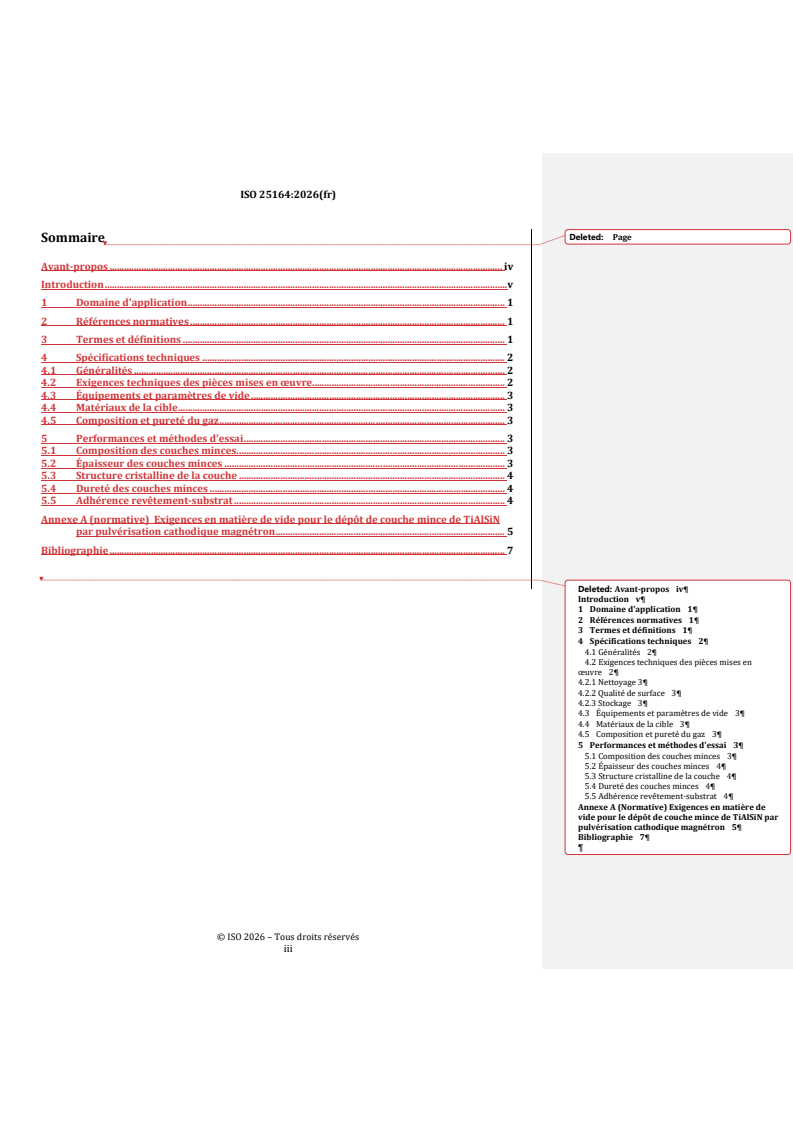
Sommaire
Avant-propos . iv
Introduction . v
1 Domaine d'application . 1
2 Références normatives . 1
3 Termes et définitions . 1
4 Spécifications techniques . 2
4.1 Généralités . 2
4.2 Exigences techniques des pièces mises en œuvre . 2
4.3 Équipements et paramètres de vide . 3
4.4 Matériaux de la cible . 3
4.5 Composition et pureté du gaz . 3
5 Performances et méthodes d'essai . 3
5.1 Composition des couches minces . 3
5.2 Épaisseur des couches minces . 3
5.3 Structure cristalline de la couche . 4
5.4 Dureté des couches minces . 4
5.5 Adhérence revêtement-substrat . 4
Annexe A (normative) Exigences en matière de vide pour le dépôt de couche mince de TiAlSiN
par pulvérisation cathodique magnétron . 5
Bibliographie . 7
Deleted: Avant-propos iv
Introduction v
1 Domaine d'application 1
2 Références normatives 1
3 Termes et définitions 1
4 Spécifications techniques 2
4.1 Généralités 2
4.2 Exigences techniques des pièces mises en
œuvre 2
4.2.1 Nettoyage 3
4.2.2 Qualité de surface 3
4.2.3 Stockage 3
4.3 Équipements et paramètres de vide 3
4.4 Matériaux de la cible 3
4.5 Composition et pureté du gaz 3
5 Performances et méthodes d'essai 3
5.1 Composition des couches minces 3
5.2 Épaisseur des couches minces 4
5.3 Structure cristalline de la couche 4
5.4 Dureté des couches minces 4
5.5 Adhérence revêtement-substrat 4
Annexe A (Normative) Exigences en matière de
vide pour le dépôt de couche mince de TiAlSiN par
pulvérisation cathodique magnétron 5
Bibliographie 7

iii
Avant-propos
L'ISO (Organisation internationale de normalisation) est une fédération mondiale d'organismes nationaux de
normalisation (comités membres de l'ISO). L'élaboration des Normes internationales est en général confiée
aux comités techniques de l'ISO. Chaque comité membre intéressé par une étude a le droit de faire partie du
comité technique créé à cet effet. Les organisations internationales, gouvernementales et non
gouvernementales, en liaison avec l'ISO participent également aux travaux. L'ISO collabore étroitement avec
la Commission électrotechnique internationale (IEC) en ce qui concerne la normalisation électrotechnique.
Les procédures utilisées pour élaborer le présent document et celles destinées à sa mise à jour sont décrites
dans les Directives ISO/IEC, Partie 1. Il convient, en particulier, de prendre note des différents critères
d'approbation requis pour les différents types de documents ISO. Le présent document a été rédigé
conformément aux règles de rédaction données dans les Directives ISO/IEC, Partie 2 (voir
www.iso.org/directives). Deleted: www.iso.org/directives
L'ISO attire l'attention sur le fait que la mise en application du présent document peut entraîner l'utilisation
d'un ou de plusieurs brevets. L'ISO ne prend pas position quant à la preuve, à la validité et à l'applicabilité de
tout droit de propriété revendiqué à cet égard. À la date de publication du présent document, l'ISO n'avait pas
reçu notification qu'un ou plusieurs brevets pouvaient être nécessaires à sa mise en application. Toutefois, il
y a lieu d'avertir les responsables de la mise en application du présent document que des informations plus
récentes sont susceptibles de figurer dans la base de données de brevets, disponible à l'adresse
www.iso.org/brevets. L'ISO ne saurait être tenue pour responsable de ne pas avoir identifié tout ou partie de Deleted: www.iso.org/brevets.
tels droits de brevet.
Les appellations commerciales éventuellement mentionnées dans le présent document sont données pour
information, par souci de commodité, à l'intention des utilisateurs et ne sauraient constituer un engagement.
Pour une explication de la nature volontaire des normes, la signification des termes et expressions spécifiques
de l'ISO liés à l'évaluation de la conformité, ou pour toute information au sujet de l'adhésion de l'ISO aux
principes de l'Organisation mondiale du commerce (OMC) concernant les obstacles techniques au commerce
(OTC), voir www.iso.org/avant-propos. Deleted: www.iso.org/avant-propos
Le présent document a été élaboré par le comité technique ISO/TC 107, Revêtements métalliques et autres
revêtements inorganiques, sous-comité SC 9, Revêtements obtenus par dépôt physique en phase vapeur. Deleted: Sous
Il convient que l'utilisateur adresse tout retour d'information ou toute question concernant le présent
document à l'organisme national de normalisation de son pays. Une liste exhaustive desdits organismes se
trouve à l'adresse www.iso.org/fr/members.html.
Deleted: www.iso.org/fr/members.html
iv
Introduction
Les couches TiAlSiN possèdent d'excellentes propriétés, notamment une dureté élevée, une résistance à
l'usure, une résistance à la corrosion et une résistance à l'oxydation à haute température. Ces caractéristiques
améliorent considérablement les performances, la durabilité et la valeur des produits. Par conséquent, les
couches TiAlSiN ont suscité beaucoup d'intérêt de la part des industriels dans les secteurs du traitement des
outils de coupe, par exemple l'automobile, l'aérospatiale et les machines en général.
La pulvérisation cathodique par magnétron est une technique de dépôt préférentielle pour les couches TiAlSiN
sur des substrats en cermet de carbure métallique. Ce procédé présente plusieurs avantages, notamment une
vitesse de dépôt rapide, une faible température de substrat, des dommages minimaux de la couche, une
réduction des contraintes, une meilleure intégration film-substrat, une grande pureté, une excellente
compacité et une épaisseur de film uniforme. Ces caractéristiques rendent la pulvérisation cathodique par
magnétron bien adaptée à la production industrielle de revêtements TiAlSiN sur des substrats de grande
surface.
v
Deleted: obetnus
Revêtements obtenus par dépôt physique en phase vapeur — Dépôt
Deleted:
de couches minces de TiAlSiN par pulvérisation cathodique
magnétron — Spécification
1 Domaine d'application
Le présent document spécifie les exigences techniques relatives aux couches minces de TiAlSiN déposées par
pulvérisation cathodique par magnétron.
Le présent document s'applique également au dépôt de couches minces de TiN, TiAlN ou TiSiN.
2 Références normatives
Les documents suivants sont cités dans le texte de sorte qu'ils constituent, pour tout ou partie de leur contenu,
des exigences du présent document. Pour les références datées, seule l'édition citée s'applique. Pour les
références non datées, la dernière édition du document de référence s'applique (y compris les éventuels
amendements).
ISO 4518, Revêtements métalliques — Mesurage de l'épaisseur de revêtement — Méthode profilométrique
Deleted: ISO 4518, Revêtements métalliques —
Mesurage de l'épaisseur de revêtement — Méthode
profilométrique
ISO 14577-1, Matériaux métalliques — Essai de pénétration instrumenté pour la détermination de la dureté et
ISO 14577-
de paramètres des matériaux — Partie 1: Méthode d'essai
Deleted:
ISO 14577-4, Matériaux métalliques — Essai de pénétration instrumenté pour la détermination de la dureté et
Deleted: ISO 14577-
de paramètres des matériaux — Partie 4: Méthode d'essai pour les revêtements métalliques et non métalliques
Deleted:
ISO 20502:2005, Céramiques techniques — Détermination de l'adhérence des revêtements céramiques par essai
Deleted: ISO 20502:2005, Céramiques techniques —
de rayure Détermination de l'adhérence des revêtements céramiques
par essai de rayure
ISO 22278, Titre manque
ISO 22278, Titre manque
ISO 23833, Analyse par microfaisceaux — Analyse
par microsonde électronique (microsonde de Castaing) —
ISO 23833, Analyse par microfaisceaux — Analyse par microsonde électronique (microsonde de Castaing) —
Vocabulaire
Vocabulaire
3 Termes et définitions
Pour les besoins du présent document, les termes et les définitions de l'ISO 4518, de l'ISO 14577-1, de Deleted: -
l'ISO 14577-4, de l'ISO 20502, de l'ISO 22278, de l'ISO 23833 ainsi que les suivants s'appliquent.
Deleted: -
L'ISO et l'IEC tiennent à jour des bases de données terminologiques destinées à être utilisées en normalisation,
consultables aux adresses suivantes:
— ISO Online browsing platform: disponible à l'adresse https://www.iso.org/obp
Deleted: —
Deleted: https://www.iso.org/obp
— IEC Electropedia: disponible à l’adresse https://www.electropedia.org/
Deleted: —
3.1
Deleted:
press
...