

ISO 13405-1:2015
(Main)Prosthetics and orthotics — Classification and description of prosthetic components — Part 1: Classification of prosthetic components
General Information
- Abstract
ISO 13405-1:2015 specifies a means of classifying the components of limb prostheses and their construction.
- Status
- Published
- Publication Date
- 15-Jan-2015
- Technical Committee
- ISO/TC 168 - Prosthetics and orthotics
- Drafting Committee
- ISO/TC 168/WG 1 - Nomenclature and classification
- Current Stage
- 9092 - International Standard to be revised
- Start Date
- 16-Jun-2025
- Completion Date
- 12-Sep-2026
Buy Documents
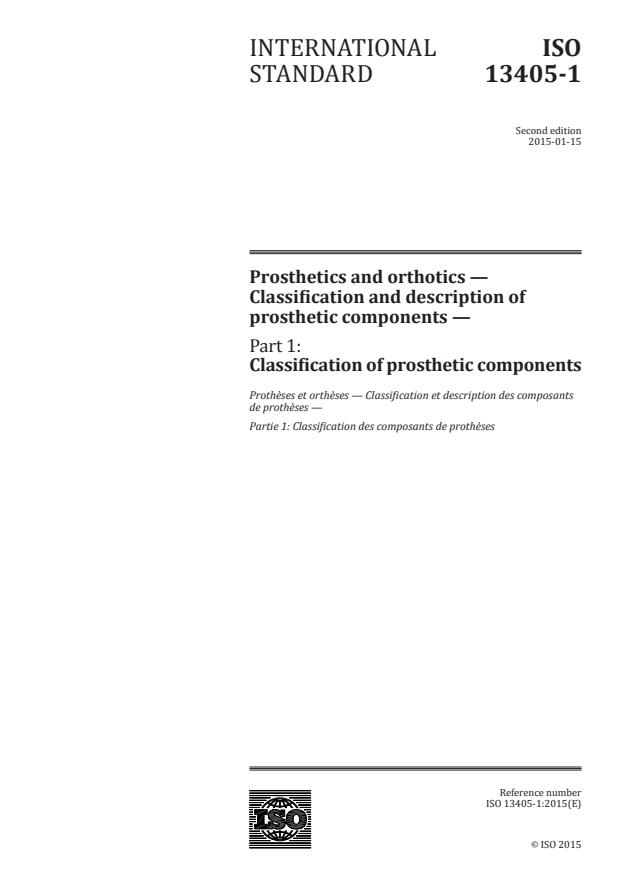
ISO 13405-1:2015 - Prosthetics and orthotics — Classification and description of prosthetic components — Part 1: Classification of prosthetic components Released:1/16/2015
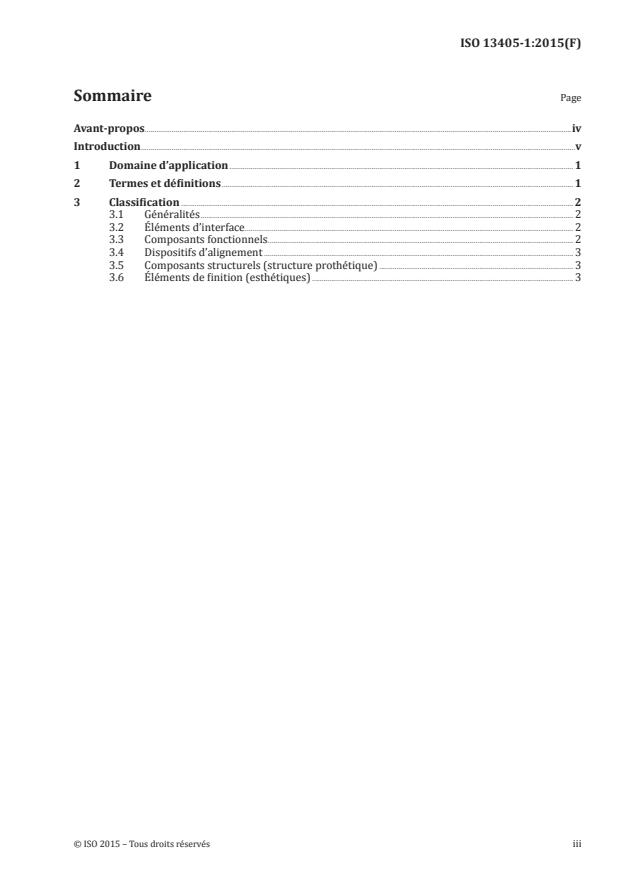
ISO 13405-1:2015 - Protheses et ortheses — Classification et description des composants de protheses — Partie 1: Classification des composants de protheses Released:1/16/2015
Overview
ISO 13405-1:2015 is an international standard published by the International Organization for Standardization (ISO) that establishes a systematic classification system for components of limb prostheses. This standard specifies the means to classify prosthetic components based on their function and construction. It forms part one of the ISO 13405 series, focusing exclusively on the classification aspect to facilitate clear communication among manufacturers, practitioners, and users in the prosthetics and orthotics field.
ISO 13405-1:2015 provides a foundation for describing limb prostheses components in a consistent way, improving documentation, reporting, and collaboration globally. It is widely used in prosthetic design, clinical practice, manufacturing, and research.
Key Topics
Classification Framework
The standard categorizes prosthetic components into five main classes:- Interface components
- Functional components
- Alignment components
- Structural components
- Finishing (cosmetic) components
Interface Components
These are the parts in direct contact with the user, responsible for stabilization and suspension of the prosthesis. Key elements include:- Sockets
- Suspensory components
- Liners (removable linings modifying force distribution and suspension)
Functional Components
Components that substitute the dynamic and sensory functions of missing limbs. The classification differentiates between:- Lower limb functional parts: ankle-foot units, knee units, hip units, torque reducers, shock absorbers, turntables, and external side joints
- Upper limb functional parts: terminal devices, wrist units, elbow units, shoulder units, turntables, and external side joints
Alignment Components
These parts allow adjustment of component positions relative to each other, enabling optimal prosthesis performance and comfort.Structural Components
These components connect and support interface, functional, and alignment parts, maintaining the prosthesis’s integrity. Types include:- Endoskeletal structure: internal framework covered by cosmetic components
- Exoskeletal structure: external framework defining the prosthesis shape
Finishing (Cosmetic) Components
These parts replicate the appearance and feel of a natural limb, including:- Cosmetic fillers and shells providing shape and soft tissue simulation
- Prosthetic skins, stockings, and gloves that mimic human skin color and texture
Applications
ISO 13405-1:2015 serves various practical purposes in the prosthetics and orthotics industry:
- Assists manufacturers in systematically categorizing and documenting prosthetic components to improve product literature and innovation.
- Supports prosthetists and clinicians in selecting, reporting, and communicating about prosthetic parts in patient treatment plans.
- Enhances the design process by offering clear terminology and classification, facilitating improved fit, functionality, and user satisfaction.
- Provides a reference framework for rehabilitation centers, researchers, and regulatory authorities to ensure consistent understanding of prosthetic components worldwide.
Related Standards
ISO 13405-1:2015 is part of a multipart standard series that comprehensively addresses prosthetic components:
- ISO 13405-2: Description of lower limb prosthetic components, detailing technical characteristics and specifications for lower limb parts.
- ISO 13405-3: Description of upper limb prosthetic components, offering detailed terminology and descriptions applicable to upper limb prostheses.
Together, these standards form an integrated system for classification, description, and specification of prosthetic components to streamline global prosthetic care and manufacturing.
Keywords: ISO 13405-1:2015, prosthetics classification, prosthetic components, limb prostheses, interface components, functional components, alignment components, structural components, finishing components, prosthetics standard, orthotics, prosthesis construction, liners, prosthetic sockets, lower limb prostheses, upper limb prostheses, prosthetic design, prosthetics manufacturing standards.
Relations
- Effective Date
- 28-Feb-2009
Buy Documents
ISO 13405-1:2015 - Prosthetics and orthotics — Classification and description of prosthetic components — Part 1: Classification of prosthetic components Released:1/16/2015
ISO 13405-1:2015 - Protheses et ortheses — Classification et description des composants de protheses — Partie 1: Classification des composants de protheses Released:1/16/2015
Get Certified
Connect with accredited certification bodies for this standard

BSI Group
BSI (British Standards Institution) is the business standards company that helps organizations make excellence a habit.

TÜV Rheinland
TÜV Rheinland is a leading international provider of technical services.

TÜV SÜD
TÜV SÜD is a trusted partner of choice for safety, security and sustainability solutions.
Sponsored listings
Frequently Asked Questions
ISO 13405-1:2015 is a standard published by the International Organization for Standardization (ISO). Its full title is "Prosthetics and orthotics — Classification and description of prosthetic components — Part 1: Classification of prosthetic components". This standard covers: ISO 13405-1:2015 specifies a means of classifying the components of limb prostheses and their construction.
ISO 13405-1:2015 specifies a means of classifying the components of limb prostheses and their construction.
ISO 13405-1:2015 is classified under the following ICS (International Classification for Standards) categories: 11.040.40 - Implants for surgery, prosthetics and orthotics. The ICS classification helps identify the subject area and facilitates finding related standards.
ISO 13405-1:2015 has the following relationships with other standards: It is inter standard links to ISO 13405-1:1996. Understanding these relationships helps ensure you are using the most current and applicable version of the standard.
ISO 13405-1:2015 is available in PDF format for immediate download after purchase. The document can be added to your cart and obtained through the secure checkout process. Digital delivery ensures instant access to the complete standard document.
Standards Content (Sample)
INTERNATIONAL ISO
STANDARD 13405-1
Second edition
2015-01-15
Prosthetics and orthotics —
Classification and description of
prosthetic components —
Part 1:
Classification of prosthetic components
Prothèses et orthèses — Classification et description des composants
de prothèses —
Partie 1: Classification des composants de prothèses
Reference number
©
ISO 2015
© ISO 2015
All rights reserved. Unless otherwise specified, no part of this publication may be reproduced or utilized otherwise in any form
or by any means, electronic or mechanical, including photocopying, or posting on the internet or an intranet, without prior
written permission. Permission can be requested from either ISO at the address below or ISO’s member body in the country of
the requester.
ISO copyright office
Case postale 56 • CH-1211 Geneva 20
Tel. + 41 22 749 01 11
Fax + 41 22 749 09 47
E-mail copyright@iso.org
Web www.iso.org
Published in Switzerland
ii © ISO 2015 – All rights reserved
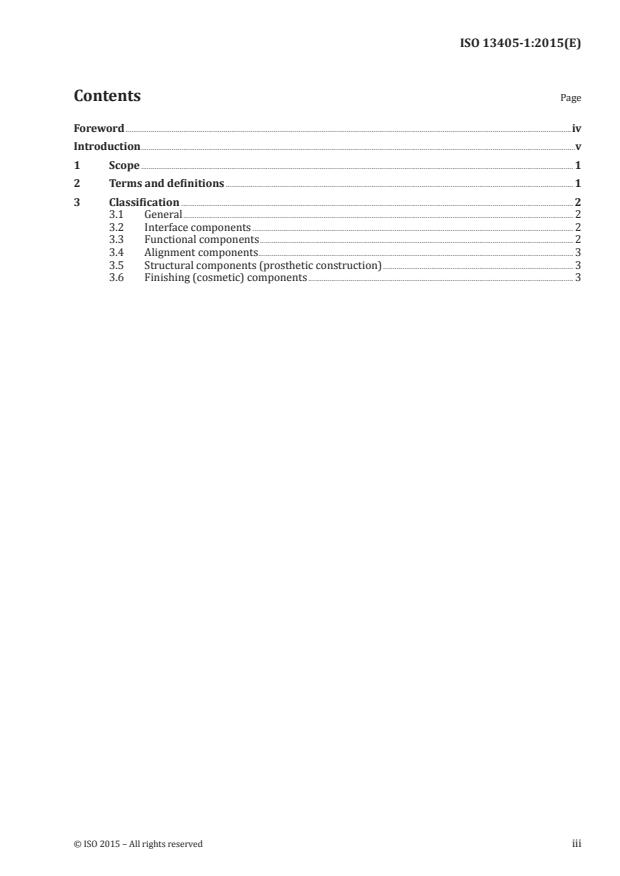
Contents Page
Foreword .iv
Introduction .v
1 Scope . 1
2 Terms and definitions . 1
3 Classification . 2
3.1 General . 2
3.2 Interface components . 2
3.3 Functional components . 2
3.4 Alignment components. 3
3.5 Structural components (prosthetic construction) . 3
3.6 Finishing (cosmetic) components . 3
Foreword
ISO (the International Organization for Standardization) is a worldwide federation of national standards
bodies (ISO member bodies). The work of preparing International Standards is normally carried out
through ISO technical committees. Each member body interested in a subject for which a technical
committee has been established has the right to be represented on that committee. International
organizations, governmental and non-governmental, in liaison with ISO, also take part in the work.
ISO collaborates closely with the International Electrotechnical Commission (IEC) on all matters of
electrotechnical standardization.
The procedures used to develop this document and those intended for its further maintenance are
described in the ISO/IEC Directives, Part 1. In particular the different approval criteria needed for the
different types of ISO documents should be noted. This document was drafted in accordance with the
editorial rules of the ISO/IEC Directives, Part 2 (see www.iso.org/directives).
Attention is drawn to the possibility that some of the elements of this document may be the subject of
patent rights. ISO shall not be held responsible for identifying any or all such patent rights. Details of any
patent rights identified during the development of the document will be in the Introduction and/or on
the ISO list of patent declarations received (see www.iso.org/patents).
Any trade name used in this document is information given for the convenience of users and does not
constitute an endorsement.
For an explanation on the meaning of ISO specific terms and expressions related to conformity
assessment, as well as information about ISO’s adherence to the WTO principles in the Technical Barriers
to Trade (TBT), see the following URL: Foreword - Supplementary Information.
The committee responsible for this document is ISO/TC 168, Prosthetics and orthotics.
This second edition cancels and replaces the first edition (ISO 13405-1:1996), which has been technically
revised with the following changes:
a) liner added to the list of interface components;
b) functional components divided into lower and upper limb and listed.
ISO 13
...
NORME ISO
INTERNATIONALE 13405-1
Deuxième édition
2015-01-15
Prothèses et orthèses —
Classification et description des
composants de prothèses —
Partie 1:
Classification des composants de
prothèses
Prosthetics and orthotics — Classification and description of
prosthetic components —
Part 1: Classification of prosthetic components
Numéro de référence
©
ISO 2015
DOCUMENT PROTÉGÉ PAR COPYRIGHT
© ISO 2015
Droits de reproduction réservés. Sauf indication contraire, aucune partie de cette publication ne peut être reproduite ni utilisée
sous quelque forme que ce soit et par aucun procédé, électronique ou mécanique, y compris la photocopie, l’affichage sur
l’internet ou sur un Intranet, sans autorisation écrite préalable. Les demandes d’autorisation peuvent être adressées à l’ISO à
l’adresse ci-après ou au comité membre de l’ISO dans le pays du demandeur.
ISO copyright office
Case postale 56 • CH-1211 Geneva 20
Tel. + 41 22 749 01 11
Fax + 41 22 749 09 47
E-mail copyright@iso.org
Web www.iso.org
Publié en Suisse
ii © ISO 2015 – Tous droits réservés
Sommaire Page
Avant-propos .iv
Introduction .v
1 Domaine d’application . 1
2 Termes et définitions . 1
3 Classification . 2
3.1 Généralités . 2
3.2 Éléments d’interface. 2
3.3 Composants fonctionnels . 2
3.4 Dispositifs d’alignement . 3
3.5 Composants structurels (structure prothétique) . 3
3.6 Éléments de finition (esthétiques) . 3
Avant-propos
L’ISO (Organisation internationale de normalisation) est une fédération mondiale d’organismes
nationaux de normalisation (comités membres de l’ISO). L’élaboration des Normes internationales est
en général confiée aux comités techniques de l’ISO. Chaque comité membre intéressé par une étude
a le droit de faire partie du comité technique créé à cet effet. Les organisations internationales,
gouvernementales et non gouvernementales, en liaison avec l’ISO participent également aux travaux.
L’ISO collabore étroitement avec la Commission électrotechnique internationale (IEC) en ce qui concerne
la normalisation électrotechnique.
Les procédures utilisées pour élaborer le présent document et celles destinées à sa mise à jour sont
décrites dans les Directives ISO/IEC, Partie 1. Il convient, en particulier de prendre note des différents
critères d’approbation requis pour les différents types de documents ISO. Le présent document a été
rédigé conformément aux règles de rédaction données dans les Directives ISO/IEC, Partie 2 (voir www.
iso.org/directives).
L’attention est appelée sur le fait que certains des éléments du présent document peuvent faire l’objet de
droits de propriété intellectuelle ou de droits analogues. L’ISO ne saurait être tenue pour responsable
de ne pas avoir identifié de tels droits de propriété et averti de leur existence. Les détails concernant les
références aux droits de propriété intellectuelle ou autres droits analogues identifiés lors de l’élaboration
du document sont indiqués dans l’Introduction et/ou dans la liste des déclarations de brevets reçues par
l’ISO (voir www.iso.org/brevets).
Les appellations commerciales éventuellement mentionnées dans le présent document sont données pour
information, par souci de commodité, à l’intention des utilisateurs et ne sauraient constituer un engagement.
Pour une explication de la signification des termes et expressions spécifiques de l’ISO liés à l’évaluation de
la conformité, ou pour toute information au sujet de l’adhésion de l’ISO aux principes de l’OMC concernant
les obstacles techniques au commerce (OTC), voir le lien suivant: Avant-propos — Informations
supplémentaires.
Le comité chargé de l’élaboration du présent document est l’ISO/TC 168, Prothèses et orthèses.
Cette deuxième édition annule et remplace la première édition (ISO 13405-1:1996), qui a fait l’objet
d’une révision technique avec les modifications suivantes:
a) ajout de manchon à la liste des éléments d’interface;
b) classement des composants fonctionnels dans la catégorie des membres inférieurs et supérieurs,
et énumération.
L’ISO 13405 comprend les parties suivantes, présentées sous le titre général Prothèses et orthèses —
Classification et description des composants de prothèses:
...