


ISO 712-1
(Main)Cereals and cereal products — Determination of moisture content — Part 1: Reference method
Cereals and cereal products — Determination of moisture content — Part 1: Reference method
ISO 712:2009 specifies a routine reference method for the determination of the moisture content of cereals and cereal products. ISO 712:2009 applies to: wheat, rice (paddy, husked and milled), barley, millet (Panicum miliaceum), rye, oats, triticale, sorghum in the form of grains, milled grains, semolina or flour. The method is not applicable to maize and pulses.
Céréales et produits céréaliers — Détermination de la teneur en eau — Partie 1: Méthode de référence
L'ISO 712:2009 spécifie une méthode de référence pratique pour la détermination de la teneur en eau des céréales et des produits céréaliers. L'ISO 712:2009 est applicable aux produits suivants: blé, riz (paddy, décortiqué et usiné), orge, millet (Panicum miliaceum), seigle, avoine, triticale, sorgho, à l'état de grains, grains broyés, semoule ou farine. La méthode n'est applicable ni au maïs ni aux légumineuses.
General Information
Relations
Buy Standard

Standards Content (Sample)
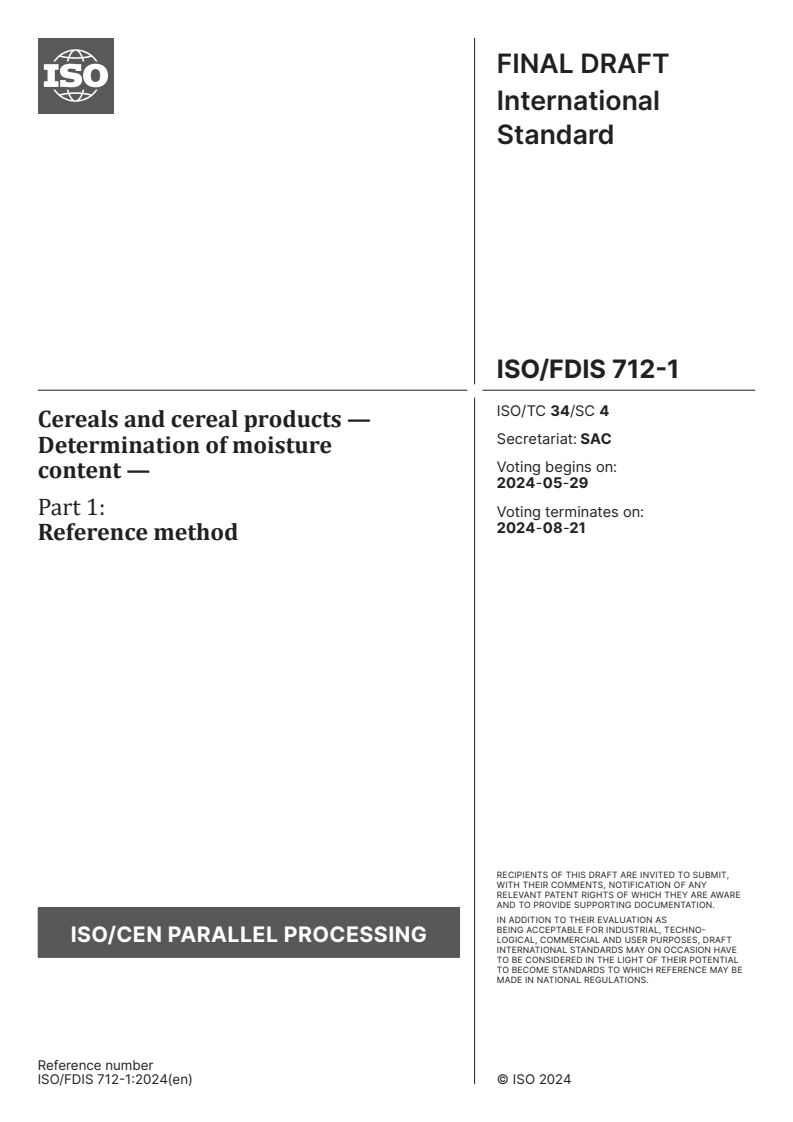
FINAL DRAFT
International
Standard
ISO/FDIS 712-1
ISO/TC 34/SC 4
Cereals and cereal products —
Secretariat: SAC
Determination of moisture
Voting begins on:
content —
2024-05-29
Part 1:
Voting terminates on:
2024-08-21
Reference method
RECIPIENTS OF THIS DRAFT ARE INVITED TO SUBMIT,
WITH THEIR COMMENTS, NOTIFICATION OF ANY
RELEVANT PATENT RIGHTS OF WHICH THEY ARE AWARE
AND TO PROVIDE SUPPOR TING DOCUMENTATION.
IN ADDITION TO THEIR EVALUATION AS
BEING ACCEPTABLE FOR INDUSTRIAL, TECHNO-
ISO/CEN PARALLEL PROCESSING LOGICAL, COMMERCIAL AND USER PURPOSES, DRAFT
INTERNATIONAL STANDARDS MAY ON OCCASION HAVE
TO BE CONSIDERED IN THE LIGHT OF THEIR POTENTIAL
TO BECOME STAN DARDS TO WHICH REFERENCE MAY BE
MADE IN NATIONAL REGULATIONS.
Reference number
ISO/FDIS 712-1:2024(en) © ISO 2024
FINAL DRAFT
ISO/FDIS 712-1:2024(en)
International
Standard
ISO/FDIS 712-1
ISO/TC 34/SC 4
Cereals and cereal products —
Secretariat: SAC
Determination of moisture
Voting begins on:
content —
Part 1:
Voting terminates on:
Reference method
RECIPIENTS OF THIS DRAFT ARE INVITED TO SUBMIT,
WITH THEIR COMMENTS, NOTIFICATION OF ANY
RELEVANT PATENT RIGHTS OF WHICH THEY ARE AWARE
AND TO PROVIDE SUPPOR TING DOCUMENTATION.
© ISO 2024
IN ADDITION TO THEIR EVALUATION AS
All rights reserved. Unless otherwise specified, or required in the context of its implementation, no part of this publication may
BEING ACCEPTABLE FOR INDUSTRIAL, TECHNO-
ISO/CEN PARALLEL PROCESSING
LOGICAL, COMMERCIAL AND USER PURPOSES, DRAFT
be reproduced or utilized otherwise in any form or by any means, electronic or mechanical, including photocopying, or posting on
INTERNATIONAL STANDARDS MAY ON OCCASION HAVE
the internet or an intranet, without prior written permission. Permission can be requested from either ISO at the address below
TO BE CONSIDERED IN THE LIGHT OF THEIR POTENTIAL
or ISO’s member body in the country of the requester.
TO BECOME STAN DARDS TO WHICH REFERENCE MAY BE
MADE IN NATIONAL REGULATIONS.
ISO copyright office
CP 401 • Ch. de Blandonnet 8
CH-1214 Vernier, Geneva
Phone: +41 22 749 01 11
Email: copyright@iso.org
Website: www.iso.org
Published in Switzerland Reference number
ISO/FDIS 712-1:2024(en) © ISO 2024
ii
ISO/FDIS 712-1:2024(en)
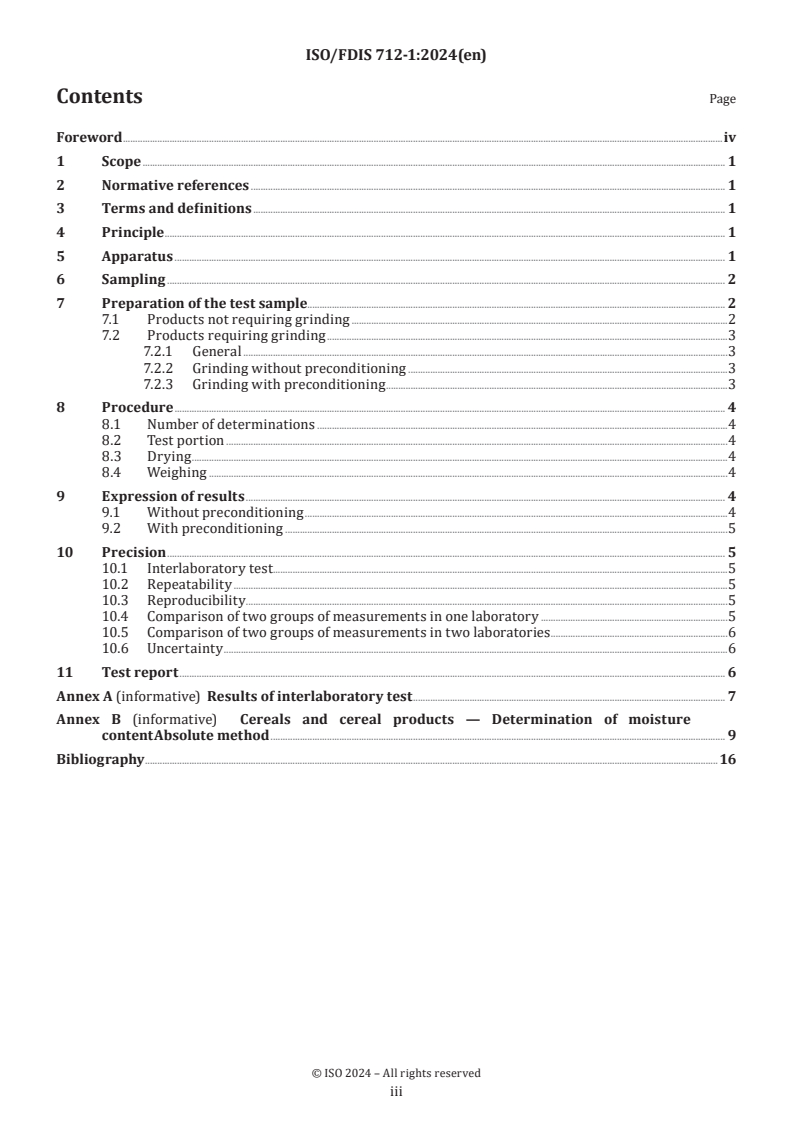
Contents Page
Foreword .iv
1 Scope . 1
2 Normative references . 1
3 Terms and definitions . 1
4 Principle . 1
5 Apparatus . 1
6 Sampling . 2
7 Preparation of the test sample. 2
7.1 Products not requiring grinding .2
7.2 Products requiring grinding .3
7.2.1 General .3
7.2.2 Grinding without preconditioning .3
7.2.3 Grinding with preconditioning .3
8 Procedure . 4
8.1 Number of determinations .4
8.2 Test portion .4
8.3 Drying .4
8.4 Weighing .4
9 Expression of results . 4
9.1 Without preconditioning .4
9.2 With preconditioning .5
10 Precision . 5
10.1 Interlaboratory test . .5
10.2 Repeatability .5
10.3 Reproducibility . .5
10.4 Comparison of two groups of measurements in one laboratory .5
10.5 Comparison of two groups of measurements in two laboratories .6
10.6 Uncertainty .6
11 Test report . 6
Annex A (informative) Results of interlaboratory test . 7
Annex B (informative) Cereals and cereal products — Determination of moisture
contentAbsolute method . 9
Bibliography .16
iii
ISO/FDIS 712-1:2024(en)
Foreword
ISO (the International Organization for Standardization) is a worldwide federation of national standards
bodies (ISO member bodies). The work of preparing International Standards is normally carried out through
ISO technical committees. Each member body interested in a subject for which a technical committee
has been established has the right to be represented on that committee. International organizations,
governmental and non-governmental, in liaison with ISO, also take part in the work. ISO collaborates closely
with the International Electrotechnical Commission (IEC) on all matters of electrotechnical standardization.
The procedures used to develop this document and those intended for its further maintenance are described
in the ISO/IEC Directives, Part 1. In particular, the different approval criteria needed for the different types
of ISO document should be noted. This document was drafted in accordance with the editorial rules of the
ISO/IEC Directives, Part 2 (see www.iso.org/directives).
ISO draws attention to the possibility that the implementation of this document may involve the use of (a)
patent(s). ISO takes no position concerning the evidence, validity or applicability of any claimed patent
rights in respect thereof. As of the date of publication of this document, ISO had not received notice of (a)
patent(s) which may be required to implement this document. However, implementers are cautioned that
this may not represent the latest information, which may be obtained from the patent database available at
www.iso.org/patents. ISO shall not be held responsible for identifying any or all such patent rights.
Any trade name used in this document is information given for the convenience of users and does not
constitute an endorsement.
For an explanation of the voluntary nature of standards, the meaning of ISO specific terms and expressions
related to conformity assessment, as well as information about ISO's adherence to the World Trade
Organization (WTO) principles in the Technical Barriers to Trade (TBT), see www.iso.org/iso/foreword.html.
This document was prepared by Technical Committee ISO/TC 34, Food products, Subcommittee SC 4, Cereals
and pulses, in collaboration with the European Committee for Standardization (CEN) Technical Committee
CEN/TC 338, Cereal and cereal products, in accordance with the Agreement on technical cooperation between
ISO and CEN (Vienna Agreement).
This first edition of ISO 712-1 cancels and replaces ISO 712:2009, of which it constitutes a minor revision.
The changes are as follows:
— numeration and change in the title to align with the new ISO 712-2.
A list of all parts in the ISO 712 series can be found on the ISO website.
Any feedback or questions on this document should be directed to the user’s national standards body. A
complete listing of these bodies can be found at www.iso.org/members.html.
iv
FINAL DRAFT International Standard ISO/FDIS 712-1:2024(en)
Cereals and cereal products — Determination of moisture
content —
Part 1:
Reference method
1 Scope
This document specifies a routine reference method for the determination of the moisture content of cereals
and cereal products.
This document applies to: wheat, rice (paddy, husked and milled), barley, millet (Panicum miliaceum), rye,
oats, triticale, sorghum in the form of grains, milled grains, semolina or flour.
The method is not applicable to maize and pulses.
[5] [7]
NOTE For moisture content determination in maize, see ISO 6540 ; and for pulses, see ISO 24557 .
2 Normative references
There are no normative references in this document.
3 Terms and definitions
For the purposes of this document, the following terms and definitions apply.
ISO and IEC maintain terminological databases for use in standardization at the following addresses:
— ISO Online browsing platform: available at https:// www .iso .org/ obp
— IEC Electropedia: available at https:// www .electropedia .org/
3.1
moisture content
true moisture content
mass loss undergone by a product
Note 1 to entry: Moisture content is expressed as a percentage.
4 Principle
If necessary, a laboratory sample is ground after conditioning. A test portion is dried at a temperature
between 130 °C and 133 °C, under conditions which enable a result to be obtained which corresponds to that
obtained by the absolute method described in Annex B.
5 Apparatus
5.1 Analytical balance, capable of weighing to an accuracy of ±0,001 g.
ISO/FDIS 712-1:2024(en)
5.2 Grinding mill, having the following characteristics:
a) made of material which does not absorb moisture;
b) easy to clean and having as little dead space as possible;
c) enables grinding to be carried out rapidly and uniformly, without appreciable development of heat
(difference of temperatures before and after grinding smaller than or equal to 5 °C);
NOTE A grinding mill fitted with a cooling device can conform with this requirement.
d) air tight to avoid water exchange between sample and external air;
e) adjustable to obtain particles of the dimensions indicated in Table 1.
5.3 Metal dish, non-corrodible under the test conditions, or glass dish, with a lid and having an effective
surface area enabling the test portion to be distributed, to give a mass per unit area of not
...
ISO /FDIS 712-1:2024(E)
ISO /TC 34/SC 4
Secretariat: XXXX SAC
Date: 2024-05-14
Cereals and cereal products — Determination of moisture
content —
Part 1:
Reference method
Céréales et produits céréaliers — Détermination de la teneur en eau —Partie 1 : Méthode de référence
FDIS stage
Warning for WDs and CDs
This document is not an ISO International Standard. It is distributed for review and comment. It is subject to
change without notice and may not be referred to as an International Standard.
Recipients of this draft are invited to submit, with their comments, notification of any relevant patent rights of
which they are aware and to provide supporting documentation.
ISO #####-#:####(X)
2 © ISO #### – All rights reserved
ISO /FDIS 712-1:2024(Een)
All rights reserved. Unless otherwise specified, or required in the context of its implementation, no part of this publication
may be reproduced or utilized otherwise in any form or by any means, electronic or mechanical, including photocopying,
or posting on the internet or an intranet, without prior written permission. Permission can be requested from either ISO
at the address below or ISO’s member body in the country of the requester.
ISO copyright office
CP 401 • Ch. de Blandonnet 8 • CP 401
CH-1214 Vernier, Geneva, Switzerland
Tel. Phone: + 41 22 749 01 11
Fax + 41 22 749 09 47
E-mail: copyright@iso.org
www.iso.org
Website: www.iso.org
Published in Switzerland
2-1:2024(en)
iv
ISO /FDIS 712-1:2024(Een)
Contents
Foreword . vii
1 Scope . 1
2 Normative references . 1
3 Terms and definitions . 1
4 Principle . 1
5 Apparatus . 1
6 Sampling . 2
7 Preparation of the test sample . 2
7.1 Products not requiring grinding . 2
7.2 Products requiring grinding . 3
7.2.1 General. 3
7.2.2 Grinding without preconditioning . 3
7.2.3 Grinding with preconditioning . 3
8 Procedure . 4
8.1 Number of determinations . 4
8.2 Test portion . 4
8.3 Drying . 4
8.4 Weighing . 4
9 Expression of results . 4
9.1 Without preconditioning . 4
9.2 With preconditioning . 5
10 Precision . 5
10.1 Interlaboratory test . 5
10.2 Repeatability . 5
10.3 Reproducibility . 5
10.4 Comparison of two groups of measurements in one laboratory . 6
10.5 Comparison of two groups of measurements in two laboratories . 6
10.6 Uncertainty. 6
11 Test report . 7
Annex A (informative) Results of interlaboratory test . 8
Annex B (informative) Cereals and cereal products — Determination of moisture
contentAbsolute method . 11
Bibliography . 19
Foreword . iv
1 Scope . 1
2 Normative references . 1
3 Terms and definitions . 1
4 Principle . 1
5 Apparatus . 1
6 Sampling . 2
© ISO 2024 – All rights reserved
v
ISO /FDIS 712-1:2024(Een)
7 Preparation of the test sample . 2
7.1 Products not requiring grinding . 2
7.2 Products requiring grinding . 3
7.2.1 General. 3
7.2.2 Grinding without preconditioning . 3
7.2.3 Grinding with preconditioning . 3
8 Procedure . 4
8.1 Number of determinations . 4
8.2 Test portion . 4
8.3 Drying . 4
8.4 Weighing . 4
9 Expression of results . 5
9.1 Without preconditioning . 5
9.2 With preconditioning . 5
10 Precision . 5
10.1 Interlaboratory test . 5
10.2 Repeatability . 5
10.3 Reproducibility . 6
10.4 Comparison of two groups of measurements in one laboratory . 6
10.5 Comparison of two groups of measurements in two laboratories . 6
10.6 Uncertainty. 6
11 Test report . 7
Annex A (informative) Results of interlaboratory test . 8
Annex B (informative) Cereals and cereal products — Determination of moisture content
Absolute method . 10
Bibliography . 17
2-1:2024(en)
vi
ISO /FDIS 712-1:2024(Een)
Foreword
ISO (the International Organization for Standardization) is a worldwide federation of national standards
bodies (ISO member bodies). The work of preparing International Standards is normally carried out through
ISO technical committees. Each member body interested in a subject for which a technical committee has been
established has the right to be represented on that committee. International organizations, governmental and
non-governmental, in liaison with ISO, also take part in the work. ISO collaborates closely with the
International Electrotechnical Commission (IEC) on all matters of electrotechnical standardization.
The procedures used to develop this document and those intended for its further maintenance are described
in the ISO/IEC Directives, Part 1. In particular, the different approval criteria needed for the different types of
ISO documentsdocument should be noted. This document was drafted in accordance with the editorial rules
of the ISO/IEC Directives, Part 2 (see www.iso.org/directiveswww.iso.org/directives).
ISO draws attention to the possibility that the implementation of this document may involve the use of (a)
patent(s). ISO takes no position concerning the evidence, validity or applicability of any claimed patent rights
in respect thereof. As of the date of publication of this document, ISO [had not] received notice of (a) patent(s)
which may be required to implement this document. However, implementers are cautioned that this may not
represent the latest information, which may be obtained from the patent database available at
www.iso.org/patents.www.iso.org/patents. ISO shall not be held responsible for identifying any or all such
patent rights.
Any trade name used in this document is information given for the convenience of users and does not
constitute an endorsement.
For an explanation of the voluntary nature of standards, the meaning of ISO specific terms and expressions
related to conformity assessment, as well as information about ISO's adherence to the World Trade
Organization (WTO) principles in the Technical Barriers to Trade (TBT), see: www.iso.org/iso/foreword.html
www.iso.org/iso/foreword.html.
This document was prepared by Techni
...
Questions, Comments and Discussion
Ask us and Technical Secretary will try to provide an answer. You can facilitate discussion about the standard in here.