

ISO 6262-1:2013
(Main)End mills with indexable inserts — Part 1: End mills with flatted cylindrical shank
General Information
- Abstract
ISO 6262-1:2013 specifies the dimensions of end mills with indexable inserts and flatted parallel shank according to ISO 3338-2.
- Status
- Published
- Publication Date
- 02-Sep-2013
- Current Stage
- 9093 - International Standard confirmed
- Start Date
- 20-Jun-2024
- Completion Date
- 29-Aug-2026
Buy Documents


ISO 6262-1:2013 - End mills with indexable inserts
ISO 6262-1:2013 - End mills with indexable inserts — Part 1: End mills with flatted cylindrical shank/3/2013

ISO 6262-1:2013 - Fraises en bout a plaquettes amovibles
ISO 6262-1:2013 - Fraises en bout à plaquettes amovibles — Partie 1: Fraises à queue cylindrique à méplat/3/2013
Overview
ISO 6262-1:2013 is an international standard developed by the International Organization for Standardization (ISO) that specifies the dimensions of end mills with indexable inserts and flatted cylindrical shanks. This standard is part one of the ISO 6262 series and focuses specifically on end mills featuring a flatted parallel shank design, in accordance with ISO 3338-2.
End mills with indexable inserts are essential cutting tools widely used in precision milling operations in the manufacturing and metalworking industries. These cutting tools enable efficient machining with the ability to replace inserts, thereby reducing downtime and improving overall productivity.
The standard provides consistent and clear dimensional parameters to facilitate compatibility across manufacturers and users, maintaining interchangeability and optimizing tool performance.
Key Topics
- Scope: Defines dimensional characteristics for end mills with indexable inserts and flatted cylindrical shanks.
- Shank Dimensions: Conforms to ISO 3338-2, detailing the specifications of the flatted parallel shank to ensure secure tool holding and alignment.
- Cutting Edge Angle: The nominal cutting edge angle for the insert is standardized at 90°, although the actual effective angle during use depends on cutter geometry and operating conditions.
- Dimensional Table: Specifies precise measurements including cutting diameter, connection diameter, head length, and overall length for various cutter sizes ranging from 16 mm to 50 mm diameter.
- Relationship with ISO 13399: Annex A maps the designations in ISO 6262-1 to the preferred symbols used in ISO 13399, which covers cutting tool data representation and exchange - facilitating digital integration and industry communication.
Applications
ISO 6262-1:2013 is critical for manufacturers, distributors, and users of milling cutters who require standardized tooling components. Key applications include:
- Precision Machining: Ensures dimensional uniformity in end mills, which is vital for producing high-quality machined components in aerospace, automotive, and general manufacturing.
- Tool Interchangeability: Manufacturers can produce cutting tools with flatted cylindrical shanks that fit various holders and machines without custom adaptations.
- Inventory and Supply Chain Efficiency: Standardized dimensions reduce complexity and errors in procurement, inventory management, and tool replacement.
- Cutting Tool Data Management: Compatibility with ISO 13399 enables accurate digital tool descriptions for CAM software and tool management systems.
Related Standards
- ISO 3338-2: Defines the dimensional characteristics of flatted cylindrical shanks for milling cutters, which is referenced directly in ISO 6262-1.
- ISO 13399 Series: Covers cutting tool data representation and exchange, enabling seamless integration of tooling specifications in digital manufacturing environments.
- ISO 6262-2: The second part of the ISO 6262 series, which specifies end mills with indexable inserts and Morse taper shanks.
Keywords
End mills, indexable inserts, flatted cylindrical shank, ISO 6262-1, milling cutters, cutting tool dimensions, ISO standards, ISO 3338-2, ISO 13399, tool interchangeability, precision machining, manufacturing standards.
By adhering to ISO 6262-1:2013, industries benefit from internationally recognized standardization of end mill dimensions, leading to improved tool compatibility, enhanced machining precision, and streamlined supply chains in metal cutting operations.
Relations
- Revises
ISO 6262-1:1982 - End mills with indexable inserts — Part 1: End mills with flatted parallel shank - Effective Date
- 07-Oct-2012
Buy Documents
ISO 6262-1:2013 - End mills with indexable inserts
ISO 6262-1:2013 - End mills with indexable inserts — Part 1: End mills with flatted cylindrical shank/3/2013
ISO 6262-1:2013 - Fraises en bout a plaquettes amovibles
ISO 6262-1:2013 - Fraises en bout à plaquettes amovibles — Partie 1: Fraises à queue cylindrique à méplat/3/2013
Get Certified
Connect with accredited certification bodies for this standard

DVS-ZERT GmbH
German welding certification society.
CARES (UK Certification Authority for Reinforcing Steels)
UK certification for reinforcing steels and construction.
EWF/IIW (European/International Welding Federation)
International welding personnel certification.
Sponsored listings
Frequently Asked Questions
ISO 6262-1:2013 is a standard published by the International Organization for Standardization (ISO). Its full title is "End mills with indexable inserts — Part 1: End mills with flatted cylindrical shank". This standard covers: ISO 6262-1:2013 specifies the dimensions of end mills with indexable inserts and flatted parallel shank according to ISO 3338-2.
ISO 6262-1:2013 specifies the dimensions of end mills with indexable inserts and flatted parallel shank according to ISO 3338-2.
ISO 6262-1:2013 is classified under the following ICS (International Classification for Standards) categories: 25.100.20 - Milling tools. The ICS classification helps identify the subject area and facilitates finding related standards.
ISO 6262-1:2013 has the following relationships with other standards: It is inter standard links to ISO 6262-1:1982. Understanding these relationships helps ensure you are using the most current and applicable version of the standard.
ISO 6262-1:2013 is available in PDF format for immediate download after purchase. The document can be added to your cart and obtained through the secure checkout process. Digital delivery ensures instant access to the complete standard document.
Standards Content (Sample)
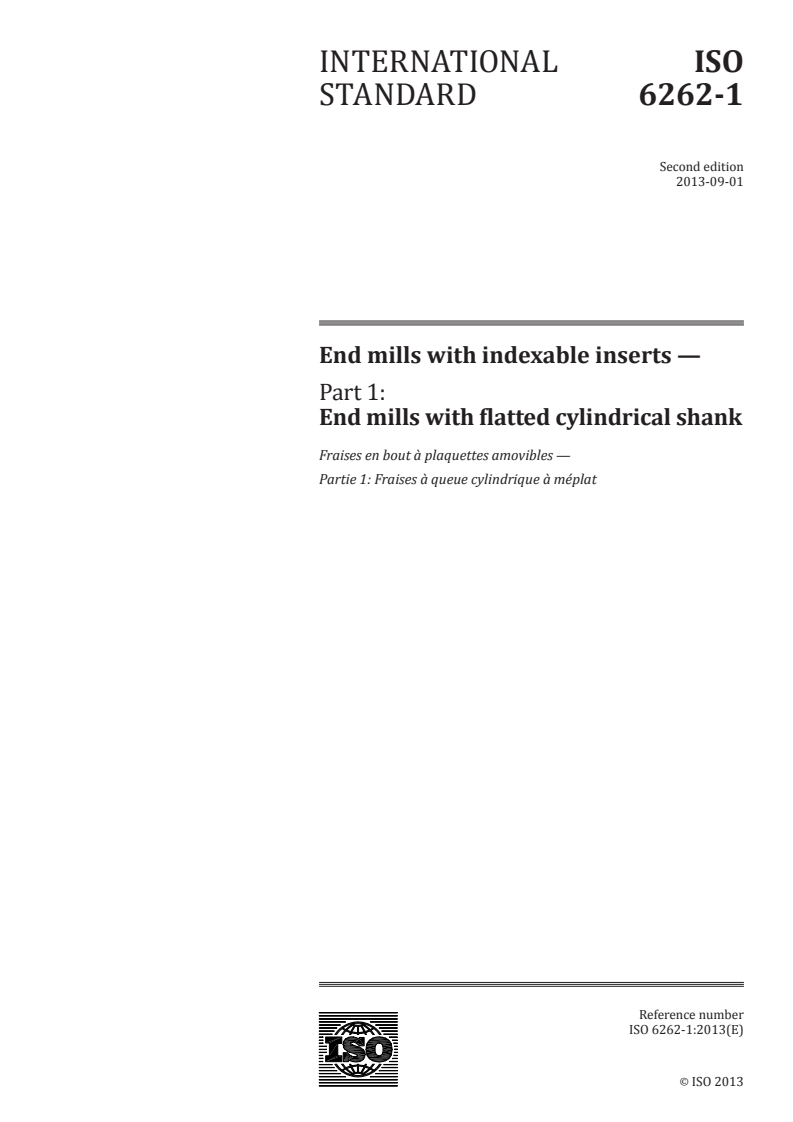
INTERNATIONAL ISO
STANDARD 6262-1
Second edition
2013-09-01
End mills with indexable inserts —
Part 1:
End mills with flatted cylindrical shank
Fraises en bout à plaquettes amovibles —
Partie 1: Fraises à queue cylindrique à méplat
Reference number
©
ISO 2013
© ISO 2013
All rights reserved. Unless otherwise specified, no part of this publication may be reproduced or utilized otherwise in any form
or by any means, electronic or mechanical, including photocopying, or posting on the internet or an intranet, without prior
written permission. Permission can be requested from either ISO at the address below or ISO’s member body in the country of
the requester.
ISO copyright office
Case postale 56 • CH-1211 Geneva 20
Tel. + 41 22 749 01 11
Fax + 41 22 749 09 47
E-mail copyright@iso.org
Web www.iso.org
Published in Switzerland
ii © ISO 2013 – All rights reserved
Contents Page
Foreword .iv
1 Scope . 1
2 Normative references . 1
3 Dimensions . 1
Annex A (informative) Relationship between designations in this part of ISO 6262 and the
ISO 13399 series . 3
Bibliography . 4
Foreword
ISO (the International Organization for Standardization) is a worldwide federation of national standards
bodies (ISO member bodies). The work of preparing International Standards is normally carried out
through ISO technical committees. Each member body interested in a subject for which a technical
committee has been established has the right to be represented on that committee. International
organizations, governmental and non-governmental, in liaison with ISO, also take part in the work.
ISO collaborates closely with the International Electrotechnical Commission (IEC) on all matters of
electrotechnical standardization.
The procedures used to develop this document and those intended for its further maintenance are
described in the ISO/IEC Directives, Part 1. In particular the different approval criteria needed for the
different types of ISO documents should be noted. This document was drafted in accordance with the
editorial rules of the ISO/IEC Directives, Part 2. www.iso.org/directives
Attention is drawn to the possibility that some of the elements of this document may be the subject of
patent rights. ISO shall not
...
INTERNATIONAL ISO
STANDARD 6262-1
Second edition
2013-09-01
End mills with indexable inserts —
Part 1:
End mills with flatted cylindrical shank
Fraises en bout à plaquettes amovibles —
Partie 1: Fraises à queue cylindrique à méplat
Reference number
©
ISO 2013
© ISO 2013
All rights reserved. Unless otherwise specified, no part of this publication may be reproduced or utilized otherwise in any form
or by any means, electronic or mechanical, including photocopying, or posting on the internet or an intranet, without prior
written permission. Permission can be requested from either ISO at the address below or ISO’s member body in the country of
the requester.
ISO copyright office
Case postale 56 • CH-1211 Geneva 20
Tel. + 41 22 749 01 11
Fax + 41 22 749 09 47
E-mail copyright@iso.org
Web www.iso.org
Published in Switzerland
ii © ISO 2013 – All rights reserved
Contents Page
Foreword .iv
1 Scope . 1
2 Normative references . 1
3 Dimensions . 1
Annex A (informative) Relationship between designations in this part of ISO 6262 and the
ISO 13399 series . 3
Bibliography . 4
Foreword
ISO (the International Organization for Standardization) is a worldwide federation of national standards
bodies (ISO member bodies). The work of preparing International Standards is normally carried out
through ISO technical committees. Each member body interested in a subject for which a technical
committee has been established has the right to be represented on that committee. International
organizations, governmental and non-governmental, in liaison with ISO, also take part in the work.
ISO collaborates closely with the International Electrotechnical Commission (IEC) on all matters of
electrotechnical standardization.
The procedures used to develop this document and those intended for its further maintenance are
described in the ISO/IEC Directives, Part 1. In particular the different approval criteria needed for the
different types of ISO documents should be noted. This document was drafted in accordance with the
editorial rules of the ISO/IEC Directives, Part 2. www.iso.org/directives
Attention is drawn to the possibility that some of the elements of this document may be the subject of
patent rights. ISO shall not
...
NORME ISO
INTERNATIONALE 6262-1
Deuxième édition
2013-09-01
Fraises en bout à plaquettes
amovibles —
Partie 1:
Fraises à queue cylindrique à méplat
End mills with indexable inserts —
Part 1: End mills with flatted cylindrical shank
Numéro de référence
©
ISO 2013
DOCUMENT PROTÉGÉ PAR COPYRIGHT
© ISO 2013
Droits de reproduction réservés. Sauf indication contraire, aucune partie de cette publication ne peut être reproduite ni utilisée
sous quelque forme que ce soit et par aucun procédé, électronique ou mécanique, y compris la photocopie, l’affichage sur
l’internet ou sur un Intranet, sans autorisation écrite préalable. Les demandes d’autorisation peuvent être adressées à l’ISO à
l’adresse ci-après ou au comité membre de l’ISO dans le pays du demandeur.
ISO copyright office
Case postale 56 • CH-1211 Geneva 20
Tel. + 41 22 749 01 11
Fax + 41 22 749 09 47
E-mail copyright@iso.org
Web www.iso.org
Publié en Suisse
ii © ISO 2013 – Tous droits réservés
Sommaire Page
Avant-propos .iv
1 Domaine d’application . 1
2 Références normatives . 1
3 Dimensions . 1
Annexe A (informative) Relation entre les désignations de la présente partie de l’ISO 6262 et
celles de l’ISO 13399 (toutes les parties) . 3
Bibliographie . 4
Avant-propos
L’ISO (Organisation internationale de normalisation) est une fédération mondiale d’organismes
nationaux de normalisation (comités membres de l’ISO). L’élaboration des Normes internationales est
en général confiée aux comités techniques de l’ISO. Chaque comité membre intéressé par une étude
a le droit de faire partie du comité technique créé à cet effet. Les organisations internationales,
gouvernementales et non gouvernementales, en liaison avec l’ISO participent également aux travaux.
L’ISO collabore étroitement avec la Commission électrotechnique internationale (CEI) en ce qui concerne
la normalisation électrotechnique.
Les procédures utilisées pour élaborer le présent document et celles destinées à sa mise à jour sont
décrites dans les Directives ISO/CEI, Partie 1. Il convient, en particulier de prendre note des différents
critères d’approbation requis pour les différents types de documents ISO. Le présent document a été
rédigé conformément aux règles de rédaction données dans les Directives ISO/CEI, Partie 2, www.iso.
org/directives.
L’attention est appelée sur le fait que certains des éléments du présent document peuvent faire l’objet de
droits de propriété intellectuelle ou de droits analogues. L’ISO ne saurait être tenue pour responsable
de ne pas avoir identifié de tels droits de propriété et averti de leur existence. Les détails concernant les
références aux droits de propriété intellectuelle ou autres droits analogues
...
NORME ISO
INTERNATIONALE 6262-1
Deuxième édition
2013-09-01
Fraises en bout à plaquettes
amovibles —
Partie 1:
Fraises à queue cylindrique à méplat
End mills with indexable inserts —
Part 1: End mills with flatted cylindrical shank
Numéro de référence
©
ISO 2013
DOCUMENT PROTÉGÉ PAR COPYRIGHT
© ISO 2013
Droits de reproduction réservés. Sauf indication contraire, aucune partie de cette publication ne peut être reproduite ni utilisée
sous quelque forme que ce soit et par aucun procédé, électronique ou mécanique, y compris la photocopie, l’affichage sur
l’internet ou sur un Intranet, sans autorisation écrite préalable. Les demandes d’autorisation peuvent être adressées à l’ISO à
l’adresse ci-après ou au comité membre de l’ISO dans le pays du demandeur.
ISO copyright office
Case postale 56 • CH-1211 Geneva 20
Tel. + 41 22 749 01 11
Fax + 41 22 749 09 47
E-mail copyright@iso.org
Web www.iso.org
Publié en Suisse
ii © ISO 2013 – Tous droits réservés
Sommaire Page
Avant-propos .iv
1 Domaine d’application . 1
2 Références normatives . 1
3 Dimensions . 1
Annexe A (informative) Relation entre les désignations de la présente partie de l’ISO 6262 et
celles de l’ISO 13399 (toutes les parties) . 3
Bibliographie . 4
Avant-propos
L’ISO (Organisation internationale de normalisation) est une fédération mondiale d’organismes
nationaux de normalisation (comités membres de l’ISO). L’élaboration des Normes internationales est
en général confiée aux comités techniques de l’ISO. Chaque comité membre intéressé par une étude
a le droit de faire partie du comité technique créé à cet effet. Les organisations internationales,
gouvernementales et non gouvernementales, en liaison avec l’ISO participent également aux travaux.
L’ISO collabore étroitement avec la Commission électrotechnique internationale (CEI) en ce qui concerne
la normalisation électrotechnique.
Les procédures utilisées pour élaborer le présent document et celles destinées à sa mise à jour sont
décrites dans les Directives ISO/CEI, Partie 1. Il convient, en particulier de prendre note des différents
critères d’approbation requis pour les différents types de documents ISO. Le présent document a été
rédigé conformément aux règles de rédaction données dans les Directives ISO/CEI, Partie 2, www.iso.
org/directives.
L’attention est appelée sur le fait que certains des éléments du présent document peuvent faire l’objet de
droits de propriété intellectuelle ou de droits analogues. L’ISO ne saurait être tenue pour responsable
de ne pas avoir identifié de tels droits de propriété et averti de leur existence. Les détails concernant les
références aux droits de propriété intellectuelle ou autres droits analogues
...