

ISO/IEC 19540-2:2022
(Main)Information technology — Object Management Group Unified Architecture Framework (OMG UAF) — Part 2: Unified Architecture Framework Profile (UAFP)
General Information
- Abstract
This document is a normative supplement to the UAF DMM document (c4i/19-06-16). This document specifies a UAF profile to enable practitioners to express architectural model elements and organize them in a set of domains, model kinds, and view specification (specified in the UAF DMM) that support the specific needs of end users in defense and commercial industry. UAFP 1.1 defines a set of stereotypes and model elements and relationships to satisfy the requirements of the UPDM 3.0 RFP and the UAF DMM. The profile specification documents the language architecture in terms of UML profiling mechanism. A number of UAFP stereotypes inherit from SysML stereotypes where reuse of SysML semantics is necessary. The reusable portions of the SysML specification are not included directly in the specification but are made explicit through the stereotype inheritance.
- Status
- Published
- Publication Date
- 20-Mar-2022
- Technical Committee
- ISO/IEC JTC 1 - Information technology
- Drafting Committee
- ISO/IEC JTC 1 - Information technology
- Current Stage
- 6060 - International Standard published
- Start Date
- 21-Mar-2022
- Due Date
- 08-Aug-2022
- Completion Date
- 21-Mar-2022


Overview
ISO/IEC 19540-2:2022 - Unified Architecture Framework Profile (UAFP) - is the ISO publication that defines a UML-based profile for the Object Management Group (OMG) Unified Architecture Framework (UAF). As a normative supplement to the UAF Domain Metamodel (UAF DMM, c4i/19-06-16), this standard specifies the UAFP language architecture and the concrete set of stereotypes, model elements, relationships and view specifications that practitioners use to express architectural models across domains and model kinds for defense and commercial systems.
The standard documents the UAFP 1.1 profile to satisfy requirements from the UPDM 3.0 RFP and the UAF DMM, describes reuse of SysML semantics via stereotype inheritance, and explains how to represent stereotype constraints (metaconstraint, metarelationship and stereotyped relationship dependencies).
Key Topics and Requirements
- UAF Profile Specification: formal UML profiling mechanism that defines stereotypes and extensions to support UAF modeling.
- Stereotypes and Model Elements: organized domains such as Dictionary, Parameters, Metadata, Strategic, Operational, Services, Personnel, Resources, Security, Projects, Standards, Actual Resources, and a Summary/Overview.
- View Specifications: prescriptive views for Strategic, Operational, Services, Personnel, Resources, Security, Projects, Standards, Actual Resources and others to support stakeholder concerns.
- Language Architecture & Constraints: rules for representing stereotype constraints, metaconstraint and metarelationship dependencies, and visual/connector extensions.
- SysML Reuse: selective inheritance from SysML stereotypes where SysML semantics are required; SysML portions are referenced via inheritance rather than duplicated.
- Measurement Library: included measurement constructs for model metrics and evaluation.
Practical Applications
- Enterprise and solution architects use ISO/IEC 19540-2 to create consistent, tool-supported architectural models that align with UAF DMM semantics.
- Systems engineers and defense modelers employ the UAFP for mission, capability, operational and system-level views to support analysis, acquisition, and interoperability.
- Tool vendors and model-driven engineering practitioners implement the UAF UML profile to enable exchange, validation, and automated analysis across modeling tools.
- Program managers and standards governance bodies use the view specifications and measurement library for compliance, reporting and lifecycle assessment.
Who Should Use This Standard
- Enterprise architects, systems engineers, modelers in defense and commercial sectors
- Modeling tool developers and integrators
- Organizations implementing UAF/UAFP or migrating from UPDM/other architecture frameworks
- Standards committees and acquisition offices requiring interoperable architecture representations
Related Standards
- OMG UAF and UAF DMM (Domain Metamodel)
- SysML (for inherited semantics)
- UPDM 3.0 RFP (requirements influencing the profile)
Keywords: ISO/IEC 19540-2:2022, UAFP, OMG UAF, Unified Architecture Framework Profile, UML profile, SysML, UPDM, architecture modeling, view specifications, stereotypes, enterprise architecture.
Get Certified
Connect with accredited certification bodies for this standard

BSI Group
BSI (British Standards Institution) is the business standards company that helps organizations make excellence a habit.

NYCE
Mexican standards and certification body.
Sponsored listings
Frequently Asked Questions
ISO/IEC 19540-2:2022 is a standard published by the International Organization for Standardization (ISO). Its full title is "Information technology — Object Management Group Unified Architecture Framework (OMG UAF) — Part 2: Unified Architecture Framework Profile (UAFP)". This standard covers: This document is a normative supplement to the UAF DMM document (c4i/19-06-16). This document specifies a UAF profile to enable practitioners to express architectural model elements and organize them in a set of domains, model kinds, and view specification (specified in the UAF DMM) that support the specific needs of end users in defense and commercial industry. UAFP 1.1 defines a set of stereotypes and model elements and relationships to satisfy the requirements of the UPDM 3.0 RFP and the UAF DMM. The profile specification documents the language architecture in terms of UML profiling mechanism. A number of UAFP stereotypes inherit from SysML stereotypes where reuse of SysML semantics is necessary. The reusable portions of the SysML specification are not included directly in the specification but are made explicit through the stereotype inheritance.
This document is a normative supplement to the UAF DMM document (c4i/19-06-16). This document specifies a UAF profile to enable practitioners to express architectural model elements and organize them in a set of domains, model kinds, and view specification (specified in the UAF DMM) that support the specific needs of end users in defense and commercial industry. UAFP 1.1 defines a set of stereotypes and model elements and relationships to satisfy the requirements of the UPDM 3.0 RFP and the UAF DMM. The profile specification documents the language architecture in terms of UML profiling mechanism. A number of UAFP stereotypes inherit from SysML stereotypes where reuse of SysML semantics is necessary. The reusable portions of the SysML specification are not included directly in the specification but are made explicit through the stereotype inheritance.
ISO/IEC 19540-2:2022 is classified under the following ICS (International Classification for Standards) categories: 35.020 - Information technology (IT) in general. The ICS classification helps identify the subject area and facilitates finding related standards.
ISO/IEC 19540-2:2022 is available in PDF format for immediate download after purchase. The document can be added to your cart and obtained through the secure checkout process. Digital delivery ensures instant access to the complete standard document.
Standards Content (Sample)
INTERNATIONAL ISO/IEC
STANDARD 19540-2
First edition
2022-03
Information technology — Object
Management Group Unified
Architecture Framework (OMG
UAF) —
Part 2:
Unified Architecture Framework
Profile (UAFP)
Reference number
© ISO/IEC 2022
© ISO/IEC 2022
All rights reserved. Unless otherwise specified, or required in the context of its implementation, no part of this publication may
be reproduced or utilized otherwise in any form or by any means, electronic or mechanical, including photocopying, or posting on
the internet or an intranet, without prior written permission. Permission can be requested from either ISO at the address below
or ISO’s member body in the country of the requester.
ISO copyright office
CP 401 • Ch. de Blandonnet 8
CH-1214 Vernier, Geneva
Phone: +41 22 749 01 11
Email: copyright@iso.org
Website: www.iso.org
Published in Switzerland
ii
© ISO/IEC 2022 – All rights reserved
Contents Page
FOREWORD . X
PREFACE . XI
1 SCOPE . 1
1.1 INTRODUCTION . 1
1.1.1 Overview . 1
2 ADDITIONAL INFORMATION . 1
2.1 LANGUAGE ARCHITECTURE . 1
2.2 CORE PRINCIPLES . 1
2.3 REPRESENTING STEREOTYPE CONSTRAINTS . 2
2.3.1 Metaconstraint dependency . 2
2.3.2 Metarelationship dependency . 3
2.3.3 Stereotyped relationship dependency . 4
3 UAF STEREOTYPES . 5
3.1 UAF . 5
3.1.1 UAF::Dictionary . 5
3.1.2 UAF::Parameters . 6
3.1.3 UAF::Metadata . 19
3.1.4 UAF::Strategic . 31
3.1.5 UAF::Operational . 43
3.1.6 UAF::Services . 61
3.1.7 UAF::Personnel . 69
3.1.8 UAF::Resources . 76
3.1.9 UAF::Security . 99
3.1.10 UAF::Projects . 113
3.1.11 UAF::Standards . 122
3.1.12 UAF::Actual Resources . 125
3.1.13 UAF::Summary and Overview . 134
4 UAF VIEW SPECIFICATIONS . 141
4.1 VIEW SPECIFICATIONS . 141
4.1.1 View Specifications::Strategic . 141
4.1.2 View Specifications::Operational . 147
4.1.3 View Specifications::Services . 155
4.1.4 View Specifications::Personnel . 162
4.1.5 View Specifications::Resources . 174
4.1.6 View Specifications::Security . 182
4.1.7 View Specifications::Projects . 189
4.1.8 View Specifications::Standards . 194
4.1.9 View Specifications::Actual Resources . 197
4.1.10 View Specifications::Dictionary . 199
4.1.11 View Specifications::Requirements . 200
4.1.12 View Specifications::Sumary & Overview . 201
4.1.13 View Specifications::Information . 202
4.1.14 View Specifications::Parameters . 203
5 MEASUREMENT LIBRARY . 207
© ISO/IEC 2022 – All rights reserved
iii
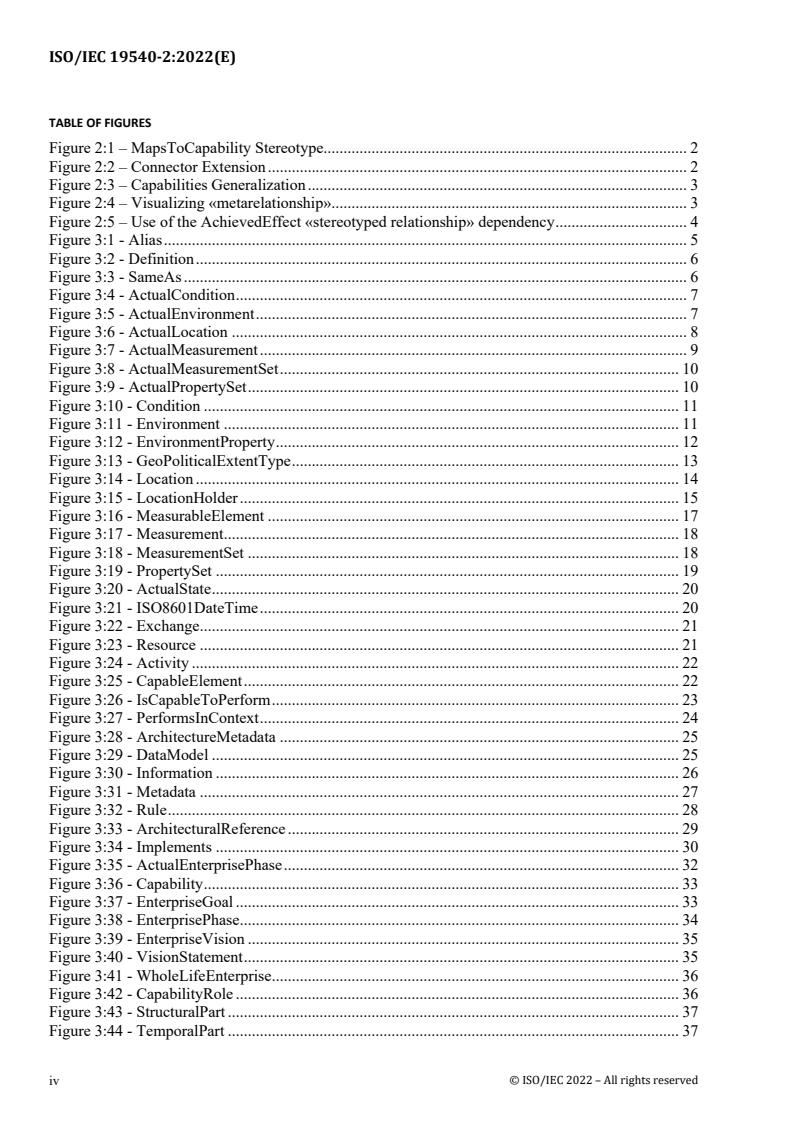
TABLE OF FIGURES
Figure 2:1 – MapsToCapability Stereotype . 2
Figure 2:2 – Connector Extension . 2
Figure 2:3 – Capabilities Generalization . 3
Figure 2:4 – Visualizing «metarelationship» . 3
Figure 2:5 – Use of the AchievedEffect «stereotyped relationship» dependency . 4
Figure 3:1 - Alias . 5
Figure 3:2 - Definition . 6
Figure 3:3 - SameAs . 6
Figure 3:4 - ActualCondition . 7
Figure 3:5 - ActualEnvironment . 7
Figure 3:6 - ActualLocation . 8
Figure 3:7 - ActualMeasurement . 9
Figure 3:8 - ActualMeasurementSet . 10
Figure 3:9 - ActualPropertySet . 10
Figure 3:10 - Condition . 11
Figure 3:11 - Environment . 11
Figure 3:12 - EnvironmentProperty . 12
Figure 3:13 - GeoPoliticalExtentType . 13
Figure 3:14 - Location . 14
Figure 3:15 - LocationHolder . 15
Figure 3:16 - MeasurableElement . 17
Figure 3:17 - Measurement . 18
Figure 3:18 - MeasurementSet . 18
Figure 3:19 - PropertySet . 19
Figure 3:20 - ActualState . 20
Figure 3:21 - ISO8601DateTime . 20
Figure 3:22 - Exchange . 21
Figure 3:23 - Resource . 21
Figure 3:24 - Activity . 22
Figure 3:25 - CapableElement . 22
Figure 3:26 - IsCapableToPerform . 23
Figure 3:27 - PerformsInContext . 24
Figure 3:28 - ArchitectureMetadata . 25
Figure 3:29 - DataModel . 25
Figure 3:30 - Information . 26
Figure 3:31 - Metadata . 27
Figure 3:32 - Rule . 28
Figure 3:33 - ArchitecturalReference . 29
Figure 3:34 - Implements . 30
Figure 3:35 - ActualEnterprisePhase . 32
Figure 3:36 - Capability . 33
Figure 3:37 - EnterpriseGoal . 33
Figure 3:38 - EnterprisePhase . 34
Figure 3:39 - EnterpriseVision . 35
Figure 3:40 - VisionStatement . 35
Figure 3:41 - WholeLifeEnterprise . 36
Figure 3:42 - CapabilityRole . 36
Figure 3:43 - StructuralPart . 37
Figure 3:44 - TemporalPart . 37
© ISO/IEC 2022 – All rights reserved
iv
Figure 3:45 - ActualEnduringTask . 38
Figure 3:46 - CapabilityForTask . 38
Figure 3:47 - EnduringTask . 39
Figure 3:48 - AchievedEffect . 39
Figure 3:49 - Achiever . 40
Figure 3:50 - DesiredEffect . 40
Figure 3:51 - Desirer . 41
Figure 3:52 - Exhibits . 41
Figure 3:53 - MapsToCapability . 42
Figure 3:54 - OrganizationInEnterprise . 42
Figure 3:55 - ArbitraryConnector . 43
Figure 3:56 - ConceptItem . 44
Figure 3:57 - ConceptRole . 44
Figure 3:58 - HighLevelOperationalConcept . 45
Figure 3:59 - KnownResource . 45
Figure 3:60 - OperationalAgent . 46
Figure 3:61 - OperationalArchitecture . 47
Figure 3:62 - OperationalMethod . 47
Figure 3:63 - OperationalParameter . 48
Figure 3:64 - OperationalPerformer . 48
Figure 3:65 - OperationalPort . 49
Figure 3:66 - OperationalRole . 50
Figure 3:67 - ProblemDomain . 50
Figure 3:68 - OperationalConnector . 51
Figure 3:69 - OperationalExchange . 52
Figure 3:70 - OperationalExchangeItem . 53
Figure 3:71 - OperationalInterface . 54
Figure 3:72 - OperationalSignal . 54
Figure 3:73 - OperationalSignalProperty . 55
Figure 3:74 - OperationalActivity . 55
Figure 3:75 - OperationalActivityAction . 56
Figure 3:76 - OperationalActivityEdge . 56
Figure 3:77 - OperationalControlFlow . 57
Figure 3:78 - OperationalObjectFlow . 57
Figure 3:79 - StandardOperationalActivity . 58
Figure 3:80 - OperationalStateDescription . 58
Figure 3:81 - OperationalMessage . 59
Figure 3:82 - InformationElement . 59
Figure 3:83 - OperationalConstraint . 60
Figure 3:84 - SubjectOfOperationalConstraint . 60
Figure 3:85 - ServiceSpecification . 61
Figure 3:86 - ServiceMethod . 62
Figure 3:87 - ServiceParameter . 62
Figure 3:88 - ServicePort . 63
Figure 3:89 - ServiceSpecificationRole . 64
Figure 3:90 - ServiceConnector . 65
Figure 3:91 - ServiceInterface . 65
Figure 3:92 - ServiceFunction . 66
Figure 3:93 - ServiceFunctionAction . 66
Figure 3:94 - ServiceStateDescription . 67
© ISO/IEC 2022 – All rights reserved
v
Figure 3:95 - ServiceMessage . 67
Figure 3:96 - ServicePolicy . 68
Figure 3:97 - Consumes . 68
Figure 3:98 - Organization . 69
Figure 3:99 - OrganizationalResource . 70
Figure 3:100 - Person . 70
Figure 3:101 - Post . 71
Figure 3:102 - Responsibility . 71
Figure 3:103 - Command . 72
Figure 3:104 - Control . 72
Figure 3:105 - CompetenceToConduct . 73
Figure 3:106 - Competence . 74
Figure 3:107 - CompetenceForRole . 74
Figure 3:108 - RequiresCompetence . 75
Figure 3:109 - ResponsibleFor . 76
Figure 3:110 - CapabilityConfiguration . 77
Figure 3:111 - NaturalResource . 77
Figure 3:112 - PhysicalResource . 78
Figure 3:113 - ResourceArchitecture . 78
Figure 3:114 - ResourceArtifact . 79
Figure 3:115 - ResourcePerformer . 79
Figure 3:116 - Software . 80
Figure 3:117 - System . 80
Figure 3:118 - ResourceMethod . 81
Figure 3:119 - ResourceParameter . 81
Figure 3:120 - ResourcePort . 82
Figure 3:121 - ResourceRole . 83
Figure 3:122 - ResourceConnector . 85
Figure 3:123 - ResourceExchange . 86
Figure 3:124 - ResourceExchangeItem . 87
Figure 3:125 - ResourceInterface . 88
Figure 3:126 - ResourceSignal . 88
Figure 3:127 - ResourceSignalProperty . 89
Figure 3:128 - Function . 89
Figure 3:129 - FunctionAction . 90
Figure 3:130 - FunctionControlFlow . 91
Figure 3:131 - FunctionEdge . 91
Figure 3:132 - FunctionObjectFlow . 92
Figure 3:133 - ResourceStateDescription . 92
Figure 3:134 - ResourceMessage . 93
Figure 3:135 - DataElement . 93
Figure 3:136 - ResourceConstraint . 94
Figure 3:137 - SubjectOfResourceConstraint . 94
Figure 3:138 - Forecast . 95
Figure 3:139 - SubjectOfForecast . 95
Figure 3:140 - Technology . 96
Figure 3:141 - VersionedElement . 96
Figure 3:142 - VersionOfConfiguration . 97
Figure 3:143 - VersionSuccession . 97
Figure 3:144 - WholeLifeConfiguration . 98
© ISO/IEC 2022 – All rights reserved
vi
Figure 3:145 - ProtocolImplementation . 99
Figure 3:146 - Asset . 100
Figure 3:147 - OperationalAsset . 100
Figure 3:148 - OperationalMitigation . 101
Figure 3:149 - ResourceAsset . 101
Figure 3:150 - ResourceMitigation . 102
Figure 3:151 - SecurityEnclave . 102
Figure 3:152 - AssetRole . 103
Figure 3:153 - DataRole . 103
Figure 3:154 - InformationRole . 104
Figure 3:155 - EnhancedSecurityControl . 104
Figure 3:156 - Enhances . 105
Figure 3:157 - Protects . 105
Figure 3:158 - ProtectsInContext . 106
Figure 3:159 - SecurityProcess . 106
Figure 3:160 - SecurityProcessAction . 107
Figure 3:161 - ActualRisk . 107
Figure 3:162 - Risk . 108
Figure 3:163 - SecurityConstraint . 108
Figure 3:164 - SecurityControl . 109
Figure 3:165 - SecurityControlFamily . 110
Figure 3:166 - SubjectOfSecurityConstraint . 110
Figure 3:167 - Affects . 111
Figure 3:168 - AffectsInContext . 111
Figure 3:169 - Mitigates . 112
Figure 3:170 - OwnsRisk . 112
Figure 3:171 - OwnsRiskInContext . 113
Figure 3:172 - Project . 114
Figure 3:173 - ProjectMilestone . 115
Figure 3:174 - ProjectMilestoneRole . 115
Figure 3:175 - ProjectRole . 116
Figure 3:176 - ProjectStatus . 116
Figure 3:177 - ProjectTheme . 117
Figure 3:178 - StatusIndicators . 117
Figure 3:179 - MilestoneDependency . 118
Figure 3:180 - ProjectSequence . 118
Figure 3:181 - ProjectActivity . 119
Figure 3:182 - ProjectActivityAction . 119
Figure 3:183 - ActualProject . 120
Figure 3:184 - ActualProjectMilestone . 121
Figure 3:185 - ActualProjectMilestoneRole . 121
Figure 3:186 - ActualProjectRole . 122
Figure 3:187 - Protocol . 123
Figure 3:188 - ProtocolStack . 123
Figure 3:189 - Standard . 124
Figure 3:190 - ProtocolLayer . 124
Figure 3:191 - ActualOrganization . 125
Figure 3:192 - ActualOrganizationalResource . 126
Figure 3:193 - ActualPerson . 126
Figure 3:194 - ActualPost . 127
© ISO/IEC 2022 – All rights reserved
vii
Figure 3:195 - ActualResource . 127
Figure 3:196 - ActualResponsibility . 128
Figure 3:197 - ActualResponsibleResource . 129
Figure 3:198 - FieldedCapability . 129
Figure 3:199 - ActualOrganizationRole . 130
Figure 3:200 - ActualResourceRole . 130
Figure 3:201 - ActualResourceRelationship . 131
Figure 3:202 - FillsPost . 131
Figure 3:203 - ActualService . 132
Figure 3:204 - ProvidedServiceLevel . 133
Figure 3:205 - ProvidesCompetence . 133
Figure 3:206 - RequiredServiceLevel . 133
Figure 3:207 - OwnsProcess . 134
Figure 3:208 - ArchitecturalDescription . 135
Figure 3:209 - Architecture . 136
Figure 3:210 - Concern . 136
Figure 3:211 - Stakeholder . 137
Figure 3:212 - UAFElement . 138
Figure 3:213 - View . 139
Figure 3:214 - Viewpoint . 139
Figure 4:1 - Strategic Taxonomy . 141
Figure 4:2 - Strategic Structure . 142
Figure 4:3 - Strategic Connectivity . 142
Figure 4:4 - Strategic States . 143
Figure 4:5 - Strategic Constraints . 144
Figure 4:6 - Strategic Roadmap: Deployment . 145
Figure 4:7 - Strategic Roadmap: Phasing . 146
Figure 4:8 - Strategic Traceability . 147
Figure 4:9 - Operational Taxonomy . 148
Figure 4:10 - Operational Structure . 149
Figure 4:11 - Operational Connectivity . 150
Figure 4:12 - Operational Processes . 151
Figure 4:13 - Operational States . 152
Figure 4:14 - Operational Interaction Scenarios . 153
Figure 4:15 - Operational Constraints . 154
Figure 4:16 - Operational Traceability . 155
Figure 4:17 - Services Taxonomy . 156
Figure 4:18 - Services Structure . 157
Figure 4:19 - Services Connectivity . 158
Figure 4:20 - Services Processes . 159
Figure 4:21 - Services States . 159
Figure 4:22 - Services Interaction Scenarios . 160
Figure 4:23 - Services Constraints . 160
Figure 4:24 - Services Roadmap . 161
Figure 4:25 - Services Traceability . 162
Figure 4:26 - Personnel Taxonomy . 162
Figure 4:27 - Personnel Sructure . 163
Figure 4:28 - Personnel Connectivity . 164
Figure 4:29 - Personnel Processes . 165
Figure 4:30 - Personnel States . 166
© ISO/IEC 2022 – All rights reserved
viii
Figure 4:31 - Personnel Interaction Scenarios . 167
Figure 4:32 - Personnel Constraints: Competence . 168
Figure 4:33 - Personnel Constraints: Drivers . 169
Figure 4:34 - Personnel Constraints: Performance .
...