

ISO 17339:2018
(Main)Ships and marine technology — Life saving and fire protection — Sea anchors for survival craft and rescue boats
General Information
- Abstract
This document specifies requirements for the design, performance and prototype testing of sea anchors fitted to survival craft (lifeboats and liferafts) and rescue boats in accordance with the IMO International Life-Saving Appliance Code.
- Status
- Published
- Publication Date
- 18-Jul-2018
- Technical Committee
- ISO/TC 8/SC 1 - Maritime safety
- Drafting Committee
- ISO/TC 8/SC 1/WG 1 - Lifesaving appliances and arrangements
- Current Stage
- 9093 - International Standard confirmed
- Start Date
- 05-Feb-2024
- Completion Date
- 29-Aug-2026
Buy Documents

ISO 17339:2018 - Ships and marine technology -- Life saving and fire protection -- Sea anchors for survival craft and rescue boats
ISO 17339:2018 - Ships and marine technology — Life saving and fire protection — Sea anchors for survival craft and rescue boats/19/2018
Overview
ISO 17339:2018 specifies design, performance and prototype testing requirements for sea anchors used with survival craft (lifeboats and liferafts) and rescue boats. Developed as a companion to IMO life‑saving appliance guidance, the standard ensures sea anchors perform reliably to stabilize craft, control drift and improve survivability in abandonment and rescue operations.
Key Topics and Requirements
- Performance criteria: Sea anchors must develop minimum drag forces by craft type and speed (see ISO 17339 for the full table). They must remain stable when towed up to 3 knot and unfold with the mouth open immediately on deployment.
- Towing line: Must be inherently rot‑proof, at least 30 m long and minimum 8 mm diameter. Required breaking loads include 7.5 kN for liferafts up to 10 persons and 10.0 kN for larger liferafts and other survival craft, or a safety factor of 3 based on towing strain at 3 knot.
- Materials and construction: Materials must be rot‑proof, corrosion‑resistant, oil and fungal resistant, and stable across stowage and operational temperature ranges (stowage −30 °C to +65 °C; seawater −1 °C to +30 °C). Attachments must retain form on deployment.
- Prototype testing: Defined tests include material tests (fabric and structural webbing strength), corrosion testing of metal parts (per ISO 9227), temperature cycling, deployment tests, towing tests (minimum 1 km at 2 and 3 knot), and ultimate strength tests.
- Environmental durability: Requirements include resistance to sunlight deterioration and specified accelerated weathering and immersion exposures as part of material qualification.
Applications and Practical Value
- Ensures consistent, evidence‑based design and testing of sea anchors so equipment performs in real emergency scenarios.
- Helps manufacturers demonstrate compliance for product certification and acceptance by maritime administrations and classification societies.
- Supports shipowners, lifeboat and liferaft manufacturers, rescue boat designers and safety equipment testers in selecting and verifying sea anchors suitable for specific craft capacities.
- Reduces risk during abandonment by standardizing deployment, towing and material performance expectations.
Who Should Use This Standard
- Marine safety equipment manufacturers and suppliers
- Lifeboat and liferaft designers and test labs
- Classification societies and maritime administrations
- Ship operators and procurement teams specifying survival equipment
Related Standards
- IMO International Life‑Saving Appliance (LSA) Code (implementation context)
- ISO 9227 (salt spray corrosion tests)
- ISO 4892‑2 (xenon‑arc accelerated weathering)
- ASTM D471 and EN 590 (fuel/immersion references)
Keywords: ISO 17339:2018, sea anchors, survival craft, liferaft, lifeboat, rescue boat, prototype testing, drag force, towing line, deployment test, maritime safety.
Relations
- Revises
ISO 17339:2002 - Ships and marine technology — Sea anchors for survival craft and rescue boats - Effective Date
- 04-Nov-2015
Buy Documents
ISO 17339:2018 - Ships and marine technology -- Life saving and fire protection -- Sea anchors for survival craft and rescue boats
ISO 17339:2018 - Ships and marine technology — Life saving and fire protection — Sea anchors for survival craft and rescue boats/19/2018
Get Certified
Connect with accredited certification bodies for this standard

DNV
DNV is an independent assurance and risk management provider.

Lloyd's Register
Lloyd's Register is a global professional services organisation specialising in engineering and technology.

FSC International
Forest Stewardship Council certification.
Sponsored listings
Frequently Asked Questions
ISO 17339:2018 is a standard published by the International Organization for Standardization (ISO). Its full title is "Ships and marine technology — Life saving and fire protection — Sea anchors for survival craft and rescue boats". This standard covers: This document specifies requirements for the design, performance and prototype testing of sea anchors fitted to survival craft (lifeboats and liferafts) and rescue boats in accordance with the IMO International Life-Saving Appliance Code.
This document specifies requirements for the design, performance and prototype testing of sea anchors fitted to survival craft (lifeboats and liferafts) and rescue boats in accordance with the IMO International Life-Saving Appliance Code.
ISO 17339:2018 is classified under the following ICS (International Classification for Standards) categories: 47.080 - Small craft. The ICS classification helps identify the subject area and facilitates finding related standards.
ISO 17339:2018 has the following relationships with other standards: It is inter standard links to ISO 17339:2002. Understanding these relationships helps ensure you are using the most current and applicable version of the standard.
ISO 17339:2018 is available in PDF format for immediate download after purchase. The document can be added to your cart and obtained through the secure checkout process. Digital delivery ensures instant access to the complete standard document.
Standards Content (Sample)
INTERNATIONAL ISO
STANDARD 17339
Second edition
2018-07
Ships and marine technology — Life
saving and fire protection — Sea
anchors for survival craft and rescue
boats
Navires et technologie maritime — Ancres flottantes pour
embarcations de sauvetage et canots de secours
Reference number
©
ISO 2018
© ISO 2018
All rights reserved. Unless otherwise specified, or required in the context of its implementation, no part of this publication may
be reproduced or utilized otherwise in any form or by any means, electronic or mechanical, including photocopying, or posting
on the internet or an intranet, without prior written permission. Permission can be requested from either ISO at the address
below or ISO’s member body in the country of the requester.
ISO copyright office
CP 401 • Ch. de Blandonnet 8
CH-1214 Vernier, Geneva
Phone: +41 22 749 01 11
Fax: +41 22 749 09 47
Email: copyright@iso.org
Website: www.iso.org
Published in Switzerland
ii © ISO 2018 – All rights reserved
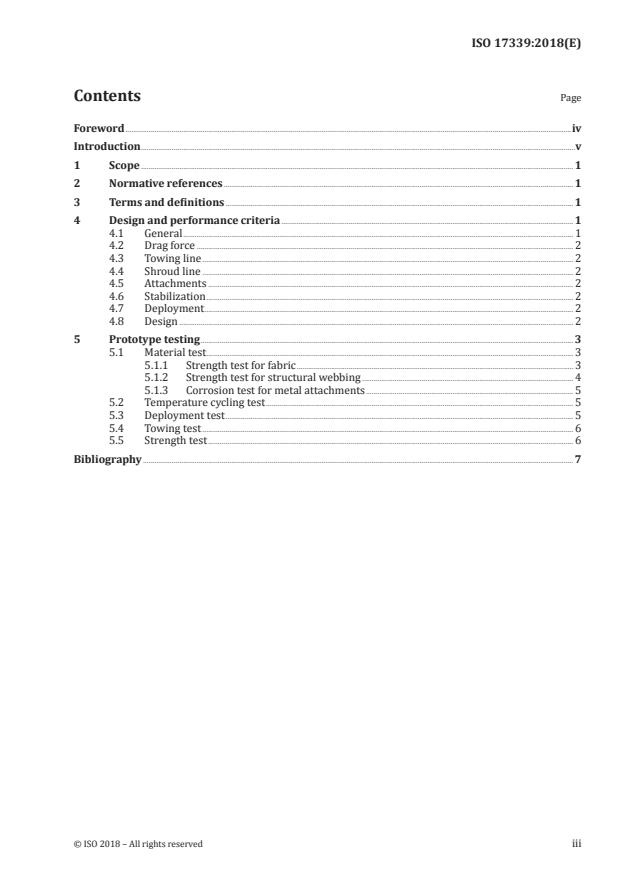
Contents Page
Foreword .iv
Introduction .v
1 Scope . 1
2 Normative references . 1
3 Terms and definitions . 1
4 Design and performance criteria . 1
4.1 General . 1
4.2 Drag force . 2
4.3 Towing line . 2
4.4 Shroud line . 2
4.5 Attachments . 2
4.6 Stabilization . 2
4.7 Deployment . 2
4.8 Design . 2
5 Prototype testing . 3
5.1 Material test . 3
5.1.1 Strength test for fabric . 3
5.1.2 Strength test for structural webbing . 4
5.1.3 Corrosion test for metal attachments . 5
5.2 Temperature cycling test . 5
5.3 Deployment test . 5
5.4 Towing test . 6
5.5 Strength test . 6
Bibliography . 7
Foreword
ISO (the International Organization for Standardization) is a worldwide federation of national standards
bodies (ISO member bodies). The work of preparing International Standards is normally carried out
through ISO technical committees. Each member body interested in a subject for which a technical
committee has been established has the right to be represented on that committee. International
organizations, governmental and non-governmental, in liaison with ISO, also take part in the work.
ISO collaborates closely with the International Electrotechnical Commission (IEC) on all matters of
electrotechnical standardization.
The procedures used to develop this document and those intended for its further maintenance are
described in the ISO/IEC Directives, Part 1. In particular the different approval criteria needed for the
different types of ISO documents should be noted. This document was drafted in accordance with the
editorial rules of the ISO/IEC Directives, Part 2 (see www .iso .org/directives).
Attention is drawn to the possibility that some of the elements of this document may be the subject of
patent rights. ISO shall not be held responsible for identifying any or all such patent rights. Details of
any patent rights identified during the development of the document will be in the Introduction and/or
on the ISO list of patent declarations received (see www .iso .org/patents).
Any trade name used in this document is information given for the convenience of users and does not
constitute an endorsement.
For an explanation on the meaning of ISO specific terms and expressions related to conformity assessment,
as well as information about ISO's adherence to the World Trade Organization (WTO) principles in the
Technical Barriers to Trade (TBT) see the following URL: www .iso .org/iso/foreword .html.
This document was prepared by Technical Committee ISO/TC 8, Ships and marine technology,
Subcommittee SC 1, Maritime safety.
This second edition cancels and replaces the first edition (ISO 17339:2002), which has been technically
revised.
Any feedback or questions on this document should be directed to the user’s national standards body. A
complete listing of these bodies can be found at www .iso .org/members .html.
iv © ISO 2018 – All rights reserved
Introduction
A sea anchor is a vital component to a drifting waterborne craft in keeping the preferred angle to wind
direction, enhancing stability and reducing drift speed. The International Life-Saving Appliance Code
prescribes the carriage and use of sea anchors for survival craft and rescue boats, yet the revised
recommendation on testing of lifesaving appliances does not provide requirements of performance
and testing procedure for the sea anchors. This document addresses those areas in which the IMO
recommendation is silent, in order to facilitate consistent implementation by maritime Administrations.
This document addresses the performance and testing of sea anchors for survival craft and rescue boats
and it is intended for use as a companion to the IMO Revised recommendation on testing of life-saving
appliances and also to encompass all other relevant life-saving appliances covered by this document
and not necessarily regulated by IMO instruments.
INTERNATIONAL STANDARD ISO 17339:2018(E)
Ships and marine technology — Life saving and fire
protection — Sea anchors for survival craft and rescue boats
1 Scope
This document specifies requirements for the design, performance and prototype testing of sea
anchors fitted to survival craft (lifeboats and liferafts) and rescue boats in accordance with the IMO
International Life-Saving Appliance Code.
2 Normative references
The following documents are referred to in the text in such a way that some or all of their content
constitutes requirements of this document. For dated references, only the edition cited applies. For
undated references, the latest edition of the referenced document (including any amendments) applies.
ISO 9227:2012, Corrosion tests in artificial atmospheres — Salt spray tests
ISO 4892-2:2013, Plastics — Methods of exposure to laboratory light sources — Part 2: Xenon-arc lamps
ASTM D 471-06, Standard Test Method for Rubber Property-Effect of Liquids
EN 590, Automotive fuels - Diesel - Requirements and test methods
3 Terms and definitions
For the purposes of this document, the following terms and definitions apply.
ISO and IEC maintain terminological databases for use in standardization at the following addresses:
— IEC Electropedia: available at http: //www .electropedia .org/
— ISO Online browsing platform: available at https: //www .iso .org/obp
3.1
sea anchor
device to stabilize the motion and to reduce wind-driven drift of a waterborne craft such as a survival
craft or rescue boat
4 Design and performance criteria
4.1 General
A sea anchor shall
1) be constructed with proper workmanship and materials;
2) not be damaged in stowage throughout the air temperature range −30 °C to +65 °C;
3) be capable of operating throughout the seawater temperature range −1 °C to +30 °C;
4) be rot-proof, corrosion-resistant, and not be unduly affected by seawater, oil or fungal attack;
5) be resistant to sunlight deterio
...
INTERNATIONAL ISO
STANDARD 17339
Second edition
2018-07
Ships and marine technology — Life
saving and fire protection — Sea
anchors for survival craft and rescue
boats
Navires et technologie maritime — Ancres flottantes pour
embarcations de sauvetage et canots de secours
Reference number
©
ISO 2018
© ISO 2018
All rights reserved. Unless otherwise specified, or required in the context of its implementation, no part of this publication may
be reproduced or utilized otherwise in any form or by any means, electronic or mechanical, including photocopying, or posting
on the internet or an intranet, without prior written permission. Permission can be requested from either ISO at the address
below or ISO’s member body in the country of the requester.
ISO copyright office
CP 401 • Ch. de Blandonnet 8
CH-1214 Vernier, Geneva
Phone: +41 22 749 01 11
Fax: +41 22 749 09 47
Email: copyright@iso.org
Website: www.iso.org
Published in Switzerland
ii © ISO 2018 – All rights reserved
Contents Page
Foreword .iv
Introduction .v
1 Scope . 1
2 Normative references . 1
3 Terms and definitions . 1
4 Design and performance criteria . 1
4.1 General . 1
4.2 Drag force . 2
4.3 Towing line . 2
4.4 Shroud line . 2
4.5 Attachments . 2
4.6 Stabilization . 2
4.7 Deployment . 2
4.8 Design . 2
5 Prototype testing . 3
5.1 Material test . 3
5.1.1 Strength test for fabric . 3
5.1.2 Strength test for structural webbing . 4
5.1.3 Corrosion test for metal attachments . 5
5.2 Temperature cycling test . 5
5.3 Deployment test . 5
5.4 Towing test . 6
5.5 Strength test . 6
Bibliography . 7
Foreword
ISO (the International Organization for Standardization) is a worldwide federation of national standards
bodies (ISO member bodies). The work of preparing International Standards is normally carried out
through ISO technical committees. Each member body interested in a subject for which a technical
committee has been established has the right to be represented on that committee. International
organizations, governmental and non-governmental, in liaison with ISO, also take part in the work.
ISO collaborates closely with the International Electrotechnical Commission (IEC) on all matters of
electrotechnical standardization.
The procedures used to develop this document and those intended for its further maintenance are
described in the ISO/IEC Directives, Part 1. In particular the different approval criteria needed for the
different types of ISO documents should be noted. This document was drafted in accordance with the
editorial rules of the ISO/IEC Directives, Part 2 (see www .iso .org/directives).
Attention is drawn to the possibility that some of the elements of this document may be the subject of
patent rights. ISO shall not be held responsible for identifying any or all such patent rights. Details of
any patent rights identified during the development of the document will be in the Introduction and/or
on the ISO list of patent declarations received (see www .iso .org/patents).
Any trade name used in this document is information given for the convenience of users and does not
constitute an endorsement.
For an explanation on the meaning of ISO specific terms and expressions related to conformity assessment,
as well as information about ISO's adherence to the World Trade Organization (WTO) principles in the
Technical Barriers to Trade (TBT) see the following URL: www .iso .org/iso/foreword .html.
This document was prepared by Technical Committee ISO/TC 8, Ships and marine technology,
Subcommittee SC 1, Maritime safety.
This second edition cancels and replaces the first edition (ISO 17339:2002), which has been technically
revised.
Any feedback or questions on this document should be directed to the user’s national standards body. A
complete listing of these bodies can be found at www .iso .org/members .html.
iv © ISO 2018 – All rights reserved
Introduction
A sea anchor is a vital component to a drifting waterborne craft in keeping the preferred angle to wind
direction, enhancing stability and reducing drift speed. The International Life-Saving Appliance Code
prescribes the carriage and use of sea anchors for survival craft and rescue boats, yet the revised
recommendation on testing of lifesaving appliances does not provide requirements of performance
and testing procedure for the sea anchors. This document addresses those areas in which the IMO
recommendation is silent, in order to facilitate consistent implementation by maritime Administrations.
This document addresses the performance and testing of sea anchors for survival craft and rescue boats
and it is intended for use as a companion to the IMO Revised recommendation on testing of life-saving
appliances and also to encompass all other relevant life-saving appliances covered by this document
and not necessarily regulated by IMO instruments.
INTERNATIONAL STANDARD ISO 17339:2018(E)
Ships and marine technology — Life saving and fire
protection — Sea anchors for survival craft and rescue boats
1 Scope
This document specifies requirements for the design, performance and prototype testing of sea
anchors fitted to survival craft (lifeboats and liferafts) and rescue boats in accordance with the IMO
International Life-Saving Appliance Code.
2 Normative references
The following documents are referred to in the text in such a way that some or all of their content
constitutes requirements of this document. For dated references, only the edition cited applies. For
undated references, the latest edition of the referenced document (including any amendments) applies.
ISO 9227:2012, Corrosion tests in artificial atmospheres — Salt spray tests
ISO 4892-2:2013, Plastics — Methods of exposure to laboratory light sources — Part 2: Xenon-arc lamps
ASTM D 471-06, Standard Test Method for Rubber Property-Effect of Liquids
EN 590, Automotive fuels - Diesel - Requirements and test methods
3 Terms and definitions
For the purposes of this document, the following terms and definitions apply.
ISO and IEC maintain terminological databases for use in standardization at the following addresses:
— IEC Electropedia: available at http: //www .electropedia .org/
— ISO Online browsing platform: available at https: //www .iso .org/obp
3.1
sea anchor
device to stabilize the motion and to reduce wind-driven drift of a waterborne craft such as a survival
craft or rescue boat
4 Design and performance criteria
4.1 General
A sea anchor shall
1) be constructed with proper workmanship and materials;
2) not be damaged in stowage throughout the air temperature range −30 °C to +65 °C;
3) be capable of operating throughout the seawater temperature range −1 °C to +30 °C;
4) be rot-proof, corrosion-resistant, and not be unduly affected by seawater, oil or fungal attack;
5) be resistant to sunlight deterio
...