

ISO/PAS 23617:2024
(Main)Healthcare organization management — Pandemic response (respiratory) — Guidance on medical support for socially vulnerable groups
General Information
- Abstract
This document provides guidance on essential social welfare services and medical support for socially vulnerable groups, who are likely to be in greater danger in the event of a respiratory epidemic disaster. This document applies to those: a) providing essential social welfare services for socially vulnerable groups in the event of a respiratory epidemic disaster; b) providing essential medical support for socially vulnerable groups in the event of a respiratory epidemic disaster.
- Status
- Published
- Publication Date
- 23-May-2024
- Technical Committee
- ISO/TC 304 - Healthcare organization management
- Drafting Committee
- ISO/TC 304 - Healthcare organization management
- Current Stage
- 6060 - International Standard published
- Start Date
- 24-May-2024
- Due Date
- 18-Jan-2025
- Completion Date
- 24-May-2024


Overview
ISO/PAS 23617:2024 - Healthcare organization management: Pandemic response (respiratory) - Guidance on medical support for socially vulnerable groups provides practical guidance for planning and delivering essential social welfare services and medical support to socially vulnerable groups during a respiratory epidemic disaster. The document helps humanitarian aid providers, local communities and healthcare organizations coordinate minimum multi‑sectoral responses that respect human dignity and prioritize those most at risk.
Key topics and requirements
- Definition and scope
- Clarifies terms such as respiratory epidemic disaster, socially vulnerable group, elderly person, person with disability and health literacy.
- Types and vulnerabilities
- Classifies vulnerable groups by physical, environmental and financial factors and describes common vulnerabilities (communication, mobility, susceptibility to infection).
- Essential social welfare services
- Communication support for people with sensory, language or cognitive barriers.
- Mobility assistance services (e.g., evacuation help, transport, wheelchair access).
- Personal care support for people requiring assistance with daily activities and medical equipment.
- Infection prevention and control in community facilities and service settings.
- Essential medical support
- Guidance on setting priorities for medical services for vulnerable groups.
- Integration of infection prevention measures with essential medical support.
- Basic preparations for delivering medical support safely during infectious disease outbreaks.
- Tools and aids
- Annex A: checklist for preparation of vulnerable groups for respiratory infectious diseases to guide preparedness and response planning.
Practical applications and users
This ISO/PAS is intended for organizations and individuals responsible for protecting socially vulnerable populations during respiratory pandemics, including:
- Public health authorities and emergency planners
- Healthcare organizations and clinical managers
- Social welfare and community service providers
- Humanitarian aid agencies and NGOs
- Local governments, long‑term care facilities and community rehabilitation centres
Practical uses:
- Develop or update pandemic response plans that prioritize vulnerable groups.
- Design targeted communication strategies for low health literacy and non‑native language speakers.
- Coordinate cross‑sector support (medical + social services) and resource allocation.
- Implement infection prevention measures tailored to communal living and care‑dependent populations.
Related standards
Referenced terminology and related documents include ISO/IEC directives and standards cited in the text, such as ISO 5472:2022, ISO/IEC TR 20322:2023, ISO 21856:2022, and ISO 7101:2023. ISO/TC 304 (Healthcare organization management) prepared the document.
Keywords: ISO/PAS 23617:2024, pandemic response, respiratory epidemic disaster, socially vulnerable groups, essential social welfare services, medical support, infection prevention, communication support, mobility assistance, health literacy.
Get Certified
Connect with accredited certification bodies for this standard

BSI Group
BSI (British Standards Institution) is the business standards company that helps organizations make excellence a habit.

TÜV Rheinland
TÜV Rheinland is a leading international provider of technical services.

TÜV SÜD
TÜV SÜD is a trusted partner of choice for safety, security and sustainability solutions.
Sponsored listings
Frequently Asked Questions
ISO/PAS 23617:2024 is a technical specification published by the International Organization for Standardization (ISO). Its full title is "Healthcare organization management — Pandemic response (respiratory) — Guidance on medical support for socially vulnerable groups". This standard covers: This document provides guidance on essential social welfare services and medical support for socially vulnerable groups, who are likely to be in greater danger in the event of a respiratory epidemic disaster. This document applies to those: a) providing essential social welfare services for socially vulnerable groups in the event of a respiratory epidemic disaster; b) providing essential medical support for socially vulnerable groups in the event of a respiratory epidemic disaster.
This document provides guidance on essential social welfare services and medical support for socially vulnerable groups, who are likely to be in greater danger in the event of a respiratory epidemic disaster. This document applies to those: a) providing essential social welfare services for socially vulnerable groups in the event of a respiratory epidemic disaster; b) providing essential medical support for socially vulnerable groups in the event of a respiratory epidemic disaster.
ISO/PAS 23617:2024 is classified under the following ICS (International Classification for Standards) categories: 11.020.01 - Quality and environmental management in health care. The ICS classification helps identify the subject area and facilitates finding related standards.
ISO/PAS 23617:2024 is available in PDF format for immediate download after purchase. The document can be added to your cart and obtained through the secure checkout process. Digital delivery ensures instant access to the complete standard document.
Standards Content (Sample)
Publicly
Available
Specification
ISO/PAS 23617
First edition
Healthcare organization
2024-05
management — Pandemic response
(respiratory) — Guidance on
medical support for socially
vulnerable groups
Management des organisations de soins de santé — Réponse en
cas de pandémie (respiratoire) — Recommandations relatives au
soutien médical pour les groupes socialement vulnérables
Reference number
© ISO 2024
All rights reserved. Unless otherwise specified, or required in the context of its implementation, no part of this publication may
be reproduced or utilized otherwise in any form or by any means, electronic or mechanical, including photocopying, or posting on
the internet or an intranet, without prior written permission. Permission can be requested from either ISO at the address below
or ISO’s member body in the country of the requester.
ISO copyright office
CP 401 • Ch. de Blandonnet 8
CH-1214 Vernier, Geneva
Phone: +41 22 749 01 11
Email: copyright@iso.org
Website: www.iso.org
Published in Switzerland
ii
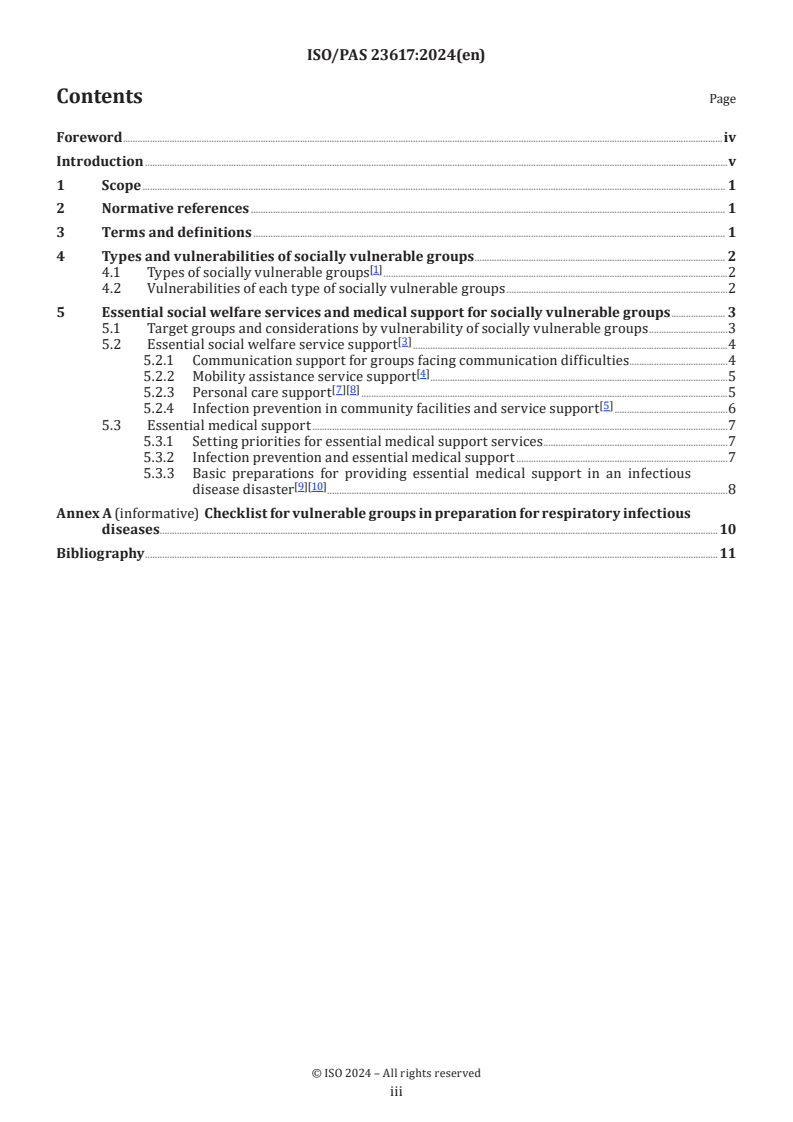
Contents Page
Foreword .iv
Introduction .v
1 Scope . 1
2 Normative references . 1
3 Terms and definitions . 1
4 Types and vulnerabilities of socially vulnerable groups . 2
[1]
4.1 Types of socially vulnerable groups .2
4.2 Vulnerabilities of each type of socially vulnerable groups .2
5 Essential social welfare services and medical support for socially vulnerable groups . 3
5.1 Target groups and considerations by vulnerability of socially vulnerable groups .3
[3]
5.2 Essential social welfare service support .4
5.2.1 Communication support for groups facing communication difficulties .4
[4]
5.2.2 Mobility assistance service support .5
[7][8]
5.2.3 Personal care support .5
[5]
5.2.4 Infection prevention in community facilities and service support .6
5.3 Essential medical support .7
5.3.1 Setting priorities for essential medical support services .7
5.3.2 Infection prevention and essential medical support .7
5.3.3 Basic preparations for providing essential medical support in an infectious
[9][10]
disease disaster . .8
Annex A (informative) Checklist for vulnerable groups in preparation for respiratory infectious
diseases . .10
Bibliography .11
iii
Foreword
ISO (the International Organization for Standardization) is a worldwide federation of national standards
bodies (ISO member bodies). The work of preparing International Standards is normally carried out through
ISO technical committees. Each member body interested in a subject for which a technical committee
has been established has the right to be represented on that committee. International organizations,
governmental and non-governmental, in liaison with ISO, also take part in the work. ISO collaborates closely
with the International Electrotechnical Commission (IEC) on all matters of electrotechnical standardization.
The procedures used to develop this document and those intended for its further maintenance are described
in the ISO/IEC Directives, Part 1. In particular, the different approval criteria needed for the different types
of ISO document should be noted. This document was drafted in accordance with the editorial rules of the
ISO/IEC Directives, Part 2 (see www.iso.org/directives).
ISO draws attention to the possibility that the implementation of this document may involve the use of (a)
patent(s). ISO takes no position concerning the evidence, validity or applicability of any claimed patent
rights in respect thereof. As of the date of publication of this document, ISO had not received notice of (a)
patent(s) which may be required to implement this document. However, implementers are cautioned that
this may not represent the latest information, which may be obtained from the patent database available at
www.iso.org/patents. ISO shall not be held responsible for identifying any or all such patent rights.
Any trade name used in this document is information given for the convenience of users and does not
constitute an endorsement.
For an explanation of the voluntary nature of standards, the meaning of ISO specific terms and expressions
related to conformity assessment, as well as information about ISO's adherence to the World Trade
Organization (WTO) principles in the Technical Barriers to Trade (TBT), see www.iso.org/iso/foreword.html.
This document was prepared by Technical Committee ISO/TC 304, Healthcare organization management.
Any feedback or questions on this document should be directed to the user’s national standards body. A
complete listing of these bodies can be found at www.iso.org/members.html.
iv
Introduction
Coronavirus disease 2019 (COVID-19) is the infectious disease caused by the most recently discovered
coronavirus that is currently affecting many countries around the world. The World Health Organization
(WHO) declared the outbreak of the novel coronavirus “a public health emergency of international concern”
on 30 January 2020 and a global pandemic on 11 March, 2020.
Public health crises pose a threat to lives, escalate socioeconomic crises, and jeopardize survival. These
crises affect all members of society, but pose a greater threat to those already affected by structural
inequalities. If the dignity of socially vulnerable groups is compromised due to a pandemic resulting from
an infectious disease, such an infringement constitutes the violation of the dignity of all individuals who are
equal as human beings.
Caring for socially vulnerable groups is important as it can strengthen social structures. According to
Strengthening and adjusting public health measures throughout the COVID-19 transition phases, policy
considerations for the WHO European Region, published by the WHO Regional Office for Europe, strengthening
social structures needs to be considered as a way of reducing socioeconomic damage, which can contribute
to the reinforcement of social cohesion and engagement while ensuring that no one is left behind. In doing
so, society can also meet the need for medical and social services, thereby ensuring the health and recovery
of its members.
Thus, this document provides guidance to enable humanitarian aid providers and local communities to
plan, establish and support a set of minimum multi-sectoral responses in terms of essential social welfare
services and medical support for socially vulnerable groups, in an effort to respect human rights based on
the dignity of all members of society in the event of a respiratory epidemic disaster.
The implementation of this document requires comprehensive cooperation among various actors involved in
humanitarian aid. In the midst of a global pandemic of an infectious disease, it is difficult to expect that any
single local community or organization has the capability to implement all necessary minimum responses
on its own. This document can be utilized by all humanitarian aid actors to coordinate and organize the
necessary forms of support. It is particularly important for local communities and authorities to actively
engage at all levels; and their engagement is essential in order to successfully adjust and implement support
measures, enhance local capacity, and ensure sustainable support.
v
Publicly Available Specification ISO/PAS 23617:2024(en)
Healthcare organization management — Pandemic response
(respiratory) — Guidance on medical support for socially
vulnerable groups
1 Scope
This document provides guidance on essential social welfare services and medical support for socially
vulnerable groups, who are likely to be in greater danger in the event of a respiratory epidemic disaster.
This document applies to those:
a) providing essential social welfare services for socially vulnerable groups in the event of a respiratory
epidemic disaster;
b) providing essential medical support for socially vulnerable groups in the event of a respiratory epidemic
disaster.
2 Normative references
There are no normative references in this document.
3 Terms and definitions
For the purposes of this document, the following terms and definitions apply.
ISO and IEC maintain terminology databases for use in standardization at the following addresses:
— ISO Online browsing platform: available at https:// www .iso .org/ obp
— IEC Electropedia: available at https:// www .electropedia .org/
3.1
coronavirus
virus that is part of a large family of viruses that can cause illness in animals or humans
Note 1 to entry: In humans, several coronaviruses are known to cause respiratory infections ranging from the common
cold to more severe diseases such as Middle East Respiratory Syndrome (MERS) and Severe Acute Respiratory
Syndrome (SARS). The coronavirus discovered in 2019 causes the coronavirus disease COVID-19.
[13]
[SOURCE: ISO 5472:2022 , 3.3]
3.2
respiratory epidemic disaster
disaster in which the spread of a respiratory infectious disease causes increasing damage and ends slowly
with the development of vaccines, cures or herd immunity
[12]
[SOURCE: Korean Society for Traumatic Stress Studies ]
3.3
socially vulnerable group
group of people who are highly vulnerable in physical, environmental or financial terms in the event of a
respiratory infectious disease outbreak, including people who are financially unable to maintain a basic
safe environment, who are physically unable to evacuate or respond quickly by themselves in the event of a
disaster, or who are vulnerable to disaster due to their environmental factors
Note 1 to entry: In this document, "socially vulnerable group" refers to a group of people who face difficulties in
communication, mobility, and other aspects, requiring assistance from social service providers to access adequate
medical services. They include elderly persons (3.4), persons with disabilities (3.5), persons with chronic or underlying
diseases, and persons with difficulties in health literacy (3.6).
3.4
elderly person
human being over the age of 65 years
[12]
[SOURCE: ISO/IEC TR 20322:2023 , 3.1, modified — Note 1 to entry has been removed.]
3.5
person with disability
person with one or more impairments, one or more activity limitations, one or more participation
restrictions, or a combination thereof
[15]
[SOURCE: ISO 21856:2022 , 3.23]
3.6
health literacy
ability of individuals to gain access to, understand and use information in ways which promote and maintain
good health for themselves, their families and their communities
[18]
[SOURCE: ISO 7101:2023 , 3.34]
4 Types and vulnerabilities of socially vulnerable groups
[1]
4.1 Types of socially vulnerable groups
Socially vulnerable groups refer to people who can be placed in greater danger in the outbreak of a
respiratory infectious disease. Such groups can be classified in physical, environmental and financial terms.
a) The physically vulnerable group includes elderly persons, persons with disabilities and persons with
chronic or underlying diseases, who have difficulty in evacuating or responding by themselves in the
event of a disaster.
b) The environmentally vulnerable group refers to foreign residents, travellers and workers (including
illegal immigrants), who are vulnerable to a disaster on a temporary or long-term basis due to
communication difficulties caused by cultural, living environment or language differences.
c) The financially vulnerable group refers to financially troubled people who do not have or are unable to
manage a stable, basic source of livelihood. Such people have difficulty in conducting disaster prevention
activities by themselves to prepare for a disaster.
4.2 Vulnerabilities of each type of socially vulnerable groups
Socially vulnerable groups have various vulnerabilities in the event of a disaster, such as communication
and mobility difficulties and susceptibility to infection (see Table 1).
[2][10]
Table 1 — Vulnerabilities of socially vulnerable groups in the outbreak of a respiratory infection
Group Vulnerabilities in a disaster
— The deterioration of physical functions due to ageing, regardless of
Living alone
their health status
Elderly peo-
With mobility difficulties — Difficulty in moving by themselves
ple
— Difficulty in assessing situations, evacuating, and describing their
With dementia
conditions
— Difficulty in collecting information and assessing situations through
With visual impairment
their vision
— Difficulty in collecting information and assessing situations through
With hearing, speech and
their voice
language impairments
— Difficulty in describing their conditions through vocal language
— Extreme difficulty in collecting information and assessing situa-
With both visual and hear-
tions due to multiple disabilities
ing impairments
— Extreme difficulty in evacuating quickly by themselves
With physical disabilities — Difficulty in moving without assistance
— Need for certain medical equipment, medications, food and service
With chronic or underlying
diseases
— Difficulty in identifying their conditions by appearance
— Difficulty in assessing situations by themselves and describing their
conditions
With intellectual disabili-
People with
ties
— Difficulty in adapting themselves to changing circumstances, which
disabilities
sometimes leads to panic attacks
— Wide variety of disabilities, including intellectual
— Difficulty in assessing situations by themselves and describing their
conditions
With developmental disa-
bilities
— Difficulty in adapting themselves to changing circumstances, which
sometimes leads to panic attacks
— Difficulty in communal living
— Difficulty in adapting themselves to changing circumstances, which
sometimes leads to panic attacks
With mental disabilities
— Need for long-term use of medication in many cases
— Difficulty in assessing situations and evacuating by themselves due
With higher brain dysfunc-
to memory, attention and executive function disorders
tion
— Difficulty in communal living
— Need for certain medical equipment, medications and food
People with chronic or underlying diseases
— Difficulty in identifying their conditions by appearance
— Difficulty in collecting information and assessing situations due to
People with difficulties in health literacy difficulties in health literacy caused by cultural, living environment, or
language differences
5 Essential social welfare services and medical support for socially vulnerable groups
5.1 Target groups and considerations by vulnerability of socially vulnerable groups
Providing essential social welfare services and medical support for socially vulnerable groups requires
consideration toward the vulnerabilities of target groups (see Table 2). Prior to such consideration, a
checklist (Annex A) may be used.
Table 2 — Considerations for each vulnerability of socially vulnerable groups in providing essential
social welfare services and medical support
Vulnera- Communication Mobility difficul- Need for personal Susceptibility to
Communal living
bility difficulties ties care infection
People with visual, People with mobil- People with disa- People with inter- People with dis-
hearing, language, ity difficulties (e.g. bilities who receive nal organ disorders abilities who use
or developmen- bedridden patients daily life support facilities, such as
People with chronic
tal (intellectual and motorized services residential facilities
or underlying dis-
Target
vulnerable group) wheelchair users) and community re-
eases
group
disabilities habilitation centres
People with chronic
diseases
Elderly people with
mobility difficulties
Improving access to Providing mobility Providing activity Improving infection Preventing infec-
information about assistance services support servic- prevention and con- tions in facilities
Consider- infectious diseases es and assistant trol, and enhancing and assisting the
ation services to ensure essential medical upkeep of their
continuous care support services
services
[3]
5.2 Essential social welfare service support
5.2.1 Communication support for groups facing communication difficulties
For groups experiencing communication difficulties, communication support is provided with the following
content
...