

ISO 2047:1975
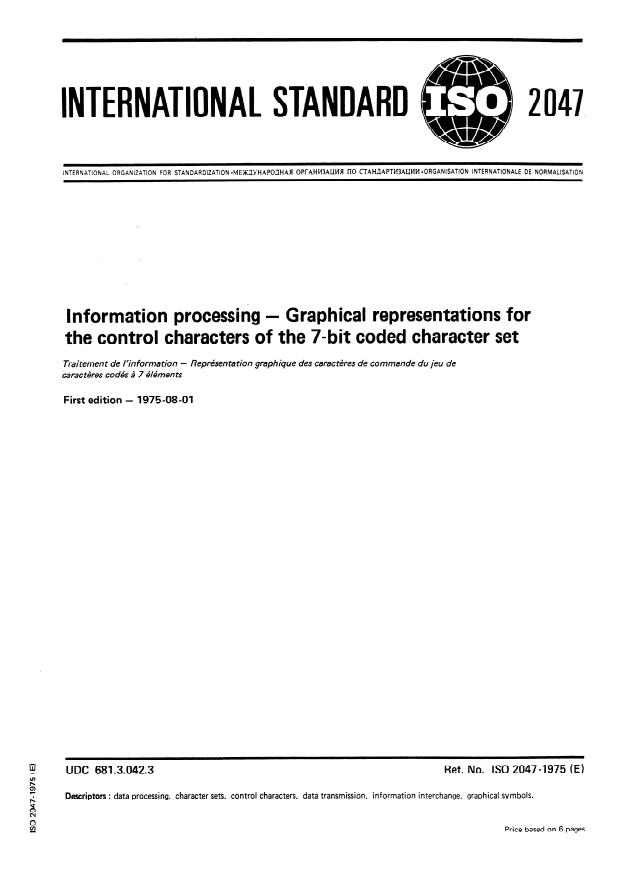
(Main)Information processing — Graphical representations for the control characters of the 7- bit coded character set
General Information
- Abstract
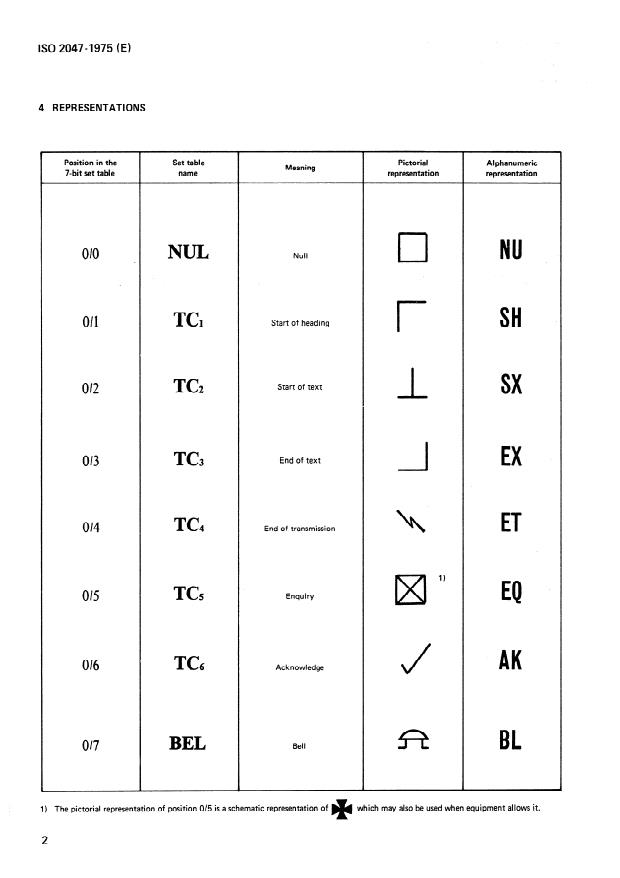
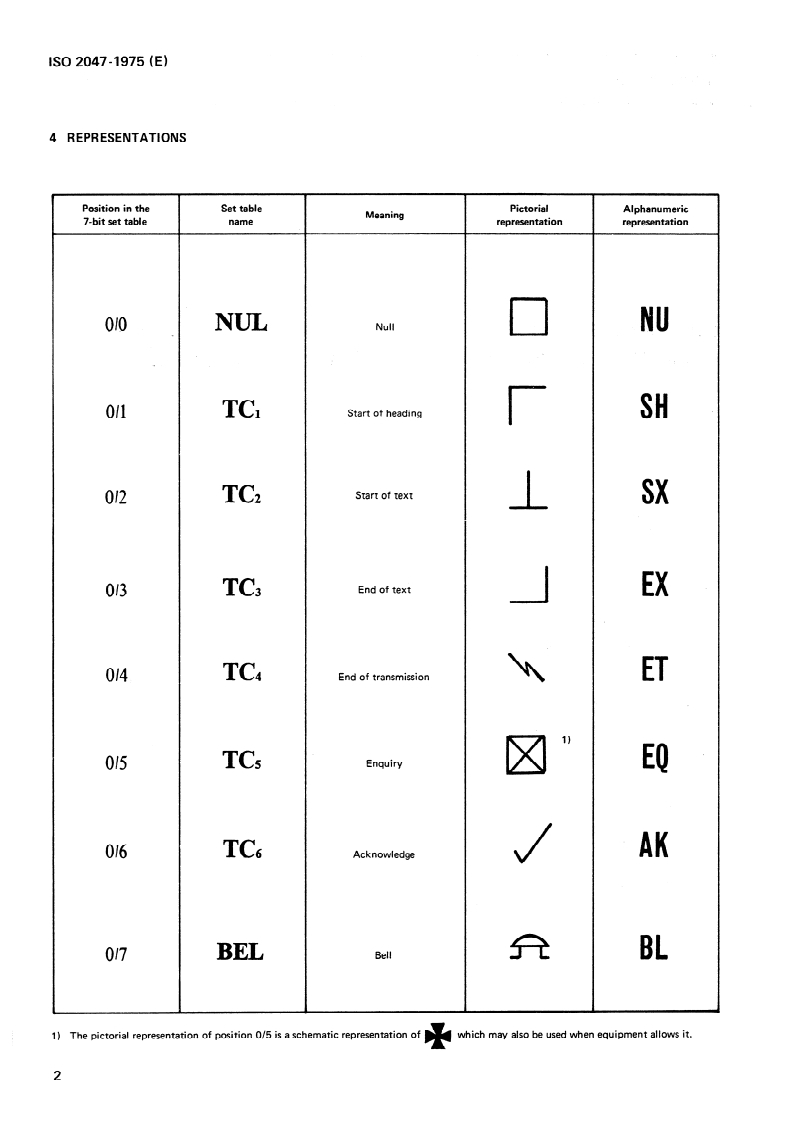
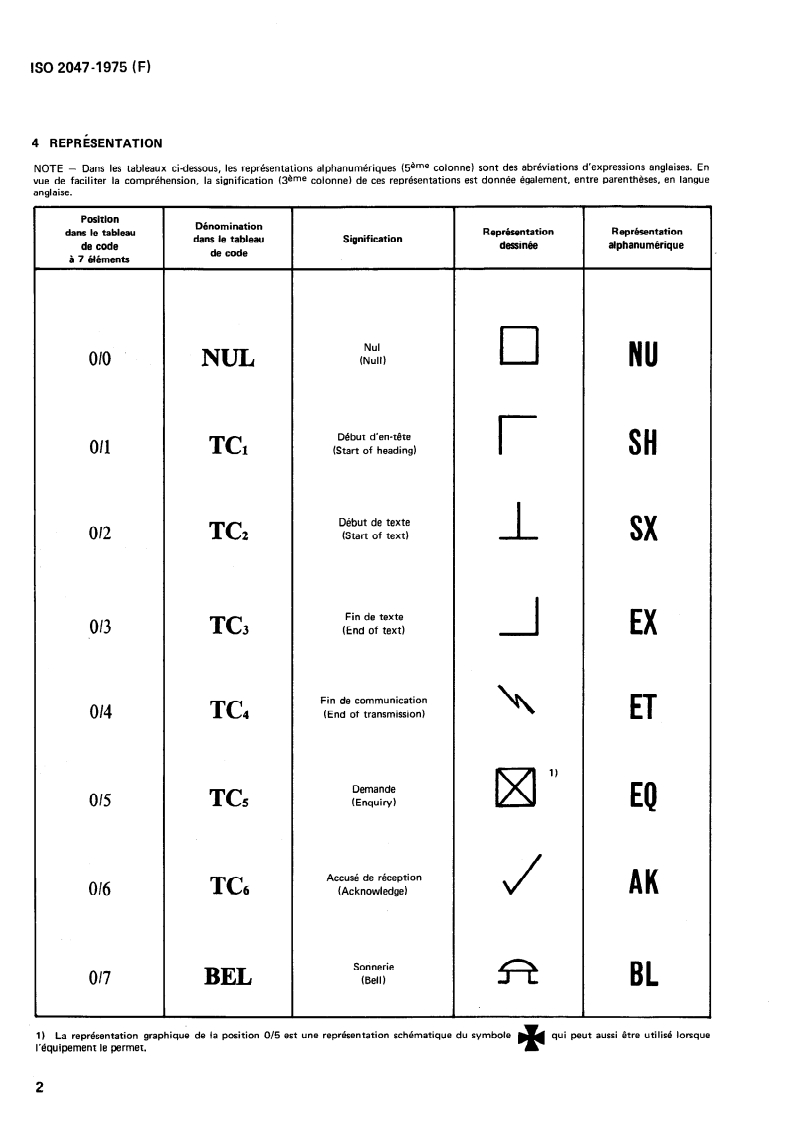
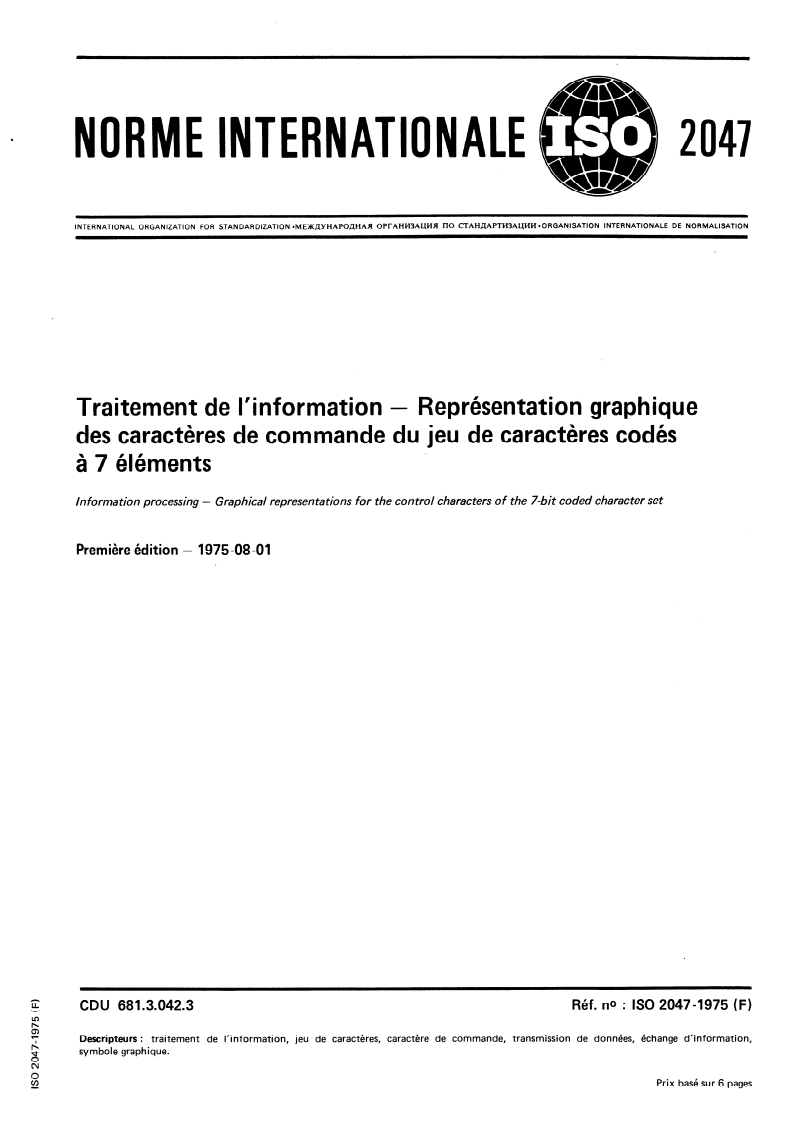
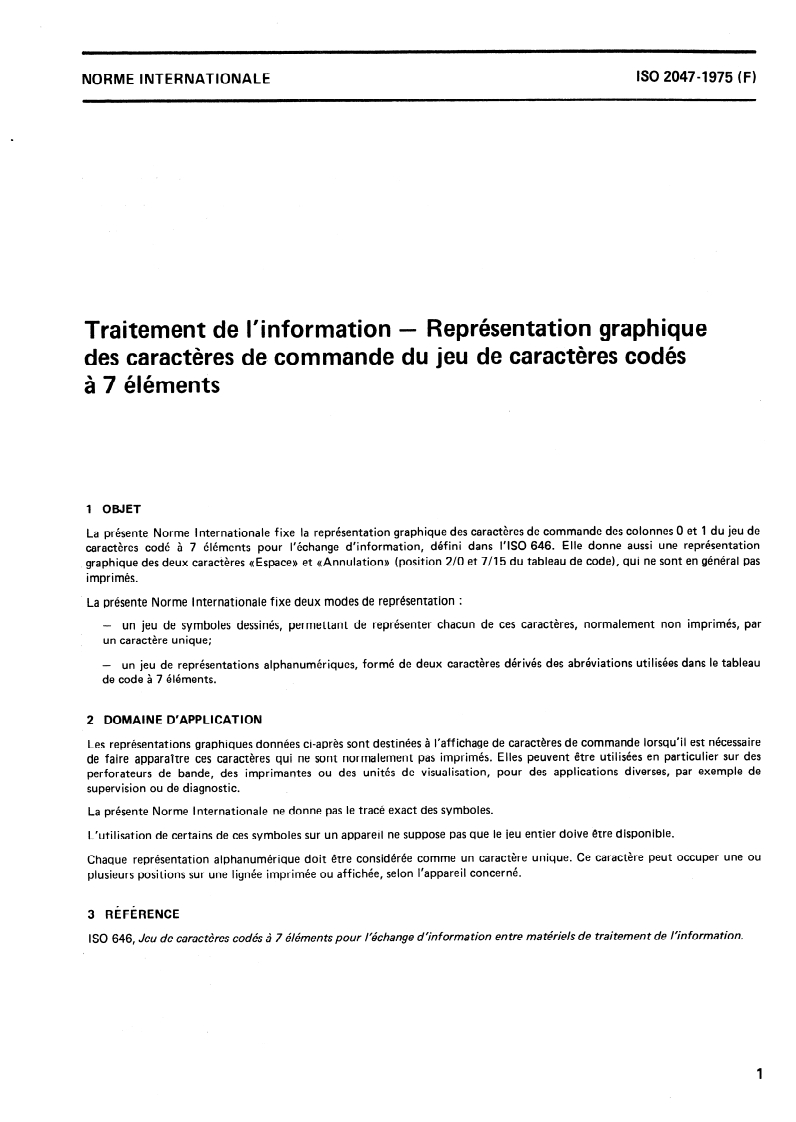
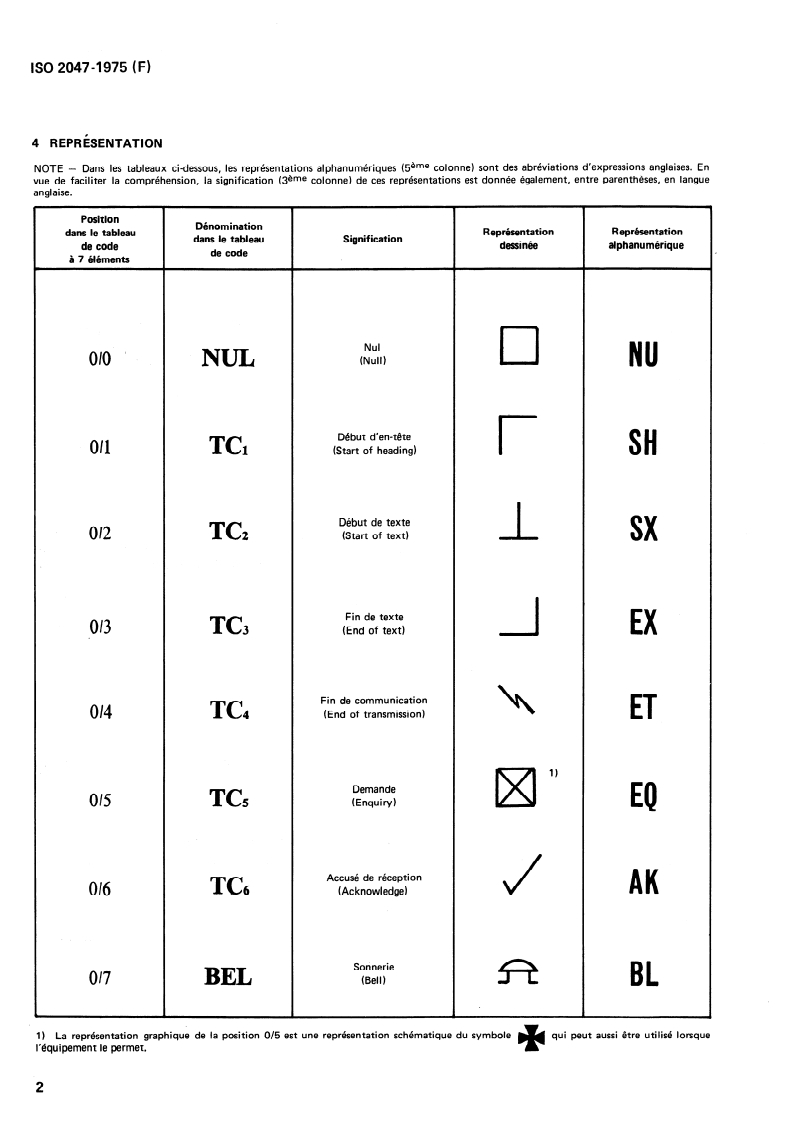
Includes 2 modes of graphical representations of the control characters of columns 0 and 1 of the ISO 7-bit coded character set for information interchange (ISO 646): a) a set of specific symbols requiring a single character for graphical representation of each of these normally non-printing characters; b) a set of alphanumeric representations comprising two characters derived from the abreviations used in the ISO 7-bit table. Also provides graphical representations for the normally non-printing characters SPACE and DELETE.
- Status
- Published
- Publication Date
- 31-Jul-1975
- Technical Committee
- ISO/IEC JTC 1/SC 2 - Coded character sets
- Drafting Committee
- ISO/IEC JTC 1/SC 2 - Coded character sets
- Current Stage
- 9093 - International Standard confirmed
- Start Date
- 27-Aug-2020
- Completion Date
- 29-Aug-2026
Buy Documents
ISO 2047:1975 - Information processing -- Graphical representations for the control characters of the 7- bit coded character set
ISO 2047:1975 - Information processing — Graphical representations for the control characters of the 7- bit coded character set/1/1975
ISO 2047:1975 - Traitement de l'information -- Représentation graphique des caracteres de commande du jeu de caracteres codés a 7 éléments
ISO 2047:1975 - Traitement de l'information -- Représentation graphique des caracteres de commande du jeu de caracteres codés a 7 éléments
ISO 2047:1975 - Traitement de l'information — Représentation graphique des caractères de commande du jeu de caractères codés à 7 éléments/1/1975
ISO 2047:1975 - Traitement de l'information — Représentation graphique des caractères de commande du jeu de caractères codés à 7 éléments/1/1975
Overview
ISO 2047:1975 is an international standard published by the International Organization for Standardization (ISO) that defines graphical representations for the control characters of the 7-bit coded character set, specifically those from columns 0 and 1 of the ISO 646 standard. These control characters are typically non-printing and used in information processing and data transmission systems. The standard provides two modes of representation to enable the visualization of these normally invisible control codes, facilitating debugging, diagnostics, and data supervision.
The two modes included are:
- Graphical symbols: Specific single-character symbols designed to represent each control character.
- Alphanumeric representations: Two-character abbreviations derived from the standard 7-bit code table, making the control characters recognizable in text displays.
ISO 2047 also includes representations for the non-printing SPACE and DELETE characters, making it a comprehensive tool for controlling and displaying 7-bit coded control characters.
Key Topics
- Control Characters Coverage: Covers all control characters in columns 0 and 1 of the ISO 7-bit coded set, including NUL, SOH, STX, ETX, EOT, ENQ, ACK, BEL, BS, HT, LF, VT, FF, CR, SO, SI, DLE, DC1-4, NAK, SYN, ETB, CAN, EM, SUB, ESC, FS, GS, RS, US, SPACE, and DELETE.
- Graphical Representations:
- Single-character symbols designed to visually denote control functions.
- Two-character alphanumeric codes based on standard abbreviations (e.g., NUL for Null, LF for Line Feed).
- Practical Usage:
- Visualization on punch card readers, teletypes, or printers.
- Diagnostic displays for data communication debugging.
- Software and hardware that need to display or log transmission control characters.
- Non-Printing Character Handling: Enhances understanding and error detection by making invisible control codes explicitly visible in user interfaces or printouts.
- Standard Relations: Builds on ISO 646, which defines the 7-bit coded character set for information interchange.
Applications
ISO 2047:1975 is crucial in various information processing and communication scenarios, including:
- Data Communication and Networking: Helps technicians and developers identify control characters during data interchange troubleshooting.
- Printing and Output Devices: Enables printers and displays to represent transmission control characters that would otherwise be invisible.
- Software Development: Useful for debuggers, terminal emulators, and diagnostic tools that need to expose non-printing control characters in logs or GUIs.
- Telecommunication Equipment: Standardizes the display of control functions on terminals and message processing systems.
- Information Exchange Systems: Facilitates error detection and correction by clearly showing control characters during data processing.
By standardizing graphical representations, ISO 2047 supports consistent interpretation and handling of control codes across different devices and applications worldwide.
Related Standards
- ISO 646: Defines the 7-bit coded character set for information interchange, which is the basis for the control characters represented in ISO 2047.
- ISO/IEC 2022: Specifies the use of control functions and character coding for information interchange.
- ITU-T V.24 / EIA RS-232: Standards defining signaling for serial data communication, where control character representation can be crucial.
- Unicode Standard: While more expansive, it includes representations for control characters, and ISO 2047’s graphic symbols have influenced visual control character displays.
Summary
ISO 2047:1975 offers practical, internationally recognized graphical symbols and alphanumeric codes to make the 7-bit control characters visible and understandable. This standard is vital for improving communication clarity, device diagnostics, and data processing integrity in systems handling text and binary data transmissions. Implementing ISO 2047’s representations enhances the reliability and user-friendliness of hardware and software managing control characters in the 7-bit code environment.
Buy Documents
ISO 2047:1975 - Information processing -- Graphical representations for the control characters of the 7- bit coded character set
ISO 2047:1975 - Information processing — Graphical representations for the control characters of the 7- bit coded character set/1/1975
ISO 2047:1975 - Traitement de l'information -- Représentation graphique des caracteres de commande du jeu de caracteres codés a 7 éléments
ISO 2047:1975 - Traitement de l'information -- Représentation graphique des caracteres de commande du jeu de caracteres codés a 7 éléments
ISO 2047:1975 - Traitement de l'information — Représentation graphique des caractères de commande du jeu de caractères codés à 7 éléments/1/1975
ISO 2047:1975 - Traitement de l'information — Représentation graphique des caractères de commande du jeu de caractères codés à 7 éléments/1/1975
Get Certified
Connect with accredited certification bodies for this standard

BSI Group
BSI (British Standards Institution) is the business standards company that helps organizations make excellence a habit.

NYCE
Mexican standards and certification body.
Sponsored listings
Frequently Asked Questions
ISO 2047:1975 is a standard published by the International Organization for Standardization (ISO). Its full title is "Information processing — Graphical representations for the control characters of the 7- bit coded character set". This standard covers: Includes 2 modes of graphical representations of the control characters of columns 0 and 1 of the ISO 7-bit coded character set for information interchange (ISO 646): a) a set of specific symbols requiring a single character for graphical representation of each of these normally non-printing characters; b) a set of alphanumeric representations comprising two characters derived from the abreviations used in the ISO 7-bit table. Also provides graphical representations for the normally non-printing characters SPACE and DELETE.
Includes 2 modes of graphical representations of the control characters of columns 0 and 1 of the ISO 7-bit coded character set for information interchange (ISO 646): a) a set of specific symbols requiring a single character for graphical representation of each of these normally non-printing characters; b) a set of alphanumeric representations comprising two characters derived from the abreviations used in the ISO 7-bit table. Also provides graphical representations for the normally non-printing characters SPACE and DELETE.
ISO 2047:1975 is classified under the following ICS (International Classification for Standards) categories: 35.040 - Information coding; 35.040.10 - Coding of character sets. The ICS classification helps identify the subject area and facilitates finding related standards.
ISO 2047:1975 is available in PDF format for immediate download after purchase. The document can be added to your cart and obtained through the secure checkout process. Digital delivery ensures instant access to the complete standard document.
Standards Content (Sample)
INTERNATIONAL STANDARD
2047.
INTERNATIONAL ORGANIZATION FOR STANDARDIZATION l MEX,WHAPO~HAJl OPrAHM3AUM(I I-IO CTAHirAPTM3AUMM*ORGANISATiON INTERNATIONALE DE NORMALISATION
.
Information processing - Graphical representations for
the control characters of the 7-bit coded character set
Traitemen t de l’informa tion - Reprgsentation graphique des caractkres de commande du jeu de
wractkres cod& ;i 7 &ments
First edition - 1975-08-01
UDC 681 l 3.042.3 Ref. No. IS0 2047-1975 (E)
Descriptors : data processing, character sets, control characters, data transmission, information interchange, graphical symbols.
Price based on 6 pages
FOREWORD
IS0 (the International- Organization for Standardization) is a worldwide federation
of national standards institutes (IS0 Member Bodies). The work of developing
International Standards is carried out through IS0 Technical Committees. Every
’ Member Body interested in a subject for which a Technical Committee has been set
up has the right to be represented on that Committee. International organizations,
governmental and non-governmental, in liaison with ISO, also take part in the work.
Draft International Standards adopted by the Technical Committees are circulated
to the Member Bodies for approval before their acceptance as International
Standards by the IS0 Council.
International Standard IS0 2047 was drawn up by Technical Committee
ISO/TC 97, Computers and information processing, and circulated to the Member
Bodies in December 1972.
It has been approved by the Member Bodies of the following countries :
South Africa, Rep. of
Belgium Ireland
Sweden
Brazil Italy
Switzerland
Canada Japan
United Kingdom
Czechoslovakia Mexico
U.S.A.
Denmark New Zealand
Poland
Egypt, Arab Rep. of
Romania
France
The Member Bodies of the following countries expressed disapproval of the
document :
Germany
Netherlands
0 International Organization for Standardization, 1975 *
Printed in Switzerland
INTERNATIONAL STANDARD
ISO 20474975 (E)
Information processing - Graphical representations for
the control characters of the 7-bit coded character set
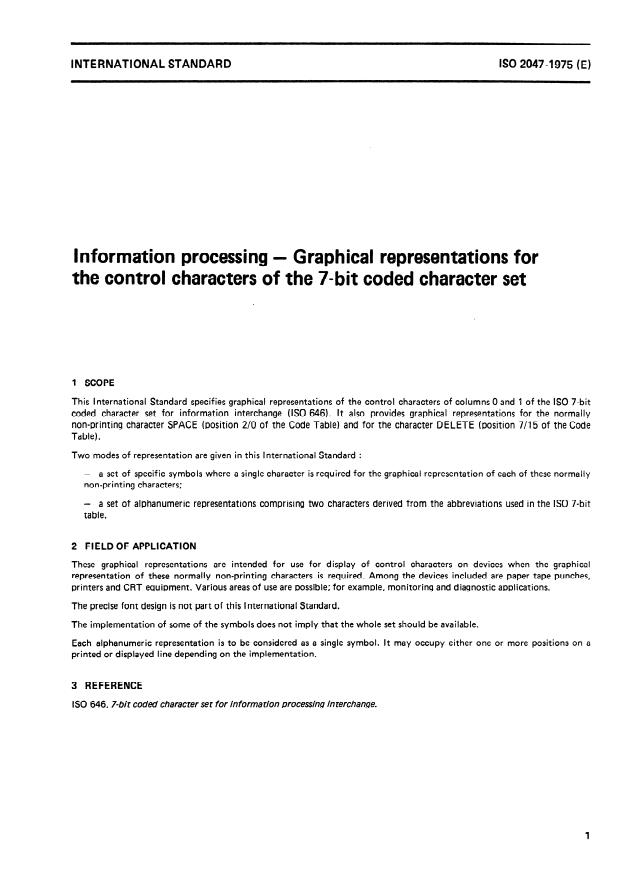
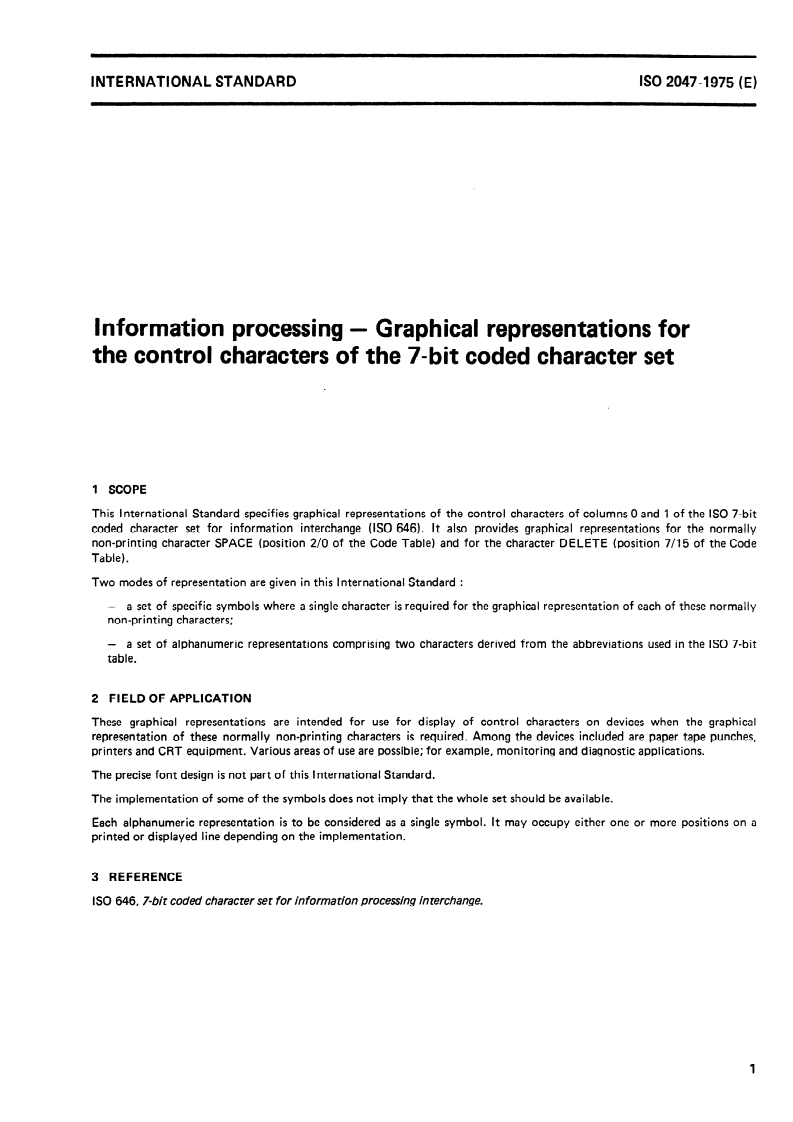
1 SCOPE
This International Standard specifies graphical representations of the control characters of columns 0 and 1 of the IS0 7-bit
coded character set for information interchange (IS0 646). It also provides graphical representations for the normally
non-printing character SPACE (position 2/O of the Code Table) and for the character DELETE (position 7/15 of the Code
Table).
Two modes of representation are given in this International Standard :
- a set of specific symbols where a single character is required for the graphical representation of each of these normally
non-printing characters;
-
a set of alphanumeric representations comprising two characters derived from the abbreviations used in the IS0 7-bit
table.
2 F
...
INTERNATIONAL STANDARD
2047.
INTERNATIONAL ORGANIZATION FOR STANDARDIZATION l MEX,WHAPO~HAJl OPrAHM3AUM(I I-IO CTAHirAPTM3AUMM*ORGANISATiON INTERNATIONALE DE NORMALISATION
.
Information processing - Graphical representations for
the control characters of the 7-bit coded character set
Traitemen t de l’informa tion - Reprgsentation graphique des caractkres de commande du jeu de
wractkres cod& ;i 7 &ments
First edition - 1975-08-01
UDC 681 l 3.042.3 Ref. No. IS0 2047-1975 (E)
Descriptors : data processing, character sets, control characters, data transmission, information interchange, graphical symbols.
Price based on 6 pages
FOREWORD
IS0 (the International- Organization for Standardization) is a worldwide federation
of national standards institutes (IS0 Member Bodies). The work of developing
International Standards is carried out through IS0 Technical Committees. Every
’ Member Body interested in a subject for which a Technical Committee has been set
up has the right to be represented on that Committee. International organizations,
governmental and non-governmental, in liaison with ISO, also take part in the work.
Draft International Standards adopted by the Technical Committees are circulated
to the Member Bodies for approval before their acceptance as International
Standards by the IS0 Council.
International Standard IS0 2047 was drawn up by Technical Committee
ISO/TC 97, Computers and information processing, and circulated to the Member
Bodies in December 1972.
It has been approved by the Member Bodies of the following countries :
South Africa, Rep. of
Belgium Ireland
Sweden
Brazil Italy
Switzerland
Canada Japan
United Kingdom
Czechoslovakia Mexico
U.S.A.
Denmark New Zealand
Poland
Egypt, Arab Rep. of
Romania
France
The Member Bodies of the following countries expressed disapproval of the
document :
Germany
Netherlands
0 International Organization for Standardization, 1975 *
Printed in Switzerland
INTERNATIONAL STANDARD
ISO 20474975 (E)
Information processing - Graphical representations for
the control characters of the 7-bit coded character set
1 SCOPE
This International Standard specifies graphical representations of the control characters of columns 0 and 1 of the IS0 7-bit
coded character set for information interchange (IS0 646). It also provides graphical representations for the normally
non-printing character SPACE (position 2/O of the Code Table) and for the character DELETE (position 7/15 of the Code
Table).
Two modes of representation are given in this International Standard :
- a set of specific symbols where a single character is required for the graphical representation of each of these normally
non-printing characters;
-
a set of alphanumeric representations comprising two characters derived from the abbreviations used in the IS0 7-bit
table.
2 F
...
NORME INTERNATIONALE
INTERNATIONAL ORGANIZATION FOR STANDARDIZATION l MEXAYHAPOAHAfi OPrAHM3ALWI II0 CTAHAAPTM3ALVWI~ORGANISATION INTERNATIONALE DE NORMALISATION
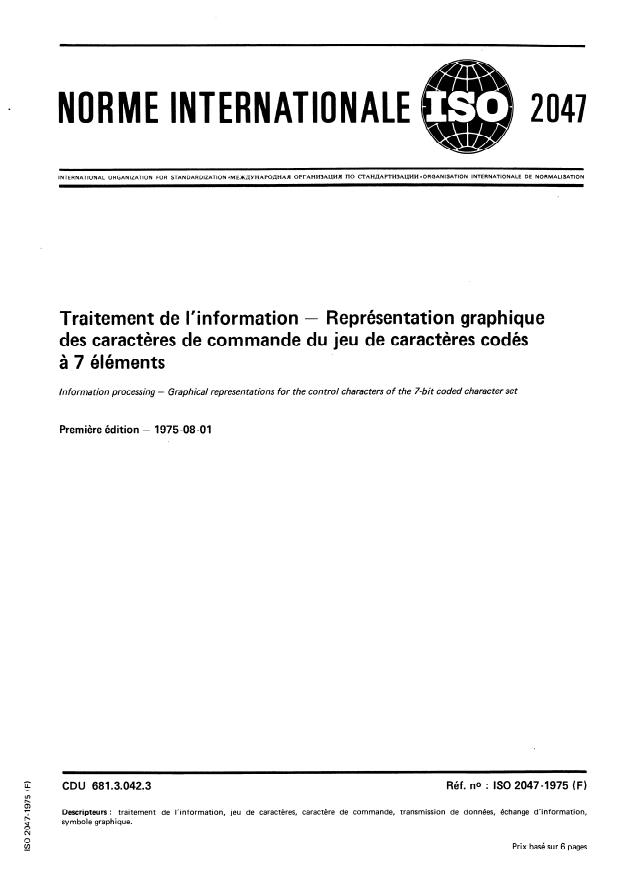
Traitement de l’information - Représentation graphique
des caractères de commande du jeu de caractères codés
à 7 éléments
Information processing - Graphical representations for the control characters of the 7-bit coded character set
Première édition - 1975-08-01
CDU 681.3.042.3 Réf. no : ISO 2047-1975 (F)
Descripteurs : traitement de l’information, jeu de caractères, caractère de commande, transmission de données, échange d’information,
symbole graphique.
Prix basé sur 6 pages
AVANT-PROPOS
L’ISO (Organisation Internationale de Normalisation) est une fédération mondiale
d’organismes nationaux de normalisation (Comités Membres ISO). L’élaboration de
Normes Internationales est confiée aux Comités Techniques ISO. Chaque Comité
Membre intéressé par une étude a le droit de faire partie du Comité Technique
correspondant. Les organisations internationales, gouvernementales et non
gouvernementales, en liaison avec I’ISO, participent également aux travaux.
Les Projets de Normes Internationales adoptés par les Comités Techniques sont
soumis aux Comités Membres pour approbation, avant leur acceptation comme
Normes Internationales par le Conseil de I’ISO.
La Norme Internationale ISO 2047 a été établie par le Comité Technique
ISO/TC 97, Calculateurs et traitement de l’information, et soumise aux Comités
Membres en décembre 1972.
Elle a été approuvée par les Comités Membres des pays suivants :
Afrique du Sud, Rép. d’ Irlande Royaume-Uni
Suède
Belgique Italie
Suisse
Brési I Japon
Canada Mexique Tchécoslovaquie
U.S.A.
Danemark Nouvelle-Zélande
Egypte, Rép. arabe d’ Pologne
France Roumanie
Les Comités Membres des pays suivants ont désapprouvé le document :
Allemagne
Pays- Bas
0 Organisation Internationale de Normalisation, 1975 l
Imprimé en Suisse
ISO 2047-1975 (F)
NORME INTERNATIONALE
Traitement de l’information - Représentation graphique
des caractères de commande du jeu de caractères codés
à 7 éléments
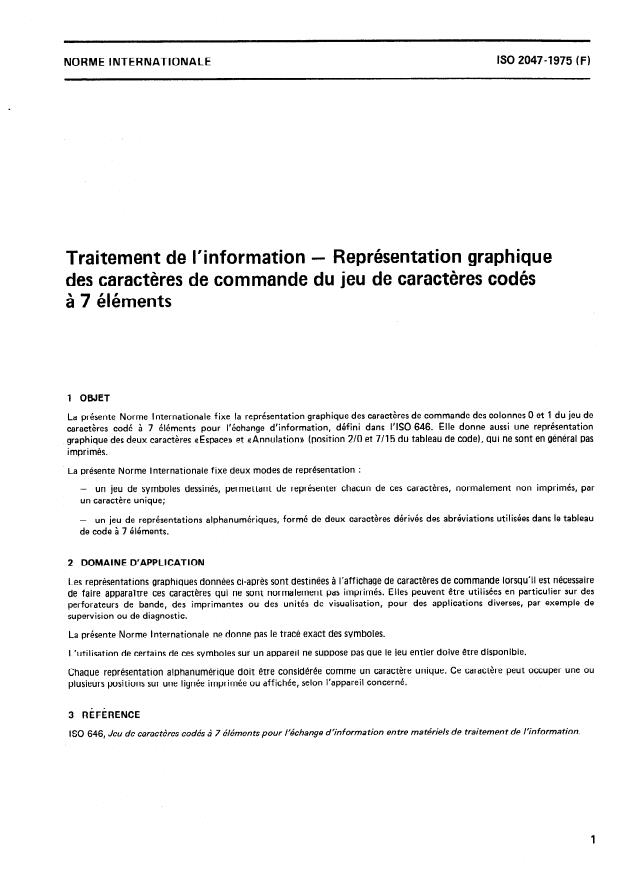
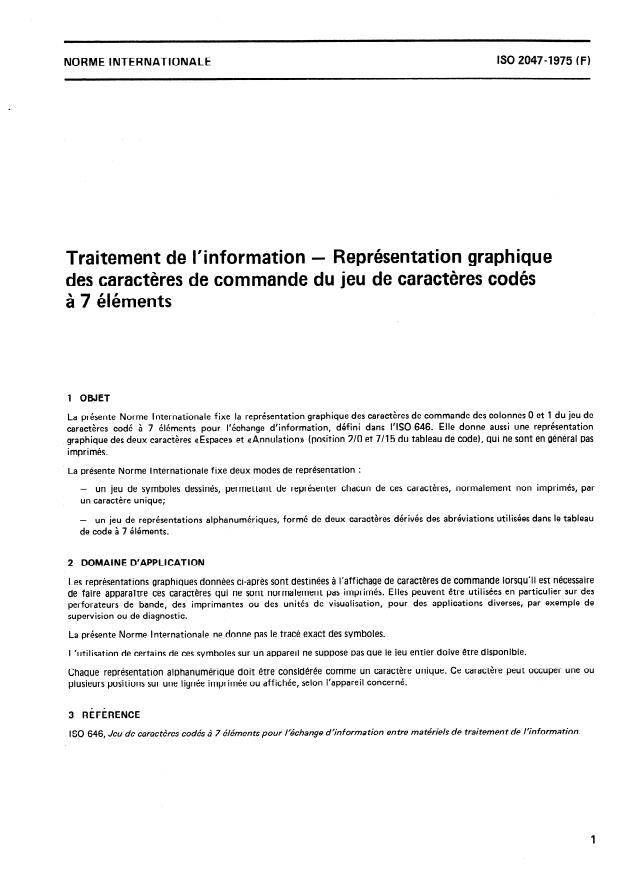
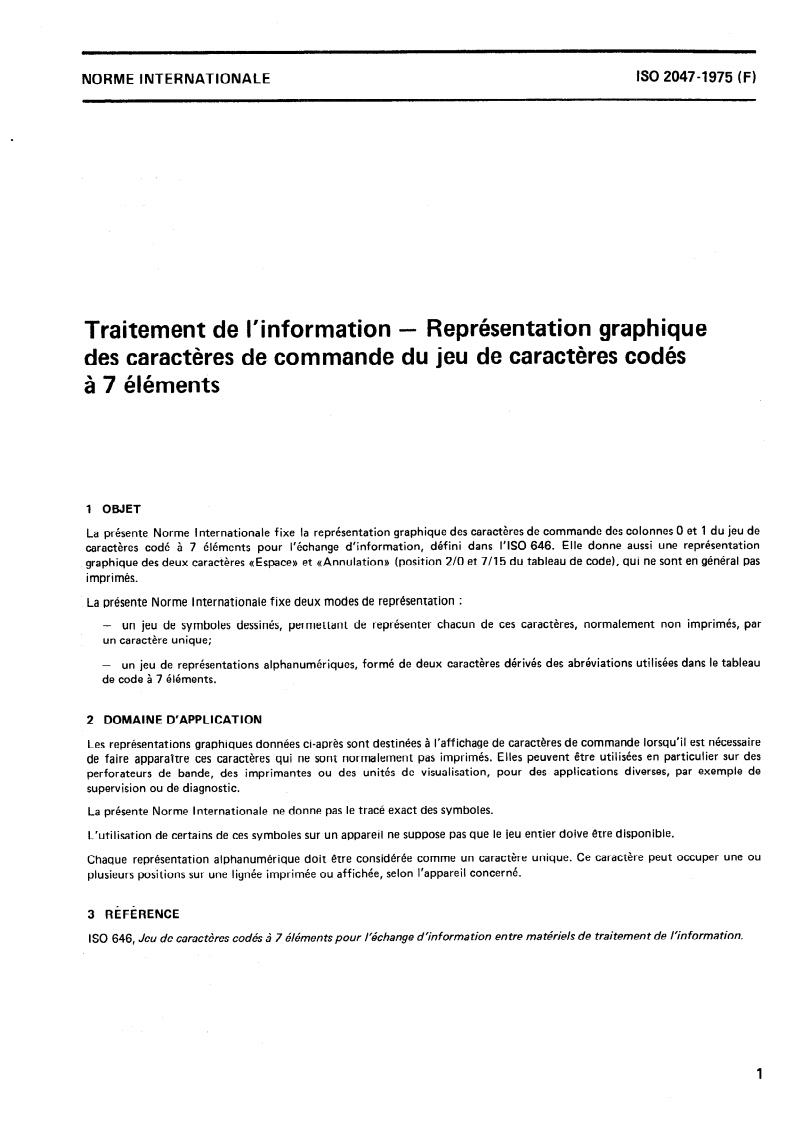
1 OBJET
La présente Norme Internationale fixe la représentation graphique des caractères de commande des colonnes 0 et 1 du jeu de
caractères codé à 7 éléments pour l’échange d’information, défini dans I’ISO 646. Elle donne aussi une représentation
graphique des deux caractères «Espace» et ((Annulation)) (position 2/0 et 7/15 du tableau de code), qui ne sont en général pas
imprimés.
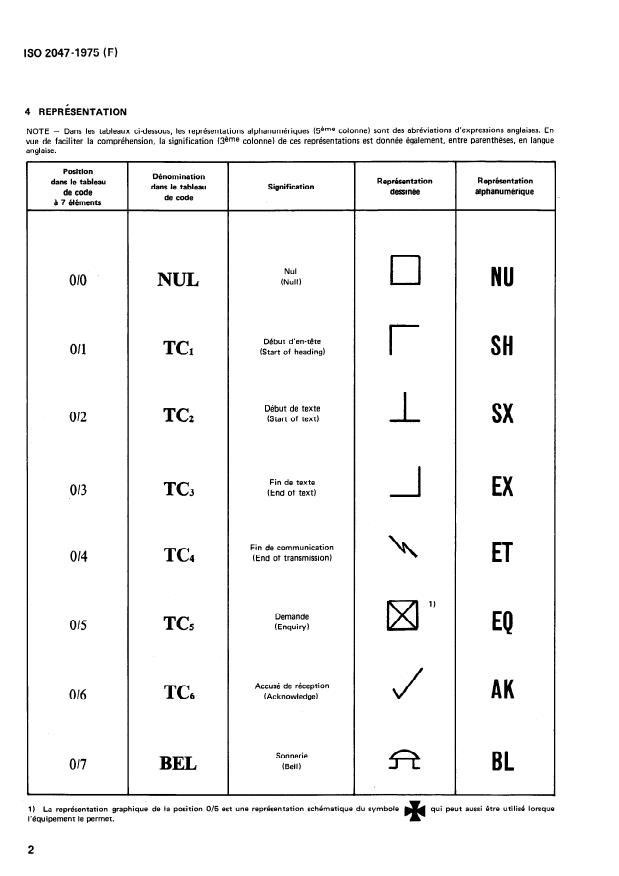
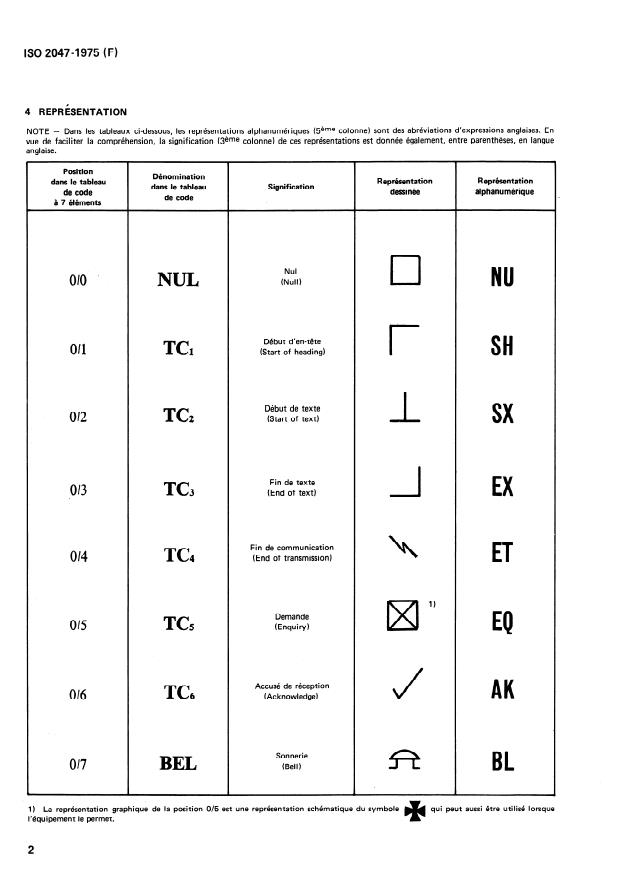
La présente Norme Internationale fixe deux modes de représentation :
-
un jeu de symboles dessinés, permettant de représenter chacun de ces caractères, normalement non imprimés, par
un caractère unique;
-
un jeu de représentations alphanumériques, formé de deux caractères dérivés des abréviations utilisées dans le tableau
de code à 7 éléments.
2 DOMAINE D’APPLICATION
Les représentations graphiques données ci-après sont destinées à I’aff ichage de caractères de commande lorsqu’il est nécessaire
de faire apparaître ces caractères qui ne sont normalement pas imprimés. Elles peuvent être utilisées en particulier sur des
perforateurs de bande, des imprimantes ou des unités de visualisation, pour des applications diverses, par exemple de
supervision ou de diagnostic.
La présente Norme Internationale ne donne pas le tracé exact des symboles.
L’utilisation de certains de ces symboles sur un appareil ne suppose pas que le jeu entier doive être disponible.
Chaque représentation alphanumérique doit être
...
NORME INTERNATIONALE
INTERNATIONAL ORGANIZATION FOR STANDARDIZATION l MEXAYHAPOAHAfi OPrAHM3ALWI II0 CTAHAAPTM3ALVWI~ORGANISATION INTERNATIONALE DE NORMALISATION
Traitement de l’information - Représentation graphique
des caractères de commande du jeu de caractères codés
à 7 éléments
Information processing - Graphical representations for the control characters of the 7-bit coded character set
Première édition - 1975-08-01
CDU 681.3.042.3 Réf. no : ISO 2047-1975 (F)
Descripteurs : traitement de l’information, jeu de caractères, caractère de commande, transmission de données, échange d’information,
symbole graphique.
Prix basé sur 6 pages
AVANT-PROPOS
L’ISO (Organisation Internationale de Normalisation) est une fédération mondiale
d’organismes nationaux de normalisation (Comités Membres ISO). L’élaboration de
Normes Internationales est confiée aux Comités Techniques ISO. Chaque Comité
Membre intéressé par une étude a le droit de faire partie du Comité Technique
correspondant. Les organisations internationales, gouvernementales et non
gouvernementales, en liaison avec I’ISO, participent également aux travaux.
Les Projets de Normes Internationales adoptés par les Comités Techniques sont
soumis aux Comités Membres pour approbation, avant leur acceptation comme
Normes Internationales par le Conseil de I’ISO.
La Norme Internationale ISO 2047 a été établie par le Comité Technique
ISO/TC 97, Calculateurs et traitement de l’information, et soumise aux Comités
Membres en décembre 1972.
Elle a été approuvée par les Comités Membres des pays suivants :
Afrique du Sud, Rép. d’ Irlande Royaume-Uni
Suède
Belgique Italie
Suisse
Brési I Japon
Canada Mexique Tchécoslovaquie
U.S.A.
Danemark Nouvelle-Zélande
Egypte, Rép. arabe d’ Pologne
France Roumanie
Les Comités Membres des pays suivants ont désapprouvé le document :
Allemagne
Pays- Bas
0 Organisation Internationale de Normalisation, 1975 l
Imprimé en Suisse
ISO 2047-1975 (F)
NORME INTERNATIONALE
Traitement de l’information - Représentation graphique
des caractères de commande du jeu de caractères codés
à 7 éléments
1 OBJET
La présente Norme Internationale fixe la représentation graphique des caractères de commande des colonnes 0 et 1 du jeu de
caractères codé à 7 éléments pour l’échange d’information, défini dans I’ISO 646. Elle donne aussi une représentation
graphique des deux caractères «Espace» et ((Annulation)) (position 2/0 et 7/15 du tableau de code), qui ne sont en général pas
imprimés.
La présente Norme Internationale fixe deux modes de représentation :
-
un jeu de symboles dessinés, permettant de représenter chacun de ces caractères, normalement non imprimés, par
un caractère unique;
-
un jeu de représentations alphanumériques, formé de deux caractères dérivés des abréviations utilisées dans le tableau
de code à 7 éléments.
2 DOMAINE D’APPLICATION
Les représentations graphiques données ci-après sont destinées à I’aff ichage de caractères de commande lorsqu’il est nécessaire
de faire apparaître ces caractères qui ne sont normalement pas imprimés. Elles peuvent être utilisées en particulier sur des
perforateurs de bande, des imprimantes ou des unités de visualisation, pour des applications diverses, par exemple de
supervision ou de diagnostic.
La présente Norme Internationale ne donne pas le tracé exact des symboles.
L’utilisation de certains de ces symboles sur un appareil ne suppose pas que le jeu entier doive être disponible.
Chaque représentation alphanumérique doit être
...
NORME INTERNATIONALE
INTERNATIONAL ORGANIZATION FOR STANDARDIZATION l MEXAYHAPOAHAfi OPrAHM3ALWI II0 CTAHAAPTM3ALVWI~ORGANISATION INTERNATIONALE DE NORMALISATION
Traitement de l’information - Représentation graphique
des caractères de commande du jeu de caractères codés
à 7 éléments
Information processing - Graphical representations for the control characters of the 7-bit coded character set
Première édition - 1975-08-01
CDU 681.3.042.3 Réf. no : ISO 2047-1975 (F)
Descripteurs : traitement de l’information, jeu de caractères, caractère de commande, transmission de données, échange d’information,
symbole graphique.
Prix basé sur 6 pages
AVANT-PROPOS
L’ISO (Organisation Internationale de Normalisation) est une fédération mondiale
d’organismes nationaux de normalisation (Comités Membres ISO). L’élaboration de
Normes Internationales est confiée aux Comités Techniques ISO. Chaque Comité
Membre intéressé par une étude a le droit de faire partie du Comité Technique
correspondant. Les organisations internationales, gouvernementales et non
gouvernementales, en liaison avec I’ISO, participent également aux travaux.
Les Projets de Normes Internationales adoptés par les Comités Techniques sont
soumis aux Comités Membres pour approbation, avant leur acceptation comme
Normes Internationales par le Conseil de I’ISO.
La Norme Internationale ISO 2047 a été établie par le Comité Technique
ISO/TC 97, Calculateurs et traitement de l’information, et soumise aux Comités
Membres en décembre 1972.
Elle a été approuvée par les Comités Membres des pays suivants :
Afrique du Sud, Rép. d’ Irlande Royaume-Uni
Suède
Belgique Italie
Suisse
Brési I Japon
Canada Mexique Tchécoslovaquie
U.S.A.
Danemark Nouvelle-Zélande
Egypte, Rép. arabe d’ Pologne
France Roumanie
Les Comités Membres des pays suivants ont désapprouvé le document :
Allemagne
Pays- Bas
0 Organisation Internationale de Normalisation, 1975 l
Imprimé en Suisse
ISO 2047-1975 (F)
NORME INTERNATIONALE
Traitement de l’information - Représentation graphique
des caractères de commande du jeu de caractères codés
à 7 éléments
1 OBJET
La présente Norme Internationale fixe la représentation graphique des caractères de commande des colonnes 0 et 1 du jeu de
caractères codé à 7 éléments pour l’échange d’information, défini dans I’ISO 646. Elle donne aussi une représentation
graphique des deux caractères «Espace» et ((Annulation)) (position 2/0 et 7/15 du tableau de code), qui ne sont en général pas
imprimés.
La présente Norme Internationale fixe deux modes de représentation :
-
un jeu de symboles dessinés, permettant de représenter chacun de ces caractères, normalement non imprimés, par
un caractère unique;
-
un jeu de représentations alphanumériques, formé de deux caractères dérivés des abréviations utilisées dans le tableau
de code à 7 éléments.
2 DOMAINE D’APPLICATION
Les représentations graphiques données ci-après sont destinées à I’aff ichage de caractères de commande lorsqu’il est nécessaire
de faire apparaître ces caractères qui ne sont normalement pas imprimés. Elles peuvent être utilisées en particulier sur des
perforateurs de bande, des imprimantes ou des unités de visualisation, pour des applications diverses, par exemple de
supervision ou de diagnostic.
La présente Norme Internationale ne donne pas le tracé exact des symboles.
L’utilisation de certains de ces symboles sur un appareil ne suppose pas que le jeu entier doive être disponible.
Chaque représentation alphanumérique doit être
...
NORME INTERNATIONALE
INTERNATIONAL ORGANIZATION FOR STANDARDIZATION l MEXAYHAPOAHAfi OPrAHM3ALWI II0 CTAHAAPTM3ALVWI~ORGANISATION INTERNATIONALE DE NORMALISATION
Traitement de l’information - Représentation graphique
des caractères de commande du jeu de caractères codés
à 7 éléments
Information processing - Graphical representations for the control characters of the 7-bit coded character set
Première édition - 1975-08-01
CDU 681.3.042.3 Réf. no : ISO 2047-1975 (F)
Descripteurs : traitement de l’information, jeu de caractères, caractère de commande, transmission de données, échange d’information,
symbole graphique.
Prix basé sur 6 pages
AVANT-PROPOS
L’ISO (Organisation Internationale de Normalisation) est une fédération mondiale
d’organismes nationaux de normalisation (Comités Membres ISO). L’élaboration de
Normes Internationales est confiée aux Comités Techniques ISO. Chaque Comité
Membre intéressé par une étude a le droit de faire partie du Comité Technique
correspondant. Les organisations internationales, gouvernementales et non
gouvernementales, en liaison avec I’ISO, participent également aux travaux.
Les Projets de Normes Internationales adoptés par les Comités Techniques sont
soumis aux Comités Membres pour approbation, avant leur acceptation comme
Normes Internationales par le Conseil de I’ISO.
La Norme Internationale ISO 2047 a été établie par le Comité Technique
ISO/TC 97, Calculateurs et traitement de l’information, et soumise aux Comités
Membres en décembre 1972.
Elle a été approuvée par les Comités Membres des pays suivants :
Afrique du Sud, Rép. d’ Irlande Royaume-Uni
Suède
Belgique Italie
Suisse
Brési I Japon
Canada Mexique Tchécoslovaquie
U.S.A.
Danemark Nouvelle-Zélande
Egypte, Rép. arabe d’ Pologne
France Roumanie
Les Comités Membres des pays suivants ont désapprouvé le document :
Allemagne
Pays- Bas
0 Organisation Internationale de Normalisation, 1975 l
Imprimé en Suisse
ISO 2047-1975 (F)
NORME INTERNATIONALE
Traitement de l’information - Représentation graphique
des caractères de commande du jeu de caractères codés
à 7 éléments
1 OBJET
La présente Norme Internationale fixe la représentation graphique des caractères de commande des colonnes 0 et 1 du jeu de
caractères codé à 7 éléments pour l’échange d’information, défini dans I’ISO 646. Elle donne aussi une représentation
graphique des deux caractères «Espace» et ((Annulation)) (position 2/0 et 7/15 du tableau de code), qui ne sont en général pas
imprimés.
La présente Norme Internationale fixe deux modes de représentation :
-
un jeu de symboles dessinés, permettant de représenter chacun de ces caractères, normalement non imprimés, par
un caractère unique;
-
un jeu de représentations alphanumériques, formé de deux caractères dérivés des abréviations utilisées dans le tableau
de code à 7 éléments.
2 DOMAINE D’APPLICATION
Les représentations graphiques données ci-après sont destinées à I’aff ichage de caractères de commande lorsqu’il est nécessaire
de faire apparaître ces caractères qui ne sont normalement pas imprimés. Elles peuvent être utilisées en particulier sur des
perforateurs de bande, des imprimantes ou des unités de visualisation, pour des applications diverses, par exemple de
supervision ou de diagnostic.
La présente Norme Internationale ne donne pas le tracé exact des symboles.
L’utilisation de certains de ces symboles sur un appareil ne suppose pas que le jeu entier doive être disponible.
Chaque représentation alphanumérique doit être
...