

ISO 3625:1994
(Main)Photography — Processing chemicals — Specifications for potassium hydroxide
General Information
- Abstract
Establishes criteria for the purity and describes the test methods for heavy metals content, iron content, halides, carbonate, appearance of solution.
- Status
- Published
- Publication Date
- 20-Apr-1994
- Technical Committee
- ISO/TC 42 - Photography
- Drafting Committee
- ISO/TC 42 - Photography
- Current Stage
- 9093 - International Standard confirmed
- Start Date
- 06-Jun-2026
- Completion Date
- 29-Aug-2026
Buy Documents
ISO 3625:1994 - Photography -- Processing chemicals -- Specifications for potassium hydroxide
ISO 3625:1994 - Photography — Processing chemicals — Specifications for potassium hydroxide/21/1994
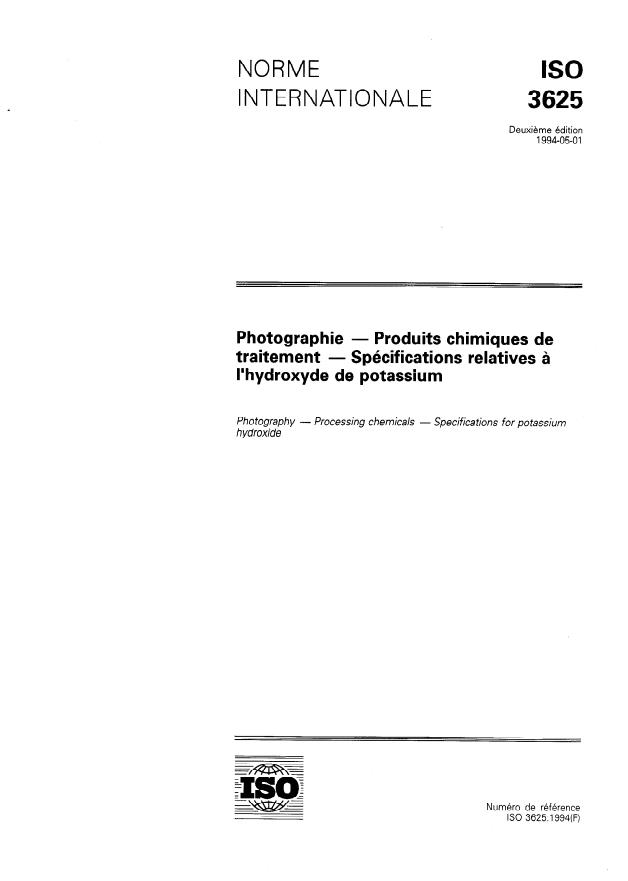
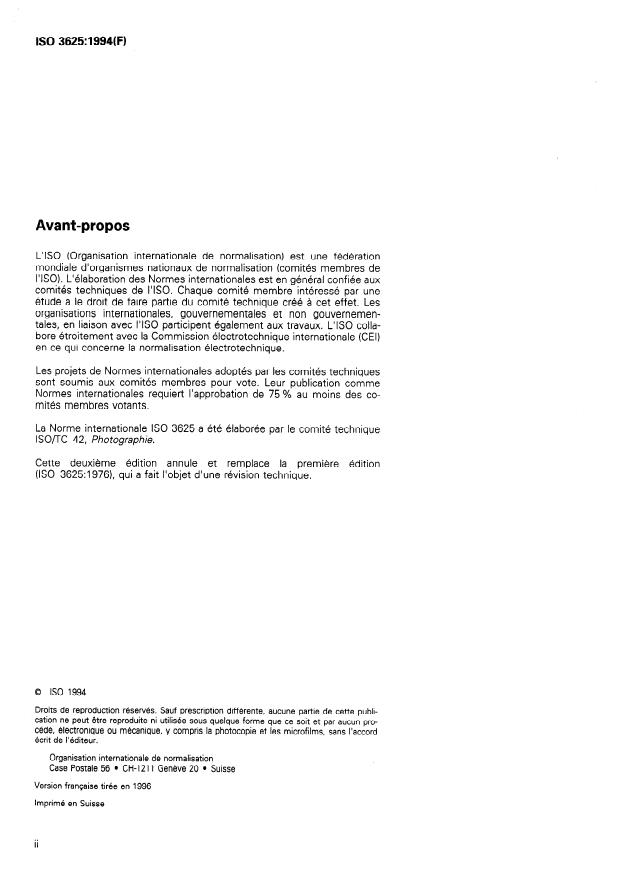
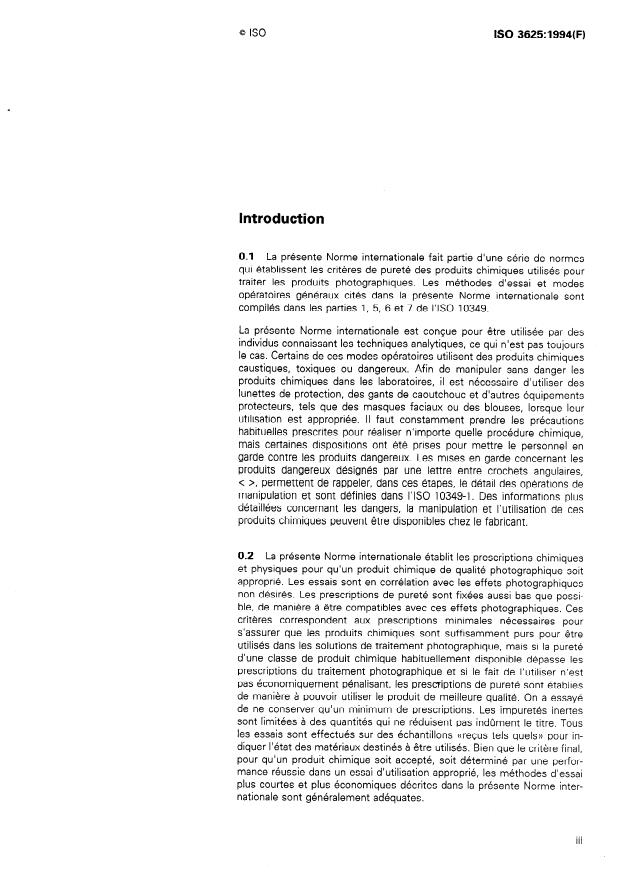
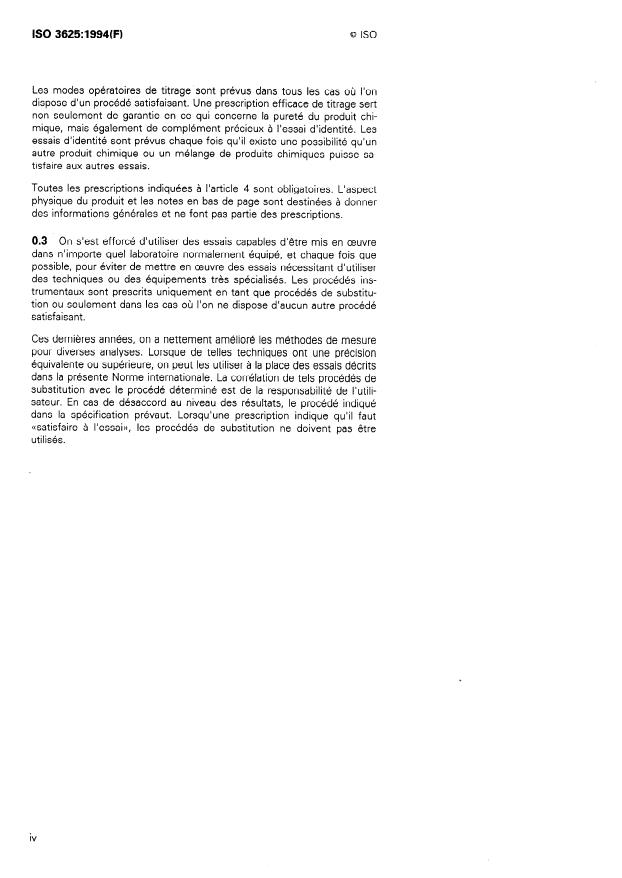
ISO 3625:1994 - Photographie -- Produits chimiques de traitement -- Spécifications relatives a l'hydroxyde de potassium
ISO 3625:1994 - Photographie -- Produits chimiques de traitement -- Spécifications relatives a l'hydroxyde de potassium
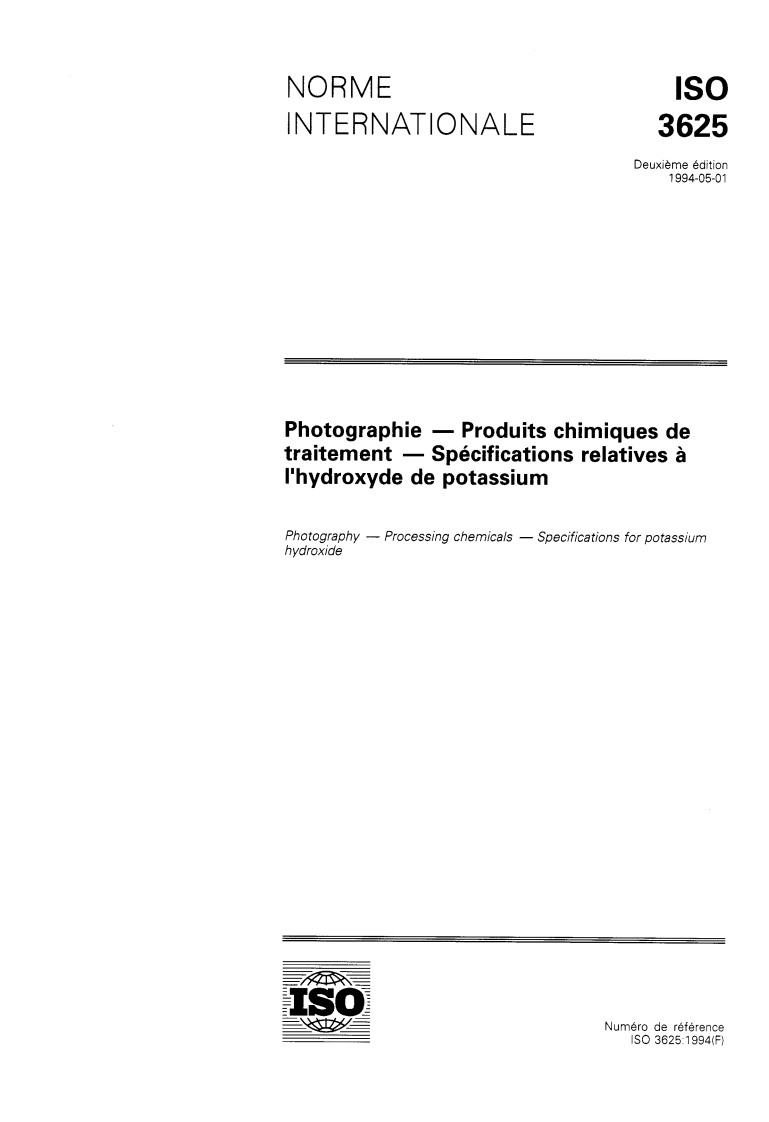
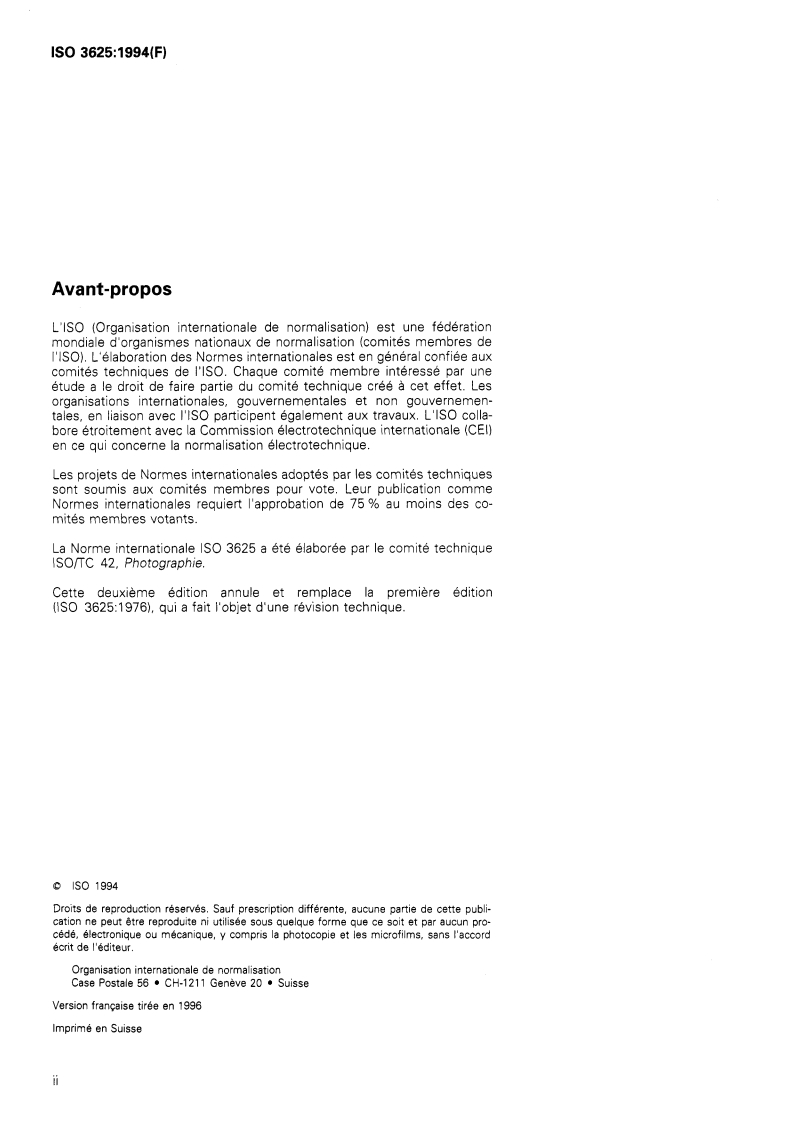
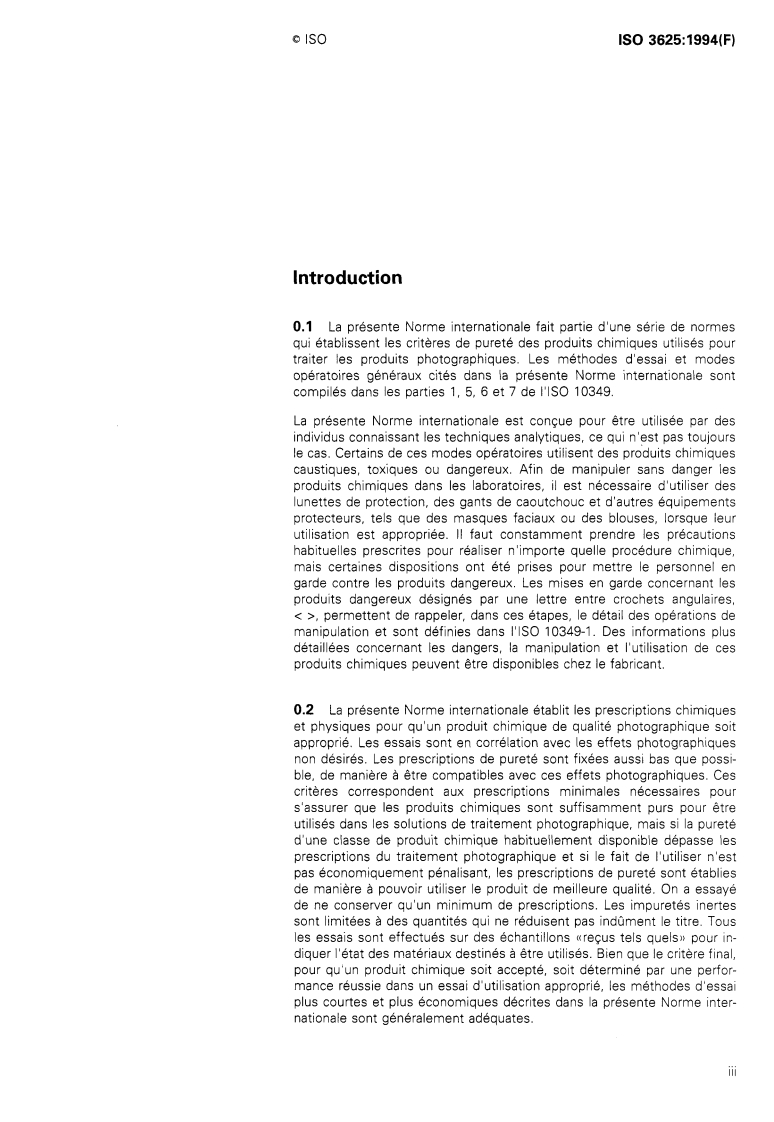
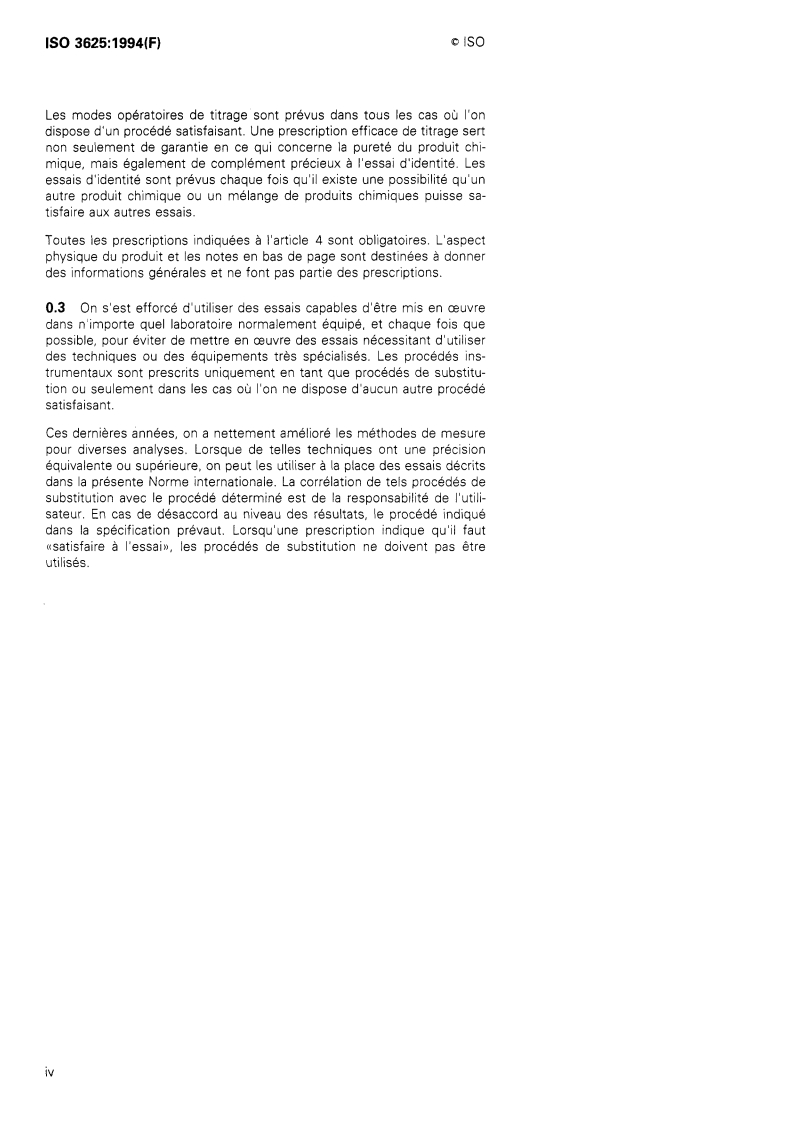
ISO 3625:1994 - Photographie — Produits chimiques de traitement — Spécifications relatives à l'hydroxyde de potassium/25/1996
ISO 3625:1994 - Photographie — Produits chimiques de traitement — Spécifications relatives à l'hydroxyde de potassium/25/1996
Overview
ISO 3625:1994 is an international standard developed by the International Organization for Standardization (ISO) that specifies the quality and purity requirements for potassium hydroxide used in photographic processing. This standard defines the chemical and physical criteria necessary to ensure potassium hydroxide’s suitability in photography applications, focusing on purity levels and the presence of impurities that may affect photographic outcomes. It also describes standardized test methods for assessing potassium hydroxide's quality, such as tests for heavy metals, iron, halides, carbonate content, and the appearance of solutions.
The standard is essential for chemical manufacturers, photographic laboratories, and quality control professionals who require consistent, reliable potassium hydroxide to maintain high-quality photographic processing.
Key Topics
Purity Criteria
ISO 3625:1994 outlines strict limits for impurities to prevent adverse effects on photographic processing:- Heavy metals (as Pb): maximum 0.003% by mass (dry matter)
- Iron (Fe): maximum 0.0005% by mass
- Halides (as Cl⁻): maximum 0.3% by mass
- Carbonate (as CO₃²⁻): maximum 1.3% by mass
- Solution appearance: must be clear and free from insoluble matter except for slight flocculence
Chemical Assay and Test Methods
The standard details chemical analysis procedures including titration methods to measure potassium hydroxide concentration (minimum 85.0% by mass) and impurities. These tests employ common laboratory equipment such as volumetric flasks, burettes, and pipettes, making them practical for routine lab use. Safety precautions are emphasized when handling caustic and hazardous chemicals.Handling and Storage Guidelines
Potassium hydroxide should be stored in tightly sealed plastic containers and kept away from moisture due to its hygroscopic nature. Proper safety gear-such as gloves, goggles, and protective clothing-is recommended to prevent exposure to this corrosive substance.Compliance and Safety
The standard aligns with existing ISO test methods (ISO 10349 series) for analyzing photographic-grade chemicals, ensuring consistency across laboratories. Hazard warning symbols and safe laboratory practices are integrated to protect users during chemical testing.
Applications
ISO 3625:1994 is critical for quality assurance throughout the photographic chemical supply chain, particularly:
Photography Industry
Ensures potassium hydroxide used in the development and processing of photographic films and papers meets purity levels that prevent image quality degradation or chemical failures.Chemical Manufacturing
Assists manufacturers in producing potassium hydroxide batches conforming to stringent specifications ideal for photographic applications.Laboratory Quality Control
Provides standardized test methods for labs verifying the composition and quality of potassium hydroxide before use in photographic processing solutions.Photo Processing Labs
Enables photographic labs to identify suitable potassium hydroxide grades to optimize processing consistency and photographic results.
Related Standards
ISO 10349 Series - Test methods for photographic-grade chemicals, including procedures for detecting heavy metals, iron, halides, and acidity/alkalinity, which complement the specifications in ISO 3625.
Material Safety Data Sheets (MSDS) - Manufacturers’ safety sheets provide additional handling and hazard information for potassium hydroxide, supporting the safe use guidelines emphasized by ISO 3625.
IEC and Other ISO Standards - Coordination with International Electrotechnical Commission (IEC) standards may be relevant for laboratories integrating photographic chemical analyses with other testing workflows.
Keywords: ISO 3625, potassium hydroxide specifications, photographic chemicals, photography chemical purity, heavy metals test, iron content, halides measurement, carbonate content, photographic processing chemicals, chemical assay methods, potassium hydroxide handling and storage, photographic material standards.
Relations
- Effective Date
- 15-Apr-2008
Buy Documents
ISO 3625:1994 - Photography -- Processing chemicals -- Specifications for potassium hydroxide
ISO 3625:1994 - Photography — Processing chemicals — Specifications for potassium hydroxide/21/1994
ISO 3625:1994 - Photographie -- Produits chimiques de traitement -- Spécifications relatives a l'hydroxyde de potassium
ISO 3625:1994 - Photographie -- Produits chimiques de traitement -- Spécifications relatives a l'hydroxyde de potassium
ISO 3625:1994 - Photographie — Produits chimiques de traitement — Spécifications relatives à l'hydroxyde de potassium/25/1996
ISO 3625:1994 - Photographie — Produits chimiques de traitement — Spécifications relatives à l'hydroxyde de potassium/25/1996
Frequently Asked Questions
ISO 3625:1994 is a standard published by the International Organization for Standardization (ISO). Its full title is "Photography — Processing chemicals — Specifications for potassium hydroxide". This standard covers: Establishes criteria for the purity and describes the test methods for heavy metals content, iron content, halides, carbonate, appearance of solution.
Establishes criteria for the purity and describes the test methods for heavy metals content, iron content, halides, carbonate, appearance of solution.
ISO 3625:1994 is classified under the following ICS (International Classification for Standards) categories: 37.040.30 - Photographic chemicals. The ICS classification helps identify the subject area and facilitates finding related standards.
ISO 3625:1994 has the following relationships with other standards: It is inter standard links to ISO 3625:1976. Understanding these relationships helps ensure you are using the most current and applicable version of the standard.
ISO 3625:1994 is available in PDF format for immediate download after purchase. The document can be added to your cart and obtained through the secure checkout process. Digital delivery ensures instant access to the complete standard document.
Standards Content (Sample)
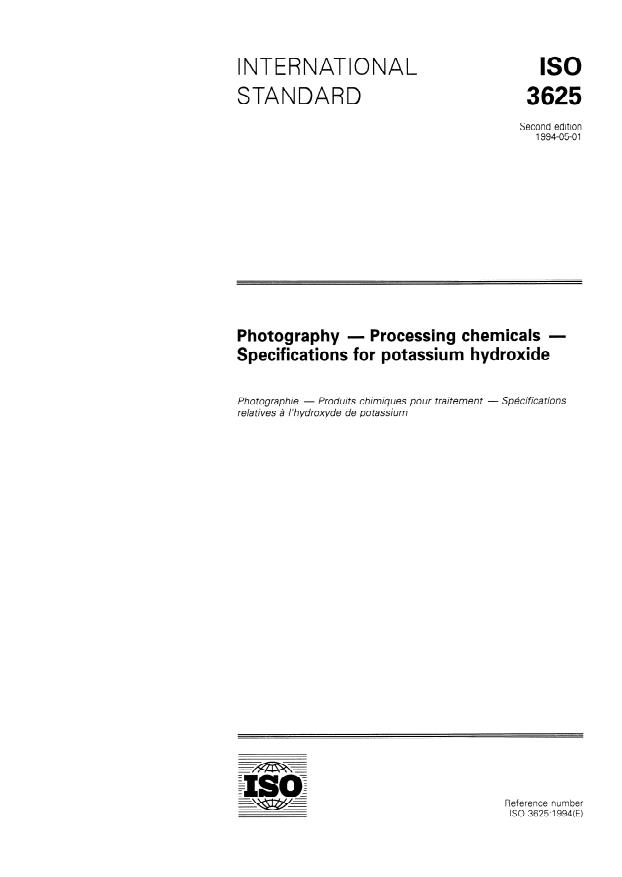
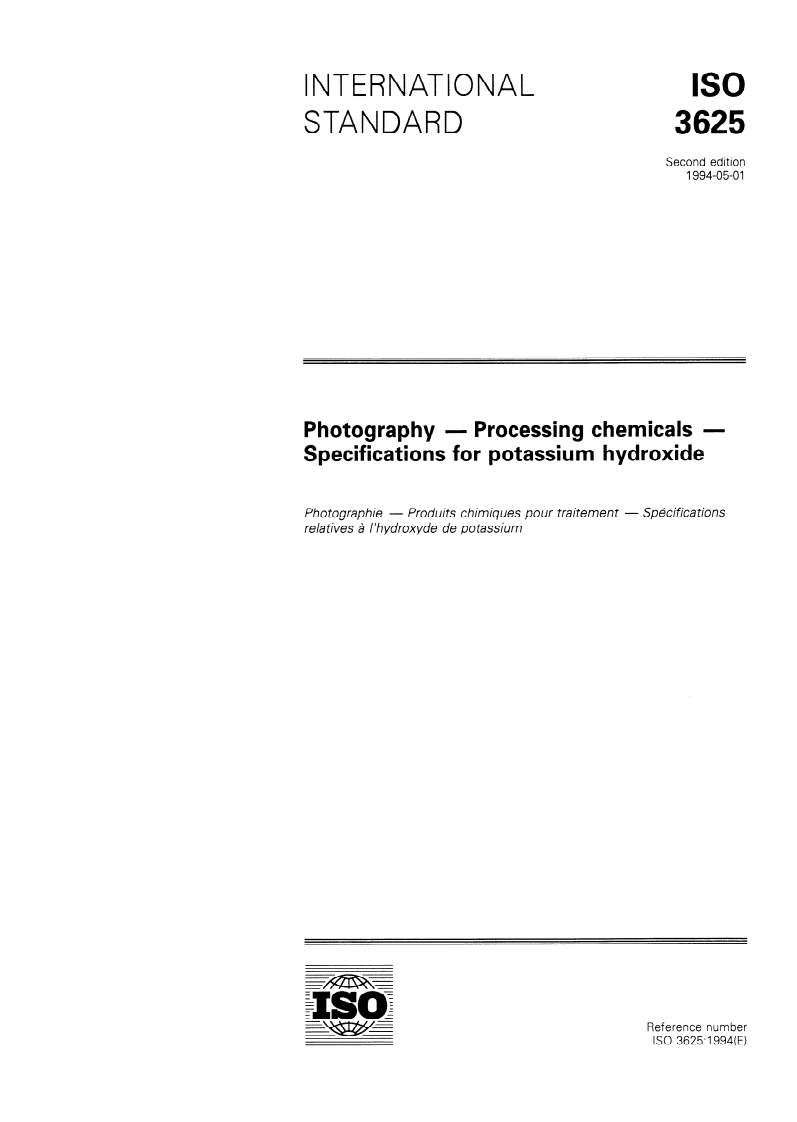
INTERNATIONAL
STANDARD
Second edition
1994-05-01
- Processing chemicals -
Photography
Specifications for potassium hydroxide
Photographie - Produits chimiques pour traitement - Spkifications
relatives a I ’h ydroxyde de potassium
Reference number
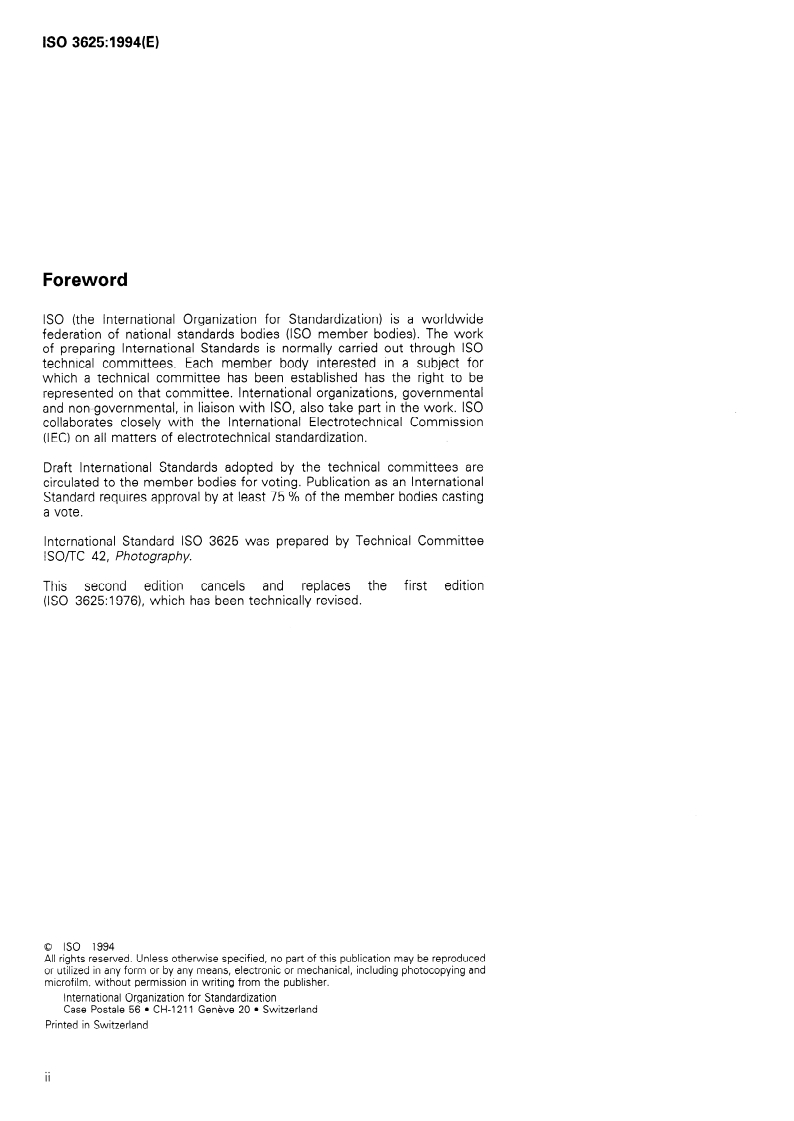
Foreword
ISO (the International Organization for Standardization) is a worldwide
federation of national Standards bodies (ISO member bodies). The work
of preparing International Standards is normally carried out through ISO
technical committees. Esch member body interested in a subject for
which a technical committee has been established has the right to be
represented on that committee. International organizations, governmental
and non-governmental, in liaison with ISO, also take part in the work. ISO
collaborates closely with the International Electrotechnical Commission
(IEC) on all matters of electrotechnical standardization.
Draft International Standards adopted by the technical committees are
circulated to the member bodies for voting. Publication as an International
Standard requires approval by at least 75 % of the member bodies casting
a vote.
International Standard ISO 3625 was prepared by Technical Committee
lSO/TC 42, Photography.
This second edition cancels and replaces the first edition
(ISO 3625:1976), which has been technically revised.
0 ISO 1994
All rights reserved. Unless otherwise specified, no part of this publication may be reproduced
or utilized in any form or by any means, electronie or mechanical, including photocopying and
microfilm, without Permission in writing from the publisher.
International Organization for Standardization
Case Postale 56 l CH-l 211 Geneve 20 l Switzerland
Printed in Switzerland
0 ISO
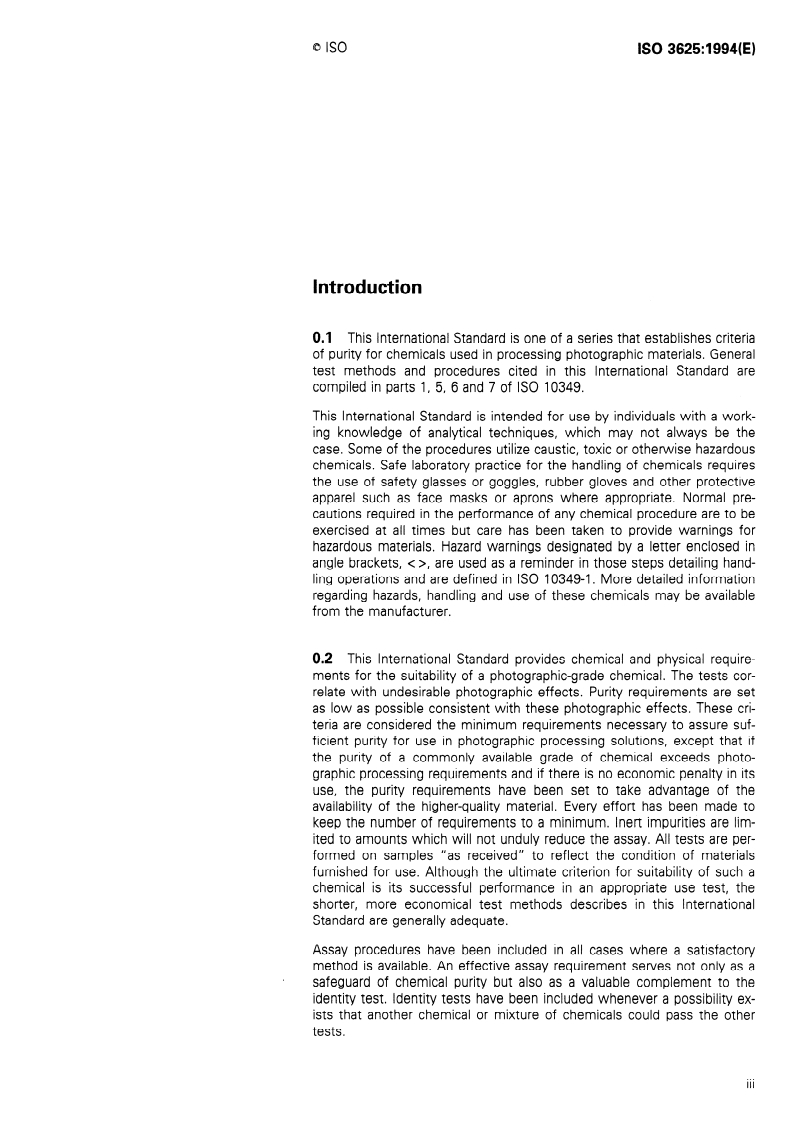
Introduction
0.1 This International Standard is one of a series that establishes criteria
of purity for chemicals used in processing photographic materials. General
test methods and procedures cited in this International Standard are
compiled in Parts 1, 5, 6 and 7 of ISO 10349.
This International Standard is intended for use by individuals with a work-
ing knowledge of analytical techniques, which may not always be the
case. Some of the procedures utilize caustic, toxic or otherwise hazardous
chemicals. Safe laboratory practice for the handling of chemicals requires
the use of safety glasses or goggles, rubber gloves and other protective
apparel such as face masks or aprons where appropriate. Normal pre-
cautions required in the Performance of any Chemical procedure are to be
exercised at all times but care has been taken to provide warnings for
hazardous materials. Hazard warnings designated by a letter enclosed in
angle brackets, < >, are used as a reminder in those Steps detailing hand-
ling operations and are defined in ISO 10349-1. More detailed information
regarding hazards, handling and use of these chemicals may be available
from the manufacturer.
0.2 This International Standard provides Chemical and physical require-
ments for the suitability of a photographit-grade Chemical. The tests cor-
relate with undesirable photographic effects. Purity requirements are set
as low as possible consistent with these photographic effects. These cri-
teria are considered the minimum requirements necessary to assure suf-
ficient purity for use in photographic processing solutions, except that if
the purity of a commonly available grade of Chemical exceeds photo-
graphic processing requirements and if there is no economic penalty in its
use, the purity requirements have been set to take advantage of the
availability of the higher-quality material. Every effort has been made to
keep the number of requirements to a minimum. Inert impurities are lim-
ited to amounts which will not unduly reduce the assay. All tests are per-
formed on samples “as received” to reflect the condition of materials
furnished for use. Although the ultimate criterion for suitability of such a
Chemical is its successful Performance in an appropriate use test, the
shorter, more economical test methods describes in this International
Standard are generally adequate.
Assay procedures have been included in all cases where
a satisfactory
method is available. An effective assay requirement serves
not only as a
safeguard of Chemical purity but also as a valuable compl
ement to the
identity test. Identity tests have been included whenever a possibility ex-
ists that another Chemical or mixture of chemicals could p iass the other
tests.
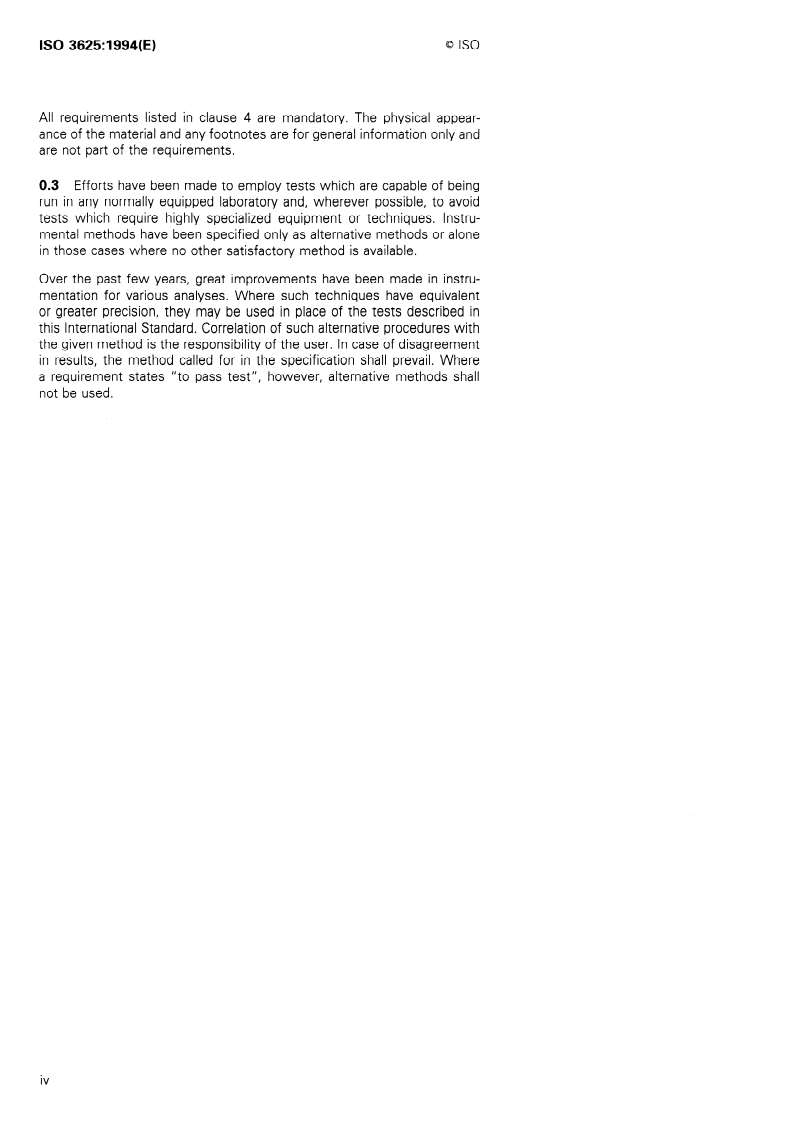
All requirements listed in clause 4 are mandatory. The physical appear-
ante of the material and any footnotes are for general information only and
are not part of the requirements.
0.3 Efforts have been made to employ tests which are capable of being
run in any normally equipped laboratory and, wherever possible, to avoid
tests which require highly specialized equipment or techniques. Instru-
mental methods have been specified only as alternative methods or alone
in those cases where no other satisfactory method is available.
Over the past few years, great improvements have been made in instru-
mentation for various analyses. Where such techniques have equivalent
or greater precision, they may be used in place of the tests described in
this International Standard. Correlation of such alternative procedures with
the given method is the responsibility of the User. In case of disagreement
in results, the method called for in the specification shall prevail. Where
a requirement states “to pass test ”, however, alternative methods shall
not be used.
iv
INTERNATIONAL STANDARD 0 ISO ISO 3625: 1994(E)
Photography - Processing chemicals -
Specifications for potassium hydroxide
1 Scope 3 General
This International Standard establishes criteria for the
3.1 Physical properties
purity of photographit-grade potassium hydroxide
Potassium hydroxide, KOH, Comes in the form of
(DANGER: << C>W and describes the tests to be
white sticks, pellets, flakes, granules or powder. lt has
used to determine the purity.
a relative molecular mass of 56,ll.
3.2 Hazardous properties
Potassium hydroxide is corrosive (DANGER: << C >>).
Avoid contact with eyes, skin, and clothing. Avoid
2 Normative references
breathing dust. Refer to the Manufacturer ’s Material
Safety Data Sheet (MSDS) for additional information.
The following Standards contain provisions which,
through reference in this text, constitute provisions
3.3 Handling and storage
of this International Standard. At the time of publi-
cation, the editions indicated were valid. All Standards
Potassium hydroxide should be stored in a properly
are subject to revision, and Parties to agreements
labelled and tightly sealed plastic Container. Potass-
based on this International Standard are encouraged
ium hydroxide readily absorbs moisture with the Iib-
to investigate the possibility of applying the most re-
eration of heat. Potassium hydroxide reacts violently
cent editions of the Standards indicated below.
with acids.
Members of IEC and ISO maintain registers of cur-
rently valid International Standards.
4 Requirements
ISO 10349-1: 1992, Photography - Photographic-
A summary of the requirements is shown in table 1.
grade chemicals - Test methods - Part 1: General.
ISO 10349-5:1992, Photography - Photogra
...
INTERNATIONAL
STANDARD
Second edition
1994-05-01
- Processing chemicals -
Photography
Specifications for potassium hydroxide
Photographie - Produits chimiques pour traitement - Spkifications
relatives a I ’h ydroxyde de potassium
Reference number
Foreword
ISO (the International Organization for Standardization) is a worldwide
federation of national Standards bodies (ISO member bodies). The work
of preparing International Standards is normally carried out through ISO
technical committees. Esch member body interested in a subject for
which a technical committee has been established has the right to be
represented on that committee. International organizations, governmental
and non-governmental, in liaison with ISO, also take part in the work. ISO
collaborates closely with the International Electrotechnical Commission
(IEC) on all matters of electrotechnical standardization.
Draft International Standards adopted by the technical committees are
circulated to the member bodies for voting. Publication as an International
Standard requires approval by at least 75 % of the member bodies casting
a vote.
International Standard ISO 3625 was prepared by Technical Committee
lSO/TC 42, Photography.
This second edition cancels and replaces the first edition
(ISO 3625:1976), which has been technically revised.
0 ISO 1994
All rights reserved. Unless otherwise specified, no part of this publication may be reproduced
or utilized in any form or by any means, electronie or mechanical, including photocopying and
microfilm, without Permission in writing from the publisher.
International Organization for Standardization
Case Postale 56 l CH-l 211 Geneve 20 l Switzerland
Printed in Switzerland
0 ISO
Introduction
0.1 This International Standard is one of a series that establishes criteria
of purity for chemicals used in processing photographic materials. General
test methods and procedures cited in this International Standard are
compiled in Parts 1, 5, 6 and 7 of ISO 10349.
This International Standard is intended for use by individuals with a work-
ing knowledge of analytical techniques, which may not always be the
case. Some of the procedures utilize caustic, toxic or otherwise hazardous
chemicals. Safe laboratory practice for the handling of chemicals requires
the use of safety glasses or goggles, rubber gloves and other protective
apparel such as face masks or aprons where appropriate. Normal pre-
cautions required in the Performance of any Chemical procedure are to be
exercised at all times but care has been taken to provide warnings for
hazardous materials. Hazard warnings designated by a letter enclosed in
angle brackets, < >, are used as a reminder in those Steps detailing hand-
ling operations and are defined in ISO 10349-1. More detailed information
regarding hazards, handling and use of these chemicals may be available
from the manufacturer.
0.2 This International Standard provides Chemical and physical require-
ments for the suitability of a photographit-grade Chemical. The tests cor-
relate with undesirable photographic effects. Purity requirements are set
as low as possible consistent with these photographic effects. These cri-
teria are considered the minimum requirements necessary to assure suf-
ficient purity for use in photographic processing solutions, except that if
the purity of a commonly available grade of Chemical exceeds photo-
graphic processing requirements and if there is no economic penalty in its
use, the purity requirements have been set to take advantage of the
availability of the higher-quality material. Every effort has been made to
keep the number of requirements to a minimum. Inert impurities are lim-
ited to amounts which will not unduly reduce the assay. All tests are per-
formed on samples “as received” to reflect the condition of materials
furnished for use. Although the ultimate criterion for suitability of such a
Chemical is its successful Performance in an appropriate use test, the
shorter, more economical test methods describes in this International
Standard are generally adequate.
Assay procedures have been included in all cases where
a satisfactory
method is available. An effective assay requirement serves
not only as a
safeguard of Chemical purity but also as a valuable compl
ement to the
identity test. Identity tests have been included whenever a possibility ex-
ists that another Chemical or mixture of chemicals could p iass the other
tests.
All requirements listed in clause 4 are mandatory. The physical appear-
ante of the material and any footnotes are for general information only and
are not part of the requirements.
0.3 Efforts have been made to employ tests which are capable of being
run in any normally equipped laboratory and, wherever possible, to avoid
tests which require highly specialized equipment or techniques. Instru-
mental methods have been specified only as alternative methods or alone
in those cases where no other satisfactory method is available.
Over the past few years, great improvements have been made in instru-
mentation for various analyses. Where such techniques have equivalent
or greater precision, they may be used in place of the tests described in
this International Standard. Correlation of such alternative procedures with
the given method is the responsibility of the User. In case of disagreement
in results, the method called for in the specification shall prevail. Where
a requirement states “to pass test ”, however, alternative methods shall
not be used.
iv
INTERNATIONAL STANDARD 0 ISO ISO 3625: 1994(E)
Photography - Processing chemicals -
Specifications for potassium hydroxide
1 Scope 3 General
This International Standard establishes criteria for the
3.1 Physical properties
purity of photographit-grade potassium hydroxide
Potassium hydroxide, KOH, Comes in the form of
(DANGER: << C>W and describes the tests to be
white sticks, pellets, flakes, granules or powder. lt has
used to determine the purity.
a relative molecular mass of 56,ll.
3.2 Hazardous properties
Potassium hydroxide is corrosive (DANGER: << C >>).
Avoid contact with eyes, skin, and clothing. Avoid
2 Normative references
breathing dust. Refer to the Manufacturer ’s Material
Safety Data Sheet (MSDS) for additional information.
The following Standards contain provisions which,
through reference in this text, constitute provisions
3.3 Handling and storage
of this International Standard. At the time of publi-
cation, the editions indicated were valid. All Standards
Potassium hydroxide should be stored in a properly
are subject to revision, and Parties to agreements
labelled and tightly sealed plastic Container. Potass-
based on this International Standard are encouraged
ium hydroxide readily absorbs moisture with the Iib-
to investigate the possibility of applying the most re-
eration of heat. Potassium hydroxide reacts violently
cent editions of the Standards indicated below.
with acids.
Members of IEC and ISO maintain registers of cur-
rently valid International Standards.
4 Requirements
ISO 10349-1: 1992, Photography - Photographic-
A summary of the requirements is shown in table 1.
grade chemicals - Test methods - Part 1: General.
ISO 10349-5:1992, Photography - Photogra
...
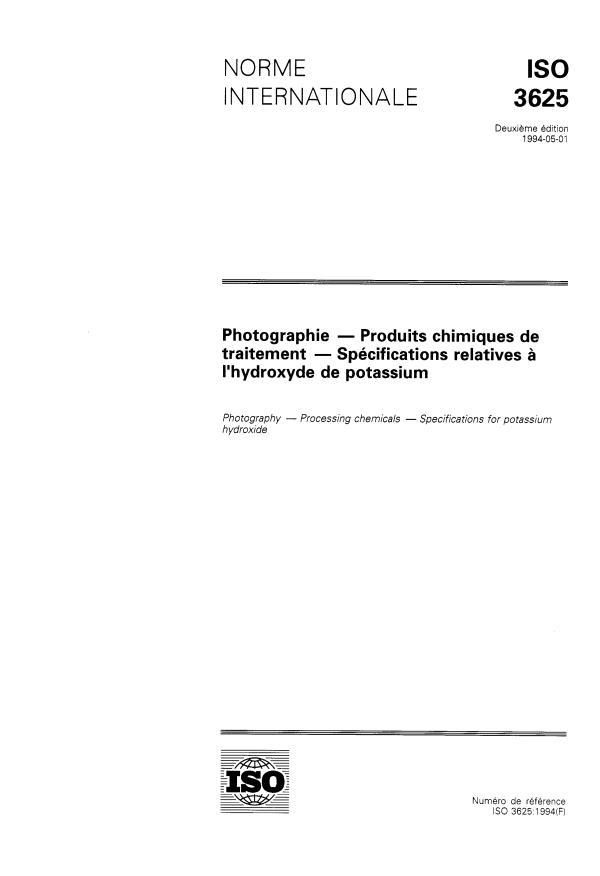
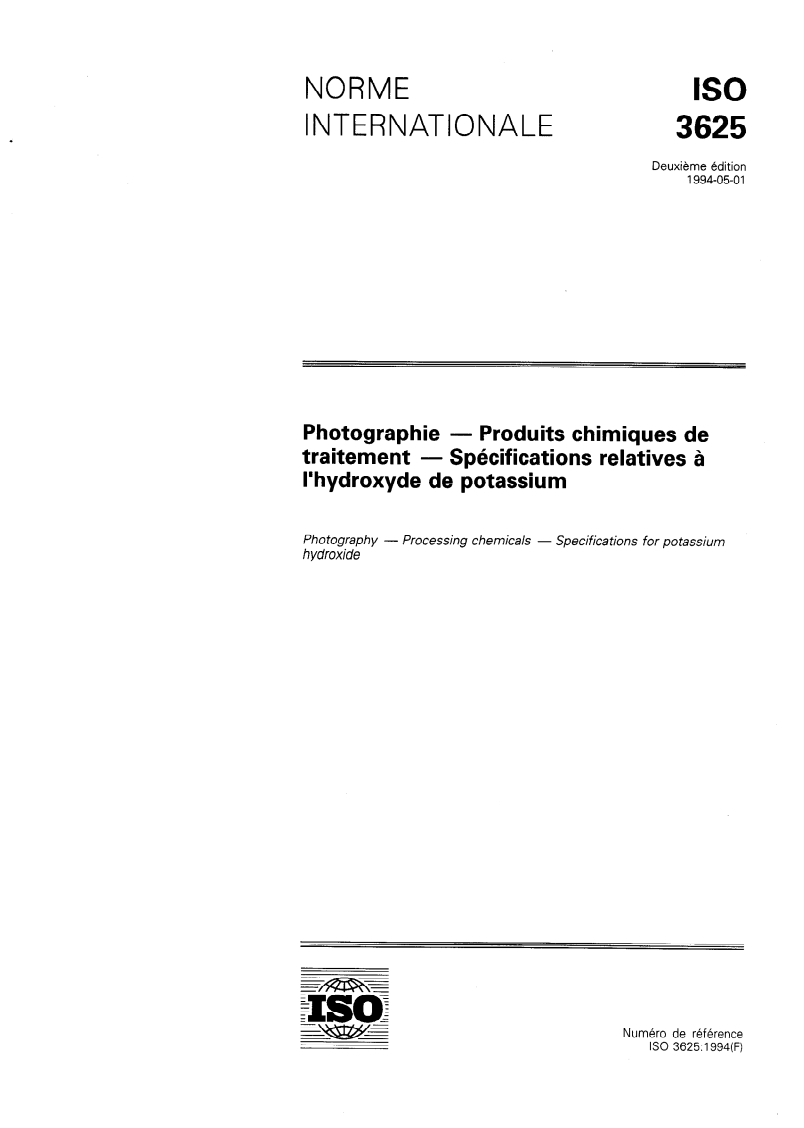
Iso
NORME
INTERNATIONALE 3625
Deuxième édition
1994-05-01
Photographie - Produits chimiques de
- Spécifications relatives à
traitement
l’hydroxyde de potassium
- Processing chemicals - Specifica tions for potassium
Photography
h ydroxide
Numéro de référence
ISO 3625: 1994(F)
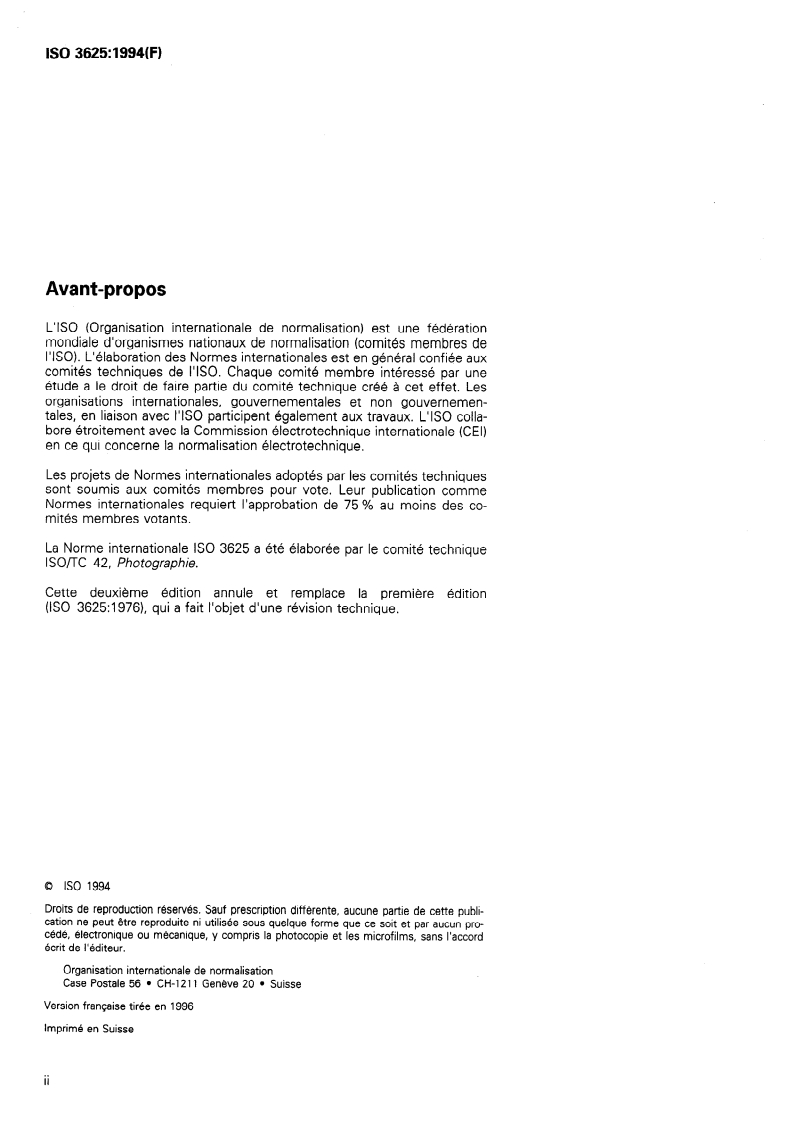
Avant-propos
L’ISO (Organisation internationale de normalisation) est une fédération
mondiale d’organismes nationaux de normalisation (comités membres de
I’ISO). L’élaboration des Normes internationales est en général confiée aux
comités techniques de I’ISO. Chaque comité membre intéressé par une
étude a le droit de faire partie du comité technique créé à cet effet. Les
organisations internationales, gouvernementales et non gouvernemen-
tales, en liaison avec I’ISO participent également aux travaux. L’ISO colla-
bore étroitement avec la Commission électrotechnique internationale (CEI)
en ce qui concerne la normalisation électrotechnique.
Les projets de Normes internationales adoptés par les comités techniques
sont soumis aux comités membres pour vote. Leur publication comme
Normes internationales requiert l’approbation de 75 % au moins des co-
mités membres votants.
La Norme internationale ISO 3625 a été élaborée par le comité technique
ISO/TC 42, Photographie.
Cette deuxième édition annule et remplace la première édition
(ISO 3625:1976), qui a fait l’objet d’une révision technique.
0 ISO 1994
Droits de reproduction réservés. Sauf prescription différente, aucune partie de cette publi-
cation ne peut être reproduite ni utilisée sous quelque forme que ce soit et par aucun pro-
cédé, électronique ou mécanique, y compris la photocopie et les microfilms, sans l’accord
écrit de l’éditeur.
Organisation internationale de normalisation
Case Postale 56 l CH-121 1 Genève 20 l Suisse
Version française tirée en 1996
Imprimé en Suisse
ii
0 ISO
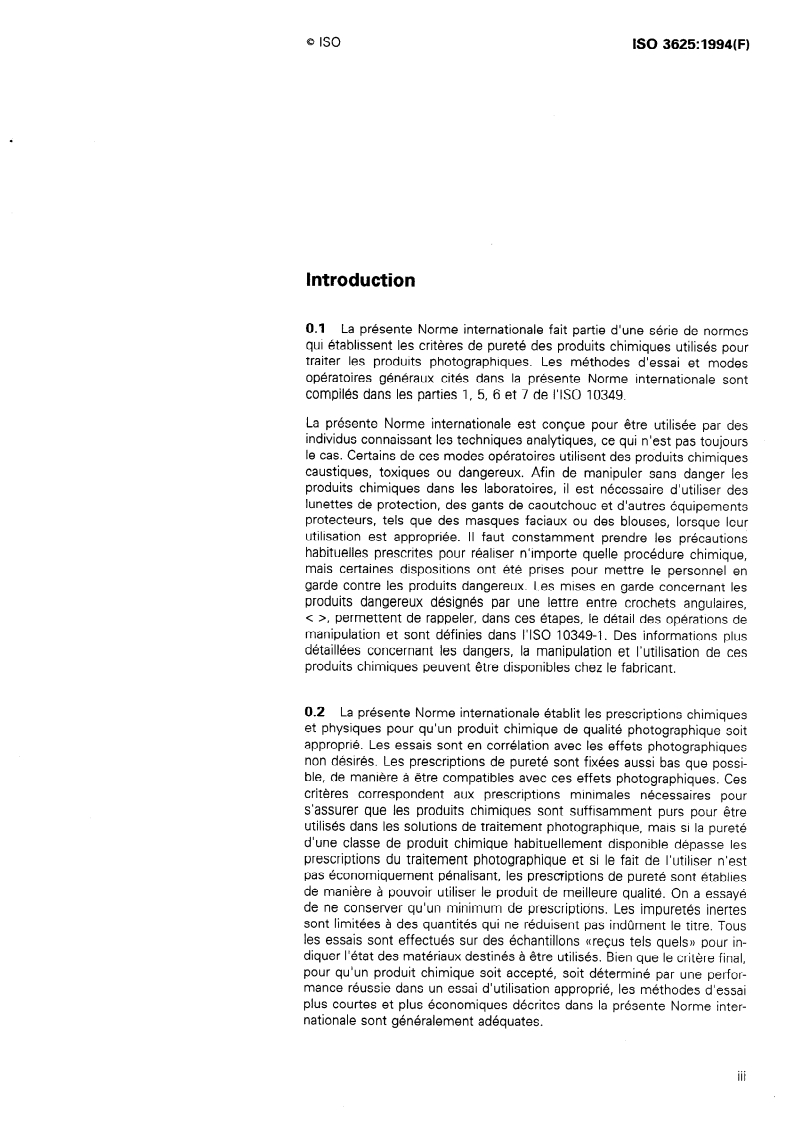
Introduction
0.1 La présente Norme internationale fait partie d’une série de normes
qui établissent les critères de pureté des produits chimiques utilisés pour
traiter les produits photographiques. Les méthodes d’essai et modes
opératoires généraux cités dans la présente Norme internationale sont
compilés dans les parties 1, 5, 6 et 7 de I’ISO 10349.
La présente Norme internationale est conçue pour être utilisée par des
individus connaissant les techniques analytiques, ce qui n’est pas toujours
le cas. Certains de ces modes opératoires utilisent des produits chimiques
caustiques, toxiques ou dangereux. Afin de manipuler sans danger les
produits chimiques dans les laboratoires, il est nécessaire d’utiliser des
lunettes de protection, des gants de caoutchouc et d’autres équipements
protecteurs, tels que des masques faciaux ou des blouses, lorsque leur
utilisation est appropriée. II faut constamment prendre les précautions
habituelles prescrites pour réaliser n’importe quelle procédure chimique,
mais certaines dispositions ont été prises pour mettre le personnel en
garde contre les produits dangereux. Les mises en garde concernant les
produits dangereux désignés par une lettre entre crochets angulaires,
c >, permettent de rappeler, dans ces étapes, le détail des opérations de
manipulation et sont définies dans I’ISO 10349-I. Des informations plus
détaillées concernant les dangers, la manipulation et l’utilisation de ces
produits chimiques peuvent être disponibles chez le fabricant.
0.2 La présente Norme internationale établit les prescriptions chimiques
et physiques pour qu’un produit chimique de qualité photographique soit
approprié. Les essais sont en corrélation avec les effets photographiques
non désirés. Les prescriptions de pureté sont fixées aussi bas que possi-
ble, de manière à être compatibles avec ces effets photographiques. Ces
critères correspondent aux prescriptions minimales nécessaires pour
s’assurer que les produits chimiques sont suffisamment purs pour être
utilisés dans les solutions de traitement photographique, mais si la pureté
d’une classe de produit chimique habituellement disponible dépasse les
prescriptions du traitement photographique et si le fait de l’utiliser n’est
pas économiquement pénalisant, les prescriptions de pureté sont établies
de manière à pouvoir utiliser le produit de meilleure qualité. On a essayé
de ne conserver qu’un minimum de prescriptions. Les impuretés inertes
sont limitées à des quantités qui ne réduisent pas indûment le titre. Tous
les essais sont effectués sur des échantillons ((reçus tels quels) pour in-
diquer l’état des matériaux destinés à être utilisés. Bien que le critère final,
pour qu’un produit chimique soit accepté, soit déterminé par une perfor-
mance réussie dans un essai d’utilisation approprié, les méthodes d’essai
plus courtes et plus économiques décrites dans la présente Norme inter-
nationale sont généralement adéquates.
. . .
III
0 ISO
ISO 3625: 1994(F)
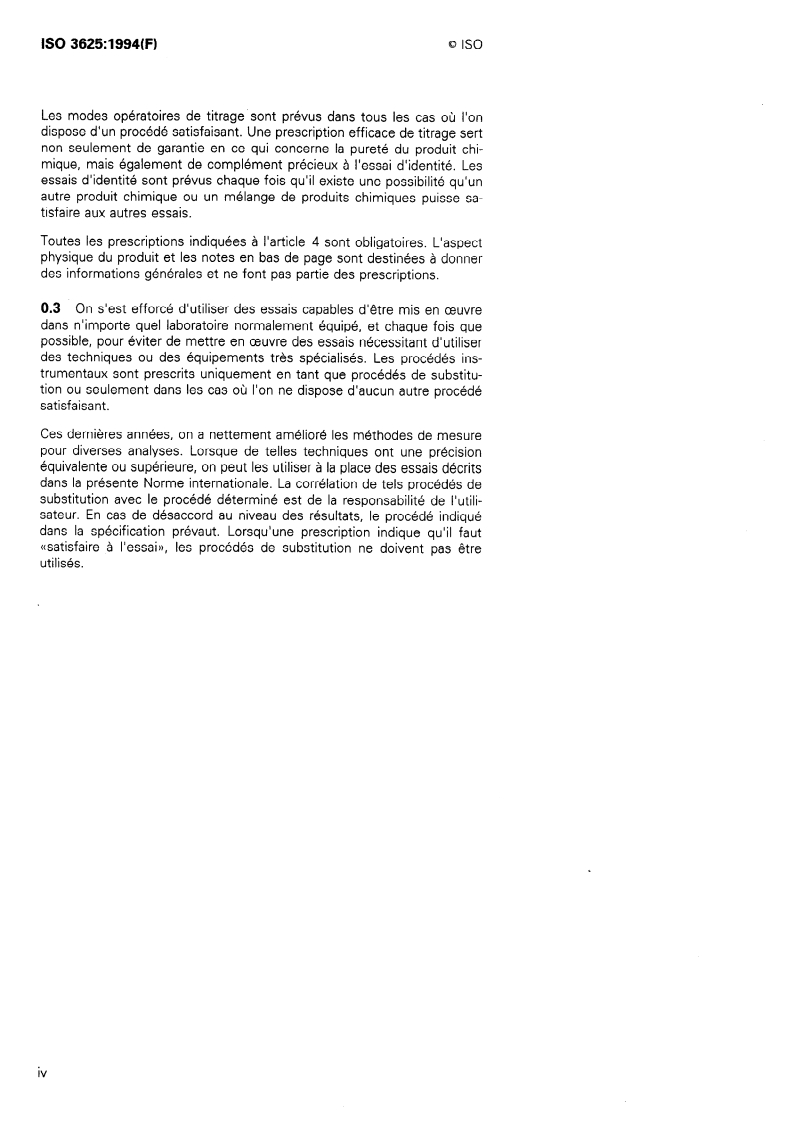
Les modes opératoires de titrage.sont prévus dans tous les cas où l’on
dispose d’un procédé satisfaisant. Une prescription efficace de titrage sert
non seulement de garantie en ce qui concerne la pureté du produit chi-
mique, mais également de complément précieux à l’essai d’identité. Les
essais d’identité sont prévus chaque fois qu’il existe une possibilité qu’un
autre produit chimique ou un mélange de produits chimiques puisse sa-
tisfaire aux autres essais.
Toutes les prescriptions indiquées à l’article 4 sont obligatoires. L’aspect
physique du produit et les notes en bas de page sont destinées à donner
des informations générales et ne font pas partie des prescriptions.
0.3 On s’est efforcé d’utiliser des essais capables d’être mis en œuvre
dans n’importe quel laboratoire normalement équipé, et chaque fois que
possible, pour éviter de mettre en œuvre des essais nécessitant d’utiliser
des techniques ou des équipements très spécialisés. Les procédés ins-
trumentaux sont prescrits uniquement en tant que procédés de substitu-
tion ou seulement dans les cas où l’on ne dispose d’aucun autre procédé
satisfaisant.
Ces dernières années, on a nettement amélioré les méthodes de mesure
pour diverses analyses. Lorsque de telles techniques ont une précision
équivalente ou supérieure, on peut les utiliser à la place des essais décrits
dans la présente Norme internationale. La corrélation de tels procédés de
substitution avec le procédé déterminé est de la responsabilité de I’utili-
sateur. En cas de désaccord au niveau des résultats, le procédé indiqué
dans la spécification prévaut. Lorsqu’une prescription indique qu’il faut
((satisfaire à l’essai)), les procédés de substitution ne doivent pas être
utilisés.
iv
NORME INTERNATIONALE 0 BO ISO 3625: 1994(F)
Photographie - Produits chimiques de traitement -
Spécifications relatives à l’hydroxyde de potassium
ISO 10349-7: 1992, Photographie - Produits chimi-
1 Domaine d’application
ques de qualité photographique - Méthodes d’essai
La présente Norme internationale établit les critères - Partie 7: Détermination de I’alcalinité ou de
de pureté de l’hydroxyde de potassium de qualité l’acidité (Publiée actuellement en anglais seulement).
photograhique (DANGER: <>)l) et décrit les es-
sais à utiliser pour déterminer la pureté.
3 Généralités
2 Références normatives
3.1 Propriétés physiques
Les normes suivantes contiennent des dispositions
L’hydroxyde de potassium, KOH, se trouve sous la
qui, par suite de la référence qui en est faite, consti-
forme de bâtonnets, de granulés, de paillettes, de
tuent des dispositions valables pour la présente
comprimés ou de poudre, de couleur blanche. Sa
Norme internationale. Au moment de la publication,
masse moléculaire relative est égale à 56,ll.
les éditions indiquées étaient en vigueur. Toute
norme est sujette à révision et les parties prenantes
des accords fondés sur la présente Norme internatio-
3.2 Dangers
nale sont invitées à rechercher la possibilité d’appli-
quer les éditions les plus récentes des normes L’hydroxyde de potassium est corrosif (DANGER:
indiquées ci-après. Les membres de la CEI et de I’ISO ccc>>). Éviter le contact avec les yeux, la peau et
possèdent le registre des Normes internationales en les vêtements. Éviter de respirer la poussière. Se ré-
férer aux instructions de sécurité du fabricant pour de
vigueur à un moment donné.
plus amples informations.
ISO 10349-I : 1992, Photographie - Produits chimi-
ques de qualité photographique - Méthodes d’essai
3.3 Manipulation et stockage
- Partie 1: Généralités (Publiée actuellement en an-
glais seulement).
II convient de stocker l’hydroxyde de potassium dans
un conteneur en plastique correctement étiqueté et
ISO 10349-5: 1992, Photographie - Produits chimi
...
NORME
IS0
I N T E R NAT I O NA L E
Deuxihme édition
1994-05-01
Photographie - Produits chimiques de
traitement - Spécifications relatives à
l'hydroxyde de potassium
Photography - Processing chemicals - Specifications for potassium
hydroxide
Numéro de référence
IS0 3625: 1994(F)
IS0 3625:1994(F)
Ava n t -pro pos
L'ISO (Organisation internationale de normalisation) est une fédération
mondiale d'organismes nationaux de normalisation (comités membres de
I'ISO). L'élaboration des Normes internationales est en général confiée aux
comités techniques de I'ISO. Chaque comité membre intéressé par une
étude a le droit de faire partie du comité technique créé à cet effet. Les
organisations internationales, gouvernementales et non gouvernemen-
tales, en liaison avec I'ISO participent également aux travaux. L'ISO colla-
bore étroitement avec la Commission électrotechnique internationale (CEI)
en ce qui concerne la normalisation électrotechnique.
Les projets de Normes internationales adoptés par les comités techniques
sont soumis aux comités membres pour vote. Leur publication comme
Normes internationales requiert l'approbation de 75 ?40 au moins des co-
mités membres votants.
La Norme internationale IS0 3625 a été élaborée par le comité technique
lSO/TC 42, Photographie.
Cette deuxième édition annule et remplace la première édition
(IS0 3625:1976), qui a fait l'objet d'une révision technique.
03 IS0 1994
Droits de reproduction réservés. Sauf prescription différente, aucune partie de cette publi-
cation ne peut être reproduite ni utilisée sous quelque forme que ce soit et par aucun pro-
cédé, électronique ou mécanique, y compris la photocopie et les microfilms, sans l'accord
écrit de I'éditeur.
Organisation internationale de normalisation
Case Postale 56 CH-121 1 Genève 20 Suisse
Version française tirée en 1996
Imprimé en Suisse
II
0 IS0
IS0 3625: 1994( F)
Introduction
0.1 La présente Norme internationale fait partie d'une série de normes
qui établissent les critères de pureté des produits chimiques utilisés pour
traiter les produits photographiques. Les méthodes d'essai et modes
opératoires généraux cités dans la présente Norme internationale sont
compilés dans les parties 1, 5, 6 et 7 de I'ISO 10349.
La présente Norme internationale est conçue pour être utilisée par des
individus connaissant les techniques analytiques, ce qui n'est pas toujours
le cas. Certains de ces modes opératoires utilisent des produits chimiques
caustiques, toxiques ou dangereux. Afin de manipuler sans danger les
produits chimiques dans les laboratoires, il est nécessaire d'utiliser des
lunettes de protection, des gants de caoutchouc et d'autres équipements
protecteurs, tels que des masques faciaux ou des blouses, lorsque leur
utilisation est appropriée. II faut constamment prendre les précautions
habituelles prescrites pour réaliser n'importe quelle procédure chimique,
mais certaines dispositions ont été prises pour mettre le personnel en
garde contre les produits dangereux. Les mises en garde concernant les
produits dangereux désignés par une lettre entre crochets angulaires,
< >, permettent de rappeler, dans ces étapes, le détail des opérations de
manipulation et sont définies dans I'ISO 10349-1. Des informations plus
détaillées concernant les dangers, la manipulation et l'utilisation de ces
produits chimiques peuvent être disponibles chez le fabricant.
0.2 La présente Norme internationale établit les prescriptions chimiques
et physiques pour qu'un produit chimique de qualité photographique soit
approprié. Les essais sont en corrélation avec les effets photographiques
non désirés. Les prescriptions de pureté sont fixées aussi bas que possi-
ble, de manière à être compatibles avec ces effets photographiques. Ces
critères correspondent aux prescriptions minimales nécessaires pour
s'assurer que les produits chimiques sont suffisamment purs pour être
utilisés dans les solutions de traitement photographique, mais si la pureté
d'une classe de produit chimique habituellement disponible dépasse les
prescriptions du traitement photographique et si le fait de l'utiliser n'est
pas économiquement pénalisant, les prescriptions de pureté sont établies
de manière à pouvoir utiliser le produit de meilleure qualité. On a essayé
de ne conserver qu'un minimum de prescriptions. Les impuretés inertes
sont limitées à des quantités qui ne réduisent pas indûment le titre. Tous
les essais sont effectués sur des échantillons ((reçus tels quels)) pour in-
diquer I'état des matériaux destinés à être utilisés. Bien que le critère final,
pour qu'un produit chimique soit accepté, soit déterminé par une perfor-
mance réussie dans un essai d'utilisation approprié, les méthodes d'essai
plus courtes et plus économiques décrites dans la présente Norme inter-
nationale sont généralement adéquates.
8 IS0
IS0 3625:1994(F)
Les modes opératoires de titrage sont prévus dans tous les cas où l'on
dispose d'un procédé satisfaisant. Une prescription efficace de titrage sert
non seulement de garantie en ce qui concerne la pureté du produit chi-
mique, mais également de complément précieux à l'essai d'identité. Les
essais d'identité sont prévus chaque fois qu'il existe une possibilité qu'un
autre produit chimique ou un mélange de produits chimiques puisse sa-
tisfaire aux autres essais.
Toutes les prescriptions indiquées à l'article 4 sont obligatoires. L'aspect
physique du produit et les notes en bas de page sont destinées à donner
des informations générales et ne font pas partie des prescriptions.
0.3 On s'est efforcé d'utiliser des essais capables d'être mis en œuvre
dans n'importe quel laboratoire normalement equipé, et chaque fois que
possible, pour éviter de mettre en œuvre des essais nécessitant d'utiliser
des techniques ou des équipements très spécialisés. Les procédés ins-
trumentaux sont prescrits uniquement en tant que procédés de substitu-
tion ou seulement dans les cas où l'on ne dispose d'aucun autre procédé
satisfaisant.
Ces dernières années, on a nettement amélioré les méthodes de mesure
pour diverses analyses. Lorsque de telles techniques ont une précision
équivalente ou supérieure, on peut les utiliser à la place des essais décrits
dans la présente Norme internationale. La corrélation de tels procédés de
substitution avec le procédé déterminé est de la responsabilité de l'utili-
sateur. En cas de désaccord au niveau des résultats, le procédé indiqué
dans la spécification prévaut. Lorsqu'une prescription indique qu'il faut
((satisfaire à l'essai)), les procédés de substitution ne doivent pas être
utilisés.
iv
~~~~
NORME INTERNATIONALE 0 IS0 IS0 3625: 1994( F)
Photographie - Produits chimiques de traitement -
Spécifications relatives à l'hydroxyde de potassium
IS0 10349-7:1992, Photographie - Produits chimi-
1 Domaine d'application
ques de qualité photographique - Méthodes d'essai
- Partie 7: Détermination de l'alcalinité ou de
La présente Norme internationale établit les criteres
l'acidité (Publiée actuellement en anglais seulement).
de pureté de l'hydroxyde de potassium de qualité
photograhique (DANGER: << C >>)'I et décrit les es-
sais à utiliser pour déterminer la pureté.
3 Généralités
2 Références normatives
3.1 Propriétés physiques
Les normes suivantes contiennent des dispositions
L'hydroxyde de potassium, KOH, se trouve sous la
qui, par suite de la référence qui en est faite, consti-
forme de bâtonnets, de granulés, de paillettes, de
tuent des dispositions valables pour la présente
comprimés ou de poudre, de couleur blanche. Sa
Norme internationale. Au moment de la publication,
masse moléculaire relative est égale à 56,ll.
les éditions indiquées étaient en vigueur. Toute
norme est sujette à révision et les parties prenantes
des accords fondés sur la présente Norme internatio-
3.2 Dangers
nale sont invitées à rechercher la possibilité d'appli-
quer les éditions les plus récentes des normes L'hydroxyde de potassium est corrosif (DANGER:
indiquées ci-après. Les membres de la CE1 et de I'ISO <>). Éviter le contact avec les yeux, la peau et
possèdent le registre des Normes internationales en les vêtements. Éviter de respirer la poussière. Se ré-
férer aux instructions de sécurité du fabricant pour de
vigueur à un moment donné.
plus amples informations.
IS0 10349-1 :I 992, Photographie - Produits chimi-
ques de qualité photographique - Méthodes d'essai
3.3 Manipulation et stockage
- Partie 1: Généralités (Publiée actuellement en an-
glais seulemen t).
II convient de stocker l'hydr
...
NORME
IS0
I N T E R NAT I O NA L E
Deuxihme édition
1994-05-01
Photographie - Produits chimiques de
traitement - Spécifications relatives à
l'hydroxyde de potassium
Photography - Processing chemicals - Specifications for potassium
hydroxide
Numéro de référence
IS0 3625: 1994(F)
IS0 3625:1994(F)
Ava n t -pro pos
L'ISO (Organisation internationale de normalisation) est une fédération
mondiale d'organismes nationaux de normalisation (comités membres de
I'ISO). L'élaboration des Normes internationales est en général confiée aux
comités techniques de I'ISO. Chaque comité membre intéressé par une
étude a le droit de faire partie du comité technique créé à cet effet. Les
organisations internationales, gouvernementales et non gouvernemen-
tales, en liaison avec I'ISO participent également aux travaux. L'ISO colla-
bore étroitement avec la Commission électrotechnique internationale (CEI)
en ce qui concerne la normalisation électrotechnique.
Les projets de Normes internationales adoptés par les comités techniques
sont soumis aux comités membres pour vote. Leur publication comme
Normes internationales requiert l'approbation de 75 ?40 au moins des co-
mités membres votants.
La Norme internationale IS0 3625 a été élaborée par le comité technique
lSO/TC 42, Photographie.
Cette deuxième édition annule et remplace la première édition
(IS0 3625:1976), qui a fait l'objet d'une révision technique.
03 IS0 1994
Droits de reproduction réservés. Sauf prescription différente, aucune partie de cette publi-
cation ne peut être reproduite ni utilisée sous quelque forme que ce soit et par aucun pro-
cédé, électronique ou mécanique, y compris la photocopie et les microfilms, sans l'accord
écrit de I'éditeur.
Organisation internationale de normalisation
Case Postale 56 CH-121 1 Genève 20 Suisse
Version française tirée en 1996
Imprimé en Suisse
II
0 IS0
IS0 3625: 1994( F)
Introduction
0.1 La présente Norme internationale fait partie d'une série de normes
qui établissent les critères de pureté des produits chimiques utilisés pour
traiter les produits photographiques. Les méthodes d'essai et modes
opératoires généraux cités dans la présente Norme internationale sont
compilés dans les parties 1, 5, 6 et 7 de I'ISO 10349.
La présente Norme internationale est conçue pour être utilisée par des
individus connaissant les techniques analytiques, ce qui n'est pas toujours
le cas. Certains de ces modes opératoires utilisent des produits chimiques
caustiques, toxiques ou dangereux. Afin de manipuler sans danger les
produits chimiques dans les laboratoires, il est nécessaire d'utiliser des
lunettes de protection, des gants de caoutchouc et d'autres équipements
protecteurs, tels que des masques faciaux ou des blouses, lorsque leur
utilisation est appropriée. II faut constamment prendre les précautions
habituelles prescrites pour réaliser n'importe quelle procédure chimique,
mais certaines dispositions ont été prises pour mettre le personnel en
garde contre les produits dangereux. Les mises en garde concernant les
produits dangereux désignés par une lettre entre crochets angulaires,
< >, permettent de rappeler, dans ces étapes, le détail des opérations de
manipulation et sont définies dans I'ISO 10349-1. Des informations plus
détaillées concernant les dangers, la manipulation et l'utilisation de ces
produits chimiques peuvent être disponibles chez le fabricant.
0.2 La présente Norme internationale établit les prescriptions chimiques
et physiques pour qu'un produit chimique de qualité photographique soit
approprié. Les essais sont en corrélation avec les effets photographiques
non désirés. Les prescriptions de pureté sont fixées aussi bas que possi-
ble, de manière à être compatibles avec ces effets photographiques. Ces
critères correspondent aux prescriptions minimales nécessaires pour
s'assurer que les produits chimiques sont suffisamment purs pour être
utilisés dans les solutions de traitement photographique, mais si la pureté
d'une classe de produit chimique habituellement disponible dépasse les
prescriptions du traitement photographique et si le fait de l'utiliser n'est
pas économiquement pénalisant, les prescriptions de pureté sont établies
de manière à pouvoir utiliser le produit de meilleure qualité. On a essayé
de ne conserver qu'un minimum de prescriptions. Les impuretés inertes
sont limitées à des quantités qui ne réduisent pas indûment le titre. Tous
les essais sont effectués sur des échantillons ((reçus tels quels)) pour in-
diquer I'état des matériaux destinés à être utilisés. Bien que le critère final,
pour qu'un produit chimique soit accepté, soit déterminé par une perfor-
mance réussie dans un essai d'utilisation approprié, les méthodes d'essai
plus courtes et plus économiques décrites dans la présente Norme inter-
nationale sont généralement adéquates.
8 IS0
IS0 3625:1994(F)
Les modes opératoires de titrage sont prévus dans tous les cas où l'on
dispose d'un procédé satisfaisant. Une prescription efficace de titrage sert
non seulement de garantie en ce qui concerne la pureté du produit chi-
mique, mais également de complément précieux à l'essai d'identité. Les
essais d'identité sont prévus chaque fois qu'il existe une possibilité qu'un
autre produit chimique ou un mélange de produits chimiques puisse sa-
tisfaire aux autres essais.
Toutes les prescriptions indiquées à l'article 4 sont obligatoires. L'aspect
physique du produit et les notes en bas de page sont destinées à donner
des informations générales et ne font pas partie des prescriptions.
0.3 On s'est efforcé d'utiliser des essais capables d'être mis en œuvre
dans n'importe quel laboratoire normalement equipé, et chaque fois que
possible, pour éviter de mettre en œuvre des essais nécessitant d'utiliser
des techniques ou des équipements très spécialisés. Les procédés ins-
trumentaux sont prescrits uniquement en tant que procédés de substitu-
tion ou seulement dans les cas où l'on ne dispose d'aucun autre procédé
satisfaisant.
Ces dernières années, on a nettement amélioré les méthodes de mesure
pour diverses analyses. Lorsque de telles techniques ont une précision
équivalente ou supérieure, on peut les utiliser à la place des essais décrits
dans la présente Norme internationale. La corrélation de tels procédés de
substitution avec le procédé déterminé est de la responsabilité de l'utili-
sateur. En cas de désaccord au niveau des résultats, le procédé indiqué
dans la spécification prévaut. Lorsqu'une prescription indique qu'il faut
((satisfaire à l'essai)), les procédés de substitution ne doivent pas être
utilisés.
iv
~~~~
NORME INTERNATIONALE 0 IS0 IS0 3625: 1994( F)
Photographie - Produits chimiques de traitement -
Spécifications relatives à l'hydroxyde de potassium
IS0 10349-7:1992, Photographie - Produits chimi-
1 Domaine d'application
ques de qualité photographique - Méthodes d'essai
- Partie 7: Détermination de l'alcalinité ou de
La présente Norme internationale établit les criteres
l'acidité (Publiée actuellement en anglais seulement).
de pureté de l'hydroxyde de potassium de qualité
photograhique (DANGER: << C >>)'I et décrit les es-
sais à utiliser pour déterminer la pureté.
3 Généralités
2 Références normatives
3.1 Propriétés physiques
Les normes suivantes contiennent des dispositions
L'hydroxyde de potassium, KOH, se trouve sous la
qui, par suite de la référence qui en est faite, consti-
forme de bâtonnets, de granulés, de paillettes, de
tuent des dispositions valables pour la présente
comprimés ou de poudre, de couleur blanche. Sa
Norme internationale. Au moment de la publication,
masse moléculaire relative est égale à 56,ll.
les éditions indiquées étaient en vigueur. Toute
norme est sujette à révision et les parties prenantes
des accords fondés sur la présente Norme internatio-
3.2 Dangers
nale sont invitées à rechercher la possibilité d'appli-
quer les éditions les plus récentes des normes L'hydroxyde de potassium est corrosif (DANGER:
indiquées ci-après. Les membres de la CE1 et de I'ISO <>). Éviter le contact avec les yeux, la peau et
possèdent le registre des Normes internationales en les vêtements. Éviter de respirer la poussière. Se ré-
férer aux instructions de sécurité du fabricant pour de
vigueur à un moment donné.
plus amples informations.
IS0 10349-1 :I 992, Photographie - Produits chimi-
ques de qualité photographique - Méthodes d'essai
3.3 Manipulation et stockage
- Partie 1: Généralités (Publiée actuellement en an-
glais seulemen t).
II convient de stocker l'hydr
...
Iso
NORME
INTERNATIONALE 3625
Deuxième édition
1994-05-01
Photographie - Produits chimiques de
- Spécifications relatives à
traitement
l’hydroxyde de potassium
- Processing chemicals - Specifica tions for potassium
Photography
h ydroxide
Numéro de référence
ISO 3625: 1994(F)
Avant-propos
L’ISO (Organisation internationale de normalisation) est une fédération
mondiale d’organismes nationaux de normalisation (comités membres de
I’ISO). L’élaboration des Normes internationales est en général confiée aux
comités techniques de I’ISO. Chaque comité membre intéressé par une
étude a le droit de faire partie du comité technique créé à cet effet. Les
organisations internationales, gouvernementales et non gouvernemen-
tales, en liaison avec I’ISO participent également aux travaux. L’ISO colla-
bore étroitement avec la Commission électrotechnique internationale (CEI)
en ce qui concerne la normalisation électrotechnique.
Les projets de Normes internationales adoptés par les comités techniques
sont soumis aux comités membres pour vote. Leur publication comme
Normes internationales requiert l’approbation de 75 % au moins des co-
mités membres votants.
La Norme internationale ISO 3625 a été élaborée par le comité technique
ISO/TC 42, Photographie.
Cette deuxième édition annule et remplace la première édition
(ISO 3625:1976), qui a fait l’objet d’une révision technique.
0 ISO 1994
Droits de reproduction réservés. Sauf prescription différente, aucune partie de cette publi-
cation ne peut être reproduite ni utilisée sous quelque forme que ce soit et par aucun pro-
cédé, électronique ou mécanique, y compris la photocopie et les microfilms, sans l’accord
écrit de l’éditeur.
Organisation internationale de normalisation
Case Postale 56 l CH-121 1 Genève 20 l Suisse
Version française tirée en 1996
Imprimé en Suisse
ii
0 ISO
Introduction
0.1 La présente Norme internationale fait partie d’une série de normes
qui établissent les critères de pureté des produits chimiques utilisés pour
traiter les produits photographiques. Les méthodes d’essai et modes
opératoires généraux cités dans la présente Norme internationale sont
compilés dans les parties 1, 5, 6 et 7 de I’ISO 10349.
La présente Norme internationale est conçue pour être utilisée par des
individus connaissant les techniques analytiques, ce qui n’est pas toujours
le cas. Certains de ces modes opératoires utilisent des produits chimiques
caustiques, toxiques ou dangereux. Afin de manipuler sans danger les
produits chimiques dans les laboratoires, il est nécessaire d’utiliser des
lunettes de protection, des gants de caoutchouc et d’autres équipements
protecteurs, tels que des masques faciaux ou des blouses, lorsque leur
utilisation est appropriée. II faut constamment prendre les précautions
habituelles prescrites pour réaliser n’importe quelle procédure chimique,
mais certaines dispositions ont été prises pour mettre le personnel en
garde contre les produits dangereux. Les mises en garde concernant les
produits dangereux désignés par une lettre entre crochets angulaires,
c >, permettent de rappeler, dans ces étapes, le détail des opérations de
manipulation et sont définies dans I’ISO 10349-I. Des informations plus
détaillées concernant les dangers, la manipulation et l’utilisation de ces
produits chimiques peuvent être disponibles chez le fabricant.
0.2 La présente Norme internationale établit les prescriptions chimiques
et physiques pour qu’un produit chimique de qualité photographique soit
approprié. Les essais sont en corrélation avec les effets photographiques
non désirés. Les prescriptions de pureté sont fixées aussi bas que possi-
ble, de manière à être compatibles avec ces effets photographiques. Ces
critères correspondent aux prescriptions minimales nécessaires pour
s’assurer que les produits chimiques sont suffisamment purs pour être
utilisés dans les solutions de traitement photographique, mais si la pureté
d’une classe de produit chimique habituellement disponible dépasse les
prescriptions du traitement photographique et si le fait de l’utiliser n’est
pas économiquement pénalisant, les prescriptions de pureté sont établies
de manière à pouvoir utiliser le produit de meilleure qualité. On a essayé
de ne conserver qu’un minimum de prescriptions. Les impuretés inertes
sont limitées à des quantités qui ne réduisent pas indûment le titre. Tous
les essais sont effectués sur des échantillons ((reçus tels quels) pour in-
diquer l’état des matériaux destinés à être utilisés. Bien que le critère final,
pour qu’un produit chimique soit accepté, soit déterminé par une perfor-
mance réussie dans un essai d’utilisation approprié, les méthodes d’essai
plus courtes et plus économiques décrites dans la présente Norme inter-
nationale sont généralement adéquates.
. . .
III
0 ISO
ISO 3625: 1994(F)
Les modes opératoires de titrage.sont prévus dans tous les cas où l’on
dispose d’un procédé satisfaisant. Une prescription efficace de titrage sert
non seulement de garantie en ce qui concerne la pureté du produit chi-
mique, mais également de complément précieux à l’essai d’identité. Les
essais d’identité sont prévus chaque fois qu’il existe une possibilité qu’un
autre produit chimique ou un mélange de produits chimiques puisse sa-
tisfaire aux autres essais.
Toutes les prescriptions indiquées à l’article 4 sont obligatoires. L’aspect
physique du produit et les notes en bas de page sont destinées à donner
des informations générales et ne font pas partie des prescriptions.
0.3 On s’est efforcé d’utiliser des essais capables d’être mis en œuvre
dans n’importe quel laboratoire normalement équipé, et chaque fois que
possible, pour éviter de mettre en œuvre des essais nécessitant d’utiliser
des techniques ou des équipements très spécialisés. Les procédés ins-
trumentaux sont prescrits uniquement en tant que procédés de substitu-
tion ou seulement dans les cas où l’on ne dispose d’aucun autre procédé
satisfaisant.
Ces dernières années, on a nettement amélioré les méthodes de mesure
pour diverses analyses. Lorsque de telles techniques ont une précision
équivalente ou supérieure, on peut les utiliser à la place des essais décrits
dans la présente Norme internationale. La corrélation de tels procédés de
substitution avec le procédé déterminé est de la responsabilité de I’utili-
sateur. En cas de désaccord au niveau des résultats, le procédé indiqué
dans la spécification prévaut. Lorsqu’une prescription indique qu’il faut
((satisfaire à l’essai)), les procédés de substitution ne doivent pas être
utilisés.
iv
NORME INTERNATIONALE 0 BO ISO 3625: 1994(F)
Photographie - Produits chimiques de traitement -
Spécifications relatives à l’hydroxyde de potassium
ISO 10349-7: 1992, Photographie - Produits chimi-
1 Domaine d’application
ques de qualité photographique - Méthodes d’essai
La présente Norme internationale établit les critères - Partie 7: Détermination de I’alcalinité ou de
de pureté de l’hydroxyde de potassium de qualité l’acidité (Publiée actuellement en anglais seulement).
photograhique (DANGER: <>)l) et décrit les es-
sais à utiliser pour déterminer la pureté.
3 Généralités
2 Références normatives
3.1 Propriétés physiques
Les normes suivantes contiennent des dispositions
L’hydroxyde de potassium, KOH, se trouve sous la
qui, par suite de la référence qui en est faite, consti-
forme de bâtonnets, de granulés, de paillettes, de
tuent des dispositions valables pour la présente
comprimés ou de poudre, de couleur blanche. Sa
Norme internationale. Au moment de la publication,
masse moléculaire relative est égale à 56,ll.
les éditions indiquées étaient en vigueur. Toute
norme est sujette à révision et les parties prenantes
des accords fondés sur la présente Norme internatio-
3.2 Dangers
nale sont invitées à rechercher la possibilité d’appli-
quer les éditions les plus récentes des normes L’hydroxyde de potassium est corrosif (DANGER:
indiquées ci-après. Les membres de la CEI et de I’ISO ccc>>). Éviter le contact avec les yeux, la peau et
possèdent le registre des Normes internationales en les vêtements. Éviter de respirer la poussière. Se ré-
férer aux instructions de sécurité du fabricant pour de
vigueur à un moment donné.
plus amples informations.
ISO 10349-I : 1992, Photographie - Produits chimi-
ques de qualité photographique - Méthodes d’essai
3.3 Manipulation et stockage
- Partie 1: Généralités (Publiée actuellement en an-
glais seulement).
II convient de stocker l’hydroxyde de potassium dans
un conteneur en plastique correctement étiqueté et
ISO 10349-5: 1992, Photographie - Produits chimi
...