


ISO 10079-2:2022
(Main)Medical suction equipment — Part 2: Manually powered suction equipment
Medical suction equipment — Part 2: Manually powered suction equipment
This document specifies safety and performance requirements for manually powered suction equipment intended for oro-pharyngeal suction. It applies to equipment operated by foot or by hand or both. The commonest use of manually powered suction is in situations outside of healthcare settings often described as field use or transport use. Use in these situations may involve extreme conditions of weather or terrain. Additional/alternative requirements for manually powered suction equipment intended for field use or transport use are included in this document. This document does not apply to mucus extractors.
Appareils d'aspiration médicale — Partie 2: Appareils d'aspiration manuelle
Le présent document spécifie les exigences de sécurité et de performance relatives aux appareils d'aspiration manuelle servant à l'aspiration oro-pharyngée. Elle s'applique aux appareils actionnés avec le pied ou avec la main ou avec les deux. Les appareils d'aspiration manuelle sont le plus souvent utilisés dans des situations en dehors des établissements de soins souvent décrites comme des utilisations sur le terrain ou lors d’un transport. L'utilisation dans ces conditions peut impliquer des situations météorologiques ou de terrain extrêmes. Le présent document comporte des exigences supplémentaires/alternatives pour les appareils d'aspiration manuelle prévus pour une utilisation sur le terrain ou une utilisation lors d’un transport. Le présent document ne s’applique pas aux les extracteurs de mucosités.
General Information
- Status
- Published
- Publication Date
- 15-Mar-2022
- Technical Committee
- ISO/TC 121/SC 8 - Suction devices
- Drafting Committee
- ISO/TC 121/SC 8 - Suction devices
- Current Stage
- 6060 - International Standard published
- Start Date
- 16-Mar-2022
- Due Date
- 28-Jan-2022
- Completion Date
- 16-Mar-2022
Relations
- Effective Date
- 12-Feb-2026
- Effective Date
- 06-Jun-2022
- Effective Date
- 17-Jul-2021
Overview
ISO 10079-2:2022 defines the safety and performance requirements for manually powered suction equipment designed for oro-pharyngeal suction procedures. This International Standard applies to suction devices operated by hand, foot, or both, with emphasis on equipment suited for use in non-traditional healthcare locations, such as during field operations or medical transport situations. Manually powered suction equipment is critical for airway management when electrical or battery-operated devices are unavailable, especially in extreme conditions. The standard provides specific guidelines to ensure patient safety and device effectiveness, including additional requirements for rugged environments. Note that this standard does not apply to mucus extractors.
Key Topics
- Scope and Purpose: Defines essential safety and performance requirements for non-electrical suction devices used for oro-pharyngeal suction, particularly in emergency, field, or ambulance settings.
- Operation Methods: Covers both foot-operated and hand-operated suction devices, ensuring they require manageable physical force for activation.
- Extreme Conditions: Includes supplementary requirements for equipment reliability in harsh environments, where weather and terrain may present significant challenges.
- Design and Usability: Focuses on ease of operation and ergonomic considerations to enable fast, effective response during emergencies.
- Water Resistance: Specifies performance validation after potential submersion, enhancing device suitability for unpredictable field conditions.
- Materials and Construction: References ISO 10079-4 for material standards, ensuring durability and biocompatibility.
- Manufacturer Obligations: Outlines the information that manufacturers must supply regarding the equipment, supporting proper selection, use, and maintenance.
Applications
ISO 10079-2:2022 has broad practical applications wherever reliable, manually powered suction is required, particularly when electrical power is unavailable or unreliable. Key use cases include:
- Emergency and Disaster Response: Enables airway management in disaster zones, remote locations, and mass casualty events.
- Ambulance and Medical Transport: Guarantees suction capability during patient transport by land, air, or sea, where equipment may be exposed to vibration, movement, or moisture.
- Military and Field Medicine: Ensures robust performance for field medics and military medical personnel operating in challenging environments.
- Resource-Limited Healthcare Settings: Provides essential airway management in clinics or regions lacking stable electrical infrastructure.
Employing equipment conforming to ISO 10079-2:2022 enhances both patient safety and responder effectiveness through standardized performance, reliable operation, and transparency of manufacturer information.
Related Standards
Organizations and professionals referencing ISO 10079-2:2022 should also consider these related standards:
- ISO 10079-1: Medical suction equipment - Part 1: Electrically powered suction equipment.
- ISO 10079-3: Medical suction equipment - Part 3: Suction equipment powered from a vacuum or positive pressure gas source.
- ISO 10079-4: Medical suction equipment - Part 4: General requirements - Specifies general requirements applicable to all medical suction devices, referenced throughout ISO 10079-2.
- IEC Electropedia & ISO Online Browsing Platform: Offer standardized terminology for suction devices and related equipment.
By adhering to ISO 10079-2:2022, manufacturers, healthcare providers, and emergency responders can ensure that their manually powered suction equipment meets stringent international safety and performance benchmarks, supporting high standards of care even in the most demanding situations.
Buy Documents
ISO 10079-2:2022 - Medical suction equipment — Part 2: Manually powered suction equipment Released:3/16/2022
ISO 10079-2:2022 - Medical suction equipment — Part 2: Manually powered suction equipment Released:3/16/2022
Get Certified
Connect with accredited certification bodies for this standard

BSI Group
BSI (British Standards Institution) is the business standards company that helps organizations make excellence a habit.

TÜV Rheinland
TÜV Rheinland is a leading international provider of technical services.

TÜV SÜD
TÜV SÜD is a trusted partner of choice for safety, security and sustainability solutions.
Sponsored listings
Frequently Asked Questions
ISO 10079-2:2022 is a standard published by the International Organization for Standardization (ISO). Its full title is "Medical suction equipment — Part 2: Manually powered suction equipment". This standard covers: This document specifies safety and performance requirements for manually powered suction equipment intended for oro-pharyngeal suction. It applies to equipment operated by foot or by hand or both. The commonest use of manually powered suction is in situations outside of healthcare settings often described as field use or transport use. Use in these situations may involve extreme conditions of weather or terrain. Additional/alternative requirements for manually powered suction equipment intended for field use or transport use are included in this document. This document does not apply to mucus extractors.
This document specifies safety and performance requirements for manually powered suction equipment intended for oro-pharyngeal suction. It applies to equipment operated by foot or by hand or both. The commonest use of manually powered suction is in situations outside of healthcare settings often described as field use or transport use. Use in these situations may involve extreme conditions of weather or terrain. Additional/alternative requirements for manually powered suction equipment intended for field use or transport use are included in this document. This document does not apply to mucus extractors.
ISO 10079-2:2022 is classified under the following ICS (International Classification for Standards) categories: 11.040.10 - Anaesthetic, respiratory and reanimation equipment. The ICS classification helps identify the subject area and facilitates finding related standards.
ISO 10079-2:2022 has the following relationships with other standards: It is inter standard links to EN ISO 10079-2:2022, ISO/IEC TR 27103:2018, ISO 10079-2:2014. Understanding these relationships helps ensure you are using the most current and applicable version of the standard.
ISO 10079-2:2022 is available in PDF format for immediate download after purchase. The document can be added to your cart and obtained through the secure checkout process. Digital delivery ensures instant access to the complete standard document.
Standards Content (Sample)
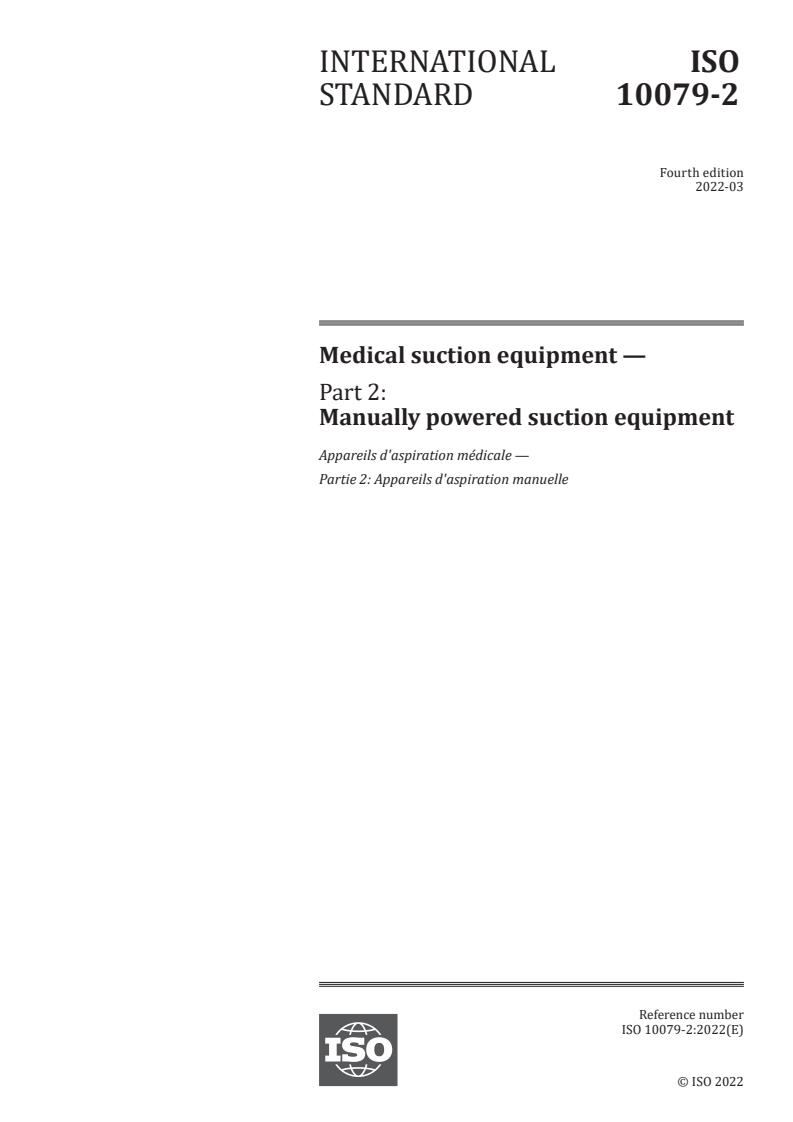
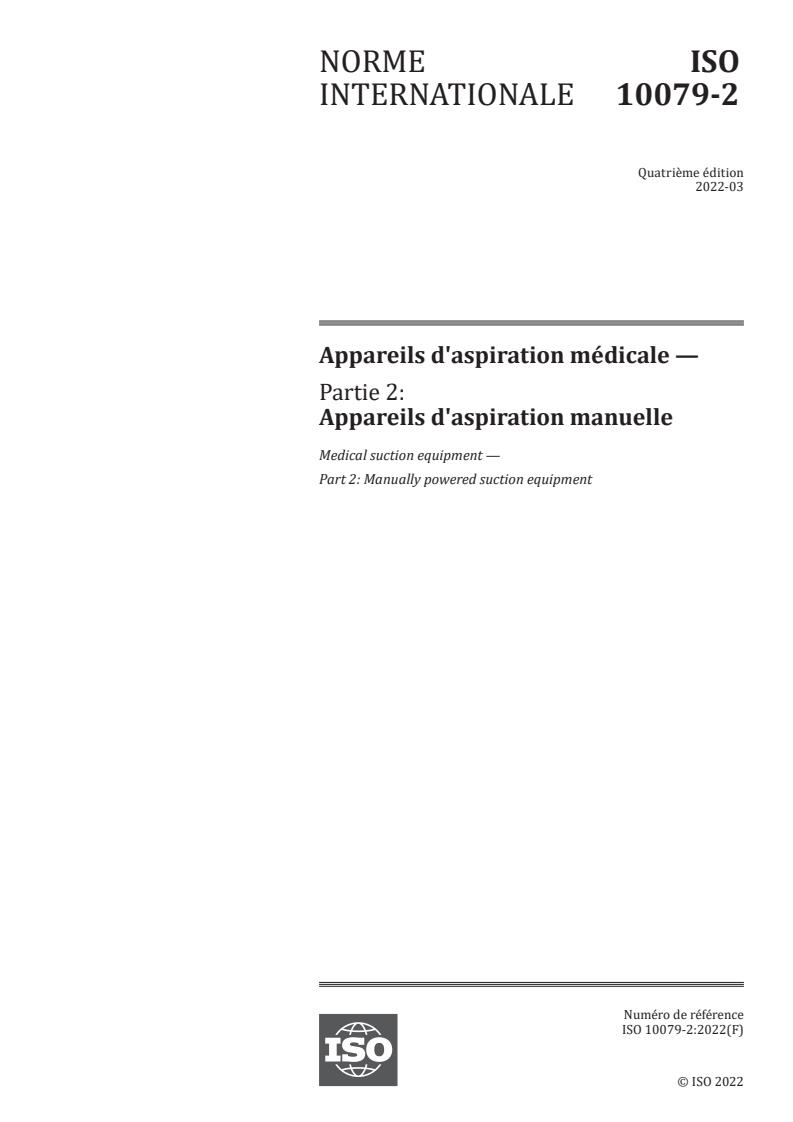
INTERNATIONAL ISO
STANDARD 10079-2
Fourth edition
2022-03
Medical suction equipment —
Part 2:
Manually powered suction equipment
Appareils d'aspiration médicale —
Partie 2: Appareils d'aspiration manuelle
Reference number
© ISO 2022
All rights reserved. Unless otherwise specified, or required in the context of its implementation, no part of this publication may
be reproduced or utilized otherwise in any form or by any means, electronic or mechanical, including photocopying, or posting on
the internet or an intranet, without prior written permission. Permission can be requested from either ISO at the address below
or ISO’s member body in the country of the requester.
ISO copyright office
CP 401 • Ch. de Blandonnet 8
CH-1214 Vernier, Geneva
Phone: +41 22 749 01 11
Email: copyright@iso.org
Website: www.iso.org
Published in Switzerland
ii
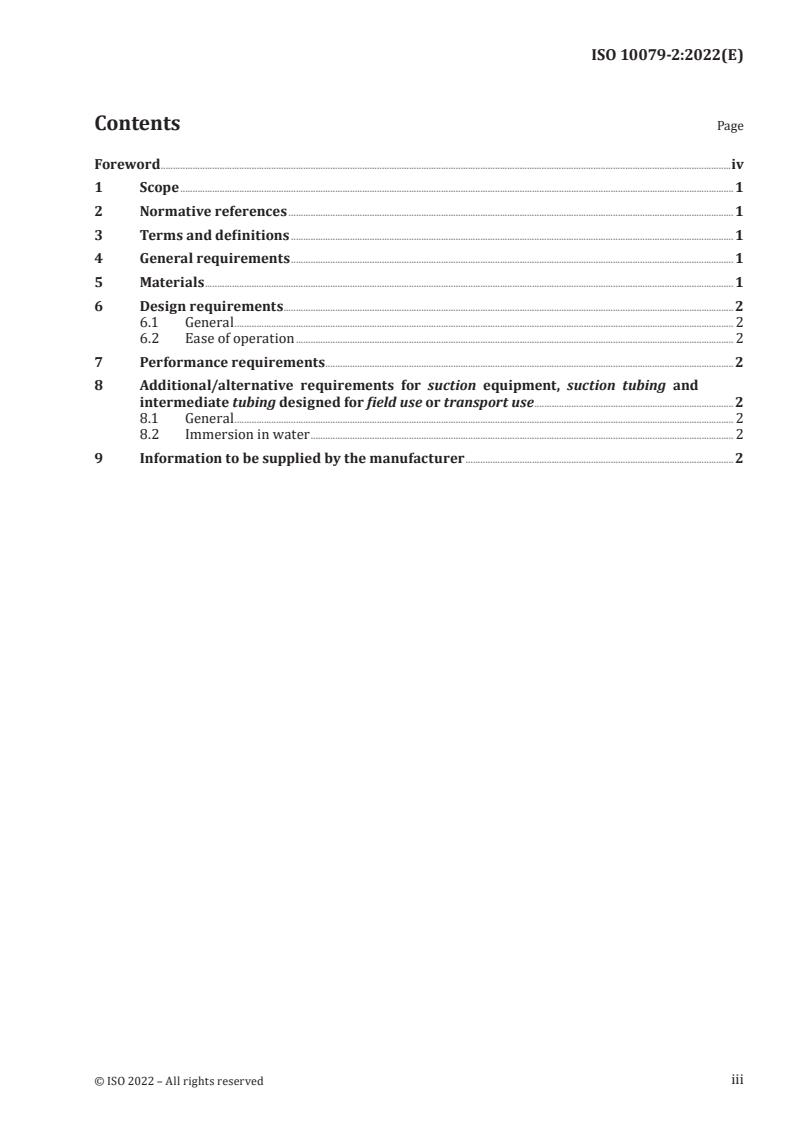
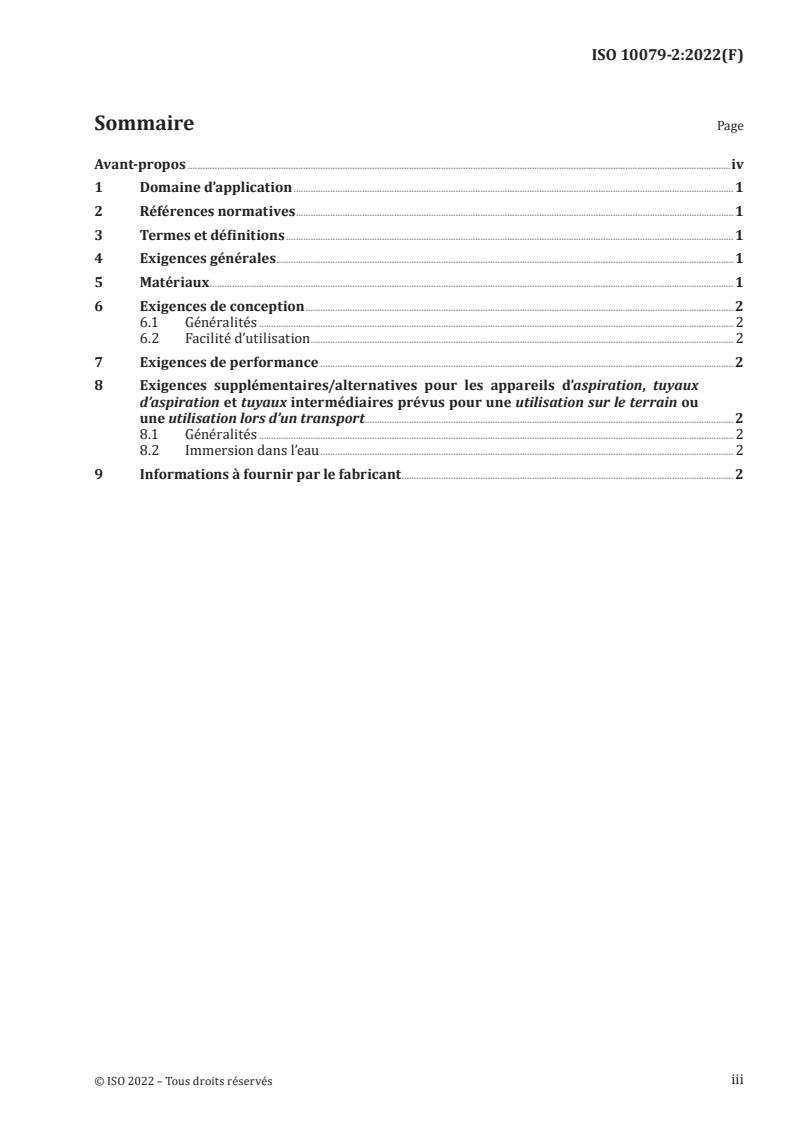
Contents Page
Foreword .iv
1 Scope . 1
2 Normative references . 1
3 Terms and definitions . 1
4 General requirements . 1
5 Materials . 1
6 Design requirements .2
6.1 General . 2
6.2 Ease of operation . 2
7 Performance requirements . .2
8 Additional/alternative requirements for suction equipment, suction tubing and
intermediate tubing designed for field use or transport use .2
8.1 General . 2
8.2 Immersion in water . 2
9 Information to be supplied by the manufacturer . 2
iii
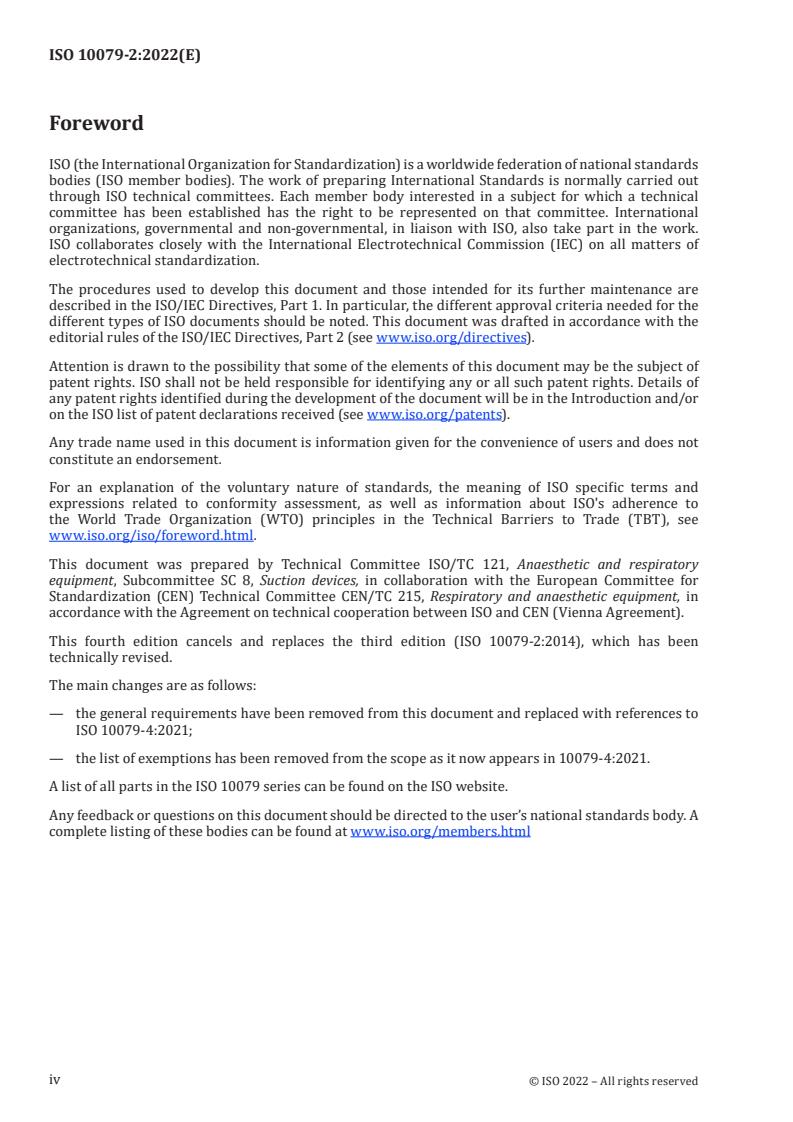
Foreword
ISO (the International Organization for Standardization) is a worldwide federation of national standards
bodies (ISO member bodies). The work of preparing International Standards is normally carried out
through ISO technical committees. Each member body interested in a subject for which a technical
committee has been established has the right to be represented on that committee. International
organizations, governmental and non-governmental, in liaison with ISO, also take part in the work.
ISO collaborates closely with the International Electrotechnical Commission (IEC) on all matters of
electrotechnical standardization.
The procedures used to develop this document and those intended for its further maintenance are
described in the ISO/IEC Directives, Part 1. In particular, the different approval criteria needed for the
different types of ISO documents should be noted. This document was drafted in accordance with the
editorial rules of the ISO/IEC Directives, Part 2 (see www.iso.org/directives).
Attention is drawn to the possibility
...
NORME ISO
INTERNATIONALE 10079-2
Quatrième édition
2022-03
Appareils d'aspiration médicale —
Partie 2:
Appareils d'aspiration manuelle
Medical suction equipment —
Part 2: Manually powered suction equipment
Numéro de référence
DOCUMENT PROTÉGÉ PAR COPYRIGHT
© ISO 2022
Tous droits réservés. Sauf prescription différente ou nécessité dans le contexte de sa mise en œuvre, aucune partie de cette
publication ne peut être reproduite ni utilisée sous quelque forme que ce soit et par aucun procédé, électronique ou mécanique,
y compris la photocopie, ou la diffusion sur l’internet ou sur un intranet, sans autorisation écrite préalable. Une autorisation peut
être demandée à l’ISO à l’adresse ci-après ou au comité membre de l’ISO dans le pays du demandeur.
ISO copyright office
Case postale 401 • Ch. de Blandonnet 8
CH-1214 Vernier, Genève
Tél.: +41 22 749 01 11
E-mail: copyright@iso.org
Web: www.iso.org
Publié en Suisse
ii
Sommaire Page
Avant-propos .iv
1 Domaine d’application . 1
2 Références normatives .1
3 Termes et définitions . 1
4 Exigences générales . .1
5 Matériaux . 1
6 Exigences de conception .2
6.1 Généralités . 2
6.2 Facilité d’utilisation . 2
7 Exigences de performance .2
8 Exigences supplémentaires/alternatives pour les appareils d’aspiration, tuyaux
d’aspiration et tuyaux intermédiaires prévus pour une utilisation sur le terrain ou
une utilisation lors d’un transport. 2
8.1 Généralités . 2
8.2 Immersion dans l’eau . 2
9 Informations à fournir par le fabricant . 2
iii
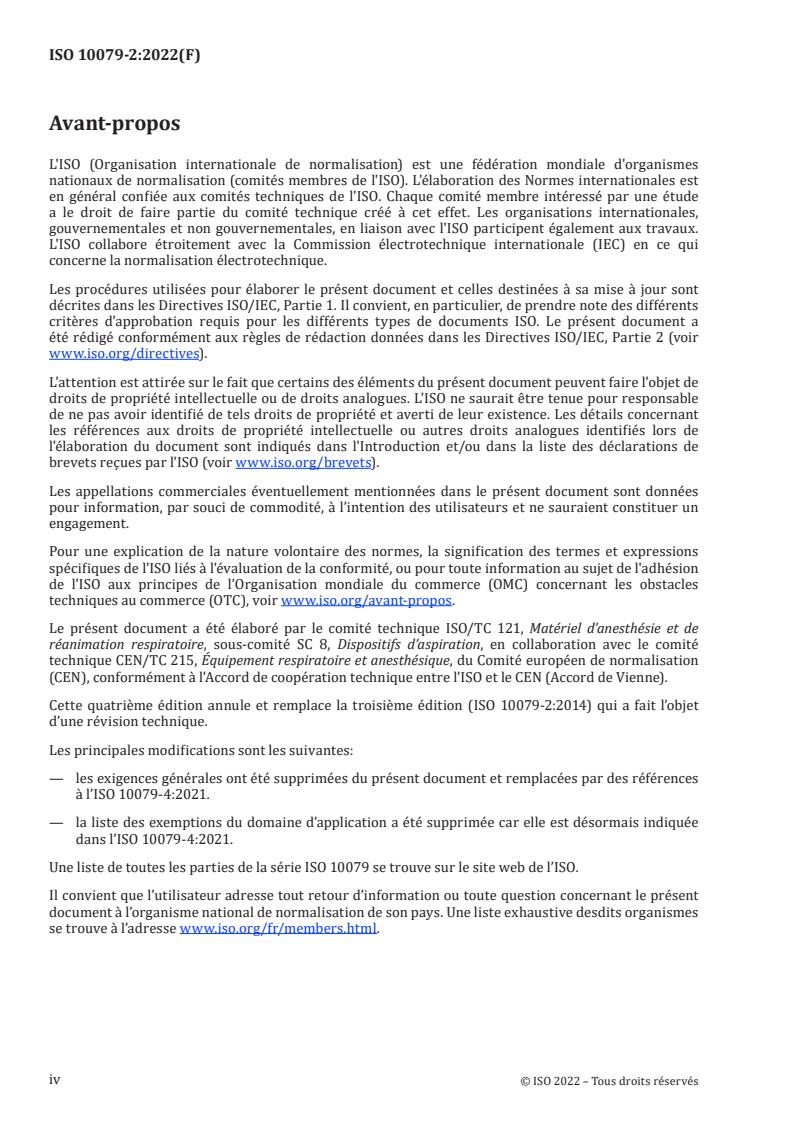
Avant-propos
L'ISO (Organisation internationale de normalisation) est une fédération mondiale d'organismes
nationaux de normalisation (comités membres de l'ISO). L'élaboration des Normes internationales est
en général confiée aux comités techniques de l'ISO. Chaque comité membre intéressé par une étude
a le droit de faire partie du comité technique créé à cet effet. Les organisations internationales,
gouvernementales et non gouvernementales, en liaison avec l'ISO participent également aux travaux.
L'ISO collabore étroitement avec la Commission électrotechnique internationale (IEC) en ce qui
concerne la normalisation électrotechnique.
Les procédures utilisées pour élaborer le présent document et celles destinées à sa mise à jour sont
décrites dans les Directives ISO/IEC, Partie 1. Il convient, en particulier, de prendre note des différents
critères d'approbation requis pour les différents types de documents ISO. Le présent document a
été rédigé conformément aux règles de rédaction données dans les Directives ISO/IEC, Partie 2 (voir
www.iso.org/directives).
L'attention est attirée sur le fait que certains des éléments du présent document peuvent faire l'objet de
droits de propriété intellectuelle ou de droits analogues. L'ISO ne saurait être tenue pour responsable
de ne pas avoir identifié de tels droits de propriété et averti de leur existence. Les détails concernant
les références aux droits de propriété intellectuelle ou autres droits analogues identifiés lors de
l'élaboration du document sont indiqués dans l'Introduction et/ou dans la liste des déclarations d
...
Questions, Comments and Discussion
Ask us and Technical Secretary will try to provide an answer. You can facilitate discussion about the standard in here.
Loading comments...