

ISO 11940-2:2007
(Main)Information and documentation — Transliteration of Thai characters into Latin characters — Part 2: Simplified transcription of Thai language
General Information
- Abstract
ISO 11940-2:2007 includes pronunciation rules and conversion tables of Thai consonants and vowels. These rules are applied, in order, to each word that can be looked up or compared in the Dictionary of the Thai Royal Institute or a dictionary of Thai pronunciation. A short-long vowel is not distinguished in the simplified transcription system. The simplified transcription system does not include the pronunciation of the tone(s) of the word. Whenever the full pronunciation of each word is necessary or needed, conversion of long vowels can be devised and tone rules can be added to the system to achieve the full pronunciation of each word.
- Status
- Published
- Publication Date
- 19-Apr-2007
- Technical Committee
- ISO/TC 46 - Information and documentation
- Drafting Committee
- ISO/TC 46 - Information and documentation
- Current Stage
- 9020 - International Standard under periodical review
- Start Date
- 15-Jul-2026
- Completion Date
- 15-Jul-2026
Overview - ISO 11940-2:2007 (Simplified transcription of Thai)
ISO 11940-2:2007 defines a simplified, pronunciation-oriented system for converting Thai script into Latin characters. It complements ISO 11940 (the full transliteration scheme) by providing pronunciation rules and conversion tables for Thai consonants and vowels intended for broad phonetic transcription. The standard is designed for machine-assisted conversion with limited human intervention and relies on authoritative pronunciation sources (for example, the Dictionary of the Thai Royal Institute).
Key topics and technical requirements
- Pronunciation rules applied in sequence: Rules must be applied in order to each word before conversion; many exceptions exist where orthography differs from pronunciation.
- Conversion tables: Mappings for Thai consonants and vowels to Latin representations are specified; preposed vowels (e.g., เ-, แ-, ใ-, ไ-, โ-) are transposed after initial clusters as part of processing.
- No vowel length or tone encoding: The simplified transcription intentionally does not distinguish short vs. long vowels and omits tone marking. Where full pronunciation is needed, the system can be extended by adding long-vowel conversion and tone rules.
- Orthographic handling rules: Detailed rules cover cluster behavior (deletion or transposition of ห and ร in specific contexts), insertion of epenthetic /a/ in certain consonant sequences, gemination rules for syllable-final consonants, and deletion of final vowel signs in specified words.
- Machine-friendly objective: The method is intended for automatic implementation, but human decisions may be required when words have multiple pronunciations or meanings.
Applications - who uses ISO 11940-2 and why
- Library and information services: Cataloguers and metadata specialists use the standard to create consistent romanized headings and improve discoverability of Thai materials.
- Localization and publishing: Translators and publishers apply the scheme for readable romanizations in guides, signage, and editorial content when tonal or fine-grained phonemic detail is unnecessary.
- Software and data engineering: Developers of search engines, indexing tools, databases, and transliteration libraries implement the rules for normalization, search matching, and user input conversion.
- Linguistics and education tools: Computational linguists and language-learning apps may use the simplified transcription as a readable bridge for learners, while adding tone/length processing separately if required.
Related standards
- ISO 11940:1998 (renumbered ISO 11940-1): The full transliteration scheme referenced normatively by ISO 11940-2; use ISO 11940-1 when reversible, precise transliteration back to Thai orthography is needed.
ISO 11940-2 is a practical, machine-oriented romanization reference for Thai-to-Latin transcription where intelligible pronunciation (without tone and vowel-length detail) and consistent data handling are the priority. Keywords: ISO 11940-2, Thai transliteration, Thai-to-Latin, simplified transcription, pronunciation rules, conversion tables, romanization.
Frequently Asked Questions
ISO 11940-2:2007 is a standard published by the International Organization for Standardization (ISO). Its full title is "Information and documentation — Transliteration of Thai characters into Latin characters — Part 2: Simplified transcription of Thai language". This standard covers: ISO 11940-2:2007 includes pronunciation rules and conversion tables of Thai consonants and vowels. These rules are applied, in order, to each word that can be looked up or compared in the Dictionary of the Thai Royal Institute or a dictionary of Thai pronunciation. A short-long vowel is not distinguished in the simplified transcription system. The simplified transcription system does not include the pronunciation of the tone(s) of the word. Whenever the full pronunciation of each word is necessary or needed, conversion of long vowels can be devised and tone rules can be added to the system to achieve the full pronunciation of each word.
ISO 11940-2:2007 includes pronunciation rules and conversion tables of Thai consonants and vowels. These rules are applied, in order, to each word that can be looked up or compared in the Dictionary of the Thai Royal Institute or a dictionary of Thai pronunciation. A short-long vowel is not distinguished in the simplified transcription system. The simplified transcription system does not include the pronunciation of the tone(s) of the word. Whenever the full pronunciation of each word is necessary or needed, conversion of long vowels can be devised and tone rules can be added to the system to achieve the full pronunciation of each word.
ISO 11940-2:2007 is classified under the following ICS (International Classification for Standards) categories: 01.140.10 - Writing and transliteration. The ICS classification helps identify the subject area and facilitates finding related standards.
ISO 11940-2:2007 is available in PDF format for immediate download after purchase. The document can be added to your cart and obtained through the secure checkout process. Digital delivery ensures instant access to the complete standard document.
Standards Content (Sample)
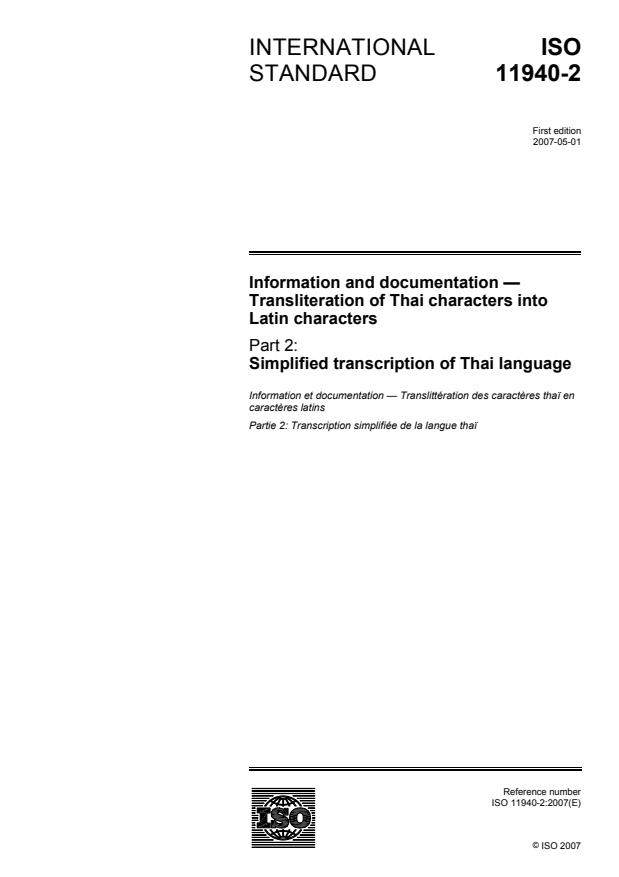
INTERNATIONAL ISO
STANDARD 11940-2
First edition
2007-05-01
Information and documentation —
Transliteration of Thai characters into
Latin characters
Part 2:
Simplified transcription of Thai language
Information et documentation — Translittération des caractères thaï en
caractères latins
Partie 2: Transcription simplifiée de la langue thaï
Reference number
©
ISO 2007
PDF disclaimer
This PDF file may contain embedded typefaces. In accordance with Adobe's licensing policy, this file may be printed or viewed but
shall not be edited unless the typefaces which are embedded are licensed to and installed on the computer performing the editing. In
downloading this file, parties accept therein the responsibility of not infringing Adobe's licensing policy. The ISO Central Secretariat
accepts no liability in this area.
Adobe is a trademark of Adobe Systems Incorporated.
Details of the software products used to create this PDF file can be found in the General Info relative to the file; the PDF-creation
parameters were optimized for printing. Every care has been taken to ensure that the file is suitable for use by ISO member bodies. In
the unlikely event that a problem relating to it is found, please inform the Central Secretariat at the address given below.
© ISO 2007
All rights reserved. Unless otherwise specified, no part of this publication may be reproduced or utilized in any form or by any means,
electronic or mechanical, including photocopying and microfilm, without permission in writing from either ISO at the address below or
ISO's member body in the country of the requester.
ISO copyright office
Case postale 56 • CH-1211 Geneva 20
Tel. + 41 22 749 01 11
Fax + 41 22 749 09 47
E-mail copyright@iso.org
Web www.iso.org
Published in Switzerland
ii © ISO 2007 – All rights reserved
Contents
Foreword . . . . . . . . . . . . . . . . . . . . . . . . . . . . . . . . . . . . . . . . . . . . . . . . . . . . . . . . . . . . . . . . . . . . . . iv
Introduction . . . . . . . . . . . . . . . . . . . . . . . . . . . . . . . . . . . . . . . . . . . . . . . . . . . . . . . . . . . . . . . . . . . . . v
1 Scope . . . . . . . . . . . . . . . . . . . . . . . . . . . . . . . . . . . . . . . . . . . . . . . . . . . . . . . . . . . . . . . . . . . . . 1
2 Normative references . . . . . . . . . . . . . . . . . . . . . . . . . . . . . . . . . . . . . . . . . . . . . . . . . . . . . . . . . 1
3 Terms and definitions . . . . . . . . . . . . . . . . . . . . . . . . . . . . . . . . . . . . . . . . . . . . . . . . . . . . . . . . 1
4 Symbols . . . . . . . . . . . . . . . . . . . . . . . . . . . . . . . . . . . . . . . . . . . . . . . . . . . . . . . . . . . . . . . . . . . 2
5 Pronunciation rules . . . . . . . . . . . . . . . . . . . . . . . . . . . . . . . . . . . . . . . . . . . . . . . . . . . . . . . . . . 2
Bibliography . . . . . . . . . . . . . . . . . . . . . . . . . . . . . . . . . . . . . . . . . . . . . . . . . . . . . . . . . . . . . . . . . . . 10
Foreword
ISO (the International Organization for Standardization) is a worldwide federation of national standards
bodies (ISO member bodies). The work of preparing International Standards is normally carried out
through ISO technical committees. Each member body interested in a subject for which a technical
committee has been established has the right to be represented on that committee. International
organizations, governmental and non-governmental, in liaison with ISO, also take part in the work.
ISO collaborates closely with the International Electrotechnical Commission (IEC) on all matters of
electrotechnical standardization.
International Standards are drafted in accordance with the rules given in the ISO/IEC Directives,
Part 2.
The main task of technical committees is to prepare International Standards. Draft International
Standards adopted by the technical committees are circulated to the member bodies for voting.
Publication as an International Standard requires approval by at least 75 % of the member bodies
casting a vote.
Attention is drawn to the possibility that some of the elements of this document may be the subject of
patent rights. ISO shall not be held responsible for identifying any or all such patent rights.
ISO 11940-2 was prepared by Technical Committee ISO/TC 46, Information and documentation.
ISO 11940 consists of the following parts, under the general title Information and documentation —
Transliteration of Thai characters into Latin characters:
— Part 2: Simplified transcription of Thai language
ISO 11940:1998, Information and documentation — Transliteration of Thai, is to be renumbered
ISO 11940-1.
iv © ISO 2007 – All rights reserved
Introduction
This part of ISO 11940 provides a specification for the conversion of Thai characters (or the
transliteration of Thai obtained from ISO 11940:1998, written here ) into
a broad phonetic transcription. The results of the application of the rules of this part of ISO 11940
are written here [in italics between square brackets]. Since some vowels in Thai are written before
the consonant which they follow in speech, text needs to be processed before the conversion takes
place. The preposed vowels เ- , แ- <æ>, ใ- <ı>, ไ- <ị>, and โ- are to be placed after an
initial or an initial cluster so that the phonotactics of the transposition will behave the same way in
the languages that make use of the Latin script. The transcription obtained using this part of ISO
11940 cannot be converted back to the transliteration which usually can be retransliterated to the Thai
characters. Certain Thai words can have more than one reading depending on its meaning in a certain
context. It is best for a transcriber to have a knowledge of the Thai language. The simplified phonetic
transcription system devised here aims to be done automatically by machine with minor assistance of
human beings to select the correct transcription in relation to its meaning provided that pronunciation
rules can be written in computer algorithm. A human decision is needed in instances where a word
has more than one choice of phonetic transcription.
INTERNATIONAL STANDARD ISO 11940-2:2007(E)
Information and documentation — Transliteration of Thai characters into
Latin characters —
Part 2:
Simplified transcription of Thai language
1 Scope
This part of ISO 11940 includes pronunciation rules and conversion tables of Thai consonants and
vowels. These rules are applied, in order, to each word which can be looked up or compared in the
Dictionary of the Thai Royal Institute or a dictionary of Thai pronunciation. A short-long vowel is
not distinguished in the simplified transcription system. The vowels เ-าะ , -อ , โ-ะ ,
and โ- are represented by a single transcription /o/. The simplified transcription system does not
include the pronunciation of the tone(s) on each word. Whenever the full pronunciation of each word
is necessary or needed, conversion of long vowels can be devised and tone rules can be added to the
system to achieve the full pronunciation of each word.
2 Normative references
The following referenced documents are indispensable for the application of this document. For dated
references, only the edition cited applies. For undated references, the latest edition of the referenced
document (including any amendments) applies.
ISO 11940:1998, Information and documentation — Transliteration of Thai
3 Terms and definitions
For the purposes of this document, the following terms and definitions apply.
3.1
nonseries consonants
liquids, fricatives, and semivowels
3.2
phonotactics
possible sequences of sounds that are acceptable in a particular language
3.3
series consonant
stops, affricates, and nasals which are classified according to their points of articulation, such as series
1 for velars, series 2 for alveopalatals or palatals, series 3 and 4 for dentals or alveolars, series 5 for
bilabials
3.4
transcriber
one who does a conversion of Thai characters into Latin characters
4 Symbols
The letter is used to represent a consonant. The apostrophe <’> is used to represent a glottal stop
sound where it physically appears in writing and pronunciation as a syllable initial.
5 Pronunciation rules
5.1 The pronunciation rules specified in this part of ISO 11940 are intended to be applied in
order, before a conversion is made.Conversion tables given in ISO 11940:1998 will not yield correct
pronunciation because pronunciation rules are not incorporated in that scheme. Note that there are
many exceptions in the pronunciation of Thai words where spelling does not conform to pronunciation.
Some words have the same spelling but different pronunciation depending on their meaning, and
some words do not follow the logic of spelling rules in their pronunciation. It is best to consult the
Dictionary of the Royal Institute or other Thai dictionaries for the pronunciation of the words.
5.2 Either ร or the first ร , is deleted in กษีณาศรพ, กําสรด, กําสรวล, เกียรติ, ขษีณาศรพ, จริง,
ซะซร้าว, โซรม, ไซร้, พนาศรม, มารค, แมร, วนาศรม, ศรัทธา, ศรัย, ศราทธ์, ศราทธพรต, ศรี, ศารท, ศีรษะ, เศรษฐ,
เศรษฐ์, เศร้า, โศรตร, สมเสร็จ, สมัคร, สรง, สรวง, สรวม, สรวล, สร้อย, สร่าง, สร้าง, สร้าวเสียว, สระ, สรุง, สามารถ,
สารท, เสร็จ, (สร)เสริญ, (สรร)เสริญ, เสริด, เสริม, แสร้ง, โสรจ, ไสร้, เฮิรตซ์, and the second ร is deleted in
ไกรศรี, นิราศรัย, ประเสริฐ, ปรารถนา, ปราศรัย, and รังสรัง.
กำสรด = กำสด
โซรม = โซม
5.3 The preposed vowels เ- , แ- <æ>, ใ- <ı>, ไ- <ị>, and โ- are transposed after the syllable
initial or the initial cluster before a conversion.
แทน <æthn> = ทแน [thaen]
ไป <ịp> = ปไ [pai]
5.3.1 If the transposed preposed vowel is next to another vowel, a special character, or a consonant
followed by a vowel, it is not further transposed.
ดเ ิน cannot be further transposed.
¯
หแ ้ง cannot be further transposed.
กเ ็บ cannot be further transposed.
พไรัช cannot be further transposed.
¯
5.3.2 If the transposed preposed vowel is preceded by ห and the next character after the vowel
is ง , ญ <ỵ>, น , ม , ย , ร , ล , or ว , it is further transposed one more time
only.
¯ ¯
หแยง = หยแง
¯ ¯
หโน่ง = หนโ ่ง
¯ ¯
หใญ่ = หญใ่
2 © ISO 2007 – All rights reserved
¯
5.3.3 If the transposed preposed vowel is preceded by ก , ข , ค , ฅ , ท , ป
, or พ and the next character is ร , it is further transposed one more time only.
กโรธ = กรโธ [krot]
คเร่ง = ครเ ่ง [khreng]
พแร่ = พรแ ่ [phrae]
An /a/ is inserted into the three words อเ ิกกเริก , ปเรียญ , and ปแรก before
the preposed vowels are further transposed after ร to become อเ ิกกaรเ ิก [’oekkaroek],
ปaรเ ียญ [parian], ปaรแก [paraek].
¯
5.3.4 If the transposed preposed vowel is preceded by ก , ข , ค , ป
, ผ , or พ
and the next character is ล , it is further transposed one more time only.
กเลี้อน = กลเี้อน [kluean]
¯ ¯
ขโลง = ขลโง [khlong]
ปไล่ = ปลไ ่ [plai]
ผโล่ = ผลโ ่ [phlo]
¯
5.3.5 If the transposed preposed vowel is preceded by ก , ข , or ค , and the next
character is ว , it is further transposed one more time only.
กแว่ง = กวแ ่ง [kwaeng]
¯ ¯
ขไว้ = ขวไ ้ [khwai]
คเว้ง = ควเ ้ง [khweng]
¯ ¯
5.3.6 If the transposed preposed vowel is preceded by ข , ฉ , ถ , or ส , and the next
character is ง , น , ม , ย , ร , ล , or ว , an /a/ is inserted before a vowel
and it is further transposed after the next consonant.
ฉเลียง = ฉaลเ ียง [chaliang]
¯ ¯
ถเลิง = ถaลเ ิง [thaloeng]
สเงี่ยม = สaงเ ี่่ยม [sangiam]
¯
5.3.7 If the transposed preposed vowel is preceded by ก , ข , or ส and the next character
is not ร , ล , or ว , an /a/ is inserted b
...