

ISO 15924:2022
(Main)Information and documentation — Codes for the representation of names of scripts
General Information
- Abstract
This document provides a code for the presentation of names of scripts. The codes were devised for use in terminology, lexicography, bibliography, and linguistics, but they can be used for any application requiring the expression of scripts in coded form. This document also includes guidance on the use of script codes in some of these applications.
- Status
- Published
- Publication Date
- 03-Mar-2022
- Technical Committee
- ISO/TC 46 - Information and documentation
- Drafting Committee
- ISO/TC 46/WG 3 - Conversion of written languages
- Current Stage
- 6060 - International Standard published
- Start Date
- 04-Mar-2022
- Due Date
- 06-Apr-2022
- Completion Date
- 04-Mar-2022


Overview
ISO 15924:2022 - Information and documentation - Codes for the representation of names of scripts is an international standard published by the International Organization for Standardization (ISO). This standard provides a comprehensive system of codes for the structured representation of script names, making it possible to identify and reference writing systems used in documents, databases, and software. The codes are designed to support activities in terminology, lexicography, bibliography, and linguistics, but their use extends to any application where expressing scripts in a standardized, coded form is required.
ISO 15924:2022 is an essential reference for professionals dealing with multilingual content and globalized information systems, enabling accurate identification and management of textual data across different scripts.
Key Topics
Script Code Structure:
ISO 15924 specifies standardized four-letter alphabetic codes (e.g., "Latn" for Latin, "Cyrl" for Cyrillic) and associated numeric codes for representing script names. These codes are carefully constructed to avoid confusion with language and country codes.Relationship to Other Standards:
The script codes complement language codes from the ISO 639 series and country codes from ISO 3166, supporting integration in multilingual and multinational documentation and software.Code Assignment and Registration:
The responsibility for allocating and maintaining script codes lies with an ISO-designated Registration Authority, which follows clear procedures for the addition and management of codes.Variants and Aliases:
Provisions exist for identifying script variants and grouped scripts (aliases), providing flexibility for representing unique or evolving writing systems.Change Management:
To maintain data integrity, any modification to existing script codes is subject to stringent review and is only undertaken for compelling reasons.
Applications
ISO 15924:2022 script codes are critical in several fields where standardized identification of scripts is essential:
Library and Information Science:
Libraries and archives use script codes in cataloguing, bibliographic records, and metadata to indicate scripts used in materials, aiding in search, retrieval, and interlibrary loan processing.Publishing and Lexicography:
Publishers and dictionary compilers employ these codes to consistently reference the script of language materials across editions and platforms.Linguistics and Academic Research:
Script codes support linguistic databases, corpora, and research, enabling accurate annotation of text samples and comparative studies.Digital Content and Software Development:
Software and web applications leverage script codes for content encoding, font selection, rendering engines, and localization to support multiple scripts within user interfaces.Internationalization and Localization:
Multinational organizations and developers reference ISO 15924 codes in standards-compliant workflows for web development, document exchange (such as XML markup), and data interoperability.
Related Standards
ISO 15924:2022 works in conjunction with several key international standards:
- ISO 639-1 / ISO 639-2 / ISO 639-3: Codes for the representation of names of languages.
- ISO 3166-1: Codes for the representation of names of countries and their subdivisions.
- ISO/IEC 10646: Information technology - Universal coded character set (UCS), fundamental to Unicode.
- ISO/IEC TR 15285: Operational model for characters and glyphs in IT systems.
ISO 15924:2022 is a vital component of the global information infrastructure, ensuring that scripts from around the world are represented in a compatible, reliable, and standardized manner for use in information management, IT applications, and cross-cultural communication. For organizations pursuing excellence in multilingual content processing, adoption of ISO 15924:2022 ensures broad compatibility, accuracy, and future-proofed information handling.
Relations
- Effective Date
- 25-Mar-2026
- Effective Date
- 15-Jun-2024
- Revises
ISO 15924:2004 - Information and documentation — Codes for the representation of names of scripts - Effective Date
- 26-Nov-2021
Frequently Asked Questions
ISO 15924:2022 is a standard published by the International Organization for Standardization (ISO). Its full title is "Information and documentation — Codes for the representation of names of scripts". This standard covers: This document provides a code for the presentation of names of scripts. The codes were devised for use in terminology, lexicography, bibliography, and linguistics, but they can be used for any application requiring the expression of scripts in coded form. This document also includes guidance on the use of script codes in some of these applications.
This document provides a code for the presentation of names of scripts. The codes were devised for use in terminology, lexicography, bibliography, and linguistics, but they can be used for any application requiring the expression of scripts in coded form. This document also includes guidance on the use of script codes in some of these applications.
ISO 15924:2022 is classified under the following ICS (International Classification for Standards) categories: 01.140.10 - Writing and transliteration; 01.140.20 - Information sciences. The ICS classification helps identify the subject area and facilitates finding related standards.
ISO 15924:2022 has the following relationships with other standards: It is inter standard links to EN ISO 19160-4:2023, ISO 15924:2022/Amd 1:2025, ISO 15924:2004. Understanding these relationships helps ensure you are using the most current and applicable version of the standard.
ISO 15924:2022 is available in PDF format for immediate download after purchase. The document can be added to your cart and obtained through the secure checkout process. Digital delivery ensures instant access to the complete standard document.
Standards Content (Sample)
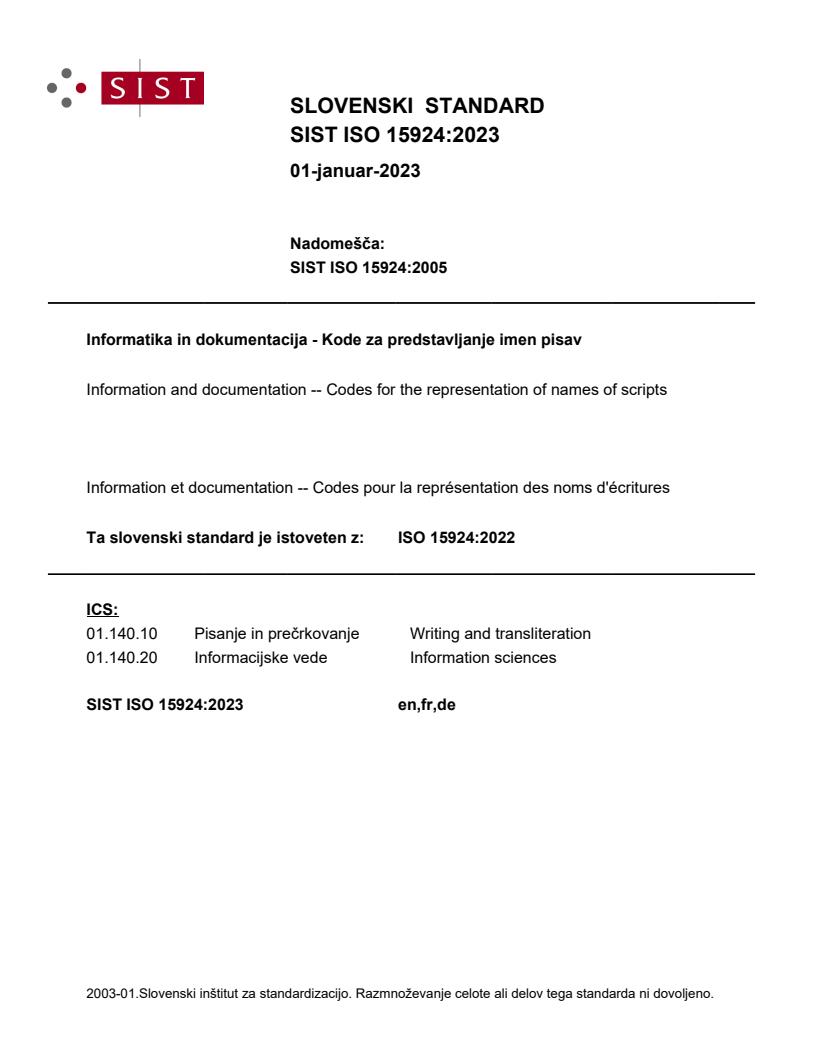
SLOVENSKI STANDARD
01-januar-2023
Nadomešča:
SIST ISO 15924:2005
Informatika in dokumentacija - Kode za predstavljanje imen pisav
Information and documentation -- Codes for the representation of names of scripts
Information et documentation -- Codes pour la représentation des noms d'écritures
Ta slovenski standard je istoveten z: ISO 15924:2022
ICS:
01.140.10 Pisanje in prečrkovanje Writing and transliteration
01.140.20 Informacijske vede Information sciences
2003-01.Slovenski inštitut za standardizacijo. Razmnoževanje celote ali delov tega standarda ni dovoljeno.
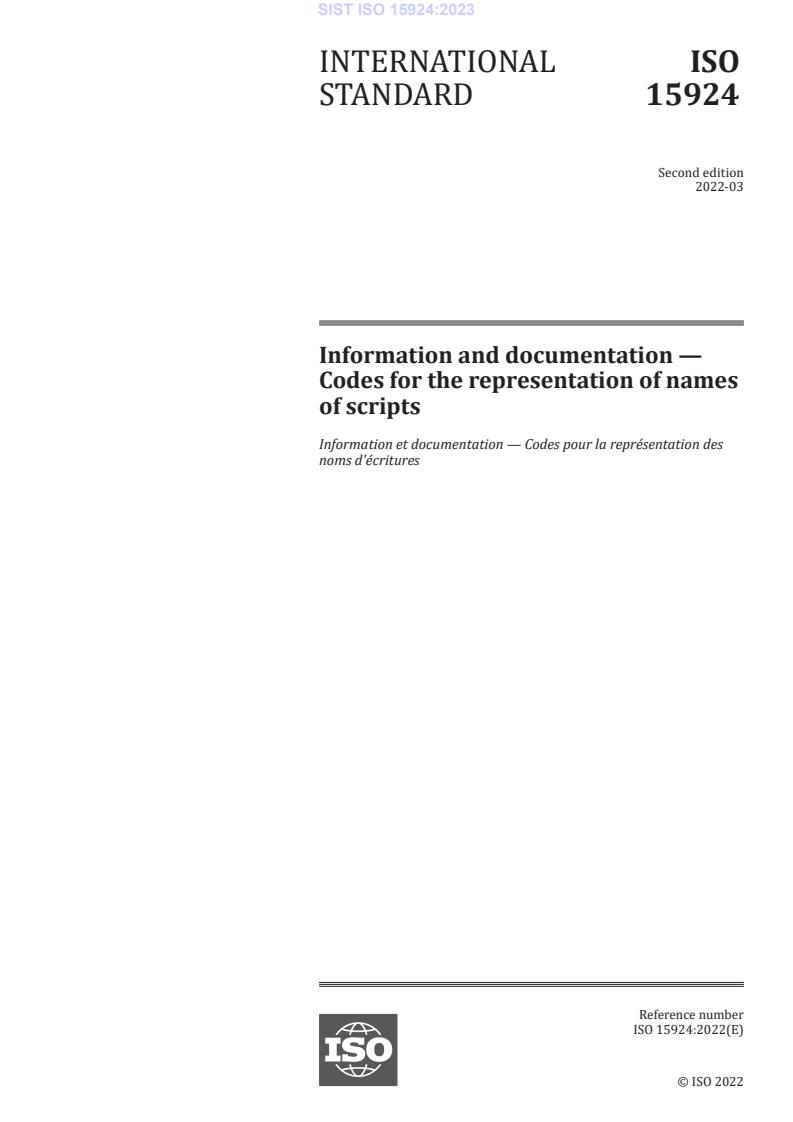
INTERNATIONAL ISO
STANDARD 15924
Second edition
2022-03
Information and documentation —
Codes for the representation of names
of scripts
Information et documentation — Codes pour la représentation des
noms d'écritures
Reference number
© ISO 2022
All rights reserved. Unless otherwise specified, or required in the context of its implementation, no part of this publication may
be reproduced or utilized otherwise in any form or by any means, electronic or mechanical, including photocopying, or posting on
the internet or an intranet, without prior written permission. Permission can be requested from either ISO at the address below
or ISO’s member body in the country of the requester.
ISO copyright office
CP 401 • Ch. de Blandonnet 8
CH-1214 Vernier, Geneva
Phone: +41 22 749 01 11
Email: copyright@iso.org
Website: www.iso.org
Published in Switzerland
ii
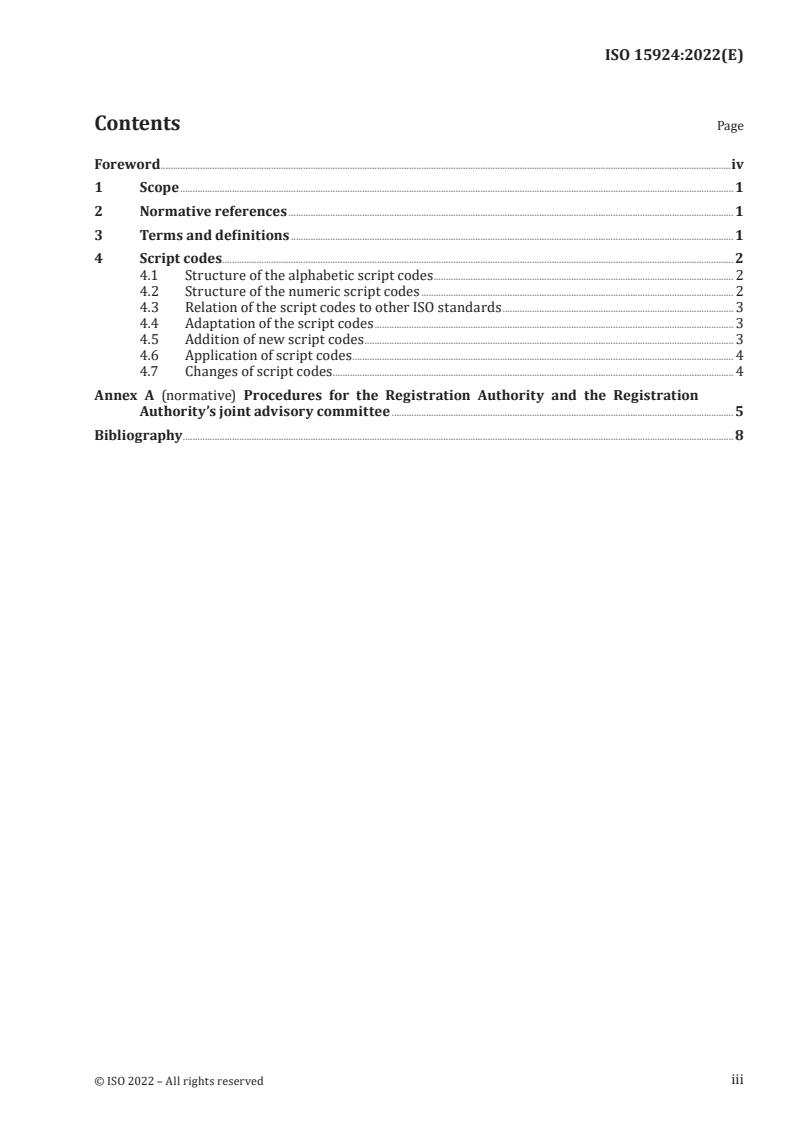
Contents Page
Foreword .iv
1 Scope . 1
2 Normative references . 1
3 Terms and definitions . 1
4 Script codes . 2
4.1 Structure of the alphabetic script codes . 2
4.2 Structure of the numeric script codes . 2
4.3 Relation of the script codes to other ISO standards . 3
4.4 Adaptation of the script codes . 3
4.5 Addition of new script codes . 3
4.6 Application of script codes . 4
4.7 Changes of script codes . 4
Annex A (normative) Procedures for the Registration Authority and the Registration
Authority’s joint advisory committee . 5
Bibliography . 8
iii
Foreword
ISO (the International Organization for Standardization) is a worldwide federation of national standards
bodies (ISO member bodies). The work of preparing International Standards is normally carried out
through ISO technical committees. Each member body interested in a subject for which a technical
committee has been established has the right to be represented on that committee. International
organizations, governmental and non-governmental, in liaison with ISO, also take part in the work.
ISO collaborates closely with the International Electrotechnical Commission (IEC) on all matters of
electrotechnical standardization.
The procedures used to develop this document and those intended for its further maintenance are
described in the ISO/IEC Directives, Part 1. In particular, the different approval criteria needed for the
different types of ISO documents should be noted. This document was drafted in accordance with the
editorial rules of the ISO/IEC Directives, Part 2 (see www.iso.org/directives).
Attention is drawn to the possibility that some of the elements of this document may be the subject of
patent rights. ISO shall not be held responsible for identifying any or all such patent rights. Details of
any patent rights identified during the development of the document will be in the Introduction and/or
on the ISO list of patent declarations received (see www.iso.org/patents).
Any trade name used in this document is information given for the convenience of users and does not
constitute an endorsement.
For an explanation of the voluntary nature of standards, the meaning of ISO specific terms and
expressions related to conformity assessment, as well as information about ISO's adherence to
the World Trade Organization (WTO) principles in the Technical Barriers to Trade (TBT), see
www.iso.org/iso/foreword.html.
This document was prepared by Technical Committee ISO/TC 46, Information and documentation.
This second edition cancels and replaces the first edition (ISO 15924:2004), which has been technically
revised.
The main changes compared to the previous edition are as follows:
— the normative references clause has been updated;
— references to the holder of the Registration Authority in the text have been removed, examples and
references throughout the document have been updated.
Any feedback or questions on this document should be directed to the user’s national standards body. A
complete listing of these bodies can be found at www.iso.org/members.html.
iv
INTERNATIONAL STANDARD ISO 15924:2022(E)
Information and documentation — Codes for the
representation of names of scripts
1 Scope
This document provides a code for the presentation of names of scripts. The codes were devised for
use in terminology, lexicography, bibliography, and linguistics, but they can be used for any application
requiring the expression of scripts in coded form. This document also includes guidance on the use of
script codes in some of these applications.
2 Normative references
There are no normative references in this document.
3 Terms and definitions
For the purposes of this document, the following terms and definitions apply.
ISO and IEC maintain terminology databases for use in standardization at the following addresses:
— ISO Online browsing platform: available at https:// www .iso .org/ obp
— IEC Electropedia: available at https:// www .electropedia .org/
3.1
alias
script code (3.8) which encompasses two or more script codes
3.2
code
data representation in different forms according to a pre-established set of rules
[SOURCE: ISO 639-2:1998, 3.1]
3.3
country code
combination of characters used to designate the name of a country
3.4
font
collection of glyph (3.5) images having the same basic design
EXAMPLE Courier, Bold, Oblique.
[SOURCE: ISO/IEC 9541-1:2012, 3.6]
3.5
glyph
recognizable abstract graphic symbol which is independent of any specific design
[SOURCE: ISO/IEC 9541-1:2012, 3.12]
3.6
language code
combination of characters used to represent [the name of] a language or languages
[SOURCE: ISO 639-2:1998, 3.2, modified — The phrase "the name of" has been added.]
3.7
script
set of graphic characters used for the written form of one or more languages
Note 1 to entry: A script, as opposed to an arbitrary subset of characters, is defined in distinction to other scripts;
in general, readers of one script may be unable to read another script easily, even where there is a historic relation
between them (see 3.9).
Note 2 to entry: In certain cases, ISO 15924 provides codes which are not subsumed under this definition.
Examples: the codes for aliases and the variant codes.
[SOURCE: ISO/IEC 10646:2020, 3.48]
3.8
script code
combination of characters used to represent the name of a script (3.7)
3.9
script variant
particular form of one script (3.7) which is so distinctive a rendering as to almost be considered a
unique script in itself
4 Script codes
4.1 Structure of the alphabetic script codes
The alphabetic script codes are created from the original script name in the language commonly used
for it, transliterated or transcribed into Latin letters. If a country, where the script concerned has the
status of a national script, requests a certain script code, preference is given to this code whenever
possible. The four-letter codes shall be written with an initial capital Latin letter and final small Latin
letters (taken from the range Aaaa to Zzzz). This serves to help differentiate script codes from language
codes and country codes: so, for example, Mong mon MON or Mong mn MN would refer to a book in the
Mongolian script, in the Mongolian language, originating in Mongolia.
NOTE See 4.7 regarding changes to the codes.
4.2 Structure of the numeric script codes
The numeric script codes have been assigned to provide some measure of mnemonicity to the codes
used. The following ranges have been used:
000–099 Hieroglyphic and cuneiform scripts
100–199 Right-to-left alphabetic scripts
200–299 Left-to-right alphabetic scripts
300–399 Alphasyllabic scripts
400–499 Syllabic scripts
500–599 Ideographic scripts
600–699 Undeciphered scripts
700–799 (unassigned)
800–899 (unassigned)
900–999 Private use, aliases, special codes
NOTE 1 ISO/IEC 10646 uses the character-glyph model (defined in ISO/IEC TR 15285) to classify the
characters used to write different languages. ISO 15924 does not attempt to apply the character-glyph model,
because it is sometimes important to identify certain script variants regardless of the encoding a given text may
employ. For example, a Syriac book can be written in one of the three variants of the Syriac script (Estrangelo,
Eastern, Western). Identification of such script variants, while outside the scope of ISO/IEC 10646, is relevant to
the content of script codes. For example, a user ordering a book through interlibrary loan might prefer, or might
wish to exclude, the Gaelic variant of the Latin script for reasons of ease of legibility or familiarity with one of the
variants.
NOTE 2 The classifications here reflect the chief attribute of the scripts so classified, and are not necessarily
comprehensive of the ways in which the scripts are used. For example, while Ogham can be written from left
to right, it is also written vertically from bottom to top. Similarly, the Hangul (Hangŭl, Hangeul) alphabet is
sometimes written in vertical columns, and the letters of its alphabet are arranged in syllab
...
INTERNATIONAL ISO
STANDARD 15924
Second edition
2022-03
Information and documentation —
Codes for the representation of names
of scripts
Information et documentation — Codes pour la représentation des
noms d'écritures
Reference number
© ISO 2022
All rights reserved. Unless otherwise specified, or required in the context of its implementation, no part of this publication may
be reproduced or utilized otherwise in any form or by any means, electronic or mechanical, including photocopying, or posting on
the internet or an intranet, without prior written permission. Permission can be requested from either ISO at the address below
or ISO’s member body in the country of the requester.
ISO copyright office
CP 401 • Ch. de Blandonnet 8
CH-1214 Vernier, Geneva
Phone: +41 22 749 01 11
Email: copyright@iso.org
Website: www.iso.org
Published in Switzerland
ii
Contents Page
Foreword .iv
1 Scope . 1
2 Normative references . 1
3 Terms and definitions . 1
4 Script codes . 2
4.1 Structure of the alphabetic script codes . 2
4.2 Structure of the numeric script codes . 2
4.3 Relation of the script codes to other ISO standards . 3
4.4 Adaptation of the script codes . 3
4.5 Addition of new script codes . 3
4.6 Application of script codes . 4
4.7 Changes of script codes . 4
Annex A (normative) Procedures for the Registration Authority and the Registration
Authority’s joint advisory committee . 5
Bibliography . 8
iii
Foreword
ISO (the International Organization for Standardization) is a worldwide federation of national standards
bodies (ISO member bodies). The work of preparing International Standards is normally carried out
through ISO technical committees. Each member body interested in a subject for which a technical
committee has been established has the right to be represented on that committee. International
organizations, governmental and non-governmental, in liaison with ISO, also take part in the work.
ISO collaborates closely with the International Electrotechnical Commission (IEC) on all matters of
electrotechnical standardization.
The procedures used to develop this document and those intended for its further maintenance are
described in the ISO/IEC Directives, Part 1. In particular, the different approval criteria needed for the
different types of ISO documents should be noted. This document was drafted in accordance with the
editorial rules of the ISO/IEC Directives, Part 2 (see www.iso.org/directives).
Attention is drawn to the possibility that some of the elements of this document may be the subject of
patent rights. ISO shall not be held responsible for identifying any or all such patent rights. Details of
any patent rights identified during the development of the document will be in the Introduction and/or
on the ISO list of patent declarations received (see www.iso.org/patents).
Any trade name used in this document is information given for the convenience of users and does not
constitute an endorsement.
For an explanation of the voluntary nature of standards, the meaning of ISO specific terms and
expressions related to conformity assessment, as well as information about ISO's adherence to
the World Trade Organization (WTO) principles in the Technical Barriers to Trade (TBT), see
www.iso.org/iso/foreword.html.
This document was prepared by Technical Committee ISO/TC 46, Information and documentation.
This second edition cancels and replaces the first edition (ISO 15924:2004), which has been technically
revised.
The main changes compared to the previous edition are as follows:
— the normative references clause has been updated;
— references to the holder of the Registration Authority in the text have been removed, examples and
references throughout the document have been updated.
Any feedback or questions on this document should be directed to the user’s national standards body. A
complete listing of these bodies can be found at www.iso.org/members.html.
iv
INTERNATIONAL STANDARD ISO 15924:2022(E)
Information and documentation — Codes for the
representation of names of scripts
1 Scope
This document provides a code for the presentation of names of scripts. The codes were devised for
use in terminology, lexicography, bibliography, and linguistics, but they can be used for any application
requiring the expression of scripts in coded form. This document also includes guidance on the use of
script codes in some of these applications.
2 Normative references
There are no normative references in this document.
3 Terms and definitions
For the purposes of this document, the following terms and definitions apply.
ISO and IEC maintain terminology databases for use in standardization at the following addresses:
— ISO Online browsing platform: available at https:// www .iso .org/ obp
— IEC Electropedia: available at https:// www .electropedia .org/
3.1
alias
script code (3.8) which encompasses two or more script codes
3.2
code
data representation in different forms according to a pre-established set of rules
[SOURCE: ISO 639-2:1998, 3.1]
3.3
country code
combination of characters used to designate the name of a country
3.4
font
collection of glyph (3.5) images having the same basic design
EXAMPLE Courier, Bold, Oblique.
[SOURCE: ISO/IEC 9541-1:2012, 3.6]
3.5
glyph
recognizable abstract graphic symbol which is independent of any specific design
[SOURCE: ISO/IEC 9541-1:2012, 3.12]
3.6
language code
combination of characters used to represent [the name of] a language or languages
[SOURCE: ISO 639-2:1998, 3.2, modified — The phrase "the name of" has been added.]
3.7
script
set of graphic characters used for the written form of one or more languages
Note 1 to entry: A script, as opposed to an arbitrary subset of characters, is defined in distinction to other scripts;
in general, readers of one script may be unable to read another script easily, even where there is a historic relation
between them (see 3.9).
Note 2 to entry: In certain cases, ISO 15924 provides codes which are not subsumed under this definition.
Examples: the codes for aliases and the variant codes.
[SOURCE: ISO/IEC 10646:2020, 3.48]
3.8
script code
combination of characters used to represent the name of a script (3.7)
3.9
script variant
particular form of one script (3.7) which is so distinctive a rendering as to almost be considered a
unique script in itself
4 Script codes
4.1 Structure of the alphabetic script codes
The alphabetic script codes are created from the original script name in the language commonly used
for it, transliterated or transcribed into Latin letters. If a country, where the script concerned has the
status of a national script, requests a certain script code, preference is given to this code whenever
possible. The four-letter codes shall be written with an initial capital Latin letter and final small Latin
letters (taken from the range Aaaa to Zzzz). This serves to help differentiate script codes from language
codes and country codes: so, for example, Mong mon MON or Mong mn MN would refer to a book in the
Mongolian script, in the Mongolian language, originating in Mongolia.
NOTE See 4.7 regarding changes to the codes.
4.2 Structure of the numeric script codes
The numeric script codes have been assigned to provide some measure of mnemonicity to the codes
used. The following ranges have been used:
000–099 Hieroglyphic and cuneiform scripts
100–199 Right-to-left alphabetic scripts
200–299 Left-to-right alphabetic scripts
300–399 Alphasyllabic scripts
400–499 Syllabic scripts
500–599 Ideographic scripts
600–699 Undeciphered scripts
700–799 (unassigned)
800–899 (unassigned)
900–999 Private use, aliases, special codes
NOTE 1 ISO/IEC 10646 uses the character-glyph model (defined in ISO/IEC TR 15285) to classify the
characters used to write different languages. ISO 15924 does not attempt to apply the character-glyph model,
because it is sometimes important to identify certain script variants regardless of the encoding a given text may
employ. For example, a Syriac book can be written in one of the three variants of the Syriac script (Estrangelo,
Eastern, Western). Identification of such script variants, while outside the scope of ISO/IEC 10646, is relevant to
the content of script codes. For example, a user ordering a book through interlibrary loan might prefer, or might
wish to exclude, the Gaelic variant of the Latin script for reasons of ease of legibility or familiarity with one of the
variants.
NOTE 2 The classifications here reflect the chief attribute of the scripts so classified, and are not necessarily
comprehensive of the ways in which the scripts are used. For example, while Ogham can be written from left
to right, it is also written vertically from bottom to top. Similarly, the Hangul (Hangŭl, Hangeul) alphabet is
sometimes written in vertical columns, and the letters of its alphabet are arranged in syllabic clusters.
NOTE 3 Within each category numeric identifiers assigned to scripts have followed a principle of chronology,
and genetic relationship, though this principle cannot be established by any hard and fast rule, since scripts may
have many different characteristics. Codes have been assigned by spacing them out so that scripts encoded in
future may be assigned to appropriate places in the range.
4.3 Relation of the script codes to other ISO standards
The
...