


ISO/IEC 29110-4-1:2011
(Main)Software engineering — Lifecycle profiles for Very Small Entities (VSEs) — Part 4-1: Profile specifications: Generic profile group
Software engineering — Lifecycle profiles for Very Small Entities (VSEs) — Part 4-1: Profile specifications: Generic profile group
ISO/IEC 29110-4-1:2011 is applicable to Very Small Entities (VSEs). A Very Small Entity (VSE) is defined as an enterprise, organization, department or project having up to 25 people. A set of standards and guides have been developed according to a set of VSEs' characteristics and needs. The guides are based on subsets of appropriate standards elements, referred to as VSE profiles. The purpose of a VSE profile is to define a subset of International Standards relevant to the VSE context. ISO/IEC 29110 is targeted by audience. ISO/IEC 29110-4 is targeted for standards producers, tool vendors and methodology vendors. It is not intended for VSEs. ISO/IEC 29110-4-m provides the specification for all the profiles in a profile group that are based on subsets of appropriate standards elements. If a new profile is needed, a Part 4-m can be developed without impacting existing documents. ISO/IEC 29110-4-1:2011 provides a profile specification for the Basic VSE profile within the Generic profile group. The Generic profile group is applicable to VSEs that do not develop critical software. The Generic profile group does not imply any specific application domain. The Basic VSE profile selects ISO/IEC 12207 project management and software implementation process elements and ISO/IEC 15289 products from the single project perspective. Its purpose is to provide the normative and informative links to the subset of ISO/IEC 12207 and ISO/IEC 15289.
Ingénierie du logiciel — Profils de cycle de vie pour très petits organismes (TPO) — Partie 4-1: Spécification de profil: Groupe de profil générique
General Information
- Status
- Withdrawn
- Publication Date
- 05-Jan-2011
- Withdrawal Date
- 05-Jan-2011
- Technical Committee
- ISO/IEC JTC 1/SC 7 - Software and systems engineering
- Current Stage
- 9599 - Withdrawal of International Standard
- Start Date
- 12-Apr-2018
- Completion Date
- 12-Feb-2026
Relations
- Effective Date
- 16-Aug-2014
Get Certified
Connect with accredited certification bodies for this standard

BSI Group
BSI (British Standards Institution) is the business standards company that helps organizations make excellence a habit.

BSCIC Certifications Pvt. Ltd.
Established 2006, accredited by NABCB, JAS-ANZ, EIAC, IAS. CDSCO Notified Body.

Intertek India Pvt. Ltd.
Delivers Assurance, Testing, Inspection & Certification since 1993 with 26 labs and 32 offices.
Sponsored listings
Frequently Asked Questions
ISO/IEC 29110-4-1:2011 is a standard published by the International Organization for Standardization (ISO). Its full title is "Software engineering — Lifecycle profiles for Very Small Entities (VSEs) — Part 4-1: Profile specifications: Generic profile group". This standard covers: ISO/IEC 29110-4-1:2011 is applicable to Very Small Entities (VSEs). A Very Small Entity (VSE) is defined as an enterprise, organization, department or project having up to 25 people. A set of standards and guides have been developed according to a set of VSEs' characteristics and needs. The guides are based on subsets of appropriate standards elements, referred to as VSE profiles. The purpose of a VSE profile is to define a subset of International Standards relevant to the VSE context. ISO/IEC 29110 is targeted by audience. ISO/IEC 29110-4 is targeted for standards producers, tool vendors and methodology vendors. It is not intended for VSEs. ISO/IEC 29110-4-m provides the specification for all the profiles in a profile group that are based on subsets of appropriate standards elements. If a new profile is needed, a Part 4-m can be developed without impacting existing documents. ISO/IEC 29110-4-1:2011 provides a profile specification for the Basic VSE profile within the Generic profile group. The Generic profile group is applicable to VSEs that do not develop critical software. The Generic profile group does not imply any specific application domain. The Basic VSE profile selects ISO/IEC 12207 project management and software implementation process elements and ISO/IEC 15289 products from the single project perspective. Its purpose is to provide the normative and informative links to the subset of ISO/IEC 12207 and ISO/IEC 15289.
ISO/IEC 29110-4-1:2011 is applicable to Very Small Entities (VSEs). A Very Small Entity (VSE) is defined as an enterprise, organization, department or project having up to 25 people. A set of standards and guides have been developed according to a set of VSEs' characteristics and needs. The guides are based on subsets of appropriate standards elements, referred to as VSE profiles. The purpose of a VSE profile is to define a subset of International Standards relevant to the VSE context. ISO/IEC 29110 is targeted by audience. ISO/IEC 29110-4 is targeted for standards producers, tool vendors and methodology vendors. It is not intended for VSEs. ISO/IEC 29110-4-m provides the specification for all the profiles in a profile group that are based on subsets of appropriate standards elements. If a new profile is needed, a Part 4-m can be developed without impacting existing documents. ISO/IEC 29110-4-1:2011 provides a profile specification for the Basic VSE profile within the Generic profile group. The Generic profile group is applicable to VSEs that do not develop critical software. The Generic profile group does not imply any specific application domain. The Basic VSE profile selects ISO/IEC 12207 project management and software implementation process elements and ISO/IEC 15289 products from the single project perspective. Its purpose is to provide the normative and informative links to the subset of ISO/IEC 12207 and ISO/IEC 15289.
ISO/IEC 29110-4-1:2011 is classified under the following ICS (International Classification for Standards) categories: 35.080 - Software. The ICS classification helps identify the subject area and facilitates finding related standards.
ISO/IEC 29110-4-1:2011 has the following relationships with other standards: It is inter standard links to ISO/IEC 29110-4-1:2018. Understanding these relationships helps ensure you are using the most current and applicable version of the standard.
ISO/IEC 29110-4-1:2011 is available in PDF format for immediate download after purchase. The document can be added to your cart and obtained through the secure checkout process. Digital delivery ensures instant access to the complete standard document.
Standards Content (Sample)
INTERNATIONAL ISO/IEC
STANDARD 29110-4-1
First edition
2011-01-15
Software engineering — Lifecycle profiles
for Very Small Entities (VSEs) —
Part 4-1:
Profile specifications: Generic profile
group
Ingénierie du logiciel — Profils de cycle de vie pour très petits
organismes (TPO) —
Partie 4-1: Spécification de profil: Groupe de profil générique
Reference number
©
ISO/IEC 2011
PDF disclaimer
This PDF file may contain embedded typefaces. In accordance with Adobe's licensing policy, this file may be printed or viewed but
shall not be edited unless the typefaces which are embedded are licensed to and installed on the computer performing the editing. In
downloading this file, parties accept therein the responsibility of not infringing Adobe's licensing policy. The ISO Central Secretariat
accepts no liability in this area.
Adobe is a trademark of Adobe Systems Incorporated.
Details of the software products used to create this PDF file can be found in the General Info relative to the file; the PDF-creation
parameters were optimized for printing. Every care has been taken to ensure that the file is suitable for use by ISO member bodies. In
the unlikely event that a problem relating to it is found, please inform the Central Secretariat at the address given below.
© ISO/IEC 2011
All rights reserved. Unless otherwise specified, no part of this publication may be reproduced or utilized in any form or by any means,
electronic or mechanical, including photocopying and microfilm, without permission in writing from either ISO at the address below or
ISO's member body in the country of the requester.
ISO copyright office
Case postale 56 • CH-1211 Geneva 20
Tel. + 41 22 749 01 11
Fax + 41 22 749 09 47
E-mail copyright@iso.org
Web www.iso.org
Published in Switzerland
ii © ISO/IEC 2011 – All rights reserved
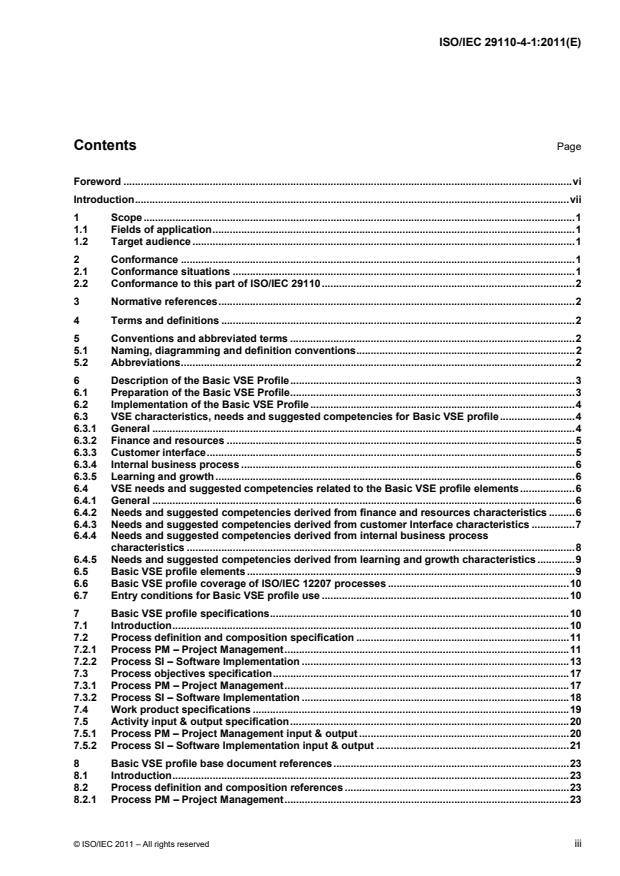
Contents Page
Foreword .vi
Introduction.vii
1 Scope.1
1.1 Fields of application.1
1.2 Target audience.1
2 Conformance .1
2.1 Conformance situations .1
2.2 Conformance to this part of ISO/IEC 29110.2
3 Normative references.2
4 Terms and definitions .2
5 Conventions and abbreviated terms .2
5.1 Naming, diagramming and definition conventions.2
5.2 Abbreviations.2
6 Description of the Basic VSE Profile.3
6.1 Preparation of the Basic VSE Profile.3
6.2 Implementation of the Basic VSE Profile.4
6.3 VSE characteristics, needs and suggested competencies for Basic VSE profile.4
6.3.1 General.4
6.3.2 Finance and resources.5
6.3.3 Customer interface.5
6.3.4 Internal business process .6
6.3.5 Learning and growth.6
6.4 VSE needs and suggested competencies related to the Basic VSE profile elements.6
6.4.1 General.6
6.4.2 Needs and suggested competencies derived from finance and resources characteristics .6
6.4.3 Needs and suggested competencies derived from customer Interface characteristics .7
6.4.4 Needs and suggested competencies derived from internal business process
characteristics .8
6.4.5 Needs and suggested competencies derived from learning and growth characteristics .9
6.5 Basic VSE profile elements .9
6.6 Basic VSE profile coverage of ISO/IEC 12207 processes .10
6.7 Entry conditions for Basic VSE profile use .10
7 Basic VSE profile specifications.10
7.1 Introduction.10
7.2 Process definition and composition specification .11
7.2.1 Process PM – Project Management.11
7.2.2 Process SI – Software Implementation .13
7.3 Process objectives specification.17
7.3.1 Process PM – Project Management.17
7.3.2 Process SI – Software Implementation .18
7.4 Work product specifications .19
7.5 Activity input & output specification.20
7.5.1 Process PM – Project Management input & output .20
7.5.2 Process SI – Software Implementation input & output .21
8 Basic VSE profile base document references.23
8.1 Introduction.23
8.2 Process definition and composition references .23
8.2.1 Process PM – Project Management.23
© ISO/IEC 2011 – All rights reserved iii
8.2.2 Process SI – Software Implementation .28
8.3 Process objectives references.36
8.3.1 Process PM – Project Management .36
8.3.2 Process SI – Software Implementation .41
8.4 Work product references .50
Annex A (normative) Process Reference Model for Basic VSE Profile Assessment.51
Bibliography .52
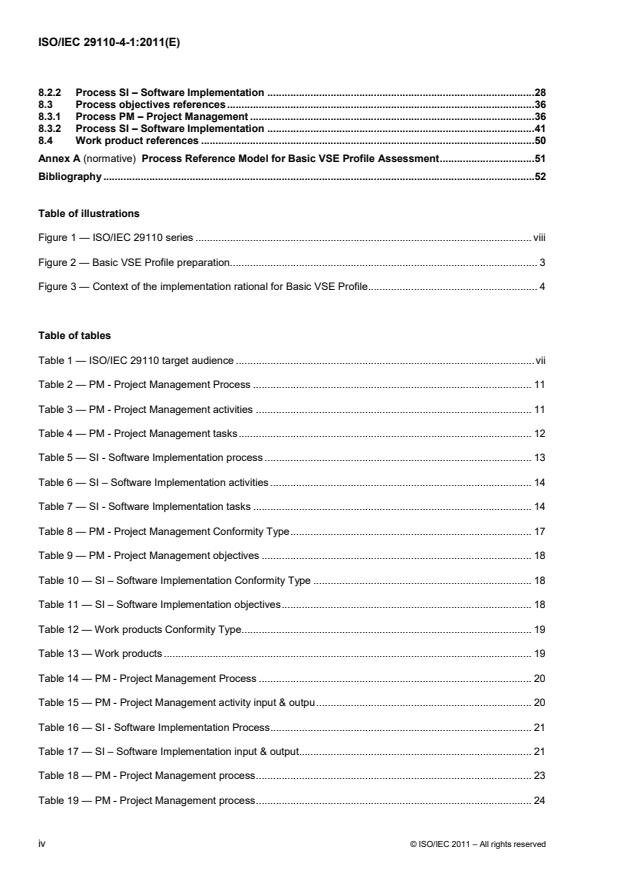
Table of illustrations
Figure 1 — ISO/IEC 29110 series . viii
Figure 2 — Basic VSE Profile preparation. 3
Figure 3 — Context of the implementation rational for Basic VSE Profile. 4
Table of tables
Table 1 — ISO/IEC 29110 target audience .vii
Table 2 — PM - Project Management Process . 11
Table 3 — PM - Project Management activities . 11
Table 4 — PM - Project Management tasks. 12
Table 5 — SI - Software Implementation process . 13
Table 6 — SI – Software Implementation activities . 14
Table 7 — SI - Software Implementation tasks . 14
Table 8 — PM - Project Management Conformity Type. 17
Table 9 — PM - Project Management objectives . 18
Table 10 — SI – Software Implementation Conformity Type . 18
Table 11 — SI – Software Implementation objectives. 18
Table 12 — Work products Conformity Type. 19
Table 13 — Work products . 19
Table 14 — PM - Project Management Process . 20
Table 15 — PM - Project Management activity input & outpu. 20
Table 16 — SI - Software Implementation Process. 21
Table 17 — SI – Software Implementation input & output. 21
Table 18 — PM - Project Management process. 23
Table 19 — PM - Project Management process. 24
iv © ISO/IEC 2011 – All rights reserved
Table 20 — PM - Project Management activities .24
Table 21 — PM - Project Management tasks.25
Table 22 — SI – Software Implementation process.28
Table 23 — SI – Software Implementation activities.29
Table 24 — SI – Software Implementation tasks .30
Table 25 — PM – Process Management process.36
Table 26 — PM - Project Management process objectives references .36
Table 27 — SI – Software Implementation process.41
Table 28 — SI – Software Implementation process objectives references.41
Table 29 — Profile Document ID.50
Table 30 — Work products references.50
© ISO/IEC 2011 – All rights reserved v
Foreword
ISO (the International Organization for Standardization) and IEC (the International Electrotechnical
Commission) form the specialized system for worldwide standardization. National bodies that are members of
ISO or IEC participate in the development of International Standards through technical committees
established by the respective organization to deal with particular fields of technical activity. ISO and IEC
technical committees collaborate in fields of mutual interest. Other international organizations, governmental
and non-governmental, in liaison with ISO and IEC, also take part in the work. In the field of information
technology, ISO and IEC have established a joint technical committee, ISO/IEC JTC 1.
International Standards are drafted in accordance with the rules given in the ISO/IEC Directives, Part 2.
The main task of the joint technical committee is to prepare International Standards. Draft International
Standards adopted by the joint technical committee are circulated to national bodies for voting. Publication as
an International Standard requires approval by at least 75 % of the national bodies casting a vote.
Attention is drawn to the possibility that some of the elements of this document may be the subject of patent
rights. ISO and IEC shall not be held responsible for identifying any or all such patent rights.
ISO/IEC 29110-4-1 was prepared by Joint Technical Committee ISO/IEC JTC 1, Information technology,
Subcommittee SC 7, Software and systems engineering.
ISO/IEC 29110 consists of the following parts, under the general title Software engineering — Lifecycle
profiles for Very Small Entities (VSEs):
⎯ Part 1: Overview [Technical Report]
⎯ Part 2: Framework and taxonomy
⎯ Part 3: Assessment guide [Technical Report]
⎯ Part 4-1: Profile specifications: Generic profile group
⎯ Part 5-1-2: Management and engineering guide: Generic profile group: Basic profile [Technical Report]
Parts 4 and 5 can be developed to accommodate new profile specifications and management and engineering
guides as follows:
⎯ Part 4-m: Profile specifications: Profile group aaaaa
⎯ Part 5-m-n: Management and engineering guide: Profile group aaaaa: Profile bbbbb [Technical Report]
This first edition of part 4-1 contains the specification for the first profile developed (Basic). As more profiles
are developed, this part will be restructured and amended to accommodate and include multiple specifications.
⎯ Part 4-1: Profile specifications: Generic profile group
vi © ISO/IEC 2011 – All rights reserved
Introduction
The software industry recognizes the value of Very Small Entities (VSEs) in contributing valuable products
and services. For the purpose of ISO/IEC 29110, a Very Small Entity (VSE) is an entity (enterprise,
organization, department or project) having up to 25 people. VSEs also develop and/or maintain software that
is used in larger systems; therefore, recognition of VSEs as suppliers of high quality software is often required.
According to the Organization for Economic Co-operation and Development (OECD) SME and
Entrepreneurship Outlook report (2005), ‘SMEs constitute the dominant form of business organisation in all
countries world-wide, accounting for over 95 % and up to 99 % of the business population depending on
country’. The challenge facing OECD governments is to provide a business environment that supports the
competitiveness of this large heterogeneous business population and that promotes a vibrant entrepreneurial
culture.
From studies and surveys conducted, it is clear that the majority of International Standards do not address the
needs of VSEs. Conformance with these standards is difficult, if not impossible, giving VSEs no way, or very
limited ways, to be recognized as entities that produce quality software in their domain. Therefore, VSEs are
often cut off from some economic activities.
It has been found that VSEs find it difficult to relate International Standards to their business needs and to
justify their application to their business practices. Most VSEs can neither afford the resources, in terms of
number of employees, budget and time, nor do they see a net benefit in establishing software lifecycle
processes. To rectify some of these difficulties, a set of guides has been developed according to a set of VSE
characteristics. The guides are based on subsets of appropriate standards elements, referred to as VSE
profiles. The purpose of a VSE profile is to define a subset of International Standards relevant to the VSE
context, for example, processes and outcomes of ISO/IEC 12207 and products of ISO/IEC 15289.
ISO/IEC 29110, targeted by audience, has been developed to improve product and/or service quality, and
process performance. See Table 1. ISO/IEC 29110 is not intended to preclude the use of different life cycles,
such as waterfall, iterative, incremental, evolutionary or agile.
Table 1 — ISO/IEC 29110 target audience
ISO/IEC 29110 Title Target audience
Part 1 Overview VSEs, assessors, standards producers, tool vendors, and
methodology vendors
Part 2 Framework and taxonomy Standards producers, tool vendors and methodology
vendors. Not intended for VSEs.
Part 3 Assessment guide Assessors and VSEs
Part 4 Profile specifications Standards producers, tool vendors and methodology
vendors. Not intended for VSEs.
Part 5 Management and engineering guide VSEs
If a new profile is needed, ISO/IEC 29110-4 and ISO/IEC TR 29110-5 can be developed without impacting
existing documents and they become ISO/IEC 29110-4-m and ISO/IEC 29110-5-m-n, respectively, through
the ISO/IEC process.
ISO/IEC TR 29110-1 defines the business terms common to the VSE Profile Set of Documents. It introduces
processes, lifecycle and standardization concepts, and the ISO/IEC 29110 series. It also introduces the
characteristics and requirements of a VSE, and clarifies the rationale for VSE-specific profiles, documents,
standards and guides.
© ISO/IEC 2011 – All rights reserved vii
ISO/IEC 29110-2 introduces the concepts for software engineering standardized profiles for VSEs, and
defines the terms common to the VSE Profile Set of Documents. It establishes the logic behind the definition
and application of standardized profiles. It specifies the elements common to all standardized profiles
(structure, conformance, assessment) and introduces the taxonomy (catalogue) of ISO/IEC 29110 profiles.
ISO/IEC TR 29110-3 defines the process assessment guidelines and compliance requirements needed to
meet the purpose of the defined VSE Profiles. ISO/IEC TR 29110-3 also contains information that can be
useful to developers of assessment methods and assessment tools. ISO/IEC TR 29110-3 is addressed to
people who have direct relation with the assessment process, e.g. the assessor and the sponsor of the
assessment, who need guidance on ensuring that the requirements for performing an assessment have been
met.
This part of ISO/IEC 29110 provides the specification for all the profiles of the Generic Profile Group. The
Generic Profile Group is applicable to VSEs that do not develop critical software products. The profiles are
based on subsets of appropriate standards elements. VSE Profiles apply and are targeted at
authors/providers of guides and authors/providers of tools and other support material.
ISO/IEC TR 29110-5-m-n provides an implementation management and engineering guide for the VSE Profile
described in ISO/IEC 29110-4-m.
Figure 1 describes the ISO/IEC 29110 series and positions the parts within the framework of reference.
Overviews and guides are published as Technical Reports (TR), and profiles are published as International
Standards (IS).
29110 Overview (TR 29110-1)
29110 Profiles (IS)
Framework and Taxonomy (IS 29110-2)
Specifications of VSE Profiles (IS 29110-4)
Specification - VSE Profile Group m
Specification - VSE Profile Group m
(IS 29110-4-m)
(IS 29110-4-m)
29110 Guides (TR)
Assessment Guide (TR 29110-3)
Management and Engineering Guide (TR 29110-5)
Management and
Management and
Engineering Guide
Engineering Guide
VSE Profile m-n
VSE Profile m-n
(TR 29110-5-m-n)
(TR 29110-5-m-n)
Figure 1 — ISO/IEC 29110 series
viii © ISO/IEC 2011 – All rights reserved
INTERNATIONAL STANDARD ISO/IEC 29110-4-1:2011(E)
Software engineering — Lifecycle profiles for Very Small
Entities (VSEs) —
Part 4-1:
Profile specifications: Generic profile group
1 Scope
1.1 Fields of application
ISO/IEC 29110 is applicable to Very Small Entities (VSEs). VSEs are enterprises, organizations, departments
or projects up to 25 people. The lifecycle processes described in ISO/IEC 29110 are not intended to preclude
or discourage their use by organizations bigger than VSEs.
The lifecycle processes defined in ISO/IEC 29110 can be used by VSEs when acquiring and using, as well as
when creating and supplying, a software system. They can be applied at any level in a software system’s
structure and at any stage in the lifecycle. The processes described in ISO/IEC 29110 are not intended to
preclude or discourage the use of additional processes that VSEs find useful.
This part of ISO/IEC 29110 provides a profile specification for the Basic VSE Profile within the Generic Profile
Group. The Basic VSE Profile applies to VSEs involved in software development. It selects ISO/IEC 12207
project management and software implementation process elements and ISO/IEC 15289:2006 products from
the single project perspective.
Its purpose is to provide the normative and informative links to the subset of ISO/IEC 12207 and
ISO/IEC 15289:2006.
1.2 Target audience
This part of ISO/IEC 29110 is targeted at assessors, VSEs that want to claim conformance, authors/providers
of guides, and authors/providers of tools and other support material.
2 Conformance
2.1 Conformance situations
This part of ISO/IEC 29110 can be implemented by
⎯ developers of products that facilitate the implementation and the use of this part of ISO/IEC 29110 within
organizations;
NOTE Examples of such products are methods, courses, teaching aids, tools, and forms.
⎯ organizations or projects implementing and using the processes and products prescribed by this part of
ISO/IEC 29110.
Therefore, conformance can be claimed by developers of products and organizations, with different
interpretations, and different conformity assessment methods.
© ISO/IEC 2011 – All rights reserved 1
It can be attested by a third party. It can be mandated as part of procurement and contractual processes
2.2 Conformance to this part of ISO/IEC 29110
A VSE that claims conformance to this part of ISO/IEC 29110 shall implement and use all the mandatory
profile elements as identified in Clause 7, and the associated properties and requirements as described in the
base standards when applicable.
Conformance is achieved by demonstrating that
⎯ mandatory requirements for the lifecycle products (information items) have been satisfied using the
content of conformant work products as evidence,
⎯ mandatory requirements for the lifecycle processes have been satisfied using the objectives (outcomes)
and products as evidence.
Conformance to this part of ISO/IEC 29110 implies conformance to ISO/IEC 12207 and ISO/IEC 15289:2006,
as per their conformance clause that allows partial or tailored conformance.
A product that claims conformance to this part of ISO/IEC 29110 shall implement all the mandatory profile
elements as identified in Clause 7, and the associated properties and requirements as described in the base
standards when applicable. Conformance is achieved by demonstrating that the conforming product does not
exclude, modify or contradict any of the mandatory profile elements.
3 Normative references
The following referenced documents are indispensable for the application of this document. For dated
references, only the edition cited applies. For undated references, the latest edition of the referenced
document (including any amendments) applies.
ISO/IEC TR 29110-1, Software engineering — Lifecycle profiles for Very Small Entities (VSEs) — Part 1:
Overview
ISO/IEC 29110-2, Software engineering — Lifecycle profiles for Very Small Entities (VSEs) — Part 2:
Framework and taxonomy
ISO/IEC 12207:2008, Systems and software engineering — Software life cycle processes
ISO/IEC 15289:2006, Systems and software engineering — Content of systems and software life cycle
process information products (Documentation)
4 Terms and definitions
For the purposes of this document, the terms and definitions given in ISO/IEC TR 29110-1 apply.
5 Conventions and abbreviated terms
5.1 Naming, diagramming and definition conventions
Conventions for naming, diagramming, describing and defining VSE Profiles are defined in ISO/IEC 29110-2.
5.2 Abbreviations
VSE Very Small Entity
VSEs Very Small Entities
2 © ISO/IEC 2011 – All rights reserved
6 Description of the Basic VSE Profile
6.1 Preparation of the Basic VSE Profile
The purpose of the Basic VSE Profile is to define a subset of processes and outcomes of ISO/IEC 12207 and
products of ISO/IEC 15289:2006 for software implementation and project management. The main reasons to
include software implementation and project management are that the VSE core business is software
development and their financial success depends on successful project completion within schedule and
budget.
The preparation of the Basic VSE Profile follows the next steps:
a) The recognition of VSE characteristics related to: finance, resources, customer interface, internal
business processes, learning and growth.
b) The identification of VSE needs and suggested Competencies that derives from those characteristics.
c) The specification of the Basic VSE Profile elements proper to respond to the VSE needs and suggested
Competencies according to ISO/IEC 29110-2.
d) The selection and link of the subset of the Basic VSE Profile elements that map to the ISO/IEC 12207
processes and outcomes elements and ISO/IEC 15289:2006 product elements related to the Basic VSE
Profile elements.
e) The definition of the Basic VSE Profile Guides: ISO/IEC TR 29110-5-1-2, Management and Engineering
Guide for the implementation of Basic VSE Profile.
Figure 2 illustrates the steps to prepare the Basic VSE Profile.
VSE
a)
Characteristics
derives
Base Standard
VSE Needs and Competencies
b)
ISO/IEC 12207
Elements
responds
included
d)
based on
ISO/IEC 29110-2
ISO/IEC 29110-4-1
VSE profile framework
Base Standard
c) Basic VSE Profile
and taxonomy ISO/IEC 15289
Specification
Elements
included
implements
ISO/IEC TR 29110-5-1-2
Management and
e)
Engineering Guide
Figure 2 — Basic VSE Profile preparation
© ISO/IEC 2011 – All rights reserved 3
The interpretation of the diagram notation is as follows: the rectangle represents the VSE elements; the ellipse
represents the standard or a subset of its elements; solid arrow is a labelled relation and circle with dashed
arrow is a number of the preparation step.
6.2 Implementation of the Basic VSE Profile
To implement a Basic VSE Profile a contract or agreement with statement of work must be defined based on
the customer requirements and supplemented by the business practices / conventions and accepted by the
VSE customer.
A VSE software development project follows the VSE Management and Engineering Guide to fulfil the
statement of work and to generate the products. VSE can perform other activities to support the project.
Figure 3 illustrates the context of the implementation rationale for the Basic VSE Profile.
Business Practices / Customer
Conventions Requirements
ISO/IEC 29110-4-1
supplemented by based on
Basic VSE Profile
Specification
Contract/Agreement
with Statement of Work
implements
depends on
ISO/IEC TR 29110-
follows
A VSE software
5-1 Management
development project
and Engineering
Guide
generates support
Products VSE activities
Figure 3 — Context of the implementation rational for Basic VSE Profile
The notation of Figure 3 is similar to Figure 2.
In order to implement the Basic VSE Profile, VSE can follow ISO/IEC TR 29110-5-1-2, which is a collection of
selected and structured process elements such as: objectives, activities, tasks, roles and work products;
useful for Basic VSE Profile implementation. For concept definition see ISO/IEC TR 29110-5-1-2.
6.3 VSE characteristics, needs and suggested competencies for Basic VSE profile
6.3.1 General
VSEs are subject to a number of characteristics, needs and suggested competencies that affect the contents,
the nature and the extent of their activities. The Basic VSE Profile addresses a subset of VSEs which are
described through the following characteristics, needs and suggested Competencies, classified in four
categories: Finance and Resources, Customer Interface, Internal Business Processes and Learning and
Growth.
4 © ISO/IEC 2011 – All rights reserved
6.3.2 Finance and resources
6.3.2.1 Characteristics:
a) small number of engineers (e.g. the cost of a payroll up to 25 people);
b) short term cash flow of each project may be critical for VSE;
c) low budget projects that last a few months and involve few people to develop small products;
d) depend on successful project completion within schedule and budget;
e) prefer separate project to perform corrective post delivery maintenance;
f) limited internal resources to perform management, support and organizational processes like risk
management, training, quality management, process improvement and reuse.
6.3.2.2 Needs and suggested competencies:
a) perform the projects within the budget and deliver the product on schedule;
b) maintain close communication with the customer to manage risks.
6.3.3 Customer interface
6.3.3.1 Characteristics:
a) usually have one customer per project at a time;
b) customer satisfaction depends on
1) fulfilment of specific requirements that may change during the project,
2) timely information during the product development,
3) delivery on schedule,
4) low level of defects found post-delivery, and
5) close communication and prompt responses to any changes.
c) customers usually do not define quantitative quality requirements;
d) a VSE is usually not in charge of the management of the system, and the software integration, installation
and operation.
6.3.3.2 Needs and suggested competencies:
a) fulfil customer requirements;
b) manage the change of customer requirements during the project;
c) provide close communication and timely update information to the customer during the product
development;
d) deliver the product with low level of defects.
© ISO/IEC 2011 – All rights reserved 5
6.3.4 Internal business process
6.3.4.1 Characteristics:
a) The main process is to develop custom software systems written in house on contract.
b) The software product is elaborated progressively and has to be consistent with customer requirements.
c) Products are developed or maintained through projects with a single line of communication between
implementation group and customer.
d) The number of engineers in the organization is small (e.g. up to 25 people); therefore most of the
communication, decision making and problem resolution can be performed promptly face to face.
e) The VSE has lean Project Management and focused Software Implementation activities.
f) Infrastructure Management, Project Portfolio Management and Human Resource Management
Processes are performed through face to face informal mechanisms.
g) Products generated in projects are software items which may have more than one version and have to be
saved and control.
6.3.4.2 Needs and suggested competencies:
a) Version control and storage of the products generated during project.
b) progressive elaboration of the software product, achieving consistency with customer requirements.
6.3.5 Learning and growth
6.3.5.1 Characteristics:
a) awareness of the importance of standards;
b) lack of human resources to engage in standardization;
c) lack of information of International Standards;
d) lack of knowledge of software process improvement and process evaluation.
6.3.5.2 Needs and suggested competencies:
a) guidelines, flexible and easy to use for beginners, to adopt practices of International Standards focused
on processes to support their software development projects needs.
6.4 VSE needs and suggested competencies related to the Basic VSE profile elements
6.4.1 General
The needs and suggested Competencies are related to Basic VSE Profile elements: processes, objectives
and work products, as given in 6.4.2 to 6.4.5.
6.4.2 Needs and suggested competencies derived from finance and resources characteristics
a) Perform the projects within the budget and deliver the product on schedule. To respond to this need and
suggested Competencies Basic VSE Profile processes, objectives and work products are:
6 © ISO/IEC 2011 – All rights reserved
Project Management Process
PM.O1. The Project Plan for the execution of the project is developed according to the Statement of
Work and validated with the Customer. The tasks and resources necessary to complete the work are
sized and estimated.
PM.O2. Progress of the project is monitored against the Project Plan and recorded in the Progress
Status Record. Corrections to remediate problems and deviations from the plan are taken when
project targets are not achieved. Appropriate Closure of the project is performed to get the Customer
acceptance documented in the Acceptance Record.
Software Implementation Process
SI.O1. Tasks of the activities are performed through the accomplishment of the current Project Plan.
Work Products: Statement of Work, Progress Status Record, Project Plan, Correction Register and
Acceptance Record.
b) Maintain close communication with the customer to manage risks. To respond to this need and suggested
Competencies Basic VSE Profile processes, objectives and work products are:
Project Management Process
PM.O5. Risks are identified as they develop and during the conduct of the project.
Work Product: Project Plan.
6.4.3 Needs and suggested competencies derived from customer Interface characteristics
a) Fulfil customer requirements. To respond to this need and suggested Competencies Basic VSE Profile
processes, objectives and work products are:
Project Management Process
PM.O7. Software Quality Assurance is performed to provide assurance that work products and
processes comply with the Project Plan and Requirements Specification.
Software Implementation Process
SI.O2. Software requirements are defined, analyzed for correctness and testability, approved by the
Customer, baselined and communicated.
Work Products: Requirements Specification, Verification Results, and Validation Results.
b) Manage the change of customer requirements during the project. To respond to this need and suggested
Competencies Basic VSE Profile processes, objectives and work products are:
Project Management Process
PM.O3. The Change Requests are addressed through their reception and analysis. Changes to the
software requirements are evaluated for cost, schedule and technical impact.
Work Product: Change Request.
© ISO/IEC 2011 – All rights reserved 7
c) Provide close communication and timely updated information response to the customer during the
product development. To respond to this need and suggested Competencies Basic VSE Profile
processes, objectives and work products are:
Project Management Process
PM.O4. Review meetings with the Work Team and the Customer are held. Agreements are
registered and tracked.
Work Product: Meeting Record.
d) Deliver the product with low level of defects. To respond to this need and suggested Competencies Basic
VSE Profile processes, objectives and work products are:
Software Implementation Process
SI.O7. Verification and Validation tasks of all required work products are performed using the defined
criteria to achieve consistency among output and input products in each activity. Defects are
identified and corrected; records are stored in the Verification/Validation Results.
Work Products: Verification Results, and Validation Results.
6.4.4 Needs and suggested competencies derived from internal business process characteristics
a) Version control and storage of the products generated during the project. To respond to this need and
suggested Competencies Basic VSE Profile processes, objectives and work products are:
Project Management Process
PM.O6. A software Version Control Strategy is developed. Items of Software Configuration are
identified, defined and baselined. Modifications and releases of the items are controlled and made
available to the Customer and Work Team including the storage, handling and delivery of the items.
Work Products: Project Repository and Project Repository Backup.
b) Elaborate progressively the software product, achieving consistency with customer requirements. To
respond to this need and suggested Competencies Basic VSE Profile processes, objectives and work
products are:
Software Implementation Process
SI.O3. Software architectural and detailed design is developed and baselined. It describes the
software items and internal and external interfaces of them. Consistency and traceability to software
requirements are established.
SI.O4. Software components defined by the design are produced. Unit test are defined and
performed to verify the consistency with requirements and the design. Traceability to the
requirements and design are established.
SI.O5. Software is produced performing integration of software components and verified using Test
Cases and Test Procedures. Results are recorded at the Test Report. Defects are corrected and
consistency and traceability to Software Design are established.
SI.O6. A Software Configuration, that meets the Requirements Specification as agreed to with the
Customer, which includes user, operation and maintenance documentations is integrated, baselined
and stored at the Project Repository. Needs for changes to the Software Configuration are detected
and related Change Requests are initiated.
Work Products: Software Components, Test Report, Maintenance Documentation, Product Operation
Guide, Software, Software Configuration, Software Design, Software User Documentation, Test Cases
and Test Procedures and Traceability Record.
8 © ISO/IEC 2011 – All rights reserved
6.4.5 Needs and suggested competencies derived from learning and growth characteristics
a) Guidelines, flexible and easy to use for beginners, to adopt practices of international standards focused
on processes to support their software development projects needs. To respond to this need and
suggested Competencies Basic VSE Profile has:
The Management and Engineering Guide ISO/IEC 29110 5-1-2 that supports the implementation of Basic
VSE Profile, useful for software development and project management, through a process description
which integrates purposes, objectives, outcomes, activities, tasks, products and roles within explicit
workflows.
6.5 Basic VSE profile elements
Basic VSE Profile is composed by Project Management (PM) and Software Implementation (SI) processes
with its corresponding objectives (identified as PM.O1, PM.O2, etc; and SI.O1, SI.O2, etc) and work products.
Project Management Process
PM.O1. The Project Plan for the execution of the project is developed according to the Statement of
Work and validated with the Customer. The tasks and resources necessary to complete the work are
sized and estimated.
PM.O2. Progress of the project is monitored against the Project Plan and recorded in the Progress
Status Record. Corrections to remediate problems and deviations from the plan are taken when
project targets are not achieved. Closure of the project is performed to get the Customer acceptance
documented in the Acceptance Record.
PM.O3. The Change Requests are addressed through their reception and analysis. Changes to the
software requirements are evaluated for cost, schedule and technical impact.
PM.O4. Review meetings with the Work Team and the Customer are held. Agreements are
registered and tracked.
PM.O5. Risks are identified as they develop and during the conduct of the project.
PM.O6. A software Version Control Strategy is developed. Items of Software Configuration are
identified, defined and baselined. Modifications and releases of the items are controlled and made
available to the Customer and Work Team including the storage, handling and delivery of the items.
PM.O7. Software Quality Assurance is performed to provide assurance that work products and
processes comply with the Project Plan and Requirements Specification.
Work Products: Statement of Work, Progress Status Record, Project Plan, Change Requests, Meeting
Record, Correction Register, Verification Results, Validation
...
Questions, Comments and Discussion
Ask us and Technical Secretary will try to provide an answer. You can facilitate discussion about the standard in here.
Loading comments...