


ISO 5536:2009
(Main)Milk fat products — Determination of water content — Karl Fischer method
Milk fat products — Determination of water content — Karl Fischer method
ISO 5536|IDF 23:2009 specifies a method for the determination of the water content of milk fat products by the Karl Fischer method. The method is applicable to butteroil (anhydrous butteroil, anhydrous butterfat, anhydrous milk fat) with a water content not exceeding 1,0 % mass fraction.
Produits à base de matière grasse laitière — Détermination de la teneur en eau — Méthode de Karl Fischer
L'ISO 5536|FIL 23:2009 spécifie une méthode de détermination de la teneur en eau des produits à base de matière grasse laitière par la méthode de Karl Fischer. Cette méthode s'applique à l'huile de beurre (huile de beurre anhydre, matière grasse butyrique anhydre, matière grasse laitière anhydre) dont la teneur en eau ne dépasse pas 1,0 % (fraction massique).
General Information
- Status
- Published
- Publication Date
- 03-Nov-2009
- Technical Committee
- ISO/TC 34/SC 5 - Milk and milk products
- Drafting Committee
- ISO/TC 34/SC 5 - Milk and milk products
- Current Stage
- 9093 - International Standard confirmed
- Start Date
- 12-Dec-2023
- Completion Date
- 12-Feb-2026
Relations
- Effective Date
- 15-Apr-2008
Overview
ISO 5536:2009 / IDF 23:2009 defines a standardized Karl Fischer (KF) titration procedure for determining the water content of milk fat products, specifically butteroil (anhydrous butteroil / anhydrous butterfat / anhydrous milk fat) with water not exceeding 1.0% mass fraction. Published jointly by ISO and the International Dairy Federation (IDF), this second edition updates the 2002 method and is intended for routine laboratory determination using volumetric KF equipment.
Key topics and technical requirements
- Scope: Applicable to butteroil samples with ≤ 1.0% water; sampling itself is not covered (see ISO 707|IDF 50).
- Method principle: Direct volumetric KF titration of the sample at ~40 °C; water content calculated from reagent consumption.
- Reagents: Pyridine‑free two‑component KF reagent (titration + solvent) or one‑component titration reagent with methanol as solvent. The titration component should have a water equivalent of approximately 2 mg/ml. Methanol water content must be ≤ 0.05%. A 10 mg/g water standard is used to determine reagent water equivalent.
- Working medium: Mix equal volumes (1+1) of the KF solvent component and 1‑octanol directly in the titration vessel.
- Apparatus: Automatic volumetric Karl Fischer titrator with a 5–10 ml burette and a double‑jacketed titration vessel maintained at 40 °C ±5 °C. Equipment must be dry and protected from atmospheric moisture.
- Procedure essentials:
- Determine instrument drift daily.
- Determine titration component water equivalent from five replicate standard injections.
- Prepare test sample by blending thoroughly at 35–40 °C to disperse water. Typical test portion ≈ 5 g.
- Shut‑off criterion: 10 s stop delay or a stop drift slightly above measured drift.
- Results & precision: Results expressed to two decimal places. Repeatability and reproducibility were evaluated via an interlaboratory trial; in not more than 5% of cases, the absolute difference should be > 0.01% (repeatability) or > 0.05% (reproducibility).
Applications and users
- Quality control and moisture specification testing in dairy processing and ingredient manufacturing.
- Laboratories performing regulatory compliance or product specification testing for anhydrous milk fat / butteroil.
- R&D and process-control analysts optimizing dehydration, storage, or shelf‑life for milk fat products.
- Equipment and reagent suppliers supporting KF titration workflows.
Related standards
- ISO 707 | IDF 50 - recommended sampling of milk and milk products.
- ISO 5725‑1 and ISO 5725‑2 - procedures for determination of repeatability and reproducibility (used for the interlaboratory precision study).
Keywords: ISO 5536:2009, Karl Fischer method, milk fat products, butteroil water content, KF titration, volumetric Karl Fischer, anhydrous butterfat, water determination.
ISO 5536:2009 - Milk fat products -- Determination of water content -- Karl Fischer method
ISO 5536:2009 - Produits a base de matiere grasse laitiere -- Détermination de la teneur en eau -- Méthode de Karl Fischer
Get Certified
Connect with accredited certification bodies for this standard

BSI Group
BSI (British Standards Institution) is the business standards company that helps organizations make excellence a habit.

Bureau Veritas
Bureau Veritas is a world leader in laboratory testing, inspection and certification services.

DNV
DNV is an independent assurance and risk management provider.
Sponsored listings
Frequently Asked Questions
ISO 5536:2009 is a standard published by the International Organization for Standardization (ISO). Its full title is "Milk fat products — Determination of water content — Karl Fischer method". This standard covers: ISO 5536|IDF 23:2009 specifies a method for the determination of the water content of milk fat products by the Karl Fischer method. The method is applicable to butteroil (anhydrous butteroil, anhydrous butterfat, anhydrous milk fat) with a water content not exceeding 1,0 % mass fraction.
ISO 5536|IDF 23:2009 specifies a method for the determination of the water content of milk fat products by the Karl Fischer method. The method is applicable to butteroil (anhydrous butteroil, anhydrous butterfat, anhydrous milk fat) with a water content not exceeding 1,0 % mass fraction.
ISO 5536:2009 is classified under the following ICS (International Classification for Standards) categories: 67.100.10 - Milk and processed milk products. The ICS classification helps identify the subject area and facilitates finding related standards.
ISO 5536:2009 has the following relationships with other standards: It is inter standard links to ISO 5536:2002. Understanding these relationships helps ensure you are using the most current and applicable version of the standard.
ISO 5536:2009 is available in PDF format for immediate download after purchase. The document can be added to your cart and obtained through the secure checkout process. Digital delivery ensures instant access to the complete standard document.
Standards Content (Sample)
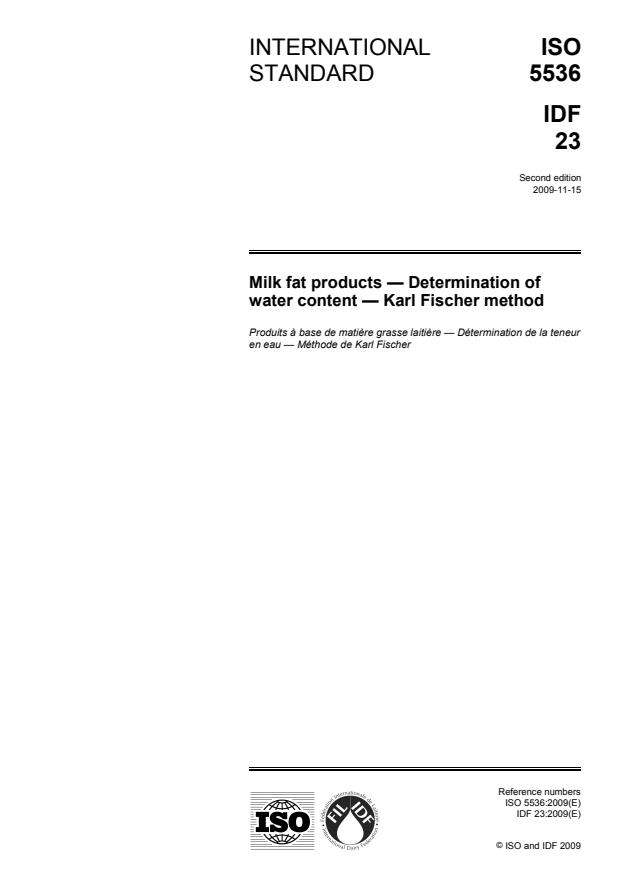
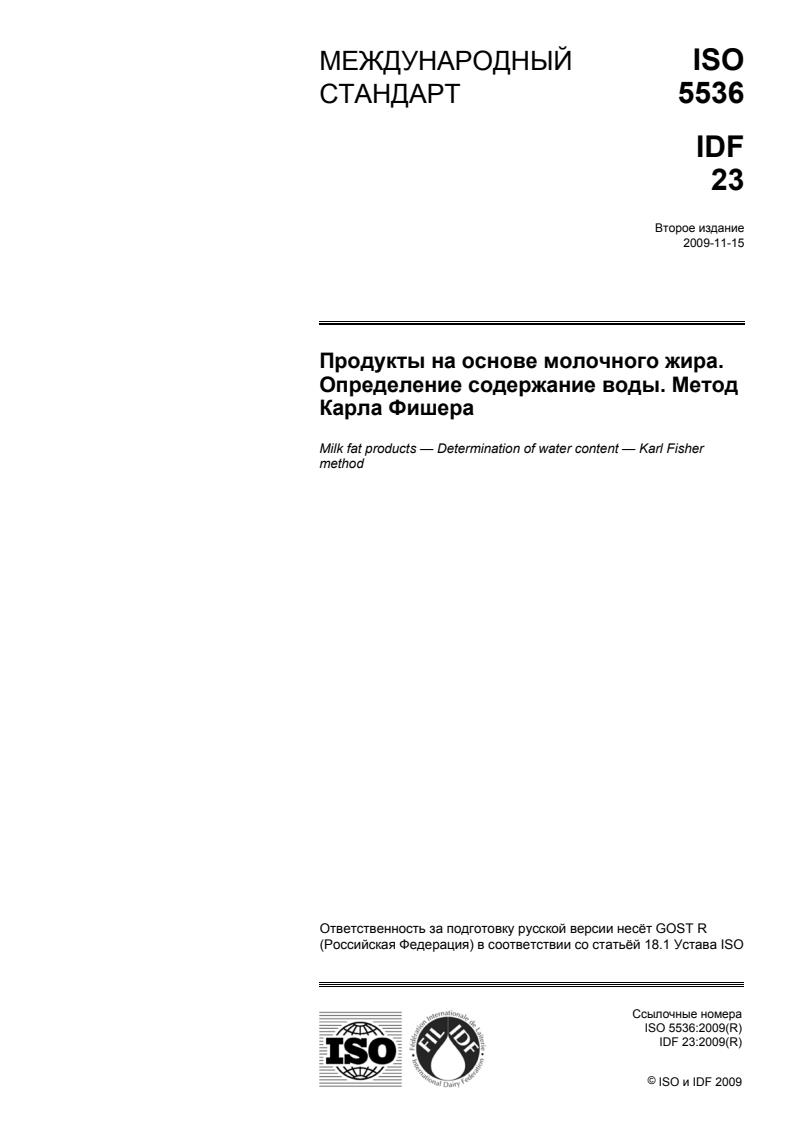
INTERNATIONAL ISO
STANDARD 5536
IDF
Second edition
2009-11-15
Milk fat products — Determination of
water content — Karl Fischer method
Produits à base de matière grasse laitière — Détermination de la teneur
en eau — Méthode de Karl Fischer
Reference numbers
IDF 23:2009(E)
©
ISO and IDF 2009
IDF 23:2009(E)
PDF disclaimer
This PDF file may contain embedded typefaces. In accordance with Adobe's licensing policy, this file may be printed or viewed but
shall not be edited unless the typefaces which are embedded are licensed to and installed on the computer performing the editing. In
downloading this file, parties accept therein the responsibility of not infringing Adobe's licensing policy. Neither the ISO Central
Secretariat nor the IDF accepts any liability in this area.
Adobe is a trademark of Adobe Systems Incorporated.
Details of the software products used to create this PDF file can be found in the General Info relative to the file; the PDF-creation
parameters were optimized for printing. Every care has been taken to ensure that the file is suitable for use by ISO member bodies
and IDF national committees. In the unlikely event that a problem relating to it is found, please inform the ISO Central Secretariat at the
address given below.
© ISO and IDF 2009
All rights reserved. Unless otherwise specified, no part of this publication may be reproduced or utilized in any form or by any means,
electronic or mechanical, including photocopying and microfilm, without permission in writing from either ISO or IDF at the respective
address below.
ISO copyright office International Dairy Federation
Case postale 56 • CH-1211 Geneva 20 Diamant Building • Boulevard Auguste Reyers 80 • B-1030 Brussels
Tel. + 41 22 749 01 11 Tel. + 32 2 733 98 88
Fax + 41 22 749 09 47 Fax + 32 2 733 04 13
E-mail copyright@iso.org E-mail info@fil-idf.org
Web www.iso.org Web www.fil-idf.org
Published in Switzerland
ii © ISO and IDF 2009 – All rights reserved
IDF 23:2009(E)
Foreword
ISO (the International Organization for Standardization) is a worldwide federation of national standards
bodies (ISO member bodies). The work of preparing International Standards is normally carried out through
ISO technical committees. Each member body interested in a subject for which a technical committee has
been established has the right to be represented on that committee. International organizations, governmental
and non-governmental, in liaison with ISO, also take part in the work. ISO collaborates closely with the
International Electrotechnical Commission (IEC) on all matters of electrotechnical standardization.
International Standards are drafted in accordance with the rules given in the ISO/IEC Directives, Part 2.
The main task of technical committees is to prepare International Standards. Draft International Standards
adopted by the technical committees are circulated to the member bodies for voting. Publication as an
International Standard requires approval by at least 75 % of the member bodies casting a vote.
Attention is drawn to the possibility that some of the elements of this document may be the subject of patent
rights. ISO shall not be held responsible for identifying any or all such patent rights.
ISO 5536⎪IDF 23 was prepared by Technical Committee ISO/TC 34, Food products, Subcommittee SC 5,
Milk and milk products, and the International Dairy Federation (IDF). It is being published jointly by ISO and
IDF.
This second edition of ISO 5536⎪IDF 23 cancels and replaces the first edition (ISO 5536⎪IDF 23:2002), which
has been technically revised.
IDF 23:2009(E)
Foreword
IDF (the International Dairy Federation) is a non-profit organization representing the dairy sector worldwide.
IDF membership comprises National Committees in every member country as well as regional dairy
associations having signed a formal agreement on cooperation with IDF. All members of IDF have the right to
be represented on the IDF Standing Committees carrying out the technical work. IDF collaborates with ISO in
the development of standard methods of analysis and sampling for milk and milk products.
The main task of Standing Committees is to prepare International Standards. Draft International Standards
adopted by the Standing Committees are circulated to the National Committees for endorsement prior to
publication as an International Standard. Publication as an International Standard requires approval by at least
50 % of IDF National Committees casting a vote.
Attention is drawn to the possibility that some of the elements of this document may be the subject of patent
rights. IDF shall not be held responsible for identifying any or all such patent rights.
International Standard ISO 5536⎪IDF 23 was prepared by Technical Committee ISO/TC 34, Food products,
Subcommittee SC 5, Milk and milk products and the International Dairy Federation (IDF). It is being published
jointly by ISO and IDF.
All work was carried out by the Joint ISO-IDF Action Team on Water of the Standing Committee on Main
components in milk under the aegis of its project leader, Prof. Dr. H.-D. Isengard (DE).
This edition of ISO 5536⎪IDF 23 cancels and replaces ISO 5536⎪IDF 23:2002, which has been technically
revised.
iv © ISO and IDF 2009 – All rights reserved
INTERNATIONAL STANDARD
IDF 23:2009(E)
Milk fat products — Determination of water content — Karl
Fischer method
1 Scope
This International Standard specifies a method for the determination of the water content of milk fat products
by the Karl Fischer (KF) method.
The method is applicable to butteroil (anhydrous butteroil, anhydrous butterfat, anhydrous milk fat) with a
water content not exceeding 1,0 % mass fraction.
2 Terms and definitions
For the purposes of this document, the following terms and definitions apply.
2.1
water content of milk fat products
w
HO
mass fraction of water determined by the procedure specified in this International Standard
NOTE The water content is expressed as a percentage mass fraction.
3 Principle
The test sample is directly titrated with a commercially available two-component Karl Fischer reagent at a
temperature of approximately 40 °C. The water content is calculated from the amount of reagent used.
4 Reagents
Use only reagents of recognized analytical grade, unless otherwise specified, and distilled or demineralized
water or water of equivalent purity.
Avoid absorption of moisture from the environment.
4.1 Karl Fischer (KF) reagent, a commercially available pyridine-free two-component reagent consisting of
a titration component (4.2) and a solvent component.
Alternatively, a pyridine-free one-component KF reagent consisting solely of a titration component (4.2) can
also be used, in which case, methanol (4.6) is used as the solvent component.
4.2 Titration component.
The titration component of the KF reagent (4.1) shall have a water equivalent of approximately 2 mg/ml.
4.3 1-Octanol (C H OH)
8 17
IDF 23:2009(E)
4.4 Working medium.
Prepare the working medium by mixing equal volumes of the solvent component of the KF reagent (4.1) and
1-octanol (4.3) (1+1) directly in the titration vessel of the KF apparatus (5.1).
4.5 Water standard, w = 10 mg/g.
H O
For the determination of the water equivalent of the titration component, use a commercially available liquid
water standard.
4.6 Methanol (CH OH), with a water content of not more than 0,05 % mass fraction.
5 Apparatus
Usual laboratory apparatus and in particular the following.
Ensure that all equipment is completely dry before use.
5.1 Karl Fischer (KF) apparatus. Use an automatic volumetric KF apparatus, with a burette of capacity
5 ml (preferably) or 10 ml and a double-jacketed titration vessel with a water inlet and outlet to carry out the
titration at approximately 40 °C.
5.2 Water bath, capable of maintaining a temperature of 40 °C ± 5 °C; equipped with a thermostat and a
pump for heating the double-jacketed titration vessel of the KF apparatus (5.1).
5.3 Analytical balance, capable of weighing to the nearest 1 mg, with a readability of 0,1 mg.
5.4 Disposable syringes, of capacity 5 ml or 10 ml; for dosing the water standard (4.5) and the test portion
(7.5).
6 Sampling
A representative sample should have been sent to the laboratory. It should not have been damaged or
changed during transport or storage.
Sampling is not part of the method specified in this International Standard. A recommended sampling method
[1]
is given in ISO 707⎪IDF 50 .
7 Procedure
7.1 KF apparatus drift
7.1.1 Determine the drift of the KF apparatus (5.1) every day and/or when the working conditions change as
follows.
Mix approximately 30 ml of working medium (4.4) in the titration vessel of the KF apparatus (5.1). Heat the
vessel and its contents to 40 °C using the water bath (5.2). Pre-titrate the working medium. Then carry out a
titration over 5 min (without addition of a test sample).
IMPORTANT — During each titration the amount of working medium used shall completely cover the
electrodes of the KF apparatus.
2 © ISO and IDF 2009 – All rights reserved
IDF 23:2009(E)
7.1.2 Calculate the KF apparatus drift, q , expressed in millilitres per minute, by using Equation (1):
V
V
d
q = (1)
V
t
where
V is the volume, in millilitres, of the amount of titration component (4.2) used in the titration (7.1.1);
d
t is the time, in minutes.
Or calculate the KF apparatus drift, q , expressed in milligrams per minute, by using Equation (2):
m
V ρ
de
q = (2)
m
t
where ρ is the water equivalent (7.2) of the titration component (4.2), in milligrams per millilitre, used in the
e
titration (7.1.1).
7.2 Water equivalent of the titration component of the KF reagent
7.2.1 Titration
To calculate for each determination the water equivalent of a titration comp
...
NORME ISO
INTERNATIONALE 5536
FIL
Deuxième édition
2009-11-15
Produits à base de matière grasse
laitière — Détermination de la teneur en
eau — Méthode de Karl Fischer
Milk fat products — Determination of water content — Karl Fischer
method
Numéros de référence
FIL 23:2009(F)
©
ISO et FIL 2009
FIL 23:2009(F)
PDF – Exonération de responsabilité
Le présent fichier PDF peut contenir des polices de caractères intégrées. Conformément aux conditions de licence d'Adobe, ce fichier
peut être imprimé ou visualisé, mais ne doit pas être modifié à moins que l'ordinateur employé à cet effet ne bénéficie d'une licence
autorisant l'utilisation de ces polices et que celles-ci y soient installées. Lors du téléchargement de ce fichier, les parties concernées
acceptent de fait la responsabilité de ne pas enfreindre les conditions de licence d'Adobe. Le Secrétariat central de l'ISO et la FIL
déclinent toute responsabilité en la matière.
Adobe est une marque déposée d'Adobe Systems Incorporated.
Les détails relatifs aux produits logiciels utilisés pour la création du présent fichier PDF sont disponibles dans la rubrique General Info
du fichier; les paramètres de création PDF ont été optimisés pour l'impression. Toutes les mesures ont été prises pour garantir
l'exploitation de ce fichier par les comités membres de l'ISO et les comités nationaux de la FIL. Dans le cas peu probable où
surviendrait un problème d'utilisation, veuillez en informer le Secrétariat central de l'ISO à l'adresse donnée ci-dessous.
DOCUMENT PROTÉGÉ PAR COPYRIGHT
© ISO et FIL 2009
Droits de reproduction réservés. Sauf prescription différente, aucune partie de cette publication ne peut être reproduite ni utilisée sous
quelque forme que ce soit et par aucun procédé, électronique ou mécanique, y compris la photocopie et les microfilms, sans l'accord écrit
soit de l'ISO soit de la FIL, à l'une ou l'autre des adresses ci-après.
ISO copyright office Fédération Internationale de Laiterie
Case postale 56 • CH-1211 Geneva 20 Diamant Building • Boulevard Auguste Reyers 80 • B-1030 Bruxelles
Tel. + 41 22 749 01 11 Tel. + 32 2 733 98 88
Fax + 41 22 749 09 47 Fax + 32 2 733 04 13
E-mail copyright@iso.org E-mail info@fil-idf.org
Web www.iso.org Web www.fil-idf.org
Publié en Suisse
ii © ISO et FIL 2009 – Tous droits réservés
FIL 23:2009(F)
Avant-propos
L'ISO (Organisation internationale de normalisation) est une fédération mondiale d'organismes nationaux
de normalisation (comités membres de l'ISO). L'élaboration des Normes internationales est en général
confiée aux comités techniques de l'ISO. Chaque comité membre intéressé par une étude a le droit de faire
partie du comité technique créé à cet effet. Les organisations internationales, gouvernementales et non
gouvernementales, en liaison avec l'ISO participent également aux travaux. L'ISO collabore étroitement avec
la Commission électrotechnique internationale (CEI) en ce qui concerne la normalisation électrotechnique.
Les Normes internationales sont rédigées conformément aux règles données dans les Directives ISO/CEI,
Partie 2.
La tâche principale des comités techniques est d'élaborer les Normes internationales. Les projets de Normes
internationales adoptés par les comités techniques sont soumis aux comités membres pour vote. Leur
publication comme Normes internationales requiert l'approbation de 75 % au moins des comités membres
votants.
L'attention est appelée sur le fait que certains des éléments du présent document peuvent faire l'objet de
droits de propriété intellectuelle ou de droits analogues. L'ISO ne saurait être tenue pour responsable de ne
pas avoir identifié de tels droits de propriété et averti de leur existence.
L'ISO 5536⎪FIL 23 a été élaborée par le comité technique ISO/TC 34, Produits alimentaires, sous-comité
SC 5, Lait et produits laitiers, et la Fédération Internationale de Laiterie (FIL). Elle est publiée conjointement
par l'ISO et la FIL.
Cette deuxième édition de l'ISO 5536⎪FIL 23 annule et remplace la première édition (ISO 5536⎪FIL 23:2002),
qui a fait l'objet d'une révision technique.
© ISO et FIL 2009 – Tous droits réservés iii
FIL 23:2009(F)
Avant-propos
La FIL (Fédération Internationale de Laiterie) est une organisation sans but lucratif représentant le secteur
laitier mondial. Les membres de la FIL se composent des Comités Nationaux dans chaque pays membre et
des associations laitières régionales avec lesquelles la FIL a signé des accords de coopération. Tout membre
de la FIL a le droit de faire partie des Comités permanents de la FIL auxquels sont confiés les travaux
techniques. La FIL collabore avec l'ISO pour l'élaboration de méthodes normalisées d'analyse et
d'échantillonnage pour le lait et les produits laitiers.
La tâche principale des Comités permanents est d'élaborer les Normes internationales. Les projets de
Normes internationales adoptés par les Comités permanents sont soumis aux Comités Nationaux pour
approbation avant publication en tant que Norme internationale. La publication comme Norme internationale
requiert l'approbation de 50 % au moins des Comités Nationaux de la FIL votants.
L'attention est appelée sur le fait que certains des éléments du présent document peuvent faire l'objet de
droits de propriété intellectuelle ou de droits analogues. La FIL ne saurait être tenue pour responsable de ne
pas avoir identifié de tels droits de propriété et averti de leur existence.
L'ISO 5536⎪FIL 23 a été élaborée par le comité technique ISO/TC 34, Produits alimentaires, sous-comité
SC 5, Lait et produits laitiers, et la Fédération internationale de laiterie (FIL). Elle est publiée conjointement
par l'ISO et la FIL.
L'ensemble des travaux a été confié à l'Équipe d'Action mixte ISO-FIL, Eau, du Comité permanent, Principaux
composants du lait, sous la conduite de son chef de projet, M. H.-D. Isengard (Allemagne).
Cette édition de l'ISO 5536⎪FIL 23 annule et remplace l'ISO 5536⎪FIL 23:2002, qui a fait l'objet d'une révision
technique.
iv © ISO et FIL 2009 – Tous droits réservés
NORME INTERNATIONALE
FIL 23:2009(F)
Produits à base de matière grasse laitière — Détermination de
la teneur en eau — Méthode de Karl Fischer
1 Domaine d'application
La présente Norme internationale spécifie une méthode de détermination de la teneur en eau des produits à
base de matière grasse laitière par la méthode de Karl Fischer.
Cette méthode s'applique à l'huile de beurre (huile de beurre anhydre, matière grasse butyrique anhydre,
matière grasse laitière anhydre) dont la teneur en eau ne dépasse pas 1,0 % (fraction massique).
2 Termes et définitions
Pour les besoins du présent document, les termes et définitions suivants s'appliquent.
2.1
teneur en eau des produits à base de matière grasse laitière
w
HO
fraction massique d'eau déterminée selon le mode opératoire spécifié dans la présente Norme internationale
NOTE La teneur en eau est exprimée en fraction massique en pourcentage.
3 Principe
L'échantillon pour essai est directement titré, à une température d'environ 40 °C, avec un réactif de Karl
Fischer à deux composants disponible dans le commerce. La teneur en eau est calculée à partir de la
quantité de réactif utilisée.
4 Réactifs
Sauf spécification contraire, utiliser uniquement des réactifs de qualité analytique reconnue et de l'eau distillée
ou déminéralisée ou de l'eau de pureté équivalente.
Éviter l'absorption de l'humidité ambiante.
4.1 Réactif de Karl Fischer (KF), réactif à deux composants, exempt de pyridine et disponible dans le
commerce, comprenant un agent de titrage (4.2) et un solvant.
Le cas échéant, un réactif KF monocomposant exempt de pyridine, comprenant uniquement un agent de
titrage (4.2) peut aussi être utilisé. Dans ce cas, utiliser du méthanol (4.6) comme solvant.
4.2 Agent de titrage.
L'agent de titrage du réactif KF (4.1) doit avoir un équivalent en eau d'environ 2 mg/ml.
© ISO et FIL 2009 – Tous droits réservés 1
FIL 23:2009(F)
4.3 Octanol-1 (C H OH).
8 17
4.4 Milieu de travail.
Préparer le milieu de travail en mélangeant des volumes égaux du solvant du réactif KF (4.1) et
d'octanol-1 (4.3) (1+1) directement dans la cellule de titrage de l'appareil KF (5.1).
4.5 Étalon d'eau, w = 10 mg/g.
H O
Pour déterminer l'équivalent en eau de l'agent de titrage, utiliser un étalon d'eau liquide disponible dans le
commerce.
4.6 Méthanol (CH OH), contenant une fraction massique d'eau de 0,05 % au plus.
5 Appareillage
Matériel courant de laboratoire et, en particulier, ce qui suit.
S'assurer que tout l'appareillage est parfaitement sec avant utilisation.
5.1 Appareil Karl Fischer (KF). Utiliser un appareil automatique de titrage volumétrique KF, muni d'une
burette ayant une capacité de 5 ml (de préférence) ou de 10 ml et d'une cellule de titrage à double paroi
comportant un raccord d'entrée et de sortie d'eau pour réaliser le titrage à environ 40 °C.
5.2 Bain-marie, permettant de maintenir une température de 40 °C ± 5 °C; équipé d'un thermostat et d'une
pompe pour chauffer la cellule de titrage à double paroi de l'appareil KF (5.1).
5.3 Balance analytique, permettant de peser à 1 mg près et ayant une lisibilité de 0,1 mg.
5.4 Seringues à usage unique, de 5 ml ou 10 ml de capacité, pour le dosage de l'étalon d'eau (4.5) et de
la prise d'essai (7.5).
6 Échantillonnage
Il convient que le laboratoire reçoive un échantillon représentatif qui n'ait pas été endommagé ou modifié
pendant le transport ou le stockage.
L'échantillonnage ne fait pas partie de la méthode spécifiée dans la présente Norme internationale. Une
[1]
méthode d'échantillonnage recommandée est donnée dans l'ISO 707⎪FIL 50 .
7 Mode opératoire
7.1 Dérive de l'appareil KF
7.1.1 Chaque jour et/ou en cas de changement des conditions de travail, déterminer la dérive de l'appareil
KF (5.1), comme suit.
Homogénéiser environ 30 ml du milieu de travail (4.4) dans la cellule de titrage de l'appareil KF (5.1). Chauffer
la cellule et son contenu dans le bain-marie (5.2) maintenu à 40 °C. Pré-titrer le milieu de travail. Puis
effectuer un titrage pendant 5 min (sans ajouter d'échantillon pour essai).
IMPORTANT — À chaque titrage, les électrodes de l'appareil KF doivent baigner complètement dans le
milieu de travail utilisé.
2 © ISO et FIL 2009 – Tous droits réservés
FIL 23:2009(F)
7.1.2 Calculer la dérive de l'appareil KF, q , exprimée en millilitres par minute, à l'aide de l'Équation (1):
V
V
d
q = (1)
V
t
où
V est le volume, en millilitres, d'agent de titrage (4.2) utilisé au cours du titrage (7.1.1);
d
t est la durée, en minutes.
Ou bien calculer la dérive de l'appareil KF, q , exprimée en milligrammes par minute, à l'aide de
m
l'Équation (2):
V ρ
de
q = (2)
m
t
où ρ est l'équivalent en eau (7.2) de l'agent de titrage (4.2), en milligrammes par millilitre, utilisé au cours du
e
titrage (7.1.1).
7.2 Équivalent en eau de l'agent de titrage du ré
...
МЕЖДУНАРОДНЫЙ ISO
СТАНДАРТ 5536
IDF
Второе издание
2009-11-15
Продукты на основе молочного жира.
Определение содержание воды. Метод
Карла Фишера
Milk fat products — Determination of water content — Karl Fisher
method
Ответственность за подготовку русской версии несёт GOST R
(Российская Федерация) в соответствии со статьёй 18.1 Устава ISO
Ссылочные номера
IDF 23:2009(R)
©
ISO и IDF 2009
IDF 23:2009(R)
Отказ от ответственности при работе в PDF
Настоящий файл PDF может содержать интегрированные шрифты. В соответствии с условиями лицензирования, принятыми
фирмой Adobe, этот файл можно распечатать или смотреть на экране, но его нельзя изменить, пока не будет получена
лицензия на интегрированные шрифты и они не будут установлены на компьютере, на котором ведется редактирование. В
случае загрузки настоящего файла заинтересованные стороны принимают на себя ответственность за соблюдение
лицензионных условий фирмы Adobe. Центральный секретариат ISO или IDF не несут никакой ответственности в этом
отношении.
Adobe – торговый знак фирмы Adobe Systems Incorporated.
Подробности, относящиеся к программным продуктам, использованные для создания настоящего файла PDF, можно найти в
рубрике General Info файла; параметры создания PDF были оптимизированы для печати. Были приняты во внимание все
меры предосторожности с тем, чтобы обеспечить пригодность настоящего файла для использования комитетами-членами
ISO и национальными комитетами IDF. В редких случаях возникновения проблемы, связанной со сказанным выше, просьба
проинформировать Центральный секретариат по адресу, приведенному ниже.
ДОКУМЕНТ ЗАЩИЩЕН АВТОРСКИМ ПРАВОМ
© ISO и IDF 2009
Все права сохраняются. Если не указано иное, никакую часть настоящей публикации нельзя копировать или использовать в
какой-либо форме или каким-либо электронным или механическим способом, включая фотокопии и микрофильмы, без
письменного согласия ISO или IDF, полученного по адресу, приведенному ниже.
ISO copyright office International Dairy Federation
Case postale 56 • CH-1211 Geneva 20 Diamant Building • Boulevard Auguste Reyers 80 • B-1030 Brussels
Tel. + 41 22 749 01 11 Tel. + 32 2 733 98 88
Fax + 41 22 749 09 47 Fax + 32 2 733 04 13
E-mail copyright@iso.org E-mail info@fil-idf.org
Web www.iso.org Web www.fil-idf.org
Опубликовано в Швейцарии
ii © ISO и IDF 2009 – Все права сохраняются
IDF 23:2009(R)
Предисловие
Международная организация по стандартизации (ISO) является всемирной федерацией
национальных организаций по стандартизации (комитетов-членов ISO). Разработка международных
стандартов обычно осуществляется техническими комитетами ISO. Каждый комитет-член ISO,
заинтересованный в деятельности, для которой был создан технический комитет, имеет право быть
представленным в этом комитете. Международные организации, правительственные и
неправительственные, имеющие связи с ISO, также принимают участие в работах. ISO
непосредственно сотрудничает с Международной электротехнической комиссией (IEC) по всем
вопросам электротехнической стандартизации.
Международные стандарты разрабатываются в соответствии с правилами, приведенными в
Директивах ISO/IEC, Часть 2.
Основная задача технических комитетов состоит в подготовке международных стандартов. Проекты
международных стандартов, одобренные техническими комитетами, рассылаются комитетам-членам
на голосование. Их опубликование в качестве международных стандартов требует одобрения, по
меньшей мере, 75 % комитетов-членов, принимающих участие в голосовании.
Следует иметь в виду, что некоторые элементы настоящего документа могут быть объектом патентных
прав. ISO не должен нести ответственность за идентификацию какого-либо одного или всех патентных
прав.
Международный стандарт ISO 5536⎪IDF 23 разработан Техническим комитетом ISO/TC 34, Пищевые
продукты, Подкомитетом SC 5, Молоко и молочные продукты, и Международной федерацией по
молочному животноводству (IDF). Этот стандарт должен быть опубликован совместно ISO и IDF.
Настоящее второе издание ISO 5536⎪IDF 23 отменяет и заменяет первое издание
(ISO 5536⎪IDF 23:2002), которое было подвергнуто техническому пересмотру.
© ISO и IDF 2009 – Все права сохраняются iii
IDF 23:2009(R)
Предисловие
Международная федерация по молочному животноводству (IDF) является некоммерческой
организацией, представляющей всемирное молочное животноводство. Членами IDF являются
Национальные комитеты каждой страны-члена, а также региональные ассоциации по молочному
животноводству, которые имеют подписанное официальное соглашение о совместной деятельности с
IDF. Каждый член IDF имеет право быть представленным в Постоянных комитетах IDF,
осуществляющих техническую работу. IDF сотрудничает с ISO по вопросам разработки стандартных
методов анализа и отбора проб молока и молочных продуктов.
Основная задача Постоянных комитетов состоит в подготовке международных стандартов. Проекты
международных стандартов, принятые Постоянными комитетами, рассылаются Национальным
комитетам для утверждения до опубликования в качестве международных стандартов. Их
опубликование в качестве международных стандартов требует одобрения не менее 50 %
Национальных комитетов IDF, принимающих участие в голосовании.
Следует иметь в виду, что некоторые элементы настоящего документа могут быть объектом патентных
прав. IDF не несет ответственность за идентификацию какого-либо одного или всех патентных прав.
Международный стандарт ISO 5536⎪IDF 23 подготовлен Техническим комитетом ISO/TC 34, Пищевые
продукты, Подкомитетом SC 5, Молоко и молочные продукты и Международной федерацией по
молочному животноводству (IDF). Этот стандарт должен быть опубликован совместно IDF и ISO.
Вся работа была проведена совместной ISO-IDF рабочей группой по Воде Постоянного комитета по
Основным компонентам молока под руководством проф. д-ра Г.-Д. Изенгарда (Германия).
Настоящее издание of ISO 5536⎪IDF 23 отменяет и заменяет ISO 5536⎪IDF 23:2002, которое было
подвергнуто техническому пересмотру.
iv © ISO и IDF 2009 – Все права сохраняются
МЕЖДУНАРОДНЫЙ СТАНДАРТ
IDF 23:2009(R)
Продукты на основе молочного жира. Определение
содержание воды. Метод Карла Фишера
1 Область применения
Настоящий международный стандарт устанавливает метод Карла Фишера (KF) для определения
содержания воды в продуктах на основе молочного жира.
Метод применим концентратам молочного жира (обезвоженному концентрату молочного жира,
обезвоженной жировой фракции масла, обезвоженному молочному жиру) с содержанием воды не
более 1,0 % массовой доли.
2 Термины и определения
Применительно к этому документу используют следующие термины и определения.
2.1
содержание воды в продуктах на основе молочного жира
water content of milk fat products
w
HO
массовая доля воды, определенная в соответствии с методикой, установленной в настоящем
международном стандарте
ПРИМЕЧАНИЕ Содержание воды выражают в процентах массовой доли.
3 Принцип
Пробу для испытания непосредственно титруют имеющимся в продаже двухкомпонентным реактивом
Карла Фишера при температуре примерно 40 °C. Содержание воды рассчитывают по количеству
используемого реактива.
4 Реактивы
Если не оговорено особо, используют только реактивы признанного аналитического качества и
дистиллированную или деминерализованную воду или воду эквивалентной чистоты.
Избегают поглощения влаги из окружающей среды.
4.1 Реактив Карла Фишера (KF), имеющийся в продаже, не содержащий пиридина,
двухкомпонентный реактив, содержащий титрующий компонент (4.2) и растворитель.
В противном случае также можно использовать не содержащий пиридина, однокомпонентный реактив
Карла Фишера, содержащий только титрующий компонент (4.2), в этом случае метанол (4.6)
используется как растворитель.
4.2 Титрующий компонент.
Титрующий компонент реактива KF (4.1) должен иметь водный эквивалент, равный приблизительно 2 мг/мл.
© ISO и IDF 2009 – Все права сохраняются 1
IDF 23:2009(R)
4.3 1-Октанол (C H OH)
8 17
4.4 Рабочая среда.
Готовят рабочую среду, смешивая равные объемы растворителя реактива KF (4.1) и 1-октанола (4.3)
(1+1) непосредственно в сосуде для титрования прибора KF (5.1).
4.5 Водный стандарт, w = 10 мг/г.
H O
Для определения водного эквивалента титрующего компонента используют имеющийся в продаже
жидкий водный стандарт.
4.6 Метанол (CH OH), с содержанием воды не более 0,05 % массовой доли.
5 Аппаратура
Используют обычную лабораторную аппаратуру и, в частности, следующую.
Перед использованием удостоверяются в том, что все оборудование совершенно сухое.
5.1 Прибор Карла Фишера (KF). Используют автоматический прибор KF для объемного титрования
с бюреткой вместимостью 5 мл (предпочтительно) или 10 мл и сосудом для титрования с двойной
рубашкой и входным и выходным отверстиями для воды, чтобы проводить титрование при
температуре примерно 40 °C.
5.2 Водяная баня, способная поддерживать температуру 40 °C ± 5 °C; оборудованная термостатом
и насосом для нагревания сосуда для титрования с двойной рубашкой в приборе KF (5.1).
5.3 Аналитические весы, способные взвешивать с точностью до 1 мг и возможностью считывания
до 0,1 мг.
5.4 Шприцы одноразового использования, вместимостью 5 мл или 10 мл; для дозирования
водного стандарта (4.5) и пробы для анализа (7.5).
6 Отбор проб
В лабораторию следует поставлять представительную пробу. Она не должна подвергаться порче или
изменению во время транспортировки или хранения.
Отбор проб не включен в метод, установленный в этом международном стандарте. Рекомендуемый
[1]
метод отбора проб приводится в ISO 707⎪IDF 50 .
7 Методика
7.1 Дрейф прибора KF
7.1.1 Определяют дрейф прибора KF (5.1) каждый день и/или в случае изменения рабочих условий
следующим образом.
Смешивают примерно 30 мл рабочей среды (4.4) в сосуде для титрования прибора KF (5.1). Нагревают
сосуд с содержимым до температуры 40 °C с помощью водяной бани (5.2). Предварительно титруют
рабочую среду. Затем выполняют титрование в течение 5 мин (без добавления пробы для испытания).
ВАЖНОЕ ЗАМЕЧАНИЕ — Во время каждого титрования используемая рабочая среда должна
полностью покрывать электроды прибора KF.
2 © ISO и IDF 2009 – Все права сохраняются
IDF 23:2009(R)
7.1.2 Рассчитывают дрейф прибора KF, q , выраженный в миллилитрах в минуту, используя
V
Формулу (1):
V
d
q =
(1)
V
t
где
V объем титрующего компонента (4.2), используемого для титрования (7.1.1), в миллилитрах;
d
t время, в минутах.
Или рассчитывают дрейф прибора KF, q , выраженный в миллиграммах в минуту, используя
m
Формулу (2):
V ρ
de
q = (2
...
Questions, Comments and Discussion
Ask us and Technical Secretary will try to provide an answer. You can facilitate discussion about the standard in here.
Loading comments...