


ISO/IEC 20926:2003
(Main)Software engineering — IFPUG 4.1 Unadjusted functional size measurement method — Counting practices manual
Software engineering — IFPUG 4.1 Unadjusted functional size measurement method — Counting practices manual
ISO/IEC 20926:2003 specifies the International Function Point Users Group (IFPUG) Release 4.1 unadjusted Functional Size Measurement Method. It provides:a clear and detailed description of function point counting; a foundation to ensure that counts are consistent; guidance to allow function point counting of Functional User Requirements from the deliverables of popular software development methodologies and techniques; a framework to enable automated support for function point counting. The provisions of ISO/IEC 20926:2003 can be applied by anyone using function point analysis for software measurement. ISO/IEC 20926:2003 was designed for use by persons new to function point counting as well as those with intermediate and advanced experience.
Ingénierie du logiciel — Méthode de mesure de la taille fonctionnelle non ajustée de IFPUG 4.1 — Manuel des pratiques de comptage
General Information
- Status
- Withdrawn
- Publication Date
- 05-Oct-2003
- Withdrawal Date
- 05-Oct-2003
- Technical Committee
- ISO/IEC JTC 1/SC 7 - Software and systems engineering
- Drafting Committee
- ISO/IEC JTC 1/SC 7 - Software and systems engineering
- Current Stage
- 9599 - Withdrawal of International Standard
- Start Date
- 24-Nov-2009
- Completion Date
- 14-Feb-2026
Relations
- Effective Date
- 20-Jun-2008
Get Certified
Connect with accredited certification bodies for this standard

BSI Group
BSI (British Standards Institution) is the business standards company that helps organizations make excellence a habit.

BSCIC Certifications Pvt. Ltd.
Established 2006, accredited by NABCB, JAS-ANZ, EIAC, IAS. CDSCO Notified Body.

Intertek India Pvt. Ltd.
Delivers Assurance, Testing, Inspection & Certification since 1993 with 26 labs and 32 offices.
Sponsored listings
Frequently Asked Questions
ISO/IEC 20926:2003 is a standard published by the International Organization for Standardization (ISO). Its full title is "Software engineering — IFPUG 4.1 Unadjusted functional size measurement method — Counting practices manual". This standard covers: ISO/IEC 20926:2003 specifies the International Function Point Users Group (IFPUG) Release 4.1 unadjusted Functional Size Measurement Method. It provides:a clear and detailed description of function point counting; a foundation to ensure that counts are consistent; guidance to allow function point counting of Functional User Requirements from the deliverables of popular software development methodologies and techniques; a framework to enable automated support for function point counting. The provisions of ISO/IEC 20926:2003 can be applied by anyone using function point analysis for software measurement. ISO/IEC 20926:2003 was designed for use by persons new to function point counting as well as those with intermediate and advanced experience.
ISO/IEC 20926:2003 specifies the International Function Point Users Group (IFPUG) Release 4.1 unadjusted Functional Size Measurement Method. It provides:a clear and detailed description of function point counting; a foundation to ensure that counts are consistent; guidance to allow function point counting of Functional User Requirements from the deliverables of popular software development methodologies and techniques; a framework to enable automated support for function point counting. The provisions of ISO/IEC 20926:2003 can be applied by anyone using function point analysis for software measurement. ISO/IEC 20926:2003 was designed for use by persons new to function point counting as well as those with intermediate and advanced experience.
ISO/IEC 20926:2003 is classified under the following ICS (International Classification for Standards) categories: 35.080 - Software. The ICS classification helps identify the subject area and facilitates finding related standards.
ISO/IEC 20926:2003 has the following relationships with other standards: It is inter standard links to ISO/IEC 20926:2009. Understanding these relationships helps ensure you are using the most current and applicable version of the standard.
ISO/IEC 20926:2003 is available in PDF format for immediate download after purchase. The document can be added to your cart and obtained through the secure checkout process. Digital delivery ensures instant access to the complete standard document.
Standards Content (Sample)
INTERNATIONAL ISO/IEC
STANDARD 20926
First edition
2003-10-01
Software engineering — IFPUG 4.1
Unadjusted functional size measurement
method — Counting practices manual
Ingénierie du logiciel — Méthode de mesure de la taille fonctionnelle
non ajustée de IFPUG 4.1 — Manuel des pratiques de comptage
Reference number
©
ISO/IEC 2003
PDF disclaimer
This PDF file may contain embedded typefaces. In accordance with Adobe's licensing policy, this file may be printed or viewed but
shall not be edited unless the typefaces which are embedded are licensed to and installed on the computer performing the editing. In
downloading this file, parties accept therein the responsibility of not infringing Adobe's licensing policy. The ISO Central Secretariat
accepts no liability in this area.
Adobe is a trademark of Adobe Systems Incorporated.
Details of the software products used to create this PDF file can be found in the General Info relative to the file; the PDF-creation
parameters were optimized for printing. Every care has been taken to ensure that the file is suitable for use by ISO member bodies. In
the unlikely event that a problem relating to it is found, please inform the Central Secretariat at the address given below.
© ISO/IEC 2003
All rights reserved. Unless otherwise specified, no part of this publication may be reproduced or utilized in any form or by any means,
electronic or mechanical, including photocopying and microfilm, without permission in writing from either ISO at the address below or
ISO's member body in the country of the requester.
ISO copyright office
Case postale 56 • CH-1211 Geneva 20
Tel. + 41 22 749 01 11
Fax + 41 22 749 09 47
E-mail copyright@iso.org
Web www.iso.org
Published in Switzerland
ii © ISO/IEC 2003 – All rights reserved
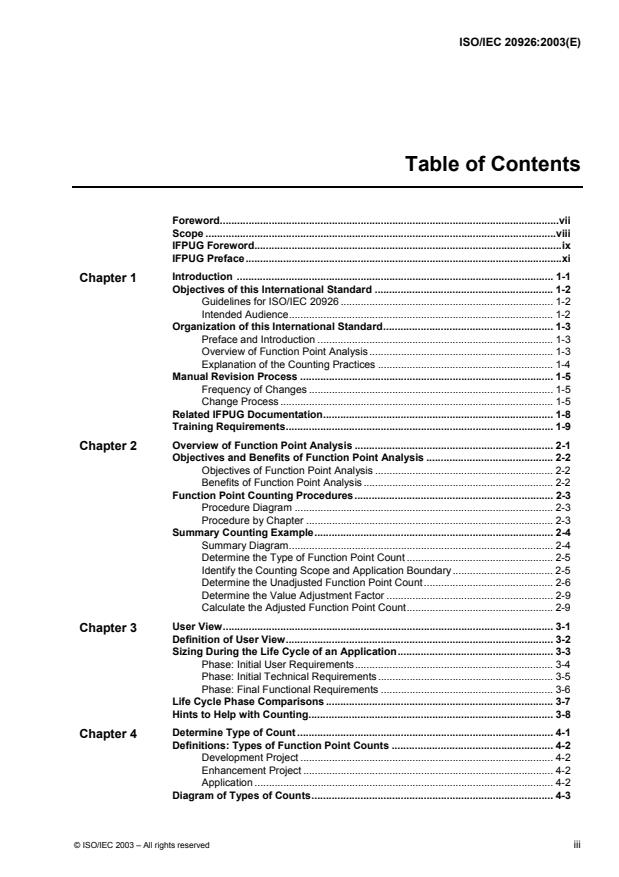
Table of Contents
Foreword.vii
Scope .viii
IFPUG Foreword.ix
IFPUG Preface.xi
Introduction . 1-1
Chapter 1
Objectives of this International Standard . 1-2
Guidelines for ISO/IEC 20926 . 1-2
Intended Audience. 1-2
Organization of this International Standard. 1-3
Preface and Introduction . 1-3
Overview of Function Point Analysis . 1-3
Explanation of the Counting Practices . 1-4
Manual Revision Process . 1-5
Frequency of Changes . 1-5
Change Process . 1-5
Related IFPUG Documentation. 1-8
Training Requirements. 1-9
Overview of Function Point Analysis . 2-1
Chapter 2
Objectives and Benefits of Function Point Analysis . 2-2
Objectives of Function Point Analysis . 2-2
Benefits of Function Point Analysis . 2-2
Function Point Counting Procedures. 2-3
Procedure Diagram . 2-3
Procedure by Chapter . 2-3
Summary Counting Example. 2-4
Summary Diagram. 2-4
Determine the Type of Function Point Count . 2-5
Identify the Counting Scope and Application Boundary. 2-5
Determine the Unadjusted Function Point Count. 2-6
Determine the Value Adjustment Factor . 2-9
Calculate the Adjusted Function Point Count. 2-9
User View. 3-1
Chapter 3
Definition of User View. 3-2
Sizing During the Life Cycle of an Application. 3-3
Phase: Initial User Requirements. 3-4
Phase: Initial Technical Requirements. 3-5
Phase: Final Functional Requirements . 3-6
Life Cycle Phase Comparisons . 3-7
Hints to Help with Counting. 3-8
Determine Type of Count . 4-1
Chapter 4
Definitions: Types of Function Point Counts . 4-2
Development Project . 4-2
Enhancement Project . 4-2
Application . 4-2
Diagram of Types of Counts. 4-3
© ISO/IEC 2003 – All rights reserved iii
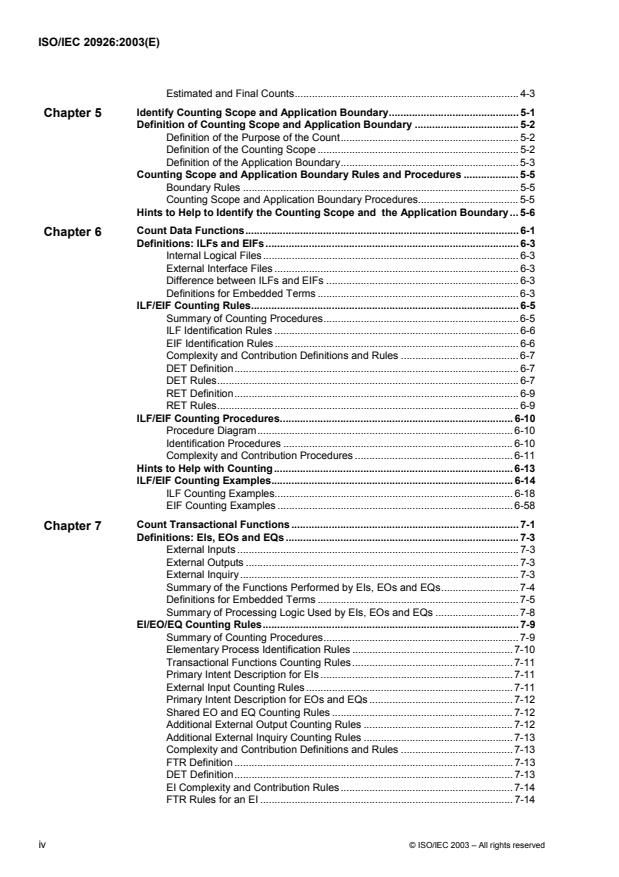
Estimated and Final Counts. 4-3
Identify Counting Scope and Application Boundary. 5-1
Chapter 5
Definition of Counting Scope and Application Boundary . 5-2
Definition of the Purpose of the Count. 5-2
Definition of the Counting Scope . 5-2
Definition of the Application Boundary. 5-3
Counting Scope and Application Boundary Rules and Procedures . 5-5
Boundary Rules . 5-5
Counting Scope and Application Boundary Procedures. 5-5
Hints to Help to Identify the Counting Scope and the Application Boundary. 5-6
Count Data Functions. 6-1
Chapter 6
Definitions: ILFs and EIFs. 6-3
Internal Logical Files. 6-3
External Interface Files . 6-3
Difference between ILFs and EIFs . 6-3
Definitions for Embedded Terms . 6-3
ILF/EIF Counting Rules. 6-5
Summary of Counting Procedures. 6-5
ILF Identification Rules . 6-6
EIF Identification Rules. 6-6
Complexity and Contribution Definitions and Rules . 6-7
DET Definition. 6-7
DET Rules. 6-7
RET Definition. 6-9
RET Rules. 6-9
ILF/EIF Counting Procedures. 6-10
Procedure Diagram. 6-10
Identification Procedures . 6-10
Complexity and Contribution Procedures . 6-11
Hints to Help with Counting. 6-13
ILF/EIF Counting Examples. 6-14
ILF Counting Examples. 6-18
EIF Counting Examples . 6-58
Count Transactional Functions . 7-1
Chapter 7
Definitions: EIs, EOs and EQs . 7-3
External Inputs . 7-3
External Outputs . 7-3
External Inquiry. 7-3
Summary of the Functions Performed by EIs, EOs and EQs. 7-4
Definitions for Embedded Terms . 7-5
Summary of Processing Logic Used by EIs, EOs and EQs . 7-8
EI/EO/EQ Counting Rules. 7-9
Summary of Counting Procedures. 7-9
Elementary Process Identification Rules . 7-10
Transactional Functions Counting Rules. 7-11
Primary Intent Description for EIs . 7-11
External Input Counting Rules . 7-11
Primary Intent Description for EOs and EQs . 7-12
Shared EO and EQ Counting Rules . 7-12
Additional External Output Counting Rules . 7-12
Additional External Inquiry Counting Rules . 7-13
Complexity and Contribution Definitions and Rules . 7-13
FTR Definition . 7-13
DET Definition. 7-13
EI Complexity and Contribution Rules. 7-14
FTR Rules for an EI . 7-14
iv © ISO/IEC 2003 – All rights reserved
DET Rules for an EI. 7-14
EO/EQ Complexity and Contribution Rules. 7-16
Shared FTR Rules for EOs and EQs . 7-16
Additional FTR Rules for an EO . 7-16
Shared DET Rules for EOs and EQs . 7-16
EI, EO and EQ Counting Procedures. 7-18
Procedure Diagram . 7-18
Identification Procedures. 7-19
Complexity and Contribution Procedures. 7-21
Hints to Help with Counting EIs, EOs and EQs . 7-24
Additional Hints to Help Counting EOs and EQs . 7-26
Elementary Process Identification Examples. 7-27
EI/EO/EQ Counting Examples . 7-45
EI Counting Examples. 7-52
EO Counting Examples . 7-89
EQ Counting Examples . 7-123
Determine Value Adjustment Factor (Optional) . 8-1
Chapter 8
Value Adjustment Factor Determination. 8-3
Procedures to Determine the VAF . 8-3
General System Characteristics . 8-4
Degrees of Influence . 8-5
Guidelines to Determine Degree of Influence. 8-6
1. Data Communications . 8-6
2. Distributed Data Processing. 8-7
3. Performance . 8-8
4. Heavily Used Configuration. 8-9
5. Transaction Rate . 8-10
6. Online Data Entry . 8-10
7. End-User Efficiency. 8-11
8. Online Update. 8-12
9. Complex Processing. 8-13
10. Reusability. 8-14
11. Installation Ease . 8-15
12. Operational Ease. 8-16
13. Multiple Sites . 8-17
14. Facilitate Change. 8-18
Calculate Adjusted Function Point Count. 9-1
Chapter 9
Review of Steps for Function Point Analysis . 9-3
Development Project Function Point Calculation . 9-4
Application Functionality. 9-4
Conversion Functionality . 9-4
Application Value Adjustment Factor . 9-4
Function Point Formula . 9-5
Example: Development Project Function Point Count . 9-6
Application Functionality. 9-6
Conversion Functionality . 9-8
Application Contribution to the Unadjusted Function Point Count . 9-9
Conversion Contribution to the Unadjusted Function Point Count. 9-10
Final Calculation . 9-10
Enhancement Project Function Point Calculation . 9-11
Application Functionality. 9-11
Conversion Functionality . 9-11
Value Adjustment Factor . 9-11
Function Point Formula . 9-12
Example: Enhancement Project Count . 9-13
Application Functionality. 9-13
© ISO/IEC 2003 – All rights reserved v
Application Contribution to the Unadjusted Function Point Count. 9-14
Final Calculation . 9-16
Application Function Point Calculation. 9-17
Formula to Establish the Initial Count. 9-17
Formula to Reflect Enhancement Projects . 9-18
Example: Application Count . 9-19
Initial Count . 9-19
Count After Enhancement . 9-19
Calculation Tables .A-1
Appendix A
Unadjusted Function Point Count Calculation Table.A-2
Value Adjustment Factor Calculation Table.A-3
The Change from CPM 4.0 to 4.1 . B-1
Appendix B
Introduction . B-2
Major Functional Change Areas in CPM 4.1. B-2
Version Control . B-3
Overview of Changes. B-3
Background . B-8
The Impact Study . B-8
Conversion from CPM 4.0 to 4.1. B-9
Impact on 4.0 Users Changing to 4.1 . B-10
Recommendations . B-10
Index
Glossary
vi © ISO/IEC 2003 – All rights reserved
Foreword
ISO (the International Organization for Standardization) and IEC (the International Electrotechnical
Commission) form the specialized system for worldwide standardization. National bodies that are members of
ISO or IEC participate in the development of International Standards through technical committees
established by the respective organization to deal with particular fields of technical activity. ISO and IEC
technical committees collaborate in fields of mutual interest. Other international organizations, governmental
and non-governmental, in liaison with ISO and IEC, also take part in the work. In the field of information
technology, ISO and IEC have established a joint technical committee, ISO/IEC JTC 1.
International Standards are drafted in accordance with the rules given in the ISO/IEC Directives, Part 2.
The main task of the joint technical committee is to prepare International Standards. Draft International
Standards adopted by the joint technical committee are circulated to national bodies for voting. Publication as
an International Standard requires approval by at least 75 % of the national bodies casting a vote.
Attention is drawn to the possibility that some of the elements of this document may be the subject of patent
rights. ISO and IEC shall not be held responsible for identifying any or all such patent rights.
ISO/IEC 20926 was prepared by Joint Technical Committee ISO/IEC JTC 1, Information technology,
Subcommittee SC 7, Software and system engineering.
© ISO/IEC 2003 – All rights reserved vii
Scope
This International Standard specifies the International Function Point Users Group (IFPUG) Release 4.1
unadjusted Functional Size Measurement Method. It provides:
• clear and detailed description of function point counting
• A foundation to ensure that counts are consistent
• Guidance to allow function point counting of Functional User Requirements from the deliverables of
popular software development methodologies and techniques
• A framework to enable automated support for function point counting
The provisions of this International Standard can be applied by anyone using function point analysis for
software measurement. It was designed for use by persons new to function point counting as well as those
with intermediate and advanced experience.
viii © ISO/IEC 2003 – All rights reserved
IFPUG Foreword
Function points are the leading metric of the software world. Although function points originated as a sizing
mechanism for software projects, the power and utility of function points have expanded into new uses far
beyond that basic purpose. As the twenty-first century approaches, function points are now being applied to
all of these tasks:
• Benchmark studies
• Development cost estimating
• Litigation involving software contracts
• Litigation involving software taxation
• Maintenance cost estimating
• Outsource contracts
• Process improvement analysis
• Quality estimating
• Quality measurements
• Sizing all software deliverables (documents, source code, test materials)
• Year 2000 software cost estimating
As usage of function point metrics expands throughout the software world, more and more companies and
government agencies are starting function point programs. This implies that the need for certified function
point analysts is rising even faster than the demand for other software professionals. Certification would not
be possible without a complete and stable set of counting rules for function point analysis.
A great deal of the credit for the rapid expansion of function point metrics should go to the International
Function Point Users Group (IFPUG) and its officers, committees, and members. One of the committees that
merits commendation is the Counting Practices Committee.
Although the basic principles of function point analysis are simple and straightforward, the real-life application
of these principles across thousands of software projects is not simple at all.
If function point counts fluctuated by more than 150% when counted by different individuals (as do lines of
code counts) then function points would have no claim to be considered a useful business metric. But thanks
to the work of the Counting Practices Committee, the reliability of function point analysis is good enough to
allow function points to serve as the basis for contracts, for carrying out scholarly research, for cost
estimating, and for creating reliable benchmarks. So far as can be determined, the accuracy of function points
is equal or superior to many other business metrics such as internal rate of return, net present value, or return
on investment.
The move to version 4.0 of the IFPUG counting practices in January of 1994 was somewhat contentious and
controversial. This is because the version 4.0 rules had the affect of reducing function point totals for some
applications, by fairly significant amounts.
The move to the version 4.1 rules should be much smoother and less controversial. The reason that 4.1 was
selected rather than 5.0 as the name of this release is because the numeric results of the new version are
close enough to the version 4.0 rules that recounting will not be necessary.
The major changes in the version 4.1 rules are in the examples, the clarification of some complex counting
situations, and improvements in the overall exposition of function point counting principles. Those learning to
© ISO/IEC 2003 – All rights reserved ix
use function points should find the version 4.1 rules to be easier to understand and apply than the prior
versions.
As software itself expands and changes, the rules for counting function points must also be expanded. When
Allan Albrecht first introduced function points in October of 1979, many of the kinds of software projects being
created in 1999 did not exist. For example, in 1979 software such as multi-tier client-server applications, web
applets, and massive enterprise resource planning (ERP) systems were still in the future.
It is a tribute to Allan Albrecht’s vision that function point metrics are as useful today as they were in 1979.
But without the work of the IFPUG organization and the Counting Practices Committee, function point metrics
would not be expanding in utility at the beginning of the twenty-first century. In fact, function points are now
used for more business purposes than any other metric in the history of software.
T. Capers Jones
Chief Scientist
Artemis Management Systems
x © ISO/IEC 2003 – All rights reserved
IFPUG Preface
The use of function points, as a measure of the functional size of software, has grown in
Introduction
the past decade from a few interested organizations to an impressive list of companies
worldwide. The IFPUG method is applicable to measuring all software
In the late 1970s, Allan Albrecht of IBM defined the concepts that enabled measuring the
IBM CIS & A
output of software development projects. These definitions were extended in IBM CIS & A
Guidelines
Guideline 313, AD/M Productivity Measurement and Estimate Validation, dated November
1, 1984.
With the growth in the use of function points, there was wider and wider application of the
Release 2.0
measure. This broadening of the application tested the original description of the measure
and made it necessary to create guidelines to interpret the original rules in new
environments. This was reflected in Release 2.0 of the International Function Point Users
Group (IFPUG) Function Point Counting Practices Manual.
Release 3.0 of the IFPUG Function Point Counting Practices Manual was a major
Release 3.0
milestone in the evolution of functional size measurement. For the first time, the IFPUG
Counting Practices Committee made an effort to change the document from a collection of
many interpretations of the rules to a truly coherent document that represented a
consensus view of the rules of function point counting. In this sense, it was the first step
to truly establishing standards for function point measurement which could be applied
across organizations.
Release 4.0 (January 1994) was the next milestone in the evolution of functional size
Release 4.0
measurement. This release reflected the use of function points early in project
development to estimate project size using information engineering disciplines. The
rapidly increasing number of graphical user interface (GUI) windows applications
mandated that we include GUI counting in the release. Because more counting was
occurring across a wider variety of situations, the release placed an emphasis on
interpreting and practicing using the counting rules. Examples were included throughout
the documentation and case studies supplemented the material. Finally, release 4.0
continued to clarify and increase the consistency of function point counting.
Release 4.1 (January 1999) provides clarifications to existing rules, new or amended rules
Release 4.1
which address previously undocumented situations and new hints and examples to aid
understanding. The IFPUG Counting Practices Committee has reviewed and processed
requests from members, following the Manual Revision Process contained in Chapter 1 of
this manual.
© ISO/IEC 2003 – All rights reserved xi
The revisions included in 4.1 clarify:
• the identification of a user, an elementary process, and control information
• the differentiation between External Outputs (EOs) and External Inquiries (EQs)
• the identification of Data Element Types (DETs) and Record Element Types (RETs) for
data functions
• the identification of Data Element Types (DETs) for transactional functions
Release 4.1 continues the process of clarifying and improving the consistency of function
point counting.
Finally, with the exception of the 14 General Systems Characteristics, it was designed to
be compliant with existing ISO standards if and when any compliance guide becomes a
standard.
This document is meant to be a living one. We must recognize how to count new
Future
environments as they are introduced. We need to be able to do this in the context of
Releases
maintaining the validity of the counts we have already made. This will not be an easy
task, yet it is an essential one if we are to be able to measure the progress we are making
in delivering value to the users and to the organizations they represent.
The Counting Practices Committee wishes to thank all those who have helped us in our
research and in the production of this manual.
Mary S. Bradley
Chairperson, Counting Practices Committee
xii © ISO/IEC 2003 – All rights reserved
1 Introduction
Introduction This chapter defines the objectives of this International Standard and this
International Standard revision process. It also describes publications that are
related to this International Standard.
The IFPUG method is applicable to measuring all software.
This chapter includes the following sections:
Contents
Topic See Page
1-2
Objectives of this International Standard
Guidelines for ISO/IEC 20926 1-2
1-2
Intended Audience
1-3
Organization of this International Standard
1-3
Preface and Introduction
Overview of Function Point Analysis 1-3
1-4
Explanation of the Counting Practices
1-5
Manual Revision Process
1-5
Frequency of Changes
Change Process 1-5
1-7
Related IFPUG Documentation
1-9
Training Requirements
© ISO/IEC 2003 – All rights reserved 1-1
Objectives of this International Standard
The primary objectives of this International Standard ISO/IEC 20926 are to
• Provide a clear and detailed description of function point counting
• Ensure that counts are consistent with the counting practices of IFPUG
affiliate members
• Provide guidance to allow function point counting from the deliverables
of popular methodologies and techniques
• Provide a common understanding to allow tool vendors to provide
automated support for function point counting
Guidelines for ISO/IEC 20926
The following guidelines were used to develop this release:
• This International Standard is based primarily on the IFPUG Function
Point Counting Practices Manual, Release 4.0.
• Secondly, this International Standard is based on IBM CIS & A Guideline
313, AD/M Productivity Measurement and Estimate Validation, dated
November 1, 1984. The function point counting methodology described
in 313 is generally referred to as Albrecht 1984.
• Finally, issues not sufficiently covered in the sources listed above were
decided by the IFPUG Counting Practices Committee and validated
through impact studies.
With its release, this International Standard should be considered the IFPUG
standard for function point counting. It is imperative that each IFPUG
member takes an active role to ensure counting consistency. IFPUG member
adherence to this standard will contribute greatly to counting consistency.
Intended Audience
The standards in this International Standard should be applied by anyone
using function point analysis for software measurement. This International
Standard was designed for use by persons new to function point counting as
well as those with intermediate and advanced experience.
1-2 © ISO/IEC 2003 – All rights reserved
Organization of this International Standard
There are three major parts in this International Standard:
• Preface and introduction
• Overview of function point analysis
• Explanation of the counting practices
Examples are used extensively throughout this International Standard to
explain counting practices concepts, rules, and procedures. Detailed
examples conclude chapters 6 and 7.
Note: A separate IFPUG Glossary includes definitions of terms used across
IFPUG publications.
Preface and Introduction
The Preface and Introduction provide an overview of this International
Standard and function point counting.
Overview of Function Point Analysis
The Overview introduces the function point counting procedures and includes
a summary example of the procedures.
© ISO/IEC 2003 – All rights reserved 1-3
Explanation of the Counting Practices
Chapter 3 explains the concept of user view.
Chapters 4 through 9 present details about each of the procedure steps
introduced in the Overview.
For example, Chapter 4, Determine Type of Count, is the first step in the
function point counting procedure. Chapter 9, Calculate Adjusted Function
Point Count, is the last step.
Information within chapters 5 through 7 is presented in the following
sequence:
• Definitions
• Rules
• Procedures
• Counting Hints
• Examples
1-4 © ISO/IEC 2003 – All rights reserved
Manual Revision Process
This section explains the frequency of changes to this International Standard
and defines the change process.
Frequency of Changes
During January of each year, a new version of this International Standard may
become effective. It will include any new or changed definitions, rules, or
counting practices that have been finalized by the Counting Practices
Committee (CPC) since the previous January.
Change Process
The following activities outline the process for adding or changing
information in this International Standard. Explanations of each activity
follow the table.
Step Action
1 The issue is submitted to the CPC.
The issue is assigned for research.
3 The CPC reviews and discusses the issue.
4 The CPC presents a proposed solution to the IFPUG membership.
An impact study is initiated if the proposed change would have any
impact on existing counts.
6 The final decision is made.
The IFPUG membership is informed of the decision.
8 Changes become effective with, and are reflected in, the next release of
this International Standard.
Issue The reader submits ideas, changes, or issues to the Counting Practices
Submitted Committee using the Reader's Request Form at the end of this International
Standard. If the page is not available, send comments to the address in the
front of this International Standard and mark it, ''ATTN: Counting Practices
Committee.''
Research A member of the CPC is assigned the responsibility for identifying all
alternatives, the rationale, and the potential impact of each alternative if it is
Assigned
implemented. Thorough examination of existing counting standards and
historical papers is completed while compiling alternatives. In addition, an
effort is made to determine what is thought to be common practice.
© ISO/IEC 2003 – All rights reserved 1-5
CPC Review The CPC reviews and discusses the rationale for each alternative, and its
potential impact. The review and discussion may result in a proposal for
change or the review may lead the committee to reject the change request.
A proposed solution is made to the IFPUG membership and written
Solution
Proposed comments are solicited.
A copy of the proposed changes is mailed to IFPUG contacts at member
organizations. The proposal also may be announced and distributed during an
IFPUG conference. The latter depends on the timing of the committee
meeting rather than the conference schedule.
Impact Study The CPC has adopted a conservative stance on initiating impact studies. If it
Initiated is possible that common practice must change, or several organizations or
types of applications will be impacted by the change, an impact study is
initiated.
The success of the impact study is the responsibility of every IFPUG member.
If the CPC receives written feedback indicating there is little or no impact, the
study is discontinued.
The committee makes a final decision using results from research, written
Final
Decision comments from members, and the impact study.
Made
The committee can complete more than one iteration of Steps 2 through 5
(research through impact study) before making a final decision. The final
decision can result in a change or the committee may decide that a change is
not warranted.
Decision The final decision is communicated in writing to IFPUG members via the
Communi- IFPUG contact at the various organizations.
cated
If any impact study results contributed to making a decision, the results and a
recommendation on how to minimize the impact of the change will also be
communicated.
Decision This International Standard is updated to reflect the decisions. The effective
Effective date of the decisions is the date of the next January release of this
Date International Standard.
1-6 © ISO/IEC 2003 – All rights reserved
Related IFPUG Documentation
This Counting Practices Manual is one module in the IFPUG documentation.
All documents complement each other.
The following table describes the other publications.
Document Description
IFPUG Brochure This publication is an introduction to the International Function Point Users
Group. It includes a brief history of the organization, introduces function
(Available)
point analysis, and defines the purpose of IFPUG. The brochure also
includes a membership application.
Audience: This publication is for anyone who wants an overview of IFPUG
or an application for membership.
IFPUG: Organizational Structure This publication describes IFPUG services, and lists the board of directors,
and Services committees, and affiliate members worldwide.
(Available) Audience: This publication is for anyone who wants background
information about IFPUG.
Guidelines for Software This International Standard provides an overview of software metrics for
Measurement organizations working to create or improve software measurement programs.
This International Standard addresses both system and customer
(Release Date: April 1994)
management, provides high-level justifications for software measurement,
and examines the components of effective measurement programs.
Audience: This International Standard is intended for IFPUG members,
Function Point Coordinators, persons who prepare the reports to
management, and other persons knowledgeable about and working directly
with function points.
Application of Measurement This International Standard explains how function points are an asset and
Information provides information to assist in implementing the use of function points.
(Current release is available as Audience: This International Standard is intended for IFPUG members,
Function Points as an Asset Function Point Coordinators, persons who prepare the reports to
Update Release: September 1994) management, and other persons knowledgeable about and working directly
with function points.
Quick Reference This quick reference guide is a summary of function point counting rules and
Counting Guide procedures.
(Release Date: January 1999) Audience: This summary information is intended for anyone applying
function point analysis.
Function Point Analysis The case studies illustrate the major counting techniques that comprise the
Case Studies Function Point Counting Practices Manual. The cases illustrate function
point counts for a sample application. The cases include the counting that
(Release Dates:
occurs at the end of the analysis phase of software development and after
Case Study 1: May 1994 system construction.
Audience: The case studies are intended for persons new to function point
Case Study 2: September 1994
analysis as well as those with intermediate and advanced experience.
Case Study 3: September 1996
Case Study 4
...
Questions, Comments and Discussion
Ask us and Technical Secretary will try to provide an answer. You can facilitate discussion about the standard in here.
Loading comments...