

ISO 25457:2023
(Main)Oil and gas industries including lower carbon energy — Flare details for general refinery and petrochemical service
General Information
- Abstract
This document specifies requirements and provides guidance for the selection, design, specification, operation, and maintenance of flares and related combustion and mechanical components used in pressure-relieving and vapor-depressurizing systems for petroleum, petrochemical, and natural gas industries. While this document is primarily intended for onshore facilities, guidance related to offshore applications is included. Guidance and best practices for the selection, specification, and mechanical details for flares and on the design, operation, and maintenance of flare combustion and related equipment is also provided. This document is a supplement to API 537, 3rd edition (2017) including Addendum 1, the requirements of which are applicable with the exceptions specified in this document.
- Status
- Published
- Publication Date
- 12-Oct-2023
- Technical Committee
- ISO/TC 67/SC 6 - Processing equipment and systems
- Drafting Committee
- ISO/TC 67/SC 6 - Processing equipment and systems
- Current Stage
- 6060 - International Standard published
- Start Date
- 13-Oct-2023
- Due Date
- 01-Mar-2024
- Completion Date
- 13-Oct-2023
Buy Documents
ISO 25457:2023 - Oil and gas industries including lower carbon energy — Flare details for general refinery and petrochemical service Released:13. 10. 2023
ISO 25457:2023 - Industries du pétrole et du gaz, y compris les énergies a faible teneur en carbone — Détails sur les torches d'usage général dans les raffineries et dans les usines pétrochimiques Released:13. 10. 2023
Overview
ISO 25457:2023 is an international standard developed by the International Organization for Standardization (ISO) for flare systems in the oil and gas industry, including applications for lower carbon energy. The document provides comprehensive requirements and guidance for selecting, designing, specifying, operating, and maintaining flares and related mechanical and combustion equipment used in pressure-relieving and vapor-depressurizing systems. While primarily intended for onshore petroleum, petrochemical, and natural gas facilities, it also covers relevant guidance for offshore applications. This standard updates and supplements API 537 (3rd edition, 2017), ensuring alignment with current industry best practices.
Key Topics
- Flare System Selection and Design: Addresses best practices for choosing and engineering flares for efficient control of process emissions and relief systems.
- Specification Requirements: Defines essential criteria for specifying flare equipment and mechanical details, supporting safe and sustainable operations.
- Operation and Maintenance Guidance: Provides recommendations to ensure reliable flare performance, longevity, and safety in refinery and petrochemical service.
- Specialized Ignition Systems: Details requirements for ballistic/pyrotechnical ignition systems, including components, safety constraints, and use of purge and capture devices.
- Flow Rate Calculation: Updates methodologies for determining volumetric flow rates through flares, supplementing and clarifying the guidance found in API 537.
- Safety and Environmental Protection: Emphasizes operational safety and emission control, supporting lower carbon energy initiatives and regulatory compliance.
Applications
ISO 25457:2023 is widely used in the following areas:
- Refineries and Petrochemical Plants: Ensures effective pressure relief and vapor depressurization, protecting personnel, assets, and the environment.
- Natural Gas Processing Facilities: Guides the design and safe specification of flare stacks and combustion devices for offgas and process emergencies.
- Onshore and Offshore Installations: Offers relevant techniques and requirements for both land-based and offshore oil and gas platforms.
- Lower Carbon Energy Operations: Supports energy transition objectives by providing best practices that facilitate emission reduction and sustainable flare operation.
- Procurement and Engineering Projects: Serves as a critical reference for project engineers, design contractors, and equipment suppliers engaged in the procurement and implementation of flare systems.
Related Standards
For a comprehensive approach to flare system specification and operation, consider referencing these related documents:
- API Standard 537 (3rd edition, 2017 & Addendum 1): Flare Details for Petroleum, Petrochemical, and Natural Gas Industries - the principal US standard, supplemented by ISO 25457:2023.
- ISO 23251 / API Standard 521: Pressure-relieving and Depressuring Systems - addresses broader safety and design aspects of relief systems.
- ISO 4126 Series: Safety devices for protection against excessive pressure, including safety valves integral to flare and vent systems.
- ISO 10418: Standard for offshore production installations, relevant for flare applications in offshore environments.
- IEC Electropedia, ISO Online Browsing Platform: Useful resources for standardization terminology and definitions.
Practical Value
Implementing ISO 25457:2023 supports safer, more reliable, and environmentally sustainable operations across the oil, gas, and petrochemical industries. By providing clear guidance on flare design, selection, and maintenance, the standard helps organizations mitigate risk, ensure regulatory compliance, and advance their lower carbon energy goals. Whether optimizing new installations or upgrading existing flare systems, this standard is an essential resource for achieving industry best practices and operational excellence.
Relations
- Effective Date
- 12-Feb-2026
- Effective Date
- 10-Sep-2022
- Effective Date
- 06-Jun-2022
Buy Documents
ISO 25457:2023 - Oil and gas industries including lower carbon energy — Flare details for general refinery and petrochemical service Released:13. 10. 2023
ISO 25457:2023 - Industries du pétrole et du gaz, y compris les énergies a faible teneur en carbone — Détails sur les torches d'usage général dans les raffineries et dans les usines pétrochimiques Released:13. 10. 2023
Get Certified
Connect with accredited certification bodies for this standard

Element Materials Technology
Materials testing and product certification.

ABS Group Brazil
ABS Group certification services in Brazil.

ABS Quality Evaluations Inc.
American Bureau of Shipping quality certification.
Sponsored listings
Frequently Asked Questions
ISO 25457:2023 is a standard published by the International Organization for Standardization (ISO). Its full title is "Oil and gas industries including lower carbon energy — Flare details for general refinery and petrochemical service". This standard covers: This document specifies requirements and provides guidance for the selection, design, specification, operation, and maintenance of flares and related combustion and mechanical components used in pressure-relieving and vapor-depressurizing systems for petroleum, petrochemical, and natural gas industries. While this document is primarily intended for onshore facilities, guidance related to offshore applications is included. Guidance and best practices for the selection, specification, and mechanical details for flares and on the design, operation, and maintenance of flare combustion and related equipment is also provided. This document is a supplement to API 537, 3rd edition (2017) including Addendum 1, the requirements of which are applicable with the exceptions specified in this document.
This document specifies requirements and provides guidance for the selection, design, specification, operation, and maintenance of flares and related combustion and mechanical components used in pressure-relieving and vapor-depressurizing systems for petroleum, petrochemical, and natural gas industries. While this document is primarily intended for onshore facilities, guidance related to offshore applications is included. Guidance and best practices for the selection, specification, and mechanical details for flares and on the design, operation, and maintenance of flare combustion and related equipment is also provided. This document is a supplement to API 537, 3rd edition (2017) including Addendum 1, the requirements of which are applicable with the exceptions specified in this document.
ISO 25457:2023 is classified under the following ICS (International Classification for Standards) categories: 75.180.20 - Processing equipment. The ICS classification helps identify the subject area and facilitates finding related standards.
ISO 25457:2023 has the following relationships with other standards: It is inter standard links to EN ISO 25457:2023, ISO/IEC TR 19075-9:2020, ISO 25457:2008. Understanding these relationships helps ensure you are using the most current and applicable version of the standard.
ISO 25457:2023 is available in PDF format for immediate download after purchase. The document can be added to your cart and obtained through the secure checkout process. Digital delivery ensures instant access to the complete standard document.
Standards Content (Sample)
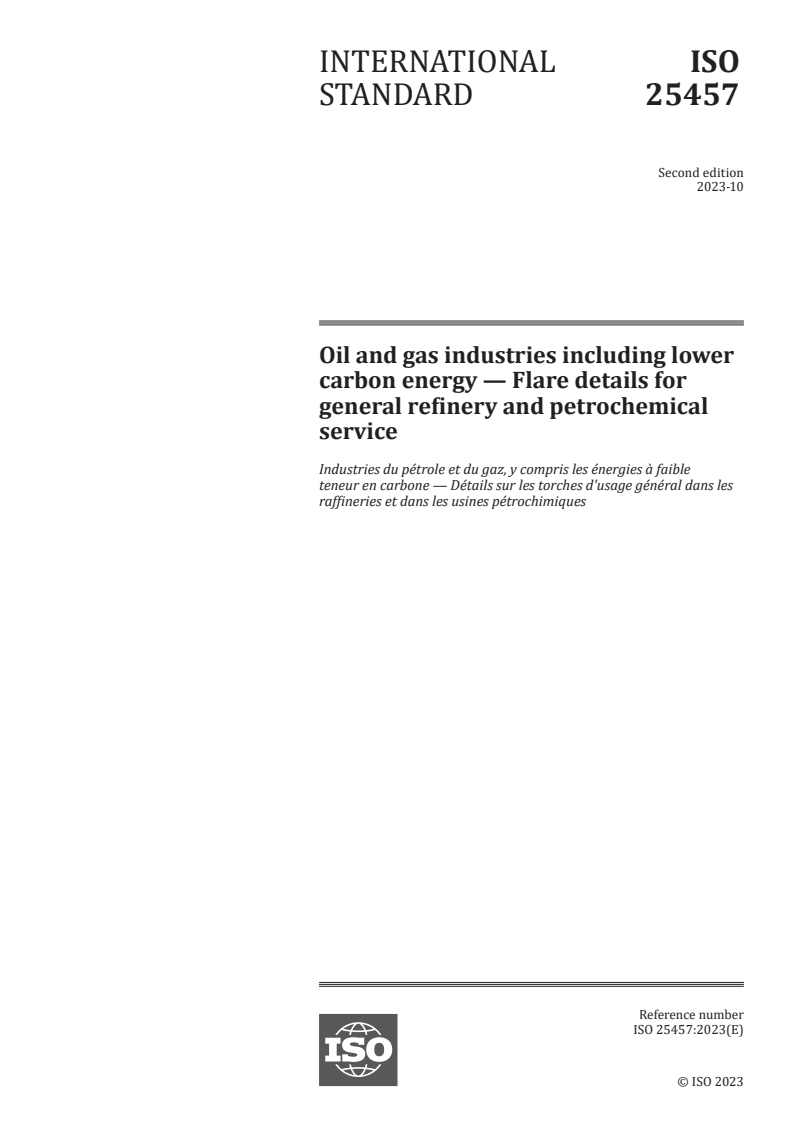
INTERNATIONAL ISO
STANDARD 25457
Second edition
2023-10
Oil and gas industries including lower
carbon energy — Flare details for
general refinery and petrochemical
service
Industries du pétrole et du gaz, y compris les énergies à faible
teneur en carbone — Détails sur les torches d'usage général dans les
raffineries et dans les usines pétrochimiques
Reference number
© ISO 2023
All rights reserved. Unless otherwise specified, or required in the context of its implementation, no part of this publication may
be reproduced or utilized otherwise in any form or by any means, electronic or mechanical, including photocopying, or posting on
the internet or an intranet, without prior written permission. Permission can be requested from either ISO at the address below
or ISO’s member body in the country of the requester.
ISO copyright office
CP 401 • Ch. de Blandonnet 8
CH-1214 Vernier, Geneva
Phone: +41 22 749 01 11
Email: copyright@iso.org
Website: www.iso.org
Published in Switzerland
ii
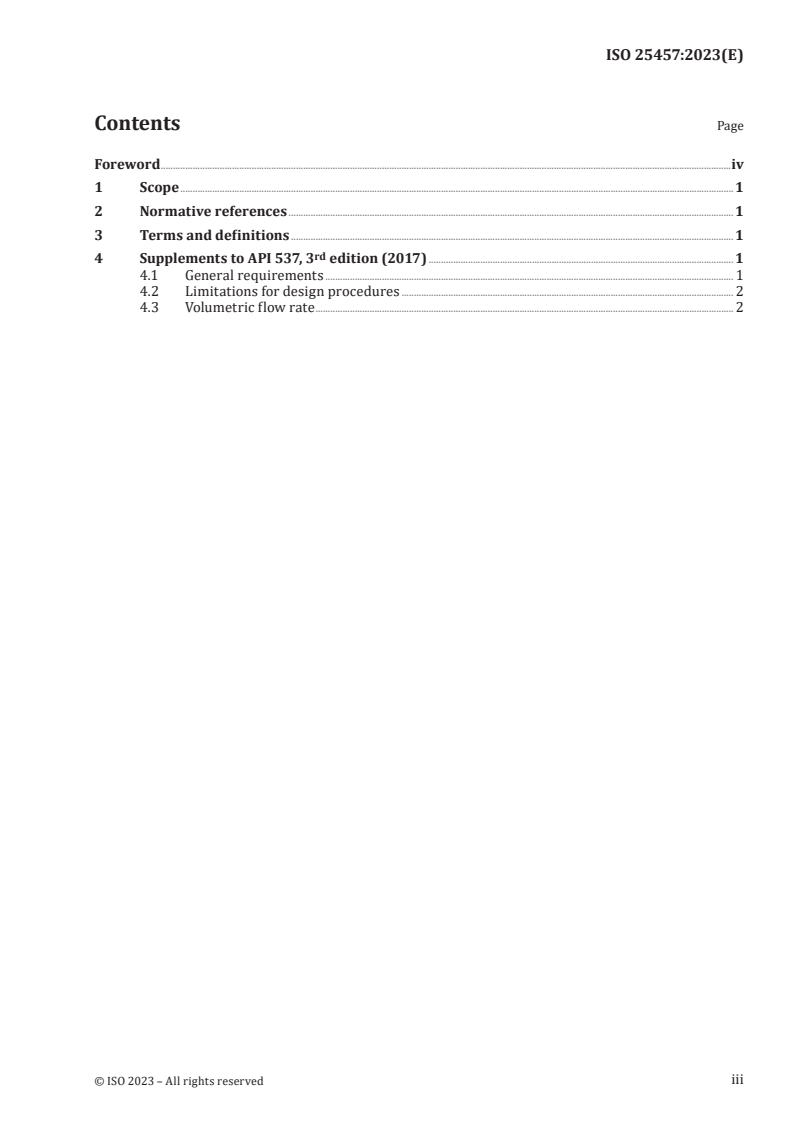
Contents Page
Foreword .iv
1 Scope . 1
2 Normative references . 1
3 Terms and definitions . 1
rd
4 Supplements to API 537, 3 edition (2017) . 1
4.1 General requirements . 1
4.2 Limitations for design procedures . 2
4.3 Volumetric flow rate . 2
iii
Foreword
ISO (the International Organization for Standardization) is a worldwide federation of national standards
bodies (ISO member bodies). The work of preparing International Standards is normally carried out
through ISO technical committees. Each member body interested in a subject for which a technical
committee has been established has the right to be represented on that committee. International
organizations, governmental and non-governmental, in liaison with ISO, also take part in the work.
ISO collaborates closely with the International Electrotechnical Commission (IEC) on all matters of
electrotechnical standardization.
The procedures used to develop this document and those intended for its further maintenance are
described in the ISO/IEC Directives, Part 1. In particular, the different approval criteria needed for the
different types of ISO document should be noted. This document was drafted in accordance with the
editorial rules of the ISO/IEC Directives, Part 2 (see www.iso.org/directives).
ISO draws attention to the possibility that the implementation of this document may involve the use
of (a) patent(s). ISO takes no position concerning the evidence, validity or applicability of any claimed
patent rights in respect thereof. As of the date of publication of this document, ISO had not received
notice of (a) patent(s) which may be required to implement this document. However, implementers are
cautioned that this may not represent the latest information, which may be obtained from the patent
database available at www.iso.org/patents. ISO shall not be held responsible for identifying any or all
such patent rights.
Any trade name used in this document is information given for the convenience of users and does not
constitute an endorsement.
For an explanation of the voluntary nature of standards, the meaning of ISO specific terms and
expressions related to conformity assessment, as well as information about ISO's adherence to
the World Trade Organization (WTO) principles in the Technical Barriers to Trade (TBT), see
www.iso.org/iso/foreword.html.
This document was prepared by Technical Committee ISO/TC 67, Oil and gas industries including lower
carbon energy, Subcommittee SC 6, Process equipment, piping, systems, and related safety, in collaboration
with the European Committee for Standardization (CEN) Technical Committee CEN/TC 12, Oil and gas
industries including lower carbon energy, in accordance with the Agreement on technical cooperation
between ISO and CEN (Vienna Agreement).
Th
...
NORME ISO
INTERNATIONALE 25457
Deuxième édition
2023-10
Industries du pétrole et du gaz, y
compris les énergies à faible teneur
en carbone — Détails sur les torches
d'usage général dans les raffineries et
dans les usines pétrochimiques
Oil and gas industries including lower carbon energy — Flare details
for general refinery and petrochemical service
Numéro de référence
DOCUMENT PROTÉGÉ PAR COPYRIGHT
© ISO 2023
Tous droits réservés. Sauf prescription différente ou nécessité dans le contexte de sa mise en œuvre, aucune partie de cette
publication ne peut être reproduite ni utilisée sous quelque forme que ce soit et par aucun procédé, électronique ou mécanique,
y compris la photocopie, ou la diffusion sur l’internet ou sur un intranet, sans autorisation écrite préalable. Une autorisation peut
être demandée à l’ISO à l’adresse ci-après ou au comité membre de l’ISO dans le pays du demandeur.
ISO copyright office
Case postale 401 • Ch. de Blandonnet 8
CH-1214 Vernier, Genève
Tél.: +41 22 749 01 11
E-mail: copyright@iso.org
Web: www.iso.org
Publié en Suisse
ii
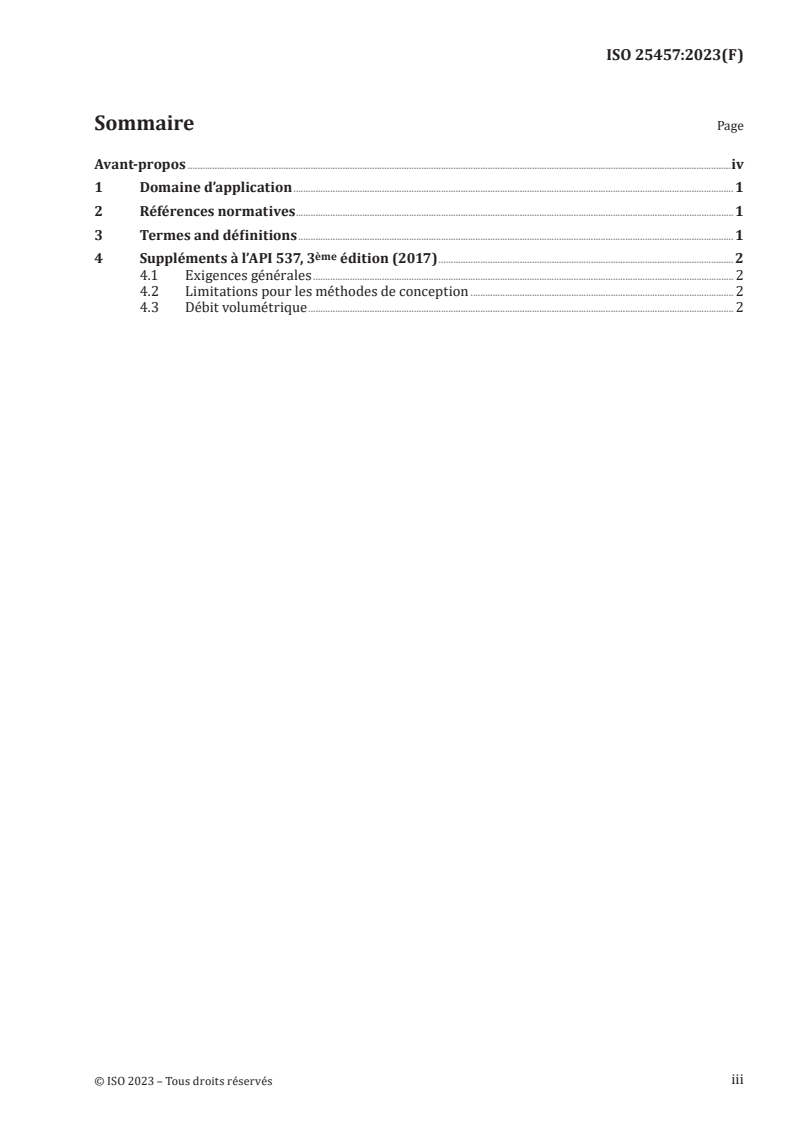
Sommaire Page
Avant-propos .iv
1 Domaine d’application . 1
2 Références normatives .1
3 Termes and définitions . 1
ème
4 Suppléments à l’API 537, 3 édition (2017) . 2
4.1 Exigences générales . 2
4.2 Limitations pour les méthodes de conception . 2
4.3 Débit volumétrique . 2
iii
Avant-propos
L'ISO (Organisation internationale de normalisation) est une fédération mondiale d'organismes
nationaux de normalisation (comités membres de l'ISO). L'élaboration des Normes internationales est
en général confiée aux comités techniques de l'ISO. Chaque comité membre intéressé par une étude
a le droit de faire partie du comité technique créé à cet effet. Les organisations internationales,
gouvernementales et non gouvernementales, en liaison avec l'ISO participent également aux travaux.
L'ISO collabore étroitement avec la Commission électrotechnique internationale (IEC) en ce qui
concerne la normalisation électrotechnique.
Les procédures utilisées pour élaborer le présent document et celles destinées à sa mise à jour sont
décrites dans les Directives ISO/IEC, Partie 1. Il convient, en particulier de prendre note des différents
critères d'approbation requis pour les différents types de documents ISO. Le présent document
a été rédigé conformément aux règles de rédaction données dans les Directives ISO/IEC, Partie 2
(voir www.iso.org/directives).
L'attention est attirée sur le fait que certains des éléments du présent document peuvent faire l'objet de
droits de propriété intellectuelle ou de droits analogues. L'ISO ne saurait être tenue pour responsable
de ne pas avoir identifié tout ou partie de tels droits de brevet. Les détails concernant les références aux
droits de propriété intellectuelle ou autres droits analogues identifiés lors de l'élaboration du document
sont indiqués dans l'Introduction et/ou dans la liste des déclarations de brevets reçues par l'ISO (voir
www.iso.org/brevets).
Les appellations commerciales éventuellement mentionnées dans le présent document sont données
pour information, par souci de commodité, à l'intention des utilisateurs et ne sauraient constituer un
engagement. Pour une explication de la signification des termes et expressions spécifiques de l'ISO liés
à l'évaluation de la conformité, ou pour toute information au sujet de l'adhésion de l'ISO aux principes de
l'Organisation mondiale du commerce (OMC) concernant les obstacles techniques au commerce (OTC),
voir le lien suivant: www.iso.org/iso/fr/avant-propos.
Le présent document a été élaboré par le comité technique ISO/TC 67, Industries du pétrole et du gaz, y
compris les énergies à faible teneur en carbone, sous-comité SC 6, Équipements des procédés, tuyauterie,
systèmes, et sécurité qui y est rattachée, en collaboration avec le comité technique CEN/TC 12, Industries
du pétrole et du gaz, y compris les énergies à faible teneur en carbone, du Comité européen de normalisation
(CEN), conformément à l'Accord de coopération technique entre l'ISO et le CEN (Accord de Vienne).
Cette seconde édition supprime et remplace la première édition (ISO 25457:2008) dont les parties
techniques ont été révisées.
Ce document complète l'API Std 537, 3ème édition (2017) y compris l'addendum 1. Les exigences
techniques de l'ISO 25457 et de l'API Std 537 étaient auparavant identiques. Entre-temps, l'API Std 537 a
été techniquement révisée en tant qu'API 537, 3ème édition (2017)
...