


ISO 9203-3:1989
(Main)Shipbuilding — Topology of ship hull structure elements — Part 3: Relations of elements
Shipbuilding — Topology of ship hull structure elements — Part 3: Relations of elements
Gives information on denomination and location of the various elements to each other to make communication easy and to prevent misunderstandings. Consists of three parts.
Construction navale — Topologie des éléments de structure de coque d'un navire — Partie 3: Relations entre les éléments
General Information
- Status
- Published
- Publication Date
- 14-Jun-1989
- Technical Committee
- ISO/TC 8/SC 8 - Ship design
- Drafting Committee
- ISO/TC 8/SC 8 - Ship design
- Current Stage
- 9020 - International Standard under periodical review
- Start Date
- 15-Jan-2026
- Completion Date
- 15-Jan-2026
Overview
ISO 9203-3:1989 is an essential international standard developed by the International Organization for Standardization (ISO) under the technical committee ISO/TC 8, focusing on shipbuilding and maritime structures. This part-Part 3: Relations of Elements-is one of three parts that define the topology of ship hull structure elements. It specifically addresses the relationships among various structural elements of a ship’s hull, enabling clear, consistent communication among shipbuilders, designers, and engineers. By standardizing terminology and spatial relationships, ISO 9203-3 helps to prevent misunderstandings and enhance collaboration within shipbuilding projects.
Key Topics
Relationship Definitions
ISO 9203-3 systematically defines how different hull structure elements relate to one another, building on the localization and description covered in Part 1 and Part 2 of ISO 9203. The standard covers complex structural junctions such as:- Traversée (Penetrations): Describes structural nodes where one element is pierced by another, detailing identifiers for pierced and piercing elements, symmetry codes, and node catalogue symbols.
- Croisement (Crossings): Explains nodes where a continuous element is intersected by a divided element, including identifiers for continuous and divided elements and additional structural components like gussets.
Structural Node Identification
To ensure unambiguous understanding, ISO 9203-3 defines specific data requirements for describing structural nodes, including:- Element identifiers (pierced, piercing, continuous, divided)
- Symmetry codes indicating locations relative to the ship’s axis (e.g., symmetrical, starboard, portside)
- Catalogue symbols detailing the type and parameters of the structural node
Scope and Application Context
The standard clearly states that the detailed catalogs of crossing and penetration nodes are outside its scope but recommends coordinating these catalogs between concerned organizations when required.
Applications
Ship Design and Engineering
ISO 9203-3 is critical for naval architects and marine engineers to precisely specify how hull structure elements connect and interact, improving design accuracy and structural integrity analysis.Construction and Assembly
Shipbuilders use the standardized topology and element relations to ensure components fit correctly and structural nodes are assembled according to accepted relationships, reducing errors during fabrication and assembly.Documentation and Communication
This standard facilitates clear technical documentation and interoperability between different teams and organizations by providing a common language and classification for hull structural relationships.Quality Assurance and Inspection
Inspectors and quality control teams rely on the standard’s definitions to evaluate structural conformity and ensure that relationships between hull elements meet design and safety requirements.
Related Standards
ISO 9203-3 is part of the three-part ISO 9203 series on ship hull structure topology, which includes:
ISO 9203-1:1989 - Localization of elements
Focuses on the denomination and physical localization of hull structure elements.ISO 9203-2:1989 - Description of elements
Defines the properties and characteristics used to describe individual hull structure elements.
Together, these standards provide a comprehensive framework for describing, locating, and understanding the relationships among ship hull structure elements systematically.
Keywords: shipbuilding standard, hull structure topology, ISO 9203-3, ship hull elements, structural relationships, naval architecture, ship construction, penetrations, crossings, ship design communication, ISO shipbuilding standards, marine engineering documentation
Buy Documents

ISO 9203-3:1989 - Shipbuilding -- Topology of ship hull structure elements

ISO 9203-3:1989 - Construction navale -- Topologie des éléments de structure de coque d'un navire
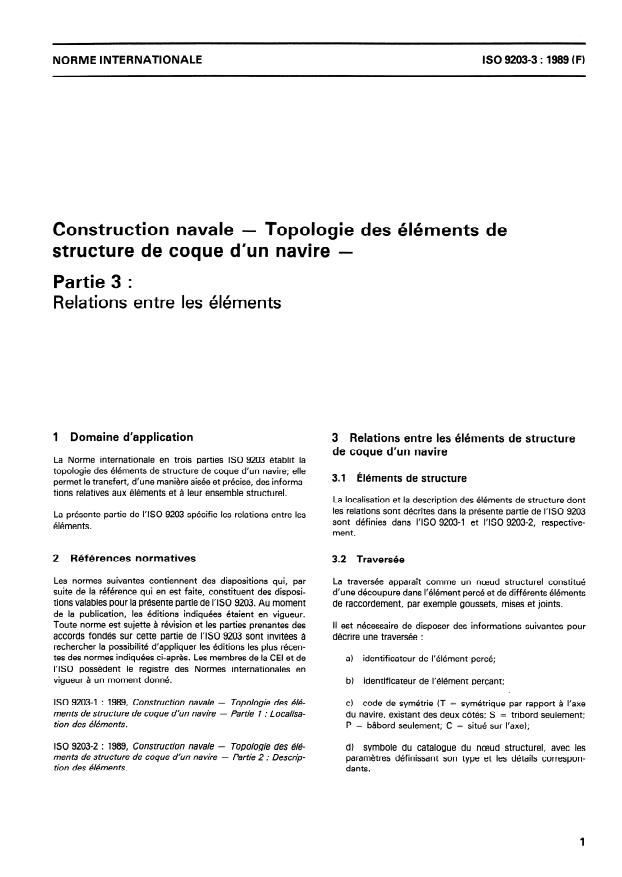

ISO 9203-3:1989 - Construction navale -- Topologie des éléments de structure de coque d'un navire
Get Certified
Connect with accredited certification bodies for this standard

DNV
DNV is an independent assurance and risk management provider.

Lloyd's Register
Lloyd's Register is a global professional services organisation specialising in engineering and technology.

ABS Quality Evaluations Inc.
American Bureau of Shipping quality certification.
Sponsored listings
Frequently Asked Questions
ISO 9203-3:1989 is a standard published by the International Organization for Standardization (ISO). Its full title is "Shipbuilding — Topology of ship hull structure elements — Part 3: Relations of elements". This standard covers: Gives information on denomination and location of the various elements to each other to make communication easy and to prevent misunderstandings. Consists of three parts.
Gives information on denomination and location of the various elements to each other to make communication easy and to prevent misunderstandings. Consists of three parts.
ISO 9203-3:1989 is classified under the following ICS (International Classification for Standards) categories: 47.020.10 - Hulls and their structure elements. The ICS classification helps identify the subject area and facilitates finding related standards.
ISO 9203-3:1989 is available in PDF format for immediate download after purchase. The document can be added to your cart and obtained through the secure checkout process. Digital delivery ensures instant access to the complete standard document.
Standards Content (Sample)
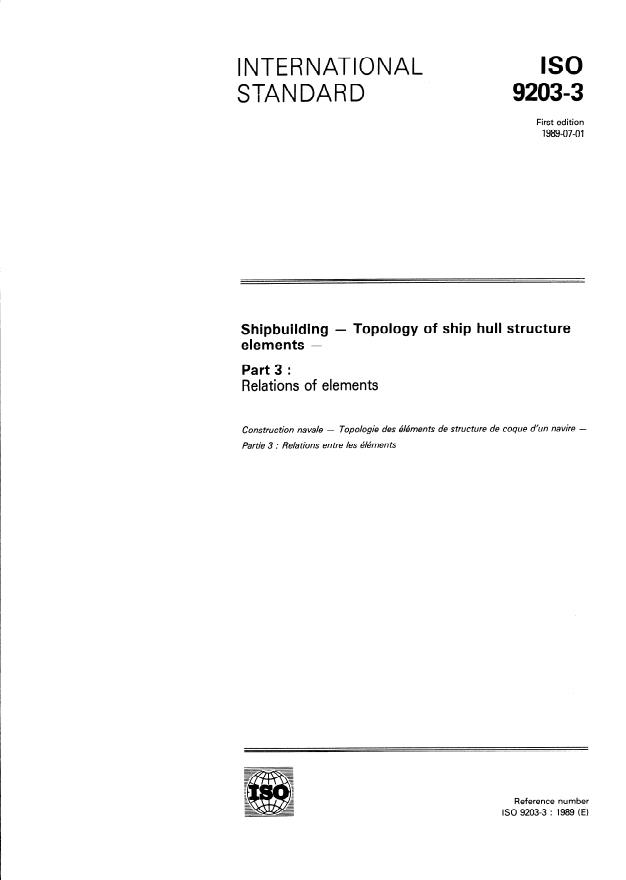
INTERNATIONAL
IS0
STANDARD
9203-3
First edition
1989-07-01
Shipbuilding - Topology of ship hull structure
elements -
Part 3 :
Relations of elements
Construction navale - Topologie des &Gnents de structure de coque d’un navire -
Partie 3 : Relations en tre /es Mments
Reference number
IS0 9203-3 : 1989 (El
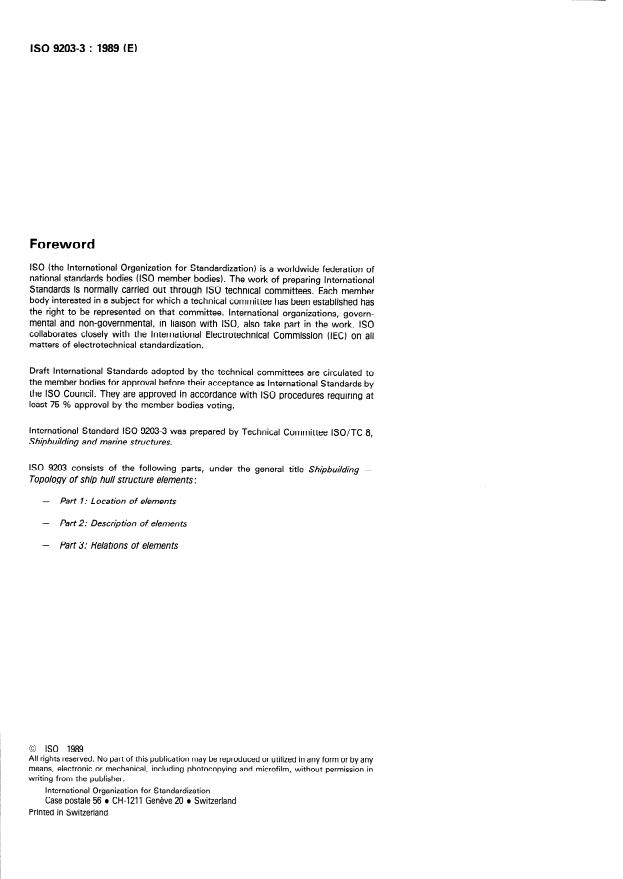
IS0 9203-3 : 1989 (E)
Foreword
IS0 (the International Organization for Standardization) is a worldwide federation of
national standards bodies US0 member bodies). The work of preparing International
Standards is normally carried out through IS0 technical committees. Each member
body interested in a subject for which a technical committee has been established has
the right to be represented on that committee. International organizations, govern-
mental and non-governmental, in liaison with ISO, also take part in the work. IS0
collaborates closely with the International Electrotechnical Commission (IEC) on all
matters of electrotechnical standardization.
Draft International Standards adopted by the technical committees are circulated to
the member bodies for approval before their acceptance as International Standards by
the IS0 Council. They are approved in accordance with IS0 procedures requiring at
least 75 % approval by the member bodies voting.
International Standard IS0 9203-3 was prepared by Technical Committee ISO/TC 8,
Shipbuilding and marine s true tures.
IS0 9203 consists of the following parts, under the general title Shipbulding -
Topology of ship hull structure elements :
-
Part 7: Location of elements
Part 2: Description of elements
-
-
Part 3: Relations of elements
0 IS0 1989
All rights reserved. No part of this publication may be reproduced or utilized in any form or by any
means, electronic or mechanical, including photocopying and microfilm, without permission in
writing from the publisher.
International Organization for Standardization
Case postale 56 l CH-1211 Geneve 20 l Switzerland
Printed in Switzerland
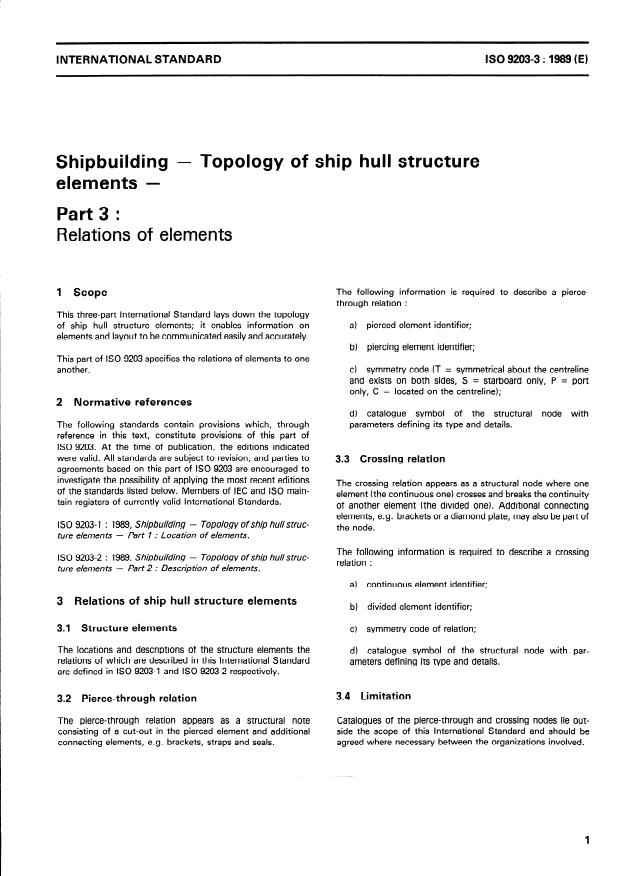
IS0 9203-3 : 1989 (E)
INTERNATIONAL STANDARD
Shipbuilding - Topology of ship hull structure
elements -
Part 3 :
Relations of elements
The following information is required to describe a pierce-
1 Scope
through relation :
This three-part International Standard lays down the topology
a) pierced element identifier;
of ship hull structure elements; it enables information on
elements and layout to be communicated easily and accurat
...
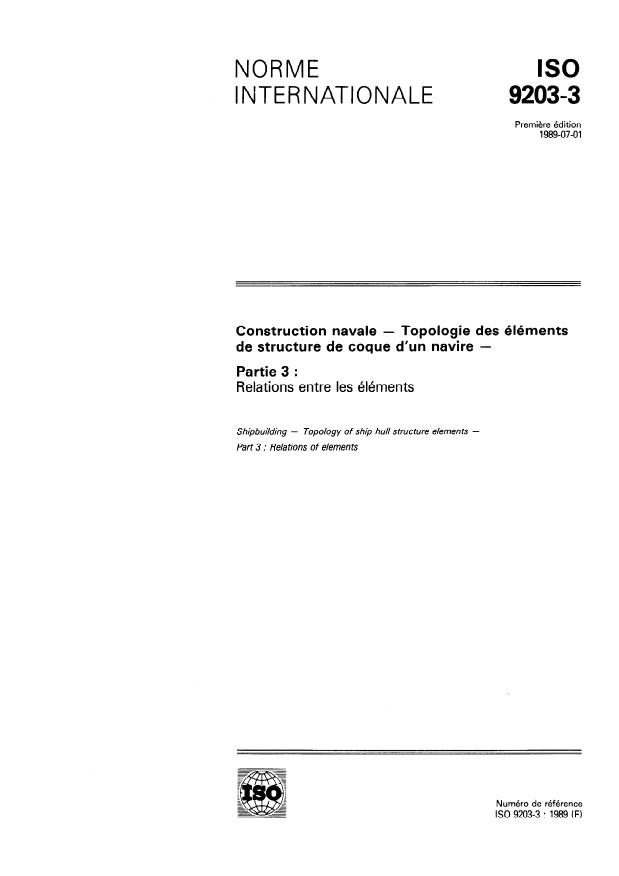
NORME ISO
INTERNATIONALE
9203-3
Première édition
1989-07-01
Construction navale - Topologie des éléments
de structure de coque d’un navire -
Partie 3 :
Relations entre les éléments
Shipbuilding - Topolog y of ship hull structure elemen ts -
Part 3 : Relations of elements
Numéro de référence
ISO 9203-3 : 1989 (F)
1sO 9203-3 : 1989 (FI
Avant-propos
L’ISO (Organisation internationale de normalisation) est une fédération mondiale
d’organismes nationaux de normalisation (comités membres de I’ISO). L’élaboration
des Normes internationales est en général confiée aux comités techniques de I’ISO.
Chaque comité membre intéressé par une étude a le droit de faire partie du comité
technique créé à cet effet. Les organisations internationales, gouvernementales et non
gouvernementales, en liaison avec I’ISO participent également aux travaux. L’ISO col-
labore étroitement avec la Commission électrotechnique internationale (CEI) en ce qui
concerne la normalisation électrotechnique.
Les projets de Normes internationales adoptés par les comités techniques sont soumis
aux comités membres pour approbation, avant leur acceptation comme Normes inter-
nationales par le Conseil de I’ISO. Les Normes internationales sont approuvées confor-
mément aux procédures de I’ISO qui requièrent l’approbation de 75 % au moins des
comités membres votants.
La Norme internationale ISO 9203-3 a été élaborée par le comité technique ISO/TC 8,
Cons truc tion na vale et s truc turcs maritimes.
L’ISO 9203 comprend les parties suivantes, présentées sous le titre général Construc-
tion navale - Topologie des éléments de structure de coque d’un na vire :
-
Partie 7: Localisation des éléments
-
Partie 2: Description des éléments
-
Partie 3: Relations entre les éléments
0 ISO 1989
Droits de reproduction réservés. Aucune partie de cette publication ne peut être reproduite ni
utilisée sous quelque forme que ce soit et par aucun procédé, électronique ou mécanique,
y compris la photocopie et les microfilms, sans l’accord écrit de l’éditeur.
Organisation internationale de normalisation
Genève 20 o Suisse
Case postale 56 l CH-1211
Imprimé en Suisse
ISO 9203-3 : 1989 (F)
NORME INTERNATIONALE
Construction navale - Topologie des éléments de
structure de coque d’un navire -
Partie 3 :
Relations entre les éléments
1 Domaine d’application 3 Relations entre les éléments de structure
de coque d’un navire
La Norme internationale en trois parties ISO 9203 établit la
topologie des éléments de structure de coque d’un navire; elle
3.1 Éléments de structure
permet le transfert, d’une manière aisée et précise, des informa-
tions relatives aux éléments et à leur ensemble structurel.
La localisation et la description des éléments de structure
...
NORME ISO
INTERNATIONALE
9203-3
Première édition
1989-07-01
Construction navale - Topologie des éléments
de structure de coque d’un navire -
Partie 3 :
Relations entre les éléments
Shipbuilding - Topolog y of ship hull structure elemen ts -
Part 3 : Relations of elements
Numéro de référence
ISO 9203-3 : 1989 (F)
1sO 9203-3 : 1989 (FI
Avant-propos
L’ISO (Organisation internationale de normalisation) est une fédération mondiale
d’organismes nationaux de normalisation (comités membres de I’ISO). L’élaboration
des Normes internationales est en général confiée aux comités techniques de I’ISO.
Chaque comité membre intéressé par une étude a le droit de faire partie du comité
technique créé à cet effet. Les organisations internationales, gouvernementales et non
gouvernementales, en liaison avec I’ISO participent également aux travaux. L’ISO col-
labore étroitement avec la Commission électrotechnique internationale (CEI) en ce qui
concerne la normalisation électrotechnique.
Les projets de Normes internationales adoptés par les comités techniques sont soumis
aux comités membres pour approbation, avant leur acceptation comme Normes inter-
nationales par le Conseil de I’ISO. Les Normes internationales sont approuvées confor-
mément aux procédures de I’ISO qui requièrent l’approbation de 75 % au moins des
comités membres votants.
La Norme internationale ISO 9203-3 a été élaborée par le comité technique ISO/TC 8,
Cons truc tion na vale et s truc turcs maritimes.
L’ISO 9203 comprend les parties suivantes, présentées sous le titre général Construc-
tion navale - Topologie des éléments de structure de coque d’un na vire :
-
Partie 7: Localisation des éléments
-
Partie 2: Description des éléments
-
Partie 3: Relations entre les éléments
0 ISO 1989
Droits de reproduction réservés. Aucune partie de cette publication ne peut être reproduite ni
utilisée sous quelque forme que ce soit et par aucun procédé, électronique ou mécanique,
y compris la photocopie et les microfilms, sans l’accord écrit de l’éditeur.
Organisation internationale de normalisation
Genève 20 o Suisse
Case postale 56 l CH-1211
Imprimé en Suisse
ISO 9203-3 : 1989 (F)
NORME INTERNATIONALE
Construction navale - Topologie des éléments de
structure de coque d’un navire -
Partie 3 :
Relations entre les éléments
1 Domaine d’application 3 Relations entre les éléments de structure
de coque d’un navire
La Norme internationale en trois parties ISO 9203 établit la
topologie des éléments de structure de coque d’un navire; elle
3.1 Éléments de structure
permet le transfert, d’une manière aisée et précise, des informa-
tions relatives aux éléments et à leur ensemble structurel.
La localisation et la description des éléments de structure
...
Questions, Comments and Discussion
Ask us and Technical Secretary will try to provide an answer. You can facilitate discussion about the standard in here.
Loading comments...