

oSIST prEN 2794-004:2026
(Main)Aerospace series - Circuit breakers, single-pole, temperature compensated, rated currents 20 A to 60 A - Part 004: UNC thread terminals - Product standard
- Abstract
This document specifies the characteristics of single-pole circuit breakers, temperature compensated with a rated current from 20 A to 25 A, used in aircraft on-board circuits at a temperature between −55 °C and 125 °C and at an altitude of 15 000 m max.
These circuit breakers are operated by a push-pull type single push button (actuator), with delayed action “trip-free” tripping.
They will continue to function up to the short-circuit current.
- Status
- Not Published
- Public Enquiry End Date
- 30-Oct-2026
- Technical Committee
- I13 - Imaginarni 13
- Current Stage
- 4020 - Public enquire (PE) (Adopted Project)
- Start Date
- 20-Aug-2026
- Due Date
- 07-Jan-2027
oSIST prEN 2794-004:2026 is the Slovenian publication of prEN 2794-004, a draft European Standard prepared by ASD-STAN for CEN. It specifies the characteristics of single-pole, temperature-compensated aerospace circuit breakers with UNC thread terminals for aircraft on-board circuits, so engineers, test labs, quality teams and buyers can check the part’s design, performance and marking.
What does oSIST prEN 2794-004:2026 specify?
oSIST prEN 2794-004:2026 is a product standard for a specific single-pole circuit breaker type used in aircraft electrical systems. It covers the breaker’s dimensions, mass, electrical and mechanical characteristics, environmental behavior, designation, delivery hardware and marking.
The document is organized into 10 clauses and a bibliography:
- Clause 1 - Scope
- Clause 2 - Normative references
- Clause 3 - Terms and definitions
- Clause 4 - Dimensions and mass, electrical diagram and panel cut-out
- Clause 5 - Characteristics
- Clause 6 - Designation
- Clause 7 - Rated current code
- Clause 8 - Delivery hardware code
- Clause 9 - Marking
- Clause 10 - Technical specification
In practice, the structure tells a reader where to find installation data, qualification limits and ordering information.
What are the key requirements of oSIST prEN 2794-004:2026?
Dimensions and installation
oSIST prEN 2794-004:2026 fixes the breaker configuration, dimensions and tolerances in Figure 1, and states that the shape need only match those dimensions. That matters when a supplier checks interchangeability or when a panel designer verifies fit.
Clause 4.2 defines the electrical state: released push button means the circuit breaker is open, and pressed means it is closed. The supply and load may be inverted, which gives some wiring flexibility during installation.
Clause 4.3 limits mass to 70 g maximum for delivery code A including hardware. Clause 4.4 sends the panel cut-out to EN 2794-001, so the mounting opening is controlled through the companion standard.
Mechanical and environmental performance
Clause 5.2 requires fasteners to follow EN 6113 and gives installation torques for the attaching nut and connection hardware. In practice, installers need these values to avoid loose connections or damage during assembly.
The same clause covers vibration, shock and mechanical endurance. These requirements matter because aircraft breakers must keep working under service vibration and handling loads.
Clauses 5.3.1 to 5.3.4 cover humidity, corrosion, contaminating liquids and lightning overvoltage. These are the environmental checks that show the breaker can survive aircraft conditions without loss of function.
Electrical performance
Clause 5.4.1 allows operation on 28 V DC and 115 V AC at 360 Hz to 800 Hz. That tells users which aircraft circuit types the breaker is intended for.
Clauses 5.4.2, 5.4.3 and 5.4.4 set voltage drop, tripping thresholds and overload trip behavior across temperature and altitude conditions. In practice, these clauses define when the breaker must carry current and when it must trip.
Clause 5.4.5 sets short-circuit values, test altitude and operating sequences, with notes on acceptable destruction behavior in some tests and on when a follow-up test may be omitted. This is the main safety and fault-withstanding requirement.
Clauses 5.4.6 to 5.4.8 cover no-load and load endurance, dielectric rigidity and insulation resistance. These requirements are used to check long-term electrical integrity and service life.
Identification and ordering
Clauses 6 to 10 define how the breaker is designated, how the rated current is coded, how the delivery hardware is coded, and what marking must appear on the product and packaging. That helps procurement, receiving inspection and configuration control identify the exact part and supplied hardware.
What terms does oSIST prEN 2794-004:2026 define?
Clause 3 points to the terms and definitions in EN 2350. Key terms used in the document include:
- Actuator - the push-pull single push button that operates the breaker.
- Trip-free tripping - delayed-action tripping that still occurs even if the button is held.
- Rated current - the current value used to identify the breaker size and its marking.
- Panel cut-out - the mounting opening in the panel for the breaker.
- Delivery hardware code - the code that identifies the supplied connection and attachment hardware.
- CO - a break operation used in the short-circuit test.
- OCO - a make operation used in the short-circuit test.
Who uses oSIST prEN 2794-004:2026?
Aerospace electrical designers use it to select a breaker that fits the panel, matches the circuit voltage and meets the required trip behavior. Test laboratories use it for qualification and short-circuit, vibration, shock and endurance testing. Quality managers and buyers use it to verify markings, hardware supply and accepted configuration for aircraft on-board circuits.
What changed in oSIST prEN 2794-004:2026 from the previous edition?
oSIST prEN 2794-004:2026 supersedes EN 2794-004:2014. The foreword states three significant technical changes: updated short-circuit values in Table 5, a mass change in Clause 4.3 from 62 g to 70 g, and a revised external diameter of the button in Figure 1.
Which standards are used with oSIST prEN 2794-004:2026?
| Standard | What it contributes |
|---|---|
| EN 2350 | Terms and definitions, and the technical specification framework for aerospace circuit breakers |
| EN 2794-001 | Panel cut-out, material and surface treatment, and several common performance requirements |
| EN 3841-305 | Short-circuit test method and the definitions of CO and OCO operations |
| EN 6113 | Connecting and attachment hardware |
| SAE-AMS-STD-595 | Colour identification used in Figure 1 |
| TR 6083 | Cut-outs for installation of electrical components |
What does the oSIST prEN 2794-004:2026 document contain?
The document contains Figure 1 for configuration, dimensions and tolerances, and Figure 2 for the electrical diagram. It also contains Tables 1 to 9, which cover operational voltages, voltage drop, tripping thresholds, overload trip, short-circuit values, endurance, dielectric rigidity, rated current code and delivery hardware code.
For readers, those tables are the working data for design, test and procurement. They tell a user what to measure, what to verify during qualification, and how to order and mark the breaker correctly.
Relations
- Effective Date
- 08-Jan-2025
Get Certified
Connect with accredited certification bodies for this standard

BUREAU VERITAS Certification Germany
Bureau Veritas certification in Germany.

Element Materials Technology
Materials testing and product certification.

AQMS Ltd.
AQMS provides ISO certification to SMEs across the UK.
Sponsored listings
Frequently Asked Questions
oSIST prEN 2794-004:2026 is a draft published by the Slovenian Institute for Standardization (SIST). Its full title is "Aerospace series - Circuit breakers, single-pole, temperature compensated, rated currents 20 A to 60 A - Part 004: UNC thread terminals - Product standard". This standard covers: This document specifies the characteristics of single-pole circuit breakers, temperature compensated with a rated current from 20 A to 25 A, used in aircraft on-board circuits at a temperature between −55 °C and 125 °C and at an altitude of 15 000 m max. These circuit breakers are operated by a push-pull type single push button (actuator), with delayed action “trip-free” tripping. They will continue to function up to the short-circuit current.
This document specifies the characteristics of single-pole circuit breakers, temperature compensated with a rated current from 20 A to 25 A, used in aircraft on-board circuits at a temperature between −55 °C and 125 °C and at an altitude of 15 000 m max. These circuit breakers are operated by a push-pull type single push button (actuator), with delayed action “trip-free” tripping. They will continue to function up to the short-circuit current.
oSIST prEN 2794-004:2026 is classified under the following ICS (International Classification for Standards) categories: 49.060 - Aerospace electric equipment and systems. The ICS classification helps identify the subject area and facilitates finding related standards.
oSIST prEN 2794-004:2026 has the following relationships with other standards: It is inter standard links to SIST EN 2794-004:2014. Understanding these relationships helps ensure you are using the most current and applicable version of the standard.
oSIST prEN 2794-004:2026 is available in PDF format for immediate download after purchase. The document can be added to your cart and obtained through the secure checkout process. Digital delivery ensures instant access to the complete standard document.
Standards Content (Sample)
SLOVENSKI STANDARD
01-oktober-2026
Aeronavtika - Odklopniki, enopolni, temperaturno kompenzirani, naznačeni tok od
20 A do 50 A - 004. del: Navojni priključki UNC - Standard za proizvod
Aerospace series - Circuit breakers, single-pole, temperature compensated, rated
currents 20 A to 60 A - Part 004: UNC thread terminals - Product standard
Luft- und Raumfahrt - Schutzschalter, einpolig, temperaturkompensiert, Nennströme von
20A bis 50A - Teil004: UNC-Klemmengewinde - Produktnorm
Série aérospatiale - Disjoncteurs unipolaires compensés en température, intensités
nominales 20 A à 50 A - Partie 004 : Bornes à filetage UNC - Norme de produit
Ta slovenski standard je istoveten z: prEN 2794-004
ICS:
49.060 Letalska in vesoljska Aerospace electric
električna oprema in sistemi equipment and systems
2003-01.Slovenski inštitut za standardizacijo. Razmnoževanje celote ali delov tega standarda ni dovoljeno.
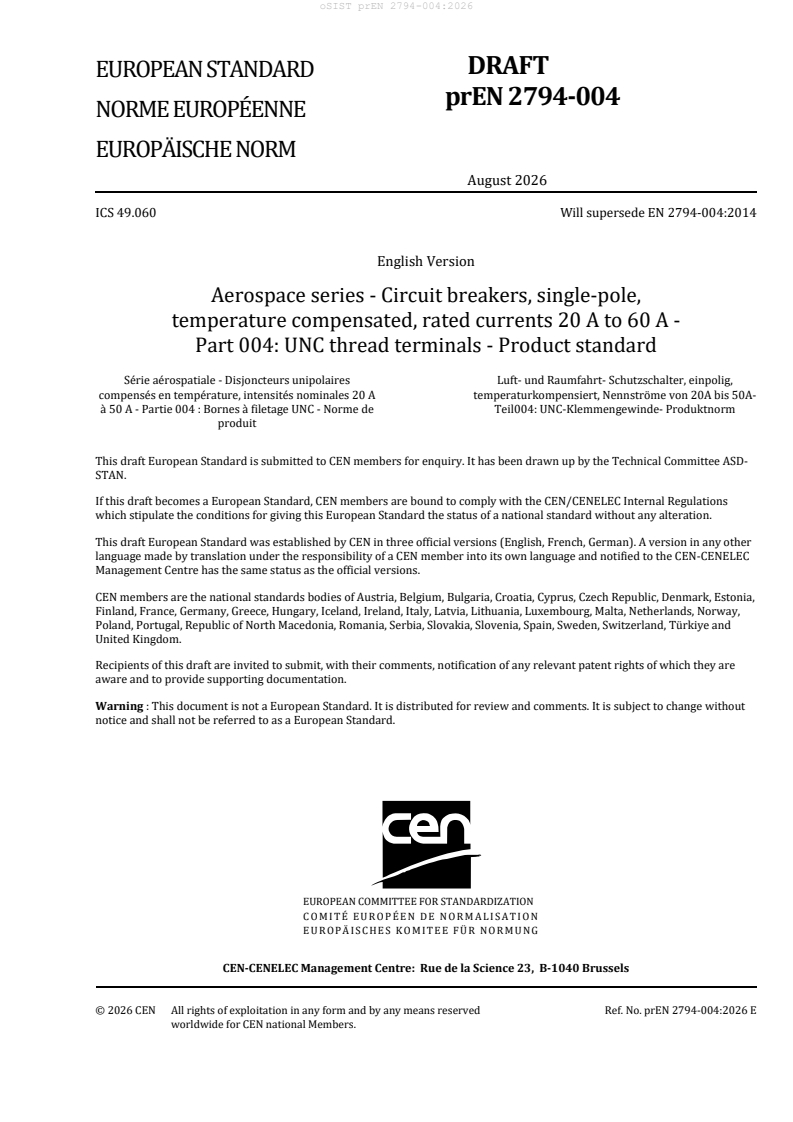
DRAFT
EUROPEAN STANDARD
NORME EUROPÉENNE
EUROPÄISCHE NORM
August 2026
ICS 49.060 Will supersede EN 2794-004:2014
English Version
Aerospace series - Circuit breakers, single-pole,
temperature compensated, rated currents 20 A to 60 A -
Part 004: UNC thread terminals - Product standard
Série aérospatiale - Disjoncteurs unipolaires Luft- und Raumfahrt- Schutzschalter, einpolig,
compensés en température, intensités nominales 20 A temperaturkompensiert, Nennströme von 20A bis 50A-
à 50 A - Partie 004 : Bornes à filetage UNC - Norme de Teil004: UNC-Klemmengewinde- Produktnorm
produit
This draft European Standard is submitted to CEN members for enquiry. It has been drawn up by the Technical Committee ASD-
STAN.
If this draft becomes a European Standard, CEN members are bound to comply with the CEN/CENELEC Internal Regulations
which stipulate the conditions for giving this European Standard the status of a national standard without any alteration.
This draft European Standard was established by CEN in three official versions (English, French, German). A version in any other
language made by translation under the responsibility of a CEN member into its own language and notified to the CEN-CENELEC
Management Centre has the same status as the official versions.
CEN members are the national standards bodies of Austria, Belgium, Bulgaria, Croatia, Cyprus, Czech Republic, Denmark, Estonia,
Finland, France, Germany, Greece, Hungary, Iceland, Ireland, Italy, Latvia, Lithuania, Luxembourg, Malta, Netherlands, Norway,
Poland, Portugal, Republic of North Macedonia, Romania, Serbia, Slovakia, Slovenia, Spain, Sweden, Switzerland, Türkiye and
United Kingdom.
Recipients of this draft are invited to submit, with their comments, notification of any relevant patent rights of which they are
aware and to provide supporting documentation.
Warning : This document is not a European Standard. It is distributed for review and comments. It is subject to change without
notice and shall not be referred to as a European Standard.
EUROPEAN COMMITTEE FOR STANDARDIZATION
COMITÉ EUROPÉEN DE NORMALISATION
EUROPÄISCHES KOMITEE FÜR NORMUNG
CEN-CENELEC Management Centre: Rue de la Science 23, B-1040 Brussels
© 2026 CEN All rights of exploitation in any form and by any means reserved Ref. No. prEN 2794-004:2026 E
worldwide for CEN national Members.
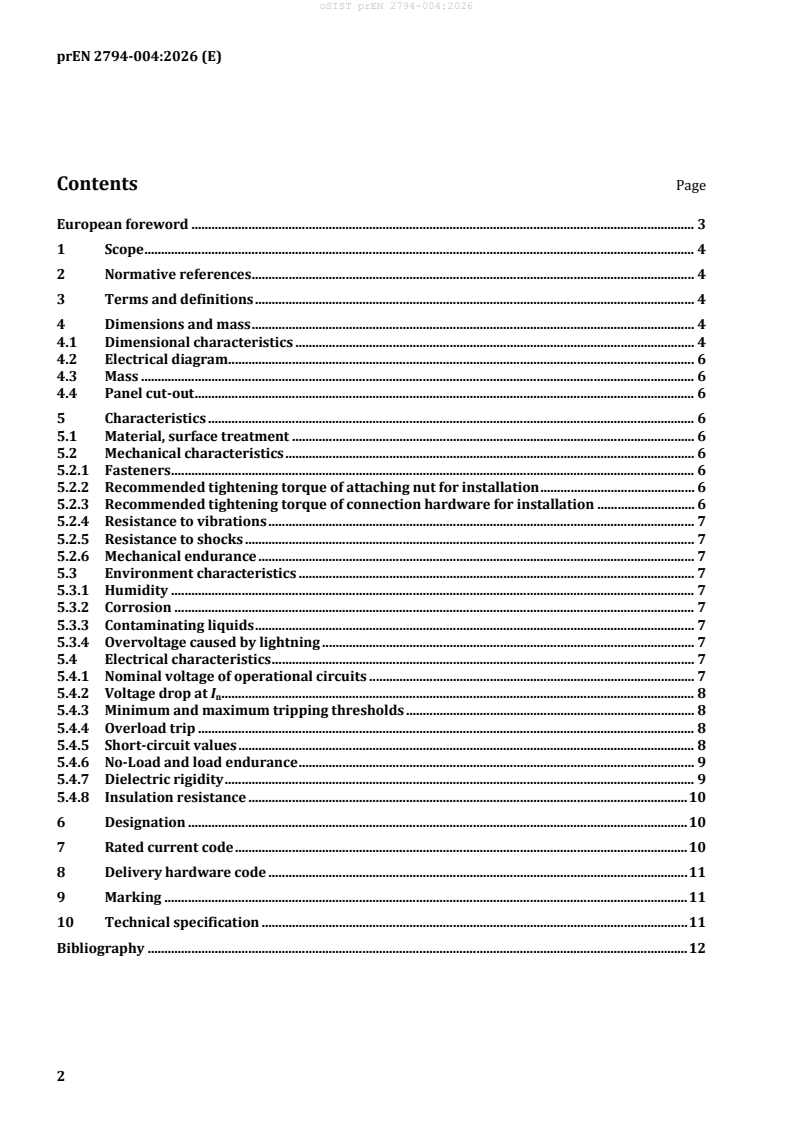
Contents Page
European foreword . 3
1 Scope . 4
2 Normative references . 4
3 Terms and definitions . 4
4 Dimensions and mass . 4
4.1 Dimensional characteristics . 4
4.2 Electrical diagram . 6
4.3 Mass . 6
4.4 Panel cut-out . 6
5 Characteristics . 6
5.1 Material, surface treatment . 6
5.2 Mechanical characteristics . 6
5.2.1 Fasteners . 6
5.2.2 Recommended tightening torque of attaching nut for installation . 6
5.2.3 Recommended tightening torque of connection hardware for installation . 6
5.2.4 Resistance to vibrations . 7
5.2.5 Resistance to shocks . 7
5.2.6 Mechanical endurance . 7
5.3 Environment characteristics . 7
5.3.1 Humidity . 7
5.3.2 Corrosion . 7
5.3.3 Contaminating liquids . 7
5.3.4 Overvoltage caused by lightning . 7
5.4 Electrical characteristics . 7
5.4.1 Nominal voltage of operational circuits . 7
5.4.2 Voltage drop at Ι . 8
n
5.4.3 Minimum and maximum tripping thresholds . 8
5.4.4 Overload trip . 8
5.4.5 Short-circuit values . 8
5.4.6 No-Load and load endurance . 9
5.4.7 Dielectric rigidity . 9
5.4.8 Insulation resistance . 10
6 Designation . 10
7 Rated current code . 10
8 Delivery hardware code . 11
9 Marking . 11
10 Technical specification . 11
Bibliography . 12
European foreword
This document (prEN 2794-004:2026) has been prepared by ASD-STAN.
After enquiries and votes carried out in accordance with the rules of this Association, this document has
received the approval of the National Associations and the Official Services of the member countries of
ASD-STAN, prior to its pr
...