

SIST EN IEC 81346-1:2022
(Main)Industrial systems, installations and equipment and industrial products - Structuring principles and reference designations - Part 1: Basic rules (IEC 81346-1:2022)
General Information
- Abstract
This part of IEC 81346, published jointly by IEC and ISO, establishes general principles for the structuring of systems including structuring of the information about systems.
Based on these principles, rules and guidance are given for the formulation of unambiguous reference designations for objects in any system.
The reference designation identifies objects for the purpose of creation and retrieval of information about an object, and where realized about its corresponding component.
A reference designation labelled at a component is the key to find information about that object among different kinds of documents.
The principles are general and are applicable to all technical areas (for example mechanical engineering, electrical engineering, construction engineering, process engineering). They can be used for systems based on different technologies or for systems combining several technologies.
This document is also a horizontal publication intended for use by technical committees in preparation of publications related to reference designations in accordance with the principles laid down in IEC Guide 108.
- Status
- Published
- Public Enquiry End Date
- 30-Jan-2021
- Publication Date
- 14-Nov-2022
- Technical Committee
- EDO - Documentation and graphical symbols
- Current Stage
- 6060 - National Implementation/Publication (Adopted Project)
- Start Date
- 19-May-2022
- Due Date
- 24-Jul-2022
- Completion Date
- 15-Nov-2022


Overview
EN IEC 81346-1:2022 (IEC 81346-1:2022) defines basic rules and general principles for the structuring of industrial systems and the formulation of unambiguous reference designations. Published jointly by IEC and ISO and adopted by CLC, this horizontal publication covers how to identify objects (components, assemblies, locations, functions, types) so that information about those objects can be created, retrieved and linked across technical documents and systems. The principles are deliberately generic and applicable across disciplines (mechanical, electrical, construction, process engineering) and technologies.
Key topics and technical requirements
- Structuring principles: guidance on forming structures that represent different “aspects” of systems (function, product, location, type, other aspects) and on combining aspects.
- Concepts and definitions: clear definitions for object, aspect, system, function, product, location, type, object occurrences and product individuals.
- Reference designation construction: rules for building single-level and multi-level reference designations, use of letter codes, and handling different structures within the same aspect.
- Reference designation set: how to manage consistent sets of designations across documents and disciplines.
- Presentation and labelling: requirements for presenting reference designations on drawings, labels and documents to ensure unambiguous identification.
- Information model and annexes: informative EXPRESS-G information model (Annex A) and guidance on object life cycle and validity (Annex B).
- Interoperability focus: intended for use by technical committees and to support harmonized application across standards (per IEC Guide 108).
Practical applications
- Standardizing identification schemes across engineering disciplines for consistent technical documentation.
- Enabling reliable cross-referencing between drawings, bills of materials, maintenance logs, PLM/ERP systems and digital twins.
- Improving configuration management, procurement, commissioning, operation and maintenance through unambiguous object identifiers.
- Supporting multi-technology projects (e.g., process plant with mechanical, electrical and instrumentation elements) by providing a common reference designation methodology.
Who should use this standard
- System and design engineers, documentation managers and technical authors
- Project managers, integrators and contractors in industry and construction
- IT/PLM/CMMS teams implementing equipment identifiers and data exchange
- Standards and committee members preparing related reference-designation publications
Related standards
- IEC/EN IEC 81346-2 (classification of objects and codes for classes)
- ISO 81346 series (e.g., Part 10 Power plants, Part 12 Construction works)
- Referenced standards used for harmonization: IEC 61175, IEC 61355, IEC 82045 and others listed in the normative annex.
Keywords: EN IEC 81346-1:2022, reference designation, structuring principles, industrial systems, technical documentation, IEC 81346.
Relations
- Effective Date
- 17-May-2022
- Effective Date
- 09-Feb-2026
- Effective Date
- 03-Feb-2026
- Effective Date
- 16-Jun-2026
- Referred By
SIST EN 15016-1:2004 - Technical drawings - Railway applications - Part 1: General Principles - Effective Date
- 09-Feb-2026
- Effective Date
- 09-Feb-2026
- Effective Date
- 09-Feb-2026
- Effective Date
- 03-Feb-2026
- Effective Date
- 03-Feb-2026
- Effective Date
- 03-Feb-2026
- Effective Date
- 03-Feb-2026
- Effective Date
- 03-Feb-2026
Get Certified
Connect with accredited certification bodies for this standard

IMQ S.p.A. (Certification)
Italian electrical product certification.

SLG Prüf- und Zertifizierungs GmbH
German testing and certification body.

UL Solutions
Global safety science company with testing, inspection and certification.
Sponsored listings
Frequently Asked Questions
SIST EN IEC 81346-1:2022 is a standard published by the Slovenian Institute for Standardization (SIST). Its full title is "Industrial systems, installations and equipment and industrial products - Structuring principles and reference designations - Part 1: Basic rules (IEC 81346-1:2022)". This standard covers: This part of IEC 81346, published jointly by IEC and ISO, establishes general principles for the structuring of systems including structuring of the information about systems. Based on these principles, rules and guidance are given for the formulation of unambiguous reference designations for objects in any system. The reference designation identifies objects for the purpose of creation and retrieval of information about an object, and where realized about its corresponding component. A reference designation labelled at a component is the key to find information about that object among different kinds of documents. The principles are general and are applicable to all technical areas (for example mechanical engineering, electrical engineering, construction engineering, process engineering). They can be used for systems based on different technologies or for systems combining several technologies. This document is also a horizontal publication intended for use by technical committees in preparation of publications related to reference designations in accordance with the principles laid down in IEC Guide 108.
This part of IEC 81346, published jointly by IEC and ISO, establishes general principles for the structuring of systems including structuring of the information about systems. Based on these principles, rules and guidance are given for the formulation of unambiguous reference designations for objects in any system. The reference designation identifies objects for the purpose of creation and retrieval of information about an object, and where realized about its corresponding component. A reference designation labelled at a component is the key to find information about that object among different kinds of documents. The principles are general and are applicable to all technical areas (for example mechanical engineering, electrical engineering, construction engineering, process engineering). They can be used for systems based on different technologies or for systems combining several technologies. This document is also a horizontal publication intended for use by technical committees in preparation of publications related to reference designations in accordance with the principles laid down in IEC Guide 108.
SIST EN IEC 81346-1:2022 is classified under the following ICS (International Classification for Standards) categories: 01.110 - Technical product documentation; 29.020 - Electrical engineering in general. The ICS classification helps identify the subject area and facilitates finding related standards.
SIST EN IEC 81346-1:2022 has the following relationships with other standards: It is inter standard links to SIST EN 81346-1:2009, SIST EN 583-5:2001, SIST EN IEC 81346-2:2019, SIST EN IEC 81346-14:2026, SIST EN 15016-1:2004, SIST EN 17206:2020, SIST EN 15380-1:2006, SIST EN 61850-5:2013/A1:2022, SIST EN 61082-1:2015, SIST EN IEC 62714-5:2022, SIST EN IEC 62881:2019, SIST EN 61175-1:2015. Understanding these relationships helps ensure you are using the most current and applicable version of the standard.
SIST EN IEC 81346-1:2022 is available in PDF format for immediate download after purchase. The document can be added to your cart and obtained through the secure checkout process. Digital delivery ensures instant access to the complete standard document.
Standards Content (Sample)
SLOVENSKI STANDARD
01-december-2022
Nadomešča:
SIST EN 81346-1:2009
Industrijski sistemi, inštalacije in oprema ter industrijski izdelki - Načela
strukturiranja in referenčne oznake - 1. del: Osnovna pravila (IEC 81346-1:2022)
Industrial systems, installations and equipment and industrial products - Structuring
principles and reference designations - Part 1: Basic rules (IEC 81346-1:2022)
Industrielle Systeme, Anlagen und Ausrüstungen und Industrieprodukte -
Strukturierungsprinzipien und Referenzkennzeichnung - Teil 1: Allgemeine Regeln (IEC
81346-1:2022)
Systèmes industriels, installations et appareils, et produits industriels - Principes de
structuration et désignations de référence - Partie 1: Règles de base (IEC 81346-
1:2022)
Ta slovenski standard je istoveten z: EN IEC 81346-1:2022
ICS:
01.110 Tehnična dokumentacija za Technical product
izdelke documentation
29.020 Elektrotehnika na splošno Electrical engineering in
general
2003-01.Slovenski inštitut za standardizacijo. Razmnoževanje celote ali delov tega standarda ni dovoljeno.
EUROPEAN STANDARD EN IEC 81346-1
NORME EUROPÉENNE
EUROPÄISCHE NORM May 2022
ICS 01.110; 29.020 Supersedes EN 81346-1:2009
English Version
Industrial systems, installations and equipment and industrial
products - Structuring principles and reference designations -
Part 1: Basic rules
(IEC 81346-1:2022)
Systèmes industriels, installations et appareils, et produits Industrielle Systeme, Anlagen und Ausrüstungen und
industriels - Principes de structuration et désignations de Industrieprodukte - Strukturierungsprinzipien und
référence - Partie 1: Règles de base Referenzkennzeichnung - Teil 1: Allgemeine Regeln
(IEC 81346-1:2022) (IEC 81346-1:2022)
This European Standard was approved by CENELEC on 2022-05-04. CENELEC members are bound to comply with the CEN/CENELEC
Internal Regulations which stipulate the conditions for giving this European Standard the status of a national standard without any alteration.
Up-to-date lists and bibliographical references concerning such national standards may be obtained on application to the CEN-CENELEC
Management Centre or to any CENELEC member.
This European Standard exists in three official versions (English, French, German). A version in any other language made by translation
under the responsibility of a CENELEC member into its own language and notified to the CEN-CENELEC Management Centre has the
same status as the official versions.
CENELEC members are the national electrotechnical committees of Austria, Belgium, Bulgaria, Croatia, Cyprus, the Czech Republic,
Denmark, Estonia, Finland, France, Germany, Greece, Hungary, Iceland, Ireland, Italy, Latvia, Lithuania, Luxembourg, Malta, the
Netherlands, Norway, Poland, Portugal, Republic of North Macedonia, Romania, Serbia, Slovakia, Slovenia, Spain, Sweden, Switzerland,
Turkey and the United Kingdom.
European Committee for Electrotechnical Standardization
Comité Européen de Normalisation Electrotechnique
Europäisches Komitee für Elektrotechnische Normung
CEN-CENELEC Management Centre: Rue de la Science 23, B-1040 Brussels
© 2022 CENELEC All rights of exploitation in any form and by any means reserved worldwide for CENELEC Members.
Ref. No. EN IEC 81346-1:2022 E
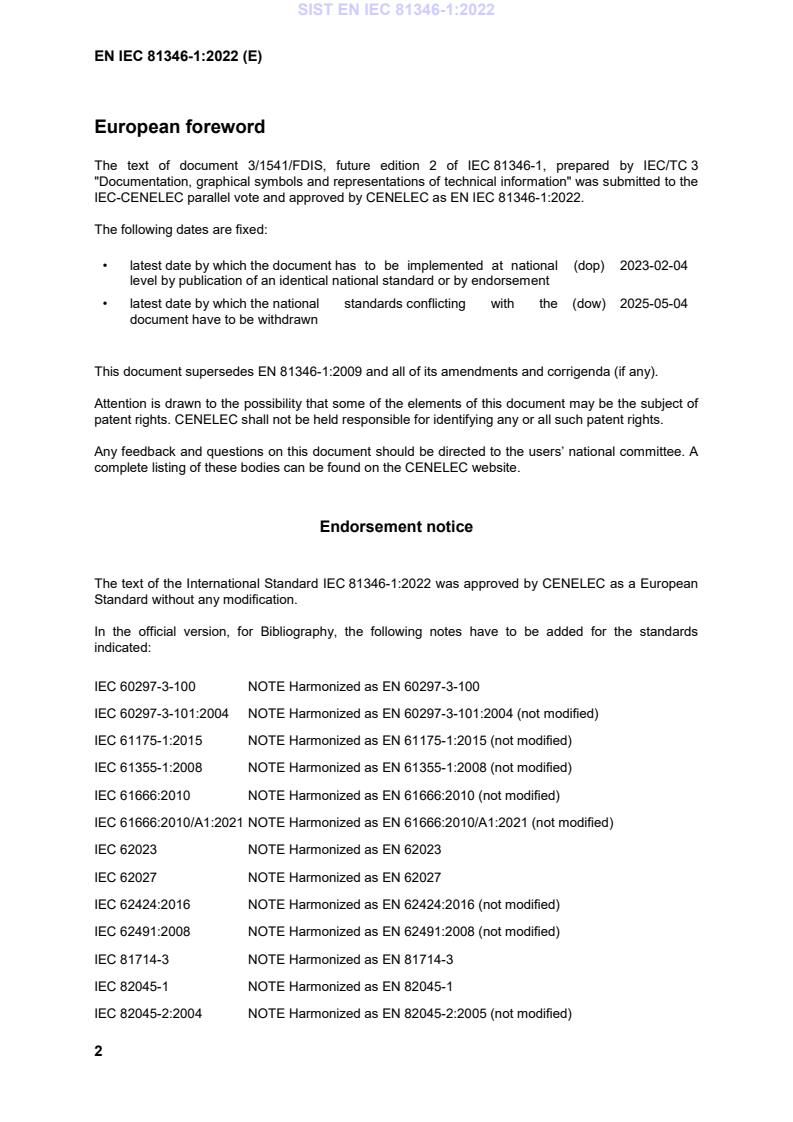
European foreword
The text of document 3/1541/FDIS, future edition 2 of IEC 81346-1, prepared by IEC/TC 3
"Documentation, graphical symbols and representations of technical information" was submitted to the
IEC-CENELEC parallel vote and approved by CENELEC as EN IEC 81346-1:2022.
The following dates are fixed:
• latest date by which the document has to be implemented at national (dop) 2023-02-04
level by publication of an identical national standard or by endorsement
• latest date by which the national standards conflicting with the (dow) 2025-05-04
document have to be withdrawn
This document supersedes EN 81346-1:2009 and all of its amendments and corrigenda (if any).
Attention is drawn to the possibility that some of the elements of this document may be the subject of
patent rights. CENELEC shall not be held responsible for identifying any or all such patent rights.
Any feedback and questions on this document should be directed to the users’ national committee. A
complete listing of these bodies can be found on the CENELEC website.
Endorsement notice
The text of the International Standard IEC 81346-1:2022 was approved by CENELEC as a European
Standard without any modification.
In the official version, for Bibliography, the following notes have to be added for the standards
indicated:
IEC 60297-3-100 NOTE Harmonized as EN 60297-3-100
IEC 60297-3-101:2004 NOTE Harmonized as EN 60297-3-101:2004 (not modified)
IEC 61175-1:2015 NOTE Harmonized as EN 61175-1:2015 (not modified)
IEC 61355-1:2008 NOTE Harmonized as EN 61355-1:2008 (not modified)
IEC 61666:2010 NOTE Harmonized as EN 61666:2010 (not modified)
IEC 61666:2010/A1:2021 NOTE Harmonized as EN 61666:2010/A1:2021 (not modified)
IEC 62023 NOTE Harmonized as EN 62023
IEC 62027 NOTE Harmonized as EN 62027
IEC 62424:2016 NOTE Harmonized as EN 62424:2016 (not modified)
IEC 62491:2008 NOTE Harmonized as EN 62491:2008 (not modified)
IEC 81714-3 NOTE Harmonized as EN 81714-3
IEC 82045-1 NOTE Harmonized as EN 82045-1
IEC 82045-2:2004 NOTE Harmonized as EN 82045-2:2005 (not modified)
IEC/IEEE 82079-1:2019 NOTE Harmonized as EN IEC/IEEE 82079-1:2020 (not modified)
ISO 3166-1 NOTE Harmonized as EN ISO 3166-1
ISO 4157 (series) NOTE Harmonized as EN ISO 4157 (series)
ISO 4157-3 NOTE Harmonized as EN ISO 4157-3
ISO 9000:2015 NOTE Harmonized as EN ISO 9000:2015 (not modified)
Annex ZA
(normative)
Normative references to international publications
with their corresponding European publications
The following documents are referred to in the text in such a way that some or all of their content
constitutes requirements of this document. For dated references, only the edition cited applies. For
undated references, the latest edition of the referenced document (including any amendments)
applies.
NOTE 1 Where an International Publication has been modified by common modifications, indicated by (mod), the
relevant EN/HD applies.
NOTE 2 Up-to-date information on the latest versions of the European Standards listed in this annex is available
here: www.cenelec.eu.
Publication Year Title EN/HD Year
IEC 81346-2 2019 Industrial systems, installations and EN IEC 81346-2 2019
equipment and industrial products -
Structuring principles and reference
designations - Part 2: Classification of
objects and codes for classes
ISO/IEC 646 - Information technology; ISO 7-bit coded - -
character set for information interchange
ISO 81346-10 — Industrial systems, installations and - -
equipment and industrial products -
Structuring principles and reference
designation - Part 10: Power plants
ISO 81346-12 2018 Industrial systems, installations and - -
equipment and industrial products -
Structuring principles and reference
designations - Part 12: Construction works
and building services
In preparation. Stage at time of publication: ISO DIS 81346-10:2021.
IEC 81346-1
Edition 2.0 2022-03
INTERNATIONAL
STANDARD
NORME
INTERNATIONALE
colour
inside
HORIZONTAL PUBLICATION
PUBLICATION HORIZONTALE
Industrial systems, installations and equipment and industrial products –
Structuring principles and reference designations –
Part 1: Basic rules
Systèmes industriels, installations et appareils, et produits industriels –
Principes de structuration et désignations de référence –
Partie 1: Règles de base
INTERNATIONAL
ELECTROTECHNICAL
COMMISSION
COMMISSION
ELECTROTECHNIQUE
INTERNATIONALE
ICS 01.110; 29.020 ISBN 978-2-8322-1077-7
– 2 – IEC 81346-1:2022 © IEC 2022
CONTENTS
FOREWORD . 8
INTRODUCTION . 11
1 Scope . 13
2 Normative references . 13
3 Terms and definitions . 14
4 Concepts . 16
4.1 Object . 16
4.2 Aspect . 17
4.3 Systems . 19
4.4 Structuring . 19
4.5 Function . 19
4.6 Products and components . 20
4.7 Location . 21
4.8 Types. 21
4.9 Object occurrences and product individuals . 21
4.10 Relations between concepts . 22
5 Structuring principles . 23
5.1 General . 23
5.2 Forming structures . 26
5.3 Function-oriented structure . 28
5.4 Product-oriented structure. 29
5.5 Location-oriented structure . 30
5.6 Type-oriented structure . 31
5.7 Structures based on "other aspects" . 31
5.8 Structures based on more than one aspect . 33
6 Construction of reference designations . 34
6.1 General . 34
6.2 Format of reference designations . 35
6.2.1 Single level . 35
6.2.2 Multi-level . 36
6.2.3 Use of letter codes . 36
6.3 Different structures within the same aspect . 37
7 Reference designation set . 37
8 Designation of locations . 39
8.1 General . 39
8.2 Assemblies . 39
9 Presentation of reference designations . 41
9.1 Reference designations . 41
9.2 Reference designation set . 42
9.3 Presentation of identifiers for the top-node . 43
10 Labelling . 44
11 Presentation of properties for an object . 45
12 Application of the reference designation system . 46
Annex A (informative) Information model on the reference designation system . 47
A.1 General . 47
IEC 81346-1:2022 © IEC 2022 – 3 –
A.2 EXPRESS-G model . 47
A.3 Entity descriptions . 48
A.3.1 object . 48
A.3.2 aspect . 48
A.3.3 object_occurrence . 48
A.3.4 function_occurrence . 48
A.3.5 product_occurrence . 49
A.3.6 location_occurrence. 49
A.3.7 type_occurrence . 49
A.3.8 other_aspect_occurrence. 49
A.3.9 reference_designation . 49
A.3.10 single_level_reference_designation . 49
A.3.11 multi_level_reference_designation . 50
A.3.12 reference_designation_set . 50
A.3.13 classification_scheme . 50
A.3.14 class . 50
A.3.15 top_node_identifier . 51
A.3.16 product_individual . 51
A.4 Enumerations . 51
A.4.1 aspect_kind . 51
A.4.2 81346_classification_domain . 51
A.5 EXPRESS code . 52
Annex B (informative) Establishment and life cycle of objects . 54
B.1 Establishment and validity of objects . 54
B.2 Life cycle story of an object. 55
B.2.1 Overview . 55
B.2.2 Function aspect and function based on a function-oriented structure (A). 55
B.2.3 Functional requirement specification FR1 (B) . 57
B.2.4 Location aspect and reference designation based on a location-oriented
structure (C) . 57
B.2.5 Component type specification CT1 (D) . 57
B.2.6 Function list for system design FL1 and location list for physical design
LL1 (E) . 58
B.2.7 Product specification PS1 (F) . 58
B.2.8 Parts list for manufacturing/installation PL1 (G) . 58
B.2.9 Transport specification (H) . 59
B.2.10 Installation (J) . 59
B.2.11 Commissioning (K) . 59
B.2.12 Acceptance and individual log IL1 (L) . 59
B.2.13 Operation and maintenance (M) . 59
B.2.14 Alternative motor product individual (N) . 60
B.2.15 Alternative motor type and supplier CT2, PS2 (P) . 60
B.2.16 Process modification (R) . 60
B.2.17 Location extension (S) . 60
B.2.18 Etc. (T) . 60
B.2.19 Closing down (U) . 60
B.2.20 Dismantling (V) . 60
B.2.21 Life cycle end (X) . 61
B.3 Discussion on the concept "object" . 61
– 4 – IEC 81346-1:2022 © IEC 2022
B.3.1 Different meanings of "motor" . 61
B.3.2 Definition of "object" . 61
B.4 Discussion on different life cycles . 62
Annex C (informative) Manipulation of objects . 63
C.1 General . 63
C.2 Establishment and validity of objects . 63
C.2.1 Structuring . 63
C.2.2 Ending the structuring . 64
C.2.3 Relations between closely related objects . 64
C.2.4 The roles of the reference designations set . 66
C.2.5 Example . 66
C.3 Life cycle situations . 71
C.3.1 One object for all aspects . 71
C.3.2 One object for each aspect . 72
Annex D (informative) Interpretation of reference designations using different aspects . 74
Annex E (normative) Object represented with several top nodes in an aspect . 77
E.1 General . 77
E.2 Example using aspect shift in structures . 77
E.3 Example using aspect-oriented structures . 78
Annex F (informative) Examples of multiple structures based on the same aspect . 80
F.1 Different function-oriented structures for a process plant . 80
F.2 Topographical location of a system versus locations within an assembly. 81
F.3 Different structuring for different needs . 82
Annex G (normative) Incorporating sub-objects in object structures . 84
G.1 General . 84
G.2 Example. 84
Annex H (informative) Example of reference designations within a system . 88
Annex I (normative) Designation of relations between objects . 94
I.1 General . 94
I.2 Basic principles . 94
I.3 Designation of associative relations . 94
I.4 Classification of relation kinds . 95
I.5 Example of designation of associative relations . 95
Annex J (normative) Requirements for developing sector-specific parts of the
International Standard 81346 series . 97
J.1 General . 97
J.2 81346 framework information model. 97
J.2.1 EXPRESS-G model . 97
J.2.2 Entity descriptions . 98
J.2.3 Enumerations – 81346_classification_domain . 100
J.2.4 EXPRESS code . 102
Annex K (informative) Metadata resource for structure management . 103
Annex L (informative) Recommendations for documentation of the application of the
reference designation system . 105
Annex M (informative) Fundamental ideas for this document. 111
M.1 General . 111
M.2 Basic requirements for a reference designation system . 111
M.3 Required properties for a reference designation system . 111
IEC 81346-1:2022 © IEC 2022 – 5 –
Annex N (informative) Relationship to other standards . 112
N.1 General . 112
N.2 Use together with ISO/IEC/IEEE 42010:2011 . 112
N.2.1 General . 112
N.2.2 Architecture description and architecture description language . 112
N.3 Use together with IEC 61355-1:2008 . 113
N.3.1 General . 113
N.3.2 Document designation . 113
N.4 Use together with IEC 61175-1:2015 . 114
N.4.1 General . 114
N.4.2 Signal designation . 114
N.5 Use together with IEC 61666:2010 . 115
N.5.1 General . 115
N.5.2 Terminal designation . 115
Bibliography . 116
Figure 1 – International Standards providing a consistent system for designation,
documentation and presentation of information . 12
Figure 2 – Illustration of an object . 17
Figure 3 – Aspects of an object . 18
Figure 4 – Generic relation between the functionality of a technical system and a
technical process . 19
Figure 5 – Example of functionality of a technical system and a technical process . 20
Figure 6 – Illustration of the concept’s product, component, type, individual and
occurrence . 22
Figure 7 – Illustration of structural decomposition of an object from different aspects . 24
Figure 8 – Illustration of a function-oriented decomposition and product-oriented
composition . 25
Figure 9 – Structure tree of object A (alternative 1) . 26
Figure 10 – Structure tree of object A (alternative 2) . 26
Figure 11 – Constituents in one aspect of object type 1 . 27
Figure 12 – Constituents in one aspect of object type 2 . 27
Figure 13 – Constituents in one aspect of object type 5 . 27
Figure 14 – Structure tree of object type 1 . 28
Figure 15 – Illustration of a function-oriented structure . 29
Figure 16 – Illustration of a product-oriented structure . 30
Figure 17 – Illustration of a location-oriented structure . 31
Figure 18 – Example of the use of "other aspect" . 32
Figure 19 – Example of the use of "other aspect" . 33
Figure 20 – Illustration of an object accessible from three aspects, and where these
aspects are used also for internal structuring . 33
Figure 21 – Illustration of an object identified by means of one aspect and with sub-
objects identified by means of another aspect . 34
Figure 22 – Relation between a multi-level reference designation and its single-level
reference designations . 36
Figure 23 – Example of reference designation sets . 38
Figure 24 – Example of designation of mounting planes inside a factory build assembly . 40
– 6 – IEC 81346-1:2022 © IEC 2022
Figure 25 – Examples of designation of locations inside a factory build assembly . 41
Figure 26 – Different objects on a site identified with top node identifiers . 44
Figure 27 – The common initial portion of reference designations . 44
Figure 28 – Labelling of reference designations . 45
Figure 29 – Presentation of a property in combination with a reference designation . 45
Figure A.1 – EXPRESS-G model of the reference designation system . 47
Figure B.1 – Development situations of objects . 54
Figure B.2 – The object’s life cycle . 56
Figure C.1 – Three independently defined objects . 65
Figure C.2 – Three separate objects with mutual relations . 65
Figure C.3 – The three objects are merged into one . 66
Figure C.4 – Overview of the process system . 67
Figure C.5 – Tree-like structures of the system . 67
Figure C.6 – Completed structures of the system . 68
Figure C.7 – Structures with designated sub-objects . 69
Figure C.8 – Structures with some merged-and-shared objects . 69
Figure C.9 – Relations expressed by reference designation sets in which both
designations are unambiguous . 70
Figure C.10 – Relations expressed by reference designation sets in which one
designation is ambiguous . 71
Figure C.11 – Situations in the beginning of an object's life cycle accessible from three
aspects . 71
Figure C.12 – Situations in the beginning of the life cycle of closely related objects,
each accessible from one aspect . 72
Figure D.1 – Shift from function to product aspect . 74
Figure D.2 – Shift from product to function aspect . 74
Figure D.3 – Shift from product to location aspect . 75
Figure D.4 – Shift from location to product aspect . 75
Figure D.5 – Shift from function to location aspect . 76
Figure D.6 – Shift from location to function aspect . 76
Figure E.1 – Object represented with several independent top nodes in one aspect . 77
Figure E.2 – Example of multi-level reference designations using different aspects of
an object with several independent top nodes in one aspect . 78
Figure E.3 – Object represented with several independent top nodes in one aspect
using aspect-oriented structures . 79
Figure F.1 – Illustration of the concept of additional functional views of an industrial
process plant . 80
Figure F.2 – Location-oriented structure of a plant . 81
Figure F.3 – Location-oriented structure within an assembly unit . 81
Figure F.4 – Location-oriented structures of the plant . 82
Figure F.5 – Example of additional product-oriented structures . 83
Figure G.1 – Sub-contractor's design . 85
Figure G.2 – Receiving organization's design . 85
Figure G.3 – Full structure of the receiving organization's design . 86
Figure H.1 – Process flow diagram for a material handling plant . 88
IEC 81346-1:2022 © IEC 2022 – 7 –
Figure H.2 – Overview diagram of part of the process system (=V1) and part of the
power supply system (=Q1). 89
Figure H.3 – Structure tree for parts of the material handling plant . 90
Figure H.4 – Layout drawing of the components of the MCC =Q1=W1 . 91
Figure H.5 – Layout drawing indicating the location of the MCC . 91
Figure H.6 – Layout drawing of the locations of the MCC =Q1=W1 . 92
Figure H.7 – Motor starter . 92
Figure H.8 – Product- and location-oriented structure trees for the MCC . 93
Figure I.1 – Structure of a relation designation . 95
Figure J.1 – International Standard 81346 framework – An EXPRESS-G model . 98
Figure N.1 – Principle of document designation . 113
Figure N.2 – Signal designation and signal connection identification . 114
Figure N.3 – Principle of terminal designation . 115
Table 1 – Identification of types, occurrences and individuals within different contexts . 23
Table 2 – Examples of single-level reference designations . 35
Table 3 – Examples of multi-level reference designations with multiple prefix signs . 37
Table 4 – Examples of presentations of multi-level reference designations . 42
Table 5 – Presentation of reference designations of a reference designation set . 43
Table C.1 – Possible reference designation sets . 70
Table G.1 – Reference designations in the receiver's design . 87
Table H.1 – Reference designation set for the constituents of the products MCC and
motor starter . 93
Table I.1 – Example of classification scheme for associative relations . 96
Table I.2 – Examples of relation designations . 96
Table K.1 – Metadata elements for reference designation systems . 104
Table L.1 – Documentation on the application of the rules . 105
– 8 – IEC 81346-1:2022 © IEC 2022
INTERNATIONAL ELECTROTECHNICAL COMMISSION
____________
INDUSTRIAL SYSTEMS, INSTALLATIONS
AND EQUIPMENT AND INDUSTRIAL PRODUCTS –
STRUCTURING PRINCIPLES AND REFERENCE DESIGNATIONS –
Part 1: Basic rules
FOREWORD
1) The International Electrotechnical Commission (IEC) is a worldwide organization for standardization comprising
all national electrotechnical committees (IEC National Committees). The object of IEC is to promote international
co-operation on all questions concerning standardization in the electrical and electronic fields. To this end and
in addition to other activities, IEC publishes International Standards, Technical Specifications, Technical Reports,
Publicly Available Specifications (PAS) and Guides (hereafter referred to as “IEC Publication(s)”). Their
preparation is entrusted to technical committees; any IEC National Committee interested in the subject dealt with
may participate in this preparatory work. International, governmental and non-governmental organizations liaising
with the IEC also participate in this preparation. IEC collaborates closely with the International Organization for
Standardization (ISO) in accordance with conditions determined by agreement between the two organizations.
2) The formal decisions or agreements of IEC on technical matters express, as nearly as possible, an international
consensus of opinion on the relevant subjects since each technical committee has representation from all
interested IEC National Committees.
3) IEC Publications have the form of recommendations for international use and are accepted by IEC National
Committees in that sense. While all reasonable efforts are made to ensure that the technical content of IEC
Publications is accurate, IEC cannot be held responsible for the way in which they are used or for any
misinterpretation by any end user.
4) In order to promote international uniformity, IEC National Committees undertake to apply IEC Publications
transparently to the maximum extent possible in their national and regional publications. Any divergence between
any IEC Publication and the corresponding national or regional publication shall be clearly indicated in the latter.
5) IEC itself does not provide any attestation of conformity. Independent certification bodies provide conformity
assessment services and, in some areas, access to IEC marks of conformity. IEC is not responsible for any
services carried out by independent certification bodies.
6) All users should ensure that they have the latest edition of this publication.
7) No liability shall attach to IEC or its directors, employees, servants or agents including individual experts and
members of its technical committees and IEC National Committees for any personal injury, property damage or
other damage of any nature whatsoever, whether direct or indirect, or for costs (including legal fees) and
expenses arising out of the publication, use of, or reliance upon, this IEC Publication or any other IEC
Publications.
8) Attention is drawn to the Normative references cited in this publication. Use of the referenced publications is
indispensable for the correct application of this publication.
9) Attention is drawn to the possibility that some of the elements of this IEC Publication may be the subject of patent
rights. IEC shall not be held responsible for identifying any or all such patent rights.
IEC 81346-1 has been prepared by IEC technical committee 3: Documentation, graphical
symbols and representations of technical information, in close cooperation with ISO technical
committee 10: Technical product documentation. It is an International Standard.
It is published as a double logo standard and has the status of a horizontal publication in
accordance with IEC Guide 108.
This second edition cancels and replaces the first edition published in 2009. This edition
constitutes a technical revision.
This edition includes the following significant technical changes with respect to the previous
edition:
a) the scope includes a reference to IEC Guide 108 for being a horizontal publication;
b) synchronization with IEC 81346-2:2019 and ISO 81346-12:2018;
IEC 81346-1:2022 © IEC 2022 – 9 –
c) the introduction of the type aspect;
d) introduction of an information model of the reference designation system;
e) introduction of an information model for the framework of reference designation system to
comply with International Standard 81346 series;
f) introduction of recommendation for metadata for design structure management;
g) introduction of rules and method for designation of relations between objects;
h) introduction of requirements for development of sector-specific parts of the International
Standard 81346 series;
i) introduction of requirements for incorporation of sub-object in object structures;
j) introduction of recommendations for documentation of the application of the International
Standard 81346 series;
k) introduced definition of new terms used;
l) new rules added and existing rules modified;
m) notes related to rules are converted to normative text as "Comment to Rule nn".
The text of this International Standard is based on the following documents:
Draft Report on voti
...