

oSIST prEN 14348:2026
(Main)Chemical disinfectants and antiseptics - Quantitative suspension test for the evaluation of tuberculocidal or mycobactericidal activity in the medical area - Test methods and requirements (phase 2, step 1)
- Abstract
This document specifies a test method and the minimum requirements for mycobactericidal (or tuberculocidal) activity of chemical disinfectant products that form a homogeneous, physically stable preparation when diluted with hard water - or in the case of ready-to-use products - with water. Products can only be tested at a concentration of 80 % or less as some dilution is always produced by adding the test organisms and interfering substance.
This document applies to products that are used in the medical area including those that are covered by the EEC/93/42 Directive on Medical Devices.
This document applies to areas and situations where disinfection is medically indicated. Such indications occur in patient care, for example:
- in hospitals, in community medical facilities and in dental institutions;
- in clinics of schools, of kindergardens and of nursing homes;
and may occur in the workplace and in the home. It may also include services such as laundries and kitchens supplying products directly for the patients.
NOTE 1 The method described is intended to determine the activity of commercial formulations or active substances under the conditions in which they are used.
NOTE 2 This method corresponds to a phase 2, step 1 test (see Annex E).
- Status
- Not Published
- Public Enquiry End Date
- 02-Jan-2027
- Technical Committee
- KDS - Cosmetics, chemical disinfectants and surface active agents
- Current Stage
- 4020 - Public enquire (PE) (Adopted Project)
- Start Date
- 05-Nov-2026
- Due Date
- 25-Mar-2027

oSIST prEN 14348:2026 is a CEN draft European Standard for chemical disinfectants and antiseptics in the medical area. It specifies a quantitative suspension test and the minimum performance needed to claim tuberculocidal or mycobactericidal activity for products such as handrubs, handwashes, instrument disinfectants, surface disinfectants and textile disinfectants. The method is a phase 2, step 1 laboratory test that evaluates products under defined contact time, temperature, test organism and interfering substance conditions.
What does oSIST prEN 14348:2026 specify?
oSIST prEN 14348:2026 specifies the test method, the minimum requirements and the reporting rules for products that form a homogeneous, physically stable preparation when diluted with hard water, or with water for ready-to-use products. It applies to the medical area, including patient care settings and related services, and it covers claims for products used as medical devices or not.
The document is organized into Clause 1 Scope, Clause 2 Normative references, Clause 3 Terms and definitions, Clause 4 Requirements, Clause 5 Test methods, and informative annexes A to E plus Annex ZA.
| Annex | What it covers |
|---|---|
| Annex A | Referenced strains in national collections |
| Annex B | Suitable neutralizers, neutralizing procedures and rinsing liquids |
| Annex C | Graphical representations of the test method |
| Annex D | Example of a typical test report |
| Annex E | Example of a typical test report including additional pre-diluted method validation C |
| Annex ZA | Relationship with Regulation (EU) 2017/745 requirements |
The scope also makes clear that products are tested in use-like conditions. That matters in practice because the result is linked to the intended application field, not just to a laboratory suspension test in abstract.
What are the key requirements of oSIST prEN 14348:2026?
Performance claims and test conditions
oSIST prEN 14348:2026 requires the product to demonstrate a decimal logarithm reduction of at least 4 lg, except that hygienic handwash products require at least 2 lg. The relevant test conditions are selected from Clause 4 and Table 1 according to the intended use, such as hygienic handrub, hygienic handwash, instrument disinfection, surface disinfection or textile disinfection.
This matters because the product must pass under the conditions that match its claimed field of application. In practice, the manufacturer has to decide which use claim is being supported and then test under the matching temperature, contact time and interfering substance.
Test organisms and product types
oSIST prEN 14348:2026 uses Mycobacterium avium and Mycobacterium terrae for mycobactericidal claims, and only Mycobacterium terrae for tuberculocidal claims. Additional test organisms may be used when needed, but their suitability and traceability have to be documented.
That matters because the choice of organism determines the claim that can be made. For buyers and quality teams, the organism list shows whether the claim is a broad mycobactericidal one or the narrower tuberculocidal one.
Dilution, concentration and practical use
oSIST prEN 14348:2026 requires product test solutions to be prepared in hard water at minimum three concentrations, including one active and one non-active concentration. The test concentration is effectively higher than the desired concentration because the suspension is diluted during the test. Ready-to-use products may be tested with the modified method, and handwash products are treated as ready-to-use after pre-dilution with hard water.
This is important because the claimed concentration must reflect how the product behaves in the laboratory when test organisms and interfering substances are added. It also means the report has to state the desired test concentration, not just the stock solution.
Method choice and validation
oSIST prEN 14348:2026 gives dilution-neutralization as the method of choice. If a suitable neutralizer cannot be found, the membrane filtration method is used. The standard also requires control of the experimental conditions, neutralizer toxicity or filtration performance, and method validation for the highest test concentration.
In practice, the test is only valid if the neutralizer actually stops the product without harming the mycobacteria, or if the filtration step works correctly. This prevents false pass or false fail results.
Counting, calculation and validity checks
oSIST prEN 14348:2026 uses colony counts on plates to calculate weighted mean counts and log reduction values. It sets counting limits, rules for out-of-range counts, and validity checks on the weighted mean ratio and on the basic counts for the test suspension, validation suspension and controls.
That matters because the laboratory cannot simply count colonies and report the result. The data have to pass the standard’s internal checks before the reduction claim is accepted.
Interpretation and field-specific pass criteria
oSIST prEN 14348:2026 ties the pass/fail conclusion to the product field. For handrub and handwash products, the claimed activity is assessed at 20 °C with the defined contact time. For instrument, surface and textile disinfection, the document links acceptance to the temperature and time ranges stated for those applications and to the chosen interfering substance.
That means the same product may pass in one field of application and fail in another. The standard therefore supports targeted claims rather than a single universal claim.
Reporting
oSIST prEN 14348:2026 requires a detailed test report covering the product identity, test method, validation, conditions, results and conclusion. Annex D and Annex E show typical report formats.
For users, the report is the document that links the laboratory result to the commercial claim and to any medical-device or regulatory file.
What terms does oSIST prEN 14348:2026 define?
- Mycobactericidal activity - activity against mycobacteria under the conditions of the standard, assessed with the specified test organisms.
- Tuberculocidal activity - activity assessed with Mycobacterium terrae for claims related to tuberculosis control.
- Interfering substance - the protein or blood load added to simulate clean or dirty use conditions.
- Validation suspension - a standardized mycobacterial suspension used for controls and method validation.
- Hard water - the defined water used to dilute products before testing.
- cfu - colony forming unit, the unit used to count surviving organisms.
- MCO - Middlebrook and Cohn 7 H 10 medium with 10 % OADC enrichment, used for recovery and counting.
- MADC-broth - Middlebrook 7 H 9 broth with 10 % ADC enrichment, used for deep freeze storage of test organisms.
Who uses oSIST prEN 14348:2026?
oSIST prEN 14348:2026 is used by microbiology and disinfectant testing laboratories, product manufacturers, and quality or regulatory teams that need evidence for tuberculocidal or mycobactericidal claims. It is relevant to suppliers of hand hygiene products, instrument disinfectants, surface disinfectants and textile disinfectants used in hospitals, community medical facilities, dental institutions, schools, kindergartens, nursing homes, workplaces, homes, laundries and kitchens supplying patients. It is also useful for teams preparing technical files for medical-device-related performance claims.
What changed in oSIST prEN 14348:2026 from the previous edition?
oSIST prEN 14348:2026 supersedes EN 14348:2005. The foreword lists these significant technical changes:
- Annex ZA was added for regulatory harmonization.
- The membrane filtration method was added.
- A test method for ready-to-use products was added.
- Test methods for hygienic handwash and textile disinfection were added.
- The neutralization time of 10 s was clarified in specific subclauses.
- Additional neutralization options were added.
- An additional pre-diluted method validation C was added.
- A validation suspension for neutralizer control NVB was added.
- The figures in Annex C were revised, including membrane filtration and modified methods.
The foreword also states that the revision does not affect the validity of results obtained with EN 14348:2005.
Which standards are used with oSIST prEN 14348:2026?
oSIST prEN 14348:2026 names two normative references:
- EN 12353 - gives the requirements for preserving the test organisms used in bactericidal, mycobactericidal, sporicidal, fungicidal and virucidal testing.
- EN 14885 - explains how the different European disinfectant and antiseptic standards relate to one another and to use recommendations, and it supplies the terms and definitions used here.
These references matter because they set the organism handling rules and the framework for interpreting the claim within the wider European disinfectant test system.
What does the oSIST prEN 14348:2026 document contain?
oSIST prEN 14348:2026 contains the full laboratory procedure for a quantitative suspension test, including the principle, materials, media, apparatus, organism preparation, product solution preparation and the two main test routes. Clause 5 covers the dilution-neutralization method, the membrane filtration method and the modified method for ready-to-use products, with control procedures, validation steps and calculation rules.
The document also includes formulas and decision rules for weighted mean counts, log reduction and validity checking. Annex C shows the methods graphically, which helps laboratories set up the sequence of additions, filtration and transfer to agar without misreading the procedure.
Annex B collects suitable neutralizers and rinsing liquids for different product chemistries, and Annex D and Annex E provide example reports that show how to document a valid result. Annex ZA links the standard to the General Safety and Performance Requirements of Regulation (EU) 2017/745 for medical devices.
Relations
- Effective Date
- 01-Dec-2026
Get Certified
Connect with accredited certification bodies for this standard

BSI Group
BSI (British Standards Institution) is the business standards company that helps organizations make excellence a habit.

TÜV Rheinland
TÜV Rheinland is a leading international provider of technical services.

TÜV SÜD
TÜV SÜD is a trusted partner of choice for safety, security and sustainability solutions.
Sponsored listings
Frequently Asked Questions
oSIST prEN 14348:2026 is a draft published by the Slovenian Institute for Standardization (SIST). Its full title is "Chemical disinfectants and antiseptics - Quantitative suspension test for the evaluation of tuberculocidal or mycobactericidal activity in the medical area - Test methods and requirements (phase 2, step 1)". This standard covers: This document specifies a test method and the minimum requirements for mycobactericidal (or tuberculocidal) activity of chemical disinfectant products that form a homogeneous, physically stable preparation when diluted with hard water - or in the case of ready-to-use products - with water. Products can only be tested at a concentration of 80 % or less as some dilution is always produced by adding the test organisms and interfering substance. This document applies to products that are used in the medical area including those that are covered by the EEC/93/42 Directive on Medical Devices. This document applies to areas and situations where disinfection is medically indicated. Such indications occur in patient care, for example: - in hospitals, in community medical facilities and in dental institutions; - in clinics of schools, of kindergardens and of nursing homes; and may occur in the workplace and in the home. It may also include services such as laundries and kitchens supplying products directly for the patients. NOTE 1 The method described is intended to determine the activity of commercial formulations or active substances under the conditions in which they are used. NOTE 2 This method corresponds to a phase 2, step 1 test (see Annex E).
This document specifies a test method and the minimum requirements for mycobactericidal (or tuberculocidal) activity of chemical disinfectant products that form a homogeneous, physically stable preparation when diluted with hard water - or in the case of ready-to-use products - with water. Products can only be tested at a concentration of 80 % or less as some dilution is always produced by adding the test organisms and interfering substance. This document applies to products that are used in the medical area including those that are covered by the EEC/93/42 Directive on Medical Devices. This document applies to areas and situations where disinfection is medically indicated. Such indications occur in patient care, for example: - in hospitals, in community medical facilities and in dental institutions; - in clinics of schools, of kindergardens and of nursing homes; and may occur in the workplace and in the home. It may also include services such as laundries and kitchens supplying products directly for the patients. NOTE 1 The method described is intended to determine the activity of commercial formulations or active substances under the conditions in which they are used. NOTE 2 This method corresponds to a phase 2, step 1 test (see Annex E).
oSIST prEN 14348:2026 is classified under the following ICS (International Classification for Standards) categories: 11.080.20 - Disinfectants and antiseptics. The ICS classification helps identify the subject area and facilitates finding related standards.
oSIST prEN 14348:2026 has the following relationships with other standards: It is inter standard links to SIST EN 14348:2005. Understanding these relationships helps ensure you are using the most current and applicable version of the standard.
oSIST prEN 14348:2026 is associated with the following European legislation: EU Directives/Regulations: 2017/745; Standardization Mandates: M/575, M/575 AMD 2. When a standard is cited in the Official Journal of the European Union, products manufactured in conformity with it benefit from a presumption of conformity with the essential requirements of the corresponding EU directive or regulation.
oSIST prEN 14348:2026 is available in PDF format for immediate download after purchase. The document can be added to your cart and obtained through the secure checkout process. Digital delivery ensures instant access to the complete standard document.
Standards Content (Sample)
SLOVENSKI STANDARD
01-december-2026
Kemična razkužila in antiseptiki - Kvantitativni suspenzijski preskus za
ocenjevanje mikobaktericidnega ali tuberkulocidnega delovanja kemičnih razkužil
in antiseptikov v humani medicini - Preskusne metode in zahteve (faza 2, stopnja
1)
Chemical disinfectants and antiseptics - Quantitative suspension test for the evaluation
of tuberculocidal or mycobactericidal activity in the medical area - Test methods and
requirements (phase 2, step 1)
Chemische Desinfektionsmittel und Antiseptika - Quantitativer Suspensionsversuch zur
Bestimmung der tuberkuloziden oder mykobakteriziden Wirkung im humanmedizinischen
Bereich - Prüfverfahren und Anforderungen (Phase 2, Stufe 1)
Antiseptiques et désinfectants chimiques - Essai quantitatif de suspension pour
l'evaluation de l'activité tuberculocide et mycobactéricide des désinfectants chimiques
utilisés en médecine humaine - Méthode d'essai et prescriptions (phase 2, étape 1)
Ta slovenski standard je istoveten z: prEN 14348
ICS:
11.080.20 Dezinfektanti in antiseptiki Disinfectants and antiseptics
2003-01.Slovenski inštitut za standardizacijo. Razmnoževanje celote ali delov tega standarda ni dovoljeno.
DRAFT
EUROPEAN STANDARD
NORME EUROPÉENNE
EUROPÄISCHE NORM
October 2026
ICS 11.080.20 Will supersede EN 14348:2005
English Version
Chemical disinfectants and antiseptics - Quantitative
suspension test for the evaluation of tuberculocidal or
mycobactericidal activity in the medical area - Test
methods and requirements (phase 2, step 1)
Antiseptiques et désinfectants chimiques - Essai Chemische Desinfektionsmittel und Antiseptika -
quantitatif en suspension pour l'evaluation de l'activité Quantitativer Suspensionsversuch zur Bestimmung der
tuberculocide ou mycobactéricide en médecine - tuberkuloziden oder mykobakteriziden Wirkung im
Méthode d'essai et exigences (phase 2, étape 1) humanmedizinischen Bereich - Prüfverfahren und
Anforderungen (Phase 2, Stufe 1)
This draft European Standard is submitted to CEN members for enquiry. It has been drawn up by the Technical Committee
CEN/TC 216.
If this draft becomes a European Standard, CEN members are bound to comply with the CEN/CENELEC Internal Regulations
which stipulate the conditions for giving this European Standard the status of a national standard without any alteration.
This draft European Standard was established by CEN in three official versions (English, French, German). A version in any other
language made by translation under the responsibility of a CEN member into its own language and notified to the CEN-CENELEC
Management Centre has the same status as the official versions.
CEN members are the national standards bodies of Austria, Belgium, Bulgaria, Croatia, Cyprus, Czech Republic, Denmark, Estonia,
Finland, France, Germany, Greece, Hungary, Iceland, Ireland, Italy, Latvia, Lithuania, Luxembourg, Malta, Netherlands, Norway,
Poland, Portugal, Republic of North Macedonia, Romania, Serbia, Slovakia, Slovenia, Spain, Sweden, Switzerland, Türkiye and
United Kingdom.
Recipients of this draft are invited to submit, with their comments, notification of any relevant patent rights of which they are
aware and to provide supporting documentation.
Warning : This document is not a European Standard. It is distributed for review and comments. It is subject to change without
notice and shall not be referred to as a European Standard.
EUROPEAN COMMITTEE FOR STANDARDIZATION
COMITÉ EUROPÉEN DE NORMALISATION
EUROPÄISCHES KOMITEE FÜR NORMUNG
CEN-CENELEC Management Centre: Rue de la Science 23, B-1040 Brussels
© 2026 CEN All rights of exploitation in any form and by any means reserved Ref. No. prEN 14348:2026 E
worldwide for CEN national Members.
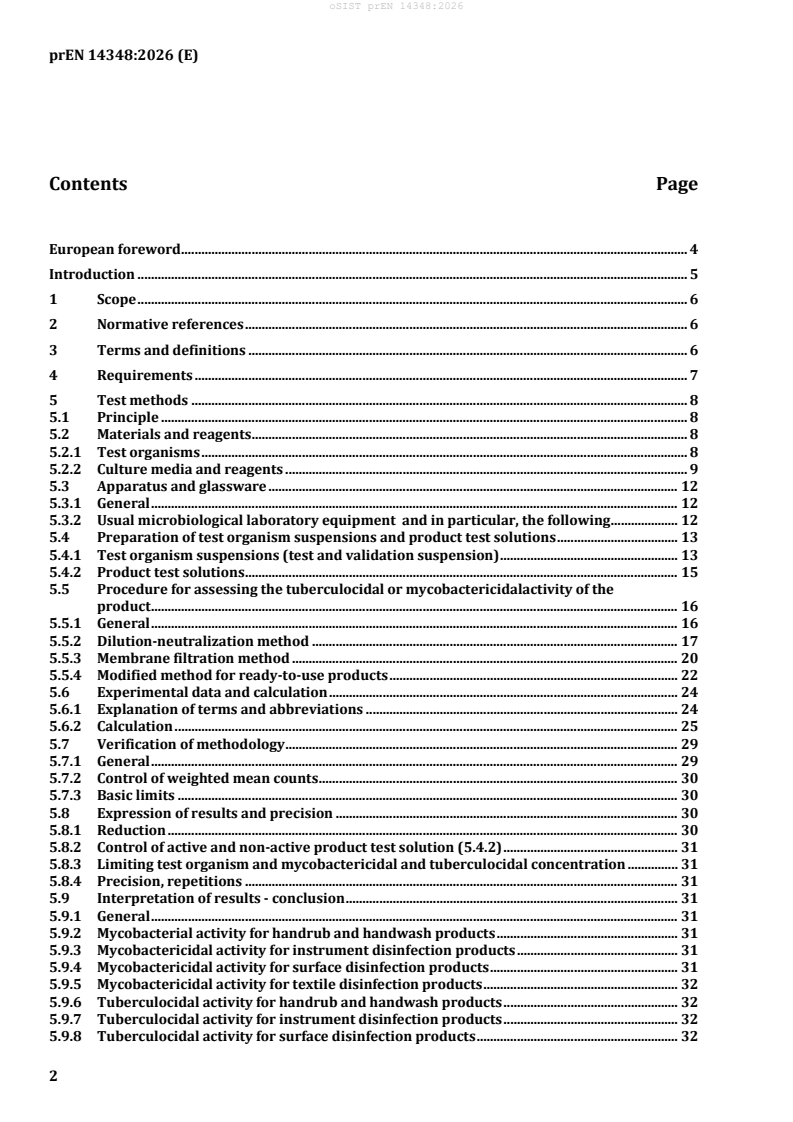
Contents Page
European foreword . 4
Introduction . 5
1 Scope . 6
2 Normative references . 6
3 Terms and definitions . 6
4 Requirements . 7
5 Test methods . 8
5.1 Principle . 8
5.2 Materials and reagents . 8
5.2.1 Test organisms . 8
5.2.2 Culture media and reagents . 9
5.3 Apparatus and glassware . 12
5.3.1 General . 12
5.3.2 Usual microbiological laboratory equipment and in particular, the following . 12
5.4 Preparation of test organism suspensions and product test solutions . 13
5.4.1 Test organism suspensions (test and validation suspension) . 13
5.4.2 Product test solutions . 15
5.5 Procedure for assessing the tuberculocidal or mycobactericidalactivity of the
product . 16
5.5.1 General . 16
5.5.2 Dilution-neutralization method . 17
5.5.3 Membrane filtration method . 20
5.5.4 Modified method for ready-to-use products . 22
5.6 Experimental data and calculation . 24
5.6.1 Explanation of terms and abbreviations . 24
5.6.2 Calculation . 25
5.7 Verification of methodology . 29
5.7.1 General . 29
5.7.2 Control of weighted mean counts . 30
5.7.3 Basic limits . 30
5.8 Expression of results and precision . 30
5.8.1 Reduction . 30
5.8.2 Control of active and non-active product test solution (5.4.2) . 31
5.8.3 Limiting test organism and mycobactericidal and tuberculocidal concentration . 31
5.8.4 Precision, repetitions . 31
5.9 Interpretation of results - conclusion . 31
5.9.1 General . 31
5.9.2 Mycobacterial activity for handrub and handwash products . 31
5.9.3 Mycobactericidal activity for instrument disinfection products . 31
5.9.4 Mycobactericidal activity for surface disinfection products . 31
5.9.5 Mycobactericidal activity for textile disinfection products . 32
5.9.6 Tuberculocidal activity for handrub and handwash products . 32
5.9.7 Tuberculocidal activity for instrument disinfection products . 32
5.9.8 Tuberculocidal activity for surface disinfection products . 32
5.9.9 Tuberculocidal activity for textile disinfection products . 32
5.9.10 Qualification for certain fields of application . 32
5.10 Test report . 32
Annex A (informative) Referenced strains in national collections . 35
Annex B (informative) Suitable neutralizers and neutralizing procedures and rinsing
liquids . 36
B.1 General . 36
B.2 Neutralizers and rinsing liquids . 36
B.3 Neutralizer added to the agar for counting: . 37
Annex C (informative) Graphical representations of the test method . 38
C.1 General . 39
C.2 Membrane filtration method . 41
C.3 Dilution-neutralization method (modified method for ready-to-use products) . 43
C.4 Membrane filtration method (modified method for ready-to-use products) . 46
Annex D (informative) Example of a typical test report - General . 48
Annex E (informative) Example of a typical test report – including additional pre-diluted
method validation C . 51
Annex ZA (informative) Relationship between this European Standard and the General
Safety and Performance Requirements of Regulation (EU) 2017/745 aimed to be
covered . 54
Bibliography . 57
European foreword
This document (prEN 14348:2026) has been prepared by Technical Committee CEN/TC 216 “Chemical
disinfectants and antiseptics”, the secretariat of which is held by AFNOR.
This document is currently submitted to the CEN-Enquiry.
This document will supersede EN 14348:2005.
A collaborative trial has been undertaken and will be evaluated to provide a precision annex to this
document.
Other methods to evaluate the efficacy of chemical disinfectants and antiseptics for different applications
in the medical area are in preparation.
The document was revised to adapt it to the latest state of science, to correct errors and ambiguities, to
harmonize the structure and wording with other tests of CEN/TC 216 existing or in preparation and to
improve the readability of the standard and thereby make it more understandable. The following is a list
of significant technical changes since the last edition:
— Annex ZA was included for harmonization;
— membrane filtration method was added;
— test method for ready-to-use products added;
— test methods for hygienic handwash and textile disinfection added;
— clarification of the neutralization time of 10 s [5.5.2.2. c) and 5.5.2.5 b)];
— further options for neutralization were included;
— an additional pre-diluted method validation C was added;
— validation suspension for the neutralizer control (N ) was added;
VB
— the figures in Annex C have been revised, in particular figures for the membrane filtration and the
modified methods have been included.
The changes of this revision have no impact on the test results obtained with reference to the version
EN 14348:2005. Those results are still valid.
This document has been prepared under a standardization request addressed to CEN by the European
Commission. The Standing Committee of the EFTA States subsequently approves these requests for its
Member States.
For the relationship with EU Legislation, see informative Annex ZA, which is an integral part of this
document.
Introduction
This document describes a suspension test for establishing whether a chemical disinfectant or an
antiseptic has or does not have a tuberculocidal or mycobactericidal activity in the area defined in the
scope.
This laboratory test takes into account practical conditions of application of the product including contact
time, temperature, test organisms and interfering substances, i.e. conditions which may influence its
action in practical situations.
The conditions are intended to cover the general uses described in this document, demonstrating that
each utilization concentration of the chemical disinfectant or antiseptic determined by this test
corresponds to the defined experimental conditions
1 Scope
This document specifies a test method and the minimum requirements for tuberculocidal or
mycobactericidal activity of chemical disinfectant and antiseptic products that form a homogeneous,
physically stable preparation when diluted with hard water, or - in the case of ready-to-use products -
with water. Products can only be tested at a concentration of 80 % or less (97 % with a modified method
for special cases) as some dilution is always produced by adding the test organisms and interfering
substance.
This document applies to products that are used in the medical area in the fields of hygienic handrub,
hygienic handwash, instrument disinfection by immersion, surface disinfection by wiping, spraying,
flooding or other means, and textile disinfection.
This document applies to areas and situations where disinfection or antisepsis is medically indicated.
Such indications occur in patient care, for example:
— in hospitals, in community medical facilities and in dental institutions;
— in clinics of schools, of kindergartens and of nursing homes;
and can occur in the workplace and in the home. It can also include services such as laundries and
kitchens supplying products directly for the patients.
NOTE 1 The method described is intended to determine the activity of commercial formulations or active
substances under the conditions in which they are used.
NOTE 2 This method corresponds to a phase 2, step 1 test.
EN 14885 specifies in detail the relationship of the various tests to one another and to “use
recommendations”.
2 Normative references
The following documents are referred to in the text in such a way that some or all of their content
constitutes requirements of this document. For dated references, only the edition cited applies. For
undated references, the latest edition of the referenced document (including any amendments) applies.
NOTE EN 12353 and EN 14885 are updated on an ongoing basis as the standards to which they refer are
developed and evolve. As the revision of both standards is much more frequent than the updating of this standard,
the standards are not dated. Users will refer to the latest version of the referenced standards.
EN 12353, Chemical disinfectants and antiseptics - Preservation of test organisms used for the
determination of bactericidal (including Legionella), mycobactericidal, sporicidal, fungicidal and virucidal
(including bacteriophages) activity
EN 14885, Chemical disinfectants and antiseptics - Application of European Standards for chemical
disinfectants and antiseptics
3 Terms and definitions
For the purposes of this document, the terms and definitions given in EN 14885 apply.
ISO and IEC maintain terminological databases for use in standardization at the following addresses:
— IEC Electropedia: available at https://www.electropedia.org/
— ISO Online browsing platform: available at https://www.iso.org/obp
4 Requirements
Regardless of whether a product manufacturer wishes to claim its products as medical devices or not, the
entire content of the standard shall be applied. The product shall demonstrate at least a 4 decimal
logarithms (lg) reduction (for hygienic handwash at least a 2 lg reduction) when tested in accordance
with Table 1 and Clause 5.
Table 1 — Minimum and additional test conditions
Surface Textile
Test Hygienic handrub Instrument
Conditions and handwash disinfection
disinfection disinfection
Minimum Tuberculocidal Tuberculocidal Tuberculocidal Tuberculocidal
spectrum of activity activity activity activity
test
Mycobacterium Mycobacterium Mycobacterium Mycobacterium
organisms
terrae terrae terrae terrae
Mycobactericidal Mycobactericidal Mycobactericidal Mycobactericidal
activity activity activity activity
Mycobacterium Mycobacterium Mycobacterium Mycobacterium
terrae terrae terrae terrae
Mycobacterium Mycobacterium Mycobacterium
Mycobacterium
avium avium avium avium
additional Any relevant test organisms
Test
according to the manufacturer’s recommendation, but at / between
temperature
e e
20 °C 20 °C ≤ 60°C 4 °C and 30 °C 20 °C and < 60°C or
any higher temp.
Contact time according to the manufacturer’s recommendation
but between but no longer than
a
30 s and 60 s 60 min 60 min
Interfering
substance
clean 0,3 g/l bovine 0,3 g/l bovine 0,3 g/l bovine 0,3 g/l bovine
conditions albumin solution albumin solution albumin solution albumin solution
b
(hygienic handrub)
and/or and/or (for pre-washed
process)
dirty 3,0 g/l bovine 3,0 g/l bovine 3,0 g/l bovine
conditions albumin solution albumin solution albumin solution
plus 3,0 ml/l plus 3,0 ml/l plus 3,0 ml/l
3,0 g/l bovine
erythrocytes erythrocytes erythrocytes
albumin solution
(hygienic plus 3,0 ml/l
c
handwash) erythrocytes
(for non-pre-washed
process)
b, c
Additional clean or dirty ; any any relevant any relevant any relevant
d
conditions relevant substance substance substance substance
a
The contact times for surface disinfectants stated in this table are chosen on the basis of the practical conditions of
the product. For further information see EN 14885.
b
Hygienic handrub shall be tested as a minimum under clean conditions.
c
Hygienic handwash shall be tested as a minimum under dirty conditions.
d
For the additional conditions, the concentration defined as a result can be lower than the one obtained under the
minimum test conditions.
e
For further information regarding validity at relevant temperatures see EN 14885.
5 Test methods
5.1 Principle
5.1.1 A test suspension of mycobacteria in a solution of an interfering substance is added to a sample
of the product as delivered and/or diluted with hard water (for ready to use products: water). The
mixture is maintained at the temperature and the contact time specified in Clause 4 and 5.5.1.1. At the
end of this contact time, an aliquot is taken; the tuberculocidal or mycobactericidal and/or the
mycobacteriostatic action in this portion is immediately neutralized or suppressed by a validated
method. The method of choice is dilution-neutralization. If a suitable neutralizer cannot be found,
membrane filtration is used. The numbers of mycobacteria surviving in each sample are determined and
the reduction is calculated.
The numbers of surviving mycobacteria in each sample are determined and the reduction is calculated.
NOTE Handwash products are always prediluted with hard water (5.2.2.8). The resulting solution is regarded
as a ready-to-use product (5.4.2).
5.1.2 The test is performed using Mycobacterium avium and Mycobacterium terrae or only
Mycobacterium terrae as test organisms (Clause 4, Table 1).
5.1.3 Additional and optional contact times and temperatures are specified (Clause 4, Table 1).
Additional interfering substances may be used.
5.2 Materials and reagents
5.2.1 Test organisms
1)
The mycobactericidal activity shall be evaluated using the following two test-organisms selected
according to Clause 4, (Table 1):
Mycobacterium avium ATCC 15769
Mycobacterium terrae ATCC 15755
The tuberculocidal activity shall be evaluated using only Mycobacterium terrae.
Refer to Annex A for strain reference in some other culture collections.
If additional test organisms are used, they shall be incubated under optimum growth conditions
(temperature, time, atmosphere, media) noted in the test report. If the additional test organisms selected
do not correspond to the specified strains, their suitability for supplying the required inocula shall be
verified. If these additional test organisms are not classified at a reference centre, their identification
characteristics shall be stated. In addition documentation ensuring the traceability of the test organism
1)
The ATCC numbers are the collection numbers of strains supplied by the American Type Culture Collections (ATCC).
This information is given for the convenience of users of this standard and does not constitute an endorsement by CEN of
the product named.
shall be retained by its owner—either the testing laboratory or the national culture collection—for a
minimum of five years.
5.2.2 Culture media and reagents
5.2.2.1 General
All weights of chemical substances given in this standard refer to the anhydrous salts. Hydrated forms
may be used as an alternative, but the weights required shall be adjusted to allow for consequent
molecular weight differences.
The reagents shall be of analytical grade and/or appropriate for microbiological purposes. They shall be
free from substances that are toxic or inhibitory to the test organisms.
To improve reproducibility, it is recommended that commercially available dehydrated material is used
for the preparation of culture media. The manufacturer's instructions relating to the preparation of these
products should be rigorously followed.
For each culture medium and reagent a limitation for use should be fixed.
5.2.2.2 Water
The water shall be freshly glass-distilled water or demineralized water, which meets the requirements of
max. 0,1µS/cm conductivity or use water for injections (see bibliographic reference [1]).
Sterilize in the autoclave [5.3.1.1 a)]. Sterilization is not necessary if the water is used e.g. for preparation
of culture media and subsequently sterilized. Alternatively, cell culture grade water is suitable for
preparation of cell culture media and other solutions used in cell culture.
See 5.2.2.7 for the procedure to prepare hard water.
5.2.2.3 Middlebrook and Cohn 7 H 10 medium with 10 % OADC enrichment (MCO)
Middlebrook 7 H 10 agar-powder 19,0 g
Glycerol (C H O ) (see [1]) 5,0 ml
3 8 3
Water (5.2.2.2) to 900,0 ml
Heat to boiling to dissolve completely. Sterilize in the autoclave [5.3.2.1 a)] and cool to 50 °C to 55 °C. Add
100 ml Middlebrook OADC enrichment under aseptic conditions. Fill 18 ml to 20 ml per plate (5.3.2.10).
The pH of the medium shall be equivalent to 6,6 ± 0,2 when measured at 25 °C (5.3.2.4).
NOTE In special circumstances (problems with neutralization see 5.5.1.2 and 5.5.1.3) it may be necessary to
add neutralizer to MCO (see Annex B.3). Do not use neutralizer that causes opalescence in the agar.
5.2.2.4 Diluent
Tryptone Sodium Chloride Solution:
Tryptone, pancreatic digest of casein 1,0 g
Sodium chloride (NaCl) 8,5 g
Water (5.2.2.2) to 1 000,0 ml
Sterilize in the autoclave [see 5.3.2.1 a)]. After sterilization the pH (5.3.2.1) of the diluent shall be
equivalent to 7,0 ± 0,2 when measured at 20 °C.
NOTE There is scientific experience that sodium chloride (NaCl) may inhibit the growth of mycobacteria. But
the presence of NaCl in products and in the interfering substance (5.2.2.9) is unavoidable and therefore diluent
might be used for the preparation of neutralizer (5.5.1.2).
5.2.2.5 Neutralizer
The neutralizer shall be validated for the product being tested in accordance with 5.5.1 and 5.5.2. The
neutralizer shall be sterile.
Information on neutralizers that have been found to be suitable for some categories of products is given
in Annex B
5.2.2.6 Rinsing liquids (for membrane filtration)
The rinsing liquids shall be validated for the product being tested in accordance with 5.5.1.2, 5.5.1.3 and
5.5.3. It shall be sterile, compatible with the filter membrane and capable of filtration through the filter
membrane under the test conditions described in 5.5.3.
Recommendations for rinsing liquids 1 and 2:
— rinsing liquid 1: 1,0 g/l polysorbate 80; 0,5 g/l sodium oleate
— rinsing liquid 2: 0,5 g/l polysorbate 80; 0,5 g/l lecithin
NOTE Information on rinsing liquids that have been found to be suitable for some categories of products and
also the combined membrane filtration and chemical neutralization procedure is given in Annex B.
5.2.2.7 Middlebrook 7 H 9 broth with 10 % ADC enrichment (MADC-broth)
MADC-broth will be used for deep freeze storage.
Middlebrook 7H9 broth-powder 4,7 g
Glycerol (C H O ) (see [1]) 100,0 ml
3 8 3
Water (5.2.2.2) 750,0 ml
Sterilize in the autoclave [5.3.2.1 a)] and cool to 45 °C. Add under aseptic conditions 100 ml Middlebrook
ADC enrichment and sterilized water (5.2.2.2) to 1 000,0 ml. The pH of the medium shall be equivalent to
6,6 ± 0,2 when measured at 25 °C (5.3.2.4).
5.2.2.8 Hard water for dilution of products
Prepare:
— prepare solution A: dissolve 19,84 g magnesium chloride (MgCl2) and 46,24 g calcium chloride
(CaCl2) in water (5.2.2.2) and dilute to 1 000 ml. Sterilize by membrane filtration (5.3.2.7) or in the
autoclave [5.3.2.1 a)]. Autoclaving – if used – may cause a loss of liquid. In this case make up to 1
000 ml with water (5.2.2.2) under aseptic conditions. Store the solution in the refrigerator (5.3.2.7)
for no longer than one month;
— prepare solution B: dissolve 35,02 g sodium bicarbonate (NaHCO3) in water (5.2.2.2) and dilute to 1
000 ml. Sterilize by membrane filtration (5.3.2.6). Store the solution in the refrigerator (5.3.2.7) for
no longer than one week;
— place 600 ml to 700 ml of water (5.2.2.2) in a 1 000 ml volumetric flask (5.3.2.12) and add 6,0 ml
(5.3.2.9) of solution A, then 8,0 ml of solution B. Mix and dilute to 1 000 ml with water (5.2.2.2). The
pH (5.3.2.4) of the hard water shall be 7,0 ± 0,2. If necessary, adjust the pH by using a solution of
approximately 40 g/l (about 1 mol/l) of sodium hydroxide (NaOH) or approximately 36,5 g/l (about
1 mol/l) of hydrochloric acid (HCl).
The hard water shall be freshly prepared under aseptic conditions and used within 12 h.
NOTE When preparing the product test solutions (5.4.2) the addition of the product to this hard water
produces a different final water hardness in each test tube. In any case the final hardness is lower than 300 mg/l of
calcium carbonate (CaCO ) in the test tube.
5.2.2.9 Interfering substance
5.2.2.9.1 General
The interfering substance shall be chosen according to the conditions of use laid down for the product.
The interfering substance shall be sterile and prepared at 10 times its final concentration in the test (50
times in the case of the modified method, see 5.2.2.9.4).
The ionic composition e.g. pH, calcium and/or magnesium hardness and chemical composition e.g.
mineral substances, protein, carbohydrates, lipids, detergents shall be defined.
NOTE In the following the term “interfering substance” is used even if it contains more than one substance.
5.2.2.9.2 Clean conditions (bovine albumin solution – low concentration)
Dissolve 0,30 g of bovine albumin fraction V (suitable for microbiological purposes) in 100 ml of diluent
(5.2.2.4).
Sterilize by membrane filtration (5.3.2.7), keep in a refrigerator (5.3.2.8) and use within 1 month.
The final concentration of the bovine albumin in the test procedure (see 5.5) is 0,3 g/l.
5.2.2.9.3 Dirty conditions (Mixture of bovine albumin solutions – high concentration with sheep
erythrocytes)
Dissolve 3,00 g of bovine albumin fraction V (suitable for microbiological purposes) in 97 ml of diluent
(5.2.2.4).
Sterilize by membrane filtration (5.3.2.7).
Prepare at least 8,0 ml fresh sterile defibrinated sheep blood (5.2.2.10) or purchase such blood from a
commercial supplier (5.2.2.10). Centrifuge the erythrocytes at 800 g for 10 min. After discarding the
supernatant, resuspend erythrocytes in diluent (5.2.2.4). Repeat this procedure at least 3 times, until the
supernatant is colourless. Resuspend 3 ml of the packed sheep erythrocytes in the 97 ml of sterilized
bovine albumin solution (see above). To avoid later contamination this mixture should be split in portions
probably needed per day and kept in separate containers for a maximum of 7 days in a refrigerator
(5.3.2.7).
The final concentration of bovine albumin and sheep erythrocytes in the test procedure (5.5) shall be
3 g/l and 3 ml/l respectively.
5.2.2.9.4 Clean and dirty conditions for the modified method for ready-to-use products (5.5.4)
Follow the procedures for preparation according to 5.2.2.9.2 and 5.2.2.9.3, but prepare the interfering
substance in fivefold higher concentrations, for the dirty conditions maximum 50 ml to avoid problems
with the filtration.
a) Clean conditions (5.2.2.9.2) – dissolve 1,50 g bovine albumin (instead of 0,3 g) in 100 ml of diluent;
b) Dirty conditions (5.2.2.9.3) – dissolve 7,5 g bovine albumin (instead of 1,5 g) in 42,5 ml of diluent
(instead of 48,5 ml). Prepare at least 20 ml (instead of 4,0 ml) sheep blood. Resuspend 7,5 ml (instead
of 1,5 ml) of the packed sheep erythrocytes in 42,5 ml of sterilized bovine albumin solution to obtain
50 ml.
5.2.2.10 Sterile defibrinated sheep blood
The defibrinated sheep blood should be sterile (aseptic blood-letting and preparation), pooled from more
than one sheep and can be acquired from a commercial supplier.
5.3 Apparatus and glassware
5.3.1 General
Sterilize all glassware and parts of the apparatus that will come into contact with the culture media and
reagents or the sample, except those which are supplied sterile, by one of the following methods:
a) by moist heat, in the autoclave [5.3.2.1 a)];
b) by dry heat, in the hot air oven [5.3.2.1 b)].
2)
5.3.2 Usual microbiological laboratory equipment and in particular, the following
5.3.2.1 Apparatus for sterilization:
+ 3
a) for moist heat sterilization, an autoclave capable of being maintained at (121 ) °C for a minimum
holding time of 15 min;
+5
b) for dry heat sterilization, a hot air oven capable of being maintained at ( 180 ) °C for a minimum
+5 +5
holding time of 30 min, at (170 ) °C for a minimum holding time of 1 h or at ( 160 ) °C for a
0 0
minimum holding time of 2 h.
5.3.2.2 Water baths, capable of being controlled at 20° C ± 1 °C until 60 °C ± 1 °C and at additional
test temperatures ± 1 °C (5.5.1).
5.3.2.3 Incubator, capable of being controlled at either 36 °C ± 1 °C or at 37 °C ± 1°C.
NOTE 1 The same temperature is to be used for all incubations performed during a test and its controls and
validation.
NOTE 2 A CO2 – incubator and a temperature of 36 °C ± 1 °C are better suited for the test organisms. If a CO2 –
incubator is not used, the inoculated plates is to be protected from drying by sealing with insulating tape or packing
them into polyethylene bags.
5.3.2.4 pH-meter, having an inaccuracy of calibration of no more than ± 0,1 pH units at 20 °C. The
additional inaccuracy of the electrodes shall not be more than ± 0,1 pH units.
NOTE A puncture electrode or a flat membrane electrode is to be used for measuring the PH of the agar media
(5.2.2.3).
5.3.2.5 Stopwatch
® 3)
5.3.2.6 Electromechanical agitator e.g. Vortex mixer .
2)
Disposable equipment is an acceptable alternative to reusable glassware.
3) ®
Vortex in an example of a suitable product available commercially. This information is given for the convenience of
users of this standard and does not constitute an endorsement by CEN of this product.
5.3.2.7 Membrane filtration apparatus, constructed of a material compatible with the substances
to be filtered, with a filter holder of at least 50 ml volume, and suitable for use of filters of diameter 47 mm
to 50 mm and with a maximum pore size of 0,45 µm for sterilization of hard water (5.2.2.7), bovine
albumin (5.2.2.9.2, 5.2.2.9.3 and 5.2.2.9.4), and if the membrane filtration method is used (5.5.3).
The vacuum source used shall give an even filtration flow rate. In order to prevent overlong filtration, the
device shall be set so as to obtain the filtration of 100 ml in 20 s to 40 s.
5.3.2.8 Refrigerator, capable of being controlled at 2 °C to 8 °C.
5.3.2.9 Graduated pipettes of nominal capacities 10 ml and 1 ml and 0,1 ml or suitable volume, or
calibrated automatic pipettes.
5.3.2.10 Petri dishes (plates) of size 90 mm to 100 mm.
5.3.2.11 Glass or ceramic beads (Diameter: 3 mm to 4 mm).
5.3.2.12 Volumetric flasks
5.3.2.13 Centrifuge (800 gN).
5.3.2.14 Plastic disposable 10μl loops
5.3.2.15 Coned bottom screw cap tubes, contents of 50 ml (diameter about 28 mm).
5.4 Preparation of test organism suspensions and product test solutions
5.4.1 Test organism suspensions (test and validation suspension)
5.4.1.1 General
For each test organism, two different test organism suspensions have to be prepared: the “test
suspension” to perform the test and the “validation suspension” to perform the controls and method
validation.
5.4.1.2 Preservation of test organisms
Test organisms shall be prepared and kept in accordance with the requirements of EN 12353, after having
been supplemented by specific procedures for mycobacteria.
Cultures are prepared by subcultivating lyophilized test organisms (5.2.1) dissolved according to the
culture collection’s instructions on plates containing MCO (5.2.2.3). Incubate Mycobacterium terrae and
Mycobacterium avium for 21 days (5.3.2.3). The test organisms are recovered from the plates using 10 ml
MADC broth (5.2.2.7) and diluted up to 100 ml with MADC broth. Pipette from this solution, 0,5 ml
portions (minimum amount) in cryovials and store them at minimum – 70 °C or less for prolonged
storage.
An alternative way of storage is by coating of beads: Pipette 1 ml of suspension into a cryovial containing
beads (5.3.2.10). Shake the vial to distribute the suspension onto the beads. Allow to stand for 30 min at
20 °C. Remove the excess cryoprotectant solution with a pipette and store them at minimum – 70 °C or
less for prolonged storage.
Calculating the number of cryovials needed for testing is advised, taking into account that two subcultures
can be obtained from one cryovial.
NOTE It is possible to prepare the test organisms for prolonged storage directly from the dissolved lyophilized
test organisms by diluting the dissolution broth with 100 ml to 120 ml of MADC broth (5.2.2.7). Immediately
afterwards the cryovials are filled (up to 2,0 ml) according to the amount of working cultures to be prepared.
5.4.1.3 Working culture of test organisms
In order to prepare the working culture of test organisms (5.2.1), subculture directly from the defrosted
cryovials (5.4.1.2) by streaking the suspension or the coated bead onto plates containing MCO (5.2.2.3.)
and incubate (5.3.2.3). After 21 days prepare a second subculture from the first subculture in the same
way and incubate for 21 days. The first and/or second subculture is/are the working culture(s).
Never produce and use a third subculture.
5.4.1.4 Test suspension (N)
a) Prepare a suitable homogeneous suspension from the working cultures (5.4.1.3) using either
— the homogenization by glass beads: with the aid of a sterile loop transfer the test organisms from
at least two plates of the working culture (5.4.1.3) into a coned bottom screw cap tube containing
6 g to 7 g of dry glass beads (5.3.2.11). The test organisms are homogenized by mixing (see
5.3.2.6) for at least 5 min to distribute them homogeneously on the beads and on most of the
parts of the screw cap tube’s internal surface. Add 10 ml water (5.2.2.2) drop by drop and
resuspend them by mixing (5.3.2.6). After 20 min sedimentation time the supernatant is
transferred to a tube.
— or the homogenization by Potter S 1 apparatus: pipette 5,0 ml water (5.2.2.2) on each of the
plates (at least two) of the working culture (5.4.1.3) and recover with a glass spatula the test
organisms. Pipette all of the liquid from the plates into a 25 ml centrifugation tube. Add up to
18 ml with water (5.2.2.2). Wash with water (5.2.2.2), centrifuging 3 times at approximately 2
for 15 min. After each centrifuging, discard the supernatant, resuspend by mixing
000 gN
(5.3.2.6) and fill up to the original volume with water (5.2.2.2).
After the last centrifuging discard the supernatant and transfer the sediment into a 15 ml glass vessel
of the Potter S 1 apparatus. Fill up to 15 ml with water (5.2.2.2). Mix, cool with ice and homogenize
for 15 min. After 20 min sedimentation time, during which enough ice for cooling should be present,
the supernatant is transferred to a tube.
4)
NOTE 1 Other methods of homogenization are allowed provided that the number of cfu/ml obtained is
appropriate and stable during the time of the test and microscopic examination shows that the suspension is
as homogeneous as after the two procedures described above.
NOTE 2 Do not use tensio-active substances (surfactants).
9 9
b) Adjust the number of cells in the (supernatant) suspension to 1,5 × 10 cfu/ml to 5,0 × 10 cfu/ml
using water (5.2.2.2) or Tryptone Sodium Chloride solution (5.2.2.4). Maintain this test suspension
at 20 °C and use at the day of preparation. Adjust the temperature to θ [5.5.1.1. a) and 5.5.1.4] only
immediately before the start of the test.
The use of spectrophotometer for adjusting the number of cells is highly recommended (about
620 nm wavelength - cuvette 10 mm path length). Therefore it is recommended to produce
calibration data. To achieve reproducible results of this measurement it may be necessary to dilute
the test suspension, e.g. 1+9.
NOTE 3 Any other optical instruments dedicated to cell suspension calibration are suitable alternatives.
−7 −8
c) For counting prepare 10 and 10 dilutions of the test suspension using water (5.2.2.2). Mix
(5.3.2.6). Take a sample of 1,0 ml of each dilution in duplicate and transfer divided in nearly equal
4)
cfu/ml = colony forming unit(s) per millilitre
amounts onto two separate plates (5.3.2.10) containing MCO (5.2.2.3), i.e. two plates per 1,0 ml
sample, four plates per duplicate 1,0 ml samples.
For incubation and counting see 5.4.1.6.
5.4.1.5 Validation suspension (N N )
V, VB
a) To prepare the validation suspension (N ), dilute the test suspension N (5.4.1.4) with water (5.2.2.2)
V
2 3 −6
to obtain 3,0 × 10 cfu/ml to 1,6 × 10 cfu/ml (about one fourth (1 + 3) of the 10 dilution). Maintain
and adjust the validation suspension, the same way as the test suspension (5.4.1.4 b)
b) To prepare the validation suspension for the neutralizer control (N ) (5.5.2.4) dilute the test
VB
4 5
suspension (5.4.1.4) with water (5.2.2.2) to obtain 3,0x 10 cfu/ml to 1,6 × 10 cfu/ml [about one
−4
fourth (1+3) of the 10 dilution] (N ).
VB
c) Maintain and use these validation suspensions (N and N ) the same way as the test suspension
V VB
(5.4.1.4 b).
−1
d) For counting prepare a 10 dilution with water (5.2.2.2), and in case of the neutralizer control
−3
N (see b) a 10 dilution. Mix (5.3.2.6). Take a sample of 1,0 ml in duplicate and transfer divided in
VB
nearly equal amounts onto two separate plates (5.3.2.10) containing MCO (5.2.2.3).
For incubation and counting see 5.4.1.6.
5.4.1.6 Incubation and counting of the test and the validation suspensions
a) Incubate (5.3.2.3) the plates for 21 days. Discard any plates which are not countable (for any reason).
Count the plates and determine the number of colony forming units (cfu) for each plate.
b) Note for each plate the exact number of colonies but record > 330 for any counts higher than 330 and
determine the V -values according to 5.6.2.2.
C
c
...